post238

Trump: Will He or Won’t He Day and Uncertainty for Investors

Trump: Will He or Won't He Day and Uncertainty for Investors

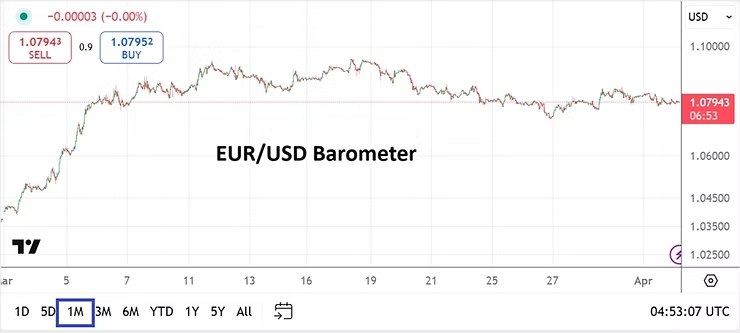
EURUSD One Month Chart as of 2nd April 2025

Liberation/Tariff Day will blow onto the global financial shores this morning. President Trump and his team are certain to take a victory lap as they announce their decisions regarding actions being imposed on commodities and products. Nations who are on the other end of the drama will be braced for the rhetoric and policies. Investors, trade ministers, financial institutions will have to sift through the pronouncements and consider their outlooks amidst uncertainty.

Trading today will be rough for smaller speculators. Choppy conditions should be expected as behavioral sentiment twists according to shifting winds and interpretations. President Trump is likely to announce aggressive penalties, but he may also try to soothe those who have worried about being punished. As an example, Trump has said recently that India has acted upon many of the White House’s wishes. Mexico, Canada, the European Union and China are likely to be mentioned as the U.S President speaks later today. Will a public scolding take place again?

Equities have faltered the past month, Forex has been volatile and commodity prices have also reflected fragile sentiment as outlooks became grey. The tariff policies announced today will affect all aspects of the financial world. Day traders thinking about wagering on the outcome should be patient and wait for the reactions which unfold from Asia, Europe, Africa, and the Americas. Wall Street will certainly be a barometer, along with the EUR/USD, USD/MXN, USD/JPY, GBP/USD, USD/SGD and gold.

While President Trump declares this is a great and magnificent day for the U.S, it will be of keen interest if an olive branch is offered to trading partners. After talking tough the past few months, financial institutions would like to hear words of optimism from the White House. If belligerence is heard and punitive actions are enacted, which are considered unproductive by investors and financial institutions the broad markets will show their disdain promptly.

President Trump’s skills as a negotiator will be judged today. The White House must play towards its constituency and show they are putting America First, but will the President also display he is cognizant that international trade provides benefits? Trump will point to his claim that he is merely putting tariffs on those who have treated the U.S unjustly and use levies against U.S goods.

It will be an important day for the Trump Presidency, because in many respects the global audience watching will decide whether or not the U.S sees itself as part of the global fabric or seeks a position which is isolationist. Brazil will look on the tariff theater intently, its position as a trading center may find increased demand from a host of nations.

Predicting the results: On the 3rd of February a fast and dangerous Forex market developed which witnessed USD centric strength exhibited with spikes in many currency pairs. In early March reactionary trading was displayed in equity indices, Forex and bonds too. Today will see wide spreads emerge in Forex with near-term resistance and support levels proving vulnerable.

Equities which sold off in March via the Nasdaq 100, S&P 500, Dow 30 and the Russell index are certainly hoping for a dose of cheer. The question is if Trump will deliver a positive message. The likelihood is that today’s events will not be the last of the tariff tirades and some proposed actions remain under deliberation. Today is unlikely to produce final results and the broad markets are probably going to be choppy as outlooks stay mitigated and absent of clear resolutions.

Gold Three Month Chart as of 4th April 2025

Day traders should think safety first today. Gold remains within record territory. If unpredictability rules near-term and the reactions of investors and financial institutions create fast conditions, the precious metal and bonds will find takers. Uncertainty breeds cravings for risk adverse assets.

post222

Apolitical Doesn’t Mean Blind to the Trump Forex Reality

Apolitical Doesn’t Mean Blind to the Trump Forex Reality

Has everyone stopped panicking in global Forex? It appears financial institutions are showing signs of stability and perhaps even optimism, this as USD centric strength appears to actually have begun giving back the outlandish gains made on Monday when spikes higher were seen across Forex.

The nervous buying of the USD early on Monday morning erupted after President Trump’s ultimatums were not taken seriously by financial institutions late last week. Outwardly it appears that the targets consisting of Mexico and Canada going into the past weekend also wanted to make believe all would be fine. The only nation to say that it would negotiate with Trump prior to Friday was China. And now Mexico and Canada have largely fallen into line.

Speculators may want to be apolitical. They may want to believe Forex has nothing to do with politics. And some traders may not like President Trump and what he represents. However, Forex participants need to make sure they put their biases to the side and understand that economic rhetoric and actions from the U.S do effect the Forex reality.

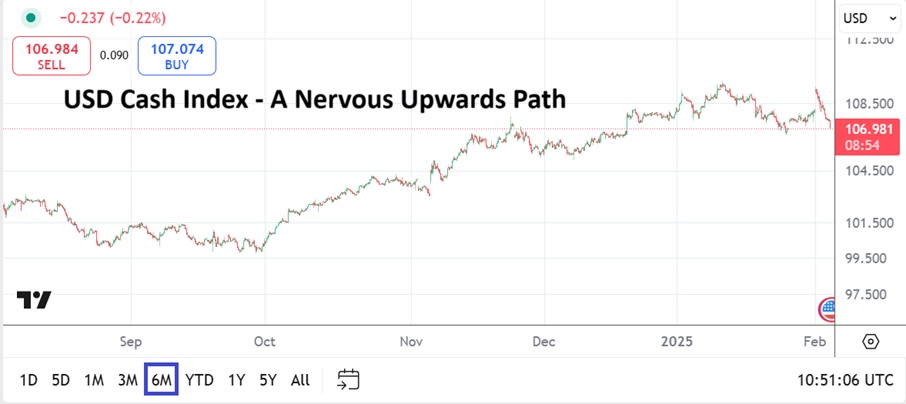
USD Cash Index Six Month Chart as of 5th February 2025

We have seen a vast example of this the past couple of weeks, in fact the past few months. Financial institutions have braced for and wagered on their outlooks since early November when the results of the U.S election became known. A strong USD centric element has been demonstrated as they prepared for President Trump to take executive power in the U.S again.

This past week has seen vivid Forex results and demonstrated why it is important to pay attention to international news flow, even when some may want to disregard what they are hearing. The price action in Forex particularly the USD/CAD and USD/MXN this week highlight the significance of not turning a blind eye. The highs seen on Monday followed by the reversals lower have brought support into view. Near-term and mid-term considerations will be fought over by financial institutions and retail traders may find technical opportunities to take advantage of nervous behavioral sentiment.

China which has dealt with President Trump before, appears to have handled the tariff bluster and negotiations better than Mexico and Canada. China has also been laying the groundwork to deal with the new White House administration based on having dealt with President Trump before. The USD/CNY has remained stable and China has set the table to deal with developing economic discussions in a calm manner.

It is not a question of liking or disliking Trump, it is a matter of understanding the reality and being ready to trade the circumstances that are seen across Forex. Bias when trading Forex can lead to bad decisions, it is not about betting on who you like, it is about wagering correctly on the results you believe will happen and managing your risks.

post217

USD/JPY: Bank of Japan Actually Does its Job: Raises Rate

USD/JPY: Bank of Japan Actually Does its Job: Raises Rate

USD/JPY Five Day Chart as of 24th January 2025

The Bank of Japan actually raised its Policy Rate by 0.25 to 0.50% this morning. The move was done while the central bank stated the Japan economy is improving. The Bank of Japan also noted that the implications of U.S tariff policy are not completely known, thus it is acting on existing facts. The action by the BoJ created selling in the USD/JPY and is a healthy sign.

While the U.S Federal Reserve has taken on a cautious tone, President Trump has started to signal via rhetoric that he would like to see U.S interest rates lowered. The Fed and President Trump may find that they are in disagreement regarding mid-term policy and Forex traders shouldn’t be surprised if the debate escalates. The USD/JPY is trading near the 155.500 vicinity with fast price action at this moment. The ability to sustain values below the 156.000 level will be important technically if maintained. A fall below the 155.000 ratio may indicate more selling should be expected.

While financial institutions globally remain nervous about U.S economic policy regarding trade negotiations, Japan for the moment is out of the spotlight regarding tariff implications. The USD/JPY was trading near the 153.000 area on the 17th of December and it will be intriguing to see if large players use this level as a target in the coming days.

Retail traders should practice solid risk taking tactics and conservative leverage. The ability of the Bank of Japan to increase its interest rate, while the U.S Fed is in the midst of considering no changes to the Federal Funds Rate is a potentially solid sign for USD/JPY bearish attitudes.

Global Forex conditions remain choppy, but there has been some buying of the EUR/USD and GBP/USD produced recently. Next week talk of tariffs against China, Canada and Mexico will heighten, but traders need to understand the tough sounding talk from Trump is part of his negotiation tactics. While he certainly seems intent on carrying out his mandate, he will also be open to finding a way to create agreements.

Behavioral sentiment is in charge of Forex for the moment. Outlooks remain unclear, but USD centric strength may be traversing within the apex of its highs in many cases.

postR195

Impolite Opinion: BRICS and a Western Loss of Power Part 2

Impolite Opinion: BRICS and a Western Loss of Power Part 2

BRICS Future Members and Potential Strangleholds

The West is moving too slowly as if stuck in an abyss of indifference, this while BRICS adds members, including the prospects of Saudi Arabia, Malaysia and others to participate. The ability of BRICS to work alone via trade agreements and increase collective strength is growing.

Some BRICS nations have expressed their perspectives the West is an antagonist that practices unfair trade and environmental colonialism. The West is accused of attaining important resources from the developing world, destroying the habitats of these nations as minerals are mined, food is grown and harvested, and energy is sought and produced that create degraded ecosystems. The West is cited for keeping their landscapes pristine, while using the ‘cheap’ land and labor of the underprivileged to procure needs. And as the West has increased their reliance on commodities attained from afar, they have become vulnerable to the threat of a potential stranglehold on resources controlled by BRICS like rare metals.

BRICS will certainly attain additional nations via the FOMO adage. The enticement of membership and ability to cease underdog statuses and stop being mere supply conduits to richer nations is appealing. Mexico is said to be considering potential BRICS inclusion, and we are probably not far away from a European State asking to join.

The Power of Commodity Prices and BRICS Influence

The West must engage and rethink associations and to make sure countries are not treated as lower tier. If nations like Mexico join the BRICS dynamic, and newly created cartels strengthen economic practices and policies of the organization, the prospects could eventually lead to the creation of a new fiat currency. For the moment BRICS has wisely pushed this goal to the side, but the idea of a unified currency is certainly being discussed openly. An increase of BRICS economic power derived from robust trade would tempt financial institutions to consider start buying bonds if offered as investments.

The West must ask what the dangers are if a needed commodity supply is controlled by a BRICS cartel that could suddenly initiate boycotts and trade limitations upon those BRICS does not agree. Food, energy, and mineral scarcity if controlled by nations not seen as allies of the West would be dangerous. Economic power within BRICS would certainly turn into geopolitical strength. The ability of developing nations to have a collective economic voice and create supply dynamics within commodities would ignite hazards for the West.

BRICS, U.S Government and USD Reserve Currency Status

While the West worries about domestic issues such as creating a politically correct happy tent for everyone, the larger powers within BRICS are engaged in the big picture which might be uglier but may carry more importance long-term. Because a lot of BRICS political power comes from more authoritarian stances, they are able to plan policy not only with five, but ten and twenty year outlooks. Western leadership needs to be willing to engage in a complex world and make sure nations that are not seen as natural bedfellows are treated with respect and brought under an economic umbrella that allows them to engage on equal terms.

The long-term future of the USD as a reserve currency is coming under increasing doubt, the trading of the currency in Forex is slowly and surely losing its footing via incremental percentage changes that point to deterioration. A void in solid leadership in the U.S and unrestrained spending are making the tasks harder for the Treasury and Federal Reserve to protect the strength of the USD. Fiscal deficits are one thing, 35.6 trillion USD of debt is another matter. How long can the U.S carnival sell tickets and expect people to be entertained in a magic act that prints money and backs it with increasingly vulnerable bonds? The U.S needs to change its fiscal policies efficiently.

There are ways of looking at this per different perspectives, but if BRICS does achieve its economic aim of creating more equitable trading coalitions, it could sustain alliances which the West may not be comfortable and actually be susceptible. The phrase that money talks and nonsense walks should be kept in mind regarding BRICS. The promise of fair trade among its members is important, but the ability to be unified politically and create economic transparency is important too. Many of the nations who are members of BRICS have not practiced solid economic policies and are still looked upon as suspicious fiscally.

Gold and a Decoupling of the USD

Importantly, we must begin to ask if financial institutions have figured a lot of what is mentioned above out and started to position themselves. Financial institutions and nations may be starting to look for a balance between the world’s reserve currency which is the USD, and the ambition stated by China’s Xi Jinping at the latest BRICS summit to create an alternative financial system.

If this alternative financial system includes BRICS as one of its foundations, and is based on organized cartels which use commodities as a backbone a new paradigm will be introduced. And if BRICS evolves and has the means to introduce a new currency along the lines of the EUR with a coalition of associated nations, the West will be faced with competitive questions. This new currency – let’s calls it the BRICS Unit (as reported by others), if it can trade calmly and with significant volume, and also offer innovation like a digital currency would change the balance of global power. The potential lose of status for the USD as the world’s reserve currency would weaken the U.S immeasurably. We have seen this show before via the GBP and the Britain.

A battle between a legacy reserve currency and an innovative upstart which wants to become a reserve currency could cause mayhem – potentially leading to a winner or all currencies losing confidence. Folks thinking ahead of the curve may already be putting money into gold because it is a historical store of value. Can the rise in gold seen the past year be quantified via not only a fear of inflation, speculation, and concerns about central banks, but also a reaction because of a looking glass into the future that does not trust the outlook of the USD? It is just a theory, but what if safe haven buying of gold signals a decoupling is taking place with the USD as its status weakens?

It should be added that the lack of a declared currency by BRICS as of yet, shows a level of political maturity and understanding of the current economic landscape. BRICS has shown the ability to take a long view and not act impulsively. A coalescing of commodity strength via gold, crude oil and other resources with organized cartels and solidified trading would give the BRICS Unit more credence upon its birth, but patience will be needed. And, like the EUR, the BRICS Unit could suffer from internal political strife, and particularly if the West wakes up and takes action to engage nations who are sitting on the economic fence and offers beneficial trading agreements.

The Western method of nonchalance that all will be well is naive. However, BRICS still face hurdles. Grievances could prevail in BRICS and cause it to falter and perish, some member nations which have had difficult relationships will need to put their distrust aside. An example of potential problems could come from Egypt and Ethiopia that have a long history with each other, both have massive populations and centuries of political intrigue when dealing with each other. However, BRICS represents the thinking of realpolitik vs. the winsome misguided aspirations of some Western nations with leaders who have their collective heads in the sand. The West needs to advocate collective interests, which includes freedom, solid enterprise agreements and large consumer markets. The West needs to focus on the competition emerging with BRICS. Pretending the danger doesn’t exist amounts to negligence and a potential lose of economic power the West cannot afford.

If you have not read Part 1, here is the link: