307

India Insider: The Need for Quality Jobs and Improved Safety

India Insider: The Need for Quality Jobs and Improved Safety

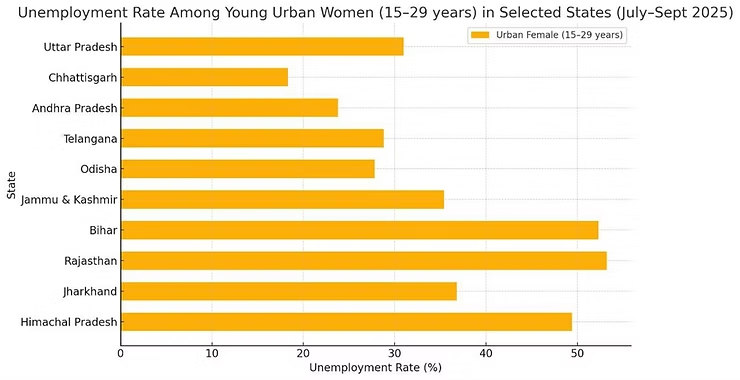
Recent data released from the Ministry of Labor Statistics depicts a worrying aspect of India’s labor market. Every second urban young woman in Bihar and Rajasthan is unemployed. Nationally, one in four young women remains without work. This reflects deep structural issues in India’s workforce and the job market’s inability to provide high-quality employment.

Industries in urban India are not generating enough decent jobs to absorb educated youth, especially women. Even when jobs exist, they are often of poor quality, lacking social safety standards and sometimes damaging workers’ health and well being.

Via the National Statistics Office of India Unemployment Data

A recent piece in The Diplomat, a magazine covering the Asia-Pacific region with current affairs, highlighted how workers trade off their health and welfare well-being for the opportunity of precarious living. If an economist like Robert Gordon, who wrote “The Rise and Fall of American Growth“, were to look at their lives, it would remind him of the 19th-century United States.

Migrant workers from Bihar and Uttar Pradesh toil in textile recycling plants under hazardous conditions for just ₹5,000 ($58.00) a month. Women form a significant share of this workforce, often assigned trivial tasks in unsafe factories. Many have developed asthma and tuberculosis after prolonged exposure to dust and poor ventilation.

The Rise of the Informal Sector

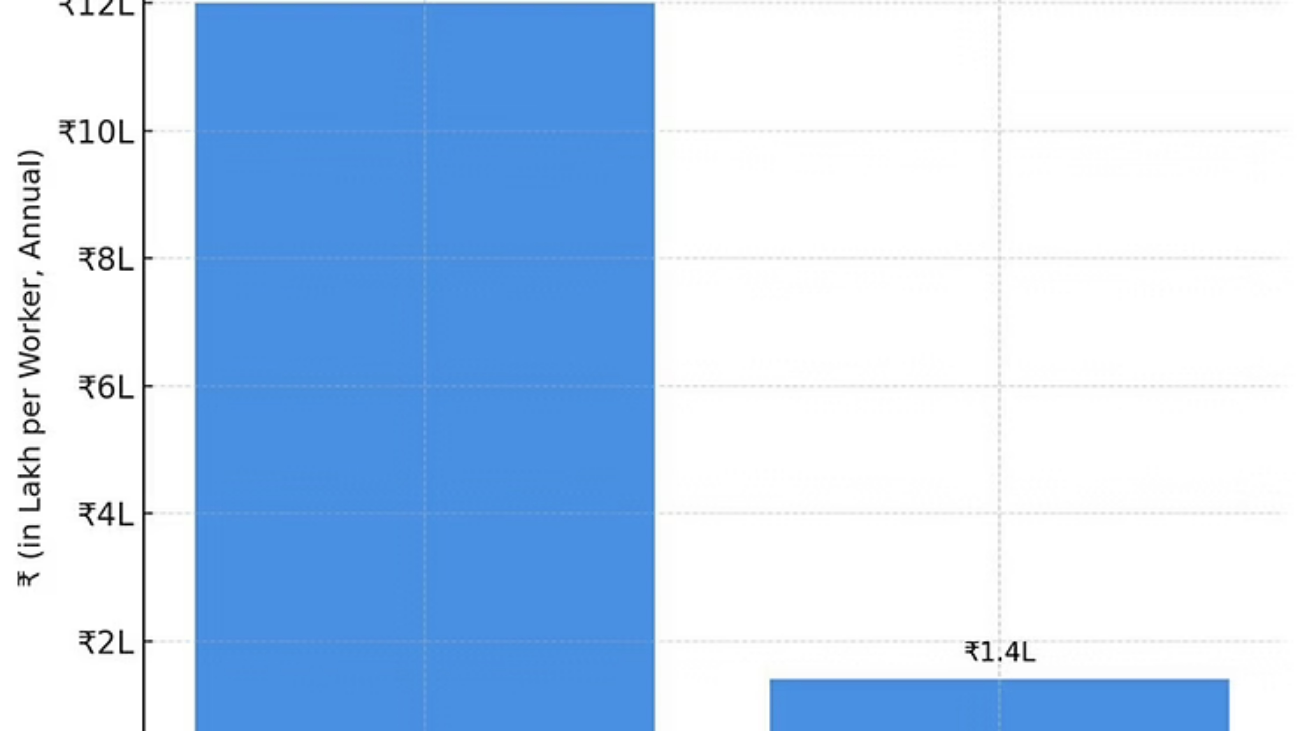
Formal workers generate an annual GVA (Gross Value Added) of ₹12 lakh, while informal workers produce just ₹1.4 lakh, according to the Annual Survey of Industries (ASI) and the Annual Survey of Unincorporated Sector Enterprises (ASUSE) 2022–23.

Neoclassical economics says wages reflect a worker’s productivity. But this logic collapses in economies like India’s, where a vast army like reserve of labor, keeps wages low – even when productivity rises.

Excess labor supply depresses pay across sectors, from private school teachers to gig workers. Many gig workers spend long hours to earn a modest income, without access to provident funds, health insurance, or paid leave. This precarity extends from India to the United States and Indonesia.

Statistics via Kuntala Karkun & Samriddhi Prakash, Pahle India Foundation

The Gap Between Law and Reality

India has strong labor codes, streamlined in 2020, yet they remain largely unenforced. Companies often ignore them due to cost pressures, effective lobbying, or weak state monitoring.

Economic growth without wage growth widens inequality and breeds social tension. For growth to be inclusive, wages must rise with GDP.

This demands more than redistribution. It requires the transformation of raising workers’ productivity, ensuring labor rights, and giving every worker their fair share of India’s prosperity.

post277

India Insider: Women in Agriculture Need Manufacturing Power

India Insider: Women in Agriculture Need Manufacturing Power

India has long been a society that has neglected Women’s Empowerment. While various states pursue proactive policies to enhance the role of women in society, their inclusion in the job market and ability to have financial independence is still lacking.

Small Scale Farm in Tiruvannamalai, India

In the suburbs of Tiruvannamalai City, in Tamil Nadu, Mrs. Revathi runs an agricultural farm where she grows rice, flowers, and vegetables. She sells them to local commission agents or directly to customers from her farm. Mrs. Revathi, who lost her husband in 2019, has two daughters, both of whom are educated and working. One of the daughters is getting married. She said that although agriculture helps her family earn money, it does not lift them out of the poverty trap because of uneven flower cultivation. The land is becoming less and less suitable for irrigation – a matter that worries her greatly too. Flowers are one of the major sources of income for many farming families in Tiruvannamalai City in Tamil Nadu.

This is just a small example of the challenges faced by women working in agriculture.
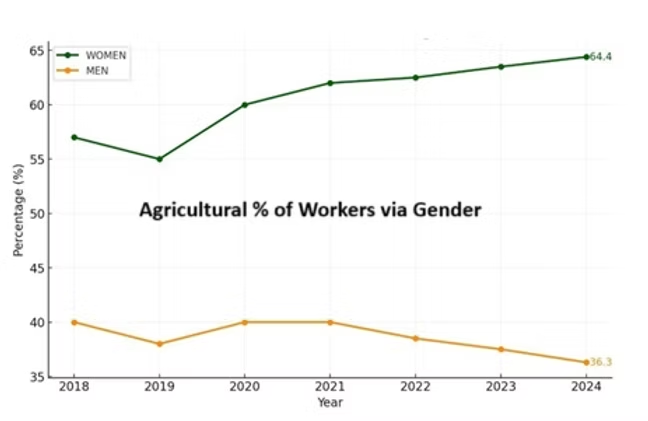
According to recent Periodic Labor Force Surveys, 64.4% of women in India work in agriculture, compared to only 36.3% of men.

Labor Workforce Percentage in India per Gender

Self employment and Access to Credit is not the Solution:

Many argue that self-employment and steady access to credit via microfinance institutions will help women become entrepreneurs and create movement up the social ladder. This is true in some cases, but many women struggle with raising families in their husband’s absence, and when working on farms where agricultural productivity is lopsided or unfit for growing vegetables or corn, times remain difficult.

First of all, why do women choose agriculture and remain small-time sellers? Because they are not able to find employment easily in formal sectors like manufacturing or other service oriented businesses.

Even within related agricultural sectors, women employed in vegetable processing plants, or value-added goods like masala manufacturing and tomato sauce production companies earn higher wages.

Unfortunately, low productivity and long spells of inactivity render agricultural workers significantly underemployed periodically. They are stuck, with nowhere else to go. Unlike in East Asian nations, which created mass employment through dynamic exports of manufactured goods, the Indian manufacturing sector’s low productivity makes it globally uncompetitive.

Manufacturing as a Solution for Women Empowerment:

Across Asia manufacturing has proven to be a powerful driver for upwards mobility. Incomes have risen, poverty has declined, and women are central parts of this transformation. In Vietnam, where a factory boom has been especially momentous, more than 68 percent of women and girls over 15 years of age are working for pay in some capacity, this according to data compiled by the World Bank. In China the rate is 63 percent, in Thailand 59 percent, and in Indonesia 53 percent of workers in manufacturing are women. Yet in India, less than 33 percent of women account for the workforce in recorded in official surveys.

In a pattern demonstrated in many industrializing societies, when more women gain jobs, families promptly invest further in education for girls. Manufacturing also lifts household spending power, fueling economic expansion that encourages investors to build more factories, providing additional jobs and reciprocal wealth creation. India is missing out on this dynamic manufacturing growth and is failing to broadly participate in the spread of improved industrialization which has helped bolster fortunes in many Asian economies and benefitted families. A vital component for a stronger Indian economy necessitates the empowerment of women.