postN81

Behavioral Sentiment: Sports and Trading a Key Correlation

Behavioral Sentiment: Sports and Trading a Key Correlation

In order to be an effective day trader a speculator needs to be able to control their emotions. A person can have years of market knowledge, the best schooling, read the world’s greatest books, be able to quote the leading financial experts and still be a bad trader. While it is important to understand the complexities being generated via technical and fundamentals and the power of behavioral sentiment, again it doesn’t guarentee you profits.
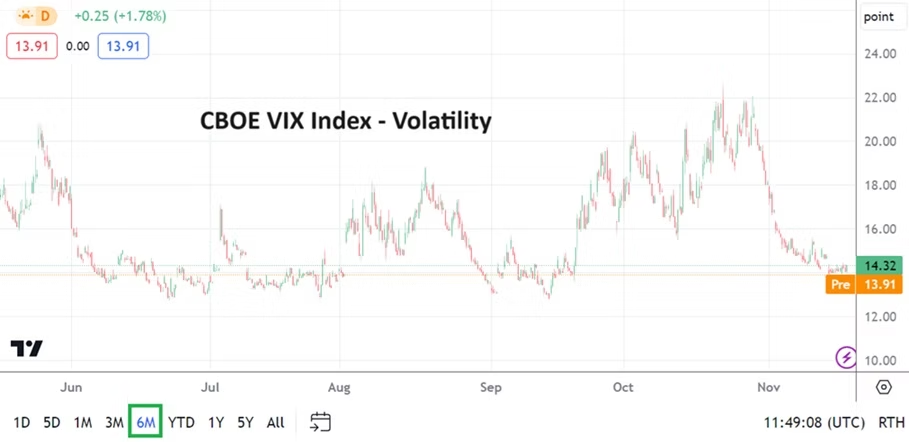
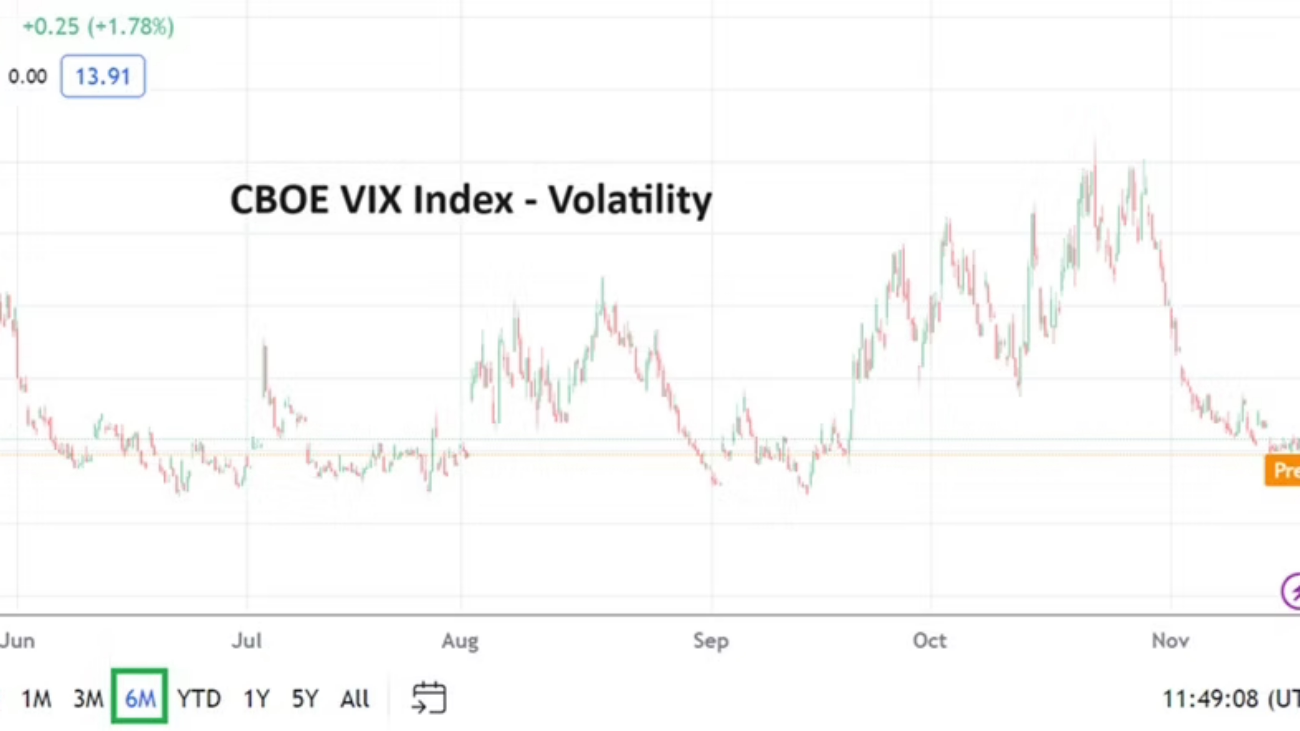
CBOE VIX Index six month chart as of 17th November 2023

When a day trader initiates pursuit of position, long or short, they can even be right about the eventual direction and still lose their money when the trade is complete. The missing link for many speculators while trading is their inability to control their emotions.

Many sports fans know that there are teams that have some of the highest paid athletes, but frequently have lackluster results because the team is not able to handle the bright lights of the stadium, they let crowds affect them. Some teams simply prove over time they are not prepared to really compete in the most important games; trading results frequently are similar when a speculator is not ready for the financial market they want to compete within.

Unless a market participant can handle their anxiousness, nervousness, frustration, assaults from value gyrations (reversals of price), doubts and the noise of the crowd (news being generated from the media that is mere hyberbole) and other challenges that can affect their emotional state – a trader is unlikely to have success.

Sports and trading are very similar sometimes. Professional athletic competitions between the world’s best are often a contest of ‘wills’. In many sports the top athletes are almost equally matched regarding their physical ability. In trading many speculators have the same perspectives regarding potential market directions, yet they produce different outcomes.

The difference maker in sports and trading when it comes to positive results – winning, is the ability to control their emotional state. Remaining calm and focused, knowing the goal and tasks that must be accomplished to achieve victory in sports and trading is often the result of keeping tranquil psychologically in the middle of battle.

You can have all the necessary trading skills needed to pursue a position within Forex, equity indices, commodities via the cash market, CFDs and futures, but if you do not have control of your emotions you are likely to lose.

Day traders also need to understand that one day of results, winning or losing, does not mean anything regarding future prospects. Like the best athletes, traders need to enter every trade as if it is a new game. Discipline, tactical objectives are important in trading. Being able to walk away from a losing position and leaving enough in your account to pursue the markets, for the next time you feel there is a potentially profitable objective that is attractive is also important.

You must know yourself to be a good trader, you must understand your own emotions and work on weaknesses. The ability to be profitable over a long time is not as simple as merely entering your online trading platform and opening a position which has been recommended or that you think is a winner.

It is one thing to understand the positive movement of a potential trade, but you must be ready for the negative possibilities when a trade is not going your way and the ability to navigate through the storm. Is your stop loss in place? Does the amount of leverage you are using allow you to walk away from a losing trade and still have enough ammunition (money) for other trades? Can you handle the volatility that is likely to ensue in potentially choppy conditions?

You need a solid gameplan. One of the greatest risks a trader is confronted by is their lack of emotional fortitude. Successful speculators embrace their trading positions because they are attractive, but they also manage their expectations and have a plan of attack in place before they enter every trade. Good traders can block out the noise of the crowd and enjoy the competitive nature of battling the financial markets.

postN68

Mets, New York City, and the Most Astounding Baseball Season

Mets, New York City, and the Most Astounding Baseball Season

Book corner: They Said it Couldn’t be Done by Wayne Coffey

In 1969, the Apollo 11 moon landing and the 400,000-strong Woodstock concert weren’t the only miracles in the United States. Wayne Coffey’s They Said it Couldn’t be Done focuses on major league baseball, where the New York Mets – a team with a losing record since its founding and who came in ninth place in the National League the year before – won the World Series to become baseball’s champions. Who says that miracles don’t happen?

Coffey is an experienced sportswriter, having written about hockey (The Boys of Winter: The Untold Story of a Coach, a Dream, and the 1980 U.S. Olympic Hockey Team), plus soccer, football, and basketball. In They Said it Couldn’t be Done, he tells the story of the championship ’69 year.

Coffey describes the history of the team. The Mets grew from the wake that was left in New York baseball when two of its three major league teams – the Brooklyn Dodgers in 1957 and the New York Giants in 1958 – relocated to California (referenced by the line “California baseball” in Billy Joel’s hit We Didn’t Start the Fire), leaving the southern boroughs without a team of their own. Created as one of two National League expansion teams in 1962 (the other being the Houston Colt 45s, later renamed as the Astros), the Mets played in the Giant’s old homestead, the Polo Grounds in upper Manhattan, until moving to Shea Stadium in Flushing, Queens in 1964.

A word about expansion teams. These teams usually comprise older players whose baseball chops have begun to erode, together with lesser-skilled players who – to put it mildly – weren’t the top prospects upon entering the league. The Mets went 40-120 their first year, a losing record for the twentieth century (and so far for the twenty-first). For the boys in Flushing, the early-to-mid-60s were a ballplaying comedy of errors, a farce with endless losing streaks, blowout games, and (as one can guess) a horrendously poor level of play. Fans would turn up to the game and watch dropped balls, outfield collisions, and balls careening off gloves. But the fiercely loyal New York fans stuck with them, taking the team to their hearts. In fact, an endearing and fun aura surrounded the young team, viewed by the fans as goofy but lovable losers.

As Coffey explains, the change began in mid-decade. Older players retired or were traded, and younger and more skilled players joined the team, such as the nimble shortstop Bud Harrelson. In 1967, two pitchers were introduced who would have a major role in the Mets future win, the left-handed Jerry Koosman and the right-handed Tom Seaver. These players – and others – were hungry for winning and were offended by the stigma of mediocrity that surrounded the team. In 1968, former Dodger star Gil Hodges began his tenure as manager, replacing the old-timer Casey Stengal. Coffey describes Hodges’ character and managerial style, and how it affected the team for the better. A decorated US marine in World War 2, and a man of the highest integrity, Hodges was calm, methodical, unflappable, with an uncanny knack for eliciting the maximum performance of his players, who respected him greatly. The ’68 team might not have even reached .500 (meaning the number of wins equals the number of losses), but for those watching closely, there were seeds of future victory being sown, as shown by good performances from catcher Jerry Grote, outfielders Cleon Jones and Ron Swoboda, and others.

Even with all the young and eager talent, the Mets began the ’69 season still outgunned in the National League, posting a losing record for the first month. But in May, they went .500 for the first time since their founding, and at the end of the month lurched ahead after a winning streak. Coffey describes the additional winning streaks in August and September where, trailing the Chicago Cubs for most of the year, the Mets edged out the Windy City boys to win, in champagne-drenched excitement, the National League East division. On this backdrop, the bulk of the book – the ’69 post-season – begins.

Going up against the Atlanta Braves in the National League Championship was frightening. Even though the Mets won more regular season games, the Braves – with powerful hitters such as Orlando Cepeda and top slugger Hank Aaron, and a pitching staff led by the right-handed All-Star Phil Niekro – were still favored to win. But in an unpredicted upset, the Mets swept the Braves, three games to zero, scoring a cumulative 27 runs compared to the Braves’ 15.

Defeating the Braves was one thing. Defeating the American League championship Baltimore Orioles in the World Series was another. With bat-wielding gladiators such as Brooks Robinson, Boog Powell, Paul Blair, and Frank Robinson, the Mets were going up against a baseball-playing war machine with almost no weak spots. Their pitching staff included four starters who won 20 games apiece, such as left-handed Mike Cuellar and Dave McNally, and right-handed Jim Palmer. Palmer, considered today one of the best pitchers ever, was still young when he took the mound against the Mets, turning 24 on the day of Game 4. But he already had five seasons under his belt, and was an experienced postseason warrior, including a World Series pitching duel in 1966 against the mighty Sandy Koufax.

The Mets went on to defeat the Orioles, four games to one, playing like lions in a World Series that has become legendary. Coffey describes these games – as he does with the Braves – in play-by-play detail, but does a good job of leaving out anything of lesser importance while highlighting the important plays, the latter including Ron Swoboda’s gravity-defying catch in Game 4 that saved the game for the Mets. A writer of lesser skill might over-indulge the reader, or conversely, skimp too much on details. Coffey is able to walk that fine line between the two, and the book’s climax bounces along at an exciting pace, with a breezy, page-turning feel. Coffey did his homework well, by conducting scores of interviews with the key players and obviously watching all the championship and World Series games (all are currently available on YouTube, for anyone interested). He includes interesting commentaries at various points, telling us what the players were thinking, analyzing their moves, and putting various key at-bats in context.

Coffey fills up the book with light vignettes of Met fans of the era, such as Howie Rose, the popular Mets sportscaster, and describes the season’s impact on New York society in general. He also delves into the background and personal stories of many players, including the hardships they endured – such as that of veteran third basemen Ed Charles, an African-American who came up from the Jim Crow South – to make it to the major leagues.

The classic baseball expression, “it ain’t over ‘til it’s over”, truly symbolized the ’69 Mets. They Said it Couldn’t be Done is a great read. Baseball fans will love the book but so will fans of any sport.

If you want to read another Book Corner article, please visit this review by Evan Rothfeld: https://www.angrymetatraders.com/post/dangerous-and-unpredictable-duties-during-the-vietnam-war

postN46

Cricketing Excellence: Factors Behind a Remarkable Evolution

Cricketing Excellence: Factors Behind a Remarkable Evolution

A recent article in a New York Times article, Studying the Limits of Human Perfection, Through Darts, analyzed how scores in darts, bowling and archery have improved over the past several years. This made me think about how the ability of cricketers has changed over time.

The New York Times article mentioned two things that stayed with me, “Athletes seem to get better, generation by generation.” “Today’s athletes may be more skilled than their predecessors. But they are often playing with better equipment or technology that can boost their scores.”

Cricket has gone through a massive transformation in the past 2 decades. The dexterity of players has undergone a significant change over the past several years. Several key factors have contributed to this remarkable improvement, showcasing the sport’s continuous drive for excellence. Here, we delve into five pivotal elements that have fueled the improvement in cricketers’ abilities:

1. Bat Design and Balance:

The evolution of cricket bats has played a pivotal role in enhancing players’ performance. Modern bat design emphasizes a delicate balance between power and control. Technological advancements have led to the creation of lightweight yet powerful bats, enabling players to deliver explosive shots without compromising precision. The increased sweet spot and improved aerodynamics have revolutionized the game, empowering cricketers to achieve unprecedented batting feats.

2. Targeted Fitness and Training:

The shift towards a more scientific approach to fitness and training has been a game-changer. Cricketers today undergo rigorous training regimens that focus on specific skills, strength, agility, and endurance. Sport science, data analytics, and specialized coaching have combined to provide players with tailored routines that optimize their physical capabilities. This holistic approach ensures that players are not only physically fit, but also capable of sustaining high performance over extended periods.

3. Mindset:

The mental aspect of cricket cannot be underestimated. Players are now equipped with psychological tools to enhance their concentration, resilience, and decision-making under pressure. Mental conditioning has enabled cricketers to overcome challenges and thrive in demanding situations. The shift from a ‘fixed’ mindset to a ‘growth’ mindset has fostered a culture of continuous improvement and adaptability, contributing to enhanced performance on the field.

4. Larger Pool of Players:

The global expansion of franchise cricket has resulted in a more diverse and competitive talent pool. Furthermore, emerging cricketing nations have produced players with unique playing styles and strategies, enriching the sport’s overall dynamics. The influx of fresh talent has spurred healthy competition and pushed established players to refine their skills, contributing to an upward trajectory of comprehensive performance standards.

5. No Fear of Failure:

The modern cricketing landscape encourages players to embrace risk-taking and learn from failures. The removal of punitive consequences for innovative shot-making or aggressive strategies has paved the way for players to express themselves freely on the field. This change in approach has led to more exciting gameplay, with cricketers aiming for higher levels of performance without being burdened by the fear of making mistakes.

The exceptional progress in cricketers’ athletic abilities can be attributed to a convergence of factors. The symbiotic relationship between bat design, targeted fitness and training, a resilient mindset, an expanded talent pool, and an environment that welcomes risk-taking has propelled the sport to new heights. As cricket continues to evolve, these factors will likely continue to synergize, driving players to even greater achievements on the global stage.