post245

Why No Major Panic in U.S Stock via Moody’s Downgrade?

Why No Major Panic in U.S Stock via Moody's Downgrade?

While Asian equity markets opened with initial nervousness yesterday after Friday’s late downgrade of U.S debt by Moody’s to Aa1. The U.S major indices did not respond with panic selling, By the end of yesterday’s trading the Dow30, Nasdaq100 and SP500 turned in rather mundane and positive results. Behavioral sentiment and knowing what experienced investors think remains important for people trying to mirror the actions of larger players while trying to take advantage of potential market action.
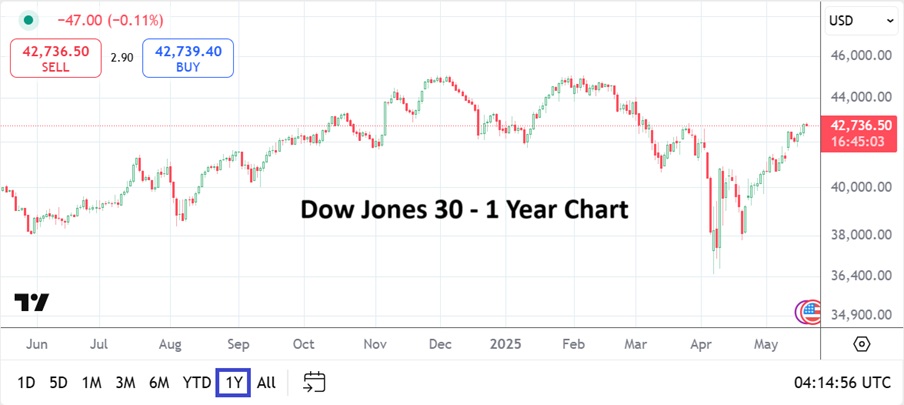
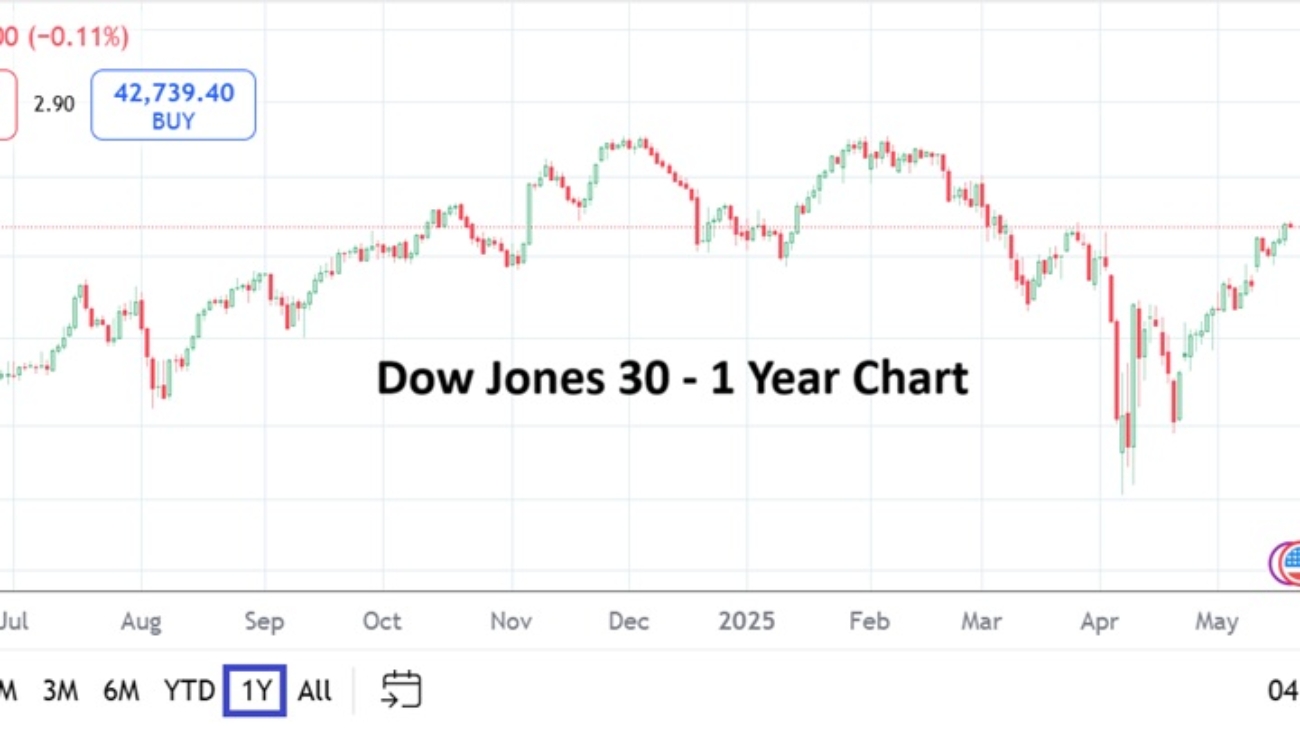
Dow Jones 30 One Year Chart as of 20th May 2025

What was NOT mentioned widely in the press yesterday were the facts that Standard & Poor’s had actually downgraded U.S debt in 2011 from AAA to AA+, also Fitch had been warning of a downgrade the past handful of years and did so in 2023 to AA+. U.S government debt remains a definite burden on the U.S economic outlook, but investment institutions have been discussing the dangers of the 36+ trillion USD deficit for years. Talking about something doesn’t mean it is fixed, but it does mean it has been acknowledged and this is where sentiment comes into play.

Wall Street remains in many respects the only game in town for large global investors looking for quiet steady returns. U.S exceptionalism – or at least the concept that the U.S economy remains a true safe haven compared to other investment vehicles worldwide – continues to spur on a confidence game that sees money pumped into it by global pension funds and long-term investors which seek yields that outpace inflation. It can certainly be argued that this endeavor is not always achieved, but the concept that the ability to grow money faster in equity investments via the likes of index investing compared to letting money sit in a bank is noteworthy. The ability of large institutions to place considerable amounts of money in more speculative pursuits like singular equities in sectors they are interested in like AI and quantum also creates a dimension to outperform benchmark indices., but is riskier.

The USD remains the world’s currency of choice for effective trade and protection against the dangers of volatile Forex. The Trump administration likely wants a weaker USD in order to spur on export from the U.S, but it certainly doesn’t want to see the greenback killed. Nor does the White House want to see U.S Treasury yields balloon too high. Day traders may not have been told to watch yields in the 10 Year U.S Treasuries by their brokers, but it is an open secret that should be used as a barometer for investor sentiment. The signals may not work everyday, but over the long-term if U.S yields on the 10 Year U.S Treasuries are soaring it likely means major U.S equity indices are struggling with anxiety – and when the yields are turning lower it can be expected that U.S equity indices are gaining.

An important piece of the confidence game that speculators should note regarding confidence in U.S markets is that 10 Year U.S Treasury yields yesterday declined, and are now lower than values seen last Friday after the ratings downgrade by Moody’s, and are testing values seen on the 14th of May. Traders should certainly stay alert, but they must remember the U.S investment landscape is resilient and is likely not going to perish suddenly. Investors like most humans tend to be optimistic and believe things will work out with positive results somehow developing. It doesn’t mean stock values will always go up, in fact they can move lower violently periodically, but a long-term vision helps when investing in U.S equities.

There has been no panic in U.S equities and the world continues to look at the SP500, Dow30 and Nasdaq100 as places to position investments. Yes, other spheres exists which can produce greater yields, but this also includes higher risks. International diversification is a solid focal point for investors, and day traders need to understand a complex game is being played. Reacting to every soundbite of developing news probably does more harm to speculators compared to good. A steady approach and conservative risk taking tactics are vital.
post244

High Level Antics as Trump Battles Institutions over Economy

High Level Antics as Trump Battles Institutions over Economy

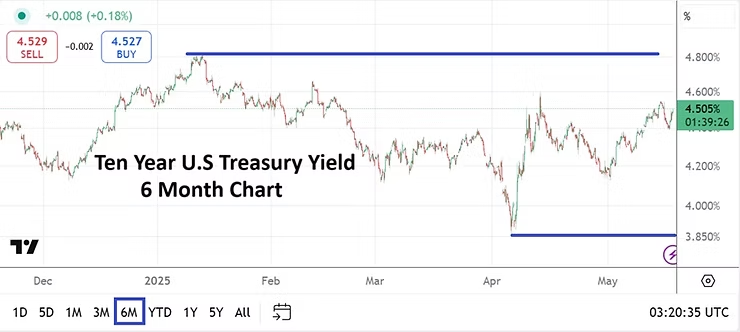
Late last week Moody’s downgraded U.S debt, and the 10 Year Treasury yields as of this morning are near 4.50%. Yet, the Chicago Volatility Index is around the 17.25 level which is actually a small victory and shows that sentiment has improved quite a bit the past month. Let’s remember the VIX was near 60.50 in early April.

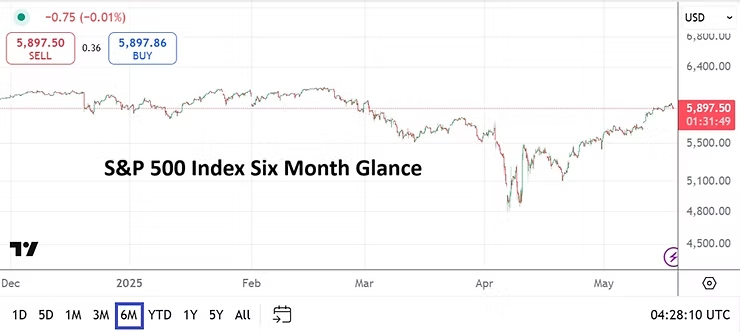
Wall Street had a handful of rather positive trading days too last week. Complexity remains a fixture for investors as they navigate their sentiment which is being generated by a rather stormy mix of perceptions. Day traders continue to face a tough betting environment via trends. The S&P 500 and other stock indices are showing signs of life, but how will they react to the Moody’s downgrade with a full weekend of consideration?

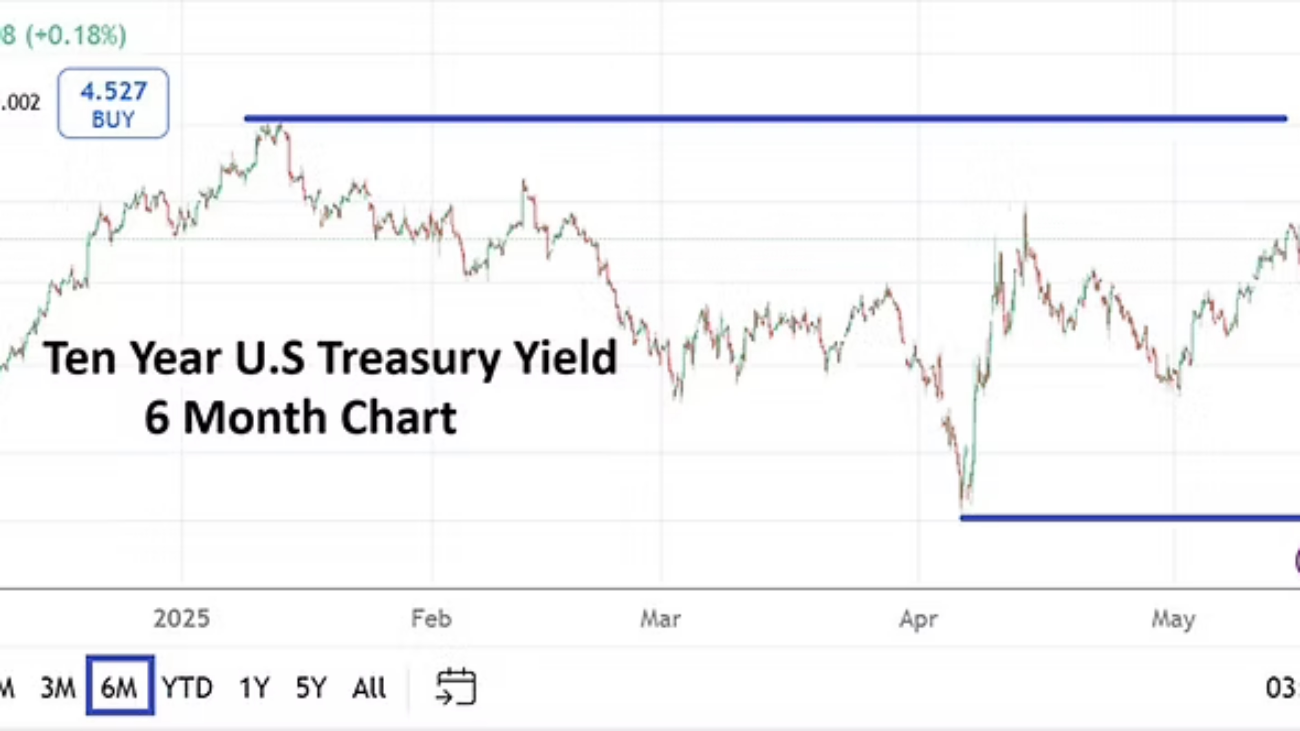
10 Year U.S Treasury Yields Six Month Chart as of 19 May 2025

Last week’s U.S inflation numbers via CPI and PPI were weaker than expected, which raises the curious and obvious question as to why the Federal Reserve remains overtly cautious and refuses to cut the Federal Funds Rate by 0.25% basis points? Short-term traders still have difficult days ahead and those anticipating a fast and powerful bullish run in equities among the bigger indices need to remain vigilant. Sustained higher price action has likely not arrived quite yet for overly optimistic endeavors.

S&P 500 Six Month Chart as of 19 May 2025

Let there be no doubt that there is a coming collision between the U.S White House and the Federal Reserve. The high level of yields the U.S Treasuries are accountable for are unsustainable and costly for the economy. President Trump will be in no mood for polite conversation with Fed Chairman Jerome Powell. Now that Trump is back from his Middle East trip he will likely turn his attention to the U.S debt downgrade and blame not only his predecessor in the White House but Powell too. Treasury Secretary Scott Bessent will likely address monetary policy too in the coming days.

The lower costs of WTI Crude Oil seen the past few months is helping fight inflation. As of this morning $61.70 is the vicinity for early trading. The price of energy appears to be within a solid lower range and likely has little ability to raise significantly. If the price of WTI remains under 70.00 USD this will help global inflation remain rather polite.

But this doesn’t take away from the threat of tariff pressures which do remain unknown. However, it can be argued the Federal Reserve is being far too cautious in the interim. Yes, the U.S central bank faces uncertain economic forecasts because of the potential of U.S tariffs hitting manufacturing and consumer prices, but there is a chance also the Trump administration will actually achieve better than anticipated trade agreements.

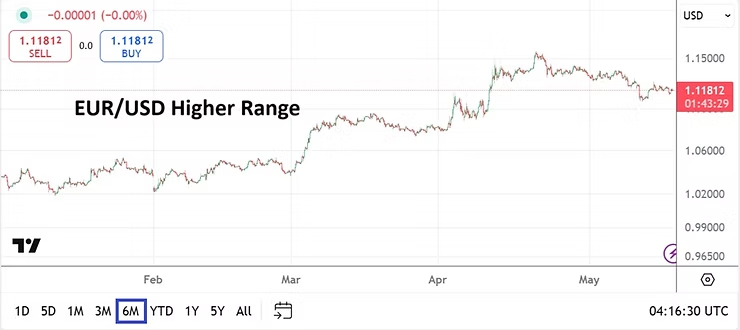
EUR/USD Six Month Chart as of 19 May 2025

Gold as of this morning is slightly above $3,200.00 per ounce, which shows that speculators and investors have backed away from the buying power the precious metal created in the third week of April when the $3,500.00 price was challenged. The USD remains in a dog fight against major currencies in Forex as financial institutions look for equilibrium and try to decide if they should gamble on the Fed cutting interest rates in July. The USD has lost value since early April and remains in weaker mid-term territory. However, the EUR/USD has given back a lot of its gains made throughout April, but financial institutions may now look at current levels as viable support and become buyers again.

Day traders remain in a difficult spot. Wagering on daily market gyrations via interpretations of behavioral sentiment is sensible, but the problem is the quickly shifting winds that still remain a danger. Folks participating in the markets should use the 10 Year U.S Treasury yields as a barometer. Having fallen to lows below 4.00% in the first week of April, investors are again demanding more incentives to buy U.S debt, highlighting murky mid-term outlooks.

U.S Manufacturing PMI numbers will be released this week on Thursday, but this will not influence the markets too much. Instead investors will keep their eyes on the White House as media focus turns from Middle East politics to U.S economic policy. While there have been ‘green shoots’ emerging in the SP500, Nasdaq100 and Dow30, traders should keep their leverage at conservative levels if they merely intend on making short-term wagers.

post41.1

Risk Friday: To Freeze or Reduce is not the Correct Question

Risk Friday: To Freeze or Reduce is not the Correct Question

The U.S debt ceiling debate in actuality, is a vote to legally increase the amount of debt the U.S government can spend. Approval of the debt ceiling vote will give a green light to the government to be a larger debtor without consequence. Other than eventually not being able to pay its bills in the future, what’s the problem some might ask. And let’s not consider potential downgrades from S&P, Fitch Ratings and others for the moment.

Here are the Problems Ahead for the U.S

U.S debt dominoes have grown heavy and are getting harder to stand back up, but those with the ability to spend simply do not care because they will never be held responsible. The U.S government seems to have forsaken capitalism and have entered the plundering stage, where the government believes it can ‘find’ enough revenues from higher taxes and the selling of long-term Treasury bonds while remaining the big man on campus.

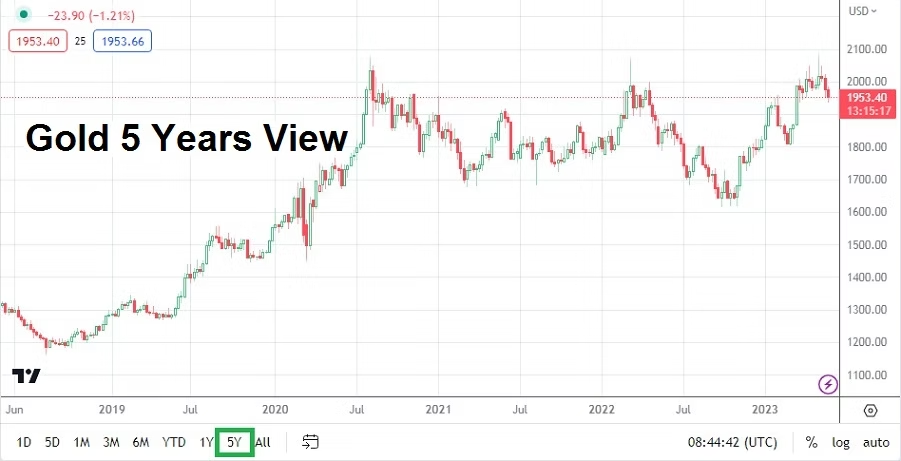
Gold Five Years Chart as of 26 May 2023

Higher taxes frequently stymie businesses and make it harder to hire employees because the expenses become too big. As an example for what the future could look like in the States turn your eyes to Chicago, where elected city leadership is considering implementing a ‘head tax’ in which businesses would need to pay a fee on each person it employs. The tax situation is getting so ridiculous in Chicago, that long time economic juggernauts like the Chicago Mercantile Exchange are grumbling and threatening to leave because of “ill-conceived” policies.

Likewise, the U.S government seemingly doesn’t understand that spending cannot be replenished by tax collection alone. Actual cuts to spending need to take place. It is called reducing the deficit. The naive will eventually be made to see the light painfully.

The Ramifications for the U.S could be Economically Untenable

U.S interest rates which have been raised the past year and a half, have affected mid and small sized banks and the amount of money the U.S government has to pay on maturing bonds because of higher borrowing costs. Fitch Ratings has recently whispered publicly they may be forced to downgrade U.S debt offerings, this if the U.S government doesn’t increase the amount of money it is legally allowed to owe. Pause for a second here, do you see the absurdity in this clown show? In other words a rating service company is OK with the debtor being allowed to ‘borrow’ more money from itself that it does not have – in order for that same debtor to be allowed to ‘promise’ it can repay its debt at a later time.

The U.S government keeps allowing debts to grow and creating entitlements as if this has no effect on inflation. Quantitative easing and stimulus packages initiated by the U.S government artificially kept the Gross Domestic Product figures looking positive and the equity markets happy for more than a handful of years. However, the proverbial ‘can’ has been kicked down the road so many times it is ready to disintegrate. The debt problem is simply being passed down to the children and grandchildren of the U.S, or so the current leadership seems to hope. But what if the debt problem explodes now? This generational problem is systematic globally, other governments practice equally bad or worse fiscal policy. Politicians do not like to walk around with empty hands.

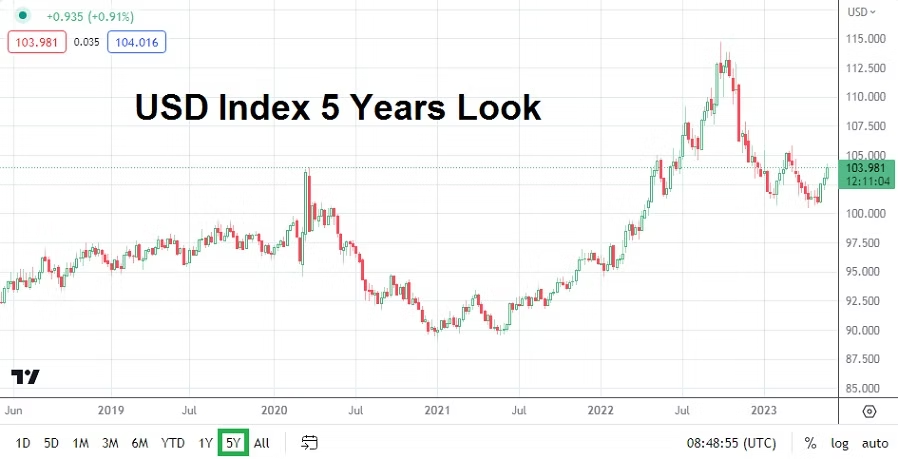
USD Index Five Years Chart as of 26 May 2023

The Clock is Ticking Loudly and Some Investors are Paying Attention

The clock is ticking in the U.S and unless they can prove expenses can be managed better, they are on a perilous road to becoming a regular nation among others, that is looked upon with scorn and derision because they cannot pay their debts. The dominance of the USD will be punished and shattered if they do not stop the nonsense. The dollar’s status as the reserve currency of the world has been slipping incrementally for a couple of decades and this will continue if the U.S government does not seize the problem and find solutions. A failure to show budgetary sanity and decrease expenditures will eventually cause something many U.S citizens do not want, relegation to the status of a ‘regular’ nation. The attitude of, “I remember when” could become a refrain heard in the U.S sooner rather than later.

The U.S is in a precarious place and sunshine in many respects is not on the horizon. Financial institutions supposedly believe the U.S debt ceiling will be taken care of in the coming days or weeks. However, a debt ceiling agreement is not the correct bandage for a broken leg, the problem is much larger. Debt should not be allowed to continuously grow. If the situation gets worse, some nations sitting on the geopolitical fence may shift their alliances depending on the ability of mutual relationships to help deliver economic stability.