post293

Opportunity? Market Ambition as Day Trading Volatility Looms

Opportunity? Market Ambition as Day Trading Volatility Looms

The U.S government shutdown looks like it will take place at 12:01 am EST on Wednesday, this if Washington D.C politicians fail to agree to a funding gap. There have been significant shutdowns in the past, thus financial institutions though not in love with concept are adept at continuing to trade during the events. President Trump’s first term in office produced a long shutdown from the 22nd of Dec. 2018 until the 25th of January 2019. President Obama’s White House had a 16 day affair in 2013. And President Clinton’s administration dealt with a shutdown lasting 21 days.
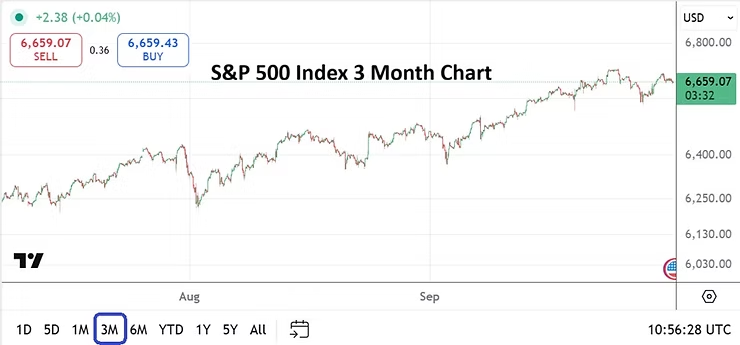
S&P 500 Index Three Month Chart as of 30th September 2025

While the financial markets will certainly survive and long-term investors will likely remain rather sedate during this developing saga, day traders need to brace for volatility. Opportunities may develop if Forex, U.S equities and gold see reactions per perceived safe haven endeavors by some investors. However, wagering in markets when shifting tides are happening due to sentiment torrents could prove difficult for speculators. Timing the market and its gyrations caused by potential mood changes poses threats for small traders.

And that is why it will be important to actually remain patient in the coming days. The Democrats appear ready to try and score a political win against President Trump. But what would a win look like? The public is seldom fooled by the government shutdowns. While government offices shutter and economic data publication dates will be postponed, the rest of the world will move forward.

Day traders should not be tricked into panic. Nor should they react too fast based on fears that are not legitimate. The U.S major indices may languish during a government shutdown, but it is also conceivable that they may perform rather well. The Nasdaq 100, S&P 500 and Dow Jones 30 are all within sight of their highest realms. The USD may find some buying action, but just like trades that have already been digested into the market when the Federal Reserve’s FOMC decisions are anticipated and acted upon, speculators should be prepared for counter-intuitive moves. In other words do not be surprised if sudden reversals in Forex via the USD develop.

Traders looking for discounts to emerge will need to be careful, but if the equity markets were to suffer a strong downturn on heightened nervousness, having a longer-term approach to speculative positions could become worthwhile. Gold which is traversing within record values may prove to be a significant near-term barometer as a safe haven gauge in the coming days. But then again gold has been within a sincere bullish trend over the long-term, so buying if produced near-term needs to be looked at suspiciously. In other words, the bullish trend in gold while getting perhaps an additional dose of fuel to ignite higher because of the potential U.S government shutdown should also be treated carefully and not traded with blind ambition.

Gold Three Month Chart as of 30th September 2025

The potential of a U.S government shutdown is a big event, but it is intransigence that financial institutions and big investors do not want to see. As long as some aspects of communication are being shared transparently with the public regarding negotiations in Washington D.C, many markets are likely to remain rather unbothered. How long will the U.S government shutdown last this time? It might all depend on how long the Democrats believe they can get the most out of the shutdown if it adds to their political image.
Both the Democrats and Republicans will want to get through the coming days as unscathed as possible. Why? Because both want to retain their power. One question waiting to be answered during this conundrum is who will come out looking best? If the financial markets begin to suffer there will be a lot of finger pointing by both sides. And again, importantly, financial institutions are unlikely to be fooled. Investors want clarity, the markets will only suffer if big players feel the crisis in Washington can cause potentially long lasting damage.
post270

India Insider: Strategic Balancing Act Comes with Risks

India Insider: Strategic Balancing Act Comes with Risks

On the 15th of August, India’s Independence Day, Prime Minister Narendra Modi announced a large reduction on Goods and Services Tax rates to boost domestic consumption. The Indian economy is certainly slowing, this as lackluster domestic consumption has prompted the Reserve Bank of India to cut the repo rates from 6.5% to 5.5% in 2025.

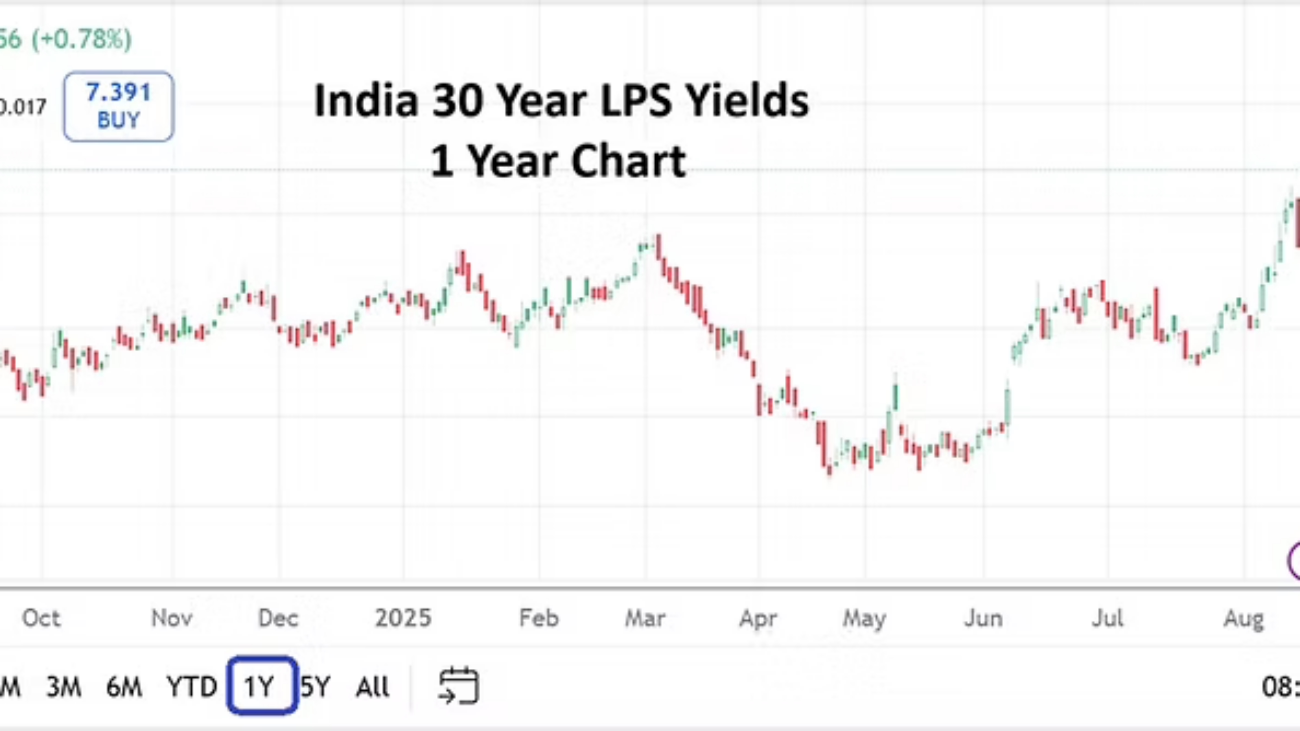
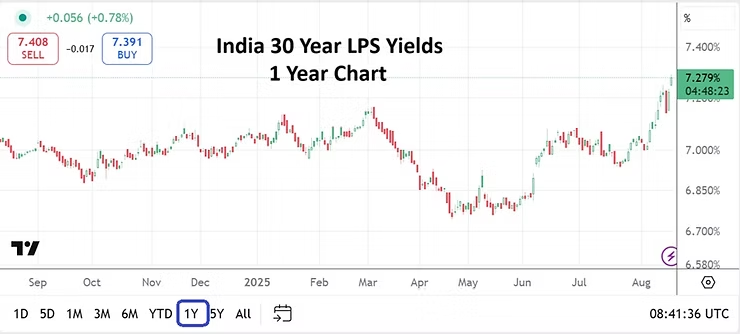
Indian Bonds 30 Year LPS Yields One Year Chart as of 19th August 2025

As trade deal discussions with Washington flounder, New Delhi is being forced to shift economic considerations towards China. The diplomatic relationship between India and China has grown colder, particularly since they clashed on the eastern border region in 2020.

Relying on China also comes with challenges for New Delhi. Since 2021, the trade deficit with China has expanded from $73.3 billion to $99.27 billion USD, showing that India still depends increasingly on China for significant importing needs.

According to Bloomberg, India’s major conglomerates have already established excellent relationships with Chinese suppliers of lithium ion batteries and EV components, although they try to discreetly tread under the radar in order to avoid the wrath of New Delhi government.

The fact is India can sustain its economy and maintain its geopolitical posture of non-alignment by practicing a multi-polar stance with Washington and Beijing. But despite clinching trade deals with the U.K and reviving trade negotiations with the E.U, New Zealand & Australia, and its deepening bilateral relationships with many central Asian nations and within BRICS, New Delhi’s major trading partner for exports remains the United States. Around 18% of India’s exports go towards the U.S, while 15% of imported goods come from China. The numbers do demonstrate an intriguing balance.

While India’s negotiations with the U.S have stalled and appear postponed indefinitely, other Southeast Asian countries, including Vietnam, Indonesia and the Philippines have secured lower tariffs with the Trump administration making them more competitive in the U.S. market. These nations are using the U.S for economic and military security, but they also rely on China for manufacturing and logistical needs.

India Faces Additional Challenges with Washington and Beijing:

Indian IT companies derive nearly 57% of their export revenues from U.S clients, making them heavily dependent on that market. And rapid advances in AI and the erosion of legacy outsourcing models are putting India’s traditional profit engines under pressure.

Meanwhile, China is not keen on helping India achieve expertise and manufacturing competitiveness which would threaten its own business model. China wants to make inroads by selling goods to the world’s largest consumer market, rather than technology transfers which would allow India to attain manufacturing supremacy.

Some economists warn that India’s own plans for mitigation of its current circumstances will likely be disinflationary. India’s bond results via yields clearly express concern about potential fiscal costs and difficulties. New Delhi’s focus has shifted towards appeasing domestic consumers, while trying to deal with uncertain foreign partners. Government capital expenditures have been declining since last year, signaling that both corporate and public investment confidence remains weak.

India’s neutrality is welcomed. It’s not anti-Western or pro-Western, and attempts to balance between the U.S and China while trying to forge new trade agreements and ties are a constant high-stakes game capable of creating strains economically and politically. The path forward with the U.S and China will remain complex and it must be worked on with precision in order to help achieve success.

postN58.1

Nervous Outlooks and Short Term Fixes Creating Anxiousness

Nervous Outlooks and Short Term Fixes Creating Anxiousness

A U.S government shutdown has been avoided, but the resolution highlights that an important year of political games is getting fully underway in Washington. Short term fixes via congressional agreements do not hide the fact the U.S government continues to bleed money and is adding to its deficit as yields on U.S Treasuries remain high.

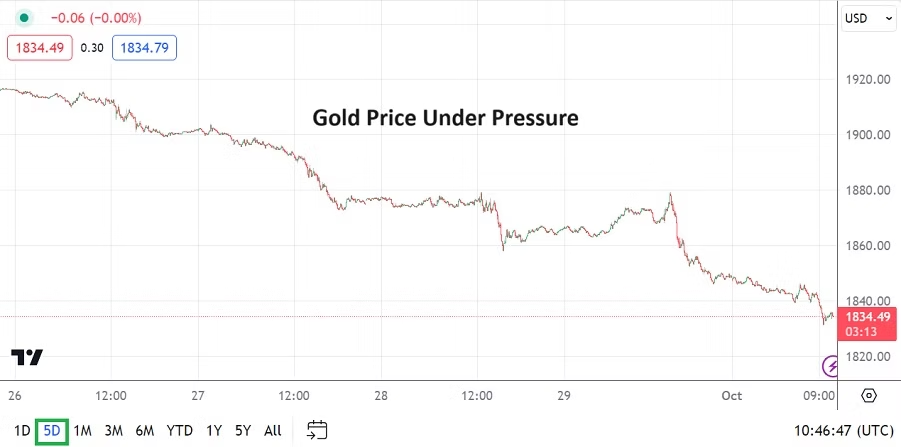
Gold Five Day Chart as of 2nd October 2023

The price of gold has sank substantially in the past week, which shows the USD continues to be strong, and that speculative short-term games within the precious metal must always be kept in mind by day traders. Long term fundamental beliefs regarding the value of gold cannot stop momentary volatility.

GDP results from the U.S last week came in slightly below estimates, but the ability to still sustain growth also creates the suspicion the U.S economy remains stubbornly strong, which effectively puts the U.S Federal Reserve in a rather difficult place. Crude Oil prices have remained high, and this week’s coming jobs data will be important for short and mid-term market participants as they position themselves while nervous behavioral sentiment continues to be evident.

U.S stock markets are near three month lows and trading conditions choppy, this as yields on U.S Treasuries are elevated and create a tough road for speculators to navigate in the short-term.

Monday, 2nd of October, U.S ISM Manufacturing PMI – a reading below 50 is anticipated which would mean sentiment remains negative regarding the U.S economy, but Core Durable Goods Orders came in better than expected last week. Thus, the result of this manufacturing report could play into short and near-term USD trading and cause a ripple as financial houses anticipate the jobs numbers later this week.

Tuesday, 3rd of October, Reserve Bank of Australia – the RBA is expected to keep its Cash Rate in place. If the RBA cooperates with financial institutions and does not change its key borrowing rate , the RBA Rate Statement will come into focus. However, the AUD/USD is still within the shadows of U.S Federal Reserve like most other major currencies.

Wednesday, 4th of October, U.S ISM Services PMI – the outcome from the Services report is expected to fall below last month’s outcome. The slight miss in the GDP numbers last week was noteworthy, but the better than expected Core Durable Goods results will make this report of interest and provide a bit of impetus to the USD and U.S indices before Friday’s key jobs data – particularly if the Services reading is better than anticipated.

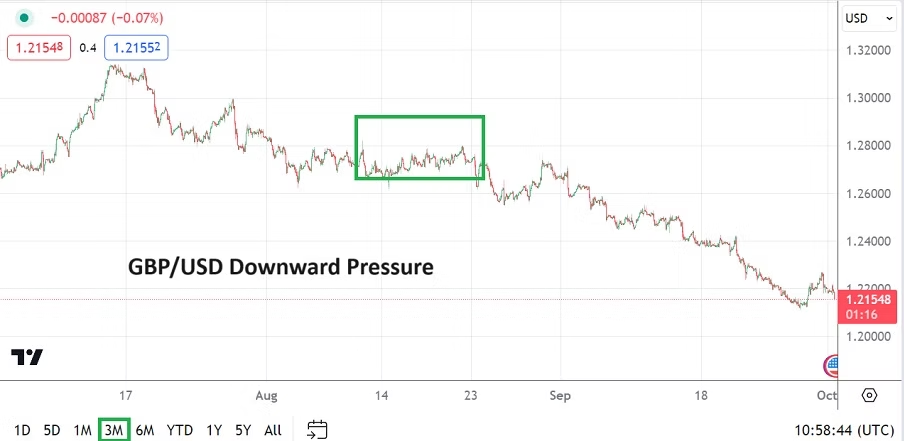
GBP/USD Three Month Chart as of 2nd Oct. 2023

Thursday, 5th of October, U.K Construction PMI – while not considered a major publication by many analysts, the ordering by purchasing managers in Britain may prove relevant as an indicator regarding outlook. The Bank of England held their interest rates in place a couple of weeks ago and this was based on the belief the U.K economy is slowing. The Construction PMI report is expected to come in slightly below last month’s outcome which could set the table for slight choppiness in the GBP/USD which has continued to trend lower.

Friday, 6th of October, U.S Non-Farm Employment Change and Average Hourly Earnings – the combination of these two reports will impact USD trading before their publication and afterwards for several hours. Financial institutions will examine these statistics carefully. If there is a hint of weakness in the U.S jobs market and wage inflation is tame, this could make the USD weaker. However, if jobs hiring remains firm and there is a slight uptick in the costs employers are having to pay workers, the USD could get stronger.