Markets Say 20260407

What Do the Markets Say?

Ambivalence Rules the Day

Opinion: The following article is commentary and its views are solely those of the author. This article was first published the 7th of April via The Angry Demagogue.

There is nothing we capitalists like saying more than “the markets say….”. What we mean is that the amorphous group of individuals and institutions that together form some sort of consensus as to the value of “things” taking everything known by the individuals involved into consideration. Since no one can know everything, the idea is that the market represents the sum of knowledge of everyone who has money to invest – or, as we like to say, “skin in the game”.

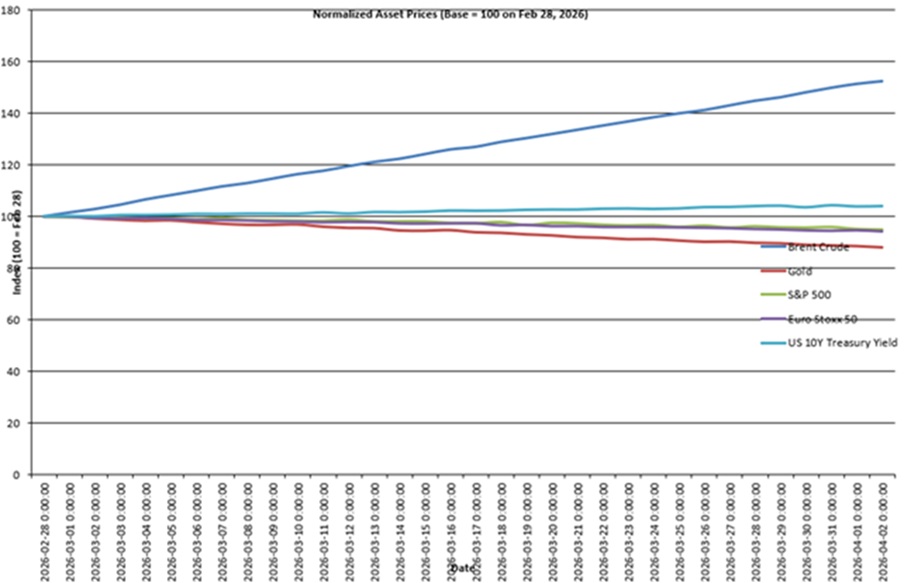
Below is a graph from the start of the war until April 2, of oil, gold, 10-Year U.S Treasury yields, American and European stocks. Each should tell us something and in general all together they should be saying the same thing. However – that is not the case here considering we are in the midst of a major Middle Eastern war, with China and Russia watching with interest and Western Europe squirming with unease.

Normalized at 100 via ChatGPT as source.

Those items that signify a flight to safety are the price of gold and the U.S Treasury yields, while those that signify a faith in the future of the economies are the index levels of the U.S and European stocks. A commodity that is directly affected, oil in this case, is expected to rise and it has, by over 50% since the start of the war.

While one would expect the price of U.S Treasuries to rise considerably as it is considered a “safe haven” by investors, it has risen just 4% as yields dropped from 4.31% to 4.13% (with bonds, prices and yields moving inversely. A rise in bond price is a decline is their yield – meaning they earn less for the bondholder). Gold, the other safe haven, though has dropped by nearly 12% since the start of the war. True enough, the price of gold has skyrocketed over the past year, but still while there is a reason why gold might underperform U.S Treasuries, it is odd that it has underperformed stocks on both sides of the Atlantic, in spite of the 50% increase in the price of oil – forcing up energy prices for industry. Stocks in the U.S have dropped by just 4.95% while in Europe the decline is just 5.8%. Neither number is one an investor wants to see in just six weeks, but all things considered the war has not caused a lack of confidence in the economies of the EU or the U.S.

People might claim that gold has lost its safe haven luster over the years, but that is not the belief of governments as India and China have been buyers of vast stores of gold and France decided to repatriate all of their gold reserves. They still see it as necessary.

So, what are the markets telling us about this war and the future of domestic and global economies? Regarding Iran, the supposed victors in this “quagmire”, the Iranian Rial has dropped 96.8% in 2026 and has moved from 0.00002378 to the dollar to an incredible 0.00000076 (that means that 1 million Iranian Rial equals 76 cents) the market speaks in one voice – no confidence.

Regarding the rest of the world the markets are not really telling us much of anything because there has not been a rush to safe havens as usually happens in wars and happened during Covid, nor has there been supreme confidence. The markets are, shall we say, ambivalent.

That volatility is high and that they move drastically on each Trumpian proclamation is more a sign that the algorithms that control the very short term market trends are mostly chasing the same thing. When X happens, sell Y is a race to the bottom by unthinking and unsophisticated (in spite of AI) analysis until that race causes the “when Y hits a certain price, buy it” or “when Z happens then buy A” algorithms kick in. After a few days or weeks, we can start to see trends as long as we ignore the record highs or lows. However, there is nothing other than “wait and see” ambivalence in the current market data.

While this does not necessarily mean that the “markets” are in support of the war, but neither does it see a debacle of any sort. The Libyan bombing campaign of 2011 lasted seven months with no real Western interests involved and the Kosovo ariel campaign of 1999 lasted around 3 months and involved humanitarian but not economic interests. The 6 weeks of this war, so far, is not at a level of “quagmire” for the markets.

If the markets are telling us anything now it is that while oil may stay high for awhile, the world is not heading south due to the war. This can change– for good or bad – but the markets themselves are not currently taking a stand either way. They are not telling us we are in for a rough ride. While we believe that this war will reshape global politics and alliances and create an economic boon for the victors, no one can be sure who will end up on top and who will suffer once the war winds down.

The defeatists around the western world could do worse than listen to what the markets are not telling us.

Disclaimer: the views expressed in this opinion article are solely those of the author, and not necessarily the opinions reflected by angrymetatraders.com or its associated parties.

You can follow Ira Slomowitz via The Angry Demagogue on Substack https://iraslomowitz.substack.com/

Copy and paste the text from AMT that you want to share

Indian Diaspora 20260325

India Insider: Why the Gulf Remains a Vital Economic Lifeboat

Indian Expat Labour and Recalibration Realities

The skyline of Dubai, once a symbol of untouchable prosperity, now sits under a shadow of regional recalibration. As Reuters recently noted, Dubai has successfully transitioned to a non-oil economy, with oil accounting for less than 2% of its GDP. It is now a powerhouse of trade, high-end real estate, and financial services. 

However, its “backyard” – the Strait of Hormuz – remains a strategic bottleneck. With 20% of global seaborne crude passing through this narrow vein, the recent tensions in March 2026 have forced a shift in perception: the Gulf is no longer an insulated sanctuary, including Dubai where millions of Indians work and earn for their families in India.

Indian Diaspora Gulf Representation

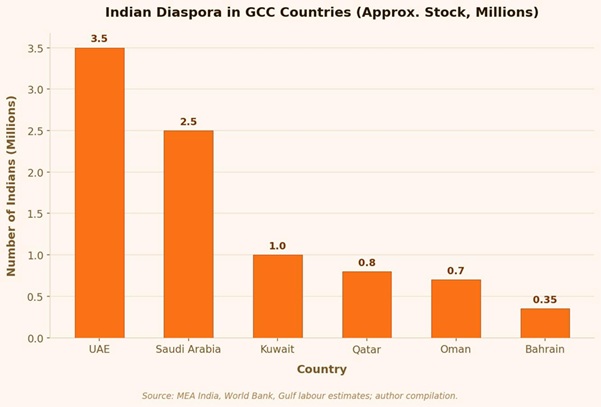
The scale of this “labour export” is enormous. As of early 2026, approximately 9.5 to 10 million Indians live and work across the GCC (Gulf Cooperation Council) countries. To put that in perspective, that is nearly the entire population of a country like the UAE, made up solely of Indian expats.

A Remittance Driven Economy

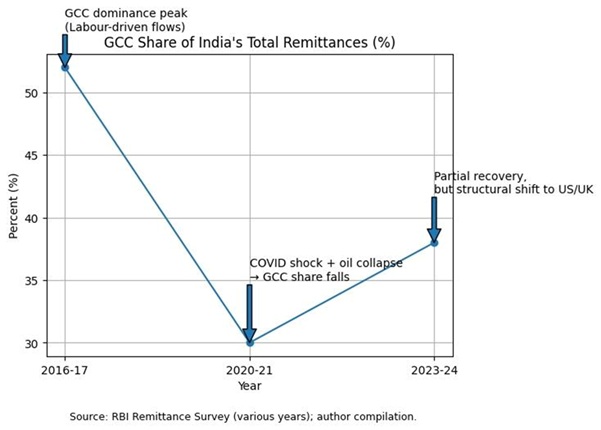
As per Government data sources, India remains the world’s top remittance recipient, with total inflows hitting a record $135.4 billion in the last fiscal year. And despite a rise in high-skilled migration to the US and UK, the GCC remains a juggernaut, contributing roughly 38% of India’s total remittances.

For states like Tamil Nadu, Kerala, and Maharashtra, which receive nearly 50% of these total inflows, it is a macroeconomic stabilizer that funds the current account deficit and keeps the Rupee from a freefall.

India’s Labour Market Paradox

But here is the real question, if people return to India due to the crisis in the Middle East, are there any “good quality” jobs waiting for them in India? The honest answer is no.

Youth unemployment remains elevated, particularly among graduates. Engineers in mechanical and construction fields face limited opportunities. Outside IT, and to some extent automobiles, there are not enough stable, high-paying jobs.

So people adjust. You will find postgraduates working in delivery jobs and informal sectors. I have personally spoken to Amazon delivery workers who told me they hold M.A degrees, or that they had worked in Dubai or Singapore before Covid and are now trying to leave again. This is becoming norm nowadays.

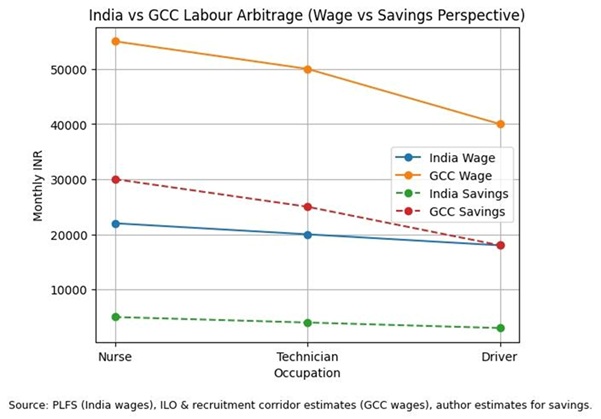
Indian National Wages and Savings Compared to Expat GCC Averages

In many towns in India, migration itself has become an economic model. People move to Singapore, Malaysia, or the Gulf, and the money they send back drives real estate, consumption, and local business activity. In many such regions, the labour market feels tight, not because jobs are available, but because the workforce has already left.

The wage gap explains everything. A nurse or lab technician in India may earn ₹15,000–₹20,000 per month. The same person can earn close to ₹80,000 in the Gulf. A private school teacher in Villupuram city in Tamil Nadu state earns around ₹8,000.

While nominal wages are  2–2.5x higher in GCC, the true driver of migration is savings arbitrage , which can be 5–6x higher.

This reflects structural differences in labour productivity and capital intensity.

India has a large pool of educated labour. But instead of becoming an advantage, it has turned into a wage suppressing force. There is always someone willing to work for less. As a result, wages remain low and bargaining power stays weak.

Percent of India’s Remittances From The GCC

At the same time, we are told growth is strong. Yes, the labour force participation is rising, but inequality is also increasing. A large share of employment remains informal and unstable. Inflation continues to erode purchasing power, and disposable incomes remain under pressure.

Right now, for many Indians, prosperous conditions are easier to find outside the country. Yes, the Gulf has risks. However, geopolitical tensions will come and go, and these are short-term disruptions.

Structurally, GCC economies will stabilize and grow again, and when they do, the flow of Indian labour will continue to pursue these opportunities. Because until India creates enough high-quality jobs at scale, migration will not slow down.

Copy and paste the text from AMT that you want to share

Iran What Losing Looks Like 20260323

Iran: What Losing Looks Like

However, the current hedge fund environment is based on much more than picking the right stocks or bonds and all that goes with it. The current hedge fund system is a group of funds, many of multiple hundreds of millions or even billions of dollars that don’t make investments per se as they try to beat their competitors by the microsecond in order to profit a very small amount on a a large but extremely short term investment (we will speak of the money of unfree countries below).

Iran: What Victory Looks Like Part 2 - The Military

Iran: What Victory Looks Like, Part 2 – The Military

Missiles, Drones, the Straits and Regime Change

Opinion: The following article is commentary and its views are solely those of the author. This article was first published the 17th of March via The Angry Demagogue.

In a recent X post, Edward Luttwak, the elder statesmen amongst strategists and one who we ignore at our own peril, stated that “The regime is impotent viz the U.S but all-powerful against its own people. So, regime change with bombs may fail but without bombs it might last for ever.” In other words, American and Israeli bombing is a necessary, but not sufficient condition for the overthrow of the Islamic Republic. Luttwak also made it clear that the Iranian people cannot overthrow the regime without native military support.

Not only will bombing not be sufficient to overthrow the regime, but American and Israeli commandos combined with Mossad and CIA operations will not be enough because for the Islamic Republic, internal, Iranian opponents of the regime are a bigger religious and ideological threat than Americans, Israelis or Sunni Arabs and they will always have enough Kalashnikovs and machine guns to kill 30,000 Iranians a night.

But regime change is not the only path to military victory. The mistaken views of the war when the opponents are “shocked”, Casablanca style, when they realize that wars are difficult and unpredictable and come with speed bumps, unexpected ups as well as downs and that not everything is in your control.

The first path to victory is one that is occurring now. That is the destruction of the military and command and control assets of the Islamic Republic. That focuses as we know, on the Revolutionary Guards (IRGC) and the “Basaj” – essentially the IRGC’s domestic militia who are responsible for keeping Iranian citizens in line and are, for the most part, ideological hardheads. With other types of dictatorships, the embarrassing way their military has handled Israeli and American attacks past and present would have been enough to topple them. However, with Shiite fanatics who know no borders (morally or geographically) and whose main enemies are domestic, that is not the case – and no one expected that to be the case.

The attacks must continue until either the regime changes or until their military-industrial infrastructure is destroyed. This means its drone and missile production, its naval forces, air-defenses and underground missile storage and nuclear facilities must be done away with. It does not mean the nearly impossible attempt to secure enriched uranium. Regime change can lead to cease fire and negotiations but without regime change the attacks must continue until the mission is completed.

The second path to victory is the opening and complete control of the Strait of Hormuz. While there still are ships that make it through, this is the one thing that the regime still holds over the United States and the world. The missiles they send to Israel and the gulf will be degraded enough if the bombings continue, but the Western world cannot allow a vicious, cruel dictatorship to control any waterway. Freedom of navigation is one of the key reasons why Taiwan is so important (which Japan knows well – making us wonder why it has not sent ships to help with the Straits) and a key reason this war must be fought. We wrote the other day about the price premium that the Islamic Republic holds over the world (and there was a Jerusalem Post article quoting Peter Navarro, head of the White House Office of Trade and Manufacturing state that the price premium is between $5-15 a barrel – we think that is understated). The Islamic Republic must be denied this ability to blackmail the world.

Of course, it seems that Western Europe is happier with the Iranian regime not losing, than with the American (or Israeli) government winning, but that is something to be dealt with later

The third thing that will bring a military victory is of course, regime change. First, the presence of a new leader on Iranian soil must be attained. This can either be the Shah’s son, Reza Pahlavi, who has been encouraging his countrymen to revolt and therefore needs to show real leadership by making his way home, or someone, possibly a senior military figure, who is in Iran now. Pahlavi is the natural choice, but he must take some risks and show he has the pull and prestige with at least part of the military in order to be able to accomplish the mission of overturning the regime.

In order for that to happen, circumstances must be created where a few divisions of the regular army can protect Pahlavi as he enters the country and he can lead the people to revolt. Once a few divisions defect and with American and Israeli air-power, they can liberate territory, further army divisions will probably join in – assuming they see a path to victory. A revolution need not happen overnight but can come with the army moving across the country and the defeat or defection of some in the IRGC. A few million in Swiss or Dubai bank accounts will also encourage defection.

Without a leader and an organized armed force, the regime just needs small weapons fire to put down any citizen revolt – and they will.

Military victory can come either with the destruction of the drone/missile capabilities and stockpiles along with the forced re-opening of the Strait of Hormuz or with regime change. If the former two, then the Iranian people will continue to suffer, but the Persian Gulf countries, Israel, the United States and the rest of the free world will not. If the latter, then everyone except China and Russia will be winners.

Let us not forget what everyone has been saying since day 1 – that only the Iranians can overthrow the government and that will only be done if the regular army decides to throw itself to the side of the people. The United States and Israel can only create the necessary (but not sufficient) conditions for this to happen. Without regime change, but with the opening and complete control of the Straits, the destruction of the regime’s naval, air defense, missile and drone forces and production, along with the elimination of senior Basaj and IRGC commanders, will still constitute a satisfactory military victory.

Disclaimer: the views expressed in this opinion article are solely those of the author, and not necessarily the opinions reflected by angrymetatraders.com or its associated parties.

You can follow Ira Slomowitz via The Angry Demagogue on Substack https://iraslomowitz.substack.com/

Copy and paste the text from AMT that you want to share

Iran Pt One 20260316

Iran: What Victory Looks Like, Part 1 – The Economy

However, the current hedge fund environment is based on much more than picking the right stocks or bonds and all that goes with it. The current hedge fund system is a group of funds, many of multiple hundreds of millions or even billions of dollars that don’t make investments per se as they try to beat their competitors by the microsecond in order to profit a very small amount on a a large but extremely short term investment (we will speak of the money of unfree countries below).

Slomowitz 20260307

End of Defeatism and a Return to Victory

The Iran War Brings a new Strategy Against Tyrants

Opinion: The following article is commentary and its views are solely those of the author. This article was first published the 8th of March via The Angry Demagogue.

We are witnessing not the end of some amorphous “rules-based international order”, but the end of defeatism and a return to victory.

The defeatist attitude amongst the talking heads regarding the Iran war stems from an inability to imagine victory. For the West, as a friend pointed out, victory has been absent from the vocabulary of war since the end of WWII. The “there is no military solution to the problem” crowd can’t imagine that force is sometimes not only necessary but is the only way to move forward. Giving up on diplomacy does not mean that force will attain the compromises that diplomacy looks for but rather attain the victory that diplomacy can never gain.

This is why the NY Times headline is “In War’s First Week, a Punishing Military Campaign with No Coherent Endgame” while the Wall Street Journal decided that the main story of the day is “Dread and paranoia spread across a 1,000-year-old city” – Teheran. The Financial Times quotes one of America’s foremost defeatists, Richard Haass – “America chose this war — and must now choose how to end it”. These are just small samples of the panic that encrusts the progressive mind when someone stands up to terrorists and tyrants with military force. For the defeatist, the “endgame” can never be victory and the deposing of an illegitimate, tyrannical and genocidal regime.

This is the hope of the tyrants worldwide and they have basically been correct in their assessment of western behavior. The so-called “rules-based international order” is not liberal in any sense of the word but a recipe for the spread of cruelty. This so-called “order” not only tolerated the disorder that tyrants and terrorists have brought for the past 70 years it has funded them, too. In South America, from Maoist terrorists in Peru to the Cuban and Venezuelan kleptocracies, they always knew there would be a chance to “negotiate”. Russia’s Putin was allowed to destroy Chechnya and occupy the Crimea, supported by European thirst for their oil and gas and American desires for a piece of the pie. In the middle east, Yassir Arafat’s Palestinian Authority and later Hamas were given billions of dollars by the United States and Western Europe in spite of their clear and present danger to the West by their spread of terror. Hezbollah and Iran run drugs throughout the world, engage in human trafficking and money laundering all to bring disorder and upset the national governments that support them by purchasing their oil and simply giving them planeloads of cash.

Off ramps are needed when victory is not possible but that is not the case regarding Iran. Imbecilic questions that the press likes to ask like “will you commit ground troops?” trying to trick the leaders of the free countries into showing their hand, are just part of the defeatist culture that has occupied the minds of the chattering classes since the French Revolution. That attitude was fine tuned in Vietnam when defeat was the preferred option and victory deemed immoral. The “end of diplomacy” in this and many other cases is not only the moral option it is the correct strategic option. The WSJ thinks there is no connection between an American victory in this and other theatres and the deterrence of China. The ignorant headline that the WSJ news section has today (one of many since the start of this war) “America’s Military Is Focused on Iran. Its Biggest Challenge Is China” cannot imagine that victory – absolute, total victory – is the greatest diplomatic weapon one can have when dealing with a country the size and strength of China.

A history professor once told me that the reason why diplomats hate war is because it means they have failed but the West has upped the ante on that failure by always insisting on a diplomatic (read: defeatist) end to whatever military action is or is about to take place. Diplomacy might be a necessary end to some conflicts but not to one that one is winning. Any description of the current war as a “quagmire” is bad faith reporting at best, traitorous propaganda at worst.

As we have stated here in the past, predicting President Trump is a fool’s game but it is also a fool’s game to assume this administration thinks in the same defeatist terms that has been the essence of the Western “rules-based international order” for the past half century and more. The same is true regarding Israel’s attitude towards this war. Israel too, has been caught up in the same defeatist attitude as it took the word “victory” out of the goals of the IDF. “Managing crises” is what brought us to October 7 as the IDF General Staff pre-October 7 were mediocrities who gained their positions for political reasons and because they “checked-off” two year stints in various jobs in the military.

Netanyahu was part of that defeatist attitude and that is why people still doubt his ability to see this through to the end. But he now has a military that is determined to win and we all hope he, under encouragement from the US administration, will follow suit. The headline that purposely plays to the anti-semitic woke and Tuckerist followers “Netanyahu Finally Got What He Wanted on Iran by Appealing to an Audience of One” misses the whole point – this is as much Trump’s pressure on Netanyahu as Netanyahu’s on Trump.

This is more than “whatever is good for Trump must be bad”. This is a failure of imagination by a large group of modern day “influencers” (yes, the so-called journalists reporting on the war are no better than Instagram and Tick Tock influencers) who can’t fathom what victory looks like and who believe that a military victory of any sort is one that is, by definition, immoral. The failure of diplomacy is not a failure of morality. Rather it is a realization that the moral way requires military force. The off ramp and the end-game is victory, plain and simple. The fact that some can’t imagine what that looks like does not mean it is not within reach.

The flip side of this of course is that the enemies of the west have an inability to admit defeat. This comes from the fact that the west seems to enjoy surrender in the name of diplomacy so these enemies can always count on the west playing the short game and demanding a return to negotiations. That is why these negotiations failed so miserably. The enemies of the west don’t seem to realize that things have changed and that the Starmer-Macron-Obama defeatist wing of the West is no longer making the decisions.

Contra all the defeatist headlines and analyses, the idea that the off ramp and endgame is now “victory” might actually deter the next tyrant and allow future negotiations to succeed.

Disclaimer: the views expressed in this opinion article are solely those of the author, and not necessarily the opinions reflected by angrymetatraders.com or its associated parties.

You can follow Ira Slomowitz via The Angry Demagogue on Substack https://iraslomowitz.substack.com/ 

Copy and paste the text from AMT that you want to share

Outflows 20250220a

India Insider: Macro Stress a Capital Flow Problem, Not a Trade One

India Insider: Macro Stress a Capital Flow Problem, Not a Trade One

Editor’s note: This article was originally written in January 2026. It has been updated to incorporate developments through February 2026, including the U.S – India interim trade agreement and subsequent capital flow data.

India is currently experiencing what can best be described as macro stress. By macro stress, we mean pressure across the broader economy that shows up simultaneously in the currency, financial markets, and capital flows, rather than a problem limited to one sector or company. In India’s case, this stress is visible in a weak rupee, persistent foreign investor outflows, and rising concerns about equity valuations.

This stress is often misinterpreted as a trade or export problem. In reality, the pressure on the Rupee and the growing fragility in equity markets stem primarily from the capital account, not from collapsing exports or remittances. Even as the U.S Dollar softens – helped by Federal Reserve rate cuts and renewed trade tensions under U.S President Donald Trump, India continues to struggle to attract foreign capital, exposing a deeper structural imbalance.

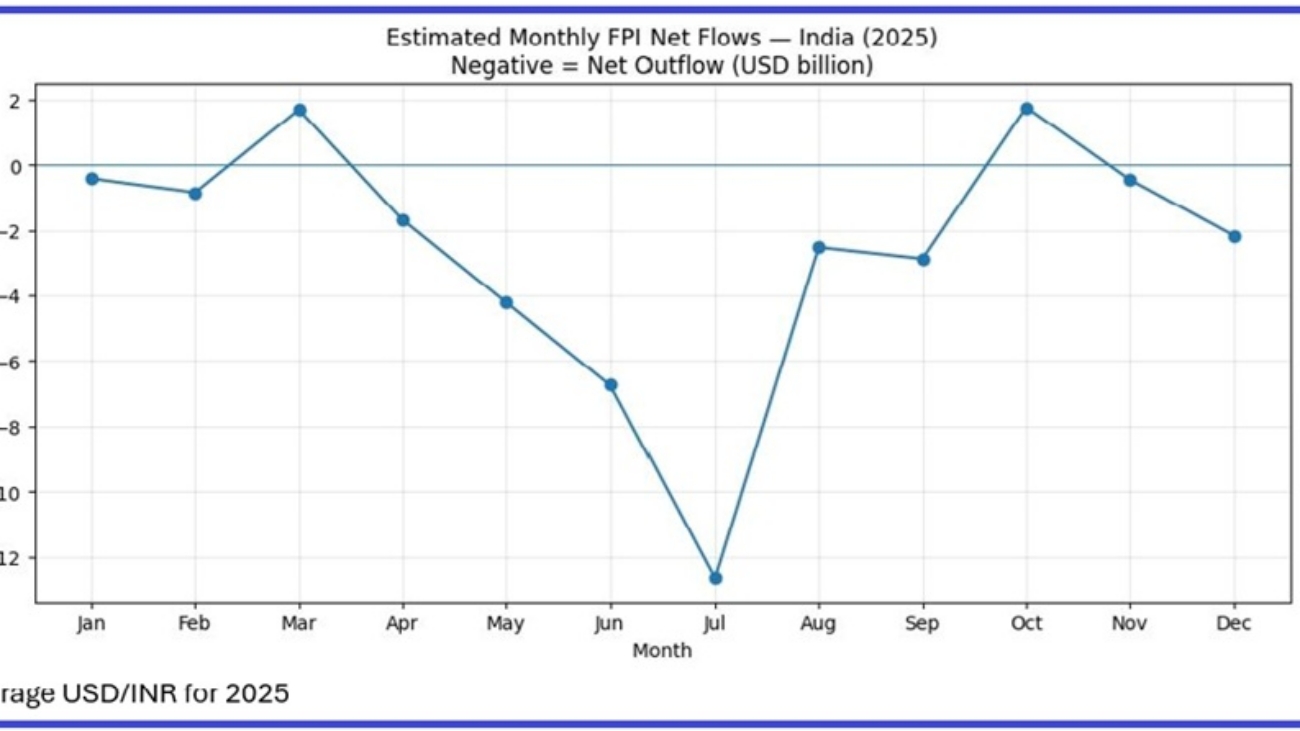
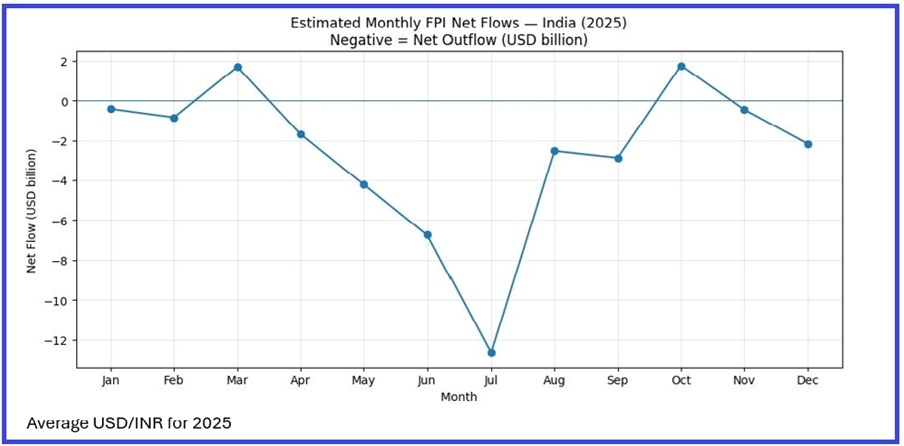
Source: NSDL (FPI Equity Flows): Reuters and author’s calculations.

Recent weakness in the USD would normally support emerging market currencies and risk assets. This time, however, the response across emerging markets has been uneven. Capital has flowed toward economies linked to artificial intelligence, semiconductors, and commodities, as well as toward markets where valuations have already adjusted. South Korea, Hong Kong, Chile, and South Africa have all benefited from this rotation. India has not.

The Rupee’s weakness reflects this divergence. USD/INR continues to trade around ₹91.5–91.6 despite the absence of a sharp deterioration in India’s trade fundamentals. Services exports, particularly IT services, remain resilient, and remittances continue to provide a steady source of foreign exchange. This brings us to the current account.

The current account represents a country’s net trade balance with the rest of the world, including goods, services, and remittances. India runs a current account deficit, meaning it imports more than it exports. While this deficit persists, it is manageable at present, supported by stable services exports and remittance inflows.

The real problem lies in the capital account, which tracks investment flows such as foreign investors buying or selling Indian equities and bonds. When foreign capital flows into the country, it helps finance the current account deficit. When it flows out, pressure builds quickly on the currency and financial markets.

Foreign capital is neither entering India in sufficient scale, nor remaining invested. Portfolio outflows have become persistent, and this has emerged as the dominant driver of currency pressure. In calendar year 2025, foreign portfolio investors sold approximately USD 19–20 billion worth of Indian equities, marking one of the largest annual equity outflow episodes in recent years. Importantly, this selling has been sustained rather than episodic, pointing to a structural reassessment of India’s growth outlook and valuation premium rather than a temporary risk off shock.

Crucially, this capital flight is not the result of a collapse in exports to the United States. Despite tariff concerns, the U.S remains India’s largest export destination. Between April and December 2025, Indian exports to the U.S rose to roughly $65–68 billion, compared with $60–63 billion during the same period last year. Trade flows, for now, are holding up better than sentiment suggests.

The effects of capital account stress are most visible in financial markets. Indian equities are failing to attract foreign inflows as growth momentum weakens. Market leadership has narrowed, with headline indices supported by a small group of large-cap stocks, while consumption-sensitive sectors such as FMCG remain under pressure.

This dynamic fits squarely within the balance of payments framework described by Professor Michael Pettis. He described, “a country cannot sustainably run a current account deficit without stable capital inflows. When capital inflows weaken, the adjustment shows up through a weaker currency, tighter financial conditions, and pressure on asset prices.”

Indian equities now trade at some of the highest valuation multiples globally, supported largely by domestic retail and mutual fund flows. However, domestic capital is structurally constrained, while global investors can freely reallocate. As Bloomberg’s Andy Mukherjee recently noted, Indian cement stocks now trade at higher valuations than Hong Kong Tech stocks showing the exuberance of Domestic equity capital chasing local themes.

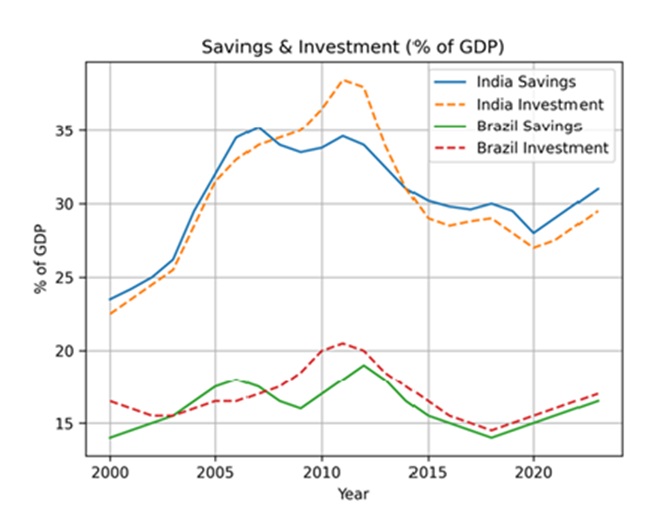
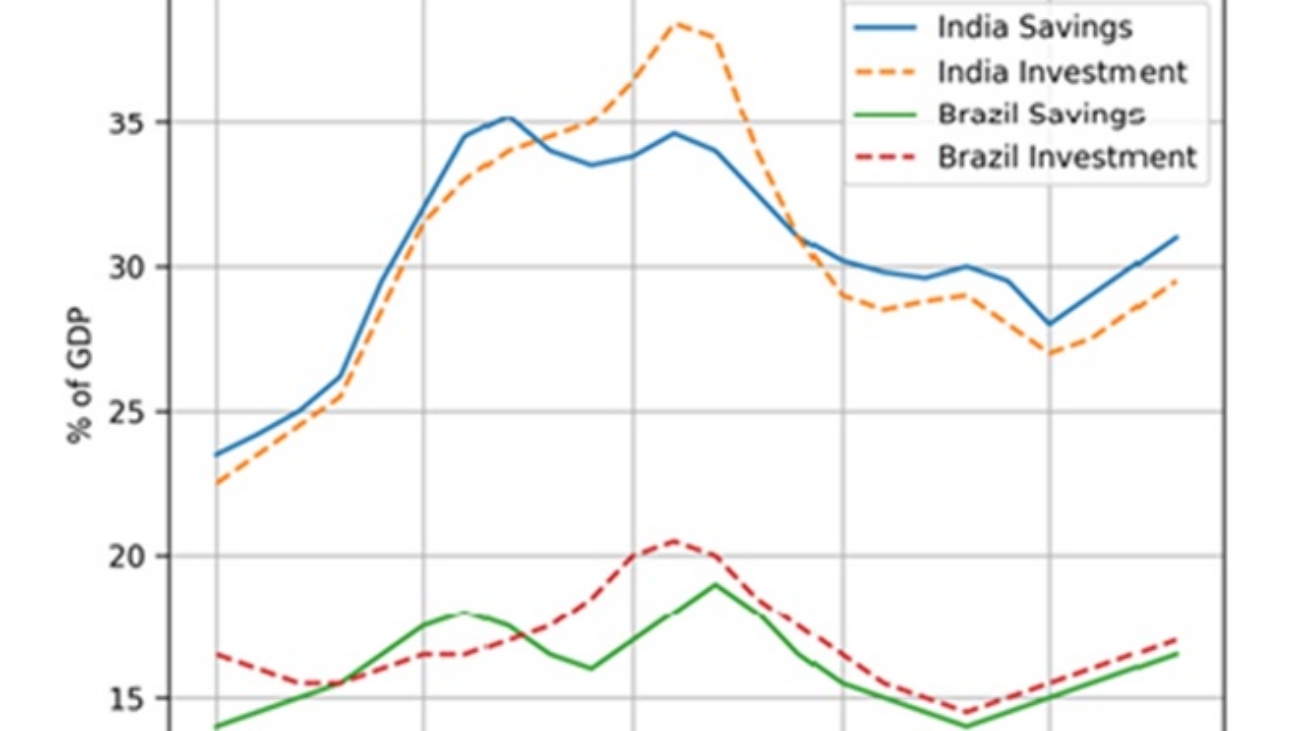
At a deeper level, India’s vulnerability reflects a structural imbalance between savings and investment. Domestic savings are insufficient relative to the economy’s long term investment needs, and the financial system lacks the institutional capacity to consistently channel savings into productivity enhancing investment. As a result, growth has become increasingly dependent on mobile foreign capital – capital that is cyclical, return sensitive, and easily reversible. It is this dependence, more than any near term trade shock, that leaves the Indian rupee vulnerable when global capital flows turn cautious.

Update: The US–India Interim Trade Agreement (February 2026)

Since this article was first written, a significant development has reshaped the near-term outlook. In early February 2026, the United States and India reached an interim trade agreement. As part of the deal, the US lowered its reciprocal tariff on Indian goods from 25% to 18%. President Trump also signed a separate executive order removing an additional punitive 25% tariff that had been imposed as a penalty for India’s purchases of Russian oil, meaning the effective tariff burden on Indian exports had, at its peak, approached 50% before being brought down to 18%.

The announcement acted as an immediate sentiment catalyst. The rupee, which had been trading in the ₹91.5–92 range under stress conditions, strengthened on the news, touching ₹90.30 before settling near ₹90.70. Foreign portfolio investors, who had spent most of 2025 as relentless net sellers, turned net buyers in the first week of February 2026, purchasing approximately $897 million worth of Indian equities.

These are meaningful moves. After 18 months of persistent underperformance relative to other emerging markets, India’s excessive valuation premium has moderated toward historical averages, which may create better entry points for global capital going forward.

Copy and paste the text from AMT that you want to share

Troll

Risk Analysis versus Trolls Demanding to Know the Impossible

Behavioral Sentiment Fatigue and Long-Term Opportunities

As I write Gold remains below $5,000.00. Silver is slightly above $75.00. The Nasdaq 100 and S&P 500 remain cautious. And my favorite exclusion choice – MicroStrategy is struggling below $129.00. The markets in general appear to be waiting for a dose of impetus, be it positive or negative. Some investors who are brave may believe assets have reached an accumulation phase as support levels get tested in equity markets. They hopefully also understand that the equity indices can go lower and they may suffer for a while as prices decline. And because of this notion, perhaps the larger investors remain ultra-cautious and are trying to time when they will re-enter the marketplace as a forceful buyer. In the meantime bonds will be bought as signals are awaited on for long-term positions in the major indices.

However, there is also a large contingent of traders who are not looking for long-term investment, instead they are hoping to take advantage of short-term price movement – positive and negative – depending on their philosophies. These folks may be part of hedge funds, or simply large players who believe they have the benefit of experience and know-how.

And then there are folks like me who watch the market and offer analysis on current conditions. I am of the opinion the broad markets are nervous and that behavioral sentiment remains troubled. While I know that experienced large players and financial institutions are accustomed to noise, there seems to be sense that an attitude of fatigue is being felt. People are tired of dealing with the constant amplitude of policy threats and risks. However, this insight regarding tired minds and markets may serve a purpose, it is possible long-term players will see current conditions as an opportunity to buy and hold.

If short-term players such as hedge funds and large speculators are too busy being nervous and assets are straddling prices in equities that are seen as potentially oversold by others, real value can be accumulated and waited upon to produce more growth. This is still a gamble, there are no guarantees. The markets go up and they go down. Cycles occur and new traders are often perplexed when their insights do not come to fruition. Patience is needed. And it is also good to have others in your ear who serve as contrarian advocates offering different opinions that you may not find agreement.

Perhaps you know someone who has an interest in the financial markets and is the same good friend. There is even a chance that you have worked with this person professionally, and have shared ideas on business management, organization and scaling trades and investing. And there is a chance that even though you like this person and find them completely engaging, that you disagree with everything they say.

Trust me when I say my friend (colleague) knows I am talking about them, and suffice it to say that I know he will completely disagree with my further comments, but also quietly embrace the words and believe he is serving his function as a voice of reason. He will not call himself a devil’s advocate, but as someone who serves to create focus. He is the person that says charge ahead, aim for an outcome and tell people what you think. He wants values to look for and timeframes to take action.

However, as a risk manager I frequently find myself being cautious, I try not to make outlandish predictions and try to remain conservative in my approach. I tend to think long-term, while he the trader frequently acts on short-term intuition with a focus on the future per his perspectives. But timing the market and exactly what is going to happen in the next five minutes, one hour, day and sometimes even a week remains a difficult and often an expensive game, I am constantly vigilant of this possible plight.

When I wrote that Silver appeared to be in a speculative mode and feared the highs, and told folks to be prepared for the metal returning to earth it was appreciated by my associate, but it also came with the question of when. When is Silver going to fall, he would ask. And I typically answered that patience was needed. And now that Silver has fallen he says, ‘you warned us that Silver would fall, but didn’t say when’, and he is correct. I cannot give an exact answer because I am not a master of the universe.

Day traders need to know that their CFD positions do not move the cash market. And even participants in the cash market are actually mostly wagering in the futures markets via exchanges and hoping for prices to move in their chosen direction only. Most people choosing to trade in the futures markets do not want to take deliverables of a commodity. Speculators in the futures markets may dream about taking Gold and Silver deliverables, but they know logically they cannot. The same goes for traders in futures with agricultural products and soft commodities.

To buy or not to buy is not the question. To participate or not to participate is the question. You do not have to trade every day, even if you are a short-term speculator. You can watch the markets. Sometimes the best trades you will ever make are the ones you do not pursue.

Copy and paste the text from AMT that you want to share

Confused Markets 20260217

Market Volatility: Structure, Geo-Politics and Culture

However, the current hedge fund environment is based on much more than picking the right stocks or bonds and all that goes with it. The current hedge fund system is a group of funds, many of multiple hundreds of millions or even billions of dollars that don’t make investments per se as they try to beat their competitors by the microsecond in order to profit a very small amount on a a large but extremely short term investment (we will speak of the money of unfree countries below).