USDJPY 20260505

Our Friend the Japanese Yen and Forex Opportunities

Bank of Japan's 'Do As We Say' A USD/JPY FX Advantage Technically

Forex traders who have been keen on trying to venture wagers on the USD/JPY certainly cannot be faulted. As of this writing the USD/JPY is near the 157.720 vicinity, this after falling to lows around the 155.750 mark and below momentarily last Thursday, Friday and briefly yesterday. 

The Bank of Japan let it be known in the middle of last week that speculators should not be buying the USD/JPY because they – the BoJ – could and would intervene with strong selling to kill off the momentum higher. The ‘do as we say’ approach from the BoJ is a contrarian trader’s dream, but one that needs as always a strong dose of risk analysis.

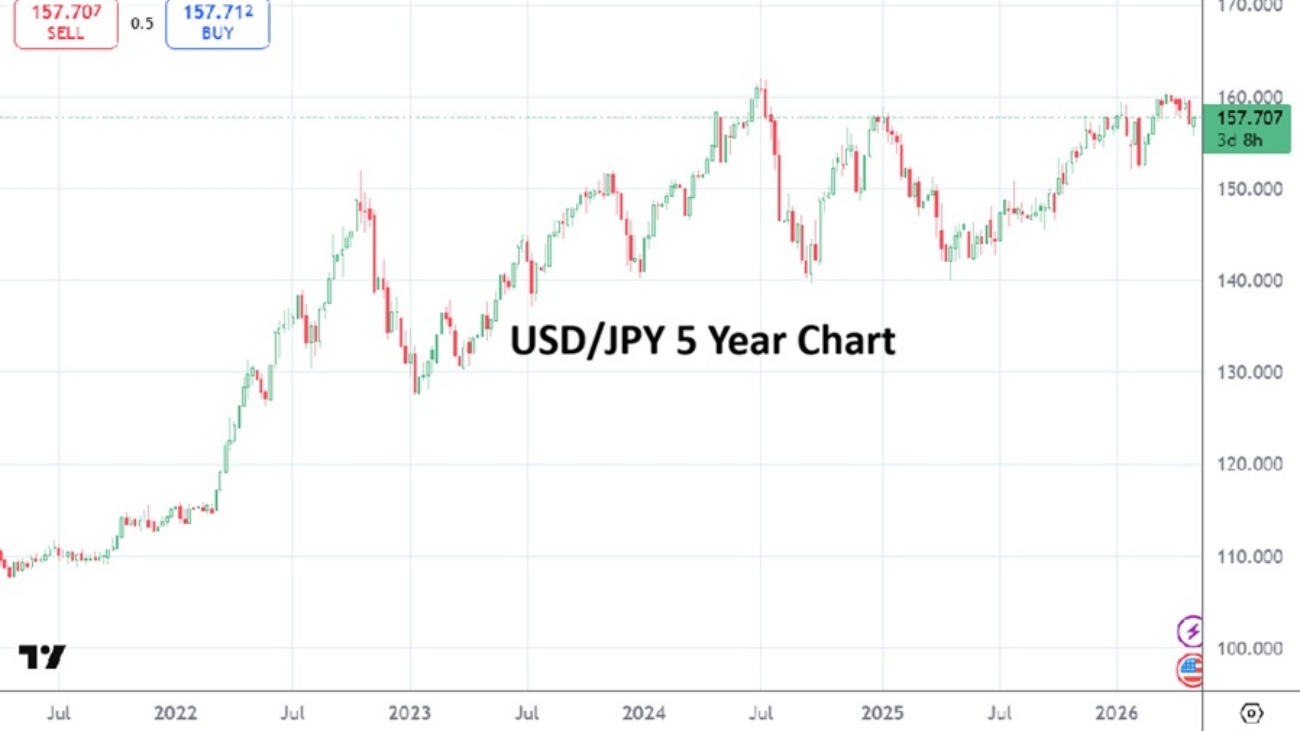
USD/JPY Five Year Chart on the 5th of May 2026

And this is where it gets properly intriguing for USD/JPY traders, because the Bank of Japan is literally setting the table for two different types of Forex trades when they threaten or actually intercede with interventions. One is a selling notion per the warnings, the second is a buying excursion for the emotionally stable after they think the intervention has run out of power.

A five year chart shows the immense pressure the Japanese Yen has been under as it has lost value against the USD. However, it is all about perspective depending on how a trader wants to chase momentum shifts. 

Technical traders can easily see that when higher vicinities are approached the USD/JPY is sometimes met with spikes downward. And then technically it is rather evident that support levels tend to spur on buying. The problem for buyers seeking support levels after Bank of Japan selling is to know when it is safe to become a buyer again.

If a trader has courage and wants to bet against the large players and financial institutions leaning into long positions of the USD/JPY, a selling position at higher marks is a solid choice. Yet, the other question then arises – where is resistance going to actually translate into a warning sounded by the BoJ in order to create the desired landslides lower in the USD/JPY?

Bank of Japan policy regarding interest rates has only been in question for over 3 decades now from outside observers who like to be critical. Yet, the conservative (and questionable) policies of the Japanese government via fiscal and monetary policy is a looking glass into practicalities for Forex traders. 

10-Year Japanese bond yields are now at twenty-nine year highs. The rate as of this writing is above the 2.50% level. The Bank of Japan Policy Rate remains low at 0.75%. While many analysts believe borrowing costs from the BoJ should be higher, what some might be missing is that the Japanese people are already being penalized via a weaker Japanese Yen. Higher borrowing costs and a weak Yen would likely not go over well with many Japanese citizens.

The Bank of Japan is in a difficult place regarding outlook as it tries to help keep exports strong, while also having to consider the higher costs of energy which is certain to hit Japanese industries over the mid-term. These considerations may cause some financial institutions to continue leaning into a buying outlook regarding the JPY, but near-term considerations must also be weighed as nervous sentiment cascades throughout the broad Forex market shifting abruptly. 

USD centric price action has been choppy, but overall the USD has also been weaker against many major currencies and even emerging market currencies. Yet, the USD/JPY remains within its higher realm. All of the Bank of Japan warnings to speculators telling them not to pursue buying the USD/JPY continues to make the BoJ sound weak and this doesn’t help sentiment surrounding the JPY. While the Bank of Japan can certainly intervene with massive amounts of buying the Japanese Yen – selling the USD/JPY – the central bank also is probably quite keen on making sure the JPY doesn’t get too strong. 

And this is where confusion must be put to the side, economics are wonderful when studied in a textbook, but the reality of trading the USD/JPY lives in the real world. Fiscal and monetary policies do not always work out the way governments intend.

The BoJ probably has a polite trading range they would like to see for the USD/JPY between 154.000 to 158.000 currently, but getting financial institutions to help achieve this realm remains difficult. The range between 156.000 to 159.000 likely remains a practical area for the BoJ as of now, one in which they believe their policies can work properly. 

Opportunities need to be viewed with a proper lens by day traders. Participating in the USD/JPY is a dangerous place because the currency pair has massive volume and the BoJ and U.S Federal Reserve often work together to gear valuations – even if they frequently disagree on techniques. Price velocity in the USD/JPY will continue to prove dynamic in the near-term and speculators need to practice patience and keep their risk taking tactics strict.
Copy and paste the text from AMT that you want to share

post297

Significant Highs All Around as Speculation Grows Frothy

Significant Highs All Around as Speculation Grows Frothy

Gold, platinum, and the major U.S indices are all flirting with record values. Fast trading is being seen on all fronts, dangerous reversals are also being displayed and causing harm for day traders. The U.S government shutdown remains in full force. Not enough pain has been heard from the U.S public yet which would make politicians pause and actually try to negotiate a deal.

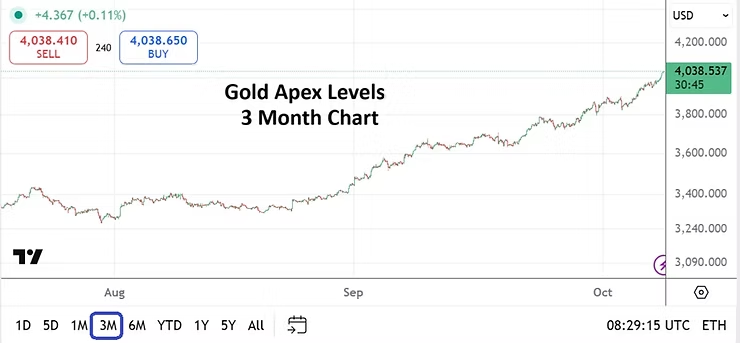
Milestone apex values have been experienced. Gold has produced the 4,000.00 USD per ounce level and sustained value, the Nasdaq 100 toppled 25,000.00 the past two days, but has moved lower for the moment. Conditions for day traders are swift and they need to be careful. And while the U.S government is shuttered, the Federal Reserve is still expected to announce their FOMC interest rate decision on the 29th of October. A Federal Funds Rate cut of 25 basis points is still anticipated.

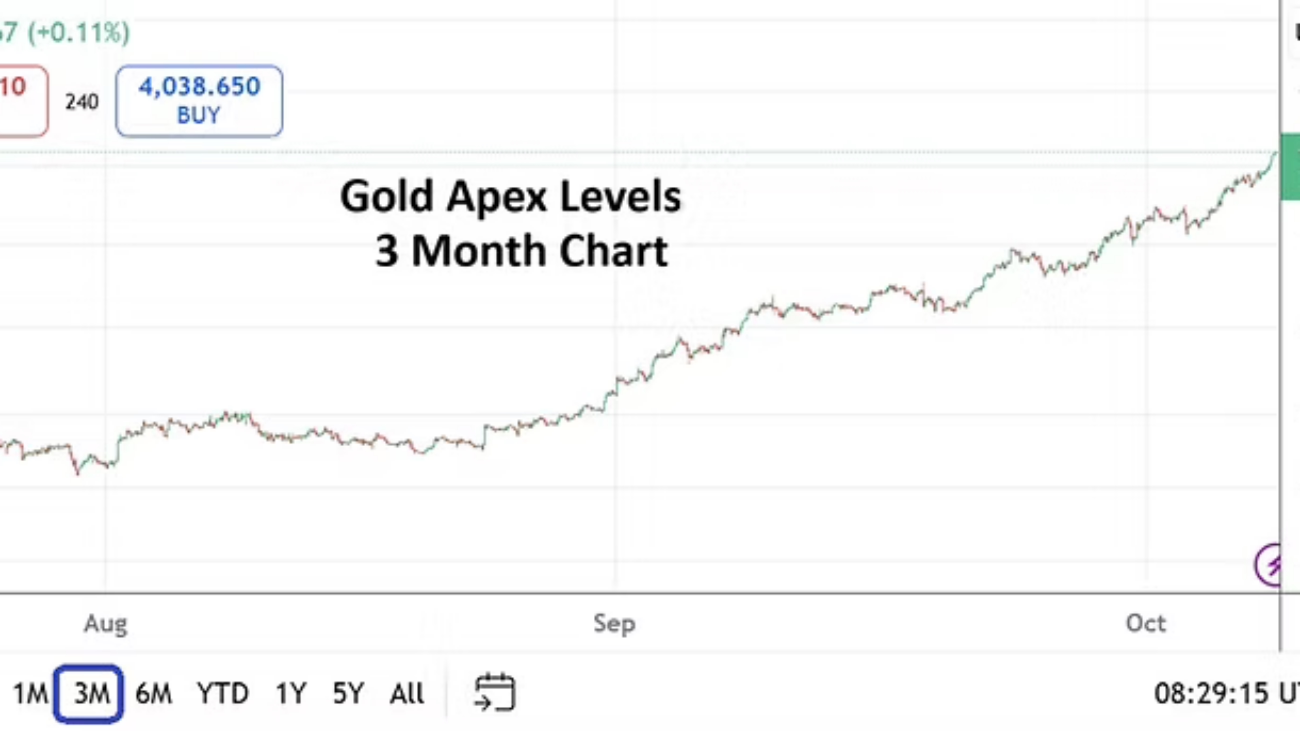
Gold Three Month Chart as of 8th October 2025

Forex has seen jittery results as the EUR, GBP, JPY have struggled in recent trading versus the USD. And while some people may point to the stellar results and values within Gold and Bitcoin as evidence for safe haven wagers being placed, large speculators are playing a key ingredient in the broad markets too. Investors are certainly looking for value and have a belief that buying now represents a discount compared to what Gold and equity values will be over the long-term. However, day traders should also remember that a large amount of influence in the markets derives via behavioral sentiment, and as record highs are being challenged anxiousness grows regarding potential responses from speculative forces particularly when profit taking remains a part of wagering.

Nvidia Three Month Chart as of 8th October 2025

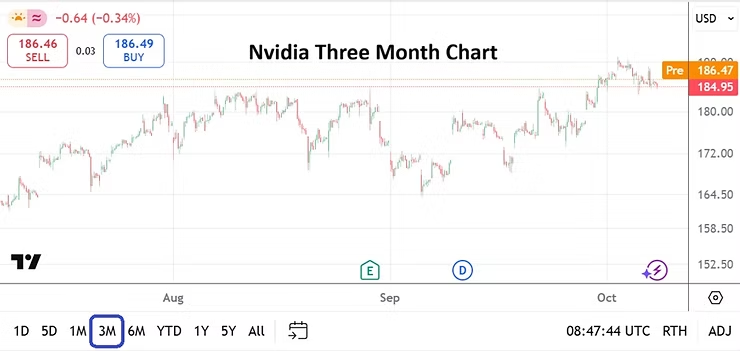
While questions and concerns are heard about a possible AI bubble being experienced and too much money being invested in equities like Nvidia, Oracle, Microsoft, etc., folks need to understand long-term investors are gearing their portfolios towards outlooks. Betting on these companies playing a significant role in technological advancements is a long-term viewpoint which works on optimism. Artificial intelligence is important, but the motor that runs AI infrastructure via semiconductors, big data distribution, servers and cybersecurity are crucial. The promise of quantum computing is also experiencing a surge of investment because of a belief in the future.

USD/JPY Three Month Chart as of 8th October 2025

And that is what day traders who are tempted to bet against the trends in the marketplace need to remember. Investors will not bet against Wall Street because of the government shutdown. In fact, they will certainly be heard joking that corporations run more effectively with less government intrusion.

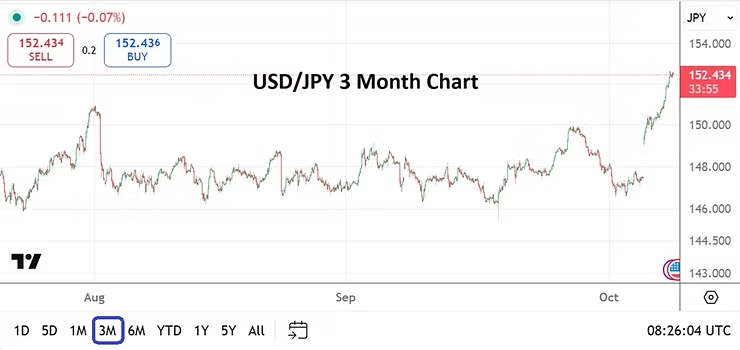
This is not a simple puzzle. Complexity certainly needs to be considered regarding valuations in the EUR/USD, GBP/USD and USD/JPY. Intriguingly, day traders may want to take a look at the South African Rand too, because technically it continues to be strong against the USD, which is rather out of step and a rather interesting non-correlation. The broad Forex market has lost some its luster for day traders the past year because of a lack of perceived volatility across the board. But volatility may be on the way, the Japanese Yen certainly stands out and should be watched via the USD/JPY and JPY crosses in the coming days and weeks.

post278

Behavioral Sentiment: False Narratives and Noisy Realities

Behavioral Sentiment: False Narratives and Noisy Realities

The past handful of months in Forex have provided day traders problems if they have been trying to pursue steady trends. Constant flashes of rhetoric and news pervading tariff implications, U.S Federal Reserve interpretations from various media and analytical corners, and mixed economic data has caused a rather mired reality for speculators trying to operate.

S&P 500 One Year Chart via Futures CFD Trading on the 9th of September 2025

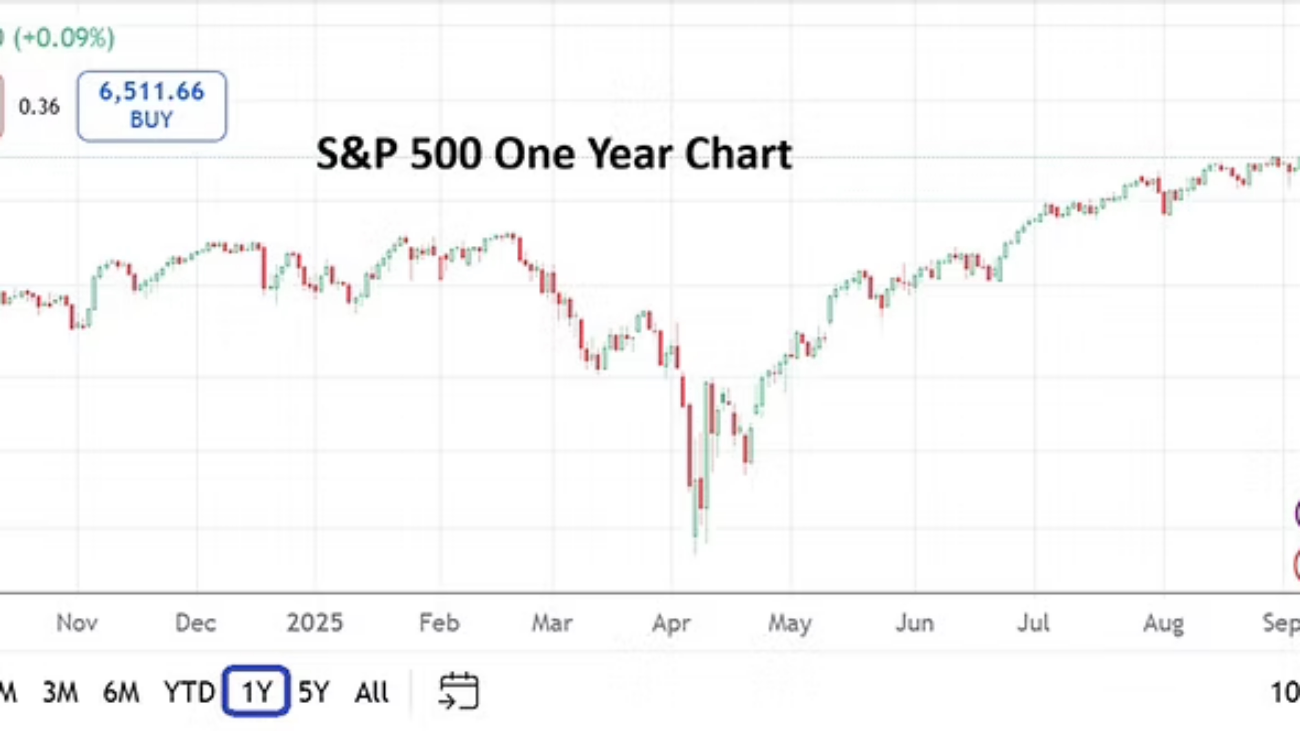
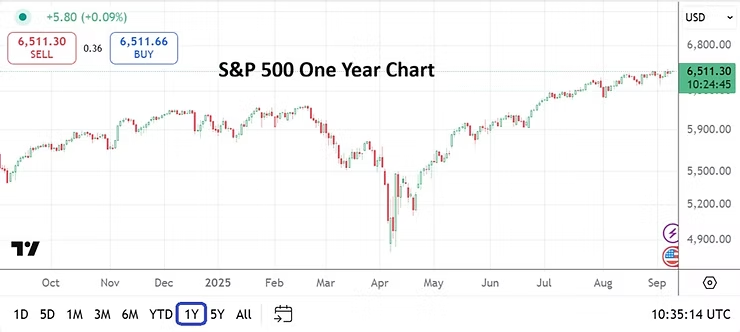
However, if the noise is turned down by day traders and sometimes given less importance regarding potential influences, signals become visible and some perceptions can be looked upon as roadmaps. While many want to to throw their hands up and proclaim some sort of developing economic meltdown and a coming apocalypse, the major U.S indices are actually performing quite well as a barometer. The S&P 500 is continuing to challenge all-time values. Yes, the Nasdaq 100 and Dow Jones 30 are not marching in lockstep with the S&P 500 to new highs, but they are not far behind. The stock market has never guaranteed people an ability to constantly move upwards, but it does offer the potential to judge outlook and mid-term sentiment.

The USD has been extremely choppy since the start of this year, this as the Trump administration has taken over, but its trend towards weakness has been rather clear. The EUR/USD and GBP/USD have done reasonably well regarding mid-term strength. Yes, the USD/JPY has produced whipsaw movements and the Japanese Yen remains awkward, but this is a direct reflection of mitigating Japanese government policy (some may call it incompetence) regarding its ability to manage fiscal concerns, interest rates, and fight deflation and now inflation (which has been going on for a few decades).

Gold is traversing record heights and is showing signs of sustaining values above 3,600.00 as of yesterday. After languishing (albeit within elevated realms) near 3,350.00 the past handful of months with prevalent volatility, the precious metal has bolted out of its consolidation. And the likely reason for this is the anticipated Federal Reserve policy changes regarding interest rates. 10 Year U.S Treasury yields have also been pushed lower recently – this as financial institutions await a definite cut in interest rates by the Fed on the 17th of September. But folks who believe a 50 point basis reduction is coming late next week are likely wrong.

The Federal Reserve under Chairman Jerome Powell has been quite conservative, this will probably not change next Wednesday. It is more likely a cut of 25 basis points will take place on the 17th, and the FOMC Statement will offer the potential of another interest rate cut in October. Tomorrow’s PPI numbers and Thursday’s CPI results will influence the Fed’s coming meeting and mid-term outlook.

What we are left with is a broad market that is having a lot of noise applied to it by people with a variety of biases. Political bantering has reached a threshold in which it might be best to simply not pay attention to anything – but that is dangerous too. Yes, some people do talk sense, and some people do show signs of actually trying to engage in adult decision making regarding their insights, but it often feels like wanting to sound correct is more important than outcomes. Technical traders may be enjoying a quiet laugh at the expense of fundamental players right now.

However, economic data remains important. While rhetoric from the U.S White House and its opponents remains within a state of hyperbole, day traders should try to turn down the noise and pay attention to signals that long term investors continue to produce and take advantage of their sentiment. Stocks continue to be pursued and indices have done well, but volatility should be expected particularly into next week.