
postR192

Telling Someone to Not Trade Works Like Reverse Psychology

Telling Someone to Not Trade Works Like Reverse Psychology

From the strange but true file, comes the realization after working within risk analysis for a long time that telling a speculator to avoid a particular market because I believe it is going to be volatile often has the opposite effect. Perhaps the best thing to do is to remain silent and allow inexperienced day traders to lose their money, convincing them to walk away from speculative endeavors forever. But I prefer to constantly teach and warn, while providing help for those who have made the firm decision they want to pursue the financial markets.

It is rather well documented that 90% of retail traders lose their money. And as pointed out within AMT since our inception most brokerage institutions are counting on you to lose money. This because many platforms are letting you trade via CFD assets and virtual Forex wagering, meaning the brokers take the risks that you may actually make money and are willing to pay out your winning bet, because they know most of the time you are going to lose. If not today then tomorrow, because casinos always believe the gamblers will lose.

People ask why I refer to wagers and bets when I write about Forex, commodities and equity CFDs. The answer is because I feel the need to remind speculators constantly they are entering a domain that is akin to gambling. I have come to learn that I cannot stop inexperienced day traders from making costly mistakes by telling them not to trade. New retail speculators can be helped by providing them risk management via basic knowledge and expanding upon the theme. Angry Meta Traders intends to always make risk management and analysis of the markets its core foundation.

Yes, we also provide our insights about potential directions in particular assets constantly, and try to contribute our thoughts on the thinking of the large players within the marketplace. We would like AMT to become a membership pass into the temple for retail traders and the occasional institutional participant that reads our material. Temples are usually the domain for philosophies which have been gained through years of experience and contemplation about the human condition.

While it may sound absurd to discuss temples, experienced traders unless they have been merely lucky their entire careers, know the psychology of financial institutions is always important. Understanding the behavioral sentiment of large players and the quantitative engineering they use to make decisions is crucial. The keys to the inner workings of the financial temples is a metaphor, hopefully allowing day traders to feel like they have been given the ability to look inside and understand the decision making process of large institutions that can move the markets.

Angry Meta Traders is not always right, our analysis and predicted movements about assets are sometimes wrong. Yet, by stressing risk management via limited leverage, stop losses when appropriate (they almost always are), and telling traders to not be overly ambitious, we hope AMT delivers constant reinforcement and needed learning.

The noise of the market can be quite intense, false narratives, and misguided analysis are dangers all traders face, even the most experienced large players and financial institutions understand they will not always be correct. And this takes us back to the notion that trading for inexperienced people is not easy. But I know telling you not to trade works in the wrong way. So what I tell you now is to be patient, learn, gather wisdom as you trade and hopefully you will attain some of the tools needed to make your speculative life easier. Knowing that 90% of traders lose money, we hope that via our efforts to inform that we can put you within the small percentage of people who actually profit.
postN77.1

Forex: Behind the Curtain as Speculative Deja Vu Strikes

Forex: Behind the Curtain as Speculative Deja Vu Strikes

Friday jobs reports came in stronger than anticipated on the surface, and this led to a roller coaster like ride for Forex traders as results were acted upon by financial institutions. However, a look behind the data shows ‘positive’ results were spurred on by part-time hiring and government influences leading to a notion that jobs numbers were not exactly a ray of sunshine regarding U.S economic health. The suspicious results cause a desire to look for ulterior motives, and to wonder if election year politics are playing a role in the U.S employment picture.

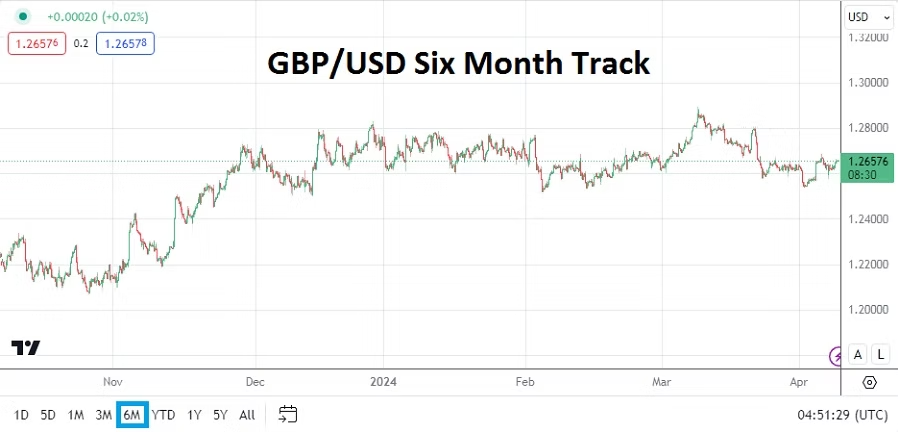
GBP/USD Six Month Chart as of 9th April 2024

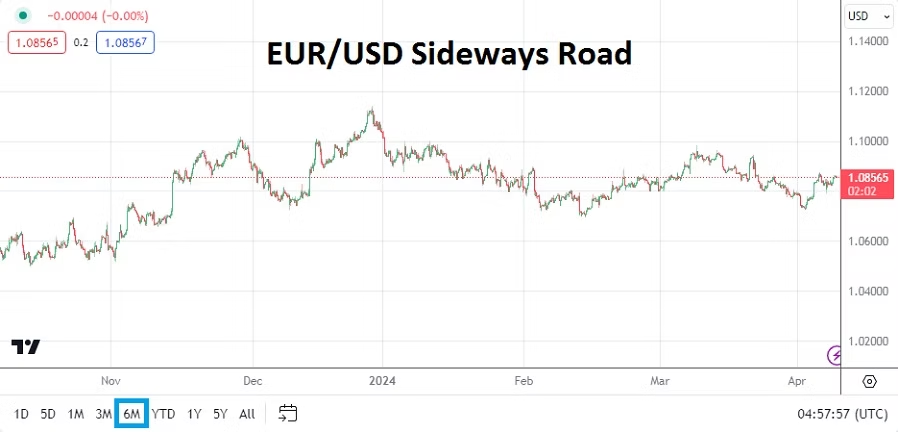
The GBP/USD and EUR/USD are rather insightful for technical and fundamental traders. The currency pairs are languishing as of today’s values near pricing that was seen in the second week of December. Since the ‘announcement’ from the U.S Federal Reserve on the 13th of December that a change in monetary policy would begin to occur in 2024, in actuality nothing has really happened, except government ‘speak’ trying to sound as if everything is understood and in control, while it is clearly not.

Economic data from the U.S and Europe has continued to be soiled by mixed results, and retail speculators looking for a trend to emerge have had to deal with choppy conditions. Financial institutions remain unclear about interest rate outlooks. The Fed while trying to ‘sound’ dovish rhetoric remains locked within a Google engine keyword mantra as they mutter the phrase ‘over time’ when trying to convince people that interest rates will ‘eventually’ be cut.

Last week leading up to the Non-Farm Employment Change numbers, many FOMC members were offering cautious tones about the Federal Funds Rate and warning it should not be changed yet. The implication of the Fed’s verbiage could lead some to suspect they have all practiced statements handed to them by their overlords who are concerned this is an election year and jobs are in jeopardy.

EUR/USD Six Month Chart as of 9th April 2024

Which leads us back to Forex and all financial assets, as investors try to swim waters which have left fundamental perspectives grasping at data which is not easy to decipher. U.S government policy is practicing fiscal spending that is causing massive debts, and perhaps influencing hiring data which may be more akin to putting lipstick on a pig. Many U.S voters seemingly lean towards electing officials who promise to hand out the biggest ‘social rewards’, while ignoring there will be a price to be paid down the road.

The Federal Reserve in the meantime tries to sound optimistic about inflation eroding, but concerns due to U.S government debt being accrued, and global geopolitical affairs combined with energy policy which is making it more expensive to maintain cheap transportation, efficient agriculture and manufacturing, shadow the Fed’s hopes. WTI Crude Oil remains over 86.00 USD per barrel. Gold is trading at record high values and above 2300.00 USD. Does anyone see the dangerous connections? Equity indices should be watched as a barometer this week.

USD/JPY Six Month Chart as of 9th April 2024

Monday, 8th of April, Japan Average Cash Earnings and Economic Watchers Sentiment – yesterday’s reports matched expectations regarding wages, but workers surveyed noted their concerns about incremental inflation which is being seen in Japan. The USD/JPY is challenging November higher values and the Bank of Japan has been widely criticized for not raising interest rates more aggressively. However, it is possible the BoJ wants the Japanese Yen to remain within its weaker price range to spark a stronger Japanese economy via exports.

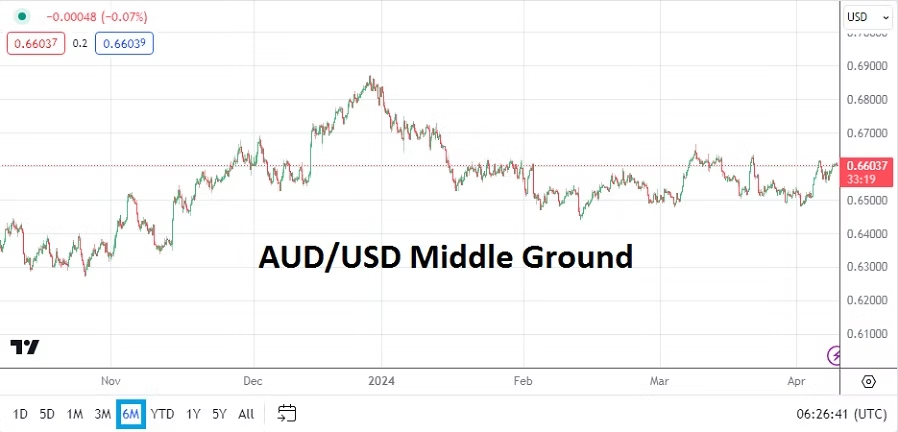
AUD/USD Six Month Chart as of 9th April 2024

Tuesday, 9th of April, Australia Westpac Consumer Sentiment – the results via the consumer reading came in negative. The AUD/USD like the GBP/USD and EUR/USD is traversing values tested in the second week of December 2023, leading to the feeling of deja vu.

Wednesday, 10th of April, U.S Consumer Price Index – you have heard this before, the inflation reports from the States are going to rattle the financial markets including Forex. The USD is certain to react. Data from the U.S has produced surprises aplenty in the past few months. The Consumer Price Index is important and day traders certainly need to pay attention.

Thursday, 11th of April, European Central Bank – the ECB is not expected to change its Main Refinancing Rate, but many analysts believe they should cut borrowing costs. However, the ECB will likely remain within the camp of choosing to ‘wait and see’. The ECB Press Conference with Christine Legarde has widely become regarded as an opportunity for political speech as much as an economic dialogue. Recent data from the European Union suggests the worst of the recessionary cycle is gone, but German Trade Balance numbers released on Monday were negative, highlighting hurdles remain. Inflation is a worry, and a cut to the interest rate might be able to help spur on economic activity while counting on lagging data to prove proactive policy should be implemented. But this likely is not going to happen and the EUR/USD will remain problematic.

Thursday, 11th of April, U.S Producer Price Index – these slew of reports should be watched carefully. If the data is stronger than expected it is likely a part of the residue caused by higher energy costs that have affected logistics and created more expensive raw materials which are needed to produce goods. It was the higher PPI reports last month that caused dramatic tidal shifts in Forex, speculators should brace for the potential of additional mayhem.

Friday, 12th of April, U.K Gross Domestic Product – last month’s GDP numbers from Great Britain came in slightly higher than expected with a 0.2% gain, this report is anticipating growth of only 0.1%. Traders should take a deeper look at the statistics upon publication and check for revisions to past months. The U.K economy has been struggling, the ‘growth’ results will affect the GBP/USD before going into the weekend.