India Vote 20260507

India Insider: How a Film Star is Reshaping Politics in Tamil Nadu

Vijay: A Stunning Victory by an Actor Turned Politician in India

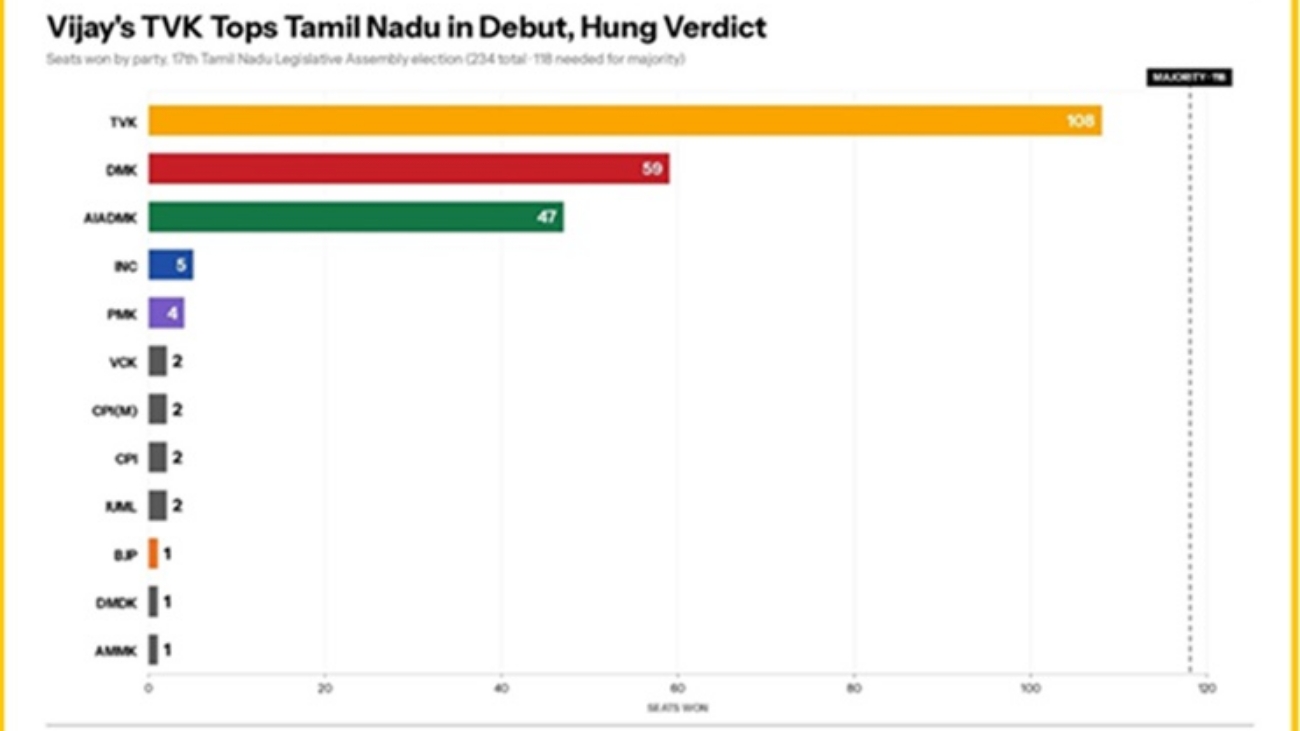
When the Tamil Nadu state election results were announced this Monday, many people were stunned that a party with barely two years of political existence had managed to unseat parties that had dominated the state for more than 75 and 50 years respectively.

TVK (Tamizhaga Vetri Kazhagam), founded by actor turned politician Vijay, used his charismatic presence in Tamil cinema along with the power of social media to attract Gen Z voters and women.

This came despite the incumbent DMK (Dravida Munnetra Kazhagam) government under Chief Minister M.K. Stalin being widely credited for stable governance and helping Tamil Nadu remain one of India’s fastest growing state economies, with a GSDP( Gross State Domestic Product) growth rate of 11.9%.

Voting Results in Tamil Nadu and TVK Topping the Results

The two major Dravidian parties – DMK and AIADMK (All India Anna Dravida Munnetra Kalagam) were originally built on the foundations of social justice, welfare, and development. For decades, they shaped Tamil Nadu’s political identity and succeeded in winning the trust of the people.

However, despite the DMK government’s governance record, allegations of corruption, nepotism, and cash for votes politics continued to surround both DMK and ADMK. These criticisms have become deeply embedded in public perception over the years.

Today’s Gen Z voters appear to want change. Many were looking for a fresh political face capable of reshaping Tamil Nadu’s political landscape.

Vijay’s party reportedly secured around 1.67 crore votes, or approximately 34.3% of the total vote share, one of the strongest performances ever recorded by a newly formed political party contesting its first major election.

India’s political landscape has also been evolving rapidly in recent years. Prime Minister Narendra Modi and the BJP have successfully consolidated much of North India politically and are now working aggressively to expand their influence in southern states such as Telangana, Karnataka, and Tamil Nadu.

For Modi, strong regional opposition leaders such as M.K. Stalin in Tamil Nadu and Mamata Banerjee in West Bengal have remained major political challenges. Any significant political shifts in states like Tamil Nadu and West Bengal could reshape India’s national political dynamics in the years ahead.

While corruption, nepotism, and vote buying are important issues to consider, it is also necessary to distinguish between political allegations and governance outcomes.

In many ways, the DMK government performed better during the last five years than several previous ADMK and DMK administrations. Social indicators are impressive while Tamil Nadu State has attracted billions of USD investment for iPhone and automobile manufacturing.

During the election results, I was driving through Tiruvannamalai in northern Tamil Nadu and noticed that the streets were unusually silent. There were hardly any people celebrating openly.

If another traditional Dravidian party had won, the roads would likely have been filled with supporters distributing sweets and celebrating publicly.

For the first time, it felt as though a major electoral victory had been shaped more by social media influence and public perception than by traditional ground level welfare based political desires.

On my way back home on Monday, I saw an elderly man sitting at a bus stop equipped with fans that helped ease the intense summer heat.

That moment made me wonder: in the next five years, will political change alone truly improve the lives of ordinary people?

Or will charisma and digital influence matter more than governance, infrastructure, and social-welfare in the long run?

Copy and paste the text from AMT that you want to share

postN76.1

India Insider: Strategic Memory and Why Unilateral Power is Resisted

India Insider: Strategic Memory and Why Unilateral Power is Resisted

After Independence, India was often described as “tilting” toward the Soviet Union. In reality, this was the outcome of India’s pursuit of Non-Alignment at a time when the United States was actively backing perceived rogue actors in South Asia, most notably Pakistan. What appeared as ideological preference was, in fact, strategic necessity born of hard experience.

The Soviet Union supported India on core security concerns when few others would. The first major Soviet defense deal was not merely a weapons sale. It included licensed production in India through Hindustan Aeronautics Limited, full technology transfer, and made India the first non-Communist country to receive the MiG-21. This distinction mattered. India was treated as a sovereign partner capable of absorbing technology, not as a dependent client expected to align unquestioningly.

By contrast, Washington’s alignment with Pakistan was driven by Cold War geopolitics rather than South Asian stability. Despite repeated military coups, wars with India, and regional destabilization, the United States armed Pakistan, provided diplomatic cover during conflicts, and sustained the relationship through military rule and nuclear proliferation. These experiences deeply shaped India’s strategic culture and explain its enduring emphasis on autonomy, redundancy, and diversified partnerships rather than alliance dependency.

This history is one of the central reasons India resists Washington dictating regional dynamics. South Asia, in New Delhi’s view, is not a chessboard for external powers to reorder at will.

Democratic Republic of the Congo Example

The same pattern is visible beyond Asia. Take the Democratic Republic of Congo. After decades of horrific colonial exploitation, the Belgians realized by the mid-20th century that they could not hold on indefinitely and exited abruptly, having never prepared the country for self-rule. What they left behind was not independence, but a political vacuum. The United States and the United Nations intervened, but their actions were shaped less by concern for Congolese society than by geopolitical rivalry, ideological competition, and racial hierarchy.

The assassination of Patrice Lumumba destroyed the Republic of the Congo’s (as it was known then) only credible attempt at building a unified nationalist state at independence. The dictatorship of Mobutu Sese Seko that followed did not merely fail to develop institutions; it actively hollowed them out. Corruption became a governing principle, loyalty replaced competence, and the state turned into a vehicle for extraction. Today’s instability in the Democratic Republic of the Congo is not a governance failure in isolation—it is the predictable outcome of a political system designed to rule without building state capacity. For countries like India, this is not ancient history, it is a warning.

Washington’s unilateralism reinforces this mistrust:

The recent military operation to remove Venezuelan President Nicolás Maduro without U.S Congress authorization, international legal justification, or an imminent threat would have been unthinkable as recently as the first Trump administration. It became possible in 2026 only because of congressional capitulation, judicial immunity, and the transformation of an apolitical defense establishment into a politicized instrument of executive power. To much of the world, this signals that restraint is no longer embedded in American decision making.

Europe exposes another contradiction. The post war order was built on liberal democracy and collective security through NATO. When that order is weakened by unilateral action, trust erodes, even among allies expected to align automatically.

Even before Trump, the U.S – India relationship remained cordial rather than fully strategic. Before 9/11, India was the most natural regional ally against Al-Qaeda, yet Washington lacked patience and local understanding to navigate India’s complex democracy and nationalism. That failure was not tactical, it was conceptual.

India’s neutrality today is deliberate:

It prioritizes diplomacy over military actions that violate international law. India sees a multipolar world emerging, not as disorder, but as the end of unchecked unilateral supremacy. This is not ambiguity. It is a strategic memory.

postR182

Risk Analysis Review: Warning about Coronavirus in Feb. 2020

Risk Analysis Review: Warning about Coronavirus in Feb. 2020

Below is a risk analysis note written in February of 2020 regarding the risks and potential implications of coronavirus as seen by Robert Petrucci on financial markets. The letter was sent to a senior associate who was a Chief Investment Officer for a firm. After speaking to the senior associate on the phone, feeling as if his thoughts were dismissed without heed and told he was too concerned about coronavirus, Mr. Petrucci sent the following to the CIO:

Thanks for asking about my thoughts.

What worries me is the opportunity for the virus to be a catalyst. The reactions in the E.U by government talking heads reminds me a lot of the financial crisis in 2007 when people publicly disregarded the potential domino effect which was becoming apparent. 

The Coronavirus imo is a potential domino which could take down the remainder of a fragile architecture. Meaning the ill-conceived philosophy and work of central banks in Asia and Europe have left them with little regarding ammunition should they need to fire an economic gun. If Europe and Asia buckle the US will be left limping too.

Psychologically the markets appear vulnerable, but as you rightly point out the higher realms of the Indices have been waiting for a bit of a sell off for a long time and the selling underway may be more of a reaction and mere trigger which has been long overdue. 

However, I wonder about the ‘clever’ algorithms which have been developed and trade also due to human bias. What concerns me more than what is taking place in China is what is happening in Italy right now. 

Italian governments have a long political history of ineptitude and disregard of reality regarding numbers which are staring them in the face, particularly with budgets and a long tradition of corruption and its destructive force on transparency. If Italy continues to spike higher infection numbers and continue to escalate then I believe the E.U is in for trouble. The inaction of Italy and its reliance on the tourism business will make it hard for them to accept shutting down major airports and cities which enjoy the fruits of international visitors year round. 

Also, I must add and circling back to China that it is not known yet if another outbreak may suddenly appear in another zone if someone dealing with this asymmetrical virus is unaware of their affliction. 

Which brings me back to the springboard, worst case scenario I fear is a major outbreak in the E.U including Germany. If we see signs of spikes statistically across Europe the next two weeks it will be devastating economically for the next quarter financially. 

As you say, things will certainly bounce back, they always do, we must look at the long term. Investors need to keep a stiff upper lip and protect themselves as you have done in many regards with Indices, US ten year bonds and some gold. 

The question for me now is what happens the next ten business days across the U.S and Europe and how the world handles this virus. Worst case is pandemic and bad Central Bank formula, which have been in place the past twelve years with cheap money. The desire to keep everything steady may in fact lead to miscalculations which have not been planned for and cause reactions in the markets which cannot be checked this time around. I do not believe we are at a Black Swan point yet, but it does worry me that the E.U politicians and even some U.S politicians seem to have their head in the sand or look like deer stuck in the headlights.

Robert Petrucci 26 Feb 2020

post 190

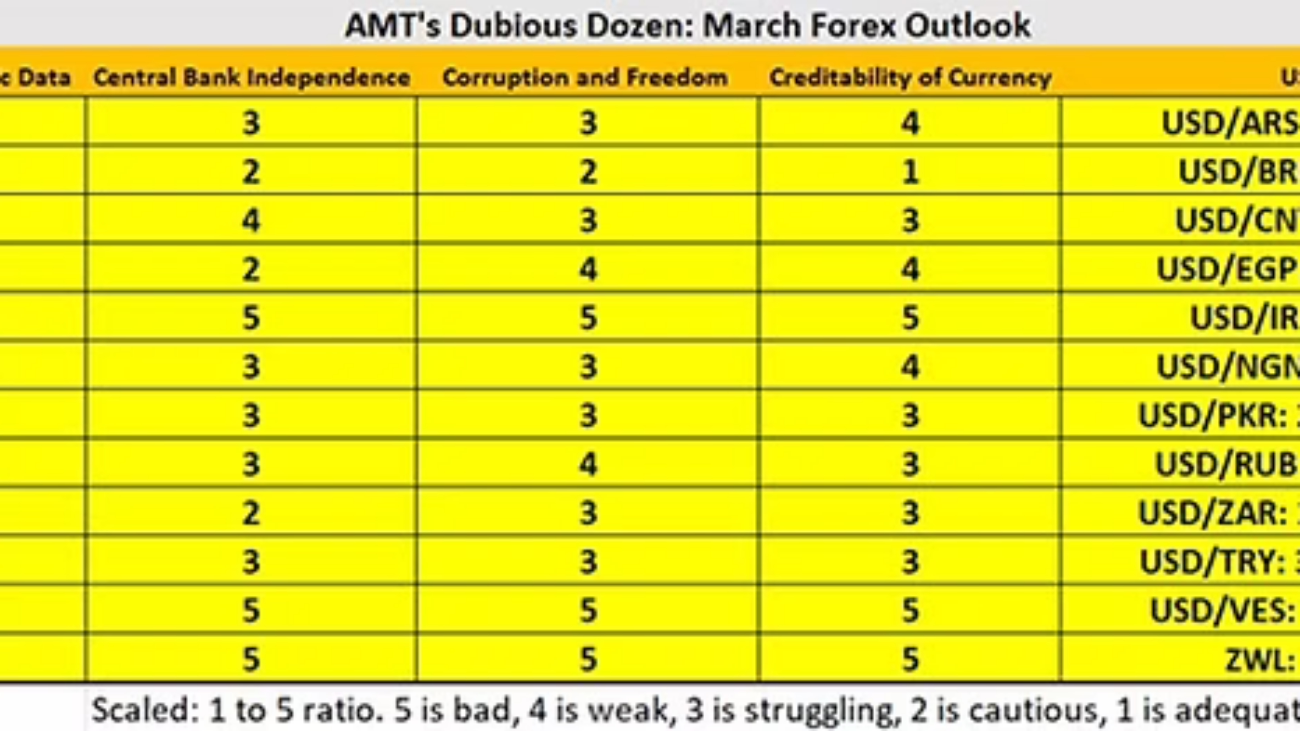
AMT’s Dubious Dozen Forex March 2024 Sentiment Outlook

AMT's Dubious Dozen Forex March 2024 Sentiment Outlook

The Dubious Dozen is comprised of nations who are wealthy or should be, and face criticism because of domestic and sometimes international policies. As the reader you are free to differ from the AMT opinions, which are admittedly subjective. The ratings and outlooks are not delivered as trading advice, but as a viewpoint to inform. The work presented is a living document. The nations and currencies listed, and data and critiques shall change monthly according to points deemed important.

AMT Dubious Dozen March 2024 Forex Sentiment Outlook

AMT’s Dubious Dozen Monthly Forex Sentiment Outlook has a scaled ratings table, listing nations and currencies that are judged to have concerns regarding outlooks due to behavioral sentiment factors within financial institutions and among citizens, based on economics, transparency, and risk concerns about government fiscal policy, and ‘leanings’ toward autocracy. Metrics like inflation, gross domestic product, direct foreign investment information, debts and budgets, and foreign currency holdings which are gathered from various public sources will sometimes be presented.

AMT also tries to judge the trust level the citizens of the nations have in their domestic currencies via exchange rates, black market FX factors, and alternative assets held to guard against potential risks – like digital assets, cryptocurrencies, and gold.

A lack of credibility in a ‘fiat’ currency is dangerous and often leads to black markets for Forex in search of safe-haven currencies like the USD. The lack of a credible domestic currency also leads to price inflation because people selling goods fear the value of the domestic currency is losing value rapidly. Rampant inflation also leads to a desire to sidestep taxation on occasion.

Problematic inflation and inability to collect taxes may open the door for certain countries to contemplate and potentially initiate Central Bank Digital Currencies in order to control domestic economic activity. It is not a coincidence that China, Iran, among others are considering implementation of CBDC’s. The potential of CBDC’s by governments could allow for draconian laws for citizens of certain nations. The ability for a government to check on how all money is used via a centralized blockchain could lead to a more authoritarian landscape.

Quick Insights of the Dubious Dozen Nations Listed:

Argentine Peso (ARS): The election of President Javier Milei has started to ignite changes within fiscal policy and has created hope among international observers of a less corrupt Argentina. However, many obstacles still must be overcome by the newly elected leader and the government, and many economic issues will take patience from the public to improve. Patience has not been a classic virtue in Argentina, unless one considers the ability to accept massive corruption and go on with everyday life as a supreme power.

Brazilian Real (BRL):  Concerns regarding potential fiscal policy changes hover over the existing government which leans towards a socialistic bent and has shown a tendency to align itself with some of the most autocratic governments. Some businesses and investors are anxious about the potential of government mismanagement to develop under President Lula da Silva. The listing of Brazil will create catcalls from some, but the fear in some circles is what might happen if fiscal policy which is led by a socialistic government becomes too populist. For the moment the BRL appears to be under control, which is a good thing. However, the Brazilian Real should be kept in sight for any signs of nervousness.

Chinese Yuan (CNY): The domestic economy remains troubling and fragile. Deflation abounds. Manufacturing, electrical usage, real estate, export numbers should be monitored by observers. Government policy, and transparency reliability due to political control by the Communist Party is problematic. Concerns are causing a backlash among many foreign investors who are looking elsewhere for long-term business endeavors, when they have the ability to divest. Stats: IMF expected GDP for China in 2024 is 4.6% for 2024. China is suffering from current monthly deflation around minus – 0.80%.

Egyptian Pound (EGP): Corruption is problematic within national institutions, bureaucracy issues plague businesses due to interference. Central bank independence is in question as the government faces a litany of fiscal problems. Worries persist about a devaluation for the EGP in order to try and get inflation under control which is currently near 26.5%. The Egyptian Pound is viewed as highly vulnerable.

Iranian Rial (IRR): The nation remains mired under international sanctions. The government practices a heavy hand regarding domestic policies which carry the threat of prison and worse because of the ability to oppress the general population. The Iranian Revolutionary Guard which has several branches of ‘service’ helps the ruling government dominate and benefits monetarily, which makes the Iranian leadership and its ability to rule comparable to a mafia. The current inflation rate in Iran is estimated to be around 32.5%. Unemployment in Iran is estimated to be above 10% and 60% of the total economy is believed to be centralized by the government.

Nigerian Naira (NGN): Corruption remains a troubling part of Nigeria. Although it is a massive exporter of commodities including ‘energy’, and has a dynamic demographic, government policy is highly questionable. Nigeria’s GDP is estimated to be around 3.46% as of December 2023. A problem for Nigeria is its shadow/informal market economy, which is estimated to be nearly 58.2%. Corruption and an inability to legitimately collect taxes hurts the government’s finances and its citizens. The Nigerian Naira is weak and is losing credibility.

Pakistani Rupee (PKR): Economic concerns regarding export and import disparities are a major factor in the lack of foreign currency reserves. A new government has been elected in Pakistan which has been able to form a ruling coalition. Issues regarding corruption remain troubling. Pakistan has also formed a stronger relationship with China, particularly as they search for strong economic partnerships, but this may leave them vulnerable politically. The IMF is a large factor in the current valuation of the PKR. The currency has been stable for a handful of months but needs monitoring.

Russian Ruble (RUB): Although the war with the Ukraine battles on, Russia has found a way to continue to create growth within its economy even in the midst of sanctions. The nation has found other ways to trade and acquire products from abroad via ‘new’ trading channels largely coming from Central and Eastern Asian routes. Russia’s government is seen as highly one dimensional and rules with an iron fist.  Russia’s economy appears to have grown at a remarkable rate of 3.6% during 2023. Core Consumer Prices were about 7.15% higher as of January 2024 per annum. Vladimir Putin has played a rather impressive game of economic poker with the ‘West’ in light of the Ukrainian war, much to the chagrin of his critics.

South African Rand (ZAR): The African National Congress has been in power nearly 30 years. Concerns about mismanagement and corruption abound which are believed to influence questionable fiscal policy. The South African economic outlook is weak due to problems regarding reliable electrical supply, logistical problems at ports, and bureaucratic interference led by government policy which leans towards central controls.  A large amount of immigrants from other African nations are still coming to South Africa as a cheap labor source, but professionally trained people are still unfortunately leaving South Africa via emigration in large numbers. The South African Rand has been within the grips a long-term trend of losing value, and while not entirely vulnerable its credibility is becoming shakier.

Turkish Lira (TRY): A thriving business and manufacturing base exists in the nation. However, inflation due to fiscal policy in Turkey remains an impediment for corporations which are forced to deal with a currency that many within the nation are worried about because of its incrementally weaker outlook which has been noteworthy for a handful of years. There are concerns about current government leadership regarding transparency and a tendency to interfere in Turkish Central Bank decisions. Financial institutions and their corporate clients have a difficult path as they try to mitigate the constant threat of high inflation in Turkey due to questionable fiscal policy.

Venezuelan Boliver Soberano (VES): The failed socialistic nightmare continues to cause squalor in Venezuela. If you want to see the potential of where the VES is headed look to Zimbabwe and the years that a combination of despotic rule under the guise of socialism has delivered. Venezuela should be a rich and successful country due to its natural resources, but it is led by a band of thieves. The black market rate of exchange if it can be found in cities like Caracas is much higher than the ‘official’ listed rate of the government. The VES has little to no credibility.

Zimbabwean Dollar (ZWD/ZWL): The nation is still trying to fix the problems caused by government mismanagement under the authoritarian leadership of Robert Mugabe which led to hyper-inflation and the destruction of the economy. Zimbabwe has a long way to go and issues to overcome to achieve the reintroduction of a domestic currency which does not suffer from a lack of faith from its citizens, which have led to a wide abandonment of the Zimbabwean Dollar and demonetization.

A national currency that is tradable internationally does not exist, the government is aiming for another attempt at monetization in 2025 if economic stability is created. The Botswana Pula (BWP), USD, and ZAR are among other currencies that are used and accepted by the population to transact business. The government tries to monitor all FX exchanges after years of misrule, but this does not stop a vigorous black market. There is an accepted perception the current leadership is trying to fix the massive problems which have created havoc in the nation for a few decades, but the road back to normality is still perilous.