Iran Pt One 20260316

Iran: What Victory Looks Like, Part 1 – The Economy

Ridding the World of the Islamic Republic Price Premium

Opinion: The following article is commentary and its views are solely those of the author. This article was first published the 16th of March via The Angry Demagogue.

There has been much chatter about what “victory” over the Islamic Republic means and it is mostly an attempt to deny the very concept of victory. We wrote about “The End of Defeatism and a Return to Victory” last week where we criticized the whole aversion to victory in Western society. The naysayers don’t like to admit that an anti-Western regime can be all that bad, and therefore endless diplomacy needs to be a goal until the final surrender of the West. They don’t really care about the cost of gasoline in the United States – they actually want it to rise – but as long as it was brought up, let us examine in part, the cost of the Islamic regime and what “economic victory” will look like.
Victory in WWII meant not only the defeat of the evil that was Nazi Germany, but it also meant the resurgence of Europe as an economically successful continent. The Marshall Plan that was the crux of the European revival was as much a part of the Allied (sans the Soviets) victory as the surrender signed by German generals.

What is “economic victory” in this war? The media is all over the costs of the war, but no one has examined the costs of allowing the Islamic Republic to continue as it is. No one has examined the cost that the mere existence of the Islamic Republic (as opposed to non-Islamic Iran) creates for the world in general and the United States in particular.

Let’s start first with the most talked about and panic-ridden event and that is the Strait of Hormuz, the gateway to the Persian Gulf and a chokepoint in international shipping to and from that region. It is the gateway to much of the oil shipped to the world, but also fertilizers and other products. The Wall Street Journal news section in another ignorant headline it considered a “scoop”, wrote that President Trump was told that the Straits might be closed in case of war and he attacked anyway. I am not sure there is a knowledgeable military or diplomatic figure or layman in the world who didn’t consider that an option, but to the WSJ news editors it was the surprise of the century.

As Condoleezza Rice said on the recent episode of Hoover Institutions “Goodfellows” a 50 cent rise in gasoline prices for a few weeks is not a reason not to attack a country who has been at war with you for 47 years. But before we even get to that point, has anyone analyzed the cost of giving Iran a veto over who gets to ship through those straits?

If we look at the insurance rates for shipping through the Strait of Hormuz from Lloyds of London we will get a first hint. From 1970-1979 (before the Islamic Republic) the typical premium was 0.01-0.05%. Once Khomeini took power the rates were 0.05-0.2%. During the Iran-Iraq war when there were the “tanker wars” (between 1984-7) those rates jumped to around 5% with a peak of 7.5%. The post Iran-Iraq and Gulf war period of 2004-19 ranged from .0.05-0.25% – well above the pre-Islamic Republic days.

As for absolute figures, a tanker valued at $200m with a rate of 0.01% (pre-Islamic Republic) cost $20,000 and .05% will cost $100,000. The cost at 0.5% is $1million. So, the pre-Islamic republic rate for a $200m tanker ranged from $20,000-$100,000 while the absolute rate at the lowest level since the Islamic Republic came into existence ranged from $100,000-$400,000 – during the best of times. This does not take into consideration the war premium for the many years Iran threatened and even hit tankers even without the excuse of American or Israeli bombing. The average “war premium” from 1979-2020 was 0.83% or $1.66 million for a $200 million vessel.

We don’t have the wherewithal to continue this analysis, but this is exactly the type of article that we used to expect from the pre-ideological WSJ (or even NY Times) news sections. Maybe some economist or even the WSJ editorial page can start to do the heavy lifting and tell us how much the Islamic Republic of Iran has added to the gasoline bill of the average American even during non-war periods.

In economic terms – victory means a eliminating the price premium for shipping energy and global trade in general brought on by the very existence of the Islamic Republic. We will know victory is here when there is a return to the insurance premiums of the pre-Islamic Republic days and when the price of oil, due to increased supply from a non-terrorist Iran reaches the levels it is capable of. A 50 cent or even a 1 dollar rise in gas prices for a month will be followed by $2-3 decreases permanently. We won’t reach the 28 cents a gallon I remember from my childhood (actually 27.9 cents), but neither will it be $4.00 (except maybe in California).

This economic victory will reverberate to other theatres. While the Russians might profit from a temporary rise in oil to $100 a barrel, in the medium and long term, if oil drops to $40 a barrel or even less, they will struggle to support the war effort.

The short term costs and dire predictions that the journalists and diplomats have foisted upon us will end up being a drop in the bucket after economic victory is achieved.

Disclaimer: the views expressed in this opinion article are solely those of the author, and not necessarily the opinions reflected by angrymetatraders.com or its associated parties.

You can follow Ira Slomowitz via The Angry Demagogue on Substack https://iraslomowitz.substack.com/ 
Copy and paste the text from AMT that you want to share

Confused Markets 20260217

Market Volatility: Structure, Geo-Politics and Culture

Why the (Free) World is so Confused and Depressed

Opinion: The following article is commentary and its views are solely those of the author. This article was first published the 16th of February via The Angry Demagogue.

Having been involved in the capital markets for the better part of the last four decades, I wouldn’t go so far as to say that I have not seen this amount of volatility and uncertainty in the markets, but I will say that this uncertainty and this volatility is different. The differences are important and have to do with the current structure of the markets as well as the geopolitical goals of the various powers and would-be powers. The trading world has changed radically over the last two decades with the advent of algorithmic trading and how they respond to global events as well as the type of money that is coming to dominate the markets.

The “type” of money has changed from those who invest in “things” – be they long term value investors like Warren Buffet and Peter Lynch, to those who chase income and dividends and to those who like to follow trends and industries. These investors, different in their own methods and goals had one thing in common – they invested in companies they felt had a future, or in the case of short-sellers (as legitimate as buyers) who thought it didn’t. The few hedge funds that were around four or five decades ago did what the name of the type of fund said – it “hedged” positions and gave up some potential upside in order to cushion losses when markets went south. That changed sometime at the end of the last century when George Soros nearly ended the United Kingdom by mercilessly shorting the Pound.

We are being very general of course and have not spoken about those who invested in bonds of “fixed income” products, corporate, federal or municipal as well as the basic speculator in all sorts of investment products. Nor have we spoken of the crooks who populate any era. We don’t want to give the impression that all was wonderful “then” – this is not a nostalgic look at the recent past but an attempt to understand what people were doing and how they did it, and how things have changed.

We are seeing now a sea change in the way the markets are responding to news and the way money is being invested. We still have the value and income investors; we have the large and small investors doing their best to pick the right stocks and bonds, and some of these investors also use options and futures to enhance and hedge their investments. Investing has become more sophisticated- read more mathematical – and the “basic” investor, large or small has been able to use this sophistication. However, the current hedge fund environment is based on much more than picking the right stocks or bonds and all that goes with it. The current hedge fund system is a group of funds, many of multiple hundreds of millions or even billions of dollars that don’t make investments per se as they try to beat their competitors by the microsecond in order to profit a very small amount on a a large but extremely short term investment (we will speak of the money of unfree countries, below).

As an example, there are dozens of hedge funds who work their “algos” to respond to market news and announcements only to get out of the position within minutes or even seconds. Each algo basically says the same thing – if X happens then buy and if Y happens, sell. The only difference is who will buy or sell quicker and then reverse what they have done. There have always been those with fingers on the button ready to buy or sell but the amounts were smaller and the effect less. Today, the reaction time is so quick that the large firms have their servers in the stock exchange buildings, close to the exchange computers so that they will get their orders in first. Remember, these are electronic so they are going at the speed of light. The difference between 100 feet way and 100 miles should not matter – but it does. We are talking the difference between 0.0000001 seconds for 100 feet and 0.000537 seconds for 100 miles – a time difference that people cannot discern.

This of course is not necessarily a bad thing if the algos themselves were correct for the long or even medium term (or what used to be called the short term – a quarter of a year). But they are programmed for the shortest of short term – what will happen over the next 30 or 40 seconds or maybe a day or two or a week. We see incredible volatility and panic where we should find none. A good or bad jobs report, inflation release or even a Federal Reserve rate cut or hike might have long term consequences but these trades that cause this radical volatility are not concerned with that. The market dropping two or three percent in a matter of minutes does not provide the comfort that investors usually seek. People jump on the bandwagon fearing the worst –when it was just the algos responses to the news rather than intelligent judgement on the news that drove the prices.

We will stop with the details and summarize – a large part of the uncertainty of the markets is structural as technology and the sheer amount of money being traded has surpassed what the markets, as currently structured can stand. As an example, as an employee of the Nasdaq Stock Market in the early 1990’s we were told to prepare for a 1 billion share day. During those days, there were very few shares that traded above $100 as the companies wanted more investors and there were many stock splits (more rare these days). The 1 billion share day in 1995 would have totaled around $40 billion. Today, daily trading activity has passed 15 billion shares and the total money is above $1 trillion.

It is not clear what structural changes need to be made in order to take all of this into consideration, but we do have some ideas (which we won’t bore you with now).

The second major issue that is the cause of the volatility and uncertainty in the markets has to do with what news is “good” and what news is “bad”. Not in the moral sense but in the economic and geo-political sense. What we mean by this is that there does not seem to be a unified view in the Western world where it should be going and because of this, it is not clear what news is in fact good and what is not. Economically it might be easier to figure out but even that has been hard since so many major American cities and so many young people are voting socialist and so much foreign money from non-free countries is flooding the market. News may say one thing for a free market economy and something entirely else for a planned socialist economy. It might mean one thing for investors in New York or Cleveland and something entirely different in China or Qatar.

Therefore, geo-politically the uncertainty is confusing. During the cold war of course we basically understood what moves were positive and which were negative. That is not to say there were no policy arguments but for the most part, the ends were agreed upon. Selling grain to the Soviets may or may not have bettered the Western world but both those like Henry Kissinger who supported it and Senator Scoop Jackson who opposed it argued based on the same goal – what was better for the free world.

This goes beyond who is considered the “enemies of the West” to what is considered the West – or even if it exists! We have always tried to write here from the perspective of what is good for free countries even if many free countries seem to think that Israel, for example, is not a member of that community. The same goes for those who doubt the cause that Ukraine is fighting for, as they support the Putin tyranny in the name of balance or alleged Christian values or whatnot. Interestingly, both sides – the right in the Russia-Ukraine war (and the Tuckeronian Right regarding Israel, too) and the left in the Israel-Islamist war – are willing to forgo freedom for some amorphous, form of justice or truth.

Iran is the perfect example. In every measure of Western values since WWII the Islamic Republic of Iran is an evil country. It denies freedom to its citizens, massacres them, executes women for immodesty and homosexuals for being homosexual. We don’t have to go on regarding the evils of the Islamic Republic of Iran but even with that, there are those in the West who support it. We are not talking about the legitimate policy debate regarding a war with Iran – morally as well as politically – but rather the fact that many just don’t consider that Iran is on the wrong side. Israel as we said is another example, but we can go on and on. Venezuela, Cuba and even China come to mind.

True enough, there were always people in the West that thought the Soviet Union or Maoist China was morally “better” than the United States or Europe, but never did they influence the politics, culture and businesses as the current naysayers do. The markets “understood’ that the Soviet Union was bad and reacted accordingly. The geo-political goals were mostly in sync.

The global markets reflect the geo-politics of the day and “vote” on it in a daily basis. The fact that there is a vast sum of money that influences the markets that are actively opposed to the freedom project – China, Qatar and Russia come to mind – does not help the situation. It is not the “foreign” money that disturbs the markets but rather which foreign money. There is a difference between an investor who is looking for the good company or the safe bond, and one who is looking to use their investment to further a radical Islamist or Chinese Communist agenda. President Trump’s trillion dollars of investments from Qatar and Saudi Arabia and others comes with a price tag he does not usually deal with – the price tag of undermining the market economy that has made him so successful. The proof of “goodwill” in the investments in the United States ought to be shown before that money flows into the economy. They have already contributed to ruining the universities (not that they needed the help) – there is no reason to permit them to ruin America’s great corporations, too.

The markets are crazy due to its structural issues and due to the “uncertainty” that is today’s world. Sadly, that uncertainty is not just uncertainty about what will happen, but uncertainty about what is good or bad (news). This goes beyond unity and “can’t we just get along?” and gets to the heart of why we are living today in the same culture. We say culture instead of country or city since that culture is the one that “got us here” as basketball or football coaches like to say.

The lack of agreement as to what matters most has affected the markets more than we think, and it all has contributed to the depression that so many in the free world are feeling at the moment.

Disclaimer: the views expressed in this opinion article are solely those of the author, and not necessarily the opinions reflected by angrymetatraders.com or its associated parties.

You can follow Ira Slomowitz via The Angry Demagogue on Substack https://iraslomowitz.substack.com/ 
 

Copy and paste the text from AMT that you want to share

postre1

India Insider: Why Russian Oil Should Be Treated Skeptically

India Insider: Why Russian Oil Should Be Treated Skeptically

As Russian President Vladimir Putin arrives in New Delhi for a bilateral summit, the mood in India’s capital is one of profound strategic tension. The core of the problem is India’s massive appetite for discounted Russian Crude Oil, which has shielded the economy from high energy prices but is now causing significant financial and geopolitical risks. This move comes at a time when India’s most important trade surpluses lies with the West, raising anxieties about U.S sanctions and shrinking strategic space.

Trapped Rupee Problem

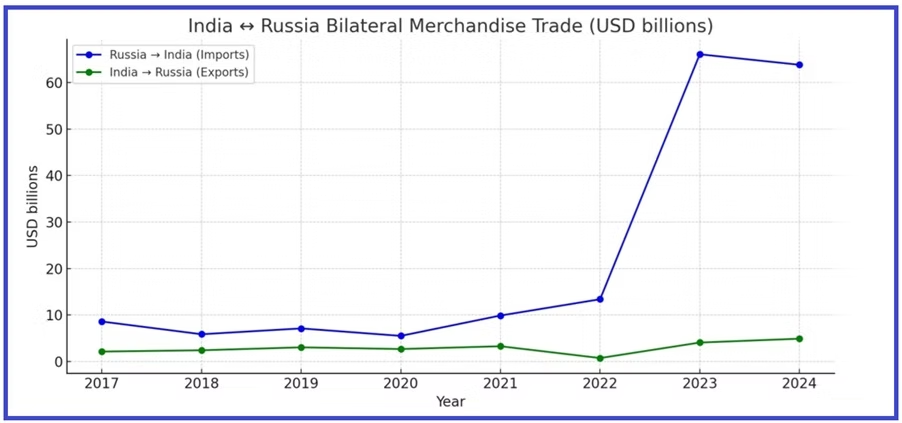
Since the Ukraine war, Russia’s share of India’s Crude Oil imports has surged from under 2% to nearly 40%. This has simultaneously inflated India’s trade deficit with Russia to nearly $59 billion.

The transactions are largely settled in Indian Rupees (INR). Moscow has accumulated billions of Rupees in Indian banks. However, because the Rupee is not fully convertible on the global market, Russia has very limited ways to use this huge surplus within India. These billions of Rupees are essentially ‘trapped liquidity’ – a problem neither country can easily solve.

India – Russia Bilateral Merchandise Trade Chart from 2017 – 2024

The Kremlin, meanwhile, is shifting its financial allegiance. It is preparing to issue Yuan denominated sovereign bonds, a decisive step that deepens its reliance on Beijing’s financial system amid a cut off from the Western financial system. This financial trajectory clearly signals the next logical step: Russia will inevitably demand that India begin paying for its oil shipments in Chinese Yuan (CNY).

Structural Risk of Holding Chinese Yuan

India has never been comfortable holding Chinese Yuan or settling trades in the currency. That’s partly strategic as New Delhi wants to protect its geopolitical autonomy and position itself as the democratic anchor of the Global South while staying closely aligned with the West.

But Russia’s financial plumbing is now increasingly routed through China. As the Kremlin becomes more deeply integrated into China’s banking and payments system, its dependence on the Yuan becomes structural. Moscow needs Yuan not only to service Chinese creditors, but also to pay for its expanding list of manufactured imports from China. The Ruble, being a largely non-convertible currency, simply cannot support this scale of trade.

For now, Russia-China trade is balanced enough because Beijing still buys large quantities of Russian energy. But this equilibrium can shift quickly. As the Ukraine war drags on and Moscow’s defense spending rises, the Kremlin will be forced to rely even more heavily on Chinese financing, Chinese goods, and ultimately the Yuan itself, tightening its economic dependency on Beijing.

When that moment arrives, the Reserve Bank of India (RBI) will be forced to accumulate Yuan as part of its Forex reserves to ensure the continued flow of oil. This decision, born of necessity, introduces a structural vulnerability into India’s financial system as the adoption of Yuan as a reserve currency subject to China’s capital controls.

Risks of Holding the Yuan

China may have both the onshore (CNY) and offshore (CNH) Yuan, but the currency is ultimately controlled by the PBOC, which makes it a risky reserve asset for India. In a crisis, Beijing’s capital controls could restrict liquidity and prevent the RBI from freely converting yuan into hard currency like the USD, effectively trapping India’s capital.

Beyond this financial rigidity, large Yuan holdings also expose India to CCP driven political risk, tying its external stability to China’s domestic decisions. And unlike the Dollar which can be deployed anywhere, Yuan reserves are usable mainly for transactions with China or countries in its financial orbit, sharply limiting India’s strategic and financial flexibility.

Strategic Win for Beijing

For Beijing, this shift delivers a double strategic win, cementing the Yuan as the dominant settlement currency across Eurasia especially among countries squeezed by Western sanctions and it allows the yuan to slip into India’s financial system indirectly, not through Chinese pressure but through Russia’s growing dependence on Chinese finance and India’s reliance on discounted Russian oil.

For Moscow, this is a reluctant compromise: giving up some monetary autonomy in exchange for necessary financial support from China.

For India, however, it introduces a new long term structural risk with a slow but steady Yuan encroachment into its trade and reserve system, operating alongside the dominant U.S Dollar. The oil corridor that was meant to offer an independent strategic opportunity for India is now becoming a channel which Beijing can strengthen its monetary footprint. In this complex triangle, India risks paying a dangerous tactical long-term price for its energy security.

post309

India Insider: Nifty Defense Index Surges in 2025 Rearmament

India Insider: Nifty Defense Index Surges in 2025 Rearmament

2025 has marked a defining moment for defense equities, both globally and in India. The Nifty India Defence (Defense) Index, which tracks the country’s leading defense manufacturers, has surged sharply on the back of robust order flows, a structural policy shift, and increasingly volatile geopolitical conditions. This rise is not an isolated event but part of a broader global rearmament cycle that is reshaping the defense industrial landscape.

Nifty India Defence (Defense) Index One Year Chart as of 20th November 2025

India’s defense sector has been one of the standout performers in the domestic equity market. By mid-2025, the Nifty Defense Index had risen more than 25% year to date, outperforming most sectoral indices. This rally is primarily anchored in strong capital expenditure by the Government of India, which continues to accelerate indigenous military modernization. The Defense Ministry’s approvals which is running into tens of thousands of crores have expanded visibility for companies such as HAL, Bharat Electronics, Bharat Dynamics, and shipbuilding PSUs (Public Sector Undertakings). For investors, the nature of long durations within defense order books has provided earnings stability at a time when other manufacturing sectors have been grappling with cyclical softness.

The second driver has been a multi-year strategic shift toward import substitution. India’s reliance on foreign weapons systems has long strained its current accounts and created operational vulnerabilities. However, the ongoing indigenization push, reinforced by Production Linked Incentive schemes, procurement embargoes on foreign systems, and export incentives, has fundamentally realigned the sector. Defense exports have crossed record levels, and Indian firms are increasingly integrated into global supply chains for electronics, avionics, and ammunition.

Global Industrial Defense Rebirth

But the domestic story is tightly interconnected with developments abroad. The global defense market is undergoing its most significant expansion since the post 9/11 decade. Russia’s war in Ukraine, the Red Sea shipping crisis, conflict in the Middle East, and a renewed great power rivalry in the Indo-Pacific have pushed countries to reassess defense readiness. NATO’s decision in 2025 to raise defense spending targets from 2% of GDP to 5% by 2035 has far reaching implications. This commitment translates into trillions of dollars in additional defense outlays over the coming decade, making Europe one of the fastest-growing defense markets.

Companies such as Rheinmetall, BAE Systems, Lockheed Martin, and Northrop Grumman are already reporting record order inflows. Rheinmetall, Germany’s largest defense company, expects its revenues to quintuple by 2030, reflecting unprecedented demand for advanced artillery, ammunition, and combat vehicles. The United States, meanwhile, continues to channel significant funding into hypersonic, missile defense, and drone systems as competition with China intensifies.

India’s Edge in Rearmaments and Technology

This global rearmament wave has a direct spillover effect on India. International supply chain shortages particularly for semiconductors, propulsion systems, and munitions have created opportunities for Indian firms to plug capability gaps. With a cheaper cost base and growing technological sophistication, Indian defense manufacturers are emerging as viable exporters in segments such as UAVs, naval platforms, and electronic warfare systems.

In this environment, the rally in the Nifty Defense Index is not merely speculative exuberance, but a significant reflection of structural and synchronized global demand. As defense has evolved from a low beta sector to a strategic growth industry, India’s integration into the global defense economy positions its companies for sustained earnings expansion over the next decade.