
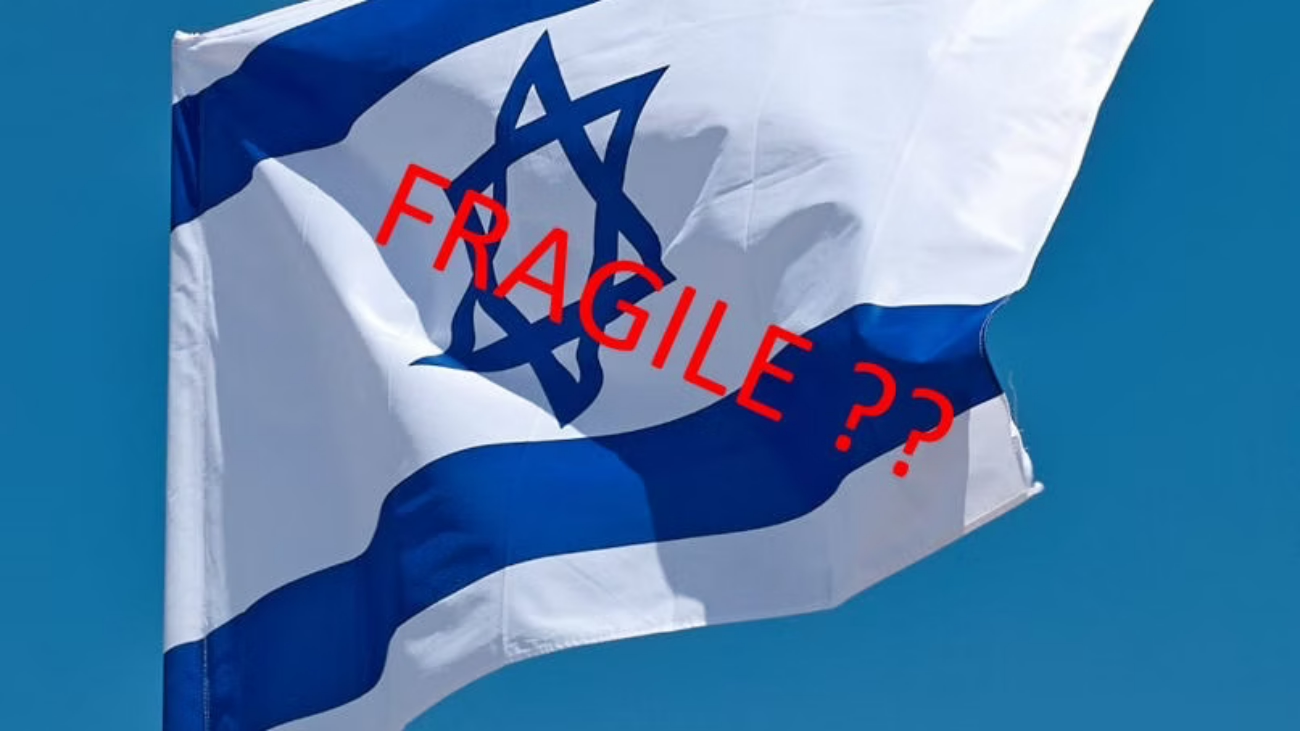
Is Israel a Fragile Country? Can it Move Towards Anti-Fragility?
Opinion: The following article is commentary and its views are solely those of the author.
One of the great books of the last decade is Nassim Taleb’s “Anti-Fragile”.
I read it years ago and bought one for each of my (grown) children and suggested they read it and think about it when making decisions. I said at the time that this should be required reading for all IDF officers. In a nutshell, Taleb differentiates between fragile, non-fragile and anti-fragile. Glass is the classic fragile substance and concrete the classic non-fragile. Both can be destroyed with correct instruments and non-fragile items will slowly decay when things like water infect them.
Anti-fragile items on the other hand, gain strength from chaos. The more an anti-fragile substance gets hit, the stronger it gets. Nature for Taleb is the classic anti-fragile system. Nature “knows” how to respond to any disturbance, and it “learns” how to adapt and survive. This adaption and survival might hurt parts of the natural world – but nature as a system will survive and be stronger – think of natural immunity from a virus.
Another of the ideas in Taleb’s book is “optionality” – decisions in life are often like buying options. When buying an option, you want a high upside and a low downside. A simple non-financial example is crossing a street. If you see a car 50 yards away and are pretty sure you can make it across the street without getting hit – you can take that “pretty sure” chance and save yourself the 10 seconds it takes for the car to pass, or you can wait the 10 seconds. The upside here is saving 10 seconds. The downside is getting hit by the car. The decision is pretty obvious for those who think of optionality.
In short – Taleb is a serious man and a serious thinker. Born in Lebanon in 1960 he is a polymath, making his name in trading and finance, and his previous book “The Black Swan”.
In any event, in a recent interview with the French newspaper L’Orient Le-Jour he called Israel a fragile country due to its dependence on the United States and said that top-down peace agreements, like that between Israel and Egypt, or the Abraham accords are doomed to fail (I don’t read French and read a summary of the interview in the Hebrew language Globes financial newspaper – the original is here – if you read French and I got it wrong, please let me know).
Is Israel a fragile country? And if so, is it more fragile than other small free countries? And finally, how can it move on the road to anti-fragility? And are fragile peace agreements worthless?
Taleb’s claim that Israel is fragile due to its dependence on the US is true in an of itself. Changes in U.S foreign policy either via elections or changes in US interests have in the past put Israel in difficult situations. When Prime Minister Yitzchak Shamir requested U.S loan guarantees from then President Bush (1) in order to fund the absorption of masses of emigrants from the falling Soviet Union he was turned down until Israel halted settlement activity in the West Bank and attended the (failed) Madrid peace conference. Today, it is very clear that if the US would decide to halt arms shipments to Israel or to stop supporting it in the Security Council, the country would be put in a situation many believe would be existential.
A big issue in Israel at the moment has to do not only with Israel’s dependence on the US for military hardware but in the relationship of its top generals with the Pentagon. There is a claim that much of the “globalized” attitudes of Israeli generals comes from the influence of the politically correct elite in the US Defense Department. It reached a point where, just a few weeks before the current war broke out, the general in charge of military intelligence stated that he fears that global warming is a greater threat to Israel than Hamas. Whatever one’s views on global warming or climate change it does seem odd that the one Israeli in charge of making life and death intelligence assessments has the time to worry about those issues to such an extent that he feels it is his job – as intelligence chief – to warn Israel about it. Further, the October 7 attack itself showed the fragility of the defense strategy of Israel’s top generals and politicians. It had a conception of Hamas and other enemies and had no allowance for its being wrong.
However, the initial response of Israel’s soldiers and officers, without the centralized support of the General Staff, show how many of Israel’s combat soldiers are “anti-fragile”. Israel’s people can also be said to be anti-fragile in Taleb’s definition of it where chaos or tragedy make one stronger. Over the 48 hours after October 7 Israel already had 350,000 reservists mobilized who were all motivated to fight for their country. That is no mean feat – for the most part these reservists went to their units before being called up or called their commanders demanding to be called up. Many thousands returned from abroad at their own expense in order to join their units and fight. In contrast – Ukraine had to forbid all men under 50 from leaving the country. In Israel, a divided, shocked and demoralized people became a strong fighting force with the home-front in total support, within hours.
Military tactics are another area where Israel is anti-fragile. Due to the utter failure of military intelligence and the lack of central control over the first hours of the war that Saturday morning, the junior and mid-level officers and soldiers took command and figured out on their own how to face down the thousands of terrorists who took over towns and villages as well as military bases. Instead of waiting for orders and making sure everything was organized for attack, a delay which would have cost many more civilian lives, Israel’s soldiers improvised with what they had and took back the territory under very difficult circumstances. Many soldiers lost their lives through many acts of bravery but the decisions they made on the spot made them, the army and the country stronger.
The same can be said in the fighting now in Gaza. Israeli intelligence understood that there were tunnels, but it seems that they didn’t know the extent of the network and therefore had no good tactics to defeat it. It was the need to penetrate them without causing casualties to soldiers as well as the potential of hostages in the tunnels, that caused them to developed tactics to deal with it. We won’t know for sure how well it has or will work, since this is now classified information, but this could be an area of anti-fragility.
But this does not disprove Taleb’s point since Israel is clearly has a “single point of failure” and that is the U.S Government. However, nearly all free countries in the world have that single point of failure and have had it since the start of the atomic age. One of Konrad Adenauer’s great fears in developing West Germany’s defense policy was that, when push came to shove, there would be no US nuclear umbrella. He was not convinced that the US would risk its own cities in defense of Europe in general and West Germany in particular. That is why he supported France’s independent nuclear deterrent and why he and De Gaulle were so close. The U.K too, when deciding on its Trident nuclear submarines had the same doubts.
Today, we can say the same about the Baltic countries. They are part of NATO now, but, like the rest of NATO are totally dependent upon the United States military to keep the Russians at bay. The rest of Europe is dependent upon the U.S but they are no longer front line states so it is less important. Newly NATO-ized Finland is probably closer to Israel in its combination of fragility and anti-fragility.
Taiwan too, is fragile in this sense and so are the weaker Indo-Pacific nations like Philippines and Singapore. It would be difficult to find a non-Axis free or semi-free country that is not dependent upon the U.S to defend its freedom – either with sailors and soldiers or with arms, money and diplomacy.
But the question Taleb poses, or the claim he makes, deals with Israel. Israel is clearly partly fragile – but is it too fragile currently that it can’t survive without the US? Or can Israel do anything to make it, if not more anti-fragile, at least more non-fragile? We have to separate out Israel’s fragility due to its dependence on the U.S and the free world’s fragility due to the same dependence. The Pax Americana that free (and non-free) countries have enjoyed since the end of WWII has probably contributed more to freedom, economic growth and a reduction of poverty in the world than any other force in human history. The question for all free countries then is how to make them less dependent upon the U.S if they want to remain strong and free -and less fragile.
That is as true for Israel as it is for Latvia, Finland, Australia and Japan.
But we will only look at solutions for Israel and leave the general question for a later time.
Israel receives from the US $3.8 billion in military aide, all of which must be spent in the United States. The annual aide started in 1999 and was $2.67 billion. Israel’s GDP in 1999 was $120.92 billion – meaning the aide constituted 4.5% of Israel’s GDP. In 2022 Israel’s GDP stood at $525 billion so its $3.8 billion in aide was just 0.7% of GDP. Israel’s 2022 defense budget was $23.4 billion – 4.45% of GDP.
Giving up the entire U.S aide is certainly do-able from an economic perspective and there have been economists in Israel who claim that the aide actually hurts the Israeli economy since all the money must be spent in the U.S. One result of this has been the demise of Israel’s textile industry since the IDF no longer purchases uniforms from Israeli companies (one has to wonder that, since clothes bought in the U.S are rarely made in the U.S, if Israel is buying uniforms made in Bangladesh but sold via U.S middlemen). Giving up the aide would be one step towards a less fragile existence for a number of reasons.
The first would be, in my opinion, to cement the U.S public’s support for Israel. Giving up U.S taxpayer aide during a time of fiscal uncertainty would certainly be looked upon positively, in spite of the fact that all the aide gets recycled into the U.S economy (there has been some money that Israel has been allowed to spend on R&D in Israel). Israel is not the same country it was in 1999 and its economy is robust and probably more anti-fragile than most other western economies.
A second positive would be in allowing Israel to spread out its arms purchases. It could buy small arms from India, artillery from South Korea, etc. It could also rejuvenate local Israeli arms manufacturing. There is no doubt that all the large ticket items like fighter jets and smart bombs will still be purchased in the U.S and there is no doubt the U.S arms industry will continue its good relations with Israel – and in fact might be made more competitive since the IDF will be free to chose from amongst many providers for various weapons systems.
Another move that Israel can make that would decrease its fragility would be to make sure it always has a 12 month supply of weapons and spare parts in order to fight a three front land war and a 5 front air war. It would have to beef up its navy and ground forces without hurting its crown jewel – the Air Force. This would make it less dependent upon the importation of arms in case of war.
An area where it will be difficult to be less fragile is the diplomatic arena as woke-ness takes over the western narrative about the world and many of the less and non free countries can’t manage to fight off Arab money and propaganda. India could be a country that could help diplomatically as they are large and powerful enough to ignore much of the pressure from the Arab and western-woke world. The problem is that the Security Council still holds sway in the world and India is not a permanent member with a veto. Of course they should replace the U.K and probably France but that won’t happen as long as India doesn’t have a reliable, permanent left-wing majority – which it won’t have for some time.
The only other major country that could help diplomatically would be Japan – but they have historically not been friendly to Israel and only in the current war have they backed it fully. They are certainly sympathetic to Israel’s plight as they figure out how to face a hegemonic China.
But under the current global situation, Israel relies on the U.S for diplomatic cover making it fragile, diplomatically. That won’t change for some time.
Economically, Israel is probably more anti-fragile than most other countries in the world. This is true for two reasons. First, Israel has a strong domestic market including a very productive real estate market. It has an agricultural center that produces enough for export and of course world class hi-tech and bio-tech industries. Most important – it has children. It is the only western country that has a high birthrate and that is something that has been underestimated in the west. Israel’s fertility rate – births per woman – stands at 2.9. The next highest western country is France at 1.8. Replacement rate is 2.1. Search out Nicholas Eberstadt for all the details.
Regarding the top-down peace agreements, Taleb himself understands for sure that the non-democratic top-down nature of most Arab countries makes this less important than in western-free countries. However, he does have a point here. Regarding Egypt, from the beginning the people – or more accurately, the professional and intellectual classes, have been opposed to Sadat’s peace. However, in spite of that, the peace has held for 45 years, which is quite a long time. I remember as a child reading the Biblical Book of Judges where the Israelites would sin, to be saved by a Judge who would rule and keep the country “quiet” for 40 years. At the time I thought – what is the big deal of 40 years of peace? As I grew (much) older I realized that 40 years of peace would be an incredible feat. So, 45 years of non-war between Israel and Egypt is quite a success. Will this continue for another 45 years? I think that if Israel remains strong, it will.
Regarding the Abraham accords, the jury is still out. We will have to see where it all progresses. This war has certainly shown that even mass violence has not caused violent reactions from the Abraham accord countries. The one peace agreement most fragile and more worrisome though is the one with Jordan. The Hashemites are first and foremost survivors and if survival means breaking the agreement, they will do it in a second.
In summary, Israel’s dependence on the US is crucial for its survival and that in itself makes it fragile. However, there are things Israel can do to make it less fragile and the will and determination of its people make it, in many senses anti-fragile in Taleb’s description (invention?) of that term. Compared to other small, free countries though, all of whom depend on the US for at least part of its defense, it is difficult to say that Israel is worse off – except that, besides the Baltic countries, its neighbors are worse and more dangerous.
In the coming days we will examine a more radical solution to the “fragility” problem of Israel and other free countries.
Disclaimer: the views expressed in this opinion article are solely those of the author, and not necessarily the opinions reflected by angrymetatraders.com or its associated parties.
You can follow Ira Slomowitz via The Angry Demagogue on Substack https://iraslomowitz.substack.com/