The BRICS nations are causing alarm in some ‘Western’ financial circles as they seek to strengthen their trading alliance reflecting their ability to be large producers and consumers. BRICS has a common goal of creating better trade and financial conditions for each other, and as a potential byproduct to possibly create an alternative to USD dominance.
While political crisis and global security concerns have grown the past few years and are causing uncertainty and instability, the strength of the USD has also caused inflationary problems for many nations including BRICS members. Cash reserve shortages of USD have become problematic and have been fueled measurably by decisions from the U.S government, Federal Reserve system and U.S Treasury. This has ignited many emerging market nations to seek dialogue about potential BRICS membership.
Alliance intrigue and concerns also shadow BRICS members often, the February 2023 naval exercise held between Russia, China and South Africa within waters near Cape Town raised anger in the United States and the European Union. The fact that the joint military exercise was held during the first anniversary of the Russian invasion of Ukraine did not go unnoticed. While no signed military alliance exists between these nations, it should be noted that Russia, China and South Africa also held a naval exercise in November 2019 also within proximity to Cape Town, South Africa.
Formation and Agenda as Members Scoff at the ‘King Dollar.
The agenda of the BRICS nations often appears a desire to topple the dominance of the USD to those watching from outside, but is it realistic? Trading alliances are important certainly in order to create better economic stability. The BRICS potential effect on the USD is concerning, although not critically dangerous at this juncture the bloc needs to be monitored. In addition there are worries from some in the West that new military alliances could be formed, but historical and cultural differences within BRICS makes this rather questionable for the time being when contemplated in total.
BRIC was an acronym coined by then Goldman Sachs Chief Economist Jim O’Neill to identify potential opportunities for investors within emerging market nations. Members in this ‘bloc’ are countries that have begun to work in unison. About two months ago, Jim O’Neill reiterated the same refrain and alluded to the BRICS theme of suppressing USD strength and its reliance in global trade. BRIC (Brazil, Russia, India and China) was formed in 2009, and they added South Africa as a member in 2010 formally initiating BRICS. This coalition has met annually to discuss coordinated policies regarding trade, finance and investment opportunities. The next annual meeting will be held in August 2023 in South Africa. Vladimir Putin’s potential attendance at this year’s meeting is being monitored widely.
Plenty of discussions have already been articulated internationally about undermining USD dominance in global trade, but little effect has come to fruit in reality and the USD retains its moniker of ‘King Dollar’. However, countries being affected by the rise of inflation and the strength of the USD are becoming numerous and this has caused a diverse group of nations to seek conversations with BRICS leadership about being able to join the trading alliance. Iran, Algeria, Argentina, Mexico, Nigeria, Saudi Arabia, Indonesia, Pakistan, Egypt, Sudan, Syria, the United Arab Emirates, Bahrain, Turkey, Venezuela, Sri Lanka and Zimbabwe are some of the nations that have expressed interest in BRICS membership.
Impact of Sanctions on Russia and its Ability to Counter via BRICS
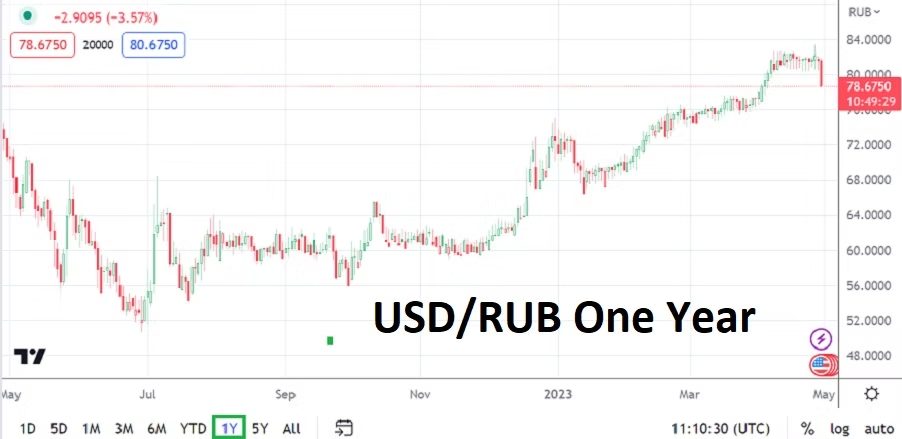
Russia has been waging a war with Ukraine for over a year and is currently under many Western sanctions. It’s been kicked out of the SWIFT banking system, which means it has limited opportunity to trade the RUB with Western countries. This in theory also limits the amount of USD that Russia can get its hands on.
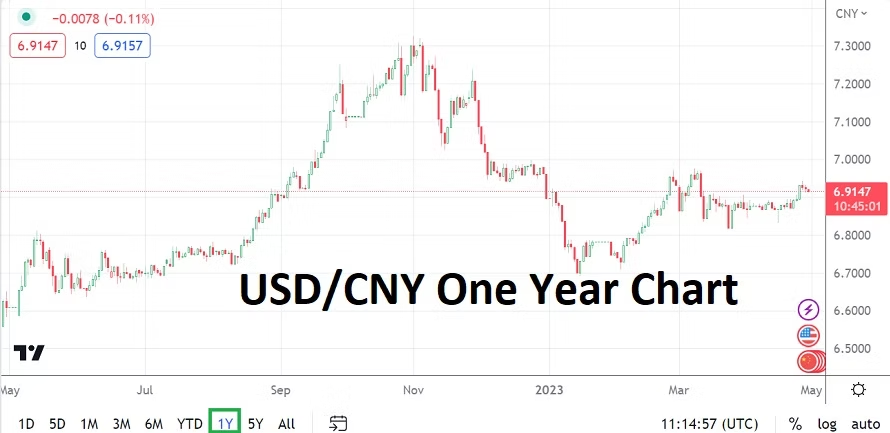
Russia last year asked to be paid in Rubles (RUB) for gas and other energy purchases when dealing with E.U countries, trying to play a game of chess which largely failed. This while China too, tries to make the Yuan (CNY), a more significant currency in order to suppress USD dominance. China certainly has plenty of political and economic reasons to have the CNY emerge as a global power.
Russia has supposedly wanted to get out of Western currencies and especially the USD, this to punish the West, but will it work out and is it pragmatic? No. Russia’s attempts are high on rhetoric, but low on quantified changes thus far. The USD is far too dominant within the global banking system, and while incremental challenges to the USD have been tested, chipping away at USD strength remains difficult at best. The Kremlin has tried to inoculate itself from the pain caused to its trade balance because of sanctions, and create problems respectively for countries that oppose its invasion of Ukraine by cutting off gas supplies which were used for heating and to generate power for industrial purposes. Threatening to not allow grain to flow from Ukraine has also been a rather constant noise made by Russia.
Prices were capped on Russian energy via the G7 beginning in 2022 as a retaliatory move to limit revenues for Russia, and alternative gas agreements were sought by many European nations creating a loss of momentum for the Kremlin’s chess game. The Nord Stream pipeline was also damaged via sabotage. Russia used to supply Europe with 50% of its energy until sometime in 2021, it now provides less than 20% after Western sanctions. Russia has moved its eye towards other nations hungry for energy, ones that are not obligated to make transactions in USD, which brings BRICS into focus.
Inflation and a Strong USD have Caused Harm Globally
Inflation has caused problems across the globe following the impact of the coronavirus epidemic. The Federal Reserve, BoE and ECB have raised rates to try and cool inflation in their respective economies. This has made the USD attractive against emerging market currencies and caused capital outflows. An economic nightmare has occurred in Sri Lanka which is suffering from staggering political and economic problems the past two years, and nations like Pakistan and Egypt have been hit hard too by inflation’s impact and debt. USD reserves dwindled in these nations and they found it difficult to service their USD denominated debt in 2022, and troubles persist in 2023. Import without any USD reserves is difficult and sometimes impossible.
Russia and China as Major Players in ‘Their’ Bipolar World with ‘Friends’
Global trade is still dominated by the “King Dollar”. Almost 88% of global trade happens with the USD. The USD accounted for more than 71% of currency reserves at central banks in 2000, but has now declined to slightly below 59%. Oil and gas exports are important for Russia as these revenues constitute nearly 45% of its Federal Budget and it’s already been in deficit since February 2023, because oil revenues have slumped by half. Russia has a growing dependence on BRICS and is actively trying to get other nations to join the trading coalition, this because it has few other places to turn, and there appears to be no end in sight regarding the war with Ukraine.
Trading with other nations and signing currency agreements which would not include USD transactions is a long term goal of Russia and China, this if monetary values via the other nations currencies can remain firm. And then there is a wished for and ‘feared’ long-term dream of creating an alternative ‘super’ currency to compete against the USD.
Even before the escalation of fighting in the Russia and Ukrainian War, Russia was strongly advocating an end to USD dominance in global trade via rhetoric, particularly during previous BRICS Summits. We need to understand the political implications and complexities within BRICS, when talk of a decoupling from USD dominance news flares up. The U.S certainly keeps an eye on BRICS and so do other Western nations. At this moment South Africa has a delegation in Washington, D.C regarding the questionable South African policy behavior, particularly in light of recent military exercises with Russia and China, to try and smooth its U.S relationship. South Africa membership in AGOA, the Africa Growth and Opportunity Act, which grants special trade benefits to the nation and other members is being questioned strongly by U.S politicians. Getting kicked out of AGOA would cost South Africa billions of dollars in aid.
China and Russia seemingly want to create a bipolar power sphere, one in which U.S dominance is not so easy. Chinese President Xi Jinping and Vladimir Putin have met several times recently and are certainly collaborating regarding trade and investments. The developing news regarding the potential of BRICS enlargement shows that China and Russia maybe preaching multi-polarities such as their involvement with South Africa, but may actually be working towards a bipolar constellation of forces in which they would lead a broad alliance of countries in countering the preponderance of Western economies and potentially military might.
By allowing membership of BRICS to expand, U.S influence and the dominance of the USD would be lessened incrementally. A long game seems to be in play and if that is the case, the game of chess being played by Russia and China together against the West is complex and the U.S and its allies will need to be ready with a response if they want to protect the USD.
From the China point of view, the internationalization of the CNY is a positive. It has recently brokered a peace deal between Saudi Arabia and Iran, long-term arch rivals which surprised many in the West and seemingly caught the U.S unaware. China has also lent close to 1 trillion in USD value to Ghana, Pakistan, Nigeria and other smaller African countries. China is wielding power via trade and investment leverage into these respective nations strategically, pushing its global trade agenda even as Washington quietly threatens to punish China for backing Russia in the war with Ukraine.
Changing Role of China on the World Stage and BRICS
China’s role today is very different than in 2009 when BRIC was founded, this as the nation has become more secure regarding its stature globally. In the initial stages of BRICS there were talks about challenging USD dominance in global trade by member countries, but China vehemently avoided discussing this proposition openly to avoid conflict. The game has changed significantly regarding rhetoric, this as U.S – China relations have worsened as global trade, military security and corporate surveillance issues become more troubling. Political tensions with Taiwan as China rattles swords is a drama that nations are also watching attentively.
For China, the developing alliance with Russia has been a complex and sometimes slowly evolving plan historically, but one that has grown amidst tensions with Washington since the Trump presidency. The Russia and Ukraine war has accelerated the desire to break U.S led global dominance, and that means trying to break the USD internationally when it is possible. It is a long game and BRICS is part of this equation.
China and Russia view themselves at the vanguard in the struggle against Western global predominance, and they are eager to bring others on board. At the last summit of BRICS in June 2022, both Chinese President Xi Jinping and Russian President Vladimir Putin argued in favor of expanding into BRICS Plus. Beijing has become particularly interested with developing BRICS as a counterweight to the G7. While it has been difficult to establish a consensus on expansion among the current BRICS members, it appears to be a certainty that expansion is coming and the summit in South Africa this August will provide insights.
China is promoting the CNY in exchange for getting oil from Russia. The CNY is now ranked fifth regarding global transactions according to many banking sources. From the Kremlin’s point of view accumulating CNY reserves is good for Putin in the short-term; this creates more buying power for goods from countries that are friendly to Russia and China collectively and creates strategic momentum.
Yes, there are long-term historical complexities between Russia and China which will likely prove difficult politically to solve, but for the moment money is helping grease their wheels of diplomacy. Differences of opinion between Russia and China cannot be ruled out in these kinds of power games. Putin is an astute politician and liable to act in a surprising manner, this while trying to help Russia and its place among nations. Russia is certainly not keen on becoming a puppet state of China.
Trust is Almost a Four Letter Word for Some Economically and Politically
In his acclaimed book ‘Trust: The Social Virtues and the Creation of Prosperity’, the political economist Francis Fukuyama illustrates how degrees of trust in a society and indeed in a company can be decisive for prosperity and the ability to compete. In “low-trust” societies such as China, Russia and Italy, you cannot assume that everyone is willing to follow the rules. Members of these societies must frequently renegotiate ‘asserted’ rules, and often have to go to court to decide on matters. Ironically, one can see that this also applies to trading of the CNY.
For instance, while China promotes the use of the CNY, countries like India are still using UAE Dirham (AED) for buying oil from Russia. BRICS still needs to sort out which currency they will use extensively for trade, this while many members try not to make enemies of other nations. South Africa exports are significantly more to the E.U, U.S and the U.K compared to Russia. Its share of exports to Russia are minuscule compared to the other three. Not only is South Africa risking free trade agreements with the U.S, E.U and U.K, but membership in key groups like AGOA as it tries to play on both sides of the fence politically is in jeopardy. Western observers are certainly watching South Africa and they will watch any other nation that joins BRICS. How long will the ANC led government of South Africa will be allowed to flirt with Russia and China militarily before it is stopped?
India has a Large Role in BRICS and is Growing in Stature
India is a vital member of BRICS, but also an important member of the QUAD alliance, the Quadrilateral Security Dialogue. Japan, Australia, the U.S and India are members and confer over trade and security. India is the largest democracy in Asia – and the world – and a Western advocate in South East Asia, even as China plays a dominant role in geopolitics. While BRICS wishes may be good for conducting bilateral trade among members, it is not necessarily good for global trade and political understandings. Complications from long-term political and historical disagreements between India and China cannot be discounted either.
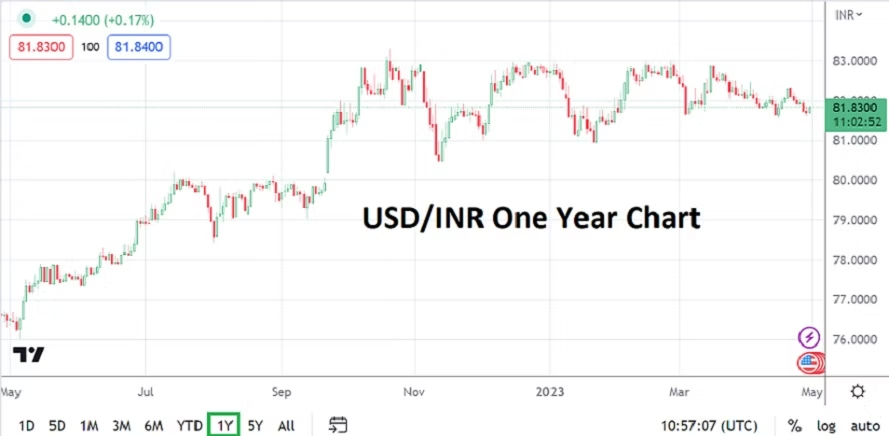
Is the Indian Rupee (INR) or CNY more relevant for international trade? Use of the INR and the CNY needs coordination with other countries many times. Australia is a good example regarding the ability to trade INR internationally. If Australia and India agree to make their payments for exports and imports in their respective nation’s currencies, trade can be conducted rather well, but then Australia would have to find another nation for its ‘extra’ INR, because it would likely suffer due to trade imbalances. It would be important for another country outside of India to agree to take INR from Australia for other trades. Potentially some Gulf countries could be open to these types of INR transactions. A bigger group of BRICS nations would help India certainly.
Saudi Arabia has recently agreed to sell oil for CNY, but shoring up CNY in their coffers has long-term implications. This as Saudi Arabia wrangles politically with the U.S occasionally. Saudi Arabia has demonstrated a desire to take on a seemingly more neutral tone and perhaps wants to limit its exposure to the strength of the USD, particularly if the U.S tries to make a weapon of the USD via political policy. Thus, India as the most populated nation in the world and a growing economic sphere of importance, has to make careful considerations moving forward as it positions its economic stature for complexities that will develop. India and Saudi Arabia may have visions of becoming great ‘neutral’ economic powers moving into the next one hundred years.
The Indian Government has made economic deals with Egypt, Sri Lanka and Malaysia for bilateral INR trade, but still no pure INR trades of significance have materialized according to official banking data. There are multiple headwinds for BRICS nations to overcome USD dominance in international finance. Whenever exchanges of INR or CNY to other currencies for trade settlement are needed, they need to first change the base currency to USD to buy RUB or AED. Few exporting countries will accumulate CNY without a total need. Holders of these currencies would likely dump the INR and CNY for USD via Forex.
China Economic Transparency is Lacking and the Future of India in BRICS
China doesn’t make it easy for foreigners to own assets in their nation. The China government does not want massive trade deficits and free capital flows are restricted with force. Who would invest in China and risk having their money being stuck in the nation without guarantees? China continues to ramp up its oversight and aggressive tactics of supervision of foreign owned companies that have operations in the nation.
Now and into the foreseeable future, the Chinese government will control transactions of CNY with an iron fist. The United States will likely remain the predominant place for trade because of its huge economy, and as a nation that allows many other countries and foreign citizens to own and invest their assets within it boundaries. There is still something to be said for transparency. Any new nation or coalition trying to challenge U.S government debt instruments are likely to fail. The U.S continues to be a place where nations can hold ‘safe assets’ with a guaranteed return of interest for the long-term. No country equals the asset size and security of U.S Treasury Bonds. On that basis alone, there will be a no challenge to the USD in the near future.
Liquidity remains an issue for capital flows and convertibility within BRICS. A lot of hard work via transparent trade agreements will have to be signed to get these issues resolved. Plenty of questions exist regarding China’s economic data and its reliability because of a lack of oversight from ‘recognized’ outside agencies which are often forbidden.
India is still having border issues with China and these problems remain unresolved. India’s role of leadership in G20 is hard to ignore despite its alliance with BRICS. The Indian government has advised traders not to speculate in CNY. This shows that strained relationships between China and India remain and a lack of trust regarding clarity continues. In the U.S, New Delhi is considered an important partner, one that can be trusted regarding the growing rivalry between the U.S and China. Prime Minister Narendra Modi, said last year, “this is not an era for wars”, and this shows India wants stability and wants to play a global role in diplomacy.
There is a definite strategy for BRICS to grow with the nations of the Middle East and others. Using their currencies for mutual trade arrangements could eventually work out, but it will take a long time for this to change the dynamics of USD dependence and dominance.
However, we shouldn’t forget that almost 40% of the world’s population lives in Asia. Yet, even if oil producing nations will trade in a BRICS backed currency basket, which has been dreamed about for a long time, China’s leader Xi didn’t highlight this goal while in Moscow or in Saudi Arabia during recent summits. China is certainly playing a long game, but it also shows they remain cautious and vulnerable to the strength of the USD globally. If Xi wanted to cause the greatest pain to the United States, he would liberalize his financial sector and make the CNY a true competitor to the USD with complete economic transparency, but that would take him in the direction of free markets and levels of openness that are likely the opposite of China’s domestic ambitions. A strong due diligence of the Chinese economy, is something Chinese leadership likely wants to avoid for the foreseeable future.
BRICS: A Multi-Polar World and Avoiding Confrontation
Many developing countries will want to avoid a confrontation consisting of China and Russia on one side, and Western powers on the other side. India has overtaken China regarding population numbers, and will likely become the world’s third largest economy before the end of this decade. India will become a strong voice in favor of a multi-polar world. Arguably, ideas of a more multi-polar world are being worked towards in pragmatic ways, but the BRICS coalition will not develop their own asset backed common currency unless they can resolve issues regarding trade and monetary agreements with transparency. It is a matter of trust.