Bank of Japan's 'Do As We Say' A USD/JPY FX Advantage Technically
Forex traders who have been keen on trying to venture wagers on the USD/JPY certainly cannot be faulted. As of this writing the USD/JPY is near the 157.720 vicinity, this after falling to lows around the 155.750 mark and below momentarily last Thursday, Friday and briefly yesterday.
The Bank of Japan let it be known in the middle of last week that speculators should not be buying the USD/JPY because they – the BoJ – could and would intervene with strong selling to kill off the momentum higher. The ‘do as we say’ approach from the BoJ is a contrarian trader’s dream, but one that needs as always a strong dose of risk analysis.

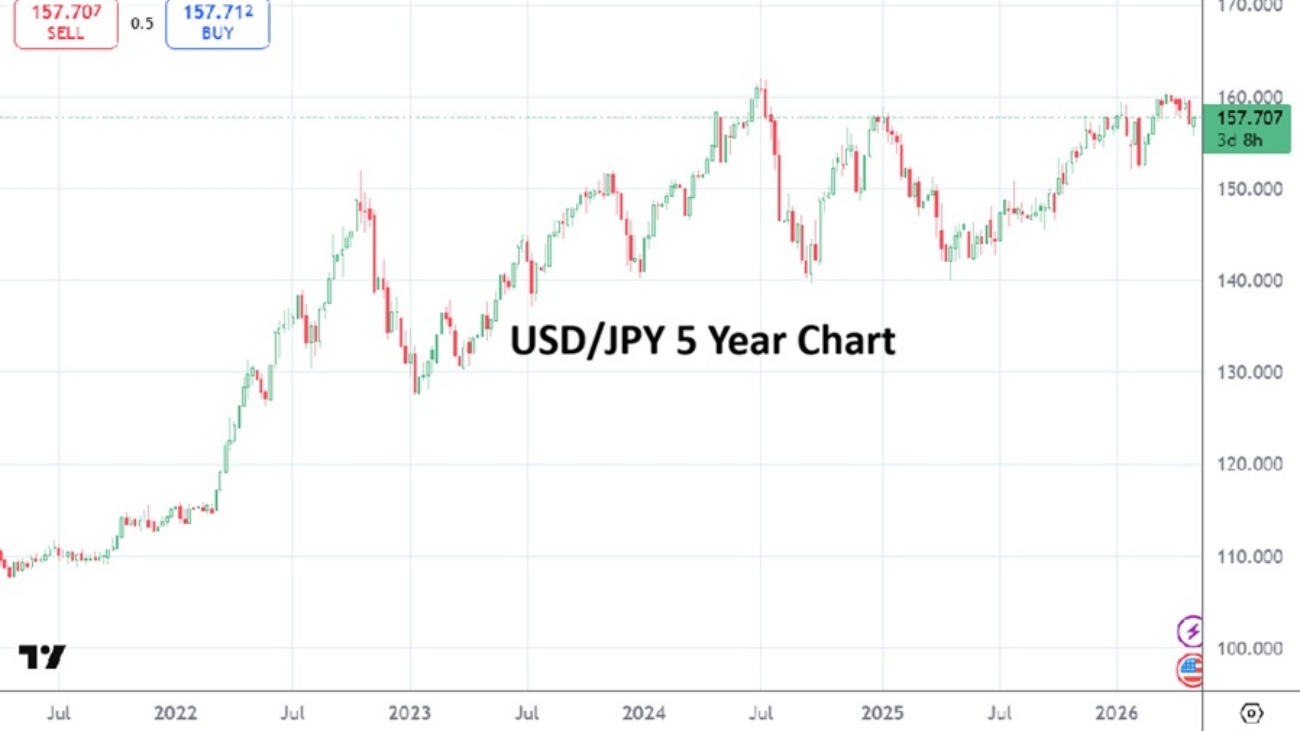
USD/JPY Five Year Chart on the 5th of May 2026
And this is where it gets properly intriguing for USD/JPY traders, because the Bank of Japan is literally setting the table for two different types of Forex trades when they threaten or actually intercede with interventions. One is a selling notion per the warnings, the second is a buying excursion for the emotionally stable after they think the intervention has run out of power.
A five year chart shows the immense pressure the Japanese Yen has been under as it has lost value against the USD. However, it is all about perspective depending on how a trader wants to chase momentum shifts.
Technical traders can easily see that when higher vicinities are approached the USD/JPY is sometimes met with spikes downward. And then technically it is rather evident that support levels tend to spur on buying. The problem for buyers seeking support levels after Bank of Japan selling is to know when it is safe to become a buyer again.
If a trader has courage and wants to bet against the large players and financial institutions leaning into long positions of the USD/JPY, a selling position at higher marks is a solid choice. Yet, the other question then arises – where is resistance going to actually translate into a warning sounded by the BoJ in order to create the desired landslides lower in the USD/JPY?
Bank of Japan policy regarding interest rates has only been in question for over 3 decades now from outside observers who like to be critical. Yet, the conservative (and questionable) policies of the Japanese government via fiscal and monetary policy is a looking glass into practicalities for Forex traders.
10-Year Japanese bond yields are now at twenty-nine year highs. The rate as of this writing is above the 2.50% level. The Bank of Japan Policy Rate remains low at 0.75%. While many analysts believe borrowing costs from the BoJ should be higher, what some might be missing is that the Japanese people are already being penalized via a weaker Japanese Yen. Higher borrowing costs and a weak Yen would likely not go over well with many Japanese citizens.
The Bank of Japan is in a difficult place regarding outlook as it tries to help keep exports strong, while also having to consider the higher costs of energy which is certain to hit Japanese industries over the mid-term. These considerations may cause some financial institutions to continue leaning into a buying outlook regarding the JPY, but near-term considerations must also be weighed as nervous sentiment cascades throughout the broad Forex market shifting abruptly.
USD centric price action has been choppy, but overall the USD has also been weaker against many major currencies and even emerging market currencies. Yet, the USD/JPY remains within its higher realm. All of the Bank of Japan warnings to speculators telling them not to pursue buying the USD/JPY continues to make the BoJ sound weak and this doesn’t help sentiment surrounding the JPY. While the Bank of Japan can certainly intervene with massive amounts of buying the Japanese Yen – selling the USD/JPY – the central bank also is probably quite keen on making sure the JPY doesn’t get too strong.
And this is where confusion must be put to the side, economics are wonderful when studied in a textbook, but the reality of trading the USD/JPY lives in the real world. Fiscal and monetary policies do not always work out the way governments intend.
The BoJ probably has a polite trading range they would like to see for the USD/JPY between 154.000 to 158.000 currently, but getting financial institutions to help achieve this realm remains difficult. The range between 156.000 to 159.000 likely remains a practical area for the BoJ as of now, one in which they believe their policies can work properly.
Opportunities need to be viewed with a proper lens by day traders. Participating in the USD/JPY is a dangerous place because the currency pair has massive volume and the BoJ and U.S Federal Reserve often work together to gear valuations – even if they frequently disagree on techniques. Price velocity in the USD/JPY will continue to prove dynamic in the near-term and speculators need to practice patience and keep their risk taking tactics strict.