AMT Top 10

AMT Top Ten Miscellaneous Insights on the 18th of May, 2026

Valuations and Drinking, Bad Storms and Politics Amidst the Resilient Nature of People

10. Resilience: The Western Cape of South Africa endured strong storm conditions last week. One of the hardest hit areas was the Cape Winelands District, but electricity and water have been widely restored. And a collective of people have proven working together can produce solid results when needed. 

9. Spencer Who: The Los Angeles mayor race is growing intriguing. A reality star turned social influencer threatens to become an influenza for his opponents. This as Spencer Pratt’s campaign gets noticed for its entertaining social media videos. This has caused many folks to ask what has happened to the state of politics and meaningful policy. But if NYC can elect a socialist, why can’t L.A elect an influencer and make some people feel sick?

AMT Top 10 Miscellaneous Insights for the 18th of May, 2026

8. Two Trillion: SpaceX early investors have agreed to allow a five for one stock split, meaning the company (and Elon Musk) are now aiming for a potential doubling of its worth when its IPO is initiated – on Nasdaq – in the second week of June. Some very serious accountants will be kept busy trying to show how SpaceX will produce enough revenue over the next twenty years in order to make a 2 trillion USD valuation palpable to future investors.

7. Drunk: Brown-Forman Corporation will begin its trading near $26.28 on the NYSE today. The company is the majority owner of Jack Daniels and other alcohol related enterprises. The value of Brown-Forman Inc. in June of 2021 was around 80.00 per share. The sobering phase of the public – particularly among young drinkers – to avoid bars and clubs, and instead stay on their mobile phones has hurt share values in many alcohol related companies. There are also concerns that too many drink companies now exists. Before Brown-Forman becomes the life of the party again, it appears some competition will have to go dry.

6. Deals: Prime Minister Modi visited Abu Dhabi a few days ago, and one of the results was an agreement to purchase and store energy reserves on a large scale in the United Arab Emirates. Modi also confirmed India’s strong connection to the UAE politically. While always trying to maintain a non-aligned stature, India appears to be moving closer to an increasingly important alliance with the UAE – which has also aligned with Israel strategically. The potential of these three nations acting together will ruffle feathers in a few noteworthy Middle Eastern and Asian countries.

5. Populists: President Trump’s tendency to say outlandish things and then suddenly turn around and show a willingness to negotiate terms has always been part of his art of the deal composite. However, saying what people want to hear and then turning on a dime and not delivering is also a symptom of populism. Trump isn’t the only politician suffering from this flaw. What do politicians really think, and how differently would they act if a they didn’t need votes for themselves or backers to remain in power?

4. Wall Street: After attaining apex highs early last week, the three major indices have taken a step backwards. Near-term concerns are effecting outlook as financial institutions balance risk averse tactics to long-term belief that sunnier days will prevail. While the Dow 30 didn’t set a record last week, the ability of the index to climb above 50,000 was noticeable. Equity markets appear tentative as this week begins and folks seemingly wait for more thunder and its potential effects.

3. Emirates: The UAE was attacked by drones yet again yesterday, this time at the Barakah nuclear facility. The hit has been downplayed, but highlights that military conflict with Iran remains very possible across the region. It is doubtful conversations are being conducted with polite undertones behind closed doors. The U.S, Israel and other nations are watching Iran – and Iran is watching them. The price of WTI Crude Oil remains a key barometer regarding the markets and concerns about the war igniting in full once more. Prices of oil remain sustained above $101.00 per barrel in the futures markets. The UAE might not want to be a focal point, but it isn’t backing down either.

2. Hawkish: The U.S Federal Reserve may have to actually consider raising interest rates before they can realistically discuss the notion of cutting borrowing costs, particularly if energy prices remain elevated and spark a sustained inflation threat over the mid-term. The USD started to show renewed strength the past few trading sessions in Forex, this as financial institutions compare their near-term anxiousness to growing concerns about mid-term ramifications regarding higher fuel costs.

1. Ego vs. Hubris: The U.S and China summit held largely in Beijing this past Thursday and Friday matched competing politicians and ideologies. In one corner U.S President Trump spoke with a rather inflated sense of himself while he detailed policy objectives and his perspectives. In the other corner Xi Jinping, the President of China, might have displayed some hubris as he warned the U.S about the Thucydides Trap. Xi expressed his belief that China is the emerging super power and that the U.S is a declining nation. However, China’s economy is known to be suffering because of a myriad of complex reasons, and could face more headwinds if energy prices and supplies remain hard-pressed.

Copy and paste the text from AMT that you want to share

Indian Diaspora 20260325

India Insider: Why the Gulf Remains a Vital Economic Lifeboat

Indian Expat Labour and Recalibration Realities

The skyline of Dubai, once a symbol of untouchable prosperity, now sits under a shadow of regional recalibration. As Reuters recently noted, Dubai has successfully transitioned to a non-oil economy, with oil accounting for less than 2% of its GDP. It is now a powerhouse of trade, high-end real estate, and financial services. 

However, its “backyard” – the Strait of Hormuz – remains a strategic bottleneck. With 20% of global seaborne crude passing through this narrow vein, the recent tensions in March 2026 have forced a shift in perception: the Gulf is no longer an insulated sanctuary, including Dubai where millions of Indians work and earn for their families in India.

Indian Diaspora Gulf Representation

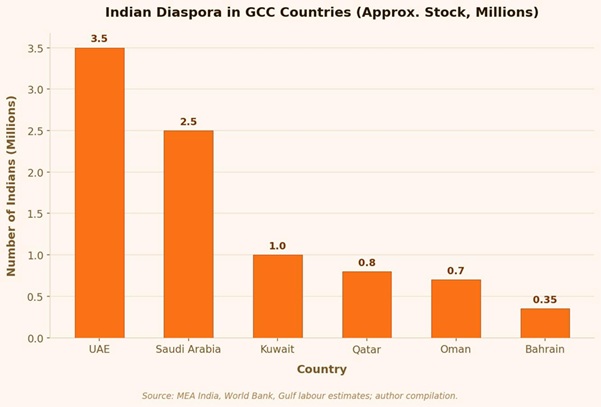
The scale of this “labour export” is enormous. As of early 2026, approximately 9.5 to 10 million Indians live and work across the GCC (Gulf Cooperation Council) countries. To put that in perspective, that is nearly the entire population of a country like the UAE, made up solely of Indian expats.

A Remittance Driven Economy

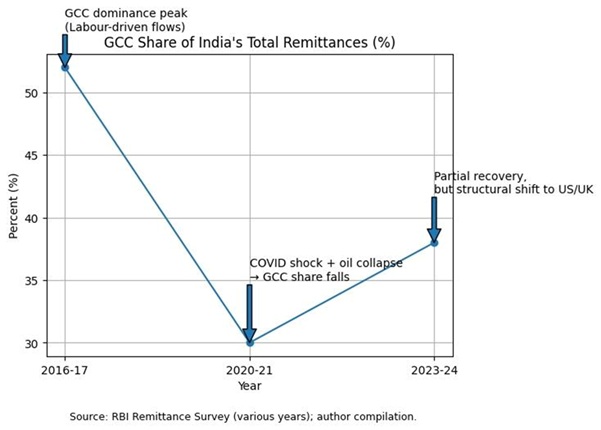
As per Government data sources, India remains the world’s top remittance recipient, with total inflows hitting a record $135.4 billion in the last fiscal year. And despite a rise in high-skilled migration to the US and UK, the GCC remains a juggernaut, contributing roughly 38% of India’s total remittances.

For states like Tamil Nadu, Kerala, and Maharashtra, which receive nearly 50% of these total inflows, it is a macroeconomic stabilizer that funds the current account deficit and keeps the Rupee from a freefall.

India’s Labour Market Paradox

But here is the real question, if people return to India due to the crisis in the Middle East, are there any “good quality” jobs waiting for them in India? The honest answer is no.

Youth unemployment remains elevated, particularly among graduates. Engineers in mechanical and construction fields face limited opportunities. Outside IT, and to some extent automobiles, there are not enough stable, high-paying jobs.

So people adjust. You will find postgraduates working in delivery jobs and informal sectors. I have personally spoken to Amazon delivery workers who told me they hold M.A degrees, or that they had worked in Dubai or Singapore before Covid and are now trying to leave again. This is becoming norm nowadays.

Indian National Wages and Savings Compared to Expat GCC Averages

In many towns in India, migration itself has become an economic model. People move to Singapore, Malaysia, or the Gulf, and the money they send back drives real estate, consumption, and local business activity. In many such regions, the labour market feels tight, not because jobs are available, but because the workforce has already left.

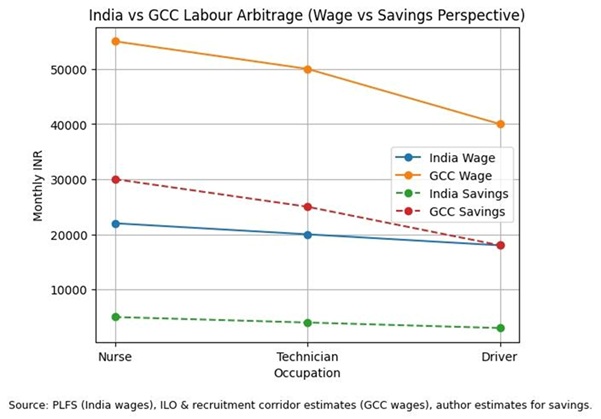
The wage gap explains everything. A nurse or lab technician in India may earn ₹15,000–₹20,000 per month. The same person can earn close to ₹80,000 in the Gulf. A private school teacher in Villupuram city in Tamil Nadu state earns around ₹8,000.

While nominal wages are  2–2.5x higher in GCC, the true driver of migration is savings arbitrage , which can be 5–6x higher.

This reflects structural differences in labour productivity and capital intensity.

India has a large pool of educated labour. But instead of becoming an advantage, it has turned into a wage suppressing force. There is always someone willing to work for less. As a result, wages remain low and bargaining power stays weak.

Percent of India’s Remittances From The GCC

At the same time, we are told growth is strong. Yes, the labour force participation is rising, but inequality is also increasing. A large share of employment remains informal and unstable. Inflation continues to erode purchasing power, and disposable incomes remain under pressure.

Right now, for many Indians, prosperous conditions are easier to find outside the country. Yes, the Gulf has risks. However, geopolitical tensions will come and go, and these are short-term disruptions.

Structurally, GCC economies will stabilize and grow again, and when they do, the flow of Indian labour will continue to pursue these opportunities. Because until India creates enough high-quality jobs at scale, migration will not slow down.

Copy and paste the text from AMT that you want to share

Iran What Losing Looks Like 20260323

Iran: What Losing Looks Like

Who is Losing Militarily, Technologically, Economically and Diplomatically?

Opinion: The following article is commentary and its views are solely those of the author. This article was first published the 20th of March via The Angry Demagogue.

It is difficult for many to admit that the US and Israel are winning the war and that conquering a country the size of France, Germany, UK, Netherlands and Spain together with only air power does not take a day or two. However, by any objective (meaning without thinking that all Trump/Bibi/Hegseth, etc. bad) standard, the allied coalition is systematically destroying the military industrial complex that is the Islamic Republic of Iran (what it is not is a State dedicated to the good of its citizens). People forget that the American air campaign in Gulf War 1 was 38 days. It started on January 17, 1991 and only by February 24 did the generals feel that they could invade and take Kuwait.

The air campaign then poured over 88,000 tons of bombs in approximately 100,000 sorties. And this to capture a country a bit smaller than New Jersey.

As we finish the third week of this war we can assess who is winning and who is not. We have spent this past week discussing what it means to be victorious in this war (The Economy and The Military) and to state unequivocally that victory is the moral choice no matter the price of oil. That being said, the price of oil is rising and hit $120 a barrel before dropping. Economists see $138 barrel as the price that could send the US into a recession. So far, the US economy is holding firm. The S&P 500 closed on the Friday before the war at 6740 and yesterday’s close was 6624 – a drop of about 1.7% – not the panic that the front pages would have us think. The Eurostoxx 50 is actually up slightly from 5719 to 5736.

The Federal Reserve did not cut rates, signifying that they don’t need to prop up the economy and risk inflation as they do when they fear a collapse.

The economies of the West seem strong in spite of (or because of?) the war which should end with the cessation of the 47 year of Islamic Republic price premium. The Russian and Chinese economies meanwhile will be under stress for quite some time. While China will have to wonder about its oil supply, Russia understands that $100 a barrel oil will encourage increased US production (and now Russian and Chinese free Venezuelan?) that will hurt them when oil prices go back to normal levels. As we will now discuss, Chinese and Russian arms deals might start to go south, too.

Technologically, this war is a further test of American and Israeli technology and abilities, and they have passed with flying colors. The American and Israeli missile and drone defense systems are outperforming what they did less than a year ago in the “12 Day War” and the U.S Navy is untouchable. The Gulf States are also fairing better than expected although due to the short distance and the lack of experience, they are getting hit more than Israel is. To top it off, the Russians have forced Ukraine to become global leaders in the defense against drones and there are now 2,000 Ukrainian anti-drone personnel in the Gulf States.

But is the air-forces that are performing so well, that one would think that the Iranians did not invest in the most advanced Russian and Chinese air-defense systems over the past few years. The S-300 or S-400 advanced Russian systems or the Chinese HQ-9B long range surface to air missile and the JY-26 (alleged) anti-stealth radar, are performing so poorly, the Chinese themselves must be hoping it is a personnel issue and not a technological one.

Speaking of personnel, this war has shown that pilot skill still matters. It is the bravery, daring and success of American and Israeli aviators that matters as much as the technology. Just look at the Gulf countries who fear sending their combined force of around 400 F-15’s and French Rafale fighters into the air.

The Russian air force (and army) has already shown it is lacking the skill to compete with even poorly trained Ukrainian pilots, let alone with American or Israeli aviators. The Chinese too, must be wondering if their air force, made up of untested, pilots from one-child families will brave the fire coming from Taiwan as well as the American and Japanese navies in order to complete their missions.

Technology is great – especially if it works as advertised, but if the “operators” are inferior, even great technology will not be up to par. No one yet has been able to match American and Israeli personnel, in the air or on the ground.

Which brings us to that annoying wild-card, the Straits of Hormuz. While the Iranians have not succeeded in closing the straits they are scaring off shipping to an extent that it is a concern not only for the present but for the future. By using this tool, by playing this card, if you will, Iran has forced the United States to make the security of the Straits a war aim. The success of the U.S operation in the Straits will turn it from an international waterway under the veto power of Iran to a U.S controlled and protected gateway from the Persian Gulf. In times of war with China the U.S Navy will be able to turn it into a Chinese energy chokepoint. If the U.S was not there prior to the Iranian gamble, they will be there now.

As for pure military, Iran is losing as no one has lost before. The combined forces have destroyed nearly all their production capabilities for military hardware, have destroyed air defenses, command and control centers, leadership on multiple levels and most of their navy. We don’t need much more to declare Iran the military loser.

Diplomatically, things are not as they appear. While no western European countries support the fighting or even the aims of the war, the Gulf States, India and others are quietly forming an unofficial coalition against regional terror. As Europe tries to figure out how to pacify its growing radical Moslem population, other counties, including Moslem ones, are finally realizing that terror against Israel and Jews slowly but surely works its way back to them. For fanatics, no one is religiously or ideologically pure enough, even if you are descended from Mohammed.

Western Europe is a clear diplomatic loser in this war as President Trump is the last person who will forgive their teachery and allow them to share in the spoils of this war. Their role in the Middle East and in global politics generally is done. Their ability to use their victory in WWI to determine and influence events around the world is finished even though they have now backtracked and agreed to help on the Straits of Hormuz issue.

Regarding China, they have now abandoned one of their main allies and the country they have depended on to provide them not only oil but a strong military presence in the Middle East. The war was clearly coming and just as the United States sent carrier groups to protect its and its allies’ interests, so too, could have China. They could have sent naval vessels to help defend Iran – or at least deter the United States but did not, either because they don’t have the ability to do it or they don’t have the will. In either case, China is a diplomatic loser in this war.

Russia is also losing the diplomatic game as Ukraine becomes closer to the Gulf states and Israel and America are neutering their best technology. Regarding Israel’s recent sinking of Iranian naval ships in the Caspian Sea, reports are coming out that they were laden with Russian military aid. Russia, like China, has not raised a finger to help their main Mideast ally, making it hard for them to claim the loyalty of other purported allies.

And Israel? Israel seems always to be a diplomatic loser, war or peace. However, this war has strengthened the bonds between the American and Israeli military in ways that no one could have foreseen just months ago. The cooperation and trust between the two militaries is beyond anything America has had since its partnership with the UK in WWII. Western Europe’s continued irrelevance on the global scene has lightened the pain the Israeli public feels for western Europe’s betrayal.

India on the other hand has tightened its ties with Israel as Prime Minister Modi’s pre-war trip to the country showed. As for the Gulf Countries, the UAE seems to be interested in strengthening its Israeli ties while Qatar does not. While Qatar is angry at Iran for their attacks it is not clear that this will lead them to abandon their goals of Islamicizing the West and ridding the world of Israel. Saudi Arabia is hard to call. We don’t expect any diplomatic breakthroughs especially if the Islamic Republic actually falls.

Israel we can say is neither a winner nor a loser, yet, in the diplomatic arena – which, considering the beating Israel gets on the world stage, might be called a win but most certainly is not a loss.

The United States can hardly be considered a diplomatic loser in this war as they are the only major power to be able to come to the aid of allies when U.S interests are also involved. The tough talk out of western Europe is a very small thorn in the side of the United States.

To summarize, Iran is the big loser of course as their support comes from a neutered Russia, an apathetic China and a global progressive left that has no power to influence, let alone determine events. Iran’s main allies have been proven ineffectual at best, uninterested at worst and their “brand” has been diminished no matter what else happens in the war.

The only part of the war that the United States and Israel can be said to be losing is the news and propaganda (but I repeat myself) war.

For the things that count though, one thing is certain – the United States and Israel are not the losers.

Disclaimer: the views expressed in this opinion article are solely those of the author, and not necessarily the opinions reflected by angrymetatraders.com or its associated parties.

You can follow Ira Slomowitz via The Angry Demagogue on Substack https://iraslomowitz.substack.com/

Copy and paste the text from AMT that you want to share

postR170

Middle East is Proving to be a New Playground for the Axis

Middle East is Proving to be a New Playground for the Axis

Opinion: The following article is commentary and its views are solely those of the author. This article was first published the 4th of July with an addendum on the 5th via The Angry Demagogue.

Blinken Gets Pushed to the Back of the Line

While the Biden-Blinken Administration is obsessing on “non-escalation” and telling allies they are on their own if they attack an Axis member that attacks the ally,  or that they will help the ally “defend itself” but not take the offensive (how you do that is a mystery) the Axis itself is establishing itself all over the Middle East.

Let’s start with a statement, quoted in Israel, by Alexander Dugin who is Putin’s ideological advisor advising the Russian leadership to arm Hezbollah and the Houthis in their fight against Israel. Earlier this week, Newsweek reported that Russia is considering arming the Houthis with cruise missiles. These could be used against Israel and against Saudi Arabia – or maybe U.S bases in the area. As Russia seeks to cement its ties with anti-Western countries and forces around the world, it seems to be partnering with Iran so as to increase the potency of Iran’s proxies and press their goal to rid the region of U.S forces. Toward this goal Iran and even Russia are manufacturing tanks together in Iran.

The Houthis themselves, under with the guidance of Iran, are attempting to expand their sea blockade from Bab al Mandab straits connecting the Gulf of Aden with the Red Sea, to the east African coast by cooperating with the Sunni and al-Qaeda based Somali terrorist group al-Shabaab al-Mujahadin. Reports in Israel quoting U.S intelligence sources claim that the two groups are cooperating and that the Houthis will supply weapons to al-Shabaab in order to interdict global shipping off the Somali coast and in order to harass U.S forces stationed in the area.

The anti-U.S alliance seem to be able to cross religious and ideological boundaries in ways that western intelligence thought impossible. That is because western (and Israeli) intelligence mis-categorize all of these groups and countries. The issue is not who is Sunni and who is Shiite, who is Russian Orthodox and who is Communist, but rather, who is for keeping the international status-quo and who’s for, to use a phrase meant for different times – a “new global order”.  

The Houthis, feeling confident in having defeated the U.S Navy in the Red Sea are now threatening Saudi Arabia for saying no to a Russian negotiated deal (under the auspices of the U.N and opposed by the U.S) which would bring an end to the embargo against the Houthis including their export of oil as well as Saudi financing of the Houthi civil government in the part of Yemen they occupy (they learned from Hamas and Qatar/PA/Israel that you really can have your enemies pay your salaries) amongst other goodies. They blame Saudi Arabia for allowing U.S jets to bomb Houthi sites from airbases inside Saudi Arabia – with no U.S carriers in the Red Sea that certainly could be true. In their threat they included videos of their bombing of Saudi oil fields in 2019 just in case the Saudis forgot. 

The Houthis, with their experience stopping shipping, have, according to a JCPA report been the point men for Iran’s plan to extend the sea embargo against Israel to the Mediterranean. This would not only hurt Israeli shipping but also the ability of its Air Force to operate properly. We wrote recently about Iran’s possible plans for Cyprus, including Hezbollah’s open threat to them, and this fits nicely with their plan to ring Israel with fire on all sides. We already know that Russian intelligence vessels are in the Mediterranean tracking Israeli submarines and that the Russian naval base in Syria is a safe haven for Iranian shipping. 

Just this week an Iranian vessel filled with arms for Hezbollah anchored in the Syrian port of Latakia (why did Israel not sink this??!!) which is 100kms (60 miles) north of the Russian naval base in Tartus, Syria – was it escorted in by the Russian Navy? Is that why?  

The U.S now has three main allies in the Middle East – Israel, Saudi Arabia and UAE, and with the exception that the UAE administration has a habit of criticizing and threatening these allies. 

It boggles the mind that Blinken does not see what the entire world sees – a so far successful effort rid the Middle East of the U.S and its allies. For Israel that means annihilation and for Saudi Arabia it means probably surrender to the Iranians while its royal family is allowed to enjoy their money (best case scenario). For the UAE it means it will be used even more than it currently is as an Axis financial center. For the U.S it means a withdrawal, not to the Western Hemisphere – but to the northern half of it. 

The Middle East is slowly becoming the playground of the Axis and it is just a matter of time before the West won’t be able to get a turn on the swings.

Addendum: A short follow regarding the Houthi ultimatum to Saudi Arabia

The Houthi’s gave the Saudis 72 hours to respond and respond they did. The Saudis have agreed to all the demands of the Houthis as they realized that the United States will not defend them from attack and are unwilling or unable to deter, let alone to destroy the Houthis offensive capabilities.

Amongst the Houthi demands that the Saudis agreed to are:

1. The re-opening of the airport in Sana’a, Yemen.  They will allow direct flights to bring pilgrims to Mecca, flights to Jordan and soon flights to everywhere. This will allow the Houthis to be re-armed by the Iranians via air transport.

2. Payment, by Saudi Arabia of Houthi government employees.

3. Allowing the Houthis to sell oil – ending the embargo.

This is a plan, as stated, sponsored by Russia and not opposed by the United States. It is a further move by the Axis into pushing the U.S out of the region. It is not clear if part of this agreement is for the Saudis to disallow U.S use of the Prince Sultan Ari Base for attacks on the Houthis.  

As an aside, the UAE has suggested that the U.S setup a base in Somaliland – a breakaway country in the horn of Africa on the coast of the Gulf of Aden and bordered by Djibouti and Ethiopia (and of course Somalia). This seems to be an attempt to rid the Gulf States of the responsibility to host U.S forces that attack Iranian proxies.  Could Biden’s “you are on your own if you attack Iran” (back in April after the 300 projectile attack on Israel) have influenced their decision?

Russia and Iran are on the rise in the region as the U.S administration preaches de-escalation and appeasement. 

Disclaimer: the views expressed in this opinion article are solely those of the author, and not necessarily the opinions reflected by angrymetatraders.com or its associated parties.

You can follow Ira Slomowitz via The Angry Demagogue on Substack https://iraslomowitz.substack.com/
post203

AMT Top Ten Miscellaneous Missiles for the 19th of April 2024

AMT Top Ten Miscellaneous Missiles for the 19th of April 2024

10. Fusion: The U.S Senate presented legislation yesterday which creates guidelines allowing the Nuclear Regulatory Commission to authorize commercial investment and research of fusion energy. Significant strides are being made in the technology and the U.S government is preparing for the newest developments.

9. Cup of Joe: Your cafe is going to get more expensive. Robusta and Arabica coffee both remain at higher values having hit apex prices respectively this Wednesday and Thursday. And Cocoa remains ‘comfortably’ above 11,000.00 USD per metric ton this morning.

8. United Arab Emirates: The UAE has been hit by heavy weather, suffering its biggest rainfall in 75 years. It was reported that over 14 centimeters of rain fell this Tuesday in Dubai, which is the equivalent to one and a half year’s worth of typical accumulation in the city.

7. India Elections: The vote in the world’s biggest democracy has begun as millions decide on the the Lok Sabha. The election process will take place for nearly a month and a half with the results formally being presented on 4th of June. The Bharatiya Janata Party is expected to win a majority in the House of the People, thus likely re-electing Narendra Modi as the country’s Prime Minister.

6. Gold: The precious metal remains within sight of record values with the price around 2,388.00 USD per ounce. Today’s earlier ratios touched the 2,420.00 vicinity.

5. Cone of Silence: Israel and Iran have remained mum on military counterstrike action scuttlebutt, which was heard this morning throughout global media. The silence from the two nations did not stop the Nikkei 225 Index from dropping over 1000 points upon the news.

4. Bitcoin Halving: A coding change is anticipated to occur soon in Bitcoin which will affect ‘mining’ parameters for the digital asset. The code change will double the amount processing needed to create one BTC, making it twice as expensive for Bitcoin operators. Day traders tempted to wager on BTC/USD over the next couple of days need to be careful. BTC/USD is near 64,560.00 at the moment of this report.

3. Fear Factor: Price of WTI Crude Oil is near 82.70 USD per barrel. Large energy traders continue to show they are experienced in geopolitics, remaining relatively calm as Middle East concerns are being brandished.

2. While Flag: U.S Fed Chairman Jerome Powell conceded that inflation remains stubborn earlier this week. Stagflation is not being discussed openly by the Fed, but it is likely raising concerns among global central bankers. The USD has returned to very strong levels as financial institutions brace for the possibility of U.S interest rates remaining high into the late summer.

1. Behavioral Sentiment: Equity indices, Treasury yields and Forex are within the midst of nervous seas as central banks and geopolitical concerns create storms. Speculators should make sure they pay attention to the waters they traverse with their bets, which could prove dangerous to navigate in the near-term.