post277

India Insider: Growth without Prosperity, Thoughts and Comparisons

Growth and Prosperity Data Meet India and China's Realities

Economic growth is important for generating prosperity. India as well as China has helped millions be lifted out of poverty using separate development trajectories. Still, questions about income distribution remain a difficult topic that policy makers in both nations often are unwilling to look at with deeper persistence because plenty of inequalities still exists and the subject remains potentially divisive.

China’s low income population is extremely large. Professor Li Shi’s research argues that nearly 300 million people in China are earning less than 1000 Yuan ($149 USD) per month in 2021, while nearly 98 million had monthly incomes below 500 Yuan ($75 USD).

The same is true for the majority in India. As per the Pahle Foundation research shows nearly 91% of India’s workforce remains in the informal sector where their annual per capita incomes are below ₹2.5 lakh Rupees or ₹20,800 Rupees per month ($217 USD per month).

Although industrial and wage models are different comparatively, for instance in China the industrial sector includes 32% of the total working age population and produces an estimate of 36 to 37% of the GDP. And 22% of China’s workforce are employed in agriculture and produce close to 7% of GDP. In India a higher share of the people are in agriculture – close to 45%, and generate roughly 15-18% of the nation’s GDP.

However, there are still problems in both countries regarding inequality via wage disparities of citizens. When income growth is stagnated or not growing, fixed assets capital formation is difficult. People save less and invest less, which in turn makes the economic consumption story difficult. This is happening in China and in India.

Regarding growth, Professor Li listed a series of mounting pressures: China’s growth rate has fallen from its high-speed era of 8 to 10% to around 5%. Household income growth has slowed sharply and the weakest gains are among the poorest groups. Urban wage growth has also softened. Consumption remains structurally weak. Fixed-asset investment, especially private investment has lost momentum. Unemployment, particularly among young people remains elevated. These are not separate problems. Taken together they raise a harder question, whether China can still generate the level of growth needed to meet its 2035 and 2050 prosperity targets?

India between 2015–2016 experienced significant growth driven by consumption, investment and services expansion. After Covid-19 its growth has stabilized around 6 to 7%, yet higher levels of prosperity are not clearly visible for many and inequality has widened.

The unemployment rate among those aged 16 to 24 in China has remained around 16% for an extended period, fluctuating during seasonal reasons. Unemployment among other age groups have also risen gradually, indicating clear pressure in the labor markets.

In India the unemployment for youth aged between 16 to 25 of age is 42%, per a Azim Premji University Surveys and State of Working India report in 2023. This unemployment rate is double the ratio of what we are witnessing in China.

While in China the education departments have shifted towards STEM (Science, Technology, Engineering and Medicine). India still focuses on Social Science curriculums and students who study within these fields often cannot find job opportunities in the labor market.

India for many years hasn’t invested a substantial amount of energy and commitment to build a vibrant manufacturing sector. Yet, studies have shown that every job created by manufacturing exports creates two additional jobs in related sectors like transportation and logistics. 

China’s wealth inequality via income has risen sharply, Professor Li Shi estimates the wealth Gini coefficient above 0.7 in 2023. India’s wealth inequality may be even more concentrated. Various estimates place India’s wealth inequality/income distribution per the Gini coefficient above 0.80, indicating an extremely unequal distribution of assets and accumulated capital. 

However, the structures of inequality differ between the two economies. In China inequality emerged alongside rapid industrialization, urbanization and export, and led to manufacturing growth. A large industrial economy generated substantial wealth – but distributed it unevenly between labor and capital. 

In India inequality is shaped not only by a wealth concentration at the top, but also by the persistence of low productivity via employment, informal labor markets, weak wage growth, and limited human capital investment across large sections of the population. Thus, while China faces the challenge of emphasizing prosperity within a middle income industrial economy, India continues to struggle with the deeper structural problem of trying to create broad based household income growth in the first place. The differential also sheds light on industrial sector based employment and those in agricultural jobs comparatively between the two nations regarding wage context.

Hard questions that China should ask include if their employment force – who are without many social protections and suffer a lack of higher wages, will allow China to attain competitive advantage over the rest of the world? While its manufacturing products are in demand, it doesn’t help the average Chinese person see realized wages go up and nor creates a dignified life. And China’s trading partners do not benefit, because a lack of competitive advantage destroys industries and makes unemployment problems even worse in other nations. It’s not a question about advantage only, it’s also about why this surplus and deficit competitive problem is growing rapidly and makes stable prosperity unachievable over the long term.

In India despite being proclaimed as the fastest growing global economy, if the young population don’t get jobs and cannot create income for their families, then what’s the purpose of this high GDP growth? Yes, the nation gets to show good growth numbers while hoping to achieve additional investment, but problematic results still occur.

Economic growth without wage growth leads to widening inequality, social unrest and sometimes political backlash. For growth to be inclusive, wages need to rise along with GDP. This requires not just distribution, but a transformation like raising the average productivity of every worker and ensuring they receive their fair share of the economic pie.


Copy and paste the text from AMT that you want to share

postN105.1

India Insider: Agriculture Still Traps Nation’s Workforce

India Insider: Agriculture Still Traps Nation's Workforce

A Field Survey in South India’s Agricultural Towns

India’s growth story is usually told through noteworthy headline numbers. Yet beneath these aggregates lies a persistent imbalance, agriculture continues to employ a large share of the workforce, while contributing a much smaller share of output. This gap shapes income stability, consumption patterns, and the complicated experience of growth across much of the country for many people.

This essay uses field observations comparing two major agricultural towns in Tamil Nadu State in India, Tiruvannamalai and Kallakurichi. After analyzing their respective data and examining how this imbalance plays out on the ground, I offer my perspective.

Typical Agricultural Field in Southern India

Tiruvannamalai: Growth Without Employment Transformation

In Tiruvannamalai district, I visited several areas where housing conditions were poor and informal settlements were widespread. I have visited many households here since 2023. These conditions are now changing, but not in a way that fundamentally transforms employment.

Capital inflows from the neighboring State of Andhra Pradesh have fueled a real estate boom and expanded services such as lodging, restaurants, and transport. While this has altered the physical landscape and raised asset values, it has not created stable non-farm jobs at scale. Employment remains largely informal, seasonal, and low-paid, leaving the underlying agricultural labor trap intact.

Although Tiruvannamalai exhibits a relatively high services share in district GDP, the income generated by this sector accrues from a narrow group of asset owners, intermediaries, and rent-seekers. As a result, per capita income figures overstate the extent of broad-based welfare. A large share of the workforce remains engaged in low-wage service activities with limited income security.

Kallakurichi: Agricultural Dependence, Weaker Services

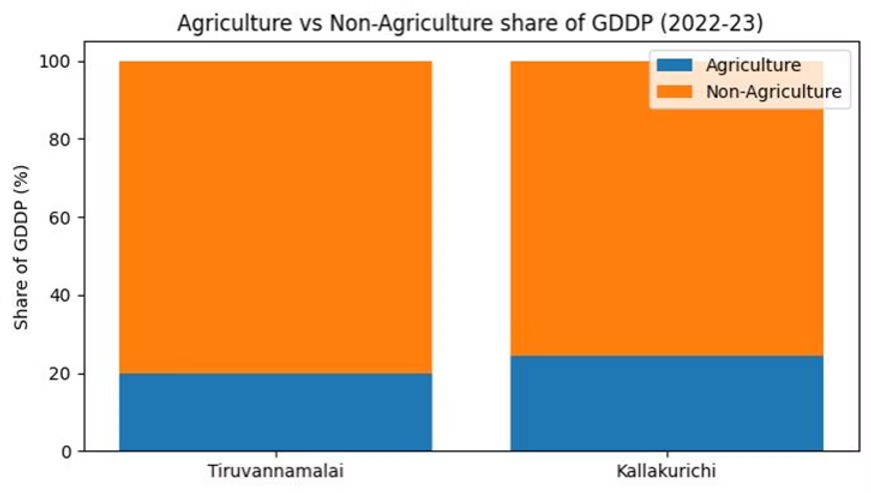
In Kallakurichi district, the structural imbalance is even more pronounced. Agriculture accounts for a noticeably larger share of district GDP than in Tiruvannamalai, while the services share is correspondingly lower. District level GDDP and sectoral composition data from the Department of Economics and Statistics, Government of Tamil Nadu (2022–23 provisional, current prices), show that agriculture contributes roughly one-fifth of district output, even as a disproportionately large share of the workforce continues to depend on this type of work for income.

This high dependence on agriculture results in extremely low output per worker, widespread disguised unemployment, and chronically weak incomes. Growth exists, but it is concentrated in activities that do not absorb labor effectively.

Gross Domestic District Product Comparison of Agriculture versus Non-Agriculture

Core Problem: Growth Composition, Not Growth Absence

The core structural problem in districts like Tiruvannamalai and Kallakurichi is therefore not the absence of growth, but its composition. Too many workers remain tied to a sector that generates relatively little value. Services and industry have expanded, but not in a manner that absorbs surplus rural labor at scale.

As long as labor remains trapped in low productivity farming, while non-farm sectors fail to provide stable employment opportunities, headline income measures will continue to overstate actual welfare.

Consumption Consequences of Agricultural Dependence

This imbalance has direct consequences for consumption. Towns that depend heavily on agriculture tend to exhibit weak and uneven consumption patterns. Farm incomes are inherently volatile, driven by fluctuations in commodity prices, weather conditions, and market access. In many cases, farmers are forced to sell produce at a discount, incur outright losses, or delay sales under distressing conditions. Only intermittently do they realize meaningful profits.

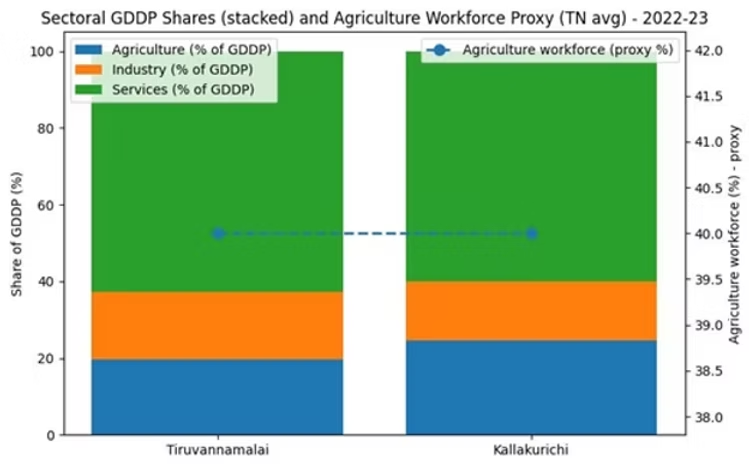
Chart Comparing Towns of Tiruvannamalai and Kallakurichi in Tamil Nadu

This volatility translates into cautious spending behavior. Consumption rises in short bursts following a good season, but thereafter contracts sharply. This pattern is clearly visible in districts such as Tiruvannamalai and Kallakurichi, where agricultural dependence suppresses steady consumption despite occasional income windfalls.

The same dynamic is visible at State level. Across Tamil Nadu, agriculture employs over 40 percent of the labor force, while contributing a far smaller share of output. The statistics exhibited at the district level are therefore not an isolated phenomenon, but a systemic one.

National Structural Imbalance

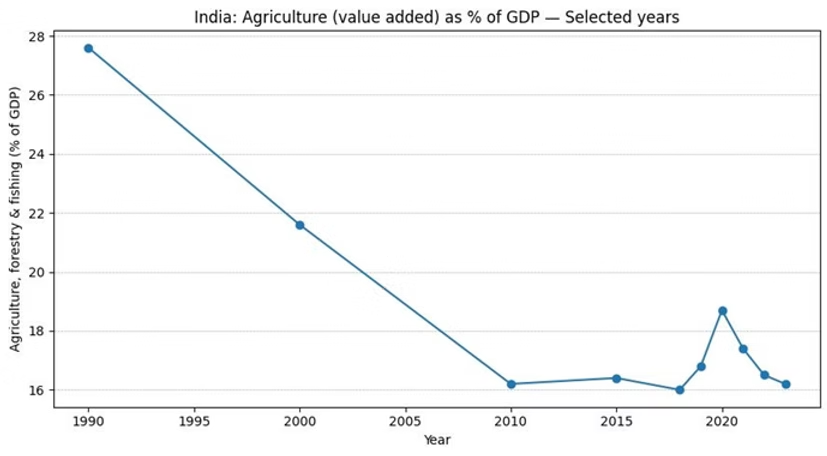
Zooming out further, what is visible in Tiruvannamalai and Kallakurichi mirrors India’s broader structural imbalance. Nationally, agriculture employs close to half the workforce, but contributes less than a fifth of GDP. This gap suppresses incomes, weakens consumption, and reflects India’s limited success in industrializing at scale.

India Agriculture as Percent of GDP from 1990s into 2020s

Services have grown rapidly, but they remain reliant on capital and skill intensive, and unable to absorb surplus rural labor in large numbers. As a result, economic growth continues without broad based prosperity. Headline GDP numbers improve, but the underlying structure remains fragile.

India’s central economic scrouge is growth without labor mobility. Until workers move out of low productivity agriculture jobs and into stable non-farm employment at scale, income volatility and weak consumption will remain defining features of the economy. Regardless of how strong the headline growth numbers appear, a national challenge remains.

Copy and paste the text from AMT that you want to share

post269

India Insider: Labor Productivity and Rising Household Debt

India Insider: Labor Productivity and Rising Household Debt

The desire for India to become a fast growing economy can be alluring, but without proper distribution of income and improved labor codes, this remains a major challenge to achieve. During coronavirus, acute problems were faced by those working in private enterprises. While some businesses and institutions supported their employees, many people were left behind without social protective measures.

According to Business Line newspaper analysis, from July 2022 to June 2023, an average salaried Indian male made 20,666 Rupees ($236 USD) and a woman made 15,722 Rupees ( $180 USD) per month.

Experience tells us that lower salaries in the rural areas are pervasive. Many private sector nurses, schoolteachers, and other service workers earn less than the international poverty line of $3 per day (around 250 Rupees per current Forex). Sometimes due to extensive workforce supply, some educated people must work blue collar service jobs additionally to make their ends meet.

Agriculture and Low Productivity:

Wage disparity and underemployment exists rampantly. Half of India’s labor force works in agriculture, where productivity is poor. In agriculture, farmers are both producers and consumers. There are barriers in food supply and demand for agricultural products. Farmers need access to local markets where their buyers can afford to purchase their produce. Without solid markets or better road infrastructure to reach them, many rural areas have less incentive to improve productivity.

As a result, many farmers produce low volumes. This is also one of the reasons why New Delhi is reluctant to permit U.S imports of agricultural and dairy products. Smaller farmers cannot afford to invest in education, which hinders their efforts to move into industries with higher wages. Without increasing labor productivity and better opportunities, most of the population will continue to work in agriculture.

Stagnant Wages, Informal Work and Problems in Micro-Finance:

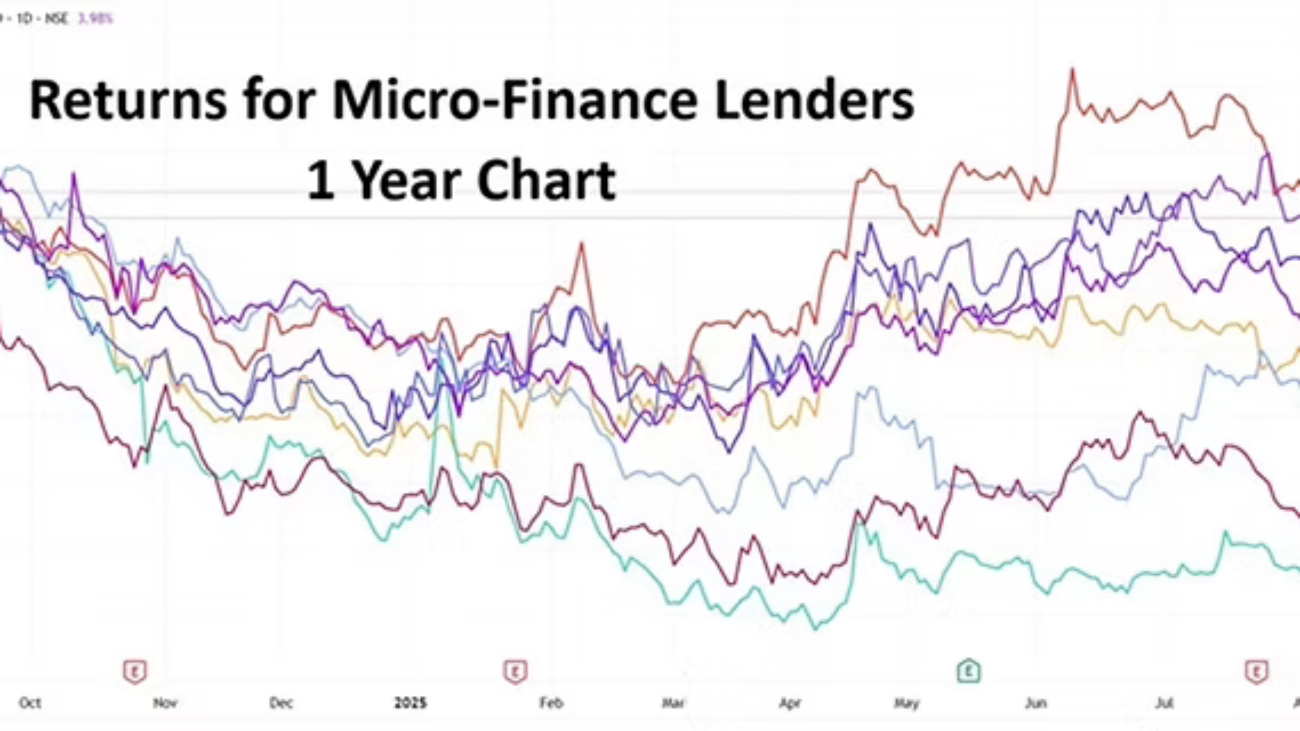
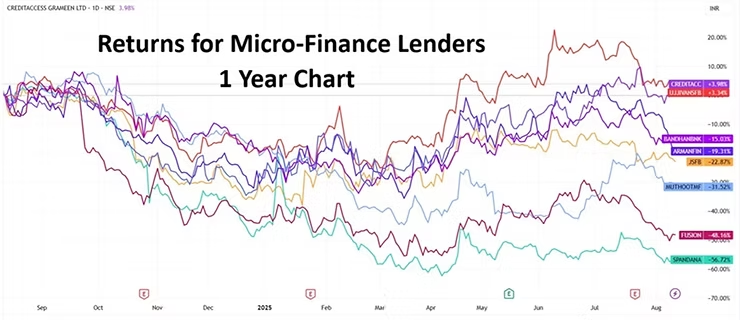
India’s Micro-Finance Lenders Culminative Returns Past Year

A large portion of the workforce is employed via informal and low-paying jobs. If wage growth does not keep pace with increased productivity, domestic consumption will remain weak, making the economy more fragile during global downturns. Drivers and gig workers provide some insights because of their inability to make ends meet. Minimum wage policies are lacking for many gig workers. Employees work higher hours in these enterprises. Yet another reason why Indian households prefer to prepare their children for government jobs.

India’s micro lending industry is under stress as delinquencies rise at an alarming pace. This has prompted the Reserve Bank of India to intervene and impose fines on lenders charging excessive interest rates. Loan disbursements shrank 13.5% year-on-year, and shares of some small finance banks have fallen, this as they have been forced to set aside higher provisions for bad loans.

Total loans outstanding in the industry are around 3.75 lakh crore rupees ($43 billion USD) in financial year 2025, with non-housing retail loans accounting for nearly 55% of total household debt. Small ticket loans were meant to ensure financial inclusion in underserved areas. The RBI defines microfinance as collateral-free loans to households with annual incomes of up to 3 lakh Rupees (approximately $3,400 USD).

But when wages do not rise in line with inflation, households begin to borrow to cover deficits, often at high interest rates. This creates risk for small finance banks when borrowers default, besides many consumers who are clearly struggling. A bank employee in Tamil Nadu has said loan disbursements are now scrutinized more closely, and applicants with monthly EMIs – equated monthly installments – above 10,000 Rupees ($115 USD) are no longer eligible for micro-loans.

Job creation in the Manufacturing:

Despite media portrayals of India’s manufacturing ascent, Harvard economist Dani Rodrik offered a compelling remark paraphrased here which points out obstacles ahead, ‘what made manufacturing a vehicle for transformational growth was its ability to generate productivity while drawing unskilled labor from traditional farming’. Rodrik seems to believe manufacturing remains a lower income sector in India due to its large work force and inability to transform efficiently, while also facing globalization problems from other Asian competitors.

The reason why manufacturing companies in India can pay lower salaries is because of high unemployment ratios and a steady supply of new graduates every year, making it easy to find new employees. Wages don’t see much improvement because workers are replaced easily. Many employees working in manufacturing actually have engineering and Masters’ degree backgrounds. Their average salary is around 15,000 Rupees a month ($170 USD), the same amount paid to low skilled employees who have technician diplomas.

India needs to work on improving core manufacturing capabilities, creating better infrastructure via land reforms and logistical capabilities. Implementing a fair minimum wage policy would also influence the economy via better household wages. Yes, inflation is a concern, but India’s aspiration to become a $10 trillion economy will remain hard to attain unless coordinated policy changes occur.

Notes: 1 USD = 87.5 Rupees