WTI Crude Oil 20260309

Fear Factor High in Oil Markets and Outlook is King

WTI Crude Oil Trading in a Storm (War)

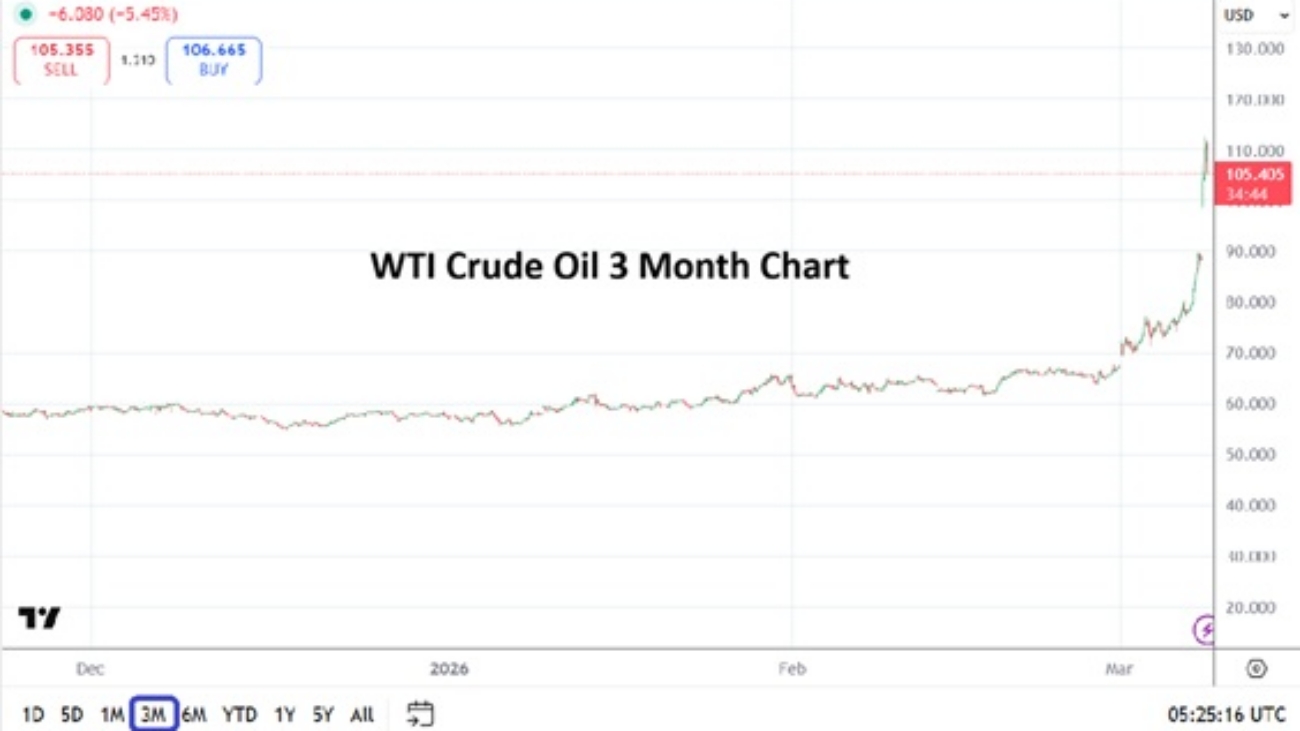
Writing from within the storm, it would be easy to feel a strong sense of nervousness as the newest Middle East War rages. However, this is unlikely the beginning of World War 3. Traders looking at WTI Crude Oil this morning have seen the commodity launch over $110.00. But the price has seen a slight dip and is now hovering above $105.00 in albeit fast conditions.
WTI Crude Oil Three Month Chart on 9th March 2026

Behavioral sentiment is nervous, there is no disregarding that notion and taking it seriously. Iran has been firing missiles and drones at neighbors and Saudi Arabia has been effected via some of their oil production. The Strait of Hormuz is certainly seeing an escalation in tension and is threatening to become a sea battle.

However, while the price of WTI Crude Oil rocks higher and day traders either make or lose money fast, speculators wager on short and near-term notions, there is likely a group of folks taking another approach and watching cash prices compared to options.

Yes, the intra-day price of WTI Crude Oil and all other energy sources will remain volatile near-term, but those with a mid and long-term outlook may be betting on optimism and the belief an end game will produce calmer prices. 

WTI Crude Oil is up close to 40% percent when a mid-term perspective is used. Will the commodity remain above 100.00 USD six months from now? Will WTI Crude Oil be above $100.00 three months from now or even one?

This thinking may deliver some type of price resistance in WTI Crude Oil. Certainly, there is a chance of greater escalation. But even though it was widely reported that oil facilities in Iran were bombed this weekend by Israel, the terminals hit were on the outskirts of Teheran, not on the island of Kharg. As dangerous as the war has become and the potential of worse damage occurring, those who are striking Iran do not want to damage Kharg terminals – at least not yet.

As for endgame, Russian oil is being allowed to be sold more easily, sanctions have been relaxed. Thus, it can be said there are international efforts to fight against price spikes. There are concerns about higher oil prices causing bedlam via inflation for the global economy rightfully. However, at some juncture things will eventually calm down. And that is what day traders need to keep in mind as WTI Crude Oil has raced higher, the notion that tactically the Iranian war will reach a de-escalation period is reasonable. 

Yes, there is a threat that Iran plays the an ‘Armageddon’ card and tries to destroy all vital energy resources in the Middle East, but we have likely passed that stage. Iran in many respects, respectfully, has been declawed. Iran can threaten, but can it really bite at this point? The island of Kharg is a key barometer, its facilities remain mostly kept out of the destruction zone, WTI Crude Oil may not spike too much higher.

As for highs, this morning’s jump occurred on fear, however the price has started to calm. We could certainly still see higher values in WTI Crude Oil this week or next, but thoughts about the potential of an end game resolving the current dangers, whatever that may be and no matter how long it will take – may prove to be an important ointment.  Time shall tell.
Copy and paste the text from AMT that you want to share

postN99

Regional War Spreads: Will Blinken Wake Up to the Reality?

Regional War Spreads: Will Blinken Wake Up to the Reality?

Opinion: The following article is commentary and its views are solely those of the author.

Despite the denial of reality by the Blinken State Department the Middle East war gets hotter and spreads eastward (even without) Israel’s intervention. After spending years appeasing the Iranians the world is now faced with the results of that policy. 

Iran has trained and funded terrorists in Gaza and the West Bank where the high intensity battles continue. In Lebanon-Israel there are close to 100,000 Israelis displaced, and it seems more Lebanese have left the area south of the Litani as heavy rocket, tank, artillery and air attacks continue from both sides of the border. Attacks have intensified against Israel from Syria and Yemen, and Iranians and their militias are attacking U.S forces in Iraq and Syria. Turkey, Russia and Syrian forces continue bombing areas of northern Syria and now both Iran and Turkey are bombing Kurdish lands.  

We know what is going on in Yemen and the surrounding seas with global shipping coming to a standstill there, and diminishing Suez Canal traffic is slowly crippling an already disastrous Egyptian economy. The U.S and the U.K have been forced to bomb Houthi areas, but this of course is after the total failure of the Blinken foreign policy of ‘ending’ the war in Yemen by cutting arms sales to the side that was pro-West while encouraging Iran to continue funding, arming and training of their Houthi allies.

A new front has now opened between Pakistan and Iran. We spoke earlier of the Sunni-Shiite war heating up, but it has spread faster and more violently than we expected. 

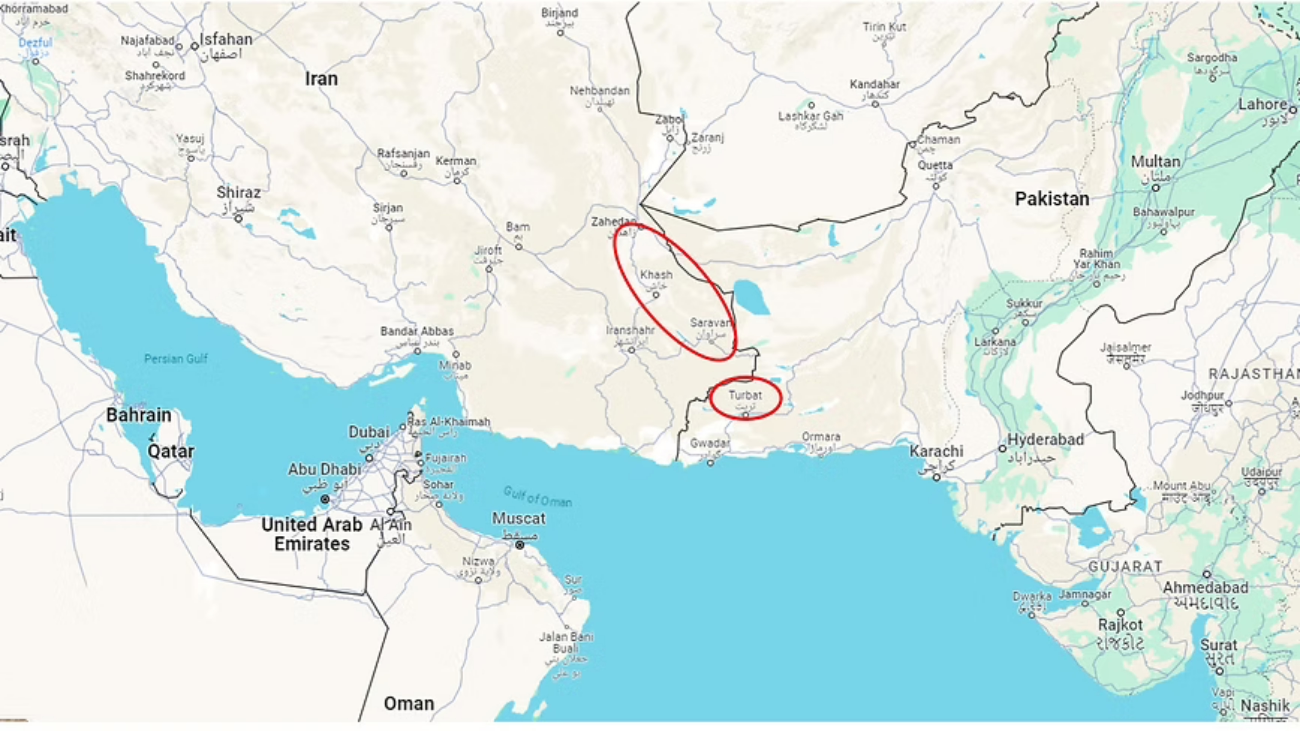
Over the last few days fighting on the Iran-Pakistan border has heated up. It started with heavy fire between the Pakistani group Jaish ul-Adl and Iranian border guards in the Sistan-Baluchestan border area, and included the assassination of Iranian Hussain Gwadanfur on the Khash-Saravan road.

In other clashes between Iranian and Pakistani forces at least two Iranian Revolutionary Guard (IRG) soldiers were killed, and the IRG has shot rockets into Pakistan hitting Turbat and surrounding areas near the coast.

Pakistan’s Ministry of Foreign Affairs released a statement claiming that they “undertook a series of highly coordinated …. precision military strikes against terrorist hideouts in Siestan-o-Baluchistan province of Iran”. At the end of the press release they speak of Iran being a “brotherly country” with “great respect and admiration for the Iranian people”. It seems that Pakistan does not want to publicly admit that official Iranian forces were involved in the attacks.

What is incredible about Iran is that they have now attacked three nuclear armed states – the U.S, Pakistan and Israel – without fear of retaliation. We can only imagine what the Revolutionary Islamic Republic of Iran will do once they too have a nuclear weapon.

We are in a regional war with fighting going on daily from Pakistan to Libya. Iran, not Israel, is at the center and is the cause of nearly all the fighting and tough statements and tough actions need to be taken against Iran – not Israel. Senate majority leader Schumer has been quoted as saying that he wants to put extra conditions upon the sale of arms to Israel, but where was he when Obama sent planeloads of cash to Iran and Biden-Blinken released further billions in November of 2023? Where are the conditions placed on a terrorist state?  

The Biden-Blinken foreign policy of appeasing enemies and threatening allies that is at the core of its operation continues apace. First with the cutoff of arms to Saudi Arabia and their Yemeni allies in order to “end the war” and then to “advice” the Ukrainians not to provoke the Russians, and next heavy pressure on Israel to ‘surrender’ to Hamas by leaving them in power.  

One can make deals with countries that are interested in their people. One cannot make deals with terrorist groups or revolutionary states that are looking to upend the global order. That is Iran in a nutshell. 

Disclaimer: the views expressed in this opinion article are solely those of the author, and not necessarily the opinions reflected by angrymetatraders.com or its associated parties.

You can follow Ira Slomowitz via The Angry Demagogue on Substack https://iraslomowitz.substack.com/

postN45

Dangerous and Unpredictable Duties During the Vietnam War

Dangerous and Unpredictable Duties During the Vietnam War

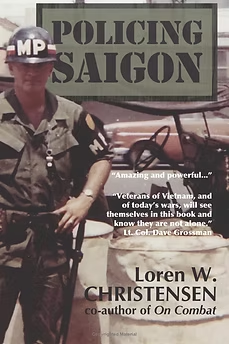
Book Corner: Policing Saigon, written by Loren Christensen.

War stories have always fascinated the public, ranging from Erich Maria Remarque’s

World War One novel All Quiet on the Western Front, to Alistair MacLean’s World War Two thriller The Guns of Navarone, up to the more recent American Sniper,

Chris Kyle’s autobiography of his combat experience in Iraq. Ex-cop and noted martial artist Loren Christensen throws his hat into the ring with Policing Saigon, the story of his

year as a military policeman patrolling the capital city of South Vietnam during the Vietnam War. Told mostly as a series of vignettes, Policing Saigon is at times dark-humored, shocking, sad, grisly, and even touching. (A note about terminology – in 1975 Saigon was renamed Ho Chi Minh City, and in 1976 South Vietnam merged with North Vietnam to become simply Vietnam.)

A cop in Portland, Oregon for 25 years, and a karate practitioner since his teens, Christensen is known mostly for a series of well-regarded policing and martial arts books. In Policing Saigon, he tells his story slowly and methodically. Growing up in suburban Washington state, his goal in college in the late 60’s was to break into radio and theater. Christensen took the initiative of enlisting, viewing the military police as an experience to draw upon for the acting world and incorrectly thinking that MP volunteers don’t receive overseas assignments (he notes that he was lied to by the recruiter).

After basic training, Christensen went through the range of military police courses such as language school and dog training. But after landing in Saigon in 1969, the 23-year old quickly realized that he was unprepared for the tough and thankless job. The MPs worked 12-hour shifts, seven days a week that often went hours into overtime in a sprawling, stifling hot and dirty city, hit hard by the war. The roads were clogged with haphazard and unregulated traffic that resulted in frequent accidents, some of which Christensen witnessed and some in which he was involved. The city was known for wretched poverty and was full of beggars, often children forced by their parents. The pollution was so severe – and the humidity was so brutal – that he developed both respiratory and fungal infections that took months into his discharge to heal.

The job was dangerous and unpredictable. The military police were hated by everyone, especially by those that were sympathetic to the Vietcong. The hate extended even to American GIs, since the MPs were often called in to arrest violent and drunken soldiers letting off steam on leave from the jungle. Christensen and his partners were also frequently called in to arrest AWOL (absent without leave) GIs, who flocked to Saigon in staggering numbers. He writes that in his tenure the number of AWOL soldiers never dipped below eighteen hundred. The American soldiers did not always go quietly and often resisted arrest, sometimes turning the scene into a brawling and bloody mess where the MPs needed backup.

As Christensen writes, the military police were also sitting ducks for all forms of terror, the perpetrators of which were impossible to catch. Snipers were liable to pick at them from nearby rooftops or windows, or bombs could be placed quickly and inconspicuously inside the military jeeps – even by children. Their job sometimes had them chasing thieves down dangerous, narrow, and winding alleys, frazzling their nerves and keeping them on edge. Even worse, as he writes, off-duty MPs were often unable to truly relax. Nighttime brought the sounds of artillery from the war’s front lines, serving as an uneasy and troubling background noise. Other MPs reacted to the stress of the war and their job in a number of ways. One of his early roommates casually kept a live python in a locker, mere meters from Christensen’s bed. Another inexplicably began shooting from the MP barrack’s balcony towards a truck transporting America’s allies, the South Vietnamese soldiers.

Crime against the American soldiers was rampant. Christensen writes that gangs of local thieves devised creative ways to steal from the American supply trucks, fueling the black market. Riding on motorbikes behind and alongside the trucks, they performed gravity-defying gymnastics while in motion as they would grab merchandise off the vehicle and speed off before unsuspecting driver realized what happened. Other crimes involved hookers. Sex-starved soldiers on leave would follow a hooker down an alley for a quick hookup and would instead be robbed. Others would actually engage in the act in the hooker’s room, while under the bed an unseen partner-in-crime (sometimes the girl’s mother) would reach out and pluck a few bills from the unsuspecting soldier’s wallet.

There are touching moments in the book, if one can call it that. Christensen isn’t a touchy-feely guy and his descriptions of these interactions come across as matter-of-fact and straight-forward. He writes of his admiration for the mainstream Saigon residents, mostly decent people trying hard to eke out a living. He notes their survivors’ mentality, and describes as they shrug off hardships and get back on their feet. In another chapter, he writes of meeting a group of cute Vietnamese kids, friendly and smiling to the MPs. But they were basically homeless street urchins living a hard life, sadly sleeping in a nearby cemetery. He writes of saying goodbye to his parents before shipping out to the army, facing an unknown future. And in one of the book’s most touching moments, he writes of his homecoming a year later, sitting quietly in his childhood room, the horrors of the war behind him.

Christensen was discharged in mid-1970 and less than 48 hours later was back home, a transition that was so fast it was jarring. He writes of his difficulty in adjusting to civilian life, suffering from PTSD until the return to martial arts would quiet his soul. He would later draw upon his MP experience for his police career, viewing it at five years’ experience combined into one year. A brown belt in karate at the time of his service, he realized that a more realistic and practical street-fighting style was needed, which he later taught privately and also to the police and military.

Christensen would be the first to admit that this not a book of heroics. This is not Band of Brothers or The Sands of Iwo Jima. But he took his job and his service in an unpopular war very seriously. The book clocks in at over 300 pages but his stories will hook you in. A worthwhile and moving read.

If you want to read another Book Corner article, please visit this review by Evan Rothfeld: https://www.angrymetatraders.com/post/ten-more-ok-now-twenty-finish-thirty-next-run-the-hill.