post289

India Insider: Speculation, IPO Mania, and Capital Erosion

India Insider: Speculation, IPO Mania, and Capital Erosion

A speculative frenzy is reflected nowadays via India social media around quarterly results and IPOs. Animated talk about investment potential in India can be compared in some respects to the Dot-com bubble in the U.S which grew in stature into the late 1990’s and peaked in March of 2020 before imploding. Retail speculators in India rush into untested technology stocks hoping for quick profits, often without understanding the businesses. Avoiding a Dot-com like crash is important.

Hedge funds and institutions with their superior supply of capital often speculate across stocks, bonds, Forex and commodities as part of their strategies. However, retail investors should only purchase individual corporate stocks like pieces of businesses which they want to own when they have the ability. Market fluctuations lower can be used to buy quality companies when intrinsic value has been discounted allowing investors with limited funds to take advantage of stock volatility.

Charlie Munger, the right hand man of Warren Buffett, when asked what the secret of running Berkshire Hathaway Inc. was replied, “Warren likes to say, just tell us the bad news, the good news can wait. So people trust us in that (decision making process), and that helps prevent mistakes from escalating into disasters. When you’re not managing for quarterly earnings and you’re managing only for the long pull, you don’t give a damn what the next quarter’s earnings look like.” And this has proven to be advice that all investors can learn from.

Lessons from Yes Bank and Ola Electric:

Many speculative investors rely on technical charts using support and resistance patterns for trading decisions. This frequent buying and selling enriches brokers but rarely investors. Technical trading entices because it often is easier to look at a chart and feel that by glancing at past results you are able to predict the future, but this frequently proves to be incorrect. Fundamentals should always be a large part of investment decisions.

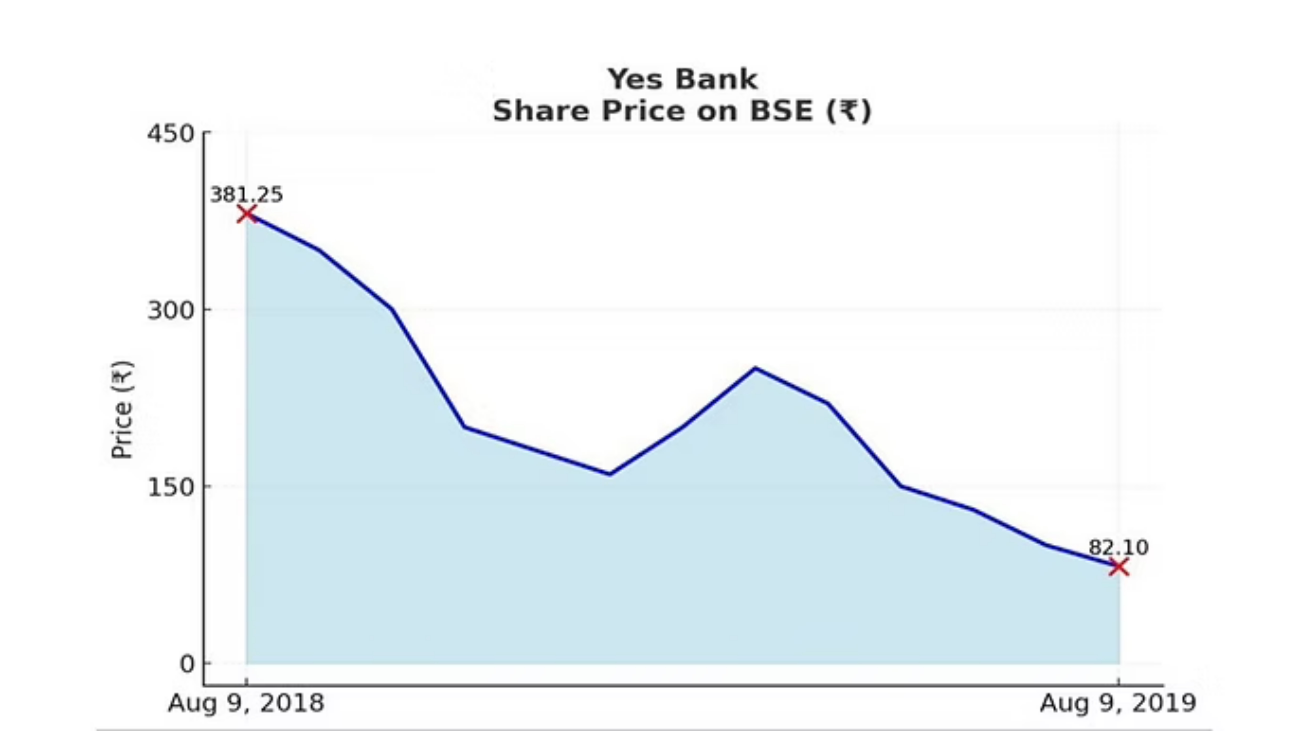
Yes Bank is a classic example. Investors assumed strong fundamentals in 2018, but allegations against founder Rana Kapoor revealed critical issues which proved to be damaging. The Reserve Bank of India stepped into the mess, forcing a consortium of banks to inject equity. Small investors who bought the dips blindly learned the cost of ignoring fundamentals and were hurt financially.
Yes Bank Share Value from 9th of August 2018 to 9th of August 2019 in India Rupees

Another example unfortunately is Ola Electric Mobility Ltd which highlights a similar trap. Ola’s 2024 IPO raised 75 billion Indian Rupees ($900 million USD) at a value of 76 INR per share. It was hailed as a ‘BYD of India’, and despite high valuation warnings, investors pushed share value towards 160 INR. Predictably as cash burn mounted and with no operating profitability, Ola Electrical Mobility value soon fell below the IPO price and speculators who dreamed big soon began to feel like they had lost. The Yes Bank and Ola Electric Mobility cases demonstrate the dangers of investing outside one’s circle of competence.
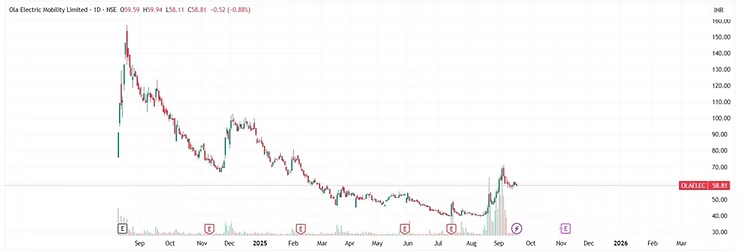
Ola Electric Mobility One Year Chart as of 17th September 2025

Valuations and Investor Behavior:

From October 2022 to October 2024, Indian markets moved significantly higher, stretching valuations beyond earnings. Even after U.S. Liberation Day tariffs triggered a pullback in India, investors continued pouring money into mutual funds through SIPs (Systematic Investment Plans), ignoring glaring fundamental problems. This raises concerns and creates doubts about whether SIP passive investing is wise without understanding individual businesses.

Investment becomes more intelligent when it is done with a business like approach. As Warren Buffett said, “the stock market is a device for transferring money from the impatient to the patient.” But patience should not mean overpaying for growth stories. Predicting future earnings is difficult, and paying lofty prices for stocks in the EV, battery, and micro-processing chip sectors based only on expectations can be dangerous.

When competition or innovation shifts, stock prices collapse as Ola Electric Mobility has shown. True investing is businesslike. It requires understanding, discipline, and buying below intrinsic values. Chasing hype, speculation, and every new IPO can lead to erosion of capital. Smaller investors can do better and they should desire to study fundamentals in order to make good decisions.
postN38.1

Reactions and Risks as Trading Clarity Remains Hard to Grasp

Reactions and Risks as Trading Clarity Remains Hard to Grasp

While many U.S government officials try to shrug off the downgrade of U.S Treasuries by Fitch Ratings last week, a warning shot has been fired regarding U.S spending and the nation’s growing deficit. Janet Yellen and others may believe the downgrade should not have happened, but the prospect that the U.S golden goose is going to stop eventually producing enough eggs is a realistic viewpoint from Fitch. Risk adverse trading on the news was seemingly sparked from the U.S Treasuries downgrade, while many prominent figures including Warren Buffet have claimed they are not worried. However, one thing that the downgrade did was certainly create more clouds for financial institutions which have already been suffering from a lack of clarity the past three weeks.

U.S economic policy remains troubling regarding its spending, and while the government believes its bonds will remain the best in the world for the foreseeable future, it would certainly help matters if responsible ‘adults’ would be allowed a voice regarding stimulus, expenditures and debt ceiling concerns. The U.S has been warned, but with a major presidential campaign approaching on the horizon, more promises to the U.S public will likely carry greater long-term costs.

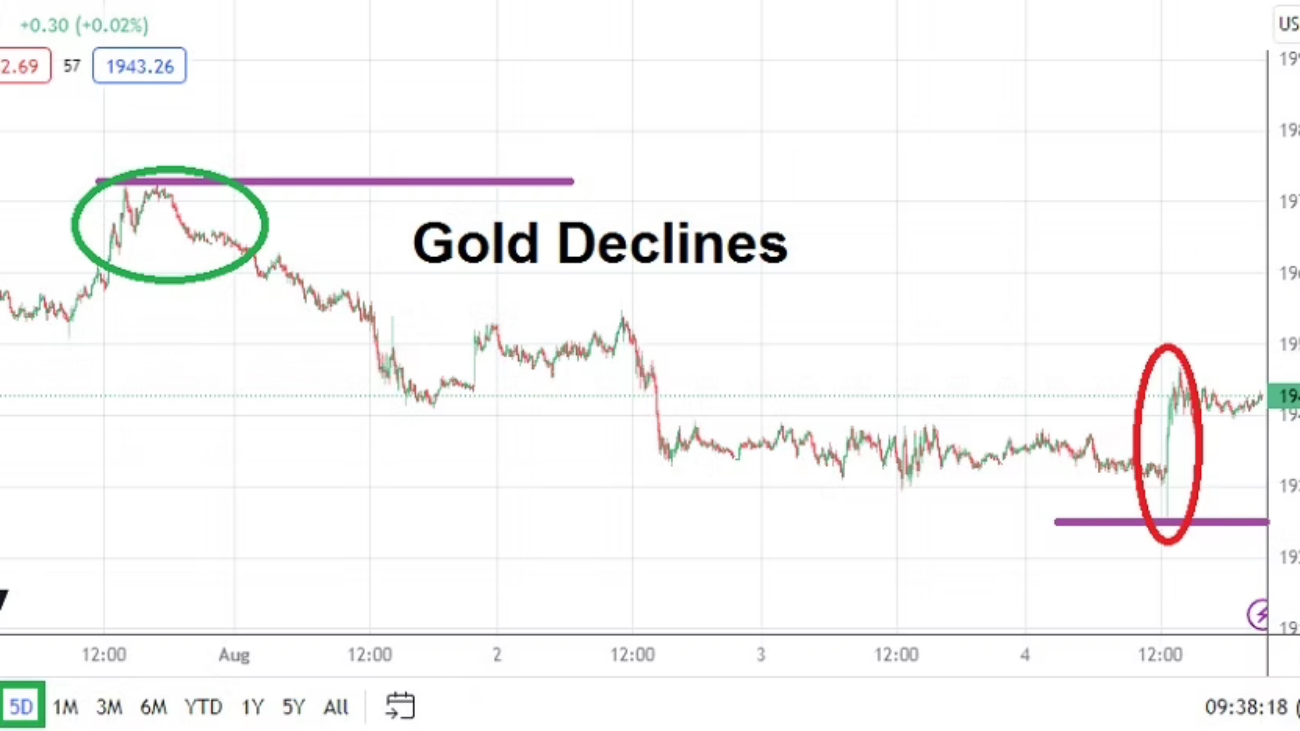
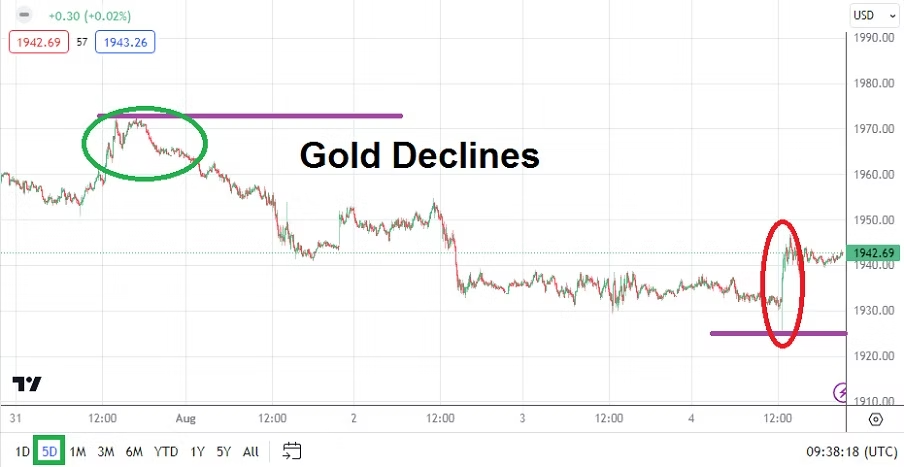
Gold One Week Chart as of 8th August 2023

While the USD did get stronger across Forex and gold finished last week near lows, some major currencies finished Friday with slight reversals higher against the USD before going into the weekend, based on the weaker than anticipated Non-Farm Employment Change outcome. However, Average Hourly Earnings came in slightly higher. The rise in wages for employees wasn’t expected, but the gains via the inflation number may not have been considered significant enough to cause a panic.

Day traders trying to navigate through the news of the ratings downgrade and the mixed jobs numbers from the U.S may have gotten ripped apart from the volatility late last week. Forex brokers likely had a good week if the majority of their speculators were ‘B’ book – virtual – traders. Survivors of last week’s dynamic price action should be aware that financial institutions do not have the best of outlooks for global central banks. This week’s coming data may help a bit, but trading could also remain rather dangerous and churn volatility.

Global Outside Influence to Give Attention:

Although Niger may seem like a world far away for most day traders, they should keep an eye on the developments of the African nation. A military coup has gotten the attention of global powers and there are threats of military intervention rattling. France, the U.S and Nigeria and other ‘Western’ leaning nations have a stake in the Niger drama, on the other side is Russia and its Wagner affiliated mercenaries. The potential for a war to to start in this landlocked northern African nation appears to be growing. A conflict in Niger could include a wide range of competing sides and create loud rhetoric and hyperbole. It could also cause uncomfortable feelings at the BRICS summit scheduled to begin on the 22nd of August in Johannesburg, South Africa.

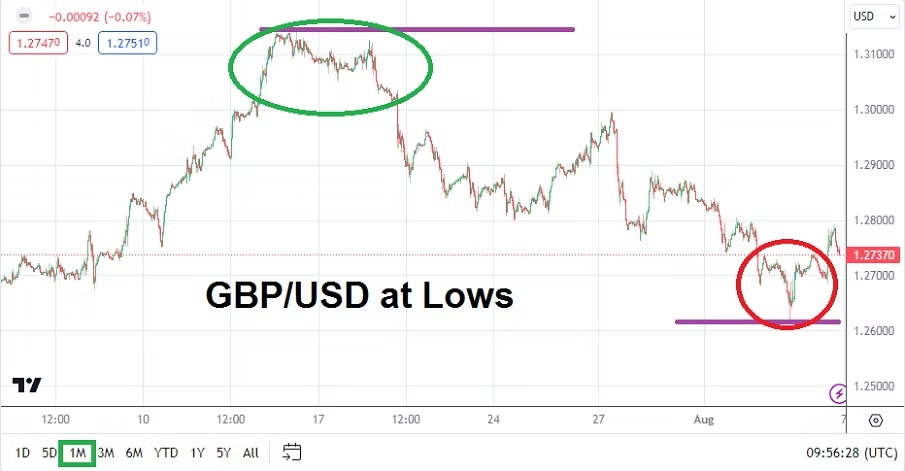
GBP/USD One Month Chart as of 8th August 2023

Monday, 7th of July, U.K Halifax Home Price Index – this data is expected to remain rather stable, but the past three results have been negative. Mortgages are getting expensive in the U.K and the pressure added from higher interest rates is not helping. The GBP/USD could react briefly to this outcome.

Monday, 7th of July, E.U Sentix Investor Confidence – the reading is anticipated to be worse than last month’s outcome regarding investor outlook. The past three months have been negative. The E.U is certainly facing recessionary pressure. Oddly enough, a poor outcome could spur on the belief the ECB may have to become less aggressive regarding their higher interest rates. The EUR/USD may see a flurry of reactions from this report.

Tuesday, 8th of July, China Trade Balance – the results will get plenty of attention because recent economic data from the nation has been troubling. Export demand is important for China’s economy.

Tuesday, 8th of July, Germany Final Consumer Price Index – the result is expected to match the forecast of a 0.3% gain. This inflation report will be watched by EUR/USD, but if expectations are met this could create rather consolidated trading until Thursday for the currency pair.

Wednesday, 9th of July, China CPI – the inflation data from the nation will be watched by global investors. Recent statistics from China have signaled concerns about ‘deflation’. An outcome of minus -0.5% is expected. Economic issues are shadowing China, this as it remains active in global affairs.

Last week Argentina announced China helped facilitate a ‘bridge loan’ for the South American nation so it could make a repayment to the IMF. Rising economic concerns in China could start to squeeze its ‘cash power’ as it tries to gain influence globally by pumping Yuan (CNY) into international finance. China has certainly been bold and is playing a ‘long game’, because its choice of Argentina as a nation to help can certainly not expect to produce short-term financial gains.

Thursday, 10th of July, U.S CPI – Consumer Price Index results from the States will cause potentially dynamic broad market movement. Inflation is expected to match last month’s rise of 0.2% via the broad and core numbers. However, traders should note that some analysts have voiced concerns rising energy prices the past month will hit the inflation numbers, if this occurs it could spark a volatile USD. Higher Crude Oil prices combined with a streak of U.S hot weather may create an intriguing outcome. Risk management should be used by day traders who are wagering in the markets as the CPI readings are released.

Friday, 11th of July, U.K GDP – the Gross Domestic Product numbers will be important immediately for the GBP/USD. Although last month’s outcome was slightly stronger than anticipated it was still negative with a minus -0.1% reading. The growth number this time around is expected to gain 0.2% per the monthly report.

Friday, 11th of July, U.S Producer Price Index – economic numbers from the States have been mixed recently. These inflation numbers are expected to show a slight rise, if the outcome meets expectations – the broad markets may remain calm. However, if inflation is stronger than expected, the result could set off fireworks if the outcome sets off fears about the U.S Fed maintaining it hawkish rhetoric.

postN32

Profits: Business Ethics in an Age of Subjective Expediency

Profits: Business Ethics in an Age of Subjective Expediency

This article was originally written in the summer of 2006, Jeremy Blatch suggests current business governance remains shadowed by the same concerns.

Most of us in business today, be we entrepreneurs, professionals or key employees, recognize that our customers, clients and staff require us to act in their best interests and that our actions should reflect this.

A code of practice or some kind of ethical standard or guideline will be needed to ensure some degree of accountability and consistency. In this we encounter the first hurdle, as the degree to which corporate and governmental governance is superimposed by regulatory bodies on business, varies between industries, businesses, professional sectors and political divides.

The effectiveness to which this is policed in reality depends on the will of those in supervision, and the willingness of those in business to conform to requirements. Many areas are of course not covered by statutory regulation and getting on with the daily running of a business requires constant decisions which often involve a degree of ethical consideration. In reality any ethical stance is at best subjective and open to subversion and expediency in the quest for profitability, which after all is the main reason for being in business in the first place.

Service providers that fail to make a profit irrespective of the quality of service that they offer will inevitably cease to be able to provide that service. But at what cost do we surrender integrity for the expediency of justifying a decision on the grounds of corporate strategy or profitability. And at what point does adopting a rigid ethical stance become a statement of moral judgment? Moralizing about the world and the problems faced by modern society has never been wise. Morality is also a subjective term, often influenced by personal experience and strongly held beliefs, but not necessarily shared.

When some of the world’s most successful entrepreneurs met recently in Monaco at the invitation of the BBC World Service and the international accountants, Ernst Young, to debate how to ‘feed the starving and save the planet’, there was broad agreement that amongst most people there is a distrust of corporate motives and skepticism of Corporate Social Responsibility, currently a trendy buzz word amongst the business elite.

Is not the sole responsibility of companies to make money, but at what costs? Does it really matter how they make money, after all is a woman with a starving child going to refuse a plate of food because it has been purchased with money from the sale of narcotics? If we have a view against investing in armaments, are we prepared therefore to open our borders to anyone who wishes to attack us for any reason, or do we wish for a society in which the strongest take all and those with weapons will be strongest?

Someone receiving a pension has strong views on the tobacco or gambling or arms production or certain drugs, and whilst they are quite happy to receive the pension income and rejoice at the level of payment, are they also prepared to self-select how the investment is managed? Business is fraught with hypocrisy in this area.

Google have weakened their ethical case by caving in to the demands of China for expediency. Brands like Nike and Gap are having their reputations challenged by allegations of sweat shop labor despite spending millions on marketing a different image. Yet people still keep buying their trendy brands. Walmart the most successful US retailer attracts more shoppers than any other store despite allegations of a poor record of employee relations. Does anyone care? Shoppers go where they can find the best quality at the keenest price.

One can make a difference in society without trying to gain the ethical high ground or slipping into moral judgment by simply giving away something you don’t need, to those who most need it. We have witnessed this last week two instances of philanthropist ‘walking the walk’ not just ‘talking the talk’ with Warren Buffet, one of the most successful investors of this century, donating much of his personal wealth to the Bill and Melina Gates Family Foundation. This injection of cash now gives the Gates Foundation around USD 30 billion, more than three times the total amount of charitable donations in the U.K, putting them with Andrew Carnegie, Henry Ford and John D Rockefeller, as the hitherto best known philanthropists of modern times.

A few days after the very public announcement of Warren Buffet’s donation, a U.K hedge fund has emerged as one of the U.K’s most generous philanthropists with a donation of around GBP 50m to charity assisting children in poverty. The Investors Forum, registered in Gibraltar, was created to give a highly professional service to investors covering the wider investment process. It comprises of an association of firms and banks committed to acting professionally, whilst giving something back to those most in need.

A unique investment concept called the “Solidarity Fund” will hopefully be launched from Gibraltar, which will give both corporate and individual investors the opportunity to make money whilst directly helping those in need. In today’s business world making a profit is essential for survival, but how we make it and what we do with it will determine what sort of people we are, and ultimately what legacy we will leave behind.

Jeremy Blatch is the Founder and Consultant of Ein Harod Family Office. You can find more of his articles at www.ehh.gi