
The Landlord Beneath the Cloud
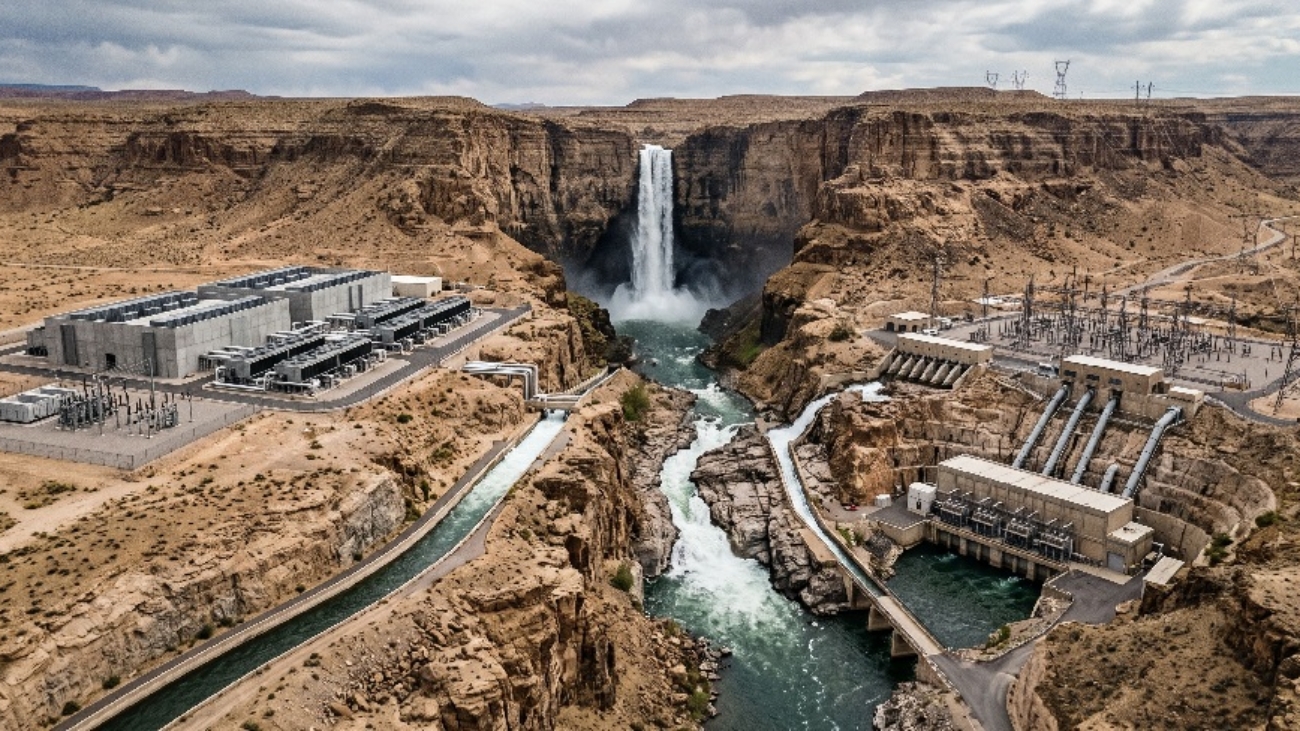
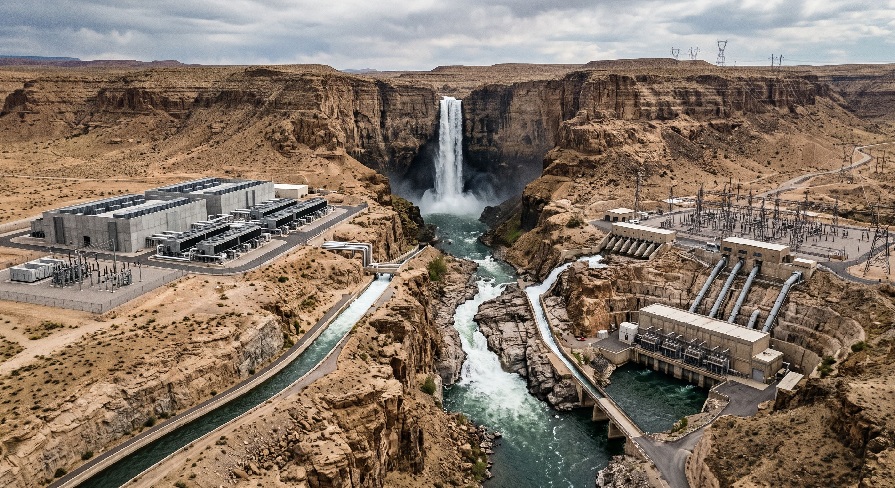
There is an old paradox: what happens when an unstoppable force meets an immovable object? The AI buildout is the unstoppable force – the largest concentrated wave of capital spending in history. The immovable object is the physical world it is colliding with. Land, power, and water are the tangible bedrock that no balance sheet can conjure into existence. The paradox has a resolution the classical philosophers never thought of: the immovable object collects the rent.
Consider the scale of the force first. The four hyperscalers – Amazon, Alphabet, Meta, and Microsoft – plan to spend roughly $725 billion on capital expenditures in 2026, up nearly 80% from the year before. Add Oracle, the neoclouds, sovereign funds, and the rest of the AI heavy spenders – and total compute capex crosses $1 trillion in a single year, the first trillion-dollar year of its kind. Much of that money flows to the visible beneficiaries the market already knows by heart: NVIDIA for the GPUs, Micron for the memory, Dell for the servers, Cisco for the networking. Silicon, racks, interconnects.
The Great Compression Part 3: The Immovable Object
But every one of those chips has to be housed somewhere. It has to be powered. It has to be cooled. And this is where the unstoppable force runs into something it cannot simply outspend.
The constraint is no longer capital, and it is increasingly no longer silicon. It is the physical world. The bottleneck has shifted to power generation and grid interconnection, which take years to permit and build, and to the land and water that data centers consume at industrial scale. The richest corporations that have ever existed are discovering that a signed check does not produce a megawatt or a water right. The immovable object has begun to set the terms.
Nowhere is this clearer than in a deal signed on June 23rd. Texas Pacific Land Corporation, aka TPL, agreed to provide the surface acreage and brackish water for Project Kilby, a large-scale power generation facility Chevron is building to supply a Microsoft data center cluster in Reeves County, Texas. When the announcement crossed the wires, Chevron’s name led every headline – and TPL was a footnote.
Meanwhile, the framing should be exactly backwards. Chevron, for all its scale, is the replaceable party in that transaction. Exxon, Occidental, or any of a dozen major energy companies could have built that power plant. What none of them could have supplied is the specific land and the specific water rights in that specific corner of the Permian Basin – because those belong to TPL, and there is no substitute for them at any price. The company that got the headlines is interchangeable. The company that got the footnote is the immovable object.
TPL is the purest expression of the scarcity trade beneath the AI buildout. It owns roughly a million acres of West Texas and produces almost nothing itself. It does not drill. It does not manufacture. It collects royalties, easements, and water fees from everyone who needs to operate on its ground. It is a toll booth on the physical world, and the AI buildout has just become one of its largest new customers. For years the market valued it as an oil-and-gas royalty play. It is quietly becoming an infrastructure landlord for compute – and almost nobody has ever heard of it.
The same logic radiates outward through the entire physical layer. Power is the genuine bottleneck, and the companies that generate it are being repriced accordingly. Constellation Energy, the largest operator of nuclear plants in the U.S., has become an unlikely AI stock as hyperscalers sign long-term deals for the one thing they cannot build fast enough: reliable, always-on baseload power. The grid that carries it has its own set of indispensable names – Quanta, which builds and maintains transmission infrastructure; GE Vernova, which supplies the turbines and grid equipment; Eaton, whose electrical systems distribute power inside the data center itself. And as chip density rises, the heat has to go somewhere, which has turned Vertiv, a maker of cooling and thermal management systems, into a core holding of the buildout.
What is striking is that this category does not merely sit still and collect. Some of its members are actively repositioning to attack. Ford, unable to win the electric-vehicle war against Tesla and nursing a $19.5 billion writedown on its EV investments, has taken the same physical assets – its plants, its battery capacity, a century of manufacturing expertise – and redirected them. In May it launched Ford Energy, a subsidiary building grid-scale battery storage systems, with data centers named explicitly as the demand driver. The immovable object, it turns out, can also choose its targets.
This is the HALO trade: Heavy Assets, Low Obsolescence. Companies whose value rests on tangible, physical assets and established operations that are expensive, time-consuming, or regulated – and therefore very hard to replicate. Land. Power. Grid. Water. Steel and concrete and copper. The unglamorous inputs that no model can commoditize because they cannot be reduced to software, and no amount of capital can summon into existence overnight.
None of this is permanently fixed, and it would be dishonest to pretend otherwise. Innovation erodes scarcity: small modular reactors, advanced geothermal, and better transmission technology will, in time, loosen some of the constraints that look absolute today. But two things blunt that threat. The first is Jevons paradox – when a resource becomes cheaper to use, consumption rises to swallow the savings, which means more efficient power generation is likely to expand the buildout, not shrink the edge of the providers. The second is that not all heavy assets are equal. The manufacturers and equipment makers face real competitive pressure over time. The owners of irreplaceable location – the specific acre, the specific water right – do not. You can build a better reactor, but you cannot build another Permian Basin.
The value that fled the human middlemen, that commoditized in the model layer, that migrated up the stack toward proprietary data and orchestration – also flows downward, and at the bottom it stops. It settles into the ground, into the wires, into the water table. But the ground is not neutral territory: land is permitted, power is regulated, water is allocated, and the fabs that print the silicon sit inside country borders. The unstoppable force keeps accelerating; the immovable object keeps collecting. And the moment we ask who owns the immovable object, the scarcity trade stops being a matter of markets and becomes a matter of sovereignty.