post220

Nasdaq 100: U.S Exceptionalism and Competition from China
Nasdaq 100: U.S Exceptionalism and Competition from China

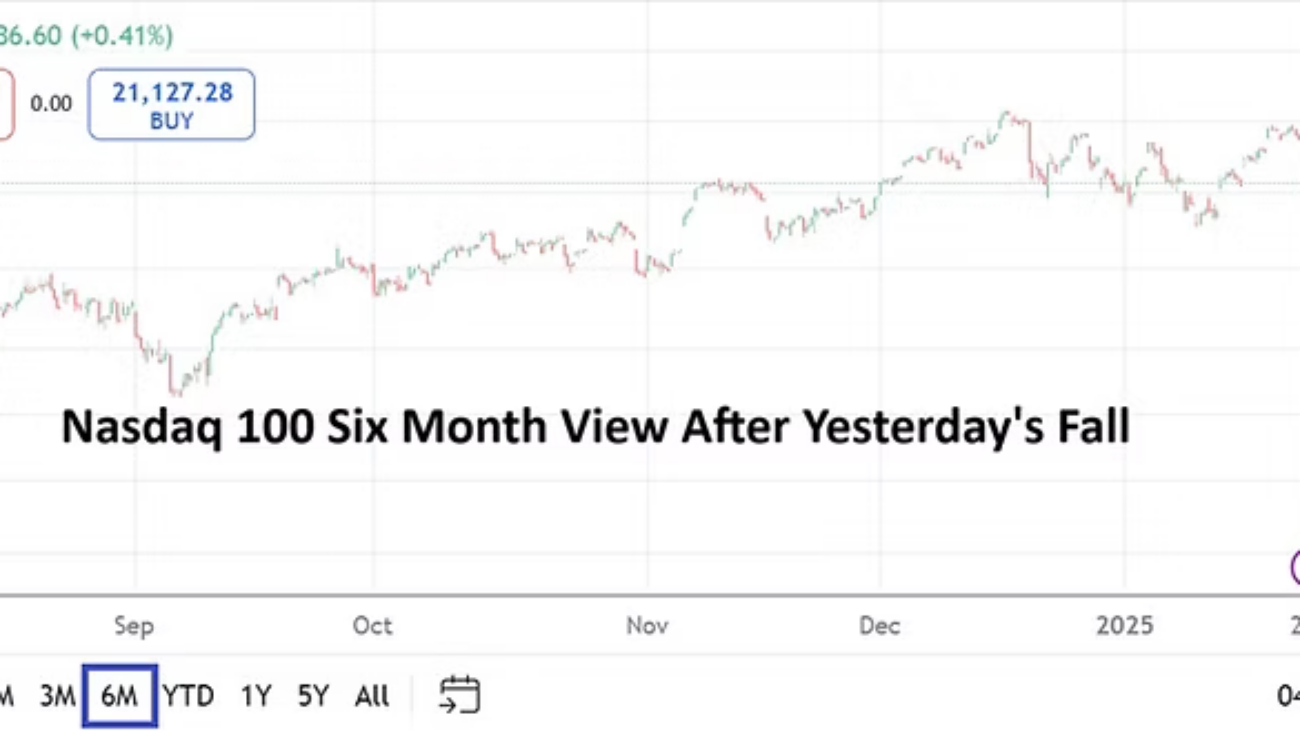
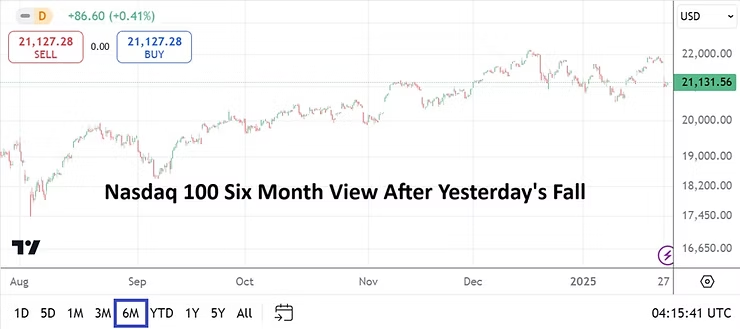
Nasdaq 100 Six Month Chart as of 28th January 2025

The losses on the Nasdaq 100 yesterday were bad. Wall Street participants were reminded that technology is and always has been a competitive landscape. It is rather remarkable that the lesson being given to capitalists came from China which is led by a Communist government. U.S Exceptionalism which has been spoken about in loud tones the past week because of President Trump’s return to the White House has been put on notice.

There will be additional bad days on Wall Street, but the idea that the Nasdaq 100 now faces an existential threat from DeepSeek is farfetched. Traders must take a healthful breath and remember yesterday’s loses while bad were not catastrophic. Premium froth from Nvidia and other companies saw some of their likely overvalued worth selloff on Monday. Perhaps more will follow today, but tech and innovation companies have always faced a competitive landscape.

Was yesterday an indication there is a crack in U.S Exceptionalism via technology that is going to be long lasting? Companies must always compete to be the best, if DeepSeek’s entry into the news cycle was a ‘sputnik’ moment as some claim, folks need to remember the U.S bounced back rather nicely and eventually outpaced the Russians – who still remain a tech competitor regarding rockets and space.

This weekend’s news from China has provided another moment the world realizes technological gains are often hard fought. While many media pundits act with hyperbolic noise and state vivid concerns about the future of the technological competition between China and companies around the globe, the race for innovation has and always will exist.

AI for the moment is grabbing the headlines, but Artificial Intelligence is also a buzzword – it is marketing usage by those who are trying to entice investors with big promises, except machine learning has been around for decades. Progress the last few years has been significant, but AI isn’t ready to make humans into a new species. Competitive battles in equity markets centering on innovation via semiconductors, quantum computing, robotics, IoT, biotech, transportation, and other sectors have been relevant and will remain this way.

Monday’s results on the Nasdaq 100 and harsh falls for some tech giants like Nvidia is a reminder that while speculating and investing in one company is a potential way to make solid returns, investing in indices and a large group of diverse companies often produces steadier yields. Yes, yesterday’s losses on the Nasdaq 100 were bad, but they were less critical compared to the losses Nvidia suffered. And let’s remember Nvidia will survive yesterday’s declines.

After Monday’s Nasdaq 100 decline, today will prove a another test of sentiment. Premium froth in companies such as Nvidia that sold off, will now cause people to question fundamental analysis of tech and innovation. Bubbles sometimes burst. The remainder of this week will be a solid test of behavioral sentiment. A battle between large speculators and investors will also be seen. Those who plan on cashing out of the market near-term to book profits may find that investors with long-term ambitions still win the race.

Perceptions are constantly being shaped, we should always be questioning the ability of technology which is proven versus marketing mayhem that is hot air. Artificial Intelligence has had a gravitational pull on the investment landscape. The froth created by investment into the AI sphere is important, but it only one part of many combined technologies constantly developing.

Many companies claiming they are AI centric have no real basis to make the statement. Semiconductor companies have led a lot of the gains in Nasdaq’s run higher because they are the ones supplying micro processing to companies that need the technology to build machine learning capabilities, China has always been a competitor and yesterday provided a wake up call for those who forgot. A dose of reality has been delivered once again to Wall Street.
post217

USD/JPY: Bank of Japan Actually Does its Job: Raises Rate

USD/JPY: Bank of Japan Actually Does its Job: Raises Rate

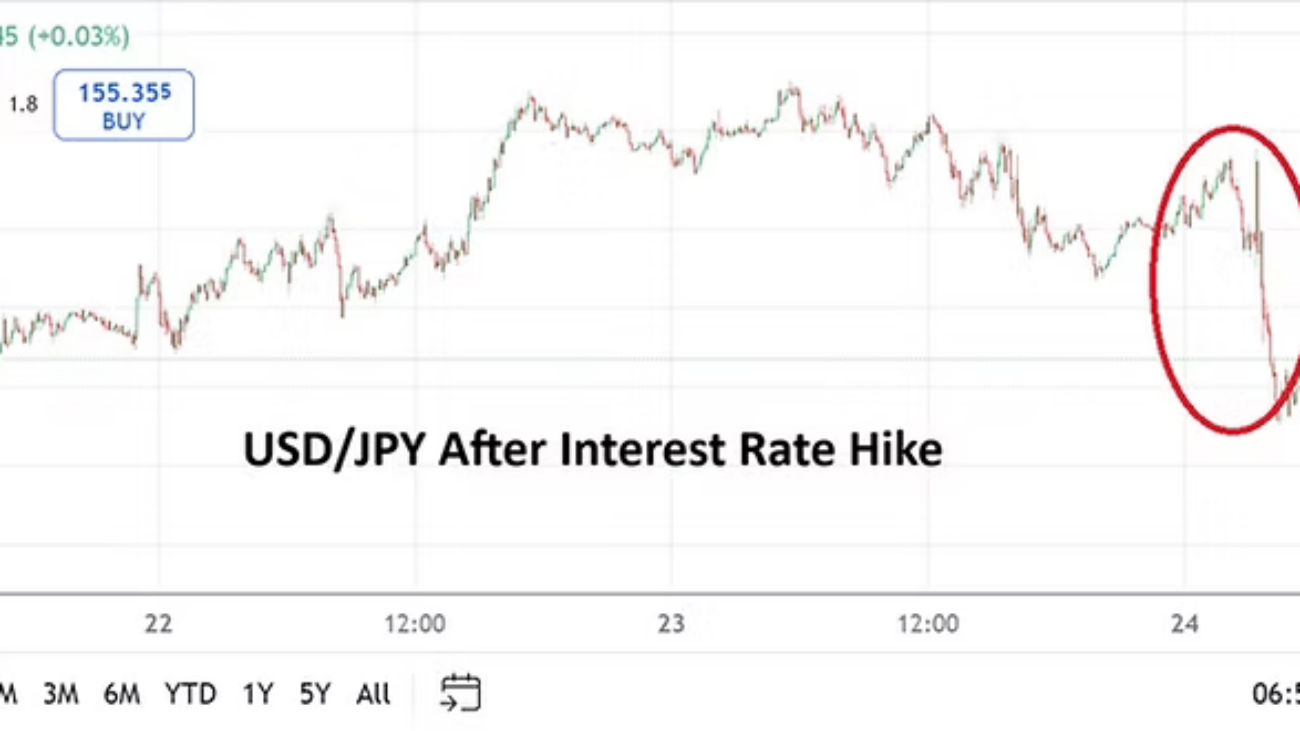
USD/JPY Five Day Chart as of 24th January 2025

The Bank of Japan actually raised its Policy Rate by 0.25 to 0.50% this morning. The move was done while the central bank stated the Japan economy is improving. The Bank of Japan also noted that the implications of U.S tariff policy are not completely known, thus it is acting on existing facts. The action by the BoJ created selling in the USD/JPY and is a healthy sign.

While the U.S Federal Reserve has taken on a cautious tone, President Trump has started to signal via rhetoric that he would like to see U.S interest rates lowered. The Fed and President Trump may find that they are in disagreement regarding mid-term policy and Forex traders shouldn’t be surprised if the debate escalates. The USD/JPY is trading near the 155.500 vicinity with fast price action at this moment. The ability to sustain values below the 156.000 level will be important technically if maintained. A fall below the 155.000 ratio may indicate more selling should be expected.

While financial institutions globally remain nervous about U.S economic policy regarding trade negotiations, Japan for the moment is out of the spotlight regarding tariff implications. The USD/JPY was trading near the 153.000 area on the 17th of December and it will be intriguing to see if large players use this level as a target in the coming days.

Retail traders should practice solid risk taking tactics and conservative leverage. The ability of the Bank of Japan to increase its interest rate, while the U.S Fed is in the midst of considering no changes to the Federal Funds Rate is a potentially solid sign for USD/JPY bearish attitudes.

Global Forex conditions remain choppy, but there has been some buying of the EUR/USD and GBP/USD produced recently. Next week talk of tariffs against China, Canada and Mexico will heighten, but traders need to understand the tough sounding talk from Trump is part of his negotiation tactics. While he certainly seems intent on carrying out his mandate, he will also be open to finding a way to create agreements.

Behavioral sentiment is in charge of Forex for the moment. Outlooks remain unclear, but USD centric strength may be traversing within the apex of its highs in many cases.

post211

AMT Top Ten Miscellaneous Reckonings for the 8th of December

AMT Top Ten Miscellaneous Reckonings for the 8th of December

10. France Falls: President Macron’s leadership is in peril after his anointed Prime Minister, Michael Bernier, suffered a no confidence vote outcome. French politics and finances are in shambles. Life for French citizens goes on as their politicians battle for their jobs, supremacy of voice and egos. With the restoration and presentation publicly of Notre Dame Cathedral yesterday, Macron now has to find something else to divert attention away from his misappropriation of power.

9. 100,000: Bitcoin came within sight of the 104,000 USD vicinity this Thursday, then sunk with a rapid pace and challenged 92,000. Once again traversing near 100 grand, large BTC whales and MicroStrategy’s Michael Saylor and his cult of followers are likely celebrating. However, if the wind changes direction what kind of damage will the low tides create this time for Bitcoin and speculative leveraged positions? The price of BTC/USD as of this writing is near 99,500.

8. Al-Assad: The Syrian regime is apparently coming to an end after 50 plus years in power. Bashar al-Assad’s whereabouts are unknown. Russia, Iran and Hezbollah appear for the moment to be big losers in this power play. The many factions will now have to see if they can create a semblance of government, but that remains doubtful. Syria will be a quagmire in the coming months as its cauldron stirs.

7. Martial Law: South Korean President Yoon Suk Yeol startled Asia and foreign investors by declaring martial law this past week, making one of the worst political miscalculations in recent memory. Yoon was quickly forced to rescind the decision. The USD/KRW spiked and KOSPI Composite sank via the instability. However, the South Korean National Assembly has shown the ability to provide leadership and display power of law prevails, this as they try to calm their citizens concerns and investor sentiment.

6. Roasted: Coffee Arabica has boiled again and commodity’s price is fighting within apex levels. Like Cocoa, both Arabica and Robusta Coffee have surged the past year as large players have created a strangulated grip which suggests the markets may be ‘cornered’. While some analysts are quick to point out weather conditions as a reason for the higher prices, the tenacity of Coffee and Cocoa to sustain upwards momentum is intriguing but also suspicious.

5. FX and Data: U.S jobs numbers this Friday were marginally better than anticipated and the Average Hourly Earnings came in slightly above expectations. Economists from different schools of thought are debating the potential of recession and inflation concerns, versus those who believe growth, greater transparency of U.S fiscal mandates and elimination of a bloated budget will be achieved when Trump’s economic policies takeover. Globally Forex conditions are showing signs of fragility because of the threat of tariffs and trade concessions by nations which may need to be made. Yet, it is quite possible the ‘bad news’ consisting of accusations of unfair trade agreements by Trump, and the reactions which have been cooked into the EUR, GBP, JPY, ZAR, MXN, CAD, NZD and others is overdone. While there could certainly be more weakness in major global currencies paired against the USD, upside potential mid-term may be more positive compared to near-term drawdowns. Retail traders still face difficult technical perceptions in the days ahead because financial institutions also remain shaky regarding their outlooks.

4. Pardon Me Joe: President Biden has forgiven his son, Hunter Biden, for crimes known and unknown for an eleven year period – that is not a round number ladies and gentlemen, with a Presidential Pardon. Why 11 years? Why not 10 or 15? There is conjecture that Joe Biden is also considering preemptive pardons for people his administration feels may face the wrath of the incoming Trump White House. However, if pardons are given to the likes of Anthony Fauci, won’t the pardons awarded to those who have not been charged with a crime yet look like an admission of guilt?

3. Central Banks: The ECB will deliver their interest rate decision on the 12th and the Federal Reserve will announce their Fed Funds Rate on the 18th. Behavioral sentiment however is seemingly more focused on the threat of potential storms that could suddenly appear due to the Trump effect. The ECB and Fed are both expected to cut their interest rates by a quarter of a point, while it appears many financial institutions no longer believe the Fed will cut again in January.

2. Chinese Gold: Tucked away in the quiet corners of the business news has been the discovery of a massive gold ore deposit in China. Some geologists claim the Wangu gold field could have up to 1,100 tons of the precious metal. If correct and the amount of gold meets or exceeds the expectations of the experts, the question about this becoming a deflationary event for gold is intriguing but likely wrong. Importantly, the gold will be a long-term benefit for China and potentially create a stronger national currency via the Renminbi (China Yuan). Perhaps also solidifying the idea of using the reserve as part of the backbone for a potential BRICS ‘Unit’ currency if and when that day ever arrives. Gold closed at nearly 2633.00 USD per ounce before going into this weekend.

1. Trump Effect: WTI Crude Oil is around 66.78 USD as the promise of easier energy production for U.S companies has created the conviction of steady and less expensive supply. The USD remains in the stronger elements of its long-term Forex range, and folks betting against the strength of the USD need to remain cautious. BRICS has been warned about not infringing on the USD by Donald Trump, and some member nations of the organization have affirmed they do not seek a BRICS currency (yet). Tariffs have been threatened, but China has responded by showing it has the ability to create potential hinderances this week via a tough negotiation stance by threatening to stop export of rare earth metals to the U.S. Mexico and Canada have felt the verbal wrath of the President-elect already and started to react. All of this while Donald Trump still has six full weeks before taking power.

post205

The Wigged and the Robed: All Hail the ICC in The Hague

The Wigged and the Robed: All Hail the ICC in The Hague

Opinion: The following article is commentary and its views are solely those of the author.

There is an old saying that extreme cases make bad law and that is mostly the case. Regarding policy though, sometimes it takes a disaster to shake people out of their mindset. Regarding the absurdly named International Criminal Court, or The Hague, as we like to call it, we have to admit that the recent decision to issue arrest warrants to Israel’s Prime Minister and ex-Defense Minister should be one of those decisions that will push the civilized world to correct its self-righteous post-Holocaust decision to create that court. 

What better way to make amends for the crimes of Europe, they thought way back when, than to judge, honestly and fairly all such “crimes against humanity” that happen in the world?

How much better the guilty Europeans will feel when they bring the less civilized to trial in their palatial courtrooms, especially as they will train the non-European judges themselves in the fineries of “human rights law”? The next Hitlers of the world will never be able to do their dastardly deeds since the civilized world will deter them with lawyers in fancy wigs and robes. Just look at all the tyrants and mass murderers who have been deterred over the past 70 years. The people of Cambodia, Rwanda, Sudan and Biafra (remember that?) thank their betters in European capitals. The Bangladeshis, too. 

I am sure that those men, women and children in Darfur have an annual party celebrating the brave men and women in wigs who sit in the Hague, for saving their lives. We understand that the hundred’s of thousands of women and girls in the Congo who have been raped (many multiple times) give a prayer of thanks to the judges in the ICC for saving them from their next rape, since the rapists have certainly been deterred by the brilliant legal analysis done in the Hague.

With the issuing of arrest warrants for Israel’s Prime Minister Benjamin Netanyahu and ex-Defense Minister Yoav Gallant, the ICC has done a great deed for all the suffering women in Congo and families in Sudan, to say nothing of all those hundreds of thousands of Syrians who have been killed or made homeless by the Syrian regime and their Russian, Iranian and Lebanese helpers. The young Iranian women who have been jailed for showing their hair and the Uighurs in China who are right now in concentration camps are now in a better place since Netanyahu and Gallant will be hunted down and shackled to be judged by the robed and wigged in The Hague.

But most important, all those European Jew haters, those of Marxist, Jihadist, Aristocratic or Nazi bent no longer must feel guilty for killing Jews. They have learned the lessons of the Holocaust very well – the lessons taught by the enablers of the perpetrators in the universities, courtrooms and media outlets.

What can the civilized world do to make sure that the wonderful gains the ICC in The Hague don’t disappear? Make the ICC disappear. There is nothing so satisfying for those of us who love truth and justice than ridding the world of another symbol of global hypocrisy and self-righteousness. I can assure you that those that actually suffer from mass murder and rape will not be worse off.

Disclaimer: the views expressed in this opinion article are solely those of the author, and not necessarily the opinions reflected by angrymetatraders.com or its associated parties.

You can follow Ira Slomowitz via The Angry Demagogue on Substack https://iraslomowitz.substack.com/ 

postR195

Impolite Opinion: BRICS and a Western Loss of Power Part 2

Impolite Opinion: BRICS and a Western Loss of Power Part 2

BRICS Future Members and Potential Strangleholds

The West is moving too slowly as if stuck in an abyss of indifference, this while BRICS adds members, including the prospects of Saudi Arabia, Malaysia and others to participate. The ability of BRICS to work alone via trade agreements and increase collective strength is growing.

Some BRICS nations have expressed their perspectives the West is an antagonist that practices unfair trade and environmental colonialism. The West is accused of attaining important resources from the developing world, destroying the habitats of these nations as minerals are mined, food is grown and harvested, and energy is sought and produced that create degraded ecosystems. The West is cited for keeping their landscapes pristine, while using the ‘cheap’ land and labor of the underprivileged to procure needs. And as the West has increased their reliance on commodities attained from afar, they have become vulnerable to the threat of a potential stranglehold on resources controlled by BRICS like rare metals.

BRICS will certainly attain additional nations via the FOMO adage. The enticement of membership and ability to cease underdog statuses and stop being mere supply conduits to richer nations is appealing. Mexico is said to be considering potential BRICS inclusion, and we are probably not far away from a European State asking to join.

The Power of Commodity Prices and BRICS Influence

The West must engage and rethink associations and to make sure countries are not treated as lower tier. If nations like Mexico join the BRICS dynamic, and newly created cartels strengthen economic practices and policies of the organization, the prospects could eventually lead to the creation of a new fiat currency. For the moment BRICS has wisely pushed this goal to the side, but the idea of a unified currency is certainly being discussed openly. An increase of BRICS economic power derived from robust trade would tempt financial institutions to consider start buying bonds if offered as investments.

The West must ask what the dangers are if a needed commodity supply is controlled by a BRICS cartel that could suddenly initiate boycotts and trade limitations upon those BRICS does not agree. Food, energy, and mineral scarcity if controlled by nations not seen as allies of the West would be dangerous. Economic power within BRICS would certainly turn into geopolitical strength. The ability of developing nations to have a collective economic voice and create supply dynamics within commodities would ignite hazards for the West.

BRICS, U.S Government and USD Reserve Currency Status

While the West worries about domestic issues such as creating a politically correct happy tent for everyone, the larger powers within BRICS are engaged in the big picture which might be uglier but may carry more importance long-term. Because a lot of BRICS political power comes from more authoritarian stances, they are able to plan policy not only with five, but ten and twenty year outlooks. Western leadership needs to be willing to engage in a complex world and make sure nations that are not seen as natural bedfellows are treated with respect and brought under an economic umbrella that allows them to engage on equal terms.

The long-term future of the USD as a reserve currency is coming under increasing doubt, the trading of the currency in Forex is slowly and surely losing its footing via incremental percentage changes that point to deterioration. A void in solid leadership in the U.S and unrestrained spending are making the tasks harder for the Treasury and Federal Reserve to protect the strength of the USD. Fiscal deficits are one thing, 35.6 trillion USD of debt is another matter. How long can the U.S carnival sell tickets and expect people to be entertained in a magic act that prints money and backs it with increasingly vulnerable bonds? The U.S needs to change its fiscal policies efficiently.

There are ways of looking at this per different perspectives, but if BRICS does achieve its economic aim of creating more equitable trading coalitions, it could sustain alliances which the West may not be comfortable and actually be susceptible. The phrase that money talks and nonsense walks should be kept in mind regarding BRICS. The promise of fair trade among its members is important, but the ability to be unified politically and create economic transparency is important too. Many of the nations who are members of BRICS have not practiced solid economic policies and are still looked upon as suspicious fiscally.

Gold and a Decoupling of the USD

Importantly, we must begin to ask if financial institutions have figured a lot of what is mentioned above out and started to position themselves. Financial institutions and nations may be starting to look for a balance between the world’s reserve currency which is the USD, and the ambition stated by China’s Xi Jinping at the latest BRICS summit to create an alternative financial system.

If this alternative financial system includes BRICS as one of its foundations, and is based on organized cartels which use commodities as a backbone a new paradigm will be introduced. And if BRICS evolves and has the means to introduce a new currency along the lines of the EUR with a coalition of associated nations, the West will be faced with competitive questions. This new currency – let’s calls it the BRICS Unit (as reported by others), if it can trade calmly and with significant volume, and also offer innovation like a digital currency would change the balance of global power. The potential lose of status for the USD as the world’s reserve currency would weaken the U.S immeasurably. We have seen this show before via the GBP and the Britain.

A battle between a legacy reserve currency and an innovative upstart which wants to become a reserve currency could cause mayhem – potentially leading to a winner or all currencies losing confidence. Folks thinking ahead of the curve may already be putting money into gold because it is a historical store of value. Can the rise in gold seen the past year be quantified via not only a fear of inflation, speculation, and concerns about central banks, but also a reaction because of a looking glass into the future that does not trust the outlook of the USD? It is just a theory, but what if safe haven buying of gold signals a decoupling is taking place with the USD as its status weakens?

It should be added that the lack of a declared currency by BRICS as of yet, shows a level of political maturity and understanding of the current economic landscape. BRICS has shown the ability to take a long view and not act impulsively. A coalescing of commodity strength via gold, crude oil and other resources with organized cartels and solidified trading would give the BRICS Unit more credence upon its birth, but patience will be needed. And, like the EUR, the BRICS Unit could suffer from internal political strife, and particularly if the West wakes up and takes action to engage nations who are sitting on the economic fence and offers beneficial trading agreements.

The Western method of nonchalance that all will be well is naive. However, BRICS still face hurdles. Grievances could prevail in BRICS and cause it to falter and perish, some member nations which have had difficult relationships will need to put their distrust aside. An example of potential problems could come from Egypt and Ethiopia that have a long history with each other, both have massive populations and centuries of political intrigue when dealing with each other. However, BRICS represents the thinking of realpolitik vs. the winsome misguided aspirations of some Western nations with leaders who have their collective heads in the sand. The West needs to advocate collective interests, which includes freedom, solid enterprise agreements and large consumer markets. The West needs to focus on the competition emerging with BRICS. Pretending the danger doesn’t exist amounts to negligence and a potential lose of economic power the West cannot afford.

If you have not read Part 1, here is the link:

postR192

Impolite Opinion: BRICS Long-Term Plans & Implications Part 1

Impolite Opinion: BRICS Long-Term Plans & Implications Part 1

The global Forex market is spastic and many major currencies are traversing within weaker whipsaw value ranges against the USD. The currency pairs are trading in price bands seen before the Fed cut its Federal Funds Rate by 0.50 basis points on the 18th of September. And there is still one and a half weeks of assured volatility that will be demonstrated. Crucial U.S data is on the schedule in the coming days via the Advance GDP and Non-Farm Employment Change statistics, and the U.S Presidential election is edging closer. Israel and Iran continue to play a game of cat and mouse in the Middle East, which thus far has led to a controlled chaos and not worldwide bedlam. Financial institutions have plenty of reasons to be apprehensive.

Expansion of BRICS Feels Inevitable

Now let’s turn our attention to a tectonic foundational shift building in global trade and geopolitics. Attention on short-term behavioral sentiment which is fragile and has a less than clear mid-term perspective, needs long-term considerations too. Investors are required to contemplate possible dangers that are hiding in open sight and will pose a problem in the future.

The BRICS 2024 Summit was conducted this week in Kazan, Russia. This included the new member nations of Egypt, Ethiopia, Iran and the United Arab Emirates. I am not here to give you a major recap on what took place behind closed doors. I wasn’t invited. But we should look at some of the results and statements made and what they imply strategically.

The BRICS attendees to this year’s conference included powerful dignitaries from approximately 36 nations. One major result of this BRICS conference was to award Partner State status to 13 countries including Algeria, Turkey, Malaysia, Indonesia, Vietnam, Thailand, Nigeria, Uganda, Kazakhstan, Uzbekistan, Belarus, Cuba and Bolivia. Saudi Arabia was invited last year and has not made their full participation official yet, but they attended this year’s conference as an invited guest. The trend appears clear, we are entering a new paradigm in which long-term thinking by the BRICS nations could out maneuver the short-term nonchalance of the West and this has implications for the USD long-term.

There were high level meetings between leaders of BRICS countries including China, India and Russia. Perhaps, more importantly was Vladimir Putin’s bold statement about BRICS desire to start its own grain exchange. Putin also advocated for the creation of a BRICS cartel in other commodities such as metals, including gold. Gemstones such as diamonds and emeralds could develop into a sizeable entity too. This needs to be taken seriously by the West.

Credence must be given because the BRICS nations already are among the largest producers of grains, legumes and oilseeds. The scope of commodity production and supply capabilities by BRICS could certainly turn into a painful thorn in the side of existing large trading companies. And a potentially coordinated energy sector via Iran, Saudi Arabia, Nigeria, Russia and others must be taken into account.

Russia and China as Friends of the Underdogs

Historical entanglements put Western nations like France and others in a vulnerable spot diplomatically as they try to maintain alliances with many BRICS nations. France serves as a good example of diminishing Western influence. France remains on the ground overtly in Africa while dealing with vestiges of a colonial past. But France’s influence in Africa is under stress and their ability to use the continent as a source of power and financial gain is being confronted. France still maintains the Presidential Council for Africa, but France is likely perceived by many of the participants as a wolf dressed in sheep’s clothing. Coups in French influenced African nations have a bloody and present history when political diplomacy does not go well.

Exploiters of the past in many African nations are looked upon with derision and scorn. Russia and China are often viewed as friendly countries who helped fight along the side of certain African nations who sought and achieved independence. The ability to create ascendancy in Africa by Russia and China needs to be looked at within a prism that suggests additional spheres of power will develop in BRICS. Many nations that dealt with colonial statuses in the past are rightfully intent on shaking off the notion of being considered laggards.

The West certainly knows in no uncertain terms it cannot return to colonialism. However, African governments should make sure they are not replacing old masters for new. While some might say it is wishful thinking – and I am still on the fence contemplating the notion – on the part of Russia and China to create powerful commodity cartels, if achieved this actually could prove to be an emphatic first step in attempting to secure a new and powerful currency by backing it with a foundation of intrinsic value. Brazil and South Africa would be a big part of this underpinning too. Russia and China’s foray into Africa via their military and money lending excursions, and the already created organizational and trade structures which exists within BRICS opens the door for the perceived underdogs to battle together against the power of Western riches.

A competition is certainly underway between the West and BRICS. What exactly is the U.S doing in Angola? The planed visit of Joe Biden in the first week of December, which was supposed to take place in mid-October was postponed due to the recent hurricanes. Will the U.S presidential visit be anything more than a sideshow, particularly if the Democrats do not win the election on November the 5th? Angola has a massive amount of Crude Oil and is an OPEC member. American energy companies and other Western corporations are active commercial participants in the African nation. However, China has a firm financial stake in Angola via infrastructure projects too. The political and financial implications between BRICS and the West is a growing dynamic, one that will be further discussed in Part 2.

postR190.1

Interest Rate Cuts and Cautious USD Centric Gusts in Forex

Interest Rate Cuts and Cautious USD Centric Gusts in Forex

U.K inflation data this morning came in well below estimates, which almost assures the Bank of England will cut their Official Bank Rate on the 7th of November by at least 0.25 basis points. Tomorrow the European Central Bank will announce its Main Refinancing Rate and it is widely anticipated a 0.25 cut will be made official.

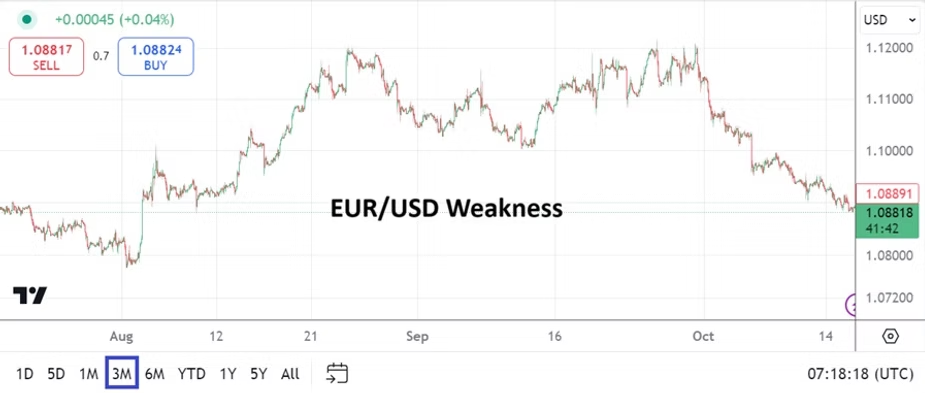
The downturns in the EUR/USD and GBP/USD are easy to see via three month technical charts, but both pairs remain above lows seen over the mid-term. However, the choppy and consistent selling in both currency pairs the past few weeks have likely caused pain for any day trader who has remained stubbornly bullish.

EUR/USD Three Month Chart as of 16th October 2024

Questions surrounding the Federal Reserve remain murky and this is creating USD strength and cautious selling in other currencies. After a rather dovish sounding round of rhetoric from Jerome Powell and a 0.50% basis point decrease in mid-September, financial institutions clearly have become more guarded about the ability of the Fed to remain aggressively dovish. Will the Fed will cut by another 0.25 on the 7th of November and then say they believe they are done being dovish until additional data backs up their stance? Is there a capability the Fed will still cut the Federal Funds Rate by 0.50 over the next handful of month as once envisioned?

GBP/USD Three Month Chart as of 16th October 2024

However, there is a chance the Fed will not cut in November and some analysts have banged their drums regarding this idea. But the Producer Price Index results last Friday did show that inflation remains under control. So I hold to the notion the Fed will cut by another 0.25 in November. Let’s see.

On Thursday the 10th of October the U.S Consumer Price Index statistics were slightly hotter than hoped for and this certainly caused some of the USD centric storms now thrashing financial institutions and day traders. It should also be mentioned that on the 4th of October the Non-Farm Employment Change numbers came in better than expected. But revisions lower in the jobs data the past handful of months needs to be remembered, and, yes, there will be another jobs report on the 1st of November. Which will be followed on the 5th by this little thing known as the U.S Presidential Election. So caution will be a solid instrument for day traders and possibly financial institutions over the next three weeks. The stronger move by the USD since the end of September has caught many folks off guard.

Gold Three Month Chart as of 16 October 2024

Gold is trading near record high levels this morning, but intriguingly WTI Crude Oil has calmed down and is challenging near-term lows. U.S Treasury yields have come down slightly to start this week. The point being that while Forex and gold have seen volatility because of interest rates uncertainty, risk taking actually appears rather solid. Yesterday did see selling in U.S equity indices, but there is no denying U.S stocks remain within sight of ultra-highs. And I might be about to sound contradictory soon, and my own personal bias needs to be carefully given consideration by myself and you the reader. Because while I feel rather comfortable about the higher values in the major U.S indices, I do not feel the same way about Chinese equities currently.

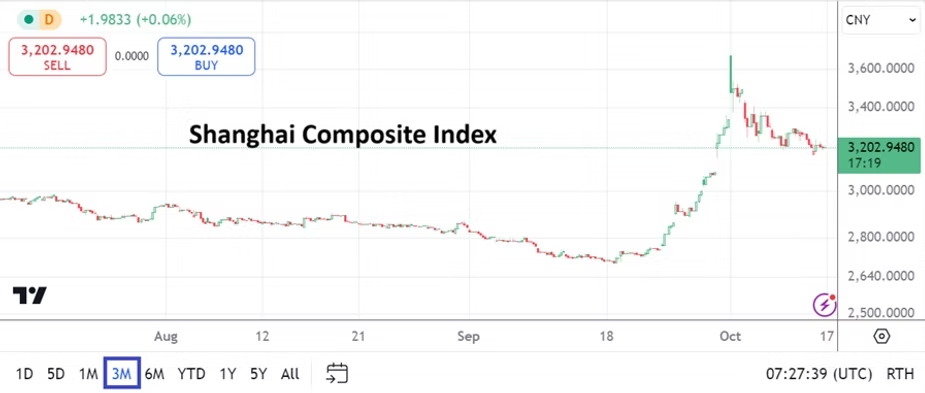
Shanghai Composite Index (SSE) Three Month Chart as of 16th October 2024

The Shanghai Composite Index has traded a little lower again, but this follows a massive swing upwards after Chinese stimulus intervention. But the U.S equity indices and the Chinese markets are not correlated. Perhaps mentioning the Shanghai Composite Index here is wrong, but the stimulus the Chinese government provided may prove to be window dressing on a storefront that suffers from poor economic infrastructure. Day traders in Asia and elsewhere who are betting on upside in Chinese equities need to be very careful, in fact they should be quite suspicious. Economic data from China to start this week has remained lackluster. On Friday GDP, Industrial Production, Retail Sales and New Home Prices data will come from China.

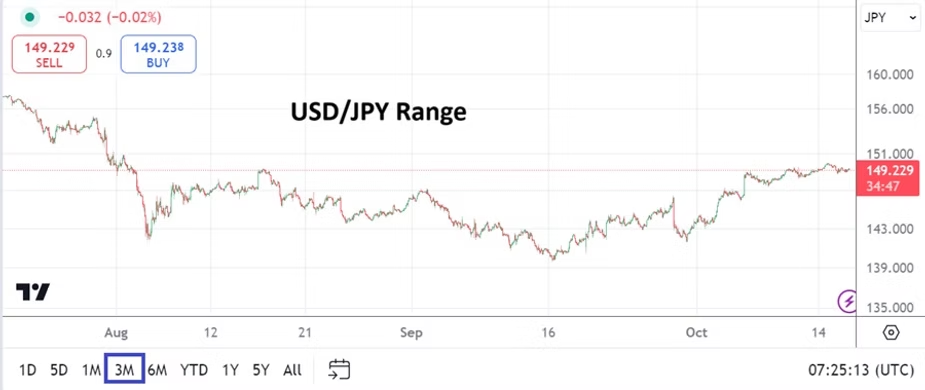
Major currencies which did very well against the USD since July have struggled the past few weeks as clouds have emerged regarding U.S interest rate outlooks. However, at some point day traders and financial institutions may believe the USD has sold off too much during this wave of caution. The JPY, GBP, and EUR have all lost value during this time. As always day traders need to remember they will find it hard to pick the correct time a strong reversal starts to take place. And it should be remembered because of the risk events lined up Forex volatility may rage a while longer. Certainly the outcome of the U.S election will be a factor in the days ahead and may create sideways trading outcomes in many assets until a winner is known.

USD/JPY Three Month Chart as of 16th October 2024

But the global markets will remain open and trade. While shouts of danger should be listened to and given heed, tomorrow’s ECB meeting and outcome will be a good start to the parade. If the ECB plays the expected song and cuts the Main Refinancing Rate by 0.25 this will prove interesting, because financial institutions have already priced in the rate cut in most cases and they will wonder if their outlooks regarding the Fed and BoE are correct. The U.S will release data tomorrow with Retail Sales and weekly Unemployment Claims. On Friday housing sector results will come from the U.S also. These reports will provide USD impetus into the markets as the near-term is considered and wagered upon.

postR196

AMT Top Ten Miscellaneous Interpretations on the 13th of Oct

AMT Top Ten Miscellaneous Interpretations on the 13th of Oct

10. Language: The French word histoirie includes both history and story via its English interpretation. The French usage conveys the acknowledgement that history is often subjective and a story written with an opinion which may or may not be the correct narrative.

9. Subway Series: New York baseball fans will be in an uproar this coming week as the Mets play the Los Angeles Dodgers, and the Yankees face the Cleveland Guardians. The potential of a crosstown World Series will have NYC holding its collective breath. New York fans shouldn’t celebrate too soon, because the Dodgers are dangerous and the Guardians will be competitive.

8. Free Press: CBS News in the U.S has been widely condemned this past week. Video released shows ’60 Minutes’ explicitly edited an interview with Kamala Harris. Also, a recorded and ‘leaked’ staff meeting from CBS management has come to light in which Tony Dokoupil, a news anchor, is reprimanded for asking critical questions to writer Ta-Nehisi Coates.

7. Barometers: Gold went into this weekend near 2,656.00, WTI Crude Oil closed around 75.45 on Friday, and U.S Treasury yields increased this week and are now challenging values last seen in the third week of August. Intriguingly, the major U.S equity indices continue to flirt with highs. Broad market results appear to be walking a tightrope as financial institutions seem to be waiting for November and U.S election outcomes. However, long-term investors who are diversified maybe cynical of this thought, and believe buy and hold remains the best policy.

6. Buy or Sell: Negativity surrounding Boeing via workers who are on strike, layoffs, a potential corporate bonds downgrade, production delays, and court decisions are still shadowing. In December of 2023, Boeing was near 265.00 USD per share value. Prices were near 158.00 this time last year, and as of this weekend Boeing is close to 151.00. The bad news surrounding Boeing has been a thorn in the side of investors. Boeing is a major corporation in the U.S and relied upon militarily and for global public aviation. What is the downside potential for Boeing the next year compared to upside capabilities long-term?

5. Crypto: The SEC has filed charges against Cumberland DRW LLC, claiming the crypto exchange has been acting as an unregistered dealer. https://www.sec.gov/enforcement-litigation/litigation-releases/lr-26151 It appears the SEC is growing more aggressive via confrontations with U.S based cryptocurrency exchanges. The U.S election result will play a role in the future leadership and direction of the SEC, and could have an affect on cryptocurrency values. BTC/USD is near 62,700.00, ETH/USD around 2,465.00, BNB/USD about 575.00 at the time of this writing.

4. Tranquility: Stronger USD centric price action continues to create some downwards motion for other major currencies, but price velocity was not as violent last week compared to previous days since the end of September. Fragile sentiment in financial institutions is still stirring. The ECB rate decision this week will come Thursday and a 0.25 basis point cut is expected. Traders need to remember that a change to the European Central Bank’s Main Refinancing Rate has likely been priced into the EUR/USD. What needs to be heard now is ECB rhetoric and that is likely to remain guarded. Price velocity in Forex remains a danger for retail traders this coming week.

3. U.S Election: There are only three weeks left until the U.S vote. Day traders need to understand financial institutions will grow more cautious as the election approaches. Speculators may want to try and wager on the outcome of the election, but unless a definitive result is predictable beforehand, it will be hard to take advantage of political winds which are swirling. It will be nearly impossible for day traders to hold onto a position over the next few weeks unless they have deep pockets, use no leverage, and have the patience of a saint.

2. Make or Break: China will release important economic data this week. Trade Balance and Foreign Direct Investment numbers are tentatively scheduled to be released on Monday, along with New Loans reporting. This coming Friday New Homes Sales, GDP, and Retail Sales figures will be released. China is trying to stimulate the economy with billions of cash, but critics suggests this will not work. The Shanghai Composite Index is near the 3,217 mark, on the 30th of September the SSE was near 3,675. Before the China stimulus was released the Shanghai Composite was near 2,755. Bullish SSE momentum has run into headwinds since the beginning of October, China may be pressured to try and create more stimulus, but will it produce a lasting positive result? Traders caught up in the buying frenzy in late September are likely getting more nervous about declines. The USD/CNY is near 7.066. Chinese economic data should be monitored this week.

1. Interest Rates: The Federal Reserve via the CPI and PPI inflation reports still appears able to cut another 0.25 basis point from the Federal Funds Rate on the 7th of November. While the Consumer Price Index data showed a slight tick up in a few categories, Friday’s Producer Price Index met expectations via the core monthly report and the broad monthly outcome came in less than anticipated. The November interest rate decision is important regarding consistency per the Fed’s messaging the past two months, and mid-term behavioral sentiment outlook among financial institutions. U.S Retail Sales and Housing numbers will be published this week.

postR196

AMT Top Ten Miscellaneous Concerns for the 6th of October

AMT Top Ten Miscellaneous Concerns for the 6th of October

10. Ya Gotta Believe: The New York Mets are finding ways to score in the late innings. Having won with last minute runs against the Atlanta Braves in the 8th and 9th innings early last week to save their season, hitting a home run to take the lead against the Brewers in the deciding game of the Wild Card in the 9th, and last night’s 5 runs in the 8th to take the lead in Game One against the Phillies in the Division Series has been rather remarkable. Game two between the Mets and Philadelphia will be played later today.

9. Information Technology: OpenAI’s value is now estimated around 157 billion USD, this after their latest round of investments garnered that includes both Nvidia and Microsoft funding. The search engine arms race will continue to get tougher and more competitive, but recent data released by Statcounter shows that Google still has over 90% of the U.S search engine traffic. While it has lost some ground in the search engine battles to upstarts statistically, Google remains dominant. Microsoft has made inroads with Bing, and Yahoo has also gained, but Google’s stranglehold via browser usage remains strong.

8. Helene Meets Milton: A pair of hurricanes – this if Milton fulfills forecasts and becomes a major storm – are not helping create easy days in the U.S Southeast, nor for the Biden administration. Criticism regarding a lack of government help has been heard in the aftermath of Helene and with another potential punch about to be delivered by Milton, U.S relief agencies like FEMA will certainly be pushed to the limit organizationally.

7. Oil Alerts: WTI Crude Oil went into the weekend close to 75.00 USD per barrel as nervousness increased about the potential of an attack on Iranian oil infrastructure. While many nations in the West do not purchase Iranian Crude Oil openly, the Iranian commodity is sold to China at nearly an 89% ratio. This allows oil from other suppliers like Saudi Arabia, the U.S and Mexico to sell elsewhere and the price of Crude Oil to remain relatively tame. However, if the supply of Iranian Crude Oil were suddenly to be crippled for any length of time, the price of the commodity from the other major suppliers would certainly go higher if expanded demand needs to be met. Speculators should pay attention to strike prices in the energy sectors via options trading in the future markets to understand potential vulnerabilities that large players may be anticipating.

6. Precious Metal: Gold prices remain within sight of record values, but below the apex values seen on the 26th of September. Risk sentiment, speculative forces and long-term investors are seemingly creating resilient support levels. Gold went into this weekend near the 2,653.00 USD ratio. Silver remains near 32.00 USD per ounce, which is where its price was traversing in May. Speculators intent on betting that silver will rise because nervous market conditions will create more demand need to be careful. A vast supply of silver exists in known mines globally, and producers simply need to extract more of the commodity to garner profits which is relatively easy. In other words, gold and silver do not correlate as much as some people believe.

5. Forex Chaos: Day traders of USDJPY, NZDUSD, EURUSD and a slew of other major currency pairs were taken on a wild ride last week as USD centric strength surged and fragile conditions in global markets grew. The coming days will remain difficult for FX retail traders as they face a whirlwind of threats. Technical and fundamental traders are being hit by shifting winds generating via a myriad of worries. Speculators without deep pockets are advised to remain cautious in the coming days because trading dynamics are not likely to ease. Yes, there will be price velocity which allows for quick profits, but those who are willing to bet on the prospects of fantastic gains must also accept the dangerous proposition that wildly expensive losses if they are on the wrong side of a trade are equally possible. Brokers will certainly welcome their clients with open arms this coming week because the volatility may entice many with the potential of getting rich. However, brokers will not tell you about the poor house on the other side of the street.

4. Unscripted: There are a little more than four weeks before the 2024 U.S elections on the 5th of November. Trump appears to be gaining momentum in polls, but certainly remains vulnerable per his ability to speak without a script and create verbal firestorms. Kamala Harris ran into problems recently with a suspected malfunctioning teleprompter and her inability to escape repeating the words ’32 days’. While the two candidates battle for voter supremacy, questions persists about the current leadership from the White House and who exactly is running the show.

3. Noisy Data: The Federal Reserve and economic data remain concerns. This Thursday the Consumer Price Index data will be released. If the inflation statistics can come in below expectations this may soothe financial institutions who have leaned into the notion the Fed needs to remain aggressive in November. Another interest rate has been expected, but some are nervous the Fed may not be able to cut as fully as wished. However, day traders need to also understand politics are playing a role in the bombastic soundbites being generated by the media, this as they try to deliver messaging which reflect their viewpoints. If inflation numbers remain under control the mid-term outlook continues to point towards more interest rate cuts. While the U.S jobs numbers on Friday were better than expected it should be noted revisions downward were seen again. There is one more Non-Farm Employment Change report before the election, by then it will probably not have an impact on potential voters, but its affect on the Fed will certainly be felt.

2. End Game: As the Iranian and Israel conflict escalates and threatens to become a dark spiral, some are still hoping for an avenue which will allow normality to return. That appears to be wishful thinking for the moment. Reports, perhaps paranoid, regarding an earthquake in Iran yesterday with a magnitude 4.5 seismic rating which was 48 kilometers from Semnan was noted by the USGS. The reason why it is potentially scary notion is because some are questioning if this was a nuclear test being conducted by Iran.

1. Risk Adverse: A trifecta of nervous behavioral sentiment is shadowing the financial markets via Fed outlook, Middle East tensions, and the approaching U.S election. Unfortunately none of these components are likely to disappear soon and in fact may grow in stature as outlooks potentially create more anxiousness. Safe havens in the USD, gold and U.S Treasuries may find they deliver some calm for those that are nervous. However, it must be noted that U.S equity indices gained nicely late last week after gains on Friday. The Dow 30 and S&P 500 remain near apexes and the Nasdaq Composite is within sight of highs. In other words, for all the talk about dark days, financial markets and investors are still active.

postR196

AMT Top Ten Miscellaneous Salvos for the 29th of September

AMT Top Ten Miscellaneous Salvos for the 29th of September

10. Profit: OpenAI has announced plans to become a money making corporation. Founded in 2015 the artificial intelligence company had the stated goal of creating ‘safe and beneficial’ technologies via its foundation, and now will face the slings and arrows of investors and potential critics. The AI boom the past two years has produced many new competitors. Can Sam Altman, the CEO of OpenAI, sustain the momentum generated or will negative organizational impetus turn the company into an also-ran?

9. Softs: Cocoa, Coffee and Sugar all remain volatile and playgrounds for day traders who like casino experiences via CFDs. Cocoa is again over 9,000 USD, Sugar touched February highs this past week as it shows signs of extreme speculation, and Coffee Arabica surged to record prices on Thursday and Friday. Over exuberance however is not being created by day traders, it is the work of large institutional traders who are in control. While the ‘softs’ may look overbought it would be unwise to bet against trends while big players pursue bullish notions. Massive money is being made in these commodities, but losses are also being felt by those who wager incorrectly.

8. Escalation: Risks in the Middle East have become a focal point, this as the region appears to have generated more must watch television. The noise which the media seemingly craves is hard to escape. Market participants cannot be blamed for maintaining vigilance as sabers rattle, especially after Friday’s events in Beirut when Hassan Nasrallah, the Hezbollah leader, was eliminated by Israel. However, experienced traders who are also strategic analysts have seen this show before and may turn the channel knowing there will be reruns in the future.

7. WTI Crude Oil: Prices closed within the lower elements of the commodity’s long-term depths. Traders did have a chance to react to Friday’s developing news from Beirut, but the energy sector remained calm. The price of WTI was around 68.57 going into this weekend, after trading at highs earlier in the week. For all the talk about fear of escalation from the Middle East, the price of Crude Oil remains within a remarkable bearish stance as large traders appear to be more concerned about lackluster economic growth globally.

6. Apex Gold: The price of the precious metal flirted with 2,685.00 momentarily on Thursday. The price of gold going into this weekend finished near 2,658.00 USD. Sustained highs have certainly continued to catch the attention of short-term speculators, but they need to be aware the commodity does remain susceptible to sudden spikes. While alluring, gold remains dangerous for day traders.

5. Countdown: The U.S Presidential vote is slightly more than 5 weeks away. Interestingly, the Fed will announce their Federal Funds Rate decision only two days after the election results. Will the outcome of the vote change the Fed’s perspective on interest rates? Financial institutions will definitely brace for the outcome of the U.S vote. Cautious winds will start to prevail as the 5th of November draws closer.

4. China: A huge stimulus package from the Chinese government has been initiated, but talk regarding potential effects and outcomes are being debated. The notion that the Chinese economy is be driven too much with a top to down centralized approach is being vocalized by some worried ‘outside’ observers. The USD/CNY is trading near 7.0105. The Shanghai Composite is near 3,087, this after massive gains via a reversal upwards which was sparked from lows around 2,691 which were seen on the 18th of September.

3. Risk Appetite: U.S equity indices continue to challenge record values in the Dow 30 and S&P 500. Yes, the Nasdaq remains beneath its highs, but is still within sight of all-time heights. Trading this week will work under the shadow of the jobs numbers coming this Friday. Financial institutions have produced rather positive behavioral sentiment and do not seem like they are ready to back away from this stance. Are some large market participants starting to quietly bet on the possibility of a Trump victory which they believe would be good for U.S stocks?

2. Forex: USD centric notions remain the impetus in foreign exchange. The USD Cash Index is within the lower boundaries of its long-term values as it trades near July 2023 realms. If the USD Cash Index moves lower it would then start to technically be within price calculations not seen since the spring of 2022. Action in the USD/JPY and GBP/USD, and other major currency pairs have been volatile, choppy conditions should be expected this week for traders leading into Friday’s key data.

1. Jobs Numbers: Last week’s GDP statistics met expectations, while inflation numbers via the Core PCE Price Index came in slightly below estimates. The growth and inflation outcomes set the table for the Non-Farm Employment Change and Average Hourly Earnings which will be reported on the 4th of October. If the employment numbers continue to trend lower and there are additional negative revisions this coming Friday, this could propel USD selling. Financial institutions are trying to figure out if the Fed will cut by 0.25% or 0.50% in November. The Fed was aggressively dovish when they cut the Federal Funds Rate by 0.50% on the 18th of September, but the U.S central bank might want to be cautious in November following the election and wait for all the dust to settle and cut by only 0.25%. Thus allowing for another interest rate cut in early 2025 if needed. The broad markets are in a reflexive mode for the time being, this Friday’s data will be important and cause an immediate reaction that day traders will notice.

postR196

AMT Top Ten Miscellaneous Battlefronts for the 7th of Sept

AMT Top Ten Miscellaneous Battlefronts for the 7th of Sept

10. Cape Town: Springboks take on the All Blacks in Round Four of the Rugby Championship later this afternoon. South Africa won last week’s test. Roster changes have been made to both starting squads. Springboks Captain Siya Kolisi will start, this after he had been listed as questionable earlier this week because of a nose fracture he suffered in last Saturday’s game, which will be dealt with surgically in the near future. The All Blacks are extremely difficult to beat two games in a row, today’s match could be a firecracker.

9. Spy Games: Alleged China spy Linda Sun is accused of trying to influence policy while working in New York Governor Kathy Hochul’s office as an aide. The alleged spy also worked in the previous New York administration under Andrew Cuomo. Sun and her husband, Chris Hu, have been charged by the U.S government to be in violation of the Foreign Agents Registration Act amidst a litany of alleged illegal activities.

8. VPN Wanted: Brazilian Supreme Court Justice Alexandre de Moraes has suspended X because of claims the social media service, previously known as Twitter, is allowing ‘misinformation’. Justice Alexandre de Moraes has broad powers and is permitting Brazil’s ruling government led by Lula da Silva to walk a perilous line that does not allow for free expression. Brazil has not heard the last of Elon Musk.

7. Boeing: Starliner returned to earth last night touching down in New Mexico, but without the astronauts it delivered to space in early June. The mission was supposed to take 8 days, but instead stranded the two astronauts on the International Space Station. NASA has stated it was potentially dangerous for the astronauts to return in Starliner. The astronauts are now scheduled to return in February 2025 with SpaceX. Starliner is owned by Boeing. This time last year Boeing’s share value was near 219.00, as of yesterday it is 157.62 USD.

6. Xmas in October: Nicolas Maduro, the Venezuelan President (dictator), has announced the Christmas holiday will be celebrated on the 1st of October, allowing Venezuelan citizens an early celebration in order to forget the troubles imposed on the nation by foes who are working against the socialist government. Maduro joins a well established line of totalitarian leadership who have historically moved or canceled religious holidays to manipulate the population.

5. Harris vs. Trump: A debate between the two candidates will take place this coming Tuesday on the 10th of September. Because of murky outlooks among many financial institutions, this televised ‘exchange of views’ will not only get the attention of U.S voters and an interested worldwide populace, but global investors as well. The last Presidential debate effectively ended Joe Biden’s hopes of being re-elected. Will this event proceed without biased moderators?

4. Wobbly High-Wire: WTI Crude Oil finished the week around 68.52 per barrel as traders appear to be worried about a U.S economic slowdown. Gold closed Friday near the 2,497.00 realm per ounce, as investors fret over the USD and Federal Reserve. BTC/USD is trading around 54,230 at the time of this writing, Bitcoin was valued around 65,000 early on the 26th of August. Cocoa closed near 8,300.00 USD per ton yesterday after flirting with lows touching 7,900.00 on Wednesday. Day traders trying to wager this past week within commodities likely found they were not immune to nervous sentiment.

3. Negative: U.S jobs data was bad. While some say the numbers were mixed the Non-Farm Employment Change came in significantly lower than its estimate, and the previous month’s statistics were revised downwards. The higher Average Hourly Earnings report provided no favors via its outcome of 0.4% compared to the expected result of 0.3%, it wasn’t too far from the estimate and should not change inflation perspectives. Simply put, the jobs numbers are causing concerns in many financial institutions who believe the Federal Reserve is being too cautious.

2. Nervous Investors: U.S equity indices finished yesterday’s trading at their lows for the week. In fact the Nasdaq 100, Dow 30 and S&P 500 are all traversing values they last saw on the 13th of August. The major indices are fragile. Equities on the 13th of August were still recovering from losses seen the week before when previous Fed and BoJ policy chaos triggered overreactive selling on the 5th of August. On Friday the 2nd of August negative Non-Farm Employment Change data was published. What will happen to indices, Forex and Treasury yields on Monday the 9th of September?

1. Fed Fail: John Williams the New York Federal Reserve President said after the jobs numbers were reported, that the Federal Funds Rate is in a position to be cut. However, Williams continued to lean into the widespread notion the Fed will only impose a 0.25% decrease. He did say he would look at the jobs numbers closely, but he believed the Fed is well positioned. Behavioral sentiment among financial institutions appeared to react poorly to Williams remarks, producing a strong selloff as Friday progressed. The dream of orchestrating a soft economic landing in the U.S by the Federal Reserve allowing inflation to erode, the jobs market to soften, and GDP to remain above recessionary pressure remains the lofty goal. However financial institutions do not like the convoluted mid-term economic outlook, they now want to hear a dovish sounding Federal Reserve and appear ready to cause more short-term chaos in the markets this coming week.

postR182

Risk Analysis Review: Warning about Coronavirus in Feb. 2020

Risk Analysis Review: Warning about Coronavirus in Feb. 2020

Below is a risk analysis note written in February of 2020 regarding the risks and potential implications of coronavirus as seen by Robert Petrucci on financial markets. The letter was sent to a senior associate who was a Chief Investment Officer for a firm. After speaking to the senior associate on the phone, feeling as if his thoughts were dismissed without heed and told he was too concerned about coronavirus, Mr. Petrucci sent the following to the CIO:

Thanks for asking about my thoughts.

What worries me is the opportunity for the virus to be a catalyst. The reactions in the E.U by government talking heads reminds me a lot of the financial crisis in 2007 when people publicly disregarded the potential domino effect which was becoming apparent. 

The Coronavirus imo is a potential domino which could take down the remainder of a fragile architecture. Meaning the ill-conceived philosophy and work of central banks in Asia and Europe have left them with little regarding ammunition should they need to fire an economic gun. If Europe and Asia buckle the US will be left limping too.

Psychologically the markets appear vulnerable, but as you rightly point out the higher realms of the Indices have been waiting for a bit of a sell off for a long time and the selling underway may be more of a reaction and mere trigger which has been long overdue. 

However, I wonder about the ‘clever’ algorithms which have been developed and trade also due to human bias. What concerns me more than what is taking place in China is what is happening in Italy right now. 

Italian governments have a long political history of ineptitude and disregard of reality regarding numbers which are staring them in the face, particularly with budgets and a long tradition of corruption and its destructive force on transparency. If Italy continues to spike higher infection numbers and continue to escalate then I believe the E.U is in for trouble. The inaction of Italy and its reliance on the tourism business will make it hard for them to accept shutting down major airports and cities which enjoy the fruits of international visitors year round. 

Also, I must add and circling back to China that it is not known yet if another outbreak may suddenly appear in another zone if someone dealing with this asymmetrical virus is unaware of their affliction. 

Which brings me back to the springboard, worst case scenario I fear is a major outbreak in the E.U including Germany. If we see signs of spikes statistically across Europe the next two weeks it will be devastating economically for the next quarter financially. 

As you say, things will certainly bounce back, they always do, we must look at the long term. Investors need to keep a stiff upper lip and protect themselves as you have done in many regards with Indices, US ten year bonds and some gold. 

The question for me now is what happens the next ten business days across the U.S and Europe and how the world handles this virus. Worst case is pandemic and bad Central Bank formula, which have been in place the past twelve years with cheap money. The desire to keep everything steady may in fact lead to miscalculations which have not been planned for and cause reactions in the markets which cannot be checked this time around. I do not believe we are at a Black Swan point yet, but it does worry me that the E.U politicians and even some U.S politicians seem to have their head in the sand or look like deer stuck in the headlights.

Robert Petrucci 26 Feb 2020