postN3.1

India Insider: Working with the West as it Deals with Others

India Insider: Working with the West as it Deals with Others

India’s Prime Minister Narendra Modi visited Tianjin, China for the 2025 Shanghai Cooperation Organization Summit in early September, which was attended by over twenty nations. Before India visited the conference in August, Washington D.C had already imposed a 50% punitive tariff on India’s exports. The initial tariff was a 25% duty, but included another 25% penalty because India purchases a large amount of Russian Oil, which the U.S seeks to reduce. An uneasy trade dilemma looms for India.

Many Western analysts quickly concluded that Prime Minister Modi was tilting India towards a stronger relationship with the Russian and Chinese camps, by potentially embracing warmer associations with Presidents Vladimir Putin and Xi Jinping, and defying Washington’s previous warnings.

Yet, the trade composition and the underlying reality highlights a different story. Despite India being positioned in the global South politically, the nation recognizes its higher value exports – which include textiles, gems and jewelry, apparel, and pharmaceuticals are primarily sold to the West. The United States clearly remains India’s biggest consumer. In essence President Trump holds a trump card.

In contrast, China’s total exports to the global South (excluding Western Europe, Australia, New Zealand, and North America) has doubled since 2015. Chinese exports to the U.S were $525 billion USD in 2024, but to the global South, China’s exports grew to nearly $1.3 trillion USD.

As Professor Michael Pettis accurately points out, “countries with expanding trade surpluses with the U.S, use their higher revenues to fund deficits with the rest of the world.”

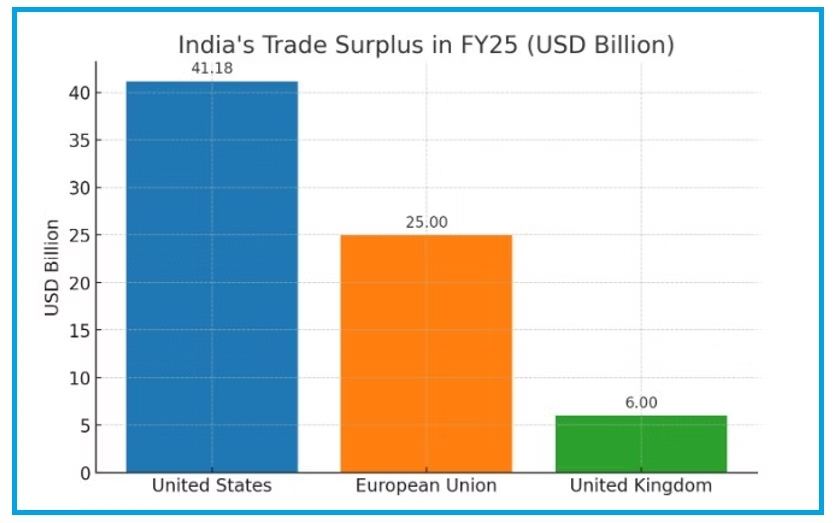
India Exports More to the West:

India’s trade surplus with United States, the European Union and U.K stands at $72.18 billion USD. If India wants to be competitive with China in terms of manufacturing, it should affiliate more astutely with the Western camp.

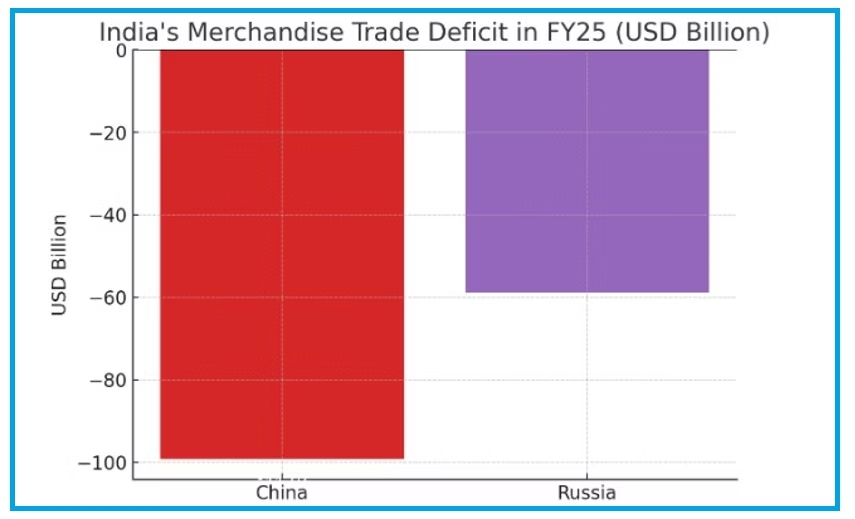
Dependence on Anti-Western Countries Hurts India’s Trade Balance:

India’s combined trade deficit with Russia and China is approximately $158 billion USD, which demonstrates how much less India exports to these two countries. India’s overall merchandise trade deficit is $282 billion USD, with a deficit of almost 56% in total attributed to Russia and China.

Service Exports a Crucial Metric in India’s Balance of Payments:

India’s services exports stood at $383 billion USD in financial year 2025, earned primarily from the U.S and other Western countries. Washington has imposed tariffs on India’s tradable goods sector, while the nation’s non-tradable sector has been operating without much stress.

India’s overall trade deficit stood at minus $94.26 billion USD in financial year 2025. Without service exports (predominately from the software services sector), India’s current account deficit would be much larger and the Indian Rupee would face greater depreciation pressures.

India’s economic stability is precarious, equilibrium needs to be found. Solid domestic outcomes for manufacturing and a stable Rupee, including exchange rates, could be achieved with a well-defined calibration that looks West but does not weaken India’s stance as a non-aligned nation. New Delhi should focus on maintaining neutrality and strategic autonomy.

While India may shake hands with Presidents Vladimir Putin and Xi Jinping, an important economic lifeline runs firmly through Washington, Brussels, and London. Crucial negotiations are said to be taking place between Prime Minister Narendra Modi’s team and President Trump’s White House behind closed doors. New Delhi could become vulnerable if it does not find adequate solutions. President Trump has recently reiterated his friendship with the Prime Minister Modi, perhaps an agreement can be produced in the mid-term.

post275

Nvidia: Short-Term Speculative Reactions Versus Investing

Nvidia: Short-Term Speculative Reactions Versus Investing

Nvidia is near 181.60 as of this writing, this after the company issued a quarterly report that beat expectations, but also pointed out that mid-term concerns may slow down the pace of some of its data driven business, and that China enterprise complications remain murky.

Nvidia Five Day Chart Early Morning as of 28th August 2025

Day traders should be certain they acknowledge the difference between a short and near-term wager on Nvidia compared to mid and long-term outlooks. Speculators who want to venture forth and gamble on Nvidia based on last night’s quarterly earnings report are free to do so. However, there is a distinct difference between betting on what today and tomorrow’s reactions in Nvidia will be compared to folks who are investing long-term in the company and believe that over the long haul it will remain a solidly profitable company that adds value to bottom lines.

In early August Nvidia was challenging the 185.00 ratio. As of this morning the stock is near the 181.60 mark. Nvidia faces headwinds currently in after hours markets because the company had the gumption to say it outperformed expectations in the last quarter, but put up a cautionary sign saying its data business may face some obstacles regarding growth, and outlooks for its China enterprise remains solid but could face some complications.

Reacting to Short-Term Temptations and Speculating:

For those who want to sell Nvidia based on the above ‘warnings’ today, they are free to try their luck. However, selling positions could quickly turn into buying opportunities. Nvidia like most equities is about considering reactions due to behavioral sentiment, short-term nervousness could rapidly shift to bullish perspectives in the eyes of investors, programmed trading software, and – yes – day traders.

Lower support for Nvidia technically when a five day chart is looked at may be 170.00 if someone is overly cautious. A look at a one month chart for day traders who have a bit more of an aggressive manner, may believe technical chart evidence suggests a lower move can be taken advantage of at 177.00, this if they are keen on waiting for a downturn to look for an opportunity to buy at lows.

Yes, perhaps some short sellers may target the mentioned values as places to cash out positions while speculating. But there is a chance Nvidia will not touch those lows. Perhaps bearish reactions – if they even happen – will fade quickly and additional bullish sentiment will continue to seep into Nvidia. Does anyone really think Nvidia is about to face a steep selling curve?

Tech Stock Consideration and Looking for a Barometer:

·       Some folks are talking about AI and its potential status as a bubble.

·       However, this is Nvidia we are talking about, even if there is a bubble in the AI sector, Nvidia long-term is a solid stock that will likely do well for years to come.

·       Short-term reactions seen the remainder of this week and perhaps over the next few weeks may be choppy, but this would include reversals in both directions.

·       Betting on a big downside in Nvidia looks to be wrongheaded.

·       Traders who are conservative and believe Nvidia is a good buy short-term after some selling happens, while looking for momentum higher – at least back to known resistance levels – may be making a solid wager.

Nvidia is one of the most important equities in the stock market. Some may justifiably say it is the most important at this moment. As a big driver of the Nasdaq 100, Nvidia has in many respects traded sideways since late July. This has been one of the reasons the Nasdaq 100 has faced headwinds too. The broader S&P 500 has been doing better than the Nasdaq 100 the past few weeks, this because tech stocks like Nvidia are facing some skepticism regarding just how high they can go. However, Nvidia as a stand alone company has excellent long-term prospects.

post273

China’s Economic Future: Speculation & Transparency Question

China's Economic Future: Speculation & Transparency Question

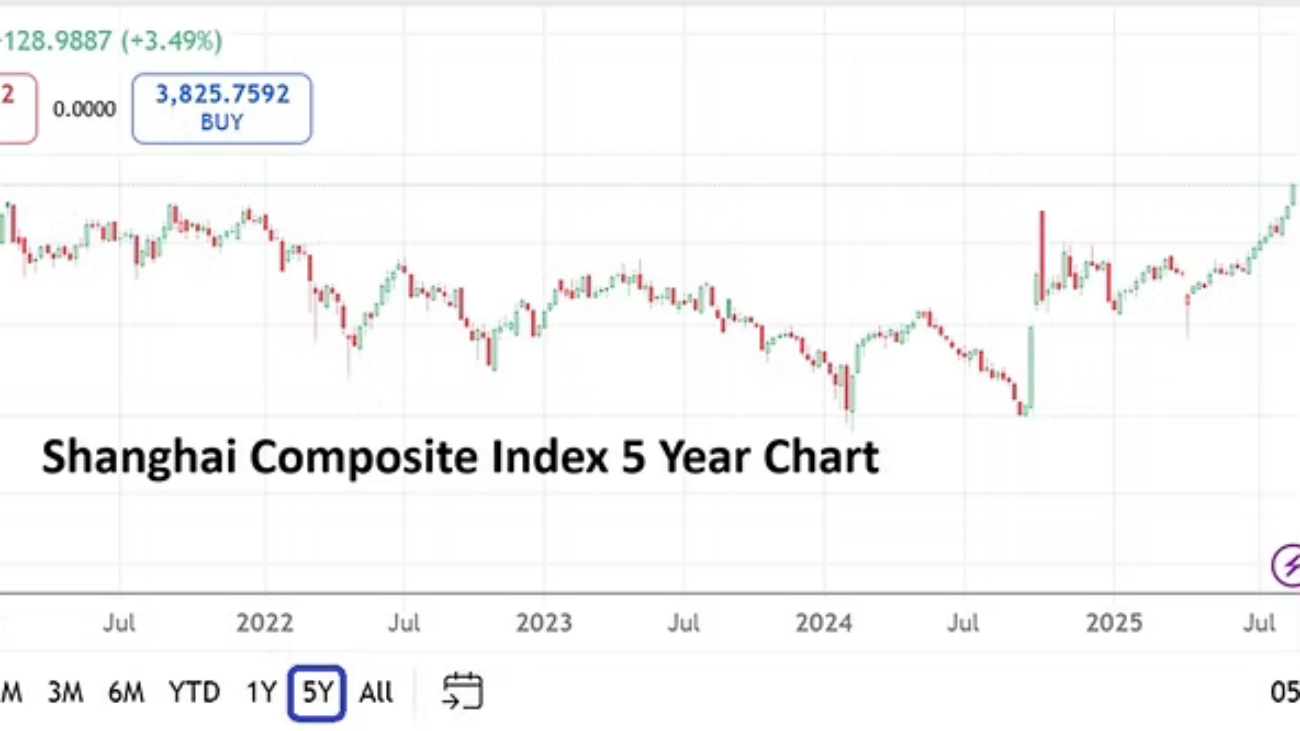
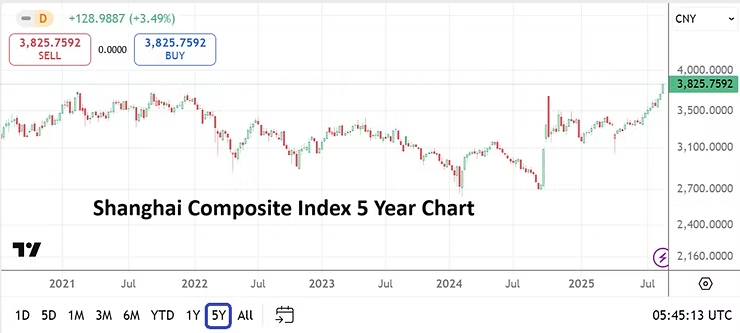
China’s economy has been underperforming for a handful of years. Growth has not only stagnated but has experienced a downturn, deflation has been experienced. Strong leadership from Xi Jinping has led to a firm approach regarding the management of China’s political and economic affairs. Until this year, Xi’s grip on power had grown significantly since he took office as the President and General Secretary of the Chinese Communist Party in 2012, but his control appears to be waning. Yet even as lackluster Chinese economic data has persisted, the Shanghai Composite Index (SSE 000001) has mirrored many global equity indices and done remarkably well since April of this year.

The SSE is near 3,826 currently. In early April the SSE was around 3,080, and in the middle of September 2024 the Shanghai Composite Index was close to 2,700, which was clearly within sight of long-term lows. The current heights of the SSE have not been seen since August of 2015. Yes, the Shanghai Composite Index was over 5,000 in April of 2015 and also in 2007. The point being that highs being traversed have not been seen in a long time. But is the positive speculation in the SSE a sign that economic conditions and political considerations in China are positive? Where is the transparency?

Shanghai Composite Index Five Year Chart as of 24th August 2025

China’s ability to create significant growth over the past four decades has transformed the nation into a global powerhouse economically and militarily. Yet, the past few years have begun to show cracks in the single handed approach to centralized decision making regarding the economy, government data presented has become suspicious. Rampant speculative forces in the SSE have been seen before. Is now the time to buy more Chinese equities or is it time to become cautious? Reliable statistics remain a troublesome aspect for investors.

China’s real estate market collapsed under the weight of too much building and speculative buying of apartments. Yes, inflated property and sudden deflation has been seen in capitalist countries in the past and will be witnessed again in the future. But the bubble in Chinese real estate and its crash also points out problems regarding a lack of transparency. While the Chinese government has tried to fix the fiscal problems caused by the real estate implosion, it has also created significant fractures within its banking system, which are confronting the Chinese government and public, and sometimes feels like a coverup trying to hide bad news. When will there be a recovery in the China real estate sector, is the worst of the crisis fixed?

Chinese political questions and some evidentiary circumstances point to intriguing considerations. There is evidence in China that a change of leadership is progressing. In the past couple of months small hints have been allowed to be published via China’s state media, the Xinhua News Agency. Rule changes have been made regarding decision making processes in the Chinese Communist Party, this was published by Xinhua in late June and republished by the South China Morning Post of Hong Kong in early July. While paraphrasing, both news entities expressed that rule changes meant Xi Jinping would officially have to delegate more decision making.

USD/CNY One Year Chart as of 24th August 2025

Speculation is growing beyond a mere whisper that the Chinese military has become a wildcard and a source of power that is potentially ready to help remove Xi Jinping. The military apparently is not supporting Xi and wants a more collective approach to decision making via the Chinese government. Yes admittedly, this information can be described as being from news services and podcasts that do not favor the Chinese government, but they seem to be singing in unison. It appears that China’s People’s Liberation Army have decided it is time for a change and is ready to play a role in the selection of new Chinese leadership.

The 80th Anniversary Victory Day Parade in Beijing will be held on the 3rd of September, what role will Xi Jinping play in the show of military force? Will it become apparent that Xi is merely a figurehead until an official decision is made on how the Chinese Communist Party will be led? Importantly, the 15th Five Year Planning Conclave for the Chinese Communist Party will be held in October and this is where a leadership change could take place including the official removal of Xi Jinping.

There appears to be – yes, via the dissident information heard, two factions within the Chinese Communist Party vying for power – hardliners and reformers. The army still hasn’t made it clear if they are backing the hardliners or the reformers. What is evident however via many publications, is that China’s PLA has decided along with other important leadership circles in China’s Communist Party that Xi had too much control and they want a more collective leadership.

Regarding the Chinese economy which has undergone a period of stagnation and lackluster results the past handful of years under Xi’s strong centralized approach, something big is about to happen which will have ramifications for the next five years. Who will lead China? The hardliners who are true believers in ideological communism or reformers who want China to move towards more of a market economy? This is a huge question. This type of political infighting has been seen in China during the past four decades and played a role in key leadership changes. It is not a conspiracy plot which is being sounded, it is the possibility of a transfer of power which happens cyclically in many nations when changes are warranted.

China’s Shanghai Index has done well recently. Perhaps this is a correlation reflecting optimism being sparked globally in equities in recent months. Or is it also possible that some folks in the know are betting on the reformists to take control of the Chinese government? Tariff concerns have seemingly been brushed to the side in China and something bigger is certainly at play. President Donald Trump is not the story here. Investors participating in China need to pay attention to the political changes that seem to be brewing. While speculation has certainly brought the Shanghai Composite Index to long-term highs, transparency from China is a concern economically and politically and there will be an impact if changes to leadership occur.

post270

India Insider: Strategic Balancing Act Comes with Risks

India Insider: Strategic Balancing Act Comes with Risks

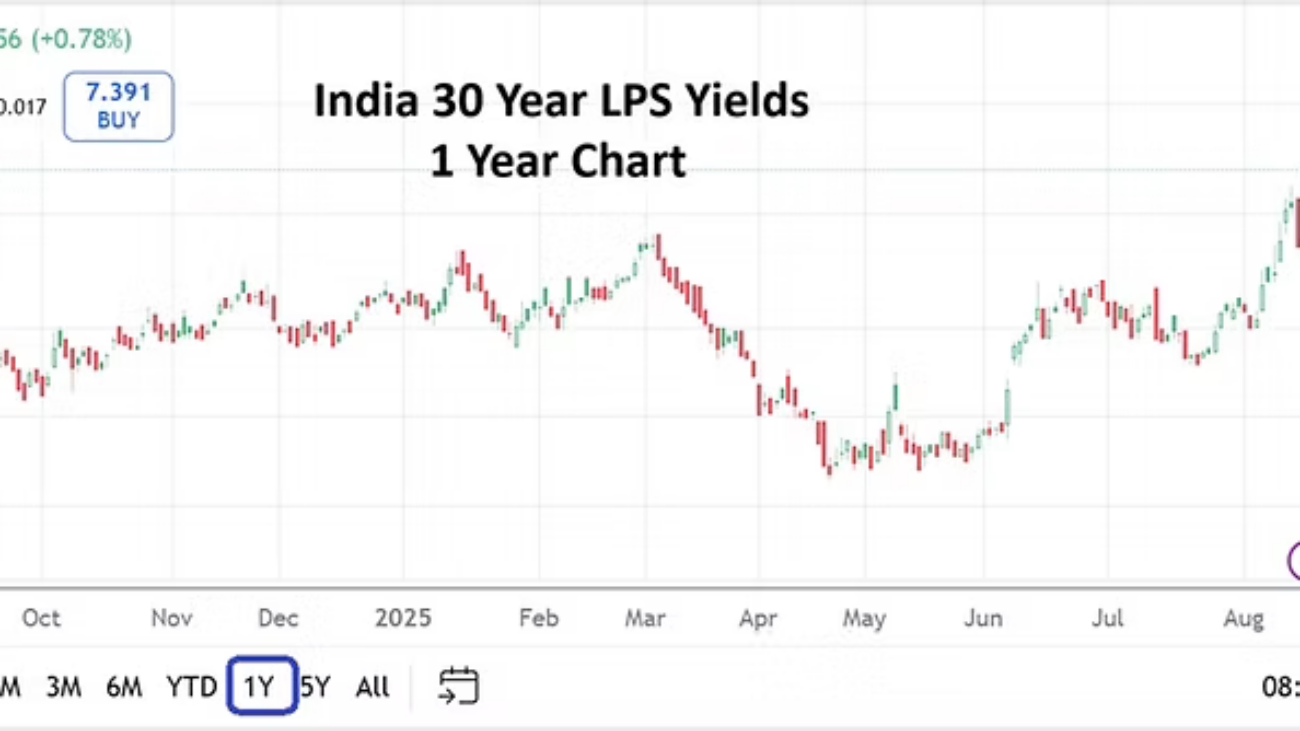
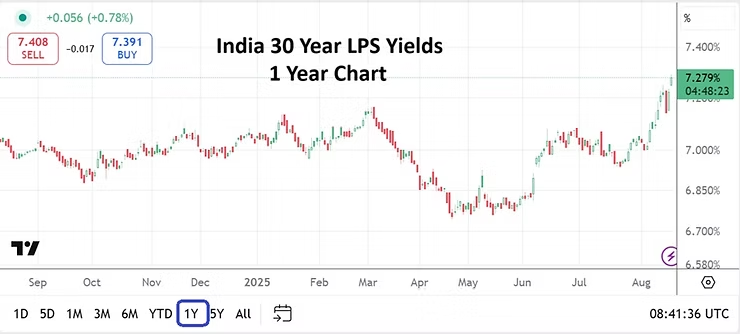
On the 15th of August, India’s Independence Day, Prime Minister Narendra Modi announced a large reduction on Goods and Services Tax rates to boost domestic consumption. The Indian economy is certainly slowing, this as lackluster domestic consumption has prompted the Reserve Bank of India to cut the repo rates from 6.5% to 5.5% in 2025.

Indian Bonds 30 Year LPS Yields One Year Chart as of 19th August 2025

As trade deal discussions with Washington flounder, New Delhi is being forced to shift economic considerations towards China. The diplomatic relationship between India and China has grown colder, particularly since they clashed on the eastern border region in 2020.

Relying on China also comes with challenges for New Delhi. Since 2021, the trade deficit with China has expanded from $73.3 billion to $99.27 billion USD, showing that India still depends increasingly on China for significant importing needs.

According to Bloomberg, India’s major conglomerates have already established excellent relationships with Chinese suppliers of lithium ion batteries and EV components, although they try to discreetly tread under the radar in order to avoid the wrath of New Delhi government.

The fact is India can sustain its economy and maintain its geopolitical posture of non-alignment by practicing a multi-polar stance with Washington and Beijing. But despite clinching trade deals with the U.K and reviving trade negotiations with the E.U, New Zealand & Australia, and its deepening bilateral relationships with many central Asian nations and within BRICS, New Delhi’s major trading partner for exports remains the United States. Around 18% of India’s exports go towards the U.S, while 15% of imported goods come from China. The numbers do demonstrate an intriguing balance.

While India’s negotiations with the U.S have stalled and appear postponed indefinitely, other Southeast Asian countries, including Vietnam, Indonesia and the Philippines have secured lower tariffs with the Trump administration making them more competitive in the U.S. market. These nations are using the U.S for economic and military security, but they also rely on China for manufacturing and logistical needs.

India Faces Additional Challenges with Washington and Beijing:

Indian IT companies derive nearly 57% of their export revenues from U.S clients, making them heavily dependent on that market. And rapid advances in AI and the erosion of legacy outsourcing models are putting India’s traditional profit engines under pressure.

Meanwhile, China is not keen on helping India achieve expertise and manufacturing competitiveness which would threaten its own business model. China wants to make inroads by selling goods to the world’s largest consumer market, rather than technology transfers which would allow India to attain manufacturing supremacy.

Some economists warn that India’s own plans for mitigation of its current circumstances will likely be disinflationary. India’s bond results via yields clearly express concern about potential fiscal costs and difficulties. New Delhi’s focus has shifted towards appeasing domestic consumers, while trying to deal with uncertain foreign partners. Government capital expenditures have been declining since last year, signaling that both corporate and public investment confidence remains weak.

India’s neutrality is welcomed. It’s not anti-Western or pro-Western, and attempts to balance between the U.S and China while trying to forge new trade agreements and ties are a constant high-stakes game capable of creating strains economically and politically. The path forward with the U.S and China will remain complex and it must be worked on with precision in order to help achieve success.

post264

India Insider: Concern IT Empire is at Risk in Age of AI

India Insider: Concern IT Empire is at Risk in Age of AI

When China’s DeepSeek announced its Generative AI program as a rival to U.S based ChatGPT, the world paid close attention. In fact, Nasdaq bellwether stock Nvidia, the world’s most valuable company, took a hit because the DeepSeek product was made with less expensive chip processors compared to ChatGPT’s infrastructure, which uses Nvidia’s GPU technology.

In North America and Europe, DeepSeek’s rollout was met with much surprise and intrigue. And the true ‘poster child’ of India’s post-liberalization era, the IT (Information Technology) sector has been facing its own challenges and was also caught off guard. India’s IT sector employs some 5.3 million people and helps maintain its current account balance sheet by earning crucial foreign exchange reserves. The top four major IT companies have a combined market cap of $300 billion USD, larger than India’s richest man Mukesh Ambani’s Reliance Industries, which stands around $238 billion USD.

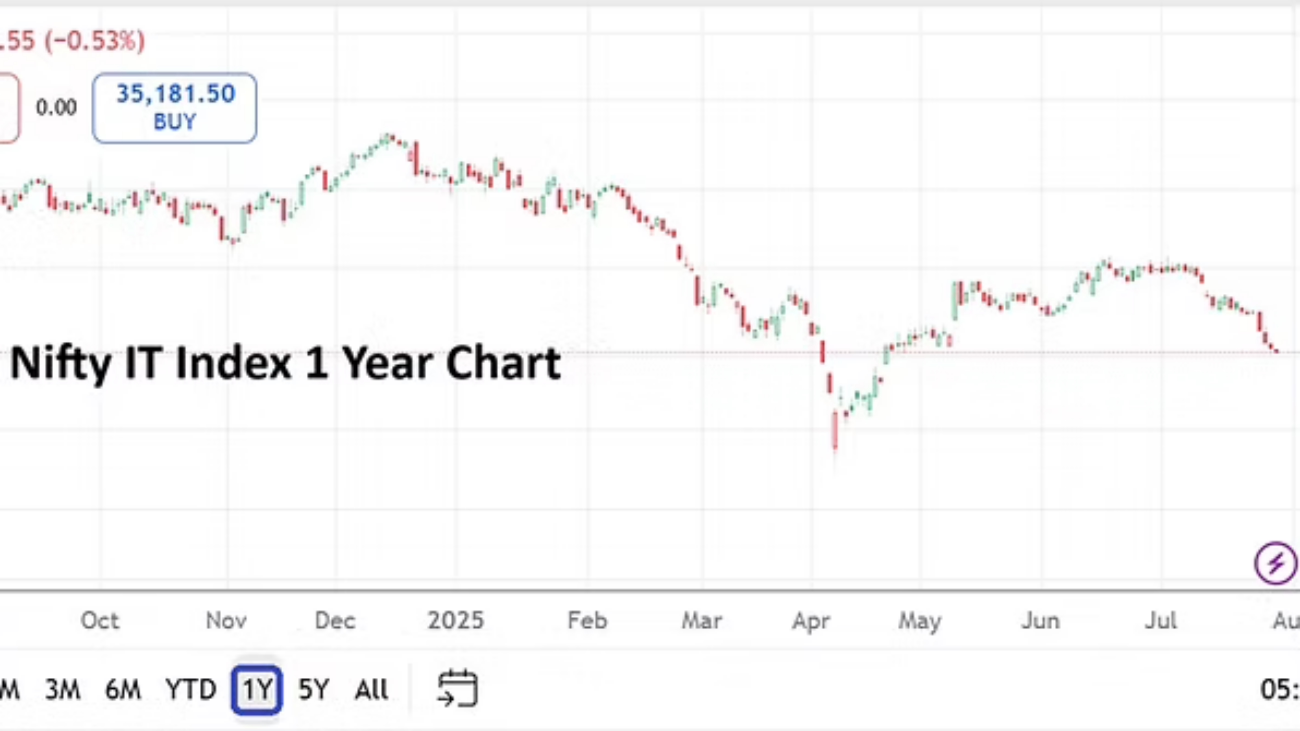
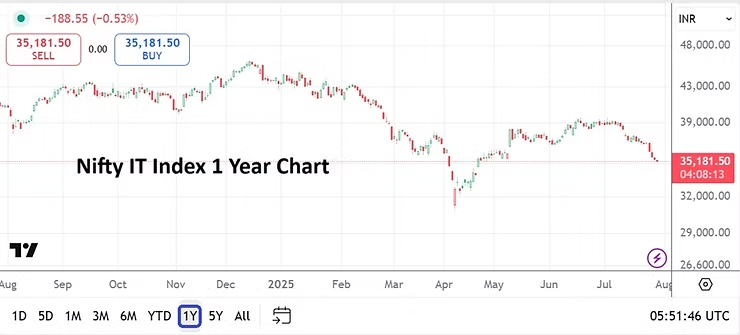
Nifty IT Index One Year Chart as of 29th July 2025

India’s IT Business Model and Artificial Intelligence

Indian IT companies operate on a model of software servicing for offshore clients, typically via medium to long-term contracts. Their business operations are embedded across the globe thanks to affordable pricing and the quality of services provided by Indian software engineers. Now, this model is being threatened by the rise of Generative AI and taking it lightly would be a serious mistake by India.

Shares of major IT companies ­- TCS, Infosys, Wipro, and HCL have delivered lackluster returns since their post pandemic rally. Since Covid high valuations amid deal pessimism were a concern. Now those worries are amplified by AI and the disruption it brings to their business models. Software exporters remain the worst performers, the Nifty IT index is down 18% year-to-date, underperforming the broader index consequentially.

The recent release of Q1 fiscal year 2026 numbers from these four IT companies have been met with skepticism regarding forecasted outlook. Analysts noted that Indian IT firms are grappling with margin pressures amid persistent macroeconomic headwinds and rising threats from AI-driven productivity improvements. In response, companies have started to protect their margins with layoffs, TCS (Tata Consultancy Services) shed around 2% of its workforce this past weekend which could affect more than 12,000 jobs.

Time For India’s IT Sector to Become Proactive

Pricing models that IT companies charge customers are changing from long to short-term flexible contracts like ‘pay as you go’ over traditional fixed annual licensing models. Despite changing CEOs in several of these companies over the last few years, animal spirits are failing thus far to innovate AI products that can enhance the bottom line. Instead, companies prefer share buybacks and paying stellar dividends to appease the shareholders rather than to invest in R&D especially when their core model is under threat.

Hang Seng Index One Year Chart as of 29th July 2025

The euphoria surrounding India’s $5.4 trillion equity market is cooling in 2025, amid concerns over slowing earnings growth, elevated valuations, and tariff related uncertainty. At the same time, sentiment towards Hong Kong’s listed Chinese shares are improving with global fund managers rapidly reallocating capital to that market. The Hang Seng Index has delivered an impressive 27% return year-to-date. Meanwhile, India’s stock market still lacks depth for investors seeking meaningful exposure to the booming Artificial Intelligence theme.

Indian IT companies excel at scaling and delivering AI solutions for global clients, but they do not own the core models, platforms, or consumer data needed to become true AI disruptors like China’s tech giants. The industry contributes approximately 7.5% to India’s GDP and remains the primary employment avenue for engineering graduates. It’s time for India’s IT sector to proactively address the growing AI threat posed by global competitors.

post256

Crude Oil: A Guess from the Underbelly On What Happens Next

Crude Oil: A Guess from the Underbelly On What Happens Next

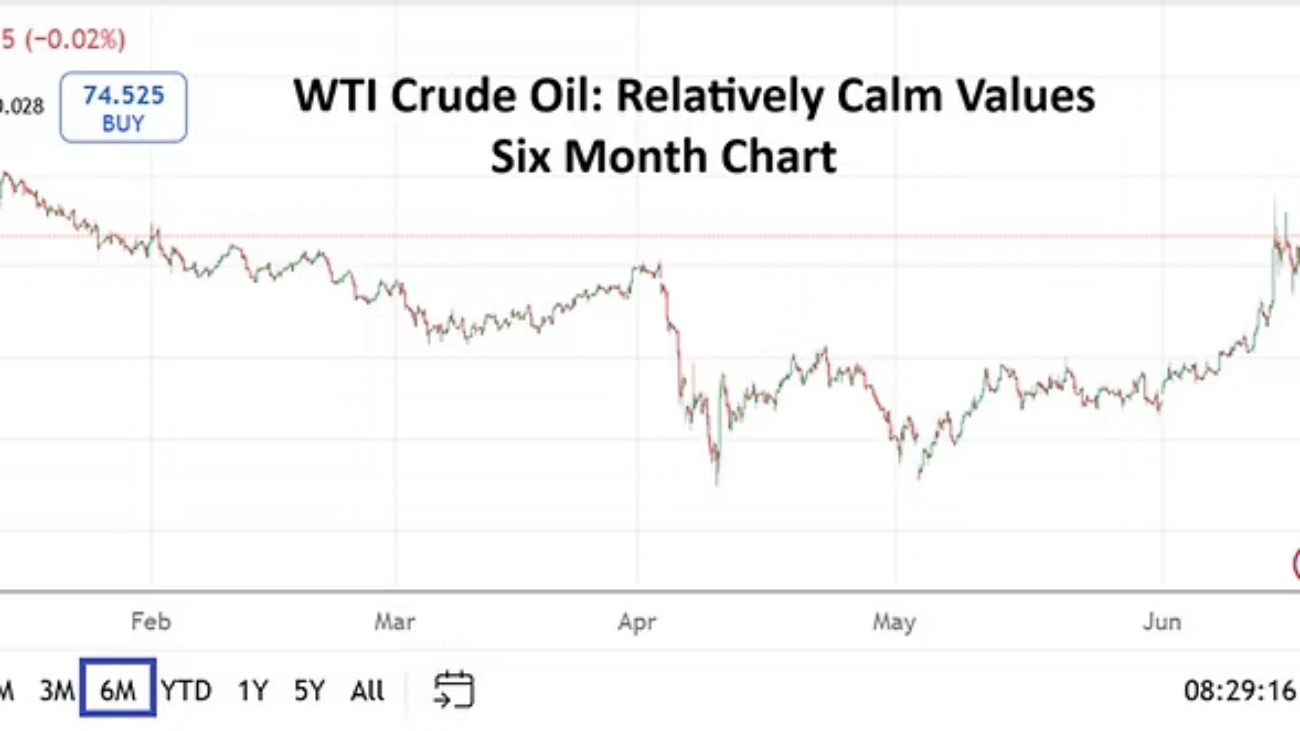
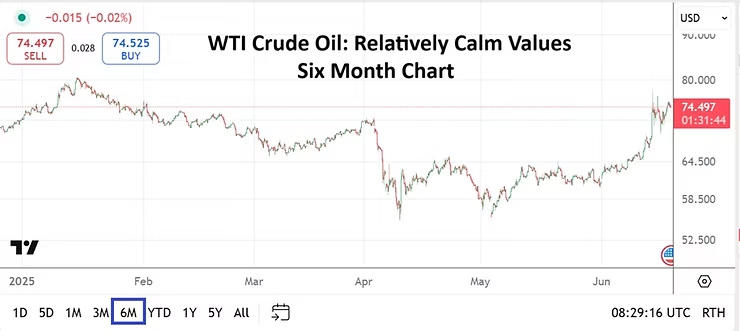
Why has the WTI Crude Oil Spot price remained relatively calm? The war between Israel and Iran has been going on per this latest violent phase since Friday the 13th. While tensions have been high between the two nations from the 7th of October 2023 in a very outward manner, and missiles were fired from Iran towards Israel on two separate dates in 2024 which then featured Israeli retaliation, the past handful of days is a new escalation.

WTI Crude Oil Spot Price Six Month Chart as of 18 June 2025

Day traders of WTI Crude Oil need to understand that large players in the energy sector have a vast amount of experience and intel regarding production and supply worldwide when they make their buying and selling decisions. However, the biggest oil traders do not always share the same political viewpoints, except to say most large players in the energy sector practice the art of realpolitik. Day traders of WTI Crude Oil should try to get into the minds of the real movers of WTI Crude Oil via realpolitik considerations.

As of this writing the price for WTI Crude Oil is around 73.930 Spot, late yesterday it did move higher to within sight of the 75.750 USD mark – this when information that President Trump is considering a U.S military strike on Iran heightened. Traders need to understand Spot Crude Oil and Futures pricing can be different. The current value of WTI Spot is higher than the Futures pricing because of the short and near-term known risks.

However, volatility in WTI Crude Oil Spot has remained fairly muted, almost tame as Israel and Iran wage war. Other spot energy prices like Brent and Natural Gas are being affected directly too because of shifts in behavioral sentiment. But again, the prices within the energy sector have remained calm considering what is at stake for global economics. Here are points that may be affecting the WTI Crude Oil landscape and energy complex, which some large traders may be contemplating:

  • It is highly likely the U.S has told Israel not to harm Iranian Oil production or supply sites, including shipping.

  • The U.S does not want the price of WTI to jump rapidly because of the current war between Israel and Iran.

  • Inflation would be a scrouge for the global economy, not to mention President Trump’s ambitions.

  • Even though the U.S has its own energy supply, the price of WTI is affected by behavioral sentiment within the global Crude Oil complex.

  • Meaning conflicts in the Middle East and elsewhere always cause ripple affects, even if Crude Oil is flowing freely in the U.S via its own production.

  • The U.S doesn’t want China to be given a reason to consider becoming an open belligerent in the Middle East war.

  • China gets a lot of Crude Oil from Iran. The stated percentage is around 15% of its total supply, but it could be more if Iran sends oil to other locations and then reroutes supply to China afterwards.

The U.S not only wants to keep China calm about its energy supply, but also doesn’t want to give China an excuse to escalate political or military tensions elsewhere – read Taiwan.

As an aside there are a lot facts and rumors coming from China, highlighting that a powerplay is emerging between competing factions for leadership in China’s military, this may include the authority that Xi Jinping has too. China will be conducting Politburo meetings in the coming weeks that will get plenty of attention via Beijing analysts. If U.S intelligence knows an internal political fight is taking place in China, they will want to keep China calm regarding external considerations and not give China excuses to act. Concerns regarding the Middle East as a justification for more Chinese actions against Taiwan in some type of economic political/ military theatre is a threat.

By telling Israel not to attack Iranian oil infrastructure, this allows the U.S to placate China. Only if Iran were to attack U.S infrastructure – including military assets or interests in the Persian Gulf via attacks on Gulf States like the UAE, Bahrain or Saudi Arabia would the U.S consider retribution against Iranian Crude Oil.

While the U.S has an interest in global politics certainly, it also wants to maintain a stable global economic environment. President Trump knows this and so does his cabinet supposedly. The Federal Reserve meets later today and they will certainly speak about uncertainty regarding inflation. Whether or not they mention the Middle East war will be interesting.

Thus, it is likely the U.S will only allow an attack on Iranian Crude Oil production and supply if it has been directly threatened. And this is where it gets potentially more interesting for Crude Oil traders. It appears likely the U.S will get involved directly in Iran by hitting known Iranian nuclear facilities deep underground with heavy U.S ordinance. If the U.S does attack Iran via B2s using heavy bombs, how will Iran’s Revolutionary Guard Corps react?

Will the existing IRGC allow for the destruction of its nuclear ambitions and accept that it will have to prepare for a new political environment in which their power will likely be challenged by not reacting? Or will those in power of the IRGC double down on stupidity and attack U.S assets with some of the Iranian military weaponry that still remains? An attack on U.S ‘interests’ would risk aggravating the U.S more – giving the U.S reasons to attack Iranian economic infrastructure which is mostly Crude Oil, and likely close the door on the chances of the IRGC to survive after the war concludes.

Things often do not work out via political and military outlooks. The law of unintended consequences is always a danger. The end game is quickly approaching for Iran’s current leadership. The U.S and Israel also hopefully have taken this into account. Recent outcomes in Iraq and Afghanistan have not gone as planned for the U.S when seeking a serene endgame.

As an example, it might be better not to eliminate the current Ayatollah Khamenei, and allow the people of Iran an opportunity to remove him if they want. The Iranian Revolutionary Guard Corps and its various factions are probably eyeing what will come after a capitulation. There will be a fight for survival politically and a leadership vacuum.

The IRGC fiefdom gets most of its money from Crude Oil revenues. It is quite possible in a forward looking manner the IRGC may choose not to risk having the U.S ruin Iran’s one giant economic asset, thinking rightly or wrongly that they can continue to profit from Crude Oil the day after the war ends.

post255

Quick Hits: Inflation, USD, China and U.S Trade and WTI

Quick Hits: Inflation, USD, China and U.S Trade and WTI

Yesterday’s weaker than anticipated CPI data from the U.S cements the realization that inflation is eroding in the States statistically in a rather consistent fashion. Today’s PPI numbers will be watched, but yesterday’s results clearly show the Federal Reserve has been far too cautious.

Media reported yesterday’s inflation results differently showing bias as some pointed out that inflation rose, compared to some outlets that showed it came in less than expected. Bottom line – inflation has been below expectations consistently and tariff concerns as of yet have not killed the U.S economy with higher prices. The Fed’s insistence on being cautious are comparable to the instincts of an overly protective parent. Day traders need to understand their perceptions are in danger of being affected by folks with confirmation bias.

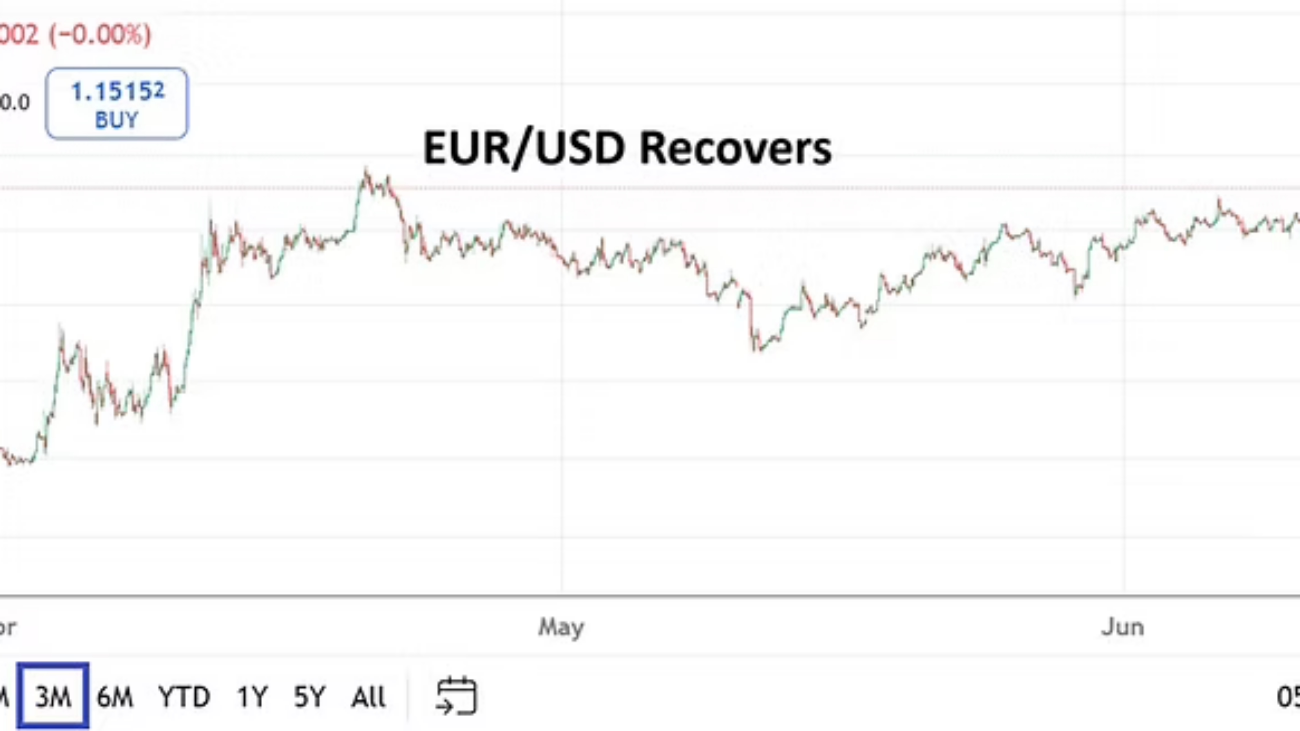
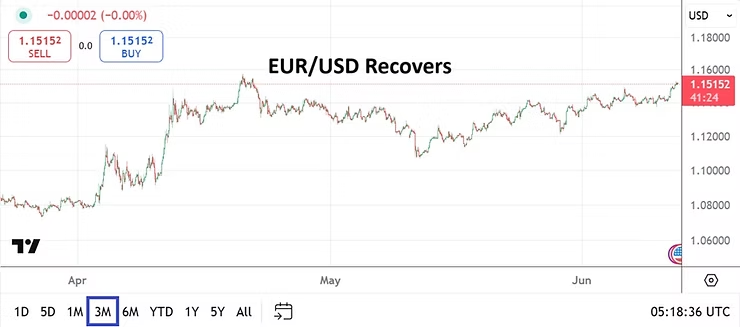
EUR/USD Three Month Chart as of 12th June 2025

The EUR/USD climbed above the 1.15000 level again yesterday confirming mid-term outlook for a weaker USD based on the notion the Federal Reserve will have to lower the Federal Funds Rate exists. While perhaps kicking and screaming against their desires to remain hawkish, the Fed will start feeling the heat to act. Next week’s FOMC meeting is unlikely to be the actual date. However, financial institutions have certainly been leaning into a weaker USD since April, and the upwards trajectory in values by major currencies against the USD may prove to be a solid baseline via support prices moving forward.

Certainly, day traders should consider the notion that larger traders have bet against the USD already, thus leaving the door open to the potential of reversals. Yet, mid-term price levels are what financial institutions are gearing their outlooks towards via cash forward transactions for commercial companies. If financial institutions believe the Fed will have to indicate the potential of a rate cut not only in July, but another one in September this could spur on additional USD weakness. Folks should also consider the notion that the White House won’t be against a somewhat weaker USD in order to help U.S manufacturers and producers export.

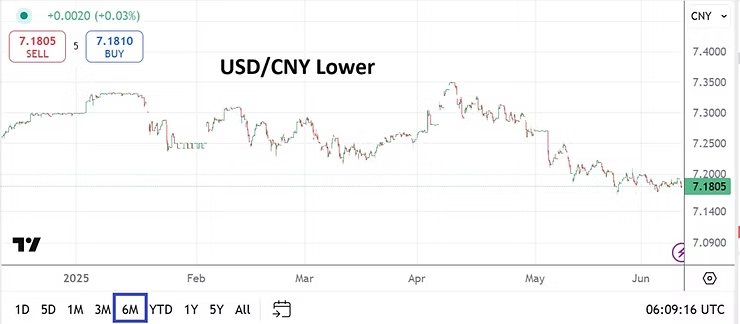
USD/CNY Six Month Chart as of 12th June 2025

U.S stock indices didn’t climb on the results of the China tariff news proclaiming a working agreement has been attained over the past two days. Perhaps markets are inclined to believe there will be more fireworks regarding rhetoric from the U.S and China over the coming months – which appears logical given the circumstances between the two nations.

While rare earth metals got the headlines, there appears to be plenty of line items in the tariff negotiations that still must be worked on. The announcement that the deadline has been pushed back again, this time until the 9th of August shows that talks are making progress – but slowly. Red lines keep getting erased.

Financial markets reacted rather passively to the U.S and China news, seemingly indicating larger players are now focused on other matters, and funds have played most of their cards regarding the China and U.S saga via their existing trading positions. Noteworthy, is the fact, the USD/CNY has reacted in a rather correlated fashion with the broad Forex market the past six months. For all the talk about a catastrophe for China and U.S trade, the USD/CYN has behaved quite well, showing the Chinese government is playing a long game against President Trump and doesn’t want to create a huge firefight via currency manipulation accusations.

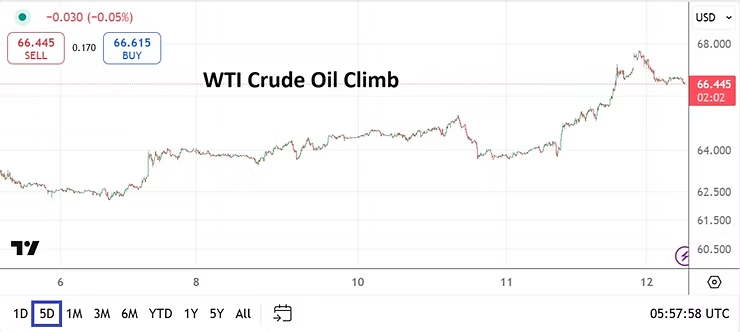
WTI Crude Oil Five Day Chart as of 12 June 2025

Middle East Escalation: WTI Crude Oil jumped late yesterday as news quickly filtered through social circles of embassy evacuations in various proximities within reach of Iran. The loud whispers certainly caused the price of the commodity to surge to almost $67.75 last night, but this morning’s values suggest some deep breaths have been taken as WTI trades near $66.45.

For options traders who want to buy cheap calls on WTI, they will likely have to look several months out and speculate on military escalation under rather speculative circumstances. If traders want an idea of what larger players are doing in options they can use CME (Chicago Mercantile Exchange) info to get some thoughts on positioning pattens in WTI Crude Oil calls and puts. The call options did get more expensive last night – meaning that some large traders are hedging against the threat of higher WTI Crude Oil prices because they are likely leaning into cheaper oil for the time being, or they are betting on the price of the commodity to rise if chaos breaks out in the Middle East.

post246

An Expanding Axis – Will Egypt and Pakistan Become Members?

An Expanding Axis - Will Egypt and Pakistan Become Members?

Opinion: The following article is commentary and its views are solely those of the author. This article was first published the 26th of May via The Angry Demagogue.

China seems to be taking advantage of the transition from the Obama-Biden appeasement based foreign policy to the Trump commercial based system. Whereas Obama-Biden had no problem punishing allies that dared to oppose the US-EU appeasement and woke revolution, Trump is looking to create alliances based on commerce – and threatens allies that don’t go along. While the Obama-Biden policy failed utterly and arguably caused the wars in Ukraine and the Middle East, the Trump administration seems to be playing for time as it restructures the global security order.

China however does not seem to care to wait and are stretching their sway not only in the South China Sea but westward towards the Middle East. The four member Axis – Russia, China, Iran and North Korea seems to be expanding to other countries with strong military dictatorships. Egypt and Pakistan will be the next members of the Axis. While much of China’s belt and road policy deals with bankrupting poor, weak countries, they seem now to concentrate on strong military dictatorships. Egypt and Pakistan are being pried from the western camp as we speak.

Pakistan has, for awhile not been firmly in the western camp. It was a cold war U.S ally as India, while democratic, sided with the Soviets on most international issues. While the US was busy in Afghanistan, the Pakistanis played double agent. Now that the U.S is not in the region and the U.S and India have become closer, Pakistan is now firmly in the Chinese camp.

In addition to Pakistan, Egypt becoming the next major member of the Axis.

Let’s take a few steps back and examine the burgeoning relationship between Egypt – a military dictatorship and Communist China. As we have written China and Egypt had joint military maneuvers that included deliberate violations of the Egyptian-Israeli peace treaty guaranteed by the United States. Egypt, in thumbing its nose not only at Israel but at the United States, allowed Chinese planes to approach the Israeli border in order to test Israeli reaction to a possible invasion. Multiple Chinese military cargo jets flew in undisclosed hardware in the days leading up to the maneuvers.

Three more Chinese Y-20 cargo planes landed in Egypt last week again, carrying unknown hardware. At least one of these planes came from Pakistan. Egypt also seems to be signing major arms deals with France as Macron reeks of desperation in his attempt to remain relevant – but a de Gaulle he is not, and he will not be able to create a force or policy independent of the U.S. Egypt will be glad to take advanced French weaponry while it creates a stronger alliance with China.

Back to Pakistan one has to wonder if the Pakistan-Indian flareup a prelude to what can happen in other theatres – or worse, a purposeful conflagration to test Chinese weapons systems in actual combat and keep the West on its back feet? According to most reports they were able to shoot down between 3 and 5 of France’s most advanced Rafal fighters without even entering Indian territory. The confrontation started with a heinous terrorist attack against Indians in Kashmir by a terror group associated with the Pakistani armed forces. India claims that Pakistan is directly involved in the attack. If so, this would not have been the first one.

The downing of the Indian French built Rafal fighters by Pakistan’s Chinese produced 10-C was, according to expert reports, not just or even mainly superior piloting but with a Chinese strategy and technology that includes all aspects of air power – including recognition of the target, locking on and attack from distances in what an American air expert called a perfect air based killing machine. This would seem to be the first real test of Chinese advanced air-power and it something that needed to be done before any invasion of Taiwan. This may not test their own pilots but it does test the strategy and the technology.

China has a main medium term goal here and it is not a secret. They are planning to take Taiwan by force and need to make sure their soldiers, sailors and hardware are up to the job. They have seen how poorly the Russian army has performed and have seen how Israel has dismantled Iran’s defenses and swatted away Iran’s offensive attacks. China has not fought a major war for decades and for all the advances they say they have made – all have been untested. Until now.

China will not risk a war with India itself but would be more than happy to have its proxy involved. Chinese fighters and their new “over the horizon” missiles are key in their plans to deter the U.S from defending Taiwan – or in defeating U.S naval airpower if the U.S does get actively involved. However, as close as French technology is to America’s it is not the same and the one country that seems to have taken U.S technology to the next level is Israel. How would Chinese weaponry due against American arms in the hands of an air force equivalent in skill and bravery to the American air forces? That has yet to be tested but that brings us back to Egypt. Is it in China’s interests for Egypt to make a major break with the U.S at China’s urging much as they made a break with the Soviet Union at America’s urging? Of course. Would that mean that China might help Egypt provoke a military confrontation with Israel in order to test Chinese arms and relieve pressure on Iran? Maybe.

On to Iran then, where it does not seem that the Americans or Israelis understand the nature of the Iranian-Chinese relationship. Not only does China get the bulk of its oil (subsidized) from Iran but they have just completed a rail link from Xinjiang, China to Teheran, Iran – running through four countries. This rail line can ship oil as well as other cargo, cutting into the American (and Indian) naval superiority around the Persian Gulf and Indian Ocean. The assumption by military planners has always been that the U.S can cut off Chinese access to oil, if necessary. That is no longer the case.

China is not standing still – they are expanding their axis of dictatorships to countries in which the army is in control. Pakistan and Egypt qualify. Iran, while a theocracy is controlled by the Iranian Revolutionary Guards. No matter the “deal” that the Trump administration negotiates with Iran they will not be pried away from Iran. China has more to offer an ideological dictatorship then commercial deals with the United States. What the alleged realists in foreign policy refuse to understand is that dictatorships have no interest in commercial success if it weakens their grip on power. They are interested in deals that enrich their regimes since that also strengthens their grip on their people.

The trillion of so dollars in deals that the U.S has now made with the Persian Gulf states ensures that America remains a player in the middle east. Those who think that the Mideast is a tertiary region at best – after Asia and South America – need to rethink their strategies. As China closes in on control of the world from the Pacific to the Mediterranean the U.S is left with just two military powers it can depend on – Israel and India – to help defend its old/new commercial interests. It is not only oil – it is not Boeing jets, Nvidia chips and many other products that are moving from the US to the Gulf as opposed from the Gulf to the U.S. The U.S is no longer a commercial client of the Gulf states but the country who needs to protect its clients. The relationship has changed but the security relationship has only gotten more important.

The addition of Egypt and Pakistan to the Axis means that the Chinese threat has expanded. They are not giving up on Taiwan, nor are they giving up on South America and the Pacific Ocean but rather, China is using its experience as a dictatorship to strengthen ties with other freedom hating countries. We can all pretend that values and culture don’t matter, but that doesn’t mean that they don’t. This Axis is one where the interest of each member is to stay in power, force its will on its people and enrich itself at the expense of its people. This is an Axis, not only of the unfree, but of those who need to eradicate freedom to “thrive”.

Disclaimer: the views expressed in this opinion article are solely those of the author, and not necessarily the opinions reflected by angrymetatraders.com or its associated parties.

You can follow Ira Slomowitz via The Angry Demagogue on Substack https://iraslomowitz.substack.com/ 

post240

Market Volatility Shelf Life Doesn’t Have an Expiration Date

Market Volatility Shelf Life Doesn't Have an Expiration Date

Updated: Apr 11

An associate in the financial world just wrote to me that “all bets are off”. Perhaps that is a solid way to think about the present speculative and investment situation. The tumultuous wave of hysteria in equity indices, Forex, commodities and U.S Treasuries are evident to everyone. President Trump’s tariff policies released last week lacked precision via perspectives for many investment institutions who suddenly had their mirage of calm destroyed. The realization that President Trump was undertaking what he had promised caught many by surprise who thought he was bluffing. Trump’s ‘Art of the Deal’ tactics are now being confronted by middlegame chess strategies from opponents.

While the broad markets have boiled and folks look for calm to return, the prospect that current volatility has the potential to carry a long shelf life with no expiration date has to be considered. Yes, the financial world will become serene again. The return of semi-tranquil trading has been seen in the Nasdaq, S&P 500 and Dow 30 the past couple of days – only because the losses and gains depending on the index have been moderate compared to last Thursday’s and Friday’s results.

Yet the shadow of more violent trading remains crystal clear. China and the U.S are now exchanging loud threats which include higher tariffs and retaliatory measures. The USD/CNY is under scrutiny as devaluation by China appears an evident threat. And U.S Treasuries are being watched as some contemplate that China is undertaking a selloff of U.S bonds. Higher U.S yields on long-term Treasuries will create pressure via the amount of debt the U.S will be obligated to pay.

Vice President J.D Vance’s peasant comments about China were not helpful on Tuesday. Why must a hornets nest must be stirred up? China has now been hit with a 104% tariff from the U.S, this while China has vowed to ‘fight till the end’ in its media. Asian markets are selling off cautiously this morning as tensions reignite. Forex pairs such as the USD/SGD, USD/ZAR and USD/BRL should be watched as a barometer not only by currency traders, but by those who want metrics regarding how global economic sentiment and credibility of policies are being contemplated. Risk adverse trading in emerging markets will cause harm and has the earmarks of looking like a stiff penalty for nations trying to develop and raise their standards of living.

While the start of this week has been smoother in relative terms compared to last week, the lack of a comprehensive end game is still missing. There is merit to treat current circumstances with cautious respect. The mid-term outlook remains highly questionable as President Trump and his negotiation gambits are tested publicly.

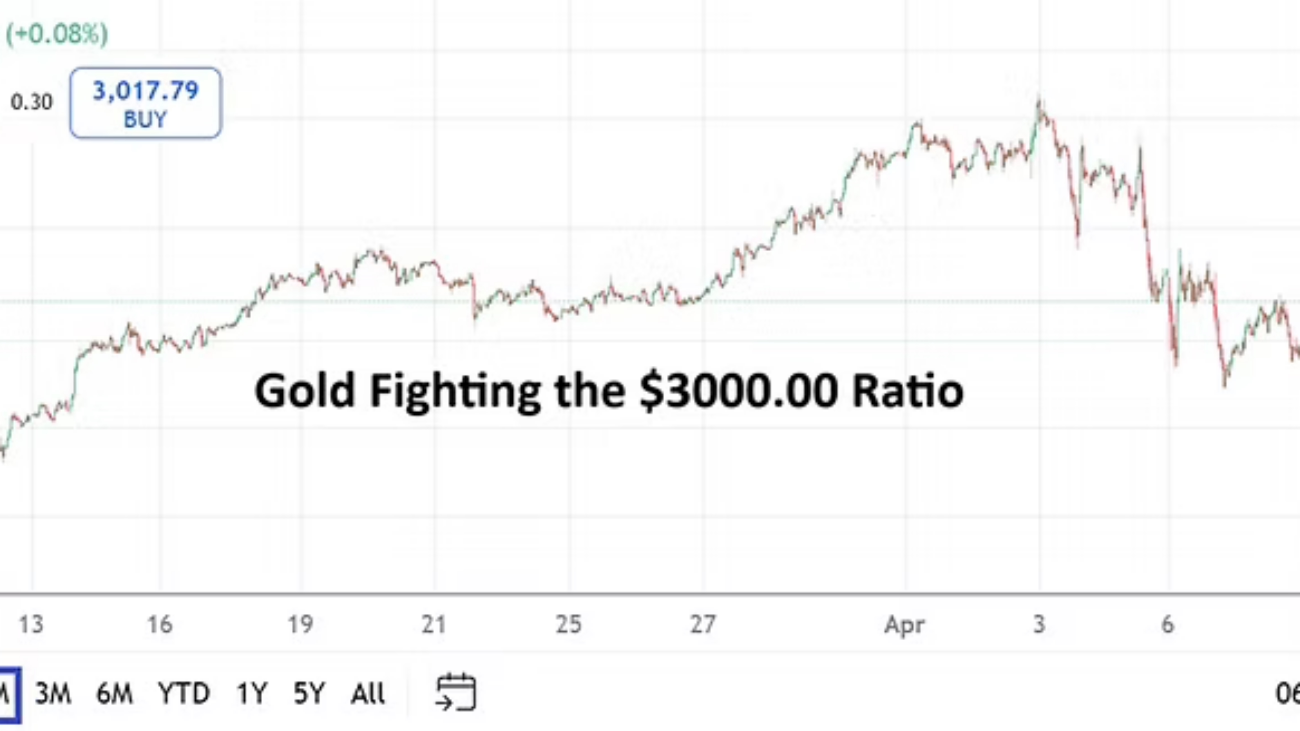
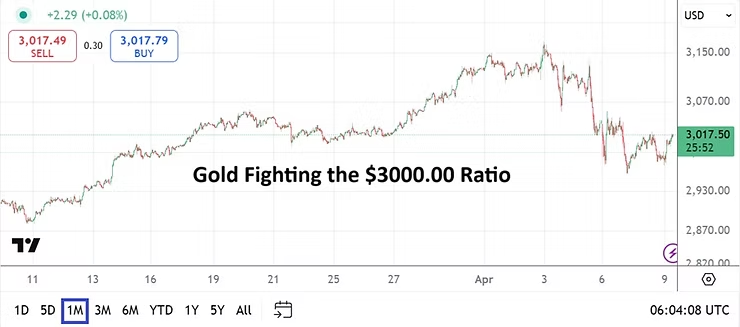
Gold One Month Chart as of 9th April 2025

Gold has stumbled back to the 3000.00 USD level, WTI Crude Oil is down and these two commodities are intriguing as a looking glass into the hearts of large players. Are people selling gold short-term because they believe inflation will lessen because of a recession which some are forecasting, or is it merely a speculative move? Gold certainly carries an important risk adverse power and its lower move showed be looked upon skeptically.

WTI Crude Oil One Month Chart as of 9th April 2025

Is WTI Crude Oil selling off because there is a belief there will be less demand due to fear tariff policies will influence a stumbling global economy? This viewpoint is plausible, the price of the commodity falling below 60.00 USD is a warning that large players are not comfortable with their outlooks and view downside risks as legitimate. The energy selloff in the past couple of hours is a negative barometer for what potentially is in store the remainder of the day in the broad markets.

The lack of finesse exhibited during these tariff negotiations is not palatable, the taste in the mouths of financial institutions has them worried. And outlooks via talking heads and analysts must be treated carefully by traders, this as they try to digest the onslaught of information and complex economic scenarios. Importantly, day traders should avoid getting caught up in the deleveraging talks surrounding the notion that large financial institutions will now pull money out of their U.S based investments in companies via stocks and Treasuries. Traders need to consider the bias of the people they are listening to and reading, and consider the scope and might of the U.S economy mid and long-term. There will be value found after the massive selloffs.

As a side note Warren Buffett has let it be known for a while he is sitting on a large amount of cash via Berkshire Hathaway. And folks should note that the annual meeting for Berkshire Hathaway is on Saturday the 3rd of May, which means people should get ready for insights from Buffett and his legions of admirers in the coming weeks. Certainly, Buffett’s comments and potential actions will be watched carefully.

The U.S Federal Reserve has taken a wait and see approach to the Trump tariff implications. Calls for an immediate cut of the Federal Funds Rate have not caused Fed Chairman Jerome Powell to shift his cautious stance yet. The coming days could bring a different attitude from the Fed if equity markets and U.S Treasuries perform badly. In the meantime some central banks have said they might become more proactive – the Reserve Bank of New Zealand cut its interest rate by 25 basis points this morning to 3.50% and said it will continue to cut their Official Cash Rate if tariff policies create more negativity.

The consideration by financial institutions regarding the beginning of a paradigm shift of the global economy is justified. However, the ramifications of the Trump tariff policies have a long way to go before these present days will be able to be pointed to as the moment the world decided that it no longer wants to participate in the U.S marketplace. That notion seems farfetched. The USD remains the world’s reserve currency, its corporations remain extraordinarily large and valuable, and U.S Treasuries as they absorb current volatility and see yields moving higher in the 30 Year bonds cannot be viewed as an economic apocalypse – yet. Yes, the warning signs are meaningful and the Trump White House will need to respond diligently.

Again, the past week of trading has seen vast disarray, but we have been here before. It is important to recognize that current circumstances however do remain dangerous, this because we are still in the midst of the crisis. At some point, egos will have to be put to the side. The Trump White House will have to negotiate with China. China may be vulnerable, but so is the U.S. Why be belligerent and show no respect to each other? The remainder of this week’s trading will produce more whipsaw results. Selling looks to be in vogue once again this morning. Behavioral sentiment and understanding its power need to be contemplated as folks await sunnier days.

post238

Trump: Will He or Won’t He Day and Uncertainty for Investors

Trump: Will He or Won't He Day and Uncertainty for Investors

EURUSD One Month Chart as of 2nd April 2025

Liberation/Tariff Day will blow onto the global financial shores this morning. President Trump and his team are certain to take a victory lap as they announce their decisions regarding actions being imposed on commodities and products. Nations who are on the other end of the drama will be braced for the rhetoric and policies. Investors, trade ministers, financial institutions will have to sift through the pronouncements and consider their outlooks amidst uncertainty.

Trading today will be rough for smaller speculators. Choppy conditions should be expected as behavioral sentiment twists according to shifting winds and interpretations. President Trump is likely to announce aggressive penalties, but he may also try to soothe those who have worried about being punished. As an example, Trump has said recently that India has acted upon many of the White House’s wishes. Mexico, Canada, the European Union and China are likely to be mentioned as the U.S President speaks later today. Will a public scolding take place again?

Equities have faltered the past month, Forex has been volatile and commodity prices have also reflected fragile sentiment as outlooks became grey. The tariff policies announced today will affect all aspects of the financial world. Day traders thinking about wagering on the outcome should be patient and wait for the reactions which unfold from Asia, Europe, Africa, and the Americas. Wall Street will certainly be a barometer, along with the EUR/USD, USD/MXN, USD/JPY, GBP/USD, USD/SGD and gold.

While President Trump declares this is a great and magnificent day for the U.S, it will be of keen interest if an olive branch is offered to trading partners. After talking tough the past few months, financial institutions would like to hear words of optimism from the White House. If belligerence is heard and punitive actions are enacted, which are considered unproductive by investors and financial institutions the broad markets will show their disdain promptly.

President Trump’s skills as a negotiator will be judged today. The White House must play towards its constituency and show they are putting America First, but will the President also display he is cognizant that international trade provides benefits? Trump will point to his claim that he is merely putting tariffs on those who have treated the U.S unjustly and use levies against U.S goods.

It will be an important day for the Trump Presidency, because in many respects the global audience watching will decide whether or not the U.S sees itself as part of the global fabric or seeks a position which is isolationist. Brazil will look on the tariff theater intently, its position as a trading center may find increased demand from a host of nations.

Predicting the results: On the 3rd of February a fast and dangerous Forex market developed which witnessed USD centric strength exhibited with spikes in many currency pairs. In early March reactionary trading was displayed in equity indices, Forex and bonds too. Today will see wide spreads emerge in Forex with near-term resistance and support levels proving vulnerable.

Equities which sold off in March via the Nasdaq 100, S&P 500, Dow 30 and the Russell index are certainly hoping for a dose of cheer. The question is if Trump will deliver a positive message. The likelihood is that today’s events will not be the last of the tariff tirades and some proposed actions remain under deliberation. Today is unlikely to produce final results and the broad markets are probably going to be choppy as outlooks stay mitigated and absent of clear resolutions.

Gold Three Month Chart as of 4th April 2025

Day traders should think safety first today. Gold remains within record territory. If unpredictability rules near-term and the reactions of investors and financial institutions create fast conditions, the precious metal and bonds will find takers. Uncertainty breeds cravings for risk adverse assets.

post234

New Alternatives for Regional Alliances & Global Effects?

New Alternatives for Regional Alliances & Global Effects?

Opinion: The following article is commentary and its views are solely those of the author. This article was first published the 14th of March, 2025 via The Angry Demagogue.

There is so much going on that it really is difficult to keep up. Israel is at the center of many of the regional developments, as would be expected. But it is not just Israel as Israel, but Israel as an ally of the United States that is interesting. The Syria problem we have written about and it is still not clear what the Trump administration’s policy is there as they look skeptically but hopefully at Al-Julani’s Syria. In our opinion that decision will be made for them, since the chances that Al-Julani has changed his stripes to a Western democrat is small and even if we are wrong there – the armed Jihadist groups that he needs to control seem more interested in ridding Syria of ‘heretics’ than stabilizing the country.

Lebanon has changed enough for the United States and Israel to take chances. While it is too bad that Israel did not do more in ridding the country of Hezbollah, the fact that Syria is no longer part of the Shiite crescent means that they are isolated and not able to get funding and arms from Iran with the same ease. What is important about the current Lebanese government is that Hezbollah is not a part of it. That does not leave them powerless, but it allows the government to act more independently. The Lebanese Shiites, under Hezbollah and the less but still militant Amal, will have to rethink their loyalty to these two organizations. At the least, it should move Amal away from their stronger partner.

Iran now has no land route to Hezbollah and will have a harder time arming the Houthis, too. But it is in Iraq that they are facing problems which could cause as much damage to their projection of power as did the loss of Syria. Due to US pressure, Iraq has stopped buying Iranian electricity although they can still buy gas. It seems that the US is giving Iraq some time to find alternatives to Iranian gas and the Iraqi government is moving away from Iran on other issues too and are trying to get rid of Iran’s Shiite militias.

But the most interesting thing to happen is Israel’s attempt to strengthen America’s relationship with Azerbaijan, a country that Israel is in close contact with regarding Iran. Israel has always been rumored to plan to use Azeri air force bases in a possible attack on Iran. The Azeri official responsible for regional development was in Israel last month and is trying to bridge differences between Israel and Turkey. The Azeri’s next stop after Israel was to Turkey. Steve Witkoff is reported to have stopped in Baku after his visit to Moscow.

An Azeri company has also bought rights to Israel’s Tamar gas field. Israel currently gets oil from Azerbaijan via a pipeline that goes through Turkey so the energy relationship is strong and longstanding between Israel and Azerbaijan. It seems that Turkey’s relationship with Azerbaijan is more important to them than their animosity towards Israel – probably because the Azeris and Armenians are enemies. It seems that sometimes not only friendships have to be ranked but enemies, too.

Trump’s game with Ukraine is not necessarily to my taste but it could be that there is something much bigger going on here and that is connecting Israel, Russia, Central Asia and Turkey to a grand alliance with the United States. I don’t think that Trump will succeed in pulling Russia away from Iran and China and that Erdogan’s Turkey will not give up their dream of destroying Israel. But what if the Iranian regime falls after a combination of harsh sanctions, economic collapse and Israeli military attacks? What if Iran is pulled away from the alliance leaving Russia with just China? What if a Russian base in Syria is dependent upon their moving away from China?

Last year the Axis held a near continuous land bridge from the Pacific to the Mediterranean. China was moving into Russia’s “sphere of influence” in the “Stans” of Central Asia with their economic bear hugs. This was something that the Biden administration ignored, but could be a bigger headache for Putin than a well armed but non-NATO Ukraine with American businessmen instead of soldiers as a tripwire.

Are we giving too much credit to Trump and his foreign policy team and to Israel’s influence in the expanded region that reaches beyond Syria? Is there more going on than we know or less?

On October 7 and the days that followed, the Biden Administration was sure that Israel was in such a panic that it would agree to anything, and they could force the Obama Middle East of a hegemonic Iran and a Palestinian state down Israel’s throats – and overthrow Netanyahu as an extra. None of those things happened.

Only a fool would predict what will be in a year, but what we have discussed above is one scenario no one would have considered even six months ago. The post WWII world looked nothing like the world of 1937, and the post WWIII world (the one we wrote about a year ago and may or may not have happened!) will look nothing like September 2023 – no matter how hard the UN yells and screams.

Could Israel and Azerbaijan be the keys to a realigned world?

It is against my nature to be optimistic, especially since Israel is still not done with Gaza, the hostages are not yet home and the internal politics are reaching levels that border on a soft coup.

However, while we don’t know where the aces are, we know that the Obama-Biden jokers are no longer in the deck.

Disclaimer: the views expressed in this opinion article are solely those of the author, and not necessarily the opinions reflected by angrymetatraders.com or its associated parties.

You can follow Ira Slomowitz via The Angry Demagogue on Substack https://iraslomowitz.substack.com/ 

post222

Apolitical Doesn’t Mean Blind to the Trump Forex Reality

Apolitical Doesn’t Mean Blind to the Trump Forex Reality

Has everyone stopped panicking in global Forex? It appears financial institutions are showing signs of stability and perhaps even optimism, this as USD centric strength appears to actually have begun giving back the outlandish gains made on Monday when spikes higher were seen across Forex.

The nervous buying of the USD early on Monday morning erupted after President Trump’s ultimatums were not taken seriously by financial institutions late last week. Outwardly it appears that the targets consisting of Mexico and Canada going into the past weekend also wanted to make believe all would be fine. The only nation to say that it would negotiate with Trump prior to Friday was China. And now Mexico and Canada have largely fallen into line.

Speculators may want to be apolitical. They may want to believe Forex has nothing to do with politics. And some traders may not like President Trump and what he represents. However, Forex participants need to make sure they put their biases to the side and understand that economic rhetoric and actions from the U.S do effect the Forex reality.

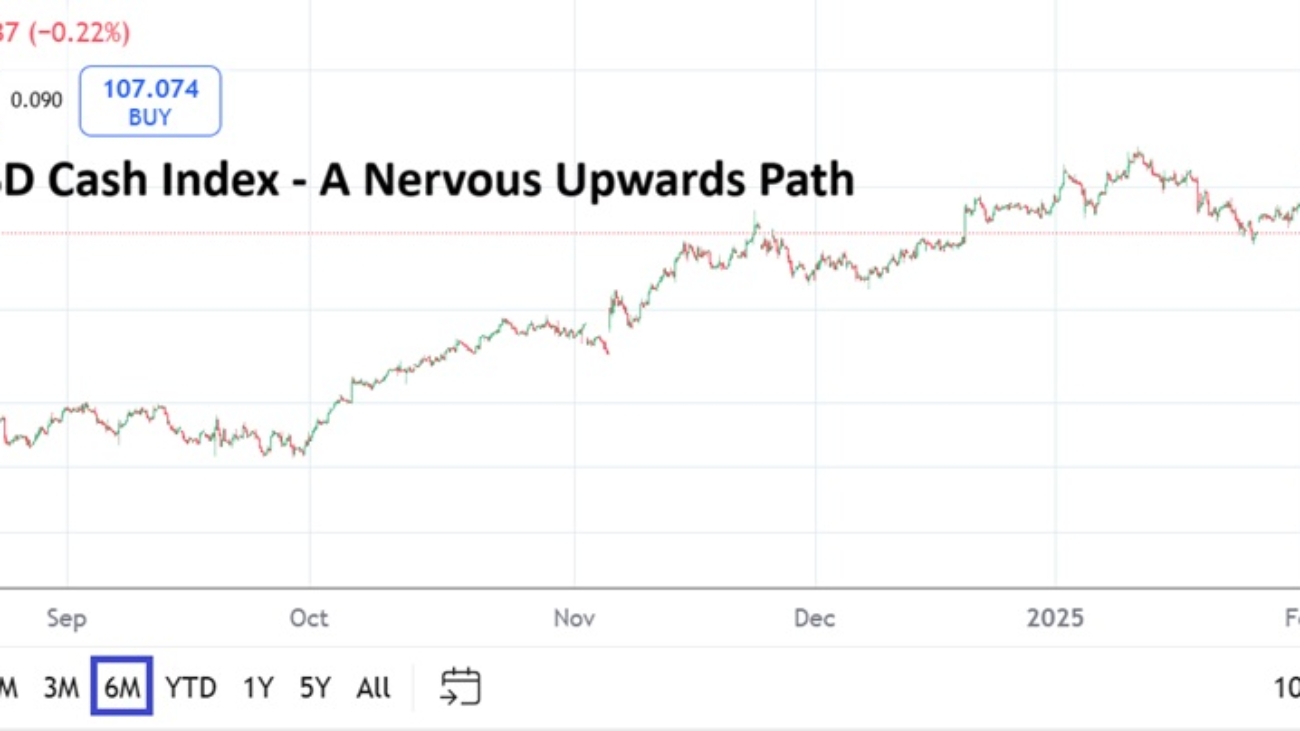
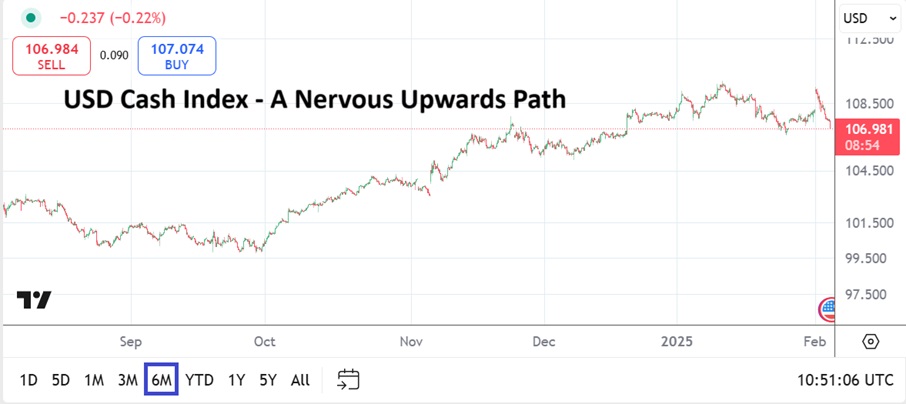
USD Cash Index Six Month Chart as of 5th February 2025

We have seen a vast example of this the past couple of weeks, in fact the past few months. Financial institutions have braced for and wagered on their outlooks since early November when the results of the U.S election became known. A strong USD centric element has been demonstrated as they prepared for President Trump to take executive power in the U.S again.

This past week has seen vivid Forex results and demonstrated why it is important to pay attention to international news flow, even when some may want to disregard what they are hearing. The price action in Forex particularly the USD/CAD and USD/MXN this week highlight the significance of not turning a blind eye. The highs seen on Monday followed by the reversals lower have brought support into view. Near-term and mid-term considerations will be fought over by financial institutions and retail traders may find technical opportunities to take advantage of nervous behavioral sentiment.

China which has dealt with President Trump before, appears to have handled the tariff bluster and negotiations better than Mexico and Canada. China has also been laying the groundwork to deal with the new White House administration based on having dealt with President Trump before. The USD/CNY has remained stable and China has set the table to deal with developing economic discussions in a calm manner.

It is not a question of liking or disliking Trump, it is a matter of understanding the reality and being ready to trade the circumstances that are seen across Forex. Bias when trading Forex can lead to bad decisions, it is not about betting on who you like, it is about wagering correctly on the results you believe will happen and managing your risks.