Female Work Percents 20260605

India Insider: Growth Matters, Development Matters Even More

Participation of Women in the Workforce and Advancing Progress

There is more poverty in this world than many of us realize and would like to comprehend when confronted by the facts, and this is also true with India.

Recently, I visited several villages in Tiruvannamalai District in Tamil Nadu State on behalf of Angry Meta Traders to survey household capital formation, wage growth and labor market dynamics. To my astonishment, in many homes, people still use rice and palm oil purchased through ration shops. The important observation is their consumption basket appears narrow and heavily dependent on subsidized essentials. I saw simple aluminum utensils in kitchens, when higher income households often use silver-plated utensils. Things that many middle-class families consider normal like energy drinks, snacks, or packaged foods were often absent.

What struck me even more was the number of women managing families alone. In some households, the husbands had died due to excessive alcohol consumption. Children attended government schools and depended on nutritious meal schemes provided by the State.

Growing up, I have seen people wear torn uniforms in school because their family could not afford new uniform every year. Some did not wear shoes, and many students stood outside the class because the fees in private schools in India are several times higher than what government schools would charge and their families could not pay on time. Yet, through education and perseverance, many people have succeeded. 

However, the poverty I witnessed in Tiruvannamalai District is different. These observations reminded me of a study published in the Lancet Regional Health Center. Researchers followed 251 children in Vellore District (closer to Tiruvannamalai District) and found that poor children living in urban areas were often exposed to calorie-rich but nutrient poor food environments.

If such conditions exist in parts of Tamil Nadu State, one of India’s more developed states, then we should think carefully about the situation across the country.

Another Transformation is Taking Place

For generations, many women carried the burden of childcare, household work, elder care and agricultural labor simultaneously. In many families, they sacrificed their own aspirations for others. Are women born to carry everyone’s burden?

Interestingly, across the globe especially in Southeast Asia, education and economic opportunities have expanded women’s choices. Researchers such as Stanford University’s visiting Professor Alice Evans argue that many women choose marriage only when their partner’s own goals align with their own. If not, remaining single becomes a reasonable choice for them
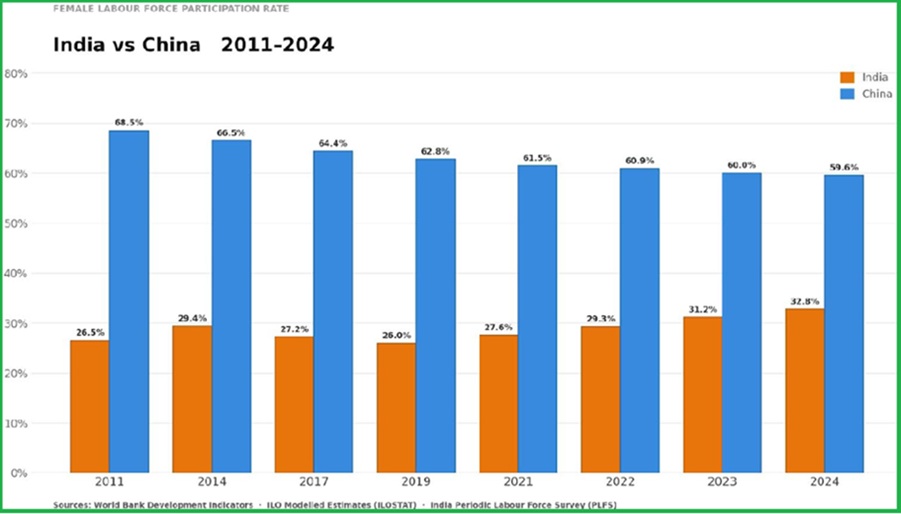
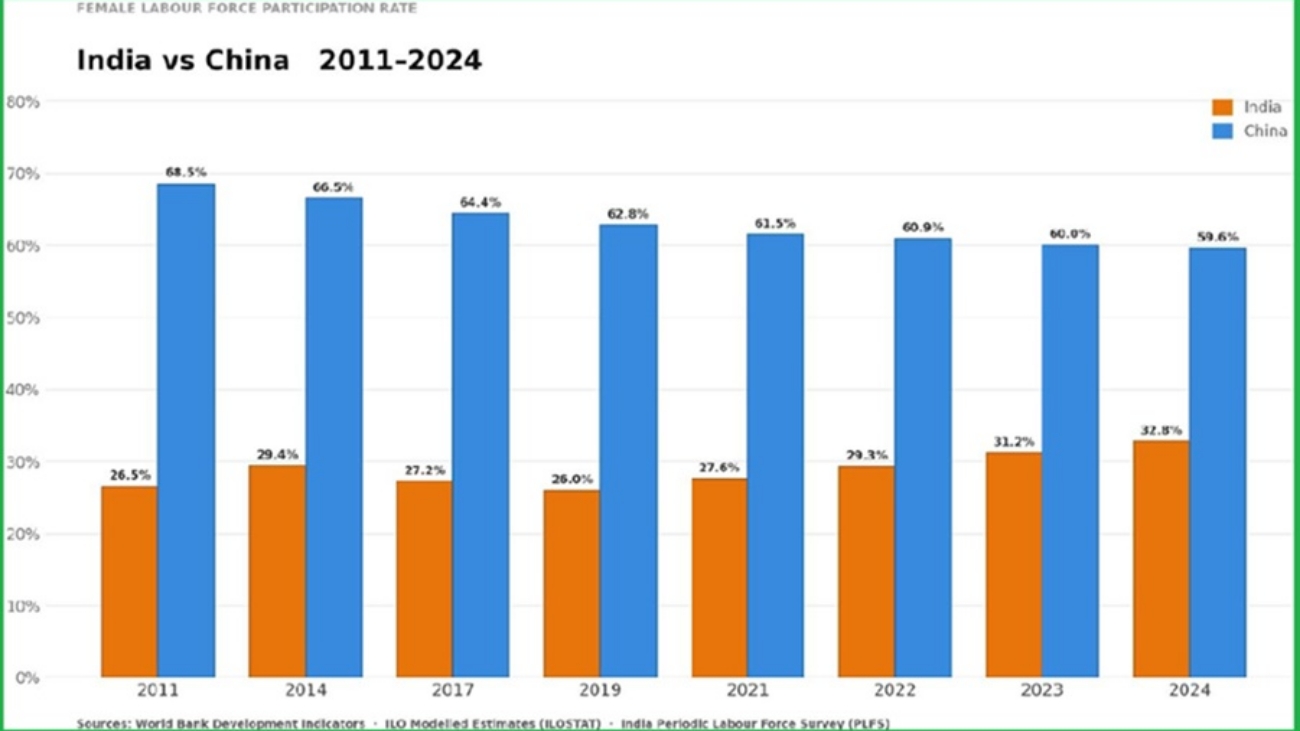
Female Labor Participation Rates Comparing India and China from 2011 to 2024

As shown in the above chart, India has certainly made progress, but female participation in the workforce remains below that of many East Asian economies. A society that fully allows women to participate in economic life is likely to become more prosperous and productive.

Economic realities are also shaping family decisions. Housing is expensive. Job markets are uncertain. Inflation remains a challenge. Asset prices have risen significantly.

Yesterday, a college friend called me. He recently built a new house in his town. He is 33 years old, unmarried, and works in Oman. Years of overseas employment and remittances have helped him to achieve his goals. I sometimes wonder whether the same outcome would have been possible had he stayed and earned entirely in India, especially outside the software and technology sectors.

India still has demographic advantages, but a demographic does not bear fruit automatically. It requires healthy, educated and economically secure citizens.

We often speak about India becoming a developed nation. However, the real question is whether growth can and will improve the lives of ordinary people, especially women, children and underprivileged. Growth matters, development matters even more.
Copy and paste the text from AMT that you want to share

post277

India Insider: Women in Agriculture Need Manufacturing Power

India Insider: Women in Agriculture Need Manufacturing Power

India has long been a society that has neglected Women’s Empowerment. While various states pursue proactive policies to enhance the role of women in society, their inclusion in the job market and ability to have financial independence is still lacking.

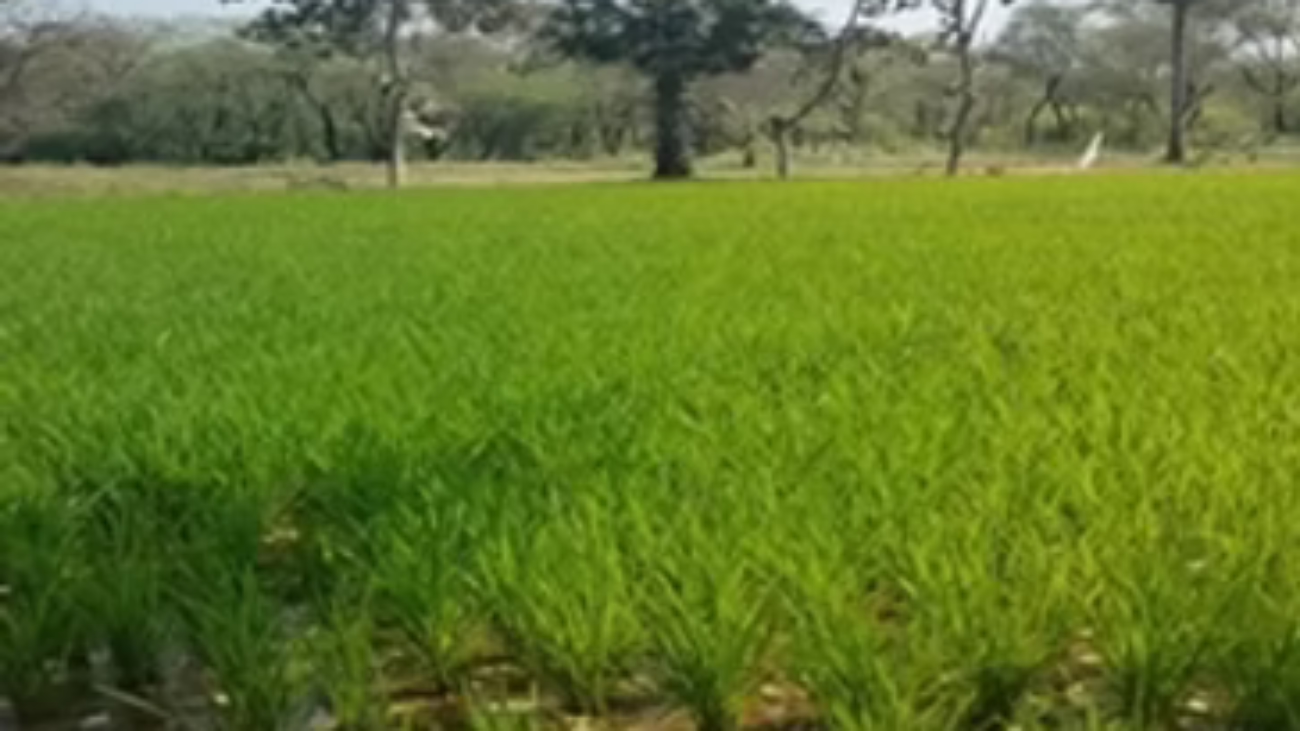
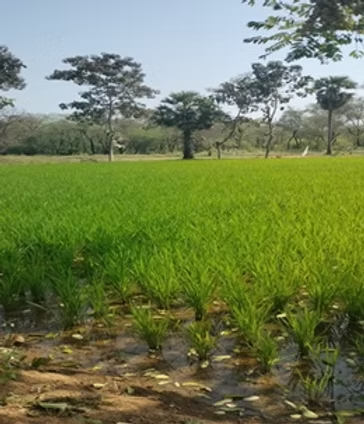
Small Scale Farm in Tiruvannamalai, India

In the suburbs of Tiruvannamalai City, in Tamil Nadu, Mrs. Revathi runs an agricultural farm where she grows rice, flowers, and vegetables. She sells them to local commission agents or directly to customers from her farm. Mrs. Revathi, who lost her husband in 2019, has two daughters, both of whom are educated and working. One of the daughters is getting married. She said that although agriculture helps her family earn money, it does not lift them out of the poverty trap because of uneven flower cultivation. The land is becoming less and less suitable for irrigation – a matter that worries her greatly too. Flowers are one of the major sources of income for many farming families in Tiruvannamalai City in Tamil Nadu.

This is just a small example of the challenges faced by women working in agriculture.
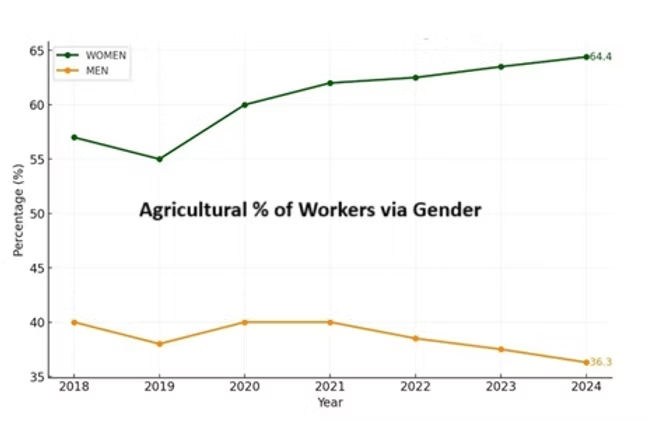
According to recent Periodic Labor Force Surveys, 64.4% of women in India work in agriculture, compared to only 36.3% of men.

Labor Workforce Percentage in India per Gender

Self employment and Access to Credit is not the Solution:

Many argue that self-employment and steady access to credit via microfinance institutions will help women become entrepreneurs and create movement up the social ladder. This is true in some cases, but many women struggle with raising families in their husband’s absence, and when working on farms where agricultural productivity is lopsided or unfit for growing vegetables or corn, times remain difficult.

First of all, why do women choose agriculture and remain small-time sellers? Because they are not able to find employment easily in formal sectors like manufacturing or other service oriented businesses.

Even within related agricultural sectors, women employed in vegetable processing plants, or value-added goods like masala manufacturing and tomato sauce production companies earn higher wages.

Unfortunately, low productivity and long spells of inactivity render agricultural workers significantly underemployed periodically. They are stuck, with nowhere else to go. Unlike in East Asian nations, which created mass employment through dynamic exports of manufactured goods, the Indian manufacturing sector’s low productivity makes it globally uncompetitive.

Manufacturing as a Solution for Women Empowerment:

Across Asia manufacturing has proven to be a powerful driver for upwards mobility. Incomes have risen, poverty has declined, and women are central parts of this transformation. In Vietnam, where a factory boom has been especially momentous, more than 68 percent of women and girls over 15 years of age are working for pay in some capacity, this according to data compiled by the World Bank. In China the rate is 63 percent, in Thailand 59 percent, and in Indonesia 53 percent of workers in manufacturing are women. Yet in India, less than 33 percent of women account for the workforce in recorded in official surveys.

In a pattern demonstrated in many industrializing societies, when more women gain jobs, families promptly invest further in education for girls. Manufacturing also lifts household spending power, fueling economic expansion that encourages investors to build more factories, providing additional jobs and reciprocal wealth creation. India is missing out on this dynamic manufacturing growth and is failing to broadly participate in the spread of improved industrialization which has helped bolster fortunes in many Asian economies and benefitted families. A vital component for a stronger Indian economy necessitates the empowerment of women.