
post277

India Insider: Women in Agriculture Need Manufacturing Power

India Insider: Women in Agriculture Need Manufacturing Power

India has long been a society that has neglected Women’s Empowerment. While various states pursue proactive policies to enhance the role of women in society, their inclusion in the job market and ability to have financial independence is still lacking.

Small Scale Farm in Tiruvannamalai, India

In the suburbs of Tiruvannamalai City, in Tamil Nadu, Mrs. Revathi runs an agricultural farm where she grows rice, flowers, and vegetables. She sells them to local commission agents or directly to customers from her farm. Mrs. Revathi, who lost her husband in 2019, has two daughters, both of whom are educated and working. One of the daughters is getting married. She said that although agriculture helps her family earn money, it does not lift them out of the poverty trap because of uneven flower cultivation. The land is becoming less and less suitable for irrigation – a matter that worries her greatly too. Flowers are one of the major sources of income for many farming families in Tiruvannamalai City in Tamil Nadu.

This is just a small example of the challenges faced by women working in agriculture.
According to recent Periodic Labor Force Surveys, 64.4% of women in India work in agriculture, compared to only 36.3% of men.
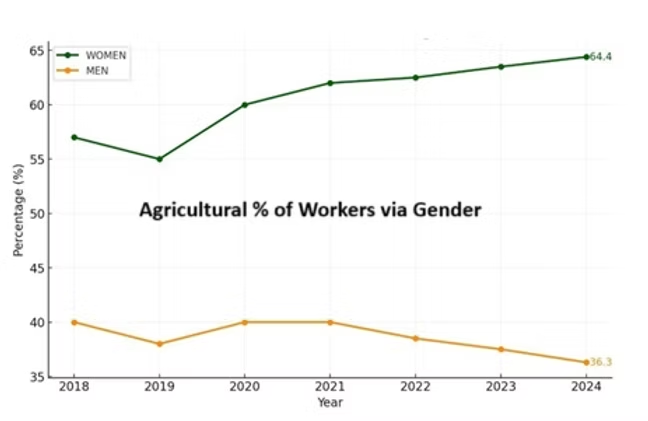
Labor Workforce Percentage in India per Gender

Self employment and Access to Credit is not the Solution:

Many argue that self-employment and steady access to credit via microfinance institutions will help women become entrepreneurs and create movement up the social ladder. This is true in some cases, but many women struggle with raising families in their husband’s absence, and when working on farms where agricultural productivity is lopsided or unfit for growing vegetables or corn, times remain difficult.

First of all, why do women choose agriculture and remain small-time sellers? Because they are not able to find employment easily in formal sectors like manufacturing or other service oriented businesses.

Even within related agricultural sectors, women employed in vegetable processing plants, or value-added goods like masala manufacturing and tomato sauce production companies earn higher wages.

Unfortunately, low productivity and long spells of inactivity render agricultural workers significantly underemployed periodically. They are stuck, with nowhere else to go. Unlike in East Asian nations, which created mass employment through dynamic exports of manufactured goods, the Indian manufacturing sector’s low productivity makes it globally uncompetitive.

Manufacturing as a Solution for Women Empowerment:

Across Asia manufacturing has proven to be a powerful driver for upwards mobility. Incomes have risen, poverty has declined, and women are central parts of this transformation. In Vietnam, where a factory boom has been especially momentous, more than 68 percent of women and girls over 15 years of age are working for pay in some capacity, this according to data compiled by the World Bank. In China the rate is 63 percent, in Thailand 59 percent, and in Indonesia 53 percent of workers in manufacturing are women. Yet in India, less than 33 percent of women account for the workforce in recorded in official surveys.

In a pattern demonstrated in many industrializing societies, when more women gain jobs, families promptly invest further in education for girls. Manufacturing also lifts household spending power, fueling economic expansion that encourages investors to build more factories, providing additional jobs and reciprocal wealth creation. India is missing out on this dynamic manufacturing growth and is failing to broadly participate in the spread of improved industrialization which has helped bolster fortunes in many Asian economies and benefitted families. A vital component for a stronger Indian economy necessitates the empowerment of women.


postN32

Profits: Business Ethics in an Age of Subjective Expediency

Profits: Business Ethics in an Age of Subjective Expediency

This article was originally written in the summer of 2006, Jeremy Blatch suggests current business governance remains shadowed by the same concerns.

Most of us in business today, be we entrepreneurs, professionals or key employees, recognize that our customers, clients and staff require us to act in their best interests and that our actions should reflect this.

A code of practice or some kind of ethical standard or guideline will be needed to ensure some degree of accountability and consistency. In this we encounter the first hurdle, as the degree to which corporate and governmental governance is superimposed by regulatory bodies on business, varies between industries, businesses, professional sectors and political divides.

The effectiveness to which this is policed in reality depends on the will of those in supervision, and the willingness of those in business to conform to requirements. Many areas are of course not covered by statutory regulation and getting on with the daily running of a business requires constant decisions which often involve a degree of ethical consideration. In reality any ethical stance is at best subjective and open to subversion and expediency in the quest for profitability, which after all is the main reason for being in business in the first place.

Service providers that fail to make a profit irrespective of the quality of service that they offer will inevitably cease to be able to provide that service. But at what cost do we surrender integrity for the expediency of justifying a decision on the grounds of corporate strategy or profitability. And at what point does adopting a rigid ethical stance become a statement of moral judgment? Moralizing about the world and the problems faced by modern society has never been wise. Morality is also a subjective term, often influenced by personal experience and strongly held beliefs, but not necessarily shared.

When some of the world’s most successful entrepreneurs met recently in Monaco at the invitation of the BBC World Service and the international accountants, Ernst Young, to debate how to ‘feed the starving and save the planet’, there was broad agreement that amongst most people there is a distrust of corporate motives and skepticism of Corporate Social Responsibility, currently a trendy buzz word amongst the business elite.

Is not the sole responsibility of companies to make money, but at what costs? Does it really matter how they make money, after all is a woman with a starving child going to refuse a plate of food because it has been purchased with money from the sale of narcotics? If we have a view against investing in armaments, are we prepared therefore to open our borders to anyone who wishes to attack us for any reason, or do we wish for a society in which the strongest take all and those with weapons will be strongest?

Someone receiving a pension has strong views on the tobacco or gambling or arms production or certain drugs, and whilst they are quite happy to receive the pension income and rejoice at the level of payment, are they also prepared to self-select how the investment is managed? Business is fraught with hypocrisy in this area.

Google have weakened their ethical case by caving in to the demands of China for expediency. Brands like Nike and Gap are having their reputations challenged by allegations of sweat shop labor despite spending millions on marketing a different image. Yet people still keep buying their trendy brands. Walmart the most successful US retailer attracts more shoppers than any other store despite allegations of a poor record of employee relations. Does anyone care? Shoppers go where they can find the best quality at the keenest price.

One can make a difference in society without trying to gain the ethical high ground or slipping into moral judgment by simply giving away something you don’t need, to those who most need it. We have witnessed this last week two instances of philanthropist ‘walking the walk’ not just ‘talking the talk’ with Warren Buffet, one of the most successful investors of this century, donating much of his personal wealth to the Bill and Melina Gates Family Foundation. This injection of cash now gives the Gates Foundation around USD 30 billion, more than three times the total amount of charitable donations in the U.K, putting them with Andrew Carnegie, Henry Ford and John D Rockefeller, as the hitherto best known philanthropists of modern times.

A few days after the very public announcement of Warren Buffet’s donation, a U.K hedge fund has emerged as one of the U.K’s most generous philanthropists with a donation of around GBP 50m to charity assisting children in poverty. The Investors Forum, registered in Gibraltar, was created to give a highly professional service to investors covering the wider investment process. It comprises of an association of firms and banks committed to acting professionally, whilst giving something back to those most in need.

A unique investment concept called the “Solidarity Fund” will hopefully be launched from Gibraltar, which will give both corporate and individual investors the opportunity to make money whilst directly helping those in need. In today’s business world making a profit is essential for survival, but how we make it and what we do with it will determine what sort of people we are, and ultimately what legacy we will leave behind.

Jeremy Blatch is the Founder and Consultant of Ein Harod Family Office. You can find more of his articles at www.ehh.gi