Perception Over Fact 20260603

Perception Over Fact: Iran as the Savior of Beirut

Trump Policy and The Art of a Middle Eastern Deal: Israel, Iran and Lebanon

Opinion: The following article is commentary and its views are solely those of the author. This article was first published the 2nd of June via The Angry Demagogue.

Although it is difficult to see where the negotiations between Iran and the United States are going – if anywhere – over the last 24 hours the United States has made Iran the “savior” of Beirut. Against American policy of creating a civil and unified Lebanon at peace with its neighbors, the Trump Administration has told the Lebanese government and people that Iran still controls what happens in Lebanon.

Perception over Fact: Iran as the Savior of Beirut

Even if this was not the case, in the art of the Middle Eastern deal, perception is more important than fact. Whether the Trump Administration actually twisted Israel’s arm due to Iran’s demands or not, the fact that Israel has agreed not to bomb the Dahiya section of Beirut after announcing that they would gives a message to the Lebanese people and government that Iran still calls the shots in Lebanon and not to rush to support those who wish to disarm or dismantle Hezbollah since you will be on the losing side.

Lebanon has been embroiled in civil wars since its inception. Beirut, the “Paris of the Middle East” has never known quiet times although that did not stop the partying (sort of like Paris itself today) and Iran’s involvement, much like Syria’s and the PLO’s before has not helped. Before the PLO inspired civil war in the mid 1970’s, after King Hussein threw them out of Jordan, the civil wars were about Lebanon itself. The French thought they created a formula for the creation of a semi-western state by dividing up the power centers amongst the religious and ethnic groups – Maronite-Christians got the Presidency, the Sunnis the Prime Minister-ship, the Shiites the speaker of the Parliament. The Druze historically were appointed Chief of the General Staff of the army.

This formula was, as can be imagined, not one for the free exchange of ideas but caused a rush to create power centers and led to conflict, civil and military. But it was all internal. Once the PLO and Yassir Arafat came, Israel became a factor in the civil war since Israel had to cross the border to stop the PLO from its numerous cross border terrorist attacks. After the First Lebanon War and the forced exit of the PLO, Iran created Hezbollah with the sole aim of using it, in the future, to destroy Israel. Therefore, from the late 1970’s until today, the Lebanese state has been embroiled, often against its will, in the Israeli-Palestinian conflict.

The goal of the Trump Administration’s negotiations in Washington between Israel and the Lebanese government is to break Iran’s stranglehold over Lebanese internal and external policy and allow it to either establish diplomatic relations with Israel or at least to put the two countries in the situation they were in before the late 1970’s – and that was a quiet, irrelevant border for both countries.

The real or even perceived notion that Beirut was “saved” from Israeli bombing by Iran’s demands has set back that goal and given Hezbollah and hence Iran, veto power over Lebanese government policy. The correct answer to Iran after their demands were made tying Lebanon to the cease fire was that Lebanon is none of your business and if your proxy decided to join your war then they will have to take responsibility for it. The time for “protecting” Lebanon was when you ordered Hezbollah to come to your aid and attack Israel’s north. The result of that – the administration needs to tell both Iran and the Lebanese government and people, is the loss of Lebanese sovereign territory to Israel and the destruction of Shiite villages in the south of the country. A further price is the destruction of the Beirut neighborhood in which Hezbollah has command and control facilities as well as underground arms depots.

Iran cannot be seen to be the savior of Beirut and Lebanon but the cause of its troubles. No amount of rhetoric to the contrary will prove to the Lebanese government and people what they see on the ground now – only Iran has the power to stop Israel’s bombing of their country. The Administration has set back its goals in Lebanon without aiding its war effort in Iran. The constant Iranian threat to make the war regional is coming true since the Administration is not taking seriously Iranian deal-making methods.

As we wrote two months ago in The Art of the (Middle Eastern) Deal” – “Each ‘concession’ by Iran will have to be paid for twice or three times – once upon agreement and then again before numerous times before implementation”. Iran agreed to open the Straits and then reneged and the US is negotiation for that again – AFTER Iran received the much needed cease fire.

Now, after the administration denied linkage to Lebanon, Iran is again demanding that linkage – not in order to open the Straits, but just to continue negotiations. This pushes both American interests to the back burner – the opening of the Straits of Hormuz and the normalization of Lebanon as a country free from Iranian influence. And the “concession” that Iran is giving for this is just a continuation of the negotiations that have been going on for over two months. In other words, like most negotiations in the middle east that are supposed to lead to “peace” – this too is moving backwards.

President Trump has asked for patience and has insisted that the United States will never accept a bad deal – and I am willing to be patient and believe that. But what if the goal of the Iranian government is not a deal at all but the ability to re-set their genocidal triad or missiles, proxies and nuclear weapons? These negotiations have given them time to dig out their underground missile cities, to keep their enriched uranium hidden and now to revive their flailing major proxy – Hezbollah. In the end, as the President said, it will be good, but by allowing Iran to take the initiative he is making it harder to get to that “good”.

What we have now is a continuation of American-Iranian negotiations where a concession was given to Iran and they are no closer to reaching an agreement. Iran is now perceived as the power to be reckoned with in Lebanon and Israel is put on a level with Hezbollah. Iran and the United States are now equals in this negotiation, something that was not the case when they started. While it might in fact end well, the journey is now a longer and more difficult one. The perception given by the last 24 hours that Iran controls Lebanon, is now the “fact” that the Middle East “knows”.

Disclaimer: the views expressed in this opinion article are solely those of the author, and not necessarily the opinions reflected by angrymetatraders.com or its associated parties.

Follow Ira Slomowitz via The Angry Demagogue on Substack https://iraslomowitz.substack.com/

Copy and paste the text from AMT that you want to share

WTI Crude Oil 20260428

Shift To Economic War Against Iran to Deprive Funds to Regime and IRGC

What If Everyone Is Looking At The Wrong Things About Iran?

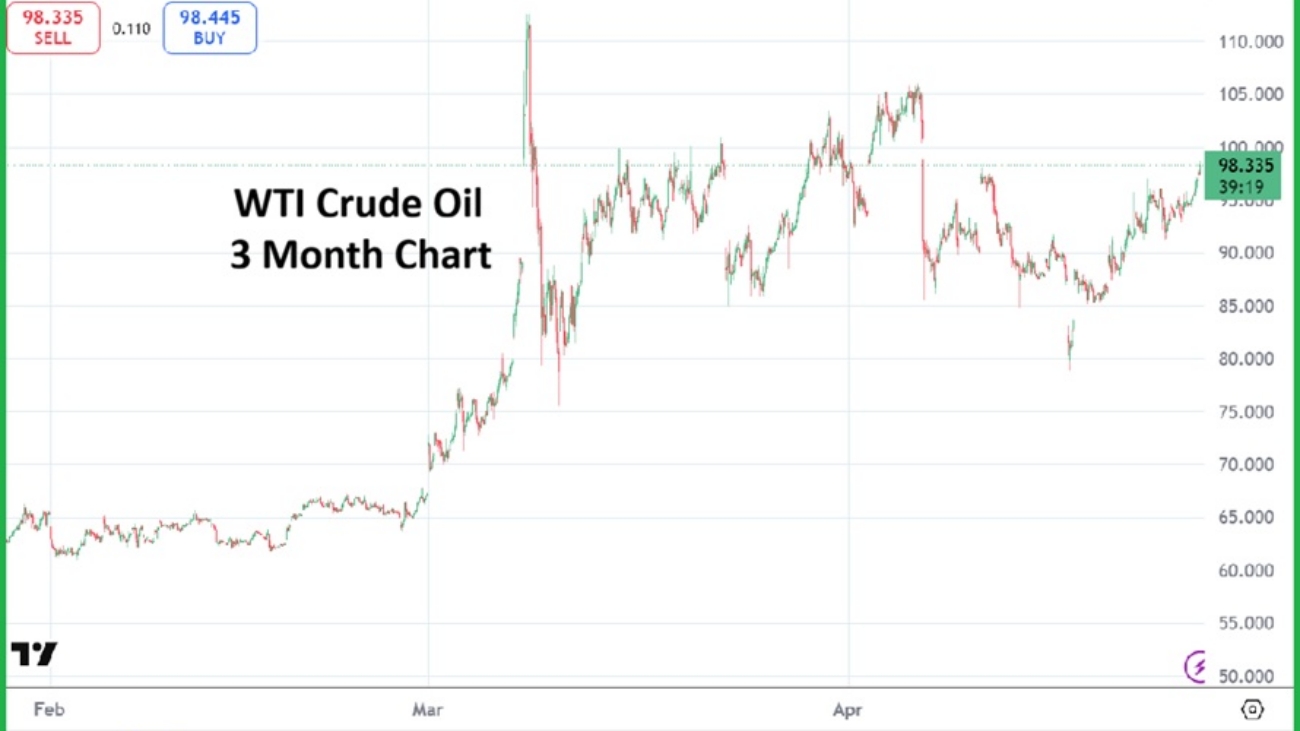
The current futures price for WTI Crude Oil is above $98.00. The cash price for the commodity is above $103.00. While many people continue to fret about what endgame strategy the U.S White House is conducting, what if we are seeing it play out in real time via the price of Crude Oil? Is it possible that President Trump has a coordinated plan to starve the Iranian regime and the IRGC of its much loved and needed money? It appears this is the case.

WTI Crude Oil Futures Three Months Chart on the 28th of April

Simply put, the Iranian Revolutionary Guard Corps is a mafia. They stay in power using the tool of fear brought upon by their ability to be ruthless to the Iranian citizens. They are a terrorist organization in the truest sense. If you disagree with that assessment, you are free to do so. However, facts when they are studied point to the conclusion Iran is a terrorist state led by its regime and the IRGC. 

Iran has made massive amounts of money via its energy products for decades. The shutdown of the Hormuz Strait, or at least the inability to export Crude Oil freely, is putting a strain on global energy prices, and it is causing a major fracture in the main financial export of Iran. 

The U.S has not only shut down easy navigation in the Hormuz Strait, but it is also going after Iran’s cryptocurrency operations. The ability to receive and transfer digital money by Iran is being strangled. What if President Trump is not only listening to the opinions of his military officers, and Secretary of State Rubio and Vice-President Vance, but also Treasury Secretary Scott Bessent who has an abundance of financial knowledge about how money flows internationally and how to create obstacles.

If the IRGC is not able to pay its own members, and other adherents to the Iranian regime are only slowly reimbursed, the apparatus of the IRGC will certainly lose its influence. The inability to pay allies that exists merely because they are employed or corrupted by the IRGC likely is starting to cause fractures regarding loyalties. 

China needs Iranian oil too. And evidence is starting to be speculated upon that China is facing tough decisions about acquiring Crude Oil from other sources. China will not be happy about having to pay higher costs, this because discounted Iranian oil that has abundantly been used is no longer available. 

Equities via the major U.S indices have done incredibly well since the end of March. The Nasdaq 100 has seemingly forgotten about AI overbought concerns, the S&P 500 is within apex territory and the VIX is acting as if sunny days are in the forecast. Forex has been volatile, but the value of the USD is within known realms.  However, the price of WTI Crude Oil is high and it has gotten higher since the 17th of April when futures prices briefly flirted with the $80.00 realm – this before going into a weekend. And this is a clue that something is afoot, beside larger players speculating on what their outlooks are for WTI Crude Oil in the mid-term.

The weekend of the 18th and 19th of April witnessed talk of an end to the Iranian war fall short; and heard President Trump essentially declare the ceasefire is still on but with the caveat that the U.S would create a blockade in the Hormuz Strait. While the semantics of a blockade can be debated, the U.S has caused shipping problems for tankers that were supposed to ship Iranian Crude Oil. The U.S clearly decided to create economic distress for Iran.

The Iranian regime still stands, but its leadership is rather shaken. The IRGC is controlling a lot of the decision making for the time being, and it appears the U.S White House is trying to make the IRGC weaker by ending their financial lifelines. It appears that it has been figured out that an economic war which includes starving Iran of cash is the most certain way to create revolts inside of the nation. When the influence of money is eroded, and temptations via other spheres of power suddenly sound tempting and can be joined, this is when shifts in authority and leadership can occur. 

While many analysts wonder about the lack of an obvious endgame being announced by the Trump administration, maybe it is already being played out. President Trump has a large ego and he is happy to extoll the virtues of his ‘tremendous’ policies frequently, but he also has shown the ability to remain quiet when it comes to plans of action and carrying them out. Yes, this can be argued into the late hours by pro-Trump and anti-Trump people. But maybe Trump is simply telling the truth when it comes to the U.S having time on its side regarding the Iranian ceasefire and the Strait of Hormuz. Maybe the clock is ticking on the eroding cash pile the Iranian regime and IRGC has within its grasp.

Copy and paste the text from AMT that you want to share

postN87

AMT Top Ten Miscellaneous Morsels for the 12th of April 2026

Optimistic Hopes Appear Ready to Fade into the Distance

10. B-ball: The NCAA Men’s Basketball Championship concluded early last week with a rather resounding outcome for the University of Michigan who won their 2nd Men’s trophy, the first one coming in 1989. Michigan dismantled the Arizona Wildcats and then handled the Connecticut Huskies. The NBA playoffs will start this coming week. The Oklahoma Thunder and the San Antonio Spurs are getting a lot of attention, and the Denver Nuggets might have something to offer.

9. Trump: A week of optimism now leads towards threats of additional noise. Peace talks held in Pakistan appear to have failed this weekend, and now another countdown has begun as the Iranian conflict appears ready to escalate. The U.S White House and President Trump will certainly make more noise in the coming days.

AMT Top 10 for the 12th of April 2026

8. Logistics Advertising: Kit Kat and Nutella have been rewarded with massive exposure. The Kit Kat truck heist of 12 tons of product (reportedly said to be in a special F1 designed candy bar theme) made headlines. Kit Kat’s owner, Nestle, was obviously content with the free publicity and proof of demand. And a jar of Nutella floated across the Artemis 2 spacecraft unexpectedly this week, gaining international attention and sparking smiles from fans of the Italian chocolate hazelnut spread.

7. Creator: Yet another candidate accused of being Satoshi Nakamoto has been produced. Blockstream’s CEO Adam Back has been named by the N.Y Times as a potential creator. In the meantime, the real question is whether anyone but Iran (as they run their illicit shadow economy), Michael Saylor of MSTR and a few big whales consisting of institutions and hedge funds are really paying any attention to BTC anymore. The BTC/USD price as of this morning is around $71,600.00. Bitcoin was traversing near $126,000.00 in the first week of October 2025.

6. Greenback: USD/JPY 159.240, EUR/USD 1.17225, USD/ZAR 16.38540, USD/INR 93.0480. USD centric strength may prove solid this coming week and other currencies may suffer a bit.

5. Sideways Shimmer: Gold finished the week near $4.745.00, roughly $100.00 above its starting point last Monday. U.S 10-Y Treasury yields went into this weekend around 4.34%. Shifting outlooks this coming week will likely ignite turbulence in both assets.

4. Blind Eyes: More than a handful of U.S politicians have been featured as big winners regarding their stock trading abilities. Their gains far exceed the winning percentages of the overall returns made by indexes (as a benchmark). Little has been done to stop what many view as insider trading. There are many forms of political corruption around the world. However, a variety of places and people, including Americans seem to accept this potential misconduct. The ‘Stop Insider Trading Act’ has been brought forth in the House of Representatives and Senate, but the legislation may simply meet a slow death and disappear.

3. Inflation: U.S interest rates via the Federal Reserve will be held in check at a minimum over the next few months. The higher costs of energy will certainly seep into prices for transportation, manufacturing and agriculture. Fed Chairman Jerome Powell may be quite content to leave his position May the 15th. The next Fed FOMC interest rate decision is due on the 29th of April.

2. Strait of Hormuz: WTI Crude Oil closed above $90.00 going into this weekend. When futures markets open early on Monday, the price of the commodity is likely to rise via increased anxiousness which will build into the mindsets of large players today because of the failure of peace talks in Pakistan. The price of Crude Oil remained high last week, only moving to a low of around $85.00 this past Tuesday, showing cautious attitudes remained. Prices above $100.00 will likely become a new target quickly for some who bet. Will an early spike upwards this week then start a counter reversal lower, or will a climb become sustained?

1.  Risk Off: The S&P 500 and Nasdaq 100 will get plenty of attention this coming week as behavioral sentiment remains fragile. Having skirted near its 200-days moving average lows in recent weeks, the indices have gained handsomely since the 31st of March. Will the upwards momentum come to an abrupt end this week, or have financial institutions been able to digest their nervousness and will they show a capability of remaining buyers?

Copy and paste the text from AMT that you want to share

Iran Pt One 20260316

Iran: What Victory Looks Like, Part 1 – The Economy

Ridding the World of the Islamic Republic Price Premium

Opinion: The following article is commentary and its views are solely those of the author. This article was first published the 16th of March via The Angry Demagogue.

There has been much chatter about what “victory” over the Islamic Republic means and it is mostly an attempt to deny the very concept of victory. We wrote about “The End of Defeatism and a Return to Victory” last week where we criticized the whole aversion to victory in Western society. The naysayers don’t like to admit that an anti-Western regime can be all that bad, and therefore endless diplomacy needs to be a goal until the final surrender of the West. They don’t really care about the cost of gasoline in the United States – they actually want it to rise – but as long as it was brought up, let us examine in part, the cost of the Islamic regime and what “economic victory” will look like.

Victory in WWII meant not only the defeat of the evil that was Nazi Germany, but it also meant the resurgence of Europe as an economically successful continent. The Marshall Plan that was the crux of the European revival was as much a part of the Allied (sans the Soviets) victory as the surrender signed by German generals.

What is “economic victory” in this war? The media is all over the costs of the war, but no one has examined the costs of allowing the Islamic Republic to continue as it is. No one has examined the cost that the mere existence of the Islamic Republic (as opposed to non-Islamic Iran) creates for the world in general and the United States in particular.

Let’s start first with the most talked about and panic-ridden event and that is the Strait of Hormuz, the gateway to the Persian Gulf and a chokepoint in international shipping to and from that region. It is the gateway to much of the oil shipped to the world, but also fertilizers and other products. The Wall Street Journal news section in another ignorant headline it considered a “scoop”, wrote that President Trump was told that the Straits might be closed in case of war and he attacked anyway. I am not sure there is a knowledgeable military or diplomatic figure or layman in the world who didn’t consider that an option, but to the WSJ news editors it was the surprise of the century.

As Condoleezza Rice said on the recent episode of Hoover Institutions “Goodfellows” a 50 cent rise in gasoline prices for a few weeks is not a reason not to attack a country who has been at war with you for 47 years. But before we even get to that point, has anyone analyzed the cost of giving Iran a veto over who gets to ship through those straits?

If we look at the insurance rates for shipping through the Strait of Hormuz from Lloyds of London we will get a first hint. From 1970-1979 (before the Islamic Republic) the typical premium was 0.01-0.05%. Once Khomeini took power the rates were 0.05-0.2%. During the Iran-Iraq war when there were the “tanker wars” (between 1984-7) those rates jumped to around 5% with a peak of 7.5%. The post Iran-Iraq and Gulf war period of 2004-19 ranged from .0.05-0.25% – well above the pre-Islamic Republic days.

As for absolute figures, a tanker valued at $200m with a rate of 0.01% (pre-Islamic Republic) cost $20,000 and .05% will cost $100,000. The cost at 0.5% is $1million. So, the pre-Islamic republic rate for a $200m tanker ranged from $20,000-$100,000 while the absolute rate at the lowest level since the Islamic Republic came into existence ranged from $100,000-$400,000 – during the best of times. This does not take into consideration the war premium for the many years Iran threatened and even hit tankers even without the excuse of American or Israeli bombing. The average “war premium” from 1979-2020 was 0.83% or $1.66 million for a $200 million vessel.

We don’t have the wherewithal to continue this analysis, but this is exactly the type of article that we used to expect from the pre-ideological WSJ (or even NY Times) news sections. Maybe some economist or even the WSJ editorial page can start to do the heavy lifting and tell us how much the Islamic Republic of Iran has added to the gasoline bill of the average American even during non-war periods.

In economic terms – victory means a eliminating the price premium for shipping energy and global trade in general brought on by the very existence of the Islamic Republic. We will know victory is here when there is a return to the insurance premiums of the pre-Islamic Republic days and when the price of oil, due to increased supply from a non-terrorist Iran reaches the levels it is capable of. A 50 cent or even a 1 dollar rise in gas prices for a month will be followed by $2-3 decreases permanently. We won’t reach the 28 cents a gallon I remember from my childhood (actually 27.9 cents), but neither will it be $4.00 (except maybe in California).

This economic victory will reverberate to other theatres. While the Russians might profit from a temporary rise in oil to $100 a barrel, in the medium and long term, if oil drops to $40 a barrel or even less, they will struggle to support the war effort.

The short term costs and dire predictions that the journalists and diplomats have foisted upon us will end up being a drop in the bucket after economic victory is achieved.

Disclaimer: the views expressed in this opinion article are solely those of the author, and not necessarily the opinions reflected by angrymetatraders.com or its associated parties.

You can follow Ira Slomowitz via The Angry Demagogue on Substack https://iraslomowitz.substack.com/ 

Copy and paste the text from AMT that you want to share