
Return of Global Investors into the Indian Marketplace
Global investors are gradually returning to Indian assets after months of persistent outflows as risk appetite sentiment has been ignited by an extended ceasefire between the U.S and Iran. Energy prices have moved in India’s favor, sparking favorable conditions.
Despite recent flare ups in the Strait of Hormuz, Brent Crude has dropped about 30% in the past quarter, easing India’s fuel concerns as the world’s third largest Crude Oil buyer. AI trade rotation is gathering pace in Asia also, this as investors pull money from chipmakers that powered this year’s rally and hunt for cheaper ways to deploy their cash.
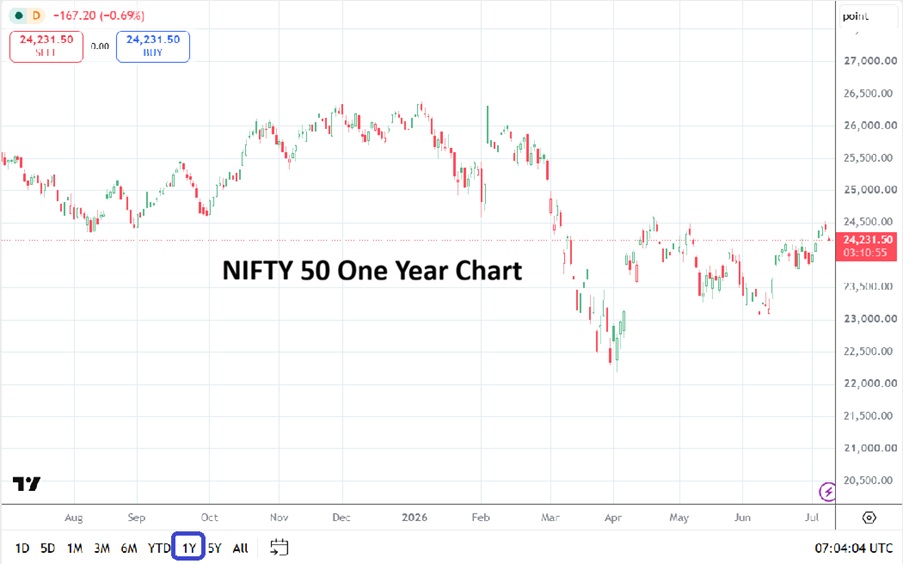
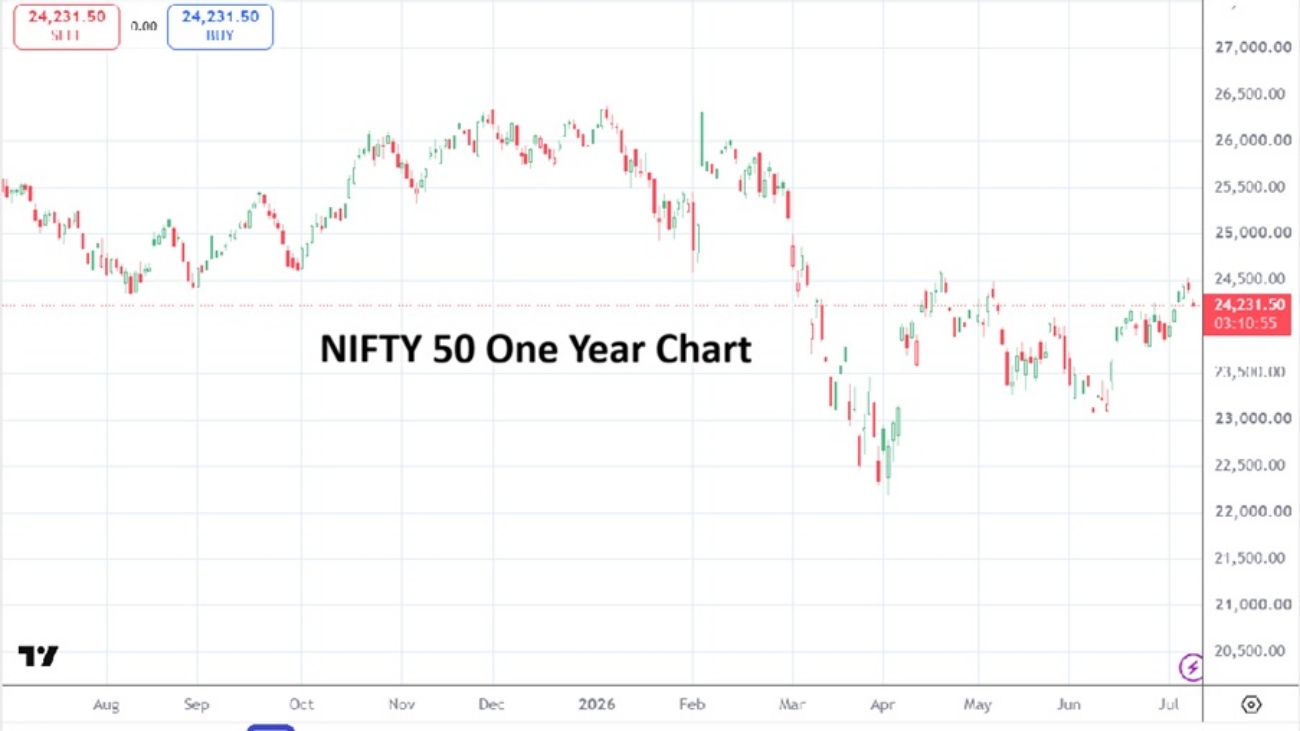
NIFTY 50 One Year Chart as of 8th of July 2026
Indian equities beat its emerging markets peers in June by its biggest margin in seven months. The Reserve Bank of India’s measures to attract foreign currency deposits and overseas capital have eased funding concerns for lenders, record foreign inflows into government bonds have helped stabilize the Rupee and improve liquidity conditions. According to Bloomberg, “Goldman Sachs favors 30-Year government bonds as lower oil prices allay inflation and fiscal risks”.
Combined with resilient credit growth and improving asset quality, India’s banking sector is once again attracting global investors, this after trading at meaningful discounts to historical valuations for quite a while.
Second Opportunity May Be Information Technology
Indian IT companies have undergone a sharp valuation correction over the past two years. Unlike the post pandemic period, when large Indian technology firms traded at substantial premiums to global peers such as Accenture. These premiums have now narrowed considerably after earnings growth slowed, and enthusiasm surrounding Artificial Intelligence shifted investor attention towards US technology companies.
As highlighted in Business Line magazine, the sector is undergoing a healthy valuation reset, with investors increasingly questioning whether premium valuations remain justified without a corresponding acceleration in earnings growth.
However, the discussion extends beyond valuations. Artificial Intelligence is fundamentally reshaping the enterprise software industry. For decades, Software as a Service (SaaS) companies dominated enterprise technology by offering standardized cloud based solutions that were cheaper and easier than developing software in-house. That advantage is now beginning to erode.
Large AI companies such as OpenAI and Anthropic are building AI agents capable of operating across multiple enterprise applications through a single conversational interface. Rather than competing within individual software categories, these horizontal AI platforms could reduce the importance of stand alone enterprise applications by seamlessly connecting them. At the same time, AI native startups are targeting specialized business functions, while advances in generative AI are encouraging enterprises to revisit the traditional ‘build versus buy’ decision as they develop customized software internally at significantly lower costs.
For Indian IT services companies, this represents both a disruption and a new opportunity. Routine application development and maintenance may become increasingly automated, placing pressure on traditional outsourcing revenues. Yet demand for AI integration, cloud migration, cybersecurity, enterprise transformation, and customised AI deployment is likely to create an entirely new investment cycle. The winners will be firms that evolve from conventional software service providers into strategic AI implementation partners.
Risks ahead for Indian Markets
The near term outlook is not without risks for India. A weak monsoon could push food inflation higher. Elevated Crude Oil prices may widen India’s external balances. And a stronger USD with elevated U.S interest rate yields could moderate foreign capital inflows. The technology sector also faces a structural challenge as Artificial Intelligence reshapes the traditional software business model, requiring companies to adapt more quickly than in previous technology cycles.
Even so, the broader macro backdrop appears to be improving. Policy measures have eased liquidity conditions, corporate balance sheets remain healthy, and valuations across several sectors have become considerably more attractive after an extended correction. Rather than chasing expensive momentum trades elsewhere in emerging markets, global investors may increasingly look toward Indian sectors where fundamentals are strengthening while expectations remain relatively subdued.