postN72

U.S National Security: USD Reserve Currency Importance

U.S National Security: USD Reserve Currency Importance

Opinion: The following article is commentary and its views are solely those of the author. This article was first published the 23rd of December via The Angry Demagogue.

We would like to start going through the U.S administration’s National Security Strategy released last month. There is a lot in there – much of it the same as in past administrations and much of it different. The tone of course is full Trump and while the introductory parts try to make it into a revolutionary document it does in fact build upon much of what has been American foreign policy for decades. One thing it most certainly gets right is that American foreign policy since the end of the Cold War has not found its compass. From a unitary world to one dependent upon global organizations, from a sharing of goals with western Europe to a pivot to Asia, from the war on terror and the middle east to Russia-Ukraine, the United States has struggled to find its way in the post-Cold War world.

We however will concentrate today on one aspect of the strategy, the third bullet in part III – “What Are America’s Available Means to Get What We Want?”. The third bullet point speaks of America having “The world’s leading financial system and capital markets, including the Dollar’s global reserve currency status” – a point that no one with any knowledge of global capital markets can not accept. The end of the bullet point – the Dollar’s global reserve currency status – is the most important because it underscores America’s leadership and essentially allows the United States of America to finance its military and its welfare state. The U.S Dollar as the “reserve currency” means that nearly all the world’s goods are quoted and therefore sold in Dollars.

Why is that important to the United States? Because the U.S government depends on its ability to issue Treasury bonds and bills at will – something no other government can do. It can do this because for another country to buy oil or copper or titanium or corn or soybeans from a country that is not their own– they need access to Dollars. Saudi Arabia and the other gulf states quote the price of oil in U.S Dollars and demand payment in U.S Dollars. The Saudis can deposit those Dollars in American banks or in what is called Eurodollar deposits in foreign banks (there are some 13 trillion Dollars in Eurodollar accounts globally). The Eurodollar accounts are essentially promises by the bank to give U.S Dollars to the holder when he makes a withdrawal. This strengthens the U.S capital markets and allows investors to have better and more investment choices. It is not only America’s often superior companies that bring profits to 401k’s and pension funds but the liquidity and vastness of America’s capital markets that can list domestic and foreign corporations. The reserve currency leading to the advanced capital markets allows the world – and America – to do this.

The U.S Treasury market is so liquid because every country needs Dollars in order to trade. They need to have enough dollar reserves since no one actually wants their own currency. In Israel, for example, local gas companies cannot buy oil with Israeli Shekels, since what will Azerbaijan, for example, do with them? There are only so many products that Israel can sell them. They need Dollars so that they are free to buy other commodities or other products.

The U.S Dollar as a reserve currency also is a break on inflation since the price of oil and other commodities is always in U.S Dollars. A weak or strong U.S Dollar influences the inflation rate in non-USD countries. A weak Israeli Shekel, South African Rand or Chinese Yuan does not influence the price of gasoline in the United States.

In short – as the Trump Administration understands well, the dollar as a reserve currency is a luxury the U.S cannot give up. The lack of the USD as a reserve currency could cause the Dollar to collapse and along with it the price of U.S Treasuries. As UST prices drop, their yields will rise and the cost of financing the U.S government will make interest payments on debt to rise well beyond its already absurd figure of over 4% of GDP – while debt itself is 120% of GDP. The U.S government currently pays over $1 trillion in debt service (interest payments on its bonds and bills). By contrast, the U.S defense budget for 2024 was $836 billion (about 3.3% of GDP).

We need to ask ourselves what can challenge the USD as the reserve currency and what could happen that would encourage the world to change? While the E.U had dreams of making the Euro an alternative reserve currency, the lack of growth in the E.U’s economy and population have put that dream to rest. The only other country that could theoretically replace the United States as the global economic go to country could be China. While in the long run, China’s lack of openness would probably mean that the Yuan would not last long as the reserve currency, that does not mean that they couldn’t jolt the global economy just enough to force it to use the Yuan to buy oil and other commodities.

China is already cornering the market on rare earth minerals and it making inroads in Africa where it mines all sorts of commodities from gold to copper to platinum and so many others (Africa has about 30% of global mineral reserves). That in itself is not enough to rock the global markets and cause a change in how the world does business.

Oil though, is that one thing that could allow China to challenge the USD as the reserve currency, even if it just presents the Yuan as an alternative.

How could that happen?

A Chinese takeover of Taiwan, by whatever means it uses would give the Chinese Communist Party control not only of the South China Sea but also allow its noisier and inferior (to America’s) submarine fleet to enter the Pacific and patrol it freely. The Chinese Navy, with a base on the “other” side of Taiwan would give it control of the north-south sea lanes that Japan and South Korea are dependent upon. Essentially, Chinese control of Taiwan would put Japan, South Korea, Vietnam and the Philippines at the mercy of the Chinese Navy. China could blockade these countries but that would be an act of war and then involve the navies of those countries and possibly the United States. It would affect the global economy negatively but it would not cause a change in world’s reserve currency. But, what if China works out a deal with Saudi Arabia to quote and sell their oil in Yuan (or the Chinese Petro-Yuan it wants to create) and then tells these countries, especially industrial powerhouses and energy poor Japan and South Korea that it will allow the passage of oil as long as they purchase the oil in Yuan?

Russia is already trying to get India to pay it for its oil in Yuan, to some success. Adding economies the size of Japan and South Korea would mean that any country that wants to buy oil could buy it in Yuan instead of Dollars. Once in Yuan, these countries would need to use the Yuan to buy Chinese products, deposit cash there and buy Chinese treasury bills. If China were to combine that with demands that all chips made in Taiwan also be sold in Yuan, the U.S Dollar would suddenly and forcefully no longer be the only reserve currency in the world.

Obviously, the way to stop this from happening is by stating outright that the United States will not tolerate a Chinese takeover of Taiwan. It is true, that the Strategy claims that the US “will also maintain our longstanding declaratory policy on Taiwan, meaning that the United States does not support any unilateral change to the status quo in the Taiwan Strait” but in practice the administration has criticized Japan’s tough talk on China instead of leaving it be. A strong silence on Prime Minister Takaichi’s remarks on China would have served the purpose of keeping the status quo more than telling her to tone down her rhetoric. There is a strong “no intervention ever” strain in the country and the President must make the case that that is not an option if the United States wants to maintain its leadership position, way of life and general prosperity.

In short, the threat to the Dollar as the reserve currency heads right through Taiwan. For those who think that the investment the U.S makes in keeping the Dollar where it is, is too expensive, just think of going on vacation and having the change to Yuan before you leave the country, wondering how much to change because of currency fluctuation and how much fun it is to return with hundreds of dollars in banknotes that you can’t use. Imagine your credit card bill on such travels and wondering how you went 15% over budget but didn’t get anything extra for it. Now imagine the national economy working that way.

Disclaimer: the views expressed in this opinion article are solely those of the author, and not necessarily the opinions reflected by angrymetatraders.com or its associated parties.

You can follow Ira Slomowitz via The Angry Demagogue on Substack https://iraslomowitz.substack.com/ 

postR169.1

Forex Debate and Coming Impetus this Week for Speculators

Forex Debate and Coming Impetus this Week for Speculators

In many respects the broad markets feel as if they are waiting for big news and this may not be delivered as wanted. Yes, the debate between Biden and Trump this Thursday will get attention, but unless there is a major television moment the outcome is not likely going to give a final affirmation regarding the U.S election results in November. Some people may be counting on Biden to literally misstep, and for Trump to say something incredibly outlandish, but it is also possible the debate disappoints even as entertainment. Perhaps the Presidential debate will deliver sideways action like the broad markets have the past week, leaving us with a desire for more.

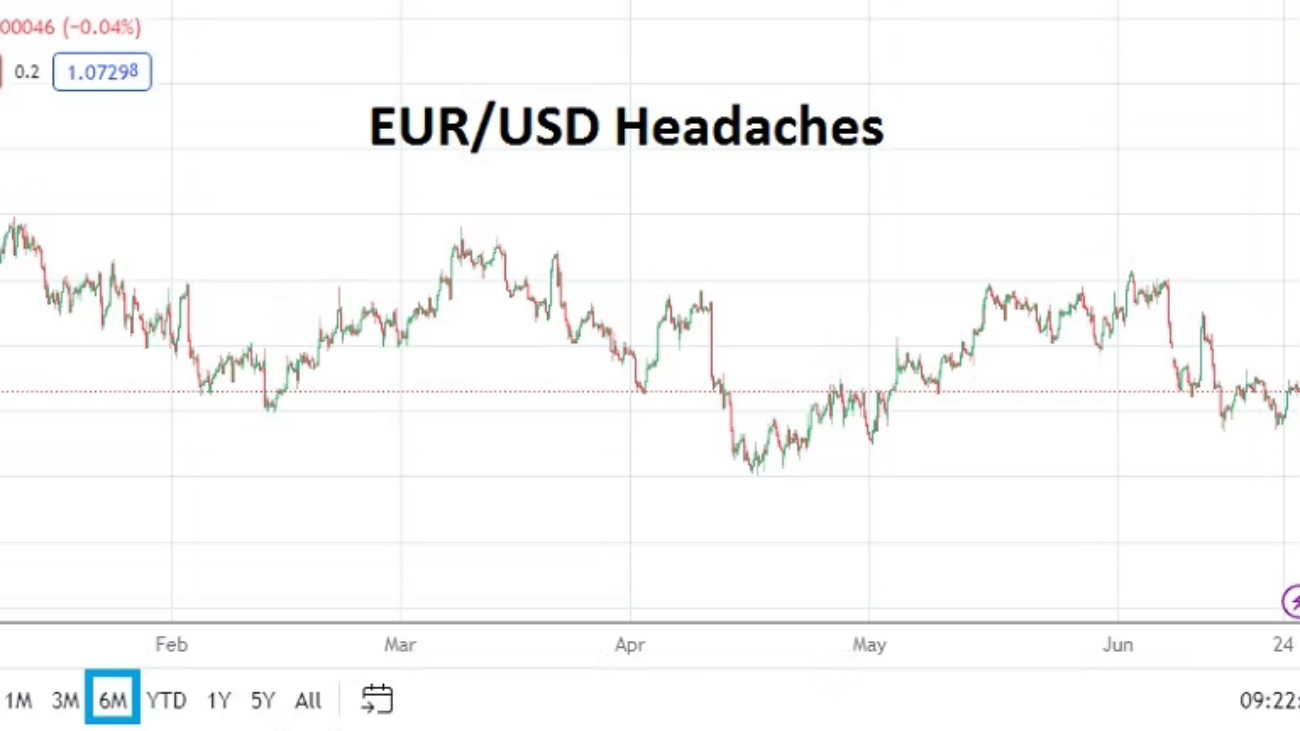
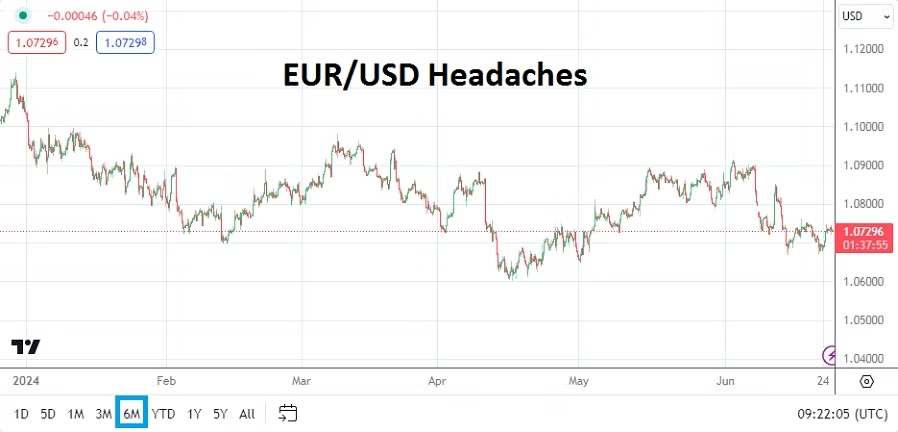
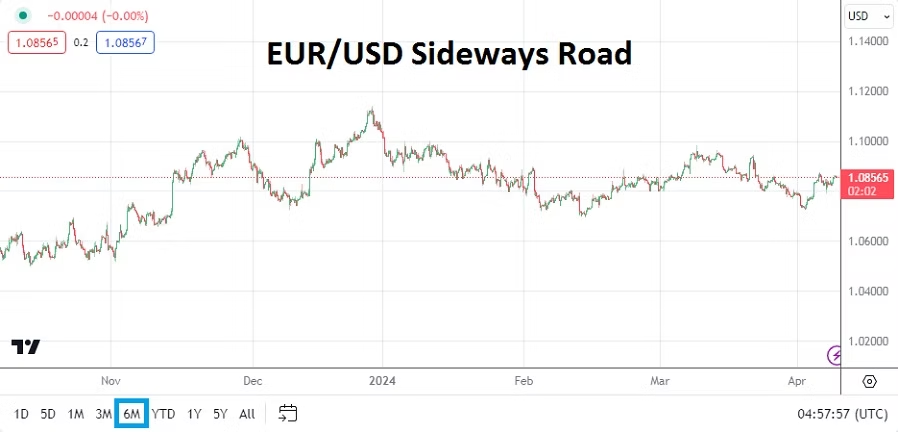
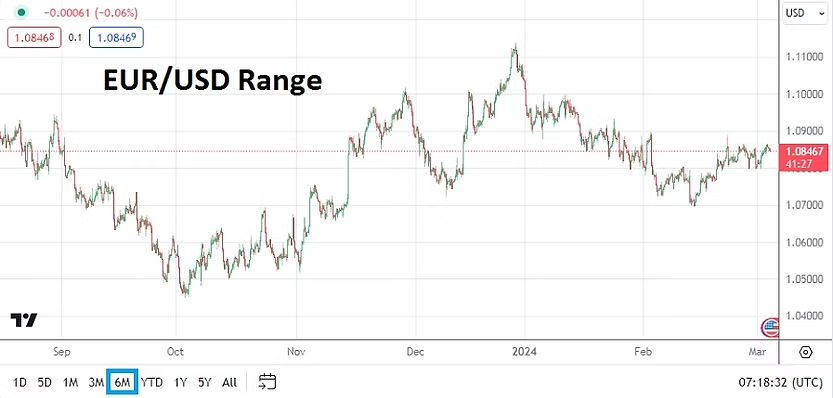
Financial institutions will look at U.S growth numbers this coming Thursday certainly, and also keep their eyes on the upcoming Sunday vote in France on the 30th which might prove rather remarkable. The EUR/USD is certainly back within its lower depths when a six month chart is inspected, and traders will react to France’s election this weekend, but it should be remembered the second and vital round of voting will not occur until the 7th of July. Until then, reactionary and precautionary results in the EUR/USD may produce headaches. The EUR does look oversold, but timeframes and the ability to hold a position may prove tough for short-term traders hoping for a wave of optimism to suddenly take hold and create a strong trend.

EUR/USD Six Month Chart on the 25th of June 2024

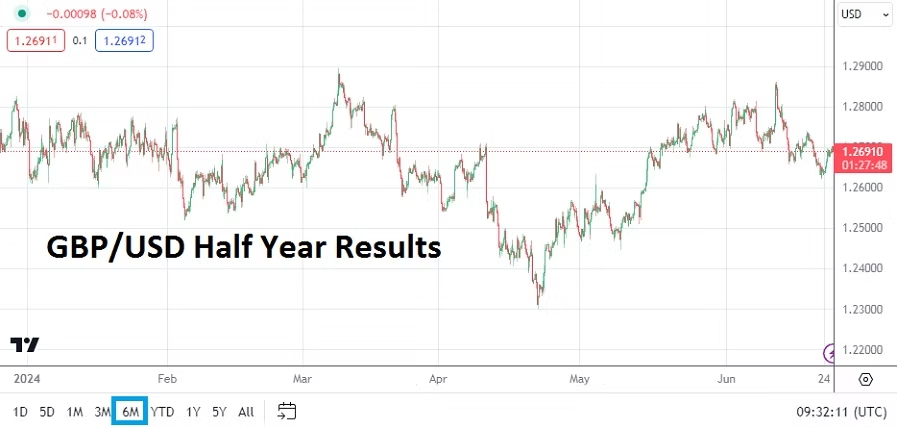
Not to be outdone the U.K is gaining plenty of attention because of its election on the 4th of July, but in this case it seems more like a coronation for the Labour Party and only a question about how devastating the carnage will be for the Tories. Financial institutions may have already factored in their perceived outlooks regarding the U.K vote into the GBP/USD. The currency pair will certainly react to the British election results, but financial institutions may have less to fear regarding sudden volatility of the British Pound, compared to the EUR/USD which could still have days ahead when it doesn’t trade in a USD correlated manner due to E.U political unknowns.

Monday, 24th of June, Germany Ifo Business Climate – the reading produced a drop to 88.6, missing the estimate of 89.4. Germany economic pressures remain negative and this may keep the idea alive that the ECB should be considering another interest rate cut. However, because the European Central Bank cut its Main Refinancing Rate recently and the U.S Fed continues to look rather neutral, it seems unlikely the ECB will decide to suddenly become the only proactive central bank around over the mid-term. Meaning, the ECB may stay conservative and want to wait on others to join the interest rate cut party, this before they create more unbalanced carry trade opportunities which could lower the value of the EUR/USD too much.

Tuesday, 25th of June, U.S CB Consumer Confidence – the reading will certainly be watched by investors, but will it create bedlam if there is surprise for equities or Forex? The likely answer is no. Behavioral sentiment has become flustered and shifted over the past handful of months, and this will create some caution no matter what today’s consumer reading says. Large financial institutions will probably stay geared to other upcoming data which will be considered more important.

Wednesday, 26th of June, U.S New Home Sales – a slight uptick in the amount of housing sales is expected. However, because of higher interest rates in the U.S via the cost of mortgages this number is likely to remain rather muted. For interested traders a look at the previous revisions of the New Home Sales data will prove interesting. The outcome of this reading should be treated with a bit of skepticism because it may be changed down the road. Unless there is a huge surprise the impact of this report may be rather calm, no matter what media narrative dictates.

Thursday, 27th of June, U.K Bank of England Governor – Andrew Bailey will speak about the Financial Stability Report. Bailey is certain to add some insights regarding the BoE’s neutral policy stance taken last week regarding interest rates, but more hints regarding potential cuts later this summer and possibly late this year again may be given. Economic data from the U.K remains troubling. The Bank of England may want to remain cautious because of inflation concerns, but financial institutions would like to see a more proactive dovish stance. Bailey might also talk about the potential affects from the U.K election, but he will have to be careful to make sure it doesn’t sound like he is taking a political side.

Thursday, 27th of June, U.S Gross Domestic Product and GDP Price Index – these two reports will impact the financial markets. The growth and inflation data will be examined by all financial institutions and generate trading reactions. The GDP growth number is expected to come at 1.4%, which is slightly higher than the previous report which posted a 1.3% result. Any number below 2.0% growth will be considered as lackluster by most financial analysts. Traders will then turn their attention to the inflation results which are supposed to match the 3.0% gain from the last Price Index report. If this number can somehow come in below expectations, this could propel some weakness in the USD. However, traders should be careful and remember U.S economic data the past handful of months has produced surprises which have created dangerous and choppy Forex conditions.

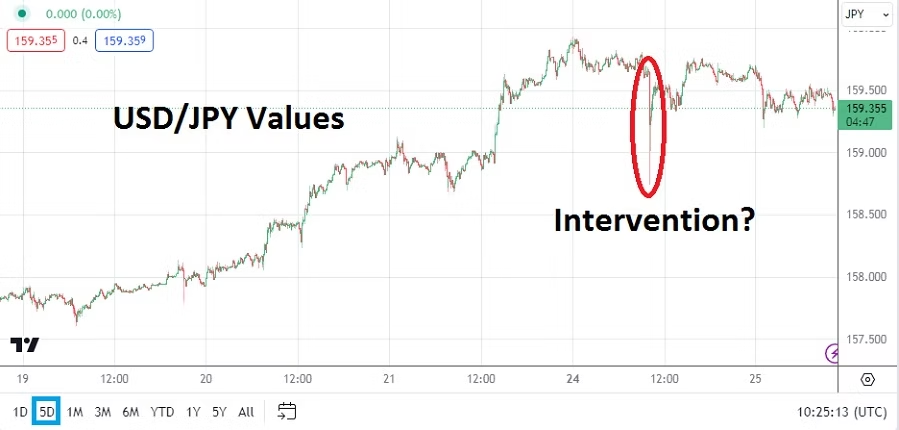
USD/JPY Five Day Chart on the 25th of June 2024

Friday, 28th of June, Japan Tokyo Core CPI – a gain of 2.0% is anticipated. The USD/JPY should be watched carefully. Early this Monday the BoJ likely tried an intervention in the Japanese Yen, but the USD/JPY only had a momentary swift selloff. As of this writing (Tuesday the 25th of June) the USD/JPY is trading near the 159.345 ratio which is very high when historical comparisons are considered. If the inflation number comes in with a 2.0% result or higher this could set off fireworks in the USD/JPY. Financial institutions clearly believe the BoJ should raise their interest rate by at least 0.25%, but the Japanese government appears keen on trying to keep the Japanese Yen weak to help GDP via exports from the nation. The Bank of Japan needs to be given attention. Speculators and the BoJ are battling against each other.

Friday, 28th of June, U.S Core PCE Price Index – the Personal Consumer Expenditures inflation report is forecasted to produce a gain of only 0.1% compared to the previous result of 0.2%. If the PCE Price Index does turn in the anticipated result, and the GDP Price Index from Thursday met expectations or came in lower, this could cause more speculative selling of the USD. However, if the inflation results come in stronger than expected Forex traders could see bullish USD buying which again challenges sellers abruptly.

postR196

AMT Top Ten Miscellaneous Blossoms for the 31st of May 2024

AMT Top Ten Miscellaneous Blossoms for the 31st of May 2024

10. European Supremacy: The NBA Championship between Boston and Dallas is set to begin on the 6th of June. If the Dallas Mavericks win, it will mean Giannis Antetokounmpo in 2021, Nikola Jokic in 2023, and Luka Doncic in 2024 were victors, and are cementing the terrain as the best players.

9. Brisk Breeze: The need for ‘chill’ among AI and server companies isn’t only about attitude. The advent of quantum computing will add to the wintry demands. Vertiv, Asia Vital Components, and Auras Technology are a few of the enterprises in the industrial environment sector helping deliver precision cooling for the technologies to work efficiently.

8. Glitches: Stalled data within the S&P 500 and Dow Jones 30 for their index calculations took place yesterday for nearly one hour, but individual trading within companies via stock prices appears to have been unaffected. Futures trading for the two indices weren’t affected. On Monday the 18th of March, Nasdaq suffered a tech problem that stopped pre-market trading for a couple of hours.

7. OPEC: The cartel will conduct a one day online meeting this coming Sunday. Production levels will be discussed, among other issues. The price of WTI Crude Oil as of this writing is below 78.00 USD per barrel. While news remains stuck in hyperbole from the Middle East, the price of Crude Oil has declined since the first week of April.

6. Conviction: Donald Trump was found guilty in a NYC courtroom yesterday, but the verdict is certain to be appealed. The law of unintended consequences could come into play from the U.S as reactions generate. The perceived notion that ineffectual and non-credible leadership is mounting in the U.S, lends credence to some people around the globe regarding dwindling American exceptionalism.

5. Results: South Africa voting counts will be finalized sometime this weekend, India’s election count will be known on the 4th of June. The unknown outcomes are affecting the USD/ZAR and USD/INR, and more volatility in the currency pairs should be expected early next week.

4. Coincident: GDP results came in around their expectations yesterday. Growth numbers produced a gain of 1.3%, while the GDP Price Index showed a 3.0% climb. The data produced does show the U.S economy is slowing and is another ripple to be considered by analysts and traders.

3. USD/JPY: The Bank of Japan appears to be betting on weaker U.S data to continue, and potential dovish Fed rhetoric on the 12th of June to propel the USD/JPY lower, thus helping the BoJ to remain on the sideline and avoid an intervention for the moment. The BoJ will release their Policy Rate decision on the 14th of June and many eyes will be on the central bank’s Monetary Policy Statement.

2. Inflation: The Core PCE Price Index report outcome today is anticipated to be around the 0.3% ratio. The Federal Reserve pays plenty of attention to this publication and if the number meets the expectation or comes in below it, this could cause a repeat of the Fed’s dovish December 2023 FOMC Statement. Financial institutions have already begun wagering that the Federal Funds Rate could be cut this summer and later again this year. Many assets will react to today’s inflation report.

1. Behavioral Sentiment: Nervous price action has been seen in the equity indices and Forex this week. Investors may have felt they got a little ahead of their risk appetite curve and now appear to be waiting on more solid impetus to reconfirm their outlooks. Choppy price action has certainly been fueled by U.S Treasury yields which increased earlier this week. Losses in the S&P 500, Dow 30 and Nasdaq the past handful of days are now waiting for buyers to reemerge. The question day traders may want to consider is if financial institutions and large investors believe assets will cost less next week, or if prices have now hit worthwhile support levels which will spur on buying today?

postN77.1

Forex: Behind the Curtain as Speculative Deja Vu Strikes

Forex: Behind the Curtain as Speculative Deja Vu Strikes

Friday jobs reports came in stronger than anticipated on the surface, and this led to a roller coaster like ride for Forex traders as results were acted upon by financial institutions. However, a look behind the data shows ‘positive’ results were spurred on by part-time hiring and government influences leading to a notion that jobs numbers were not exactly a ray of sunshine regarding U.S economic health. The suspicious results cause a desire to look for ulterior motives, and to wonder if election year politics are playing a role in the U.S employment picture.

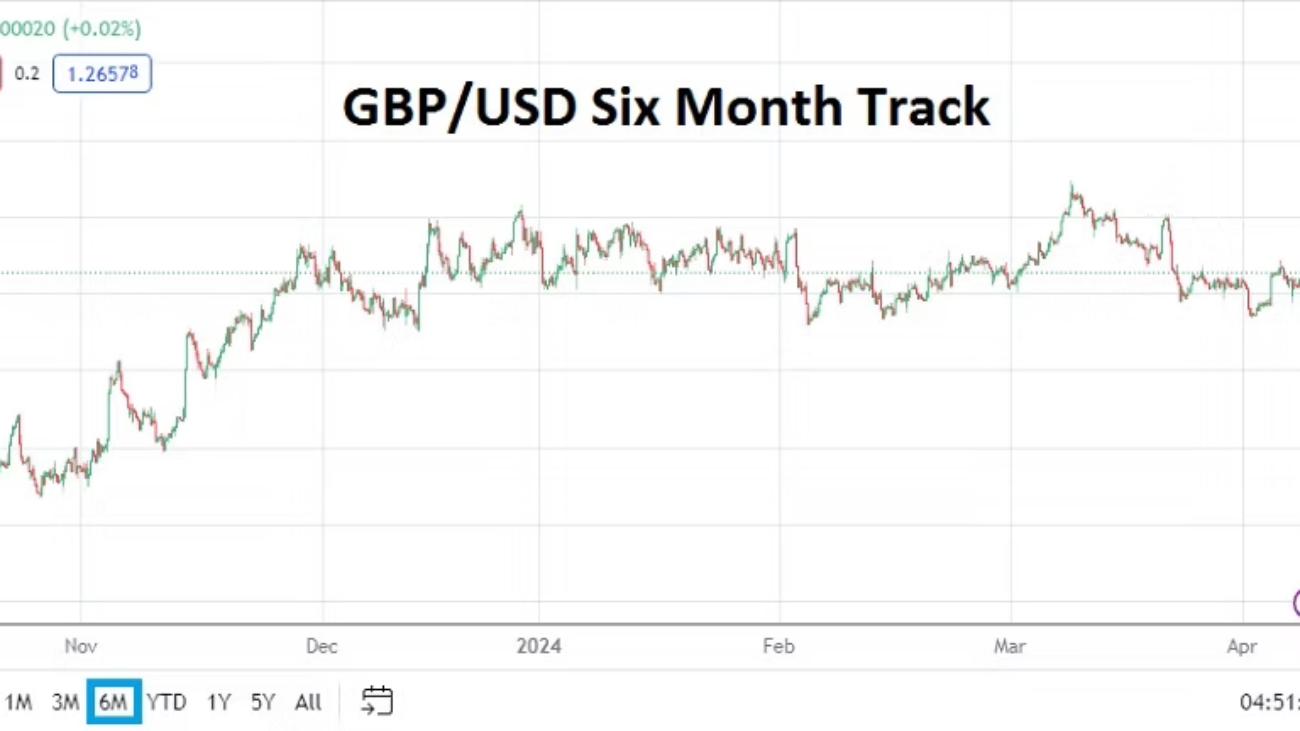
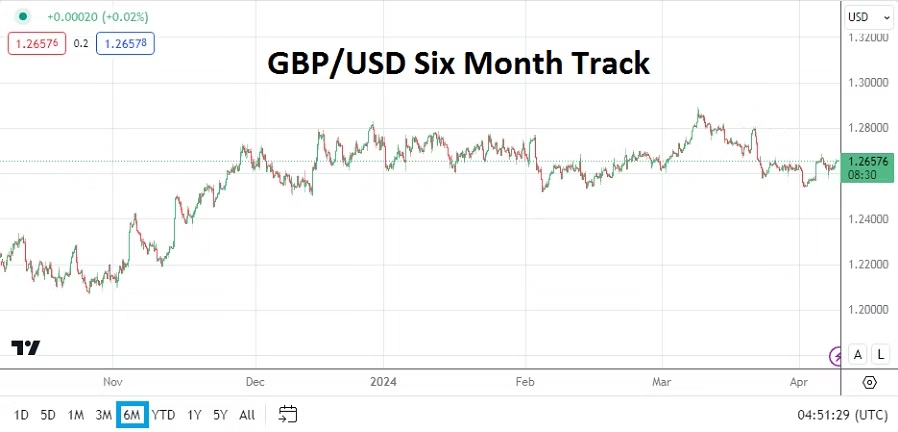
GBP/USD Six Month Chart as of 9th April 2024

The GBP/USD and EUR/USD are rather insightful for technical and fundamental traders. The currency pairs are languishing as of today’s values near pricing that was seen in the second week of December. Since the ‘announcement’ from the U.S Federal Reserve on the 13th of December that a change in monetary policy would begin to occur in 2024, in actuality nothing has really happened, except government ‘speak’ trying to sound as if everything is understood and in control, while it is clearly not.

Economic data from the U.S and Europe has continued to be soiled by mixed results, and retail speculators looking for a trend to emerge have had to deal with choppy conditions. Financial institutions remain unclear about interest rate outlooks. The Fed while trying to ‘sound’ dovish rhetoric remains locked within a Google engine keyword mantra as they mutter the phrase ‘over time’ when trying to convince people that interest rates will ‘eventually’ be cut.

Last week leading up to the Non-Farm Employment Change numbers, many FOMC members were offering cautious tones about the Federal Funds Rate and warning it should not be changed yet. The implication of the Fed’s verbiage could lead some to suspect they have all practiced statements handed to them by their overlords who are concerned this is an election year and jobs are in jeopardy.

EUR/USD Six Month Chart as of 9th April 2024

Which leads us back to Forex and all financial assets, as investors try to swim waters which have left fundamental perspectives grasping at data which is not easy to decipher. U.S government policy is practicing fiscal spending that is causing massive debts, and perhaps influencing hiring data which may be more akin to putting lipstick on a pig. Many U.S voters seemingly lean towards electing officials who promise to hand out the biggest ‘social rewards’, while ignoring there will be a price to be paid down the road.

The Federal Reserve in the meantime tries to sound optimistic about inflation eroding, but concerns due to U.S government debt being accrued, and global geopolitical affairs combined with energy policy which is making it more expensive to maintain cheap transportation, efficient agriculture and manufacturing, shadow the Fed’s hopes. WTI Crude Oil remains over 86.00 USD per barrel. Gold is trading at record high values and above 2300.00 USD. Does anyone see the dangerous connections? Equity indices should be watched as a barometer this week.

USD/JPY Six Month Chart as of 9th April 2024

Monday, 8th of April, Japan Average Cash Earnings and Economic Watchers Sentiment – yesterday’s reports matched expectations regarding wages, but workers surveyed noted their concerns about incremental inflation which is being seen in Japan. The USD/JPY is challenging November higher values and the Bank of Japan has been widely criticized for not raising interest rates more aggressively. However, it is possible the BoJ wants the Japanese Yen to remain within its weaker price range to spark a stronger Japanese economy via exports.

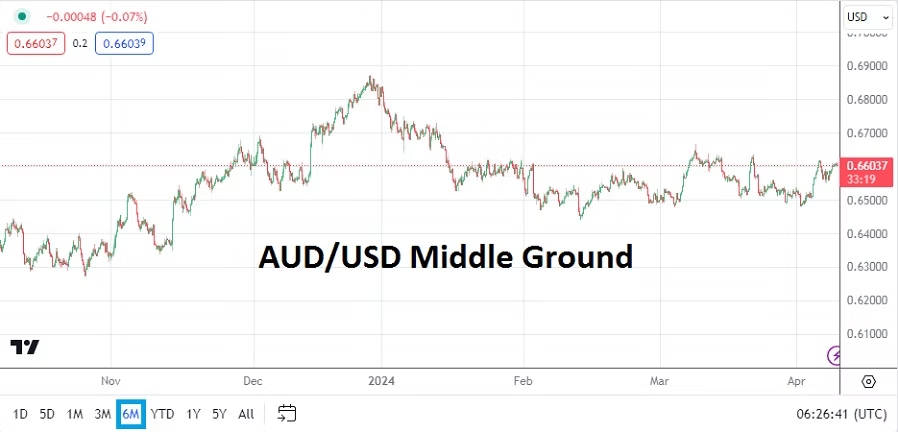
AUD/USD Six Month Chart as of 9th April 2024

Tuesday, 9th of April, Australia Westpac Consumer Sentiment – the results via the consumer reading came in negative. The AUD/USD like the GBP/USD and EUR/USD is traversing values tested in the second week of December 2023, leading to the feeling of deja vu.

Wednesday, 10th of April, U.S Consumer Price Index – you have heard this before, the inflation reports from the States are going to rattle the financial markets including Forex. The USD is certain to react. Data from the U.S has produced surprises aplenty in the past few months. The Consumer Price Index is important and day traders certainly need to pay attention.

Thursday, 11th of April, European Central Bank – the ECB is not expected to change its Main Refinancing Rate, but many analysts believe they should cut borrowing costs. However, the ECB will likely remain within the camp of choosing to ‘wait and see’. The ECB Press Conference with Christine Legarde has widely become regarded as an opportunity for political speech as much as an economic dialogue. Recent data from the European Union suggests the worst of the recessionary cycle is gone, but German Trade Balance numbers released on Monday were negative, highlighting hurdles remain. Inflation is a worry, and a cut to the interest rate might be able to help spur on economic activity while counting on lagging data to prove proactive policy should be implemented. But this likely is not going to happen and the EUR/USD will remain problematic.

Thursday, 11th of April, U.S Producer Price Index – these slew of reports should be watched carefully. If the data is stronger than expected it is likely a part of the residue caused by higher energy costs that have affected logistics and created more expensive raw materials which are needed to produce goods. It was the higher PPI reports last month that caused dramatic tidal shifts in Forex, speculators should brace for the potential of additional mayhem.

Friday, 12th of April, U.K Gross Domestic Product – last month’s GDP numbers from Great Britain came in slightly higher than expected with a 0.2% gain, this report is anticipating growth of only 0.1%. Traders should take a deeper look at the statistics upon publication and check for revisions to past months. The U.K economy has been struggling, the ‘growth’ results will affect the GBP/USD before going into the weekend.

postN89.1

Forex: Powell, ECB and U.S Jobs Numbers as Gold and Oil Run

Forex: Powell, ECB and U.S Jobs Numbers as Gold and Oil Run

Day traders and investors received a dose of optimistic ‘news’ last week as U.S economic data came in weaker than expected. While Forex certainly proved choppy as anticipated, the USD has shown signs of stability and perhaps has created a durable resistance level up above regarding its potential value looking into the mid-term.

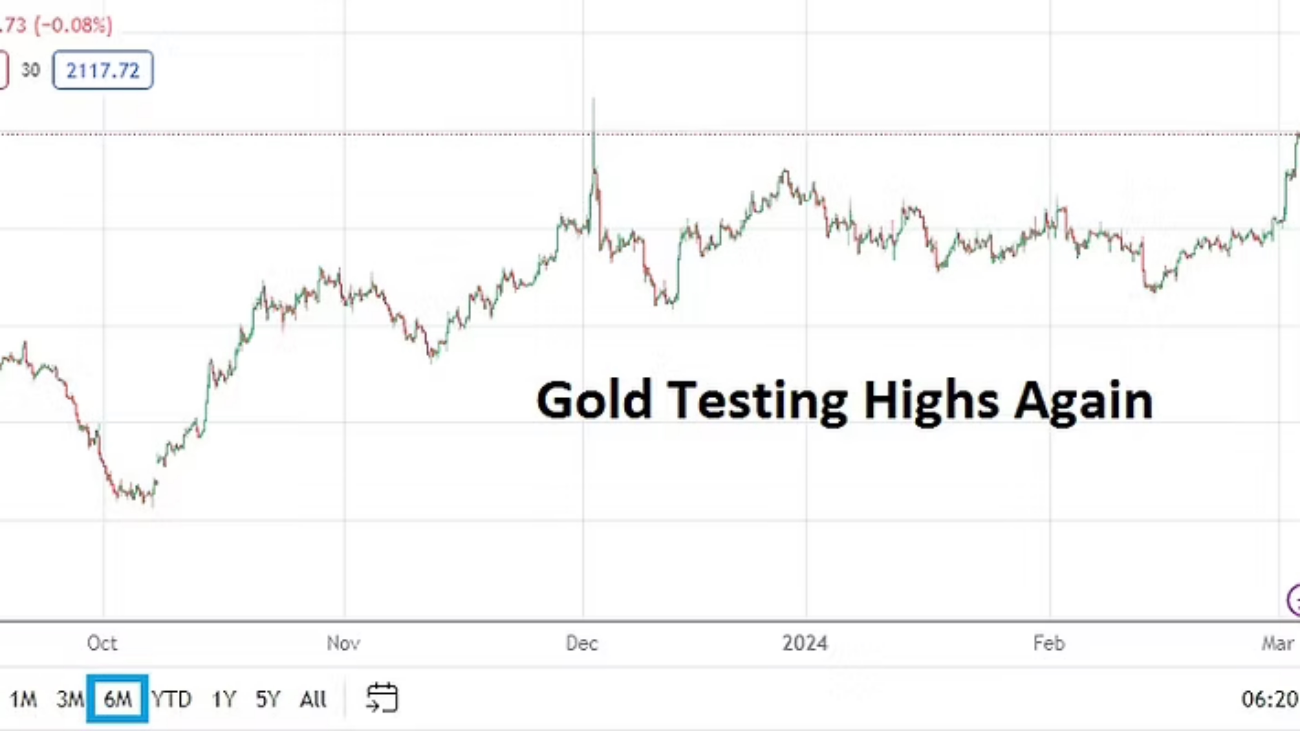
Gold Six Month Chart as of 5th March 2024

A potential telltale sign regarding the USD in Forex is the current price of Gold which is testing highs and as of this writing is near 2115.00 USD. While below the speculative heights of early December, the precious metal is above prices seen in late December when the USD was being sold heavily. The value of Gold is a rather solid barometer regarding outlook for behavioral sentiment in Forex. A weaker USD translates into a higher Gold price in many cases.

U.S Treasury yields have also decreased slightly over the past handful of days. And while U.S equity indices are within sight of record values, traders should monitor developing news regarding U.S regional banks and concerns about New York Community Bancorp (NYBC). For the moment it appears investors have not turned too nervous when considering the bigger picture of stock markets. Perhaps last year’s regional bank crisis has made investors in equity indices feel immune to fears of contagion stemming from bad commercial real estate lending. Or perhaps many folks are marching along merrily and refuse to pay attention for fear of missing out when their associates continue to parade into the indices.

The cryptocurrency market has come out of its deep freeze and sunshine is pervading the mindsets of speculative gamblers in crypto assets. U.S run ETFs are raising a lot of money. Folks have driven the market sky high again in the digital asset Bitcoin and its fellow travelers like Ethereum, Binance Coin, and there have been signs of pure casino like wagering in Dogecoin and Shibu Inu. Be carefu if you are considering dipping your toes into this ‘market’. Volatility and changes of sentiment can happen in the flick of an eye.

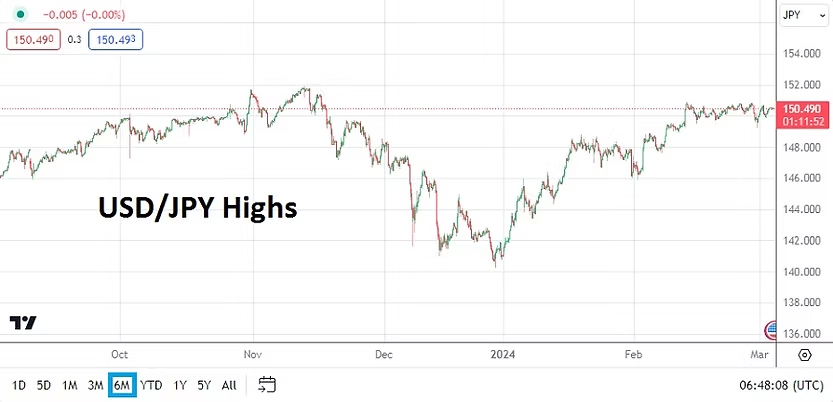
USD/JPY Six Month Chart as of 5th March 2024

Monday, 4th of March, Japan Capital Spending – a huge jump of 16.4% was reported yesterday. This points to better economic sentiment. The Bank of Japan has been getting a lot of attention the past handful of months because some financial institutions expect the BoJ’s monetary policy to begin changing. The USD/JPY remains near important resistance levels, but below the highs of last October and November 2023 values. Mid-term speculators may be leaning towards bearish sentiment in the currency pair, but a trend lower has not been established yet.

Tuesday, 5th of March, U.S Service PMI via ISM – last week’s growth and inflation data from the U.S was less than expected. While the U.S economy has shown rather stubborn growth, the American economy may be showing signs of slowing. Today’s reading is expected to come in below the previous month’s outcome.

Wednesday, 6th of March, U.S Federal Reserve Chairman Powell – the Fed chief will testify before the Senate via the Semi-Annual Monetary Report over a two day span. Because it is an election year a rather aggressive amount of questions will be asked. However, Powell is a skilled speaker and it unlikely he will be rattled by political rhetoric. Of interest will be any comments regarding inflation, this as the Fed Chairman is asked for insights regarding the Federal Funds Rate outlook. While this testimony in Washington D.C is usually a polite get together, the notion that some politicians may try to score points will make this a potentially important calendar event for investors to pay attention regarding financial market gyrations. Powell is expected to remain cautious regarding his answers.

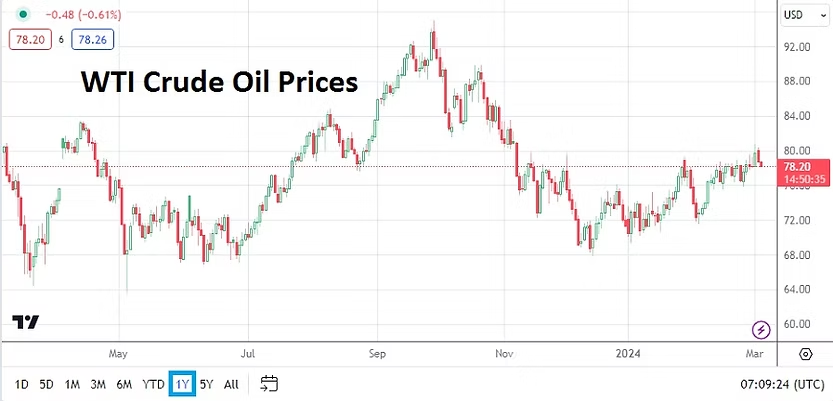
WTI Crude Oil One Year Chart as of 5th March 2024

Wednesday, 6th of March, U.S Crude Oil Inventories – last week’s U.S supply report posted increased results, yet the price of WTI Crude Oil jumped the end of last week. The value of the commodity remains within the lower part of its one year range and should be watched. Recent speculative action has shown some buying momentum. The price of energy is a big component within global inflation and should be watched as the 80.00 USD Crude Oil level is challenged.

EUR/USD Six Month Chart as of 5th March 2024

Thursday, 7th of March, European Central Bank Main Refinancing Rate – once again the ECB is expected to not act. The question is if financial institutions may try to send the European Central Bank a message because of its ‘inaction’ as inflation remains stubborn in Europe and growth hard to achieve. The EUR/USD has returned to value above the 1.08000 mark again, but visions of a stronger EUR have been hard to attain. The combination of the ECB Monetary Policy Statement and Press Conference, as Fed Chairman Jerome Powell is addressing politicians in Washington D.C could make for an interesting day of volatility in Forex.

Thursday, 7th of March, U.S State of the Union – President Joe Biden will deliver his address to Congress.

Friday, 8th of March, U.S Non-Farm Employment Change and Average Hourly Earnings – weaker jobs numbers and diminishing wage escalation are expected. U.S economic data last week came in below estimates. This report will be a solid barometer for financial institutions. While the work force numbers in the U.S are said to be tight – meaning there is full employment – layoffs have certainly been taking place in some sectors. Also worth paying attention to in the ‘back pages’ of the report, will be the amount of average hours worked by employees which have seen a statistical decline emerge.

postN96

Is Israel a Fragile Country? Can it Move Towards Anti-Fragility?

Is Israel a Fragile Country? Can it Move Towards Anti-Fragility?

Opinion: The following article is commentary and its views are solely those of the author.

One of the great books of the last decade is Nassim Taleb’s “Anti-Fragile”. 

I read it years ago and bought one for each of my (grown) children and suggested they read it and think about it when making decisions. I said at the time that this should be required reading for all IDF officers. In a nutshell, Taleb differentiates between fragile, non-fragile and anti-fragile. Glass is the classic fragile substance and concrete the classic non-fragile. Both can be destroyed with correct instruments and non-fragile items will slowly decay when things like water infect them.  

Anti-fragile items on the other hand, gain strength from chaos. The more an anti-fragile substance gets hit, the stronger it gets. Nature for Taleb is the classic anti-fragile system. Nature “knows” how to respond to any disturbance, and it “learns” how to adapt and survive. This adaption and survival might hurt parts of the natural world – but nature as a system will survive and be stronger – think of natural immunity from a virus. 

Another of the ideas in Taleb’s book is “optionality” – decisions in life are often like buying options. When buying an option, you want a high upside and a low downside.   A simple non-financial example is crossing a street. If you see a car 50 yards away and are pretty sure you can make it across the street without getting hit – you can take that “pretty sure” chance and save yourself the 10 seconds it takes for the car to pass, or you can wait the 10 seconds. The upside here is saving 10 seconds. The downside is getting hit by the car. The decision is pretty obvious for those who think of optionality.

In short – Taleb is a serious man and a serious thinker. Born in Lebanon in 1960 he is a polymath, making his name in trading and finance, and his previous book “The Black Swan”.

In any event, in a recent interview with the French newspaper L’Orient Le-Jour he called Israel a fragile country due to its dependence on the United States and said that top-down peace agreements, like that between Israel and Egypt, or the Abraham accords are doomed to fail (I don’t read French and read a summary of the interview in the Hebrew language Globes financial newspaper – the original is here – if you read French and I got it wrong, please let me know).

Is Israel a fragile country? And if so, is it more fragile than other small free countries? And finally, how can it move on the road to anti-fragility? And are fragile peace agreements worthless?

Taleb’s claim that Israel is fragile due to its dependence on the US is true in an of itself. Changes in U.S foreign policy either via elections or changes in US interests have in the past put Israel in difficult situations. When Prime Minister Yitzchak Shamir requested U.S loan guarantees from then President Bush (1) in order to fund the absorption of masses of emigrants from the falling Soviet Union he was turned down until Israel halted settlement activity in the West Bank and attended the (failed) Madrid peace conference. Today, it is very clear that if the US would decide to halt arms shipments to Israel or to stop supporting it in the Security Council, the country would be put in a situation many believe would be existential.

A big issue in Israel at the moment has to do not only with Israel’s dependence on the US for military hardware but in the relationship of its top generals with the Pentagon. There is a claim that much of the “globalized” attitudes of Israeli generals comes from the influence of the politically correct elite in the US Defense Department. It reached a point where, just a few weeks before the current war broke out, the general in charge of military intelligence stated that he fears that global warming is a greater threat to Israel than Hamas. Whatever one’s views on global warming or climate change it does seem odd that the one Israeli in charge of making life and death intelligence assessments has the time to worry about those issues to such an extent that he feels it is his job – as intelligence chief – to warn Israel about it. Further, the October 7 attack itself showed the fragility of the defense strategy of Israel’s top generals and politicians. It had a conception of Hamas and other enemies and had no allowance for its being wrong. 

However, the initial response of Israel’s soldiers and officers, without the centralized support of the General Staff, show how many of Israel’s combat soldiers are “anti-fragile”. Israel’s people can also be said to be anti-fragile in Taleb’s definition of it where chaos or tragedy make one stronger. Over the 48 hours after October 7 Israel already had 350,000 reservists mobilized who were all motivated to fight for their country. That is no mean feat – for the most part these reservists went to their units before being called up or called their commanders demanding to be called up. Many thousands returned from abroad at their own expense in order to join their units and fight. In contrast – Ukraine had to forbid all men under 50 from leaving the country.   In Israel, a divided, shocked and demoralized people became a strong fighting force with the home-front in total support, within hours.

Military tactics are another area where Israel is anti-fragile. Due to the utter failure of military intelligence and the lack of central control over the first hours of the war that Saturday morning, the junior and mid-level officers and soldiers took command and figured out on their own how to face down the thousands of terrorists who took over towns and villages as well as military bases. Instead of waiting for orders and making sure everything was organized for attack, a delay which would have cost many more civilian lives, Israel’s soldiers improvised with what they had and took back the territory under very difficult circumstances. Many soldiers lost their lives through many acts of bravery but the decisions they made on the spot made them, the army and the country stronger.

The same can be said in the fighting now in Gaza. Israeli intelligence understood that there were tunnels, but it seems that they didn’t know the extent of the network and therefore had no good tactics to defeat it. It was the need to penetrate them without causing casualties to soldiers as well as the potential of hostages in the tunnels, that caused them to developed tactics to deal with it. We won’t know for sure how well it has or will work, since this is now classified information, but this could be an area of anti-fragility.

But this does not disprove Taleb’s point since Israel is clearly has a “single point of failure” and that is the U.S Government. However, nearly all free countries in the world have that single point of failure and have had it since the start of the atomic age.   One of Konrad Adenauer’s great fears in developing West Germany’s defense policy was that, when push came to shove, there would be no US nuclear umbrella. He was not convinced that the US would risk its own cities in defense of Europe in general and West Germany in particular. That is why he supported France’s independent nuclear deterrent and why he and De Gaulle were so close. The U.K too, when deciding on its Trident nuclear submarines had the same doubts. 

Today, we can say the same about the Baltic countries. They are part of NATO now, but, like the rest of NATO are totally dependent upon the United States military to keep the Russians at bay. The rest of Europe is dependent upon the U.S but they are no longer front line states so it is less important. Newly NATO-ized Finland is probably closer to Israel in its combination of fragility and anti-fragility.

Taiwan too, is fragile in this sense and so are the weaker Indo-Pacific nations like Philippines and Singapore. It would be difficult to find a non-Axis free or semi-free country that is not dependent upon the U.S to defend its freedom – either with sailors and soldiers or with arms, money and diplomacy.  

But the question Taleb poses, or the claim he makes, deals with Israel. Israel is clearly partly fragile – but is it too fragile currently that it can’t survive without the US? Or can Israel do anything to make it, if not more anti-fragile, at least more non-fragile? We have to separate out Israel’s fragility due to its dependence on the U.S and the free world’s fragility due to the same dependence. The Pax Americana that free (and non-free) countries have enjoyed since the end of WWII has probably contributed more to freedom, economic growth and a reduction of poverty in the world than any other force in human history. The question for all free countries then is how to make them less dependent upon the U.S if they want to remain strong and free -and less fragile.  

That is as true for Israel as it is for Latvia, Finland, Australia and Japan. 

But we will only look at solutions for Israel and leave the general question for a later time.

Israel receives from the US $3.8 billion in military aide, all of which must be spent in the United States. The annual aide started in 1999 and was $2.67 billion. Israel’s GDP in 1999 was $120.92 billion – meaning the aide constituted 4.5% of Israel’s GDP.  In 2022 Israel’s GDP stood at $525 billion so its $3.8 billion in aide was just 0.7% of GDP. Israel’s 2022 defense budget was $23.4 billion – 4.45% of GDP.

Giving up the entire U.S aide is certainly do-able from an economic perspective and there have been economists in Israel who claim that the aide actually hurts the Israeli economy since all the money must be spent in the U.S. One result of this has been the demise of Israel’s textile industry since the IDF no longer purchases uniforms from Israeli companies (one has to wonder that, since clothes bought in the U.S are rarely made in the U.S, if Israel is buying uniforms made in Bangladesh but sold via U.S middlemen). Giving up the aide would be one step towards a less fragile existence for a number of reasons.

The first would be, in my opinion, to cement the U.S public’s support for Israel. Giving up U.S taxpayer aide during a time of fiscal uncertainty would certainly be looked upon positively, in spite of the fact that all the aide gets recycled into the U.S economy (there has been some money that Israel has been allowed to spend on R&D in Israel). Israel is not the same country it was in 1999 and its economy is robust and probably more anti-fragile than most other western economies.

A second positive would be in allowing Israel to spread out its arms purchases. It could buy small arms from India, artillery from South Korea, etc. It could also rejuvenate local Israeli arms manufacturing. There is no doubt that all the large ticket items like fighter jets and smart bombs will still be purchased in the U.S and there is no doubt the U.S arms industry will continue its good relations with Israel – and in fact might be made more competitive since the IDF will be free to chose from amongst many providers for various weapons systems. 

Another move that Israel can make that would decrease its fragility would be to make sure it always has a 12 month supply of weapons and spare parts in order to fight a three front land war and a 5 front air war. It would have to beef up its navy and ground forces without hurting its crown jewel – the Air Force. This would make it less dependent upon the importation of arms in case of war.

An area where it will be difficult to be less fragile is the diplomatic arena as woke-ness takes over the western narrative about the world and many of the less and non free countries can’t manage to fight off Arab money and propaganda. India could be a country that could help diplomatically as they are large and powerful enough to ignore much of the pressure from the Arab and western-woke world. The problem is that the Security Council still holds sway in the world and India is not a permanent member with a veto. Of course they should replace the U.K and probably France but that won’t happen as long as India doesn’t have a reliable, permanent left-wing majority – which it won’t have for some time.

The only other major country that could help diplomatically would be Japan – but they have historically not been friendly to Israel and only in the current war have they backed it fully. They are certainly sympathetic to Israel’s plight as they figure out how to face a hegemonic China.

But under the current global situation, Israel relies on the U.S for diplomatic cover making it fragile, diplomatically. That won’t change for some time.

Economically, Israel is probably more anti-fragile than most other countries in the world. This is true for two reasons. First, Israel has a strong domestic market including a very productive real estate market. It has an agricultural center that produces enough for export and of course world class hi-tech and bio-tech industries. Most important – it has children. It is the only western country that has a high birthrate and that is something that has been underestimated in the west. Israel’s fertility rate – births per woman – stands at 2.9. The next highest western country is France at 1.8.  Replacement rate is 2.1.  Search out Nicholas Eberstadt for all the details.

Regarding the top-down peace agreements, Taleb himself understands for sure that the non-democratic top-down nature of most Arab countries makes this less important than in western-free countries. However, he does have a point here. Regarding Egypt, from the beginning the people – or more accurately, the professional and intellectual classes, have been opposed to Sadat’s peace. However, in spite of that, the peace has held for 45 years, which is quite a long time. I remember as a child reading the Biblical Book of Judges where the Israelites would sin, to be saved by a Judge who would rule and keep the country “quiet” for 40 years. At the time I thought – what is the big deal of 40 years of peace? As I grew (much) older I realized that 40 years of peace would be an incredible feat. So, 45 years of non-war between Israel and Egypt is quite a success. Will this continue for another 45 years? I think that if Israel remains strong, it will. 

Regarding the Abraham accords, the jury is still out. We will have to see where it all progresses. This war has certainly shown that even mass violence has not caused violent reactions from the Abraham accord countries. The one peace agreement most fragile and more worrisome though is the one with Jordan. The Hashemites are first and foremost survivors and if survival means breaking the agreement, they will do it in a second.

http://angrymetatraders.com

In summary, Israel’s dependence on the US is crucial for its survival and that in itself makes it fragile. However, there are things Israel can do to make it less fragile and the will and determination of its people make it, in many senses anti-fragile in Taleb’s description (invention?) of that term. Compared to other small, free countries though, all of whom depend on the US for at least part of its defense, it is difficult to say that Israel is worse off – except that, besides the Baltic countries, its neighbors are worse and more dangerous.

In the coming days we will examine a more radical solution to the “fragility” problem of Israel and other free countries.

Disclaimer: the views expressed in this opinion article are solely those of the author, and not necessarily the opinions reflected by angrymetatraders.com or its associated parties.
You can follow Ira Slomowitz via The Angry Demagogue on Substack https://iraslomowitz.substack.com/

postN85

Shohei Gets Shown the Money: Dodgers sign Ohtani for 700M

Shohei Gets Shown the Money: Dodgers sign Ohtani for 700M

Shohei Ohtani signed a contract yesterday with the Los Angeles Dodgers for 700 million USD over the next ten years. You probably know that already. Here’s the thing, the Dodgers are actually going to make much more money from Ohtani than he will make from them. There are always questions about a player’s health and ability to last the lenght of a long-term contract, but the reasons why this was a good deal for the Dodgers are strong.

Yes, Ohtani does have a track record of getting hurt once in a while. He will likely not be able to pitch during 2024 as his arm heals from a throwing injury from the recently played MLB season. Yet, he will hit, and he will likely do this at a significant level, which could help propel the Dodgers into playoff and championship contention. He is 29 years old and only turns 30 in July of 2024, which signals he has a handful of years ahead with a potential for excellent performances. While playing for the Los Angeles Angels since 2018, Shohei Ohtani has not been able to showcase his talents in the MLB playoffs. That will certainly change when playing for the Dodgers.

Let’s not forget Ohtani’s performance in the 2023 World Baseball Classic. He struck out Angel teammate, Mike Trout, to win the Championship for Japan in an absolutely electric moment in March while defeating team USA. Ohtani has and can produce big under the spotlight. He has consistently lived up to and exceeded expectations during his MLB career. It isn’t often players are compared to Babe Ruth in the same sentence, a comparison that was laughable when any name was mentioned with the famous Yankee (and Red Sox before), discussing Ohtani’s ability to pitch and hit puts him politely into the conversation. Ohtani will have to achieve World Series Championships however to solidify this juxtaposition.

The money being paid to Ohtani may seem obscene to we, the mere mortals of this world, but let’s take a look at some numbers. Let’s consider the additional advertising money the Dodgers will now make being able to market into Japan, and perhaps other nations that love baseball in Asia. Clearly there will be heaps of money made on selling jerseys, not only with Ohtani’s name spelled in English, but Japanese as well. Sponsorships, licenses and merchandising contract costs and values will jump through the roof for companies wanting to be affiliated with the Dodgers.

There is also the worth of the Los Angeles Dodgers baseball team, which likely just added to their price tag if ‘suiters’ want to try and buy the club, which in the spring of 2023 had an estimated value of 4.8 billion USD. Having Ohtani in the midst of Los Angeles will make this number jump substantially. The Dodgers television and advertising rights are massive already, and can grow larger because of the money they will charge during the broadcasts for commercials. The Dodgers reportably have a 8.35 billion USD deal for their regional broadcast rights with Spectrum SportsNet LA – Time Warner Cable already.

Dentsu Inc., the advertising and public relations giant in Japan, signed a six year 275 million USD with Major League Baseball to sell the rights of MLB games into Japan starting in 2024. However, the Dodgers who are already followed in Japan will certainly add to their exposure among MLB baseball fans in the nation who will want to watch Ohtani play. Major League Baseball and Dentsu are probably thrilled that the Japanese star has signed with the Dodgers and the prospect of more international media attention.

Baseball fans that love the Dodgers and for those that hate them, there is also the knowledge that Ohtani has apparently agreed to defer a huge amount of his contract until year ten. This means the Dodgers will be left room via MLB’S Competitive Balance Tax to operate effectively and still have money to spend on other highly prized players. The Dodgers can go after Japanese pitching ace Yoshinobu Yamamoto with additional piles of cash, who will certainly listen now that Ohtani has joined Los Angeles.

Lastly in terms of numbers, the contract with Ohtani is staggering. Yet there are other contracts in sports that are eye opening. Jon Rahm, the golfer, apparently inked an individual deal with LIV Golf last week which will be worth around 500 million USD to play on the highly cash infused ‘Saudi’ tour instead of the PGA. There has certainly been inflation in the world, but the money being tossed around for ‘players’ is gigantic in the NFL, IPL – Indian Premier League Cricket, assorted football (soccer) leagues globally, Formula 1, NBA, LIV Golf, and MLB which make many contracts questionable. But again, Ohtani may prove to be quite a steal for the Dodgers regarding their ability to make money via this contract.

postN19

Preventing WWIII: This is a 1936 Moment for the Middle East

Preventing WWIII: This is a 1936 Moment for the Middle East

Opinion: The following article is commentary and its views are solely those of the author.

The wonderful historian and public intellectual Niall Ferguson has aptly called the current US-China relationship a “Cold War II” and the current debate in the punditry is if the Israel-Hamas war lead to a WWIII. But what if we are already in WWIII? While Russia and the rest of the world did not expect the war in Ukraine to still be fought nearly three years later, the Russia-Ukraine war is now clearly a part of the fight of the West vs the new Axis – Russia/Iran/China/North Korea. But it was the Hamas attack of Israel on October 7 and the response of the Axis and its allies that have more clearly established the battle lines.

We have Russian and Iranian weaponry vs. American and Israeli weaponry. The Russians and the Iranians are using what we so quaintly call “proxies” for a plausible (un)deniability, sheltering them from retaliation. Iran has its various Shiite militias, with Hezbollah being the strongest and most lethal. Hamas and Palestinian Islamic Jihad (PIF) are the Sunni useful idiots helping the Shiite empire to destroy their Sunni cousins by dying for the cause. The Shiite militias formed and fighting in Iraq and Syria along with the Houthis in Yemen round out Iran’s ability to pretend it is not fighting while creating a genocide of Sunnis in Syria and Iraq and Jews in Israel. On the Russian side we have of course the infamous Wagner Group which in its racist undertaking is taking over and subjugating sub-Saharan Africa in its run to control minerals, gold and diamonds. They are now helping Hezbollah with weaponry and training by providing anti-aircraft weapons. The two groups fought hand in hand saving Bashir Assad, the leader and butcher of Syria, to stay in power so they already have close ties. Wagner is Russia and Russia is Wagner. Hezbollah is Iran and Iran is Hezbollah. The quicker we understand this the better off we will be.

We don’t have any details on Chinese or North Korean weaponry being used by Hamas or Hezbollah, but that might just be a timing issue. China has already decided not to report Hamas atrocities to its people in its official Chinese language news service and are eliminating Israel from its maps. It only reports Israeli’s response and has taken a clear stance supporting its ally, Iran. Will they learn from their Axis allies and also form proxies in Asia to destabilize countries like the Philippines or Vietnam while being immune to retaliation? They don’t need to conquer or even blockade Taiwan if they can destabilize their neighbors while still selling the West all that it wants to buy and inundate our youth via Tik-Tok propaganda.

Japan has realized what this war is about, and is supporting Israel like it never has. Being totally dependent upon the Mideast for its oil, Japan has never been a close friend of Israel. But they have now condemned the Hamas attack while refusing the criticize Israel’s massive response. The Japanese understand well that an Israeli defeat can lead to Chinese dominance in the Indo-Pacific.

Back to the Mideast – it seems we always go back to the Mideast.

Iranian backed Hamas and PIJ launched a brutal attack on Israel.

The Iranian backed Houthis in Yemen declared war on Israel and launched cruise missiles and drones in their opening attack.

Iranian backed and financed Shiite militias are moving to Syria and Lebanon hoping to open two new fronts against Israel.

Iranian backed and financed Hezbollah is attacking from the north in what, for some reason, we are not yet considering a war.

And Iran itself is feeling safe from attack from Israel or the US/West since “only” its proxies are fighting.

This is the remilitarization of the Rhineland of 1936 and a Western betrayal of Israel by hamstringing the IDF by allowing gasoline into Gaza or by a forced cease fire, will be the Munich, 1938.

Are we in WWIII yet? Not being an expert, I don’t know. But the main link tying the Axis together is Iran. They are the most experienced in exporting terror and supporting anti-Western regimes from the Mideast to Africa to America’s doorstep – Latin America. They support and are supported by the Castroite regimes in Cuba and Venezuela and have made deep inroads in Argentina, Brazil and now even Mexico. They are currently nearly as great a threat to the west as is China and probably a greater threat than Russia. A nuclear Iran would create three nuclear powers that could threaten the West as an Axis or independently. The Obama-Biden Iranian policy has been proven a total disaster and its seems that the Biden team is finally understanding this. But they can, in Margaret Thatcher’s famous warning to the first President Bush, “go wobbly” at any moment.

The only way to prevent a full fledged WWIII is Iranian regime change. This would bring the entire Persian Gulf (and its oil) into the Western sphere of influence as China does not yet have the naval power to challenge the US. Hezbollah would be instantly neutralized reducing the threat of war and denying the anti-Western powers another presence in the Eastern Mediterranean. Although the Syrian butcher, Bashir Assad would still have Russia to back him, it is not clear that Russian power alone could keep him in power. In Latin America, Iranian export of terror would stop instantly.

This does not mean that the US needs to invade Iran in order to defeat it. A majority of the Iranian people are sick of the Islamist regime and sick of paying the price for their being ruled by terrorists. The destruction of Iranian nuclear and missile facilities along with the destruction, by air and cruise missiles, of the main Revolutionary Guard bases will be enough. It is not an easy task -but one within the capabilities of the US Navy and Air Force. It is only the Revolutionary Guards that keep the terrorists in power in Iran – the regular Iranian armed forces can be left alone to decide if they want to help overthrow the regime or stay in their barracks. Once they see that the Guards are weakened it is a good bet they will take the side of the Iranian people and help topple the Islamist-terrorist regime.

Regime change in Iran in 2023 will change the global dynamic just as regime change in Nazi Germany in 1936 would have saved 70 million lives in WWII. A failure to act against the source of evil and to cut off the main link in the current Axis will just kick the can down the road – once again. We have appeased Iran enough and if the West and the US don’t act quickly it will have to act while simultaneously fighting off a Chinese attack in the Indo-Pacific – on its own or with its very own proxies – as well as terrorist attempts coming from Latin America and Russian nuclear blackmail in Europe.

And we haven’t even spoken of the West’s moral obligation to prevent a second holocaust, which will be the very first task of a nuclear Iranian regime.

Disclaimer: the views expressed in this opinion article are solely those of the author, and not necessarily the opinions reflected by angrymetatraders.com or its associated parties.
You can follow Ira Slomowitz via The Angry Demagogue on Substack https://iraslomowitz.substack.com/

postN44.1

Dog Days of Summer and a Return of Calm as Storms Threaten

Dog Days of Summer and a Return of Calm as Storms Threaten

With essentially two full weeks of trading until the end of August and the unofficial end of summer in sight, perhaps this week may be a good time for retail traders to be observers if they do not have the stomach for potentially noisy speeches and markets.

However, speculators who can block out media hyperbole and microphone soundbites from folks standing on podiums may find conditions rather attractive. As always outlook depends on perspective, time frames and managing risk. Behavioral sentiment has been rather chaotic the past month and some traders may suspect we are approaching the end of the loud spectacles of nervous drama in the markets.

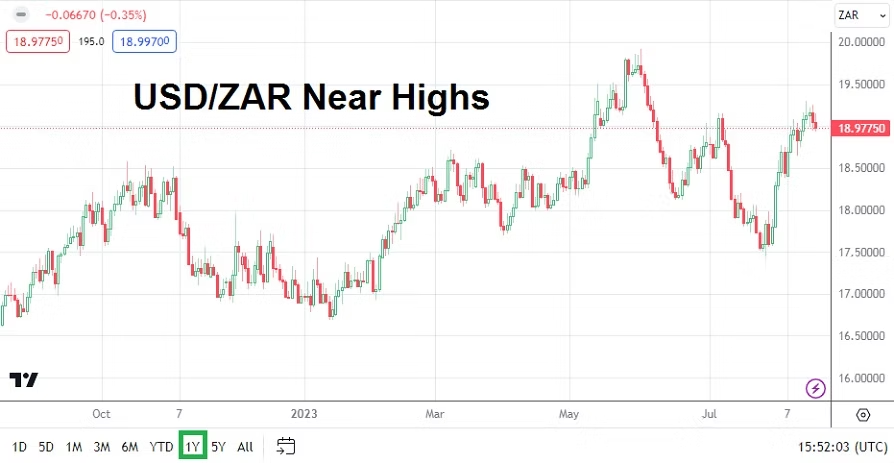
USD/ZAR One Year Chart as of 20th August 2023

The economic data this coming week should prove to be a rather mild schedule, but outside influences will certainly get publicity and get fanfare from talking heads who want 15 minutes of your attention. The BRICS Summit will get underway in Johannesburg, South Africa officially on the 22nd. Another big conference later this week will be the U.S Federal Reserve’s Jackson Hole Symposium. Both events will produce plenty of conversations about inflation, economic stability and a more cohesive global cooperation monetarily. This will also create many raised eyebrows among traders who are skeptical about these type of events.

While leaders of China, Russia, India, Brasil and South Africa get together in Johannesburg, it is likely we will hear talk about potential BRICS expansion and the pursuit of a new unified currency which doesn’t rely upon the USD. However, in the background there is likely to be plenty of distraction because of China’s faltering economic data and Russia’s Ruble which has been impacted severely in the past month. Plenty of large rugs will be needed to hide the dust which threatens to make this BRICS event rather memorable.

Add the ongoing saga of Niger and the absence of a political solution for the world’s fourth largest producer of uranium as a potential flash point standing on the side of the stage waiting to make an appearance regarding Africa news. Perhaps it is too cynical to wonder if coordinated military action within Niger will await the end of the BRICS Summit. This so China and Russia are not given an opportunity on the ‘world stage’ as a united voice to offer their opinions regarding an intervention.

The Jackson Hole get together of global central bankers from the Fed, BoE, ECB, BoJ and others will certainly grab headlines late this week, but the script is mostly known regarding the rhetoric to come from the Federal Reserve’s annual event. Forex may move based on comments from the central bank chiefs as they speak towards the end of this week, but it is unlikely anything surprising is going to be heard. U.S Treasuries will remain a topic because of the ability to lock in a solid return over the mid-term compared to betting on the outcomes of the stock market, but this scenario has been playing out the past month. Investors should prepare for a long line of speeches regarding economic outlooks from central bank officials all week. Day traders should also remember that the chatter starts to be ‘tuned out’ as the speeches grow longer.

Traders looking for other outside influences may want to look at the cryptocurrency market where major assets have shown signs of struggling. Bitcoin and Binance coin could remain in the headlines for all the wrong reasons, if their prices continue to challenge important support levels and become more vulnerable.

Monday, 21st August, China Prime Rates – economic data from the nation has caused concerns that real estate problems are spilling over into the domestic consumer market. The interest rates China lends money to consumers is expected to be lowered to try and spark spending. Recent economic reports from China have been bad, and readers who believe this is merely ‘Western’ bias being reported should be careful to look for other sources to confirm data. Investment within the second biggest economy of the world has become tentative, because there is a fear the ‘official’ China numbers may be worse than those being reported.

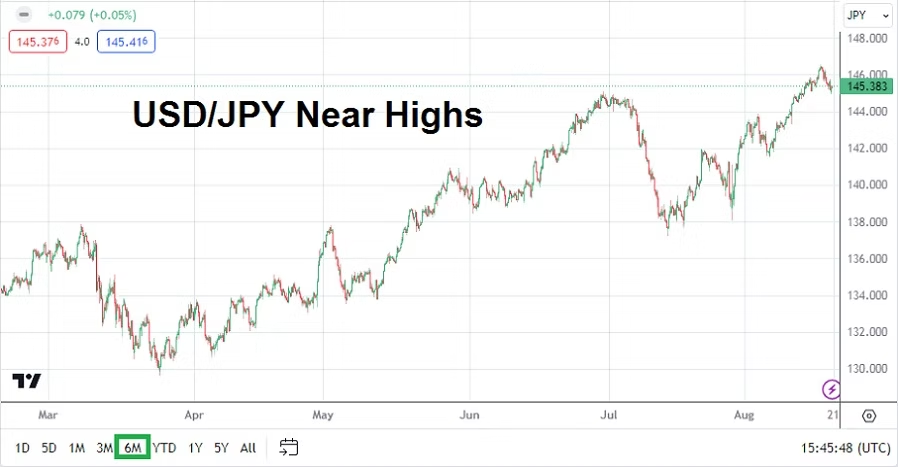
USD/JPY Six Months Chart as of 20th August 2023

Tuesday, 22nd August, Japan Consumer Price Index – the Bank of Japan report is expected to show a slight decline to the inflation numbers. Last month’s outcome of 3.0% is expected to lower and produce a 2.9% result. The USD/JPY could react momentarily to the outcome, the currency pair is near highs it hasn’t touched since November 2022.

Tuesday, 22nd August, U.S Existing Home Sales – the data is expected to show a slight decline of purchases. Mortgage prices continue to climb in the U.S and homeowners are less likely to desire taking on a new higher mortgage, this if they already have a lower mortgage locked in from a few years ago within a dwelling they already live.

Wednesday, 23rd August, Flash European Manufacturing and Services PMI – the reports will come from the E.U and U.K. The German and British outcomes will stir the Forex markets. The manufacturing data from Germany and Britain are forecast to be slightly negative.

Wednesday, 23rd of August, U.S Flash Manufacturing and Services PMI – the U.S reports are expected to show a decline in the manufacturing sector. If a negative result materializes, this could actually spark a selloff of the USD – if the financial markets have returned to calm waters by the middle of this week. Weaker numbers might be interpreted as another reason for the U.S Federal Reserve to remain neutral and why they should consider becoming dovish over the mid-term.

Thursday, 24th of August, U.S Durable Goods Orders – the core and broad numbers are anticipated to show declines. If the Durable Goods Orders numbers are worse than expected this could spark more USD selling, particularly if financial institutions are already calm and feel the data is another step to ‘lowering’ the Fed’s hawkish interest rate rhetoric. However, for the USD to weaken the markets will likely have needed to be tranquil beforehand, without major surprises having happened earlier in the week that may have escalated nervous behavioral sentiment in the broad markets.

Friday, 25th of August, Germany Business Climate and GDP – the ifo Business Climate report comes from a composite of manufacturers, wholesalers, and other enterprises and is expected to be lower than last month’s outcome. The Gross Domestic Product results are anticipated to show no changes, which would mean Germany’s economy remains in the doldrums and is flirting with recessionary pressures.

Friday, 25th of August, U.S University of Michigan Consumer Sentiment – this revised reading is expected to show U.S consumers remain steady without significant changes compared to the previous outcome.

postN11.1

Week Ahead: Inflation Followed by the U.S Federal Reserve

Week Ahead: Inflation Followed by the U.S Federal Reserve

Monday, 12th of June, U.S Federal Budget Balance – hold down the laughter and snickers please as you wonder why you should care, this as the report shows monthly income versus spending from the month before. Yes, the U.S ‘Debt Ceiling’ bill was passed recently. Very few people are going to pay attention to Budget Balance report, except economists and traders who have ‘skin in the game’ via hedge funds as an example – that make long-term bets, and U.S politicians who want to hoot and holler…….while nothing really gets done to limit wasteful spending in Washington D.C.

Tuesday, 13th of June, U.S Consumer Price Index reports – yes, this inflation data will be important per the monthly numbers showing what consumers are spending. A slight uptick is expected with an outcome of plus 0.2% via the broad statistics – last month’s number showed a gain of 0.4%. The outcome of the broad and core CPI statistics will give the Federal Reserve a sounding board for what will take place on Wednesday via the Federal Funds Rate announcement. Stronger than expected inflation numbers could cause a rupture and nervousness. A weaker result would calm Forex and perhaps make the USD slightly weaker.

EUR/USD One Month Chart as of 11th June 2023

Wednesday, 14th of June, U.S Producer Price Index – these numbers will be released early in the day and will be followed by the Federal Reserve five and half hours later. The inflation outcome via the PPI if stronger than anticipated would cause some caution before the Federal Reserve takes the stage.

Wednesday, 14th of June, U.S Federal Funds Rate, FOMC Statement and FOMC Press Conference – while many analysts seem convinced the Fed will not hike the interest rate this week, there are obviously no guarantees. The FOMC Statement will indicate the U.S central bank’s outlook. Traders who are intent on trading before the official interest rate announcement and statement are playing with fire. Speculators should keep in mind that other central banks have surprised folks with increases recently including Canada and Australia. A hike from the U.S Federal Reserve would surprise a lot of people and financial institutions, but stranger things have happened.

Thursday, 15th of June, New Zealand Gross Domestic Product – the growth numbers which will come out a handful of hours after the U.S Fed leaves the stage will be intriguing and provide NZD/USD traders more impetus into what will likely already be a volatile trading session taking place.

Thursday, 15th of June, China Industrial Production and Retail Sales – these two reports from the economic giant will be watched closely. China’s economy is struggling a bit, and weakness in the housing sector via values are starting to cause a reaction in domestic spending. Industrial Production numbers will give some insights regarding global demand. Economic problems in Europe and North America are certainly not helping matters in China because demand for goods are restrained and hurting the manufacturing sector.

Thursday, 15th of June, U.S Retail Sales – consumers in the U.S have been expected to start producing negative numbers via these statistics, will they begin to do it? A stronger number would be of interest to some, but after Wednesdays’ FOMC Statement and news that will be generated, it is questionable who will give full attention to this report and what affect it could have.

Thursday, 15th of June, E.U ECB Press Conference – this question and answer session could prove to be interesting depending on what the U.S Fed does the day before. Certainly the European Central Bank will give their opinions on monetary policy and economic circumstances in the European Union and abroad. The EUR/USD could be affected.

USD/JPY One Month Chart as of 11th June 2023

Friday, 16th of June, Japan BoJ Policy Rate and Monetary Policy Statement – no major changes are expected from the Bank of Japan. This is the one central bank unwilling to change its attitude regarding monetary policy because of the whims of others. Perhaps if the U.S Federal Reserve surprised everyone on Wednesday with a hike, this could change the quiet rhetoric from the BoJ – but even that is doubtful. USD/JPY traders should pay attention to the BoJ Press Conference just in case.

post26.1

BRICS and a Potential New Currency Paradigm

BRICS and a Potential New Currency Paradigm

The BRICS nations are causing alarm in some ‘Western’ financial circles as they seek to strengthen their trading alliance reflecting their ability to be large producers and consumers. BRICS has a common goal of creating better trade and financial conditions for each other, and as a potential byproduct to possibly create an alternative to USD dominance.

While political crisis and global security concerns have grown the past few years and are causing uncertainty and instability, the strength of the USD has also caused inflationary problems for many nations including BRICS members. Cash reserve shortages of USD have become problematic and have been fueled measurably by decisions from the U.S government, Federal Reserve system and U.S Treasury. This has ignited many emerging market nations to seek dialogue about potential BRICS membership.

Alliance intrigue and concerns also shadow BRICS members often, the February 2023 naval exercise held between Russia, China and South Africa within waters near Cape Town raised anger in the United States and the European Union. The fact that the joint military exercise was held during the first anniversary of the Russian invasion of Ukraine did not go unnoticed. While no signed military alliance exists between these nations, it should be noted that Russia, China and South Africa also held a naval exercise in November 2019 also within proximity to Cape Town, South Africa.

USD/ZAR 1 Year Chart as of 28th April 2023

Formation and Agenda as Members Scoff at the ‘King Dollar.

The agenda of the BRICS nations often appears a desire to topple the dominance of the USD to those watching from outside, but is it realistic? Trading alliances are important certainly in order to create better economic stability. The BRICS potential effect on the USD is concerning, although not critically dangerous at this juncture the bloc needs to be monitored. In addition there are worries from some in the West that new military alliances could be formed, but historical and cultural differences within BRICS makes this rather questionable for the time being when contemplated in total.

BRIC was an acronym coined by then Goldman Sachs Chief Economist Jim O’Neill to identify potential opportunities for investors within emerging market nations. Members in this ‘bloc’ are countries that have begun to work in unison. About two months ago, Jim O’Neill reiterated the same refrain and alluded to the BRICS theme of suppressing USD strength and its reliance in global trade. BRIC (Brazil, Russia, India and China) was formed in 2009, and they added South Africa as a member in 2010 formally initiating BRICS. This coalition has met annually to discuss coordinated policies regarding trade, finance and investment opportunities. The next annual meeting will be held in August 2023 in South Africa. Vladimir Putin’s potential attendance at this year’s meeting is being monitored widely.
Plenty of discussions have already been articulated internationally about undermining USD dominance in global trade, but little effect has come to fruit in reality and the USD retains its moniker of ‘King Dollar’. However, countries being affected by the rise of inflation and the strength of the USD are becoming numerous and this has caused a diverse group of nations to seek conversations with BRICS leadership about being able to join the trading alliance. Iran, Algeria, Argentina, Mexico, Nigeria, Saudi Arabia, Indonesia, Pakistan, Egypt, Sudan, Syria, the United Arab Emirates, Bahrain, Turkey, Venezuela, Sri Lanka and Zimbabwe are some of the nations that have expressed interest in BRICS membership.

Impact of Sanctions on Russia and its Ability to Counter via BRICS

Russia has been waging a war with Ukraine for over a year and is currently under many Western sanctions. It’s been kicked out of the SWIFT banking system, which means it has limited opportunity to trade the RUB with Western countries. This in theory also limits the amount of USD that Russia can get its hands on.

Russia last year asked to be paid in Rubles (RUB) for gas and other energy purchases when dealing with E.U countries, trying to play a game of chess which largely failed. This while China too, tries to make the Yuan (CNY), a more significant currency in order to suppress USD dominance. China certainly has plenty of political and economic reasons to have the CNY emerge as a global power.

Russia has supposedly wanted to get out of Western currencies and especially the USD, this to punish the West, but will it work out and is it pragmatic? No. Russia’s attempts are high on rhetoric, but low on quantified changes thus far. The USD is far too dominant within the global banking system, and while incremental challenges to the USD have been tested, chipping away at USD strength remains difficult at best. The Kremlin has tried to inoculate itself from the pain caused to its trade balance because of sanctions, and create problems respectively for countries that oppose its invasion of Ukraine by cutting off gas supplies which were used for heating and to generate power for industrial purposes. Threatening to not allow grain to flow from Ukraine has also been a rather constant noise made by Russia.

Prices were capped on Russian energy via the G7 beginning in 2022 as a retaliatory move to limit revenues for Russia, and alternative gas agreements were sought by many European nations creating a loss of momentum for the Kremlin’s chess game. The Nord Stream pipeline was also damaged via sabotage. Russia used to supply Europe with 50% of its energy until sometime in 2021, it now provides less than 20% after Western sanctions. Russia has moved its eye towards other nations hungry for energy, ones that are not obligated to make transactions in USD, which brings BRICS into focus.


USD/RUB 1 Year Chart as of 28th April 2023

Inflation and a Strong USD have Caused Harm Globally

Inflation has caused problems across the globe following the impact of the coronavirus epidemic. The Federal Reserve, BoE and ECB have raised rates to try and cool inflation in their respective economies. This has made the USD attractive against emerging market currencies and caused capital outflows. An economic nightmare has occurred in Sri Lanka which is suffering from staggering political and economic problems the past two years, and nations like Pakistan and Egypt have been hit hard too by inflation’s impact and debt. USD reserves dwindled in these nations and they found it difficult to service their USD denominated debt in 2022, and troubles persist in 2023. Import without any USD reserves is difficult and sometimes impossible.

Russia and China as Major Players in ‘Their’ Bipolar World with ‘Friends’

Global trade is still dominated by the “King Dollar”. Almost 88% of global trade happens with the USD. The USD accounted for more than 71% of currency reserves at central banks in 2000, but has now declined to slightly below 59%. Oil and gas exports are important for Russia as these revenues constitute nearly 45% of its Federal Budget and it’s already been in deficit since February 2023, because oil revenues have slumped by half. Russia has a growing dependence on BRICS and is actively trying to get other nations to join the trading coalition, this because it has few other places to turn, and there appears to be no end in sight regarding the war with Ukraine.

Trading with other nations and signing currency agreements which would not include USD transactions is a long term goal of Russia and China, this if monetary values via the other nations currencies can remain firm. And then there is a wished for and ‘feared’ long-term dream of creating an alternative ‘super’ currency to compete against the USD.

Even before the escalation of fighting in the Russia and Ukrainian War, Russia was strongly advocating an end to USD dominance in global trade via rhetoric, particularly during previous BRICS Summits. We need to understand the political implications and complexities within BRICS, when talk of a decoupling from USD dominance news flares up. The U.S certainly keeps an eye on BRICS and so do other Western nations. At this moment South Africa has a delegation in Washington, D.C regarding the questionable South African policy behavior, particularly in light of recent military exercises with Russia and China, to try and smooth its U.S relationship. South Africa membership in AGOA, the Africa Growth and Opportunity Act, which grants special trade benefits to the nation and other members is being questioned strongly by U.S politicians. Getting kicked out of AGOA would cost South Africa billions of dollars in aid.

China and Russia seemingly want to create a bipolar power sphere, one in which U.S dominance is not so easy. Chinese President Xi Jinping and Vladimir Putin have met several times recently and are certainly collaborating regarding trade and investments. The developing news regarding the potential of BRICS enlargement shows that China and Russia maybe preaching multi-polarities such as their involvement with South Africa, but may actually be working towards a bipolar constellation of forces in which they would lead a broad alliance of countries in countering the preponderance of Western economies and potentially military might.

USD/CNY 1 Year Chart as of 28th April 2023


By allowing membership of BRICS to expand, U.S influence and the dominance of the USD would be lessened incrementally. A long game seems to be in play and if that is the case, the game of chess being played by Russia and China together against the West is complex and the U.S and its allies will need to be ready with a response if they want to protect the USD.

From the China point of view, the internationalization of the CNY is a positive. It has recently brokered a peace deal between Saudi Arabia and Iran, long-term arch rivals which surprised many in the West and seemingly caught the U.S unaware. China has also lent close to 1 trillion in USD value to Ghana, Pakistan, Nigeria and other smaller African countries. China is wielding power via trade and investment leverage into these respective nations strategically, pushing its global trade agenda even as Washington quietly threatens to punish China for backing Russia in the war with Ukraine.

Changing Role of China on the World Stage and BRICS

China’s role today is very different than in 2009 when BRIC was founded, this as the nation has become more secure regarding its stature globally. In the initial stages of BRICS there were talks about challenging USD dominance in global trade by member countries, but China vehemently avoided discussing this proposition openly to avoid conflict. The game has changed significantly regarding rhetoric, this as U.S – China relations have worsened as global trade, military security and corporate surveillance issues become more troubling. Political tensions with Taiwan as China rattles swords is a drama that nations are also watching attentively.

For China, the developing alliance with Russia has been a complex and sometimes slowly evolving plan historically, but one that has grown amidst tensions with Washington since the Trump presidency. The Russia and Ukraine war has accelerated the desire to break U.S led global dominance, and that means trying to break the USD internationally when it is possible. It is a long game and BRICS is part of this equation.

China and Russia view themselves at the vanguard in the struggle against Western global predominance, and they are eager to bring others on board. At the last summit of BRICS in June 2022, both Chinese President Xi Jinping and Russian President Vladimir Putin argued in favor of expanding into BRICS Plus. Beijing has become particularly interested with developing BRICS as a counterweight to the G7. While it has been difficult to establish a consensus on expansion among the current BRICS members, it appears to be a certainty that expansion is coming and the summit in South Africa this August will provide insights.

China is promoting the CNY in exchange for getting oil from Russia. The CNY is now ranked fifth regarding global transactions according to many banking sources. From the Kremlin’s point of view accumulating CNY reserves is good for Putin in the short-term; this creates more buying power for goods from countries that are friendly to Russia and China collectively and creates strategic momentum.

Yes, there are long-term historical complexities between Russia and China which will likely prove difficult politically to solve, but for the moment money is helping grease their wheels of diplomacy. Differences of opinion between Russia and China cannot be ruled out in these kinds of power games. Putin is an astute politician and liable to act in a surprising manner, this while trying to help Russia and its place among nations. Russia is certainly not keen on becoming a puppet state of China.

Trust is Almost a Four Letter Word for Some Economically and Politically

In his acclaimed book ‘Trust: The Social Virtues and the Creation of Prosperity’, the political economist Francis Fukuyama illustrates how degrees of trust in a society and indeed in a company can be decisive for prosperity and the ability to compete. In “low-trust” societies such as China, Russia and Italy, you cannot assume that everyone is willing to follow the rules. Members of these societies must frequently renegotiate ‘asserted’ rules, and often have to go to court to decide on matters. Ironically, one can see that this also applies to trading of the CNY.

USD/INR 1 Year Chart as of 28th of April 2023

For instance, while China promotes the use of the CNY, countries like India are still using UAE Dirham (AED) for buying oil from Russia. BRICS still needs to sort out which currency they will use extensively for trade, this while many members try not to make enemies of other nations. South Africa exports are significantly more to the E.U, U.S and the U.K compared to Russia. Its share of exports to Russia are minuscule compared to the other three. Not only is South Africa risking free trade agreements with the U.S, E.U and U.K, but membership in key groups like AGOA as it tries to play on both sides of the fence politically is in jeopardy. Western observers are certainly watching South Africa and they will watch any other nation that joins BRICS. How long will the ANC led government of South Africa will be allowed to flirt with Russia and China militarily before it is stopped?

India has a Large Role in BRICS and is Growing in Stature

India is a vital member of BRICS, but also an important member of the QUAD alliance, the Quadrilateral Security Dialogue. Japan, Australia, the U.S and India are members and confer over trade and security. India is the largest democracy in Asia – and the world – and a Western advocate in South East Asia, even as China plays a dominant role in geopolitics. While BRICS wishes may be good for conducting bilateral trade among members, it is not necessarily good for global trade and political understandings. Complications from long-term political and historical disagreements between India and China cannot be discounted either.

Is the Indian Rupee (INR) or CNY more relevant for international trade? Use of the INR and the CNY needs coordination with other countries many times. Australia is a good example regarding the ability to trade INR internationally. If Australia and India agree to make their payments for exports and imports in their respective nation’s currencies, trade can be conducted rather well, but then Australia would have to find another nation for its ‘extra’ INR, because it would likely suffer due to trade imbalances. It would be important for another country outside of India to agree to take INR from Australia for other trades. Potentially some Gulf countries could be open to these types of INR transactions. A bigger group of BRICS nations would help India certainly.

Saudi Arabia has recently agreed to sell oil for CNY, but shoring up CNY in their coffers has long-term implications. This as Saudi Arabia wrangles politically with the U.S occasionally. Saudi Arabia has demonstrated a desire to take on a seemingly more neutral tone and perhaps wants to limit its exposure to the strength of the USD, particularly if the U.S tries to make a weapon of the USD via political policy. Thus, India as the most populated nation in the world and a growing economic sphere of importance, has to make careful considerations moving forward as it positions its economic stature for complexities that will develop. India and Saudi Arabia may have visions of becoming great ‘neutral’ economic powers moving into the next one hundred years.

The Indian Government has made economic deals with Egypt, Sri Lanka and Malaysia for bilateral INR trade, but still no pure INR trades of significance have materialized according to official banking data. There are multiple headwinds for BRICS nations to overcome USD dominance in international finance. Whenever exchanges of INR or CNY to other currencies for trade settlement are needed, they need to first change the base currency to USD to buy RUB or AED. Few exporting countries will accumulate CNY without a total need. Holders of these currencies would likely dump the INR and CNY for USD via Forex.

China Economic Transparency is Lacking and the Future of India in BRICS

China doesn’t make it easy for foreigners to own assets in their nation. The China government does not want massive trade deficits and free capital flows are restricted with force. Who would invest in China and risk having their money being stuck in the nation without guarantees? China continues to ramp up its oversight and aggressive tactics of supervision of foreign owned companies that have operations in the nation.

Now and into the foreseeable future, the Chinese government will control transactions of CNY with an iron fist. The United States will likely remain the predominant place for trade because of its huge economy, and as a nation that allows many other countries and foreign citizens to own and invest their assets within it boundaries. There is still something to be said for transparency. Any new nation or coalition trying to challenge U.S government debt instruments are likely to fail. The U.S continues to be a place where nations can hold ‘safe assets’ with a guaranteed return of interest for the long-term. No country equals the asset size and security of U.S Treasury Bonds. On that basis alone, there will be a no challenge to the USD in the near future.

Liquidity remains an issue for capital flows and convertibility within BRICS. A lot of hard work via transparent trade agreements will have to be signed to get these issues resolved. Plenty of questions exist regarding China’s economic data and its reliability because of a lack of oversight from ‘recognized’ outside agencies which are often forbidden.

India is still having border issues with China and these problems remain unresolved. India’s role of leadership in G20 is hard to ignore despite its alliance with BRICS. The Indian government has advised traders not to speculate in CNY. This shows that strained relationships between China and India remain and a lack of trust regarding clarity continues. In the U.S, New Delhi is considered an important partner, one that can be trusted regarding the growing rivalry between the U.S and China. Prime Minister Narendra Modi, said last year, “this is not an era for wars”, and this shows India wants stability and wants to play a global role in diplomacy.

There is a definite strategy for BRICS to grow with the nations of the Middle East and others. Using their currencies for mutual trade arrangements could eventually work out, but it will take a long time for this to change the dynamics of USD dependence and dominance.

However, we shouldn’t forget that almost 40% of the world’s population lives in Asia. Yet, even if oil producing nations will trade in a BRICS backed currency basket, which has been dreamed about for a long time, China’s leader Xi didn’t highlight this goal while in Moscow or in Saudi Arabia during recent summits. China is certainly playing a long game, but it also shows they remain cautious and vulnerable to the strength of the USD globally. If Xi wanted to cause the greatest pain to the United States, he would liberalize his financial sector and make the CNY a true competitor to the USD with complete economic transparency, but that would take him in the direction of free markets and levels of openness that are likely the opposite of China’s domestic ambitions. A strong due diligence of the Chinese economy, is something Chinese leadership likely wants to avoid for the foreseeable future.

BRICS: A Multi-Polar World and Avoiding Confrontation

Many developing countries will want to avoid a confrontation consisting of China and Russia on one side, and Western powers on the other side. India has overtaken China regarding population numbers, and will likely become the world’s third largest economy before the end of this decade. India will become a strong voice in favor of a multi-polar world. Arguably, ideas of a more multi-polar world are being worked towards in pragmatic ways, but the BRICS coalition will not develop their own asset backed common currency unless they can resolve issues regarding trade and monetary agreements with transparency. It is a matter of trust.

post10

Central Bank Capitulation led by Federal Reserve

Central Bank Capitulation led by Federal Reserve

The 21st and 22nd of September were potentially important signals for traders as the Federal Reserve admitted they remain reactive to inflationary pressures, and other global central banks countered with acts of their own.

While it is difficult and often foolish to believe the markets can be timed, this past Wednesday may have been an important moment for speculators in Forex. Many traders may have veered off into cryptocurrencies or into equities as day traders the past few years, but FX still remains a place that offers volatility and where wagers on price direction can be made.

The Federal Reserve raised their interest rate 0.75% again, and importantly issued a loud admission that the U.S central bank is caught in a reactionary mode. Other global central banks have begun to protect their own currencies too. Jerome Powell, the U.S Federal Reserve Chairman, said he believes the current interest rate is likely at the low end of the spectrum regarding where it has to be to have an affect on current inflationary pressures.

The USD has been strong against many major currencies with a rather unforgiving bullish trend. Raising the Federal Funds rate from 0.25% to 3.25% the past year in the U.S has made short term purchases of U.S debt attractive to many financial institutions. On Wednesday, Jerome Powell made it clear other hikes will be delivered and it is not farfetched to believe the U.S is looking at a potential rate of 4.50% and higher in the spring of 2023. This doesn’t mean the Fed’s policy is correct, it is simply an outlook for the potential Federal Funds Rate based on rhetoric.

  • A Federal Funds Rate in the U.S of 4.00% is likely by early this winter, per the Federal Reserve’s interest rate outlook.

  • Global central banks have reacted to the U.S Fed’s recent interest rate hike, by enacting methods to try and safeguard the value of their own domestic currencies.

The USD surged ahead slightly before the rate announcement from the Fed, while many other currencies lost value. However, on Thursday the Bank of Japan intervened by starting to buy Japanese Yen against the USD. The Bank of Japan said it will not raise interest rates yet, but its action showed it clearly does not want the JPY to lose additional value to the USD, via the USD/JPY Forex pair. Whether the BoJ’s actions work mid-term remain to be seen.

Global Central Banks feel they must counter the U.S Federal Reserve’s Actions

Other central banks started to act too. The Bank of England and Swiss central bank both raised interest rates yesterday. Speculators who have been watching the USD dominate Forex the past year, may now have to consider that the last two day’s of action via global central banks is a signal an attitude change has taken place, which may begin to affect Forex long term. Traders need to understand opportunity also means there are risks.

Inflation remains high and governments have reached a point where they have had to admit they will have to risk slowing their economies and potentially suffer recessionary pressures to curb price increases. Many central banks likely feel they have to match the hike increases by the U.S Federal Reserve within their own systems to protect the value of their currencies.

BoJ Intervention on the 22nd of September

End of the Dominant USD Bullish Cycle in Forex?

While Japan for the moment refuses to raise borrowing rates, the BoJ’s buying of JPY effectively signals the USD has become too strong and is starting to hurt the Japanese economy. The the Bank of Japan will be interesting to study long term, to quantify if Japan’s lack of raising rates proves to actually be correct in the current environment.

Philosophical differences and central bank maneuvering is complex and has a long history of debate. Having said that the Bank of Japan has been largely scorned by many other central banks the past three decades for its methods, but while Japan has never recaptured the growth numbers it attained in the 1970’s and 1980’s, the nation remains one of the world’s richest.

The action of the BoJ and other global central banks means that speculators may want begin to look at Forex and tinker with the notion that the bullish trend of a dominant USD may start coming to an end. The cycle has been strong and again, it is difficult to say today is the day. Timing the market is often proven wrong, but the messaging from global central banks that they will start to shadow and react to the U.S Federal Reserve’s actions may mean that they will try to curtail the decreasing values of their own domestic currencies with more robust methods.

Day Traders need to understand a Complex Puzzle is Ahead

Forex markets can produce dramatic changes of value abruptly and cause costly losses to traders who bet wildly. The use of too much leverage and a lack of efficient risk management frequently destroys value quickly. However, now may be the time to contemplate testing Forex with the notion the USD may start to incrementally loss value. A lot has to happen. There are plenty of risk events ahead which could lead to wildly unforeseen results. In other words there are no guarantees.

Global equities led by the U.S indices appear very fragile and if the major stocks loss more value, this could also cause a stronger USD. Why? Because the USD would have to be purchased to buy U.S stocks by foreign investors who want a safe heaven. While it may seem contradictory to think U.S equities would be bought in downturns, this is what has historically happened when global financial institutions seek safe havens and believe other places are too dangerous to invest.

Remember financial institutions are not supposed to be day traders, they are supposed to be long term investment vehicles. Meaning if global equities suffer, even if U.S indices suffer too, the U.S is likely to remain the choice of investment houses as the place to seek shelter if they have to purchase equities as part of their mandates.

Yes, Forex will always be a complex puzzle for short term traders seeking to take advantage of the daily gyrations in the global markets. If a speculator insists on participating with wagers in the market place, they must consider that financial storms are always brewing because trading is seldom easy.