postN72

U.S National Security: USD Reserve Currency Importance

U.S National Security: USD Reserve Currency Importance

Opinion: The following article is commentary and its views are solely those of the author. This article was first published the 23rd of December via The Angry Demagogue.

We would like to start going through the U.S administration’s National Security Strategy released last month. There is a lot in there – much of it the same as in past administrations and much of it different. The tone of course is full Trump and while the introductory parts try to make it into a revolutionary document it does in fact build upon much of what has been American foreign policy for decades. One thing it most certainly gets right is that American foreign policy since the end of the Cold War has not found its compass. From a unitary world to one dependent upon global organizations, from a sharing of goals with western Europe to a pivot to Asia, from the war on terror and the middle east to Russia-Ukraine, the United States has struggled to find its way in the post-Cold War world.
We however will concentrate today on one aspect of the strategy, the third bullet in part III – “What Are America’s Available Means to Get What We Want?”. The third bullet point speaks of America having “The world’s leading financial system and capital markets, including the Dollar’s global reserve currency status” – a point that no one with any knowledge of global capital markets can not accept. The end of the bullet point – the Dollar’s global reserve currency status – is the most important because it underscores America’s leadership and essentially allows the United States of America to finance its military and its welfare state. The U.S Dollar as the “reserve currency” means that nearly all the world’s goods are quoted and therefore sold in Dollars.

Why is that important to the United States? Because the U.S government depends on its ability to issue Treasury bonds and bills at will – something no other government can do. It can do this because for another country to buy oil or copper or titanium or corn or soybeans from a country that is not their own– they need access to Dollars. Saudi Arabia and the other gulf states quote the price of oil in U.S Dollars and demand payment in U.S Dollars. The Saudis can deposit those Dollars in American banks or in what is called Eurodollar deposits in foreign banks (there are some 13 trillion Dollars in Eurodollar accounts globally). The Eurodollar accounts are essentially promises by the bank to give U.S Dollars to the holder when he makes a withdrawal. This strengthens the U.S capital markets and allows investors to have better and more investment choices. It is not only America’s often superior companies that bring profits to 401k’s and pension funds but the liquidity and vastness of America’s capital markets that can list domestic and foreign corporations. The reserve currency leading to the advanced capital markets allows the world – and America – to do this.

The U.S Treasury market is so liquid because every country needs Dollars in order to trade. They need to have enough dollar reserves since no one actually wants their own currency. In Israel, for example, local gas companies cannot buy oil with Israeli Shekels, since what will Azerbaijan, for example, do with them? There are only so many products that Israel can sell them. They need Dollars so that they are free to buy other commodities or other products.

The U.S Dollar as a reserve currency also is a break on inflation since the price of oil and other commodities is always in U.S Dollars. A weak or strong U.S Dollar influences the inflation rate in non-USD countries. A weak Israeli Shekel, South African Rand or Chinese Yuan does not influence the price of gasoline in the United States.

In short – as the Trump Administration understands well, the dollar as a reserve currency is a luxury the U.S cannot give up. The lack of the USD as a reserve currency could cause the Dollar to collapse and along with it the price of U.S Treasuries. As UST prices drop, their yields will rise and the cost of financing the U.S government will make interest payments on debt to rise well beyond its already absurd figure of over 4% of GDP – while debt itself is 120% of GDP. The U.S government currently pays over $1 trillion in debt service (interest payments on its bonds and bills). By contrast, the U.S defense budget for 2024 was $836 billion (about 3.3% of GDP).

We need to ask ourselves what can challenge the USD as the reserve currency and what could happen that would encourage the world to change? While the E.U had dreams of making the Euro an alternative reserve currency, the lack of growth in the E.U’s economy and population have put that dream to rest. The only other country that could theoretically replace the United States as the global economic go to country could be China. While in the long run, China’s lack of openness would probably mean that the Yuan would not last long as the reserve currency, that does not mean that they couldn’t jolt the global economy just enough to force it to use the Yuan to buy oil and other commodities.

China is already cornering the market on rare earth minerals and it making inroads in Africa where it mines all sorts of commodities from gold to copper to platinum and so many others (Africa has about 30% of global mineral reserves). That in itself is not enough to rock the global markets and cause a change in how the world does business.

Oil though, is that one thing that could allow China to challenge the USD as the reserve currency, even if it just presents the Yuan as an alternative.

How could that happen?

A Chinese takeover of Taiwan, by whatever means it uses would give the Chinese Communist Party control not only of the South China Sea but also allow its noisier and inferior (to America’s) submarine fleet to enter the Pacific and patrol it freely. The Chinese Navy, with a base on the “other” side of Taiwan would give it control of the north-south sea lanes that Japan and South Korea are dependent upon. Essentially, Chinese control of Taiwan would put Japan, South Korea, Vietnam and the Philippines at the mercy of the Chinese Navy. China could blockade these countries but that would be an act of war and then involve the navies of those countries and possibly the United States. It would affect the global economy negatively but it would not cause a change in world’s reserve currency. But, what if China works out a deal with Saudi Arabia to quote and sell their oil in Yuan (or the Chinese Petro-Yuan it wants to create) and then tells these countries, especially industrial powerhouses and energy poor Japan and South Korea that it will allow the passage of oil as long as they purchase the oil in Yuan?

Russia is already trying to get India to pay it for its oil in Yuan, to some success. Adding economies the size of Japan and South Korea would mean that any country that wants to buy oil could buy it in Yuan instead of Dollars. Once in Yuan, these countries would need to use the Yuan to buy Chinese products, deposit cash there and buy Chinese treasury bills. If China were to combine that with demands that all chips made in Taiwan also be sold in Yuan, the U.S Dollar would suddenly and forcefully no longer be the only reserve currency in the world.

Obviously, the way to stop this from happening is by stating outright that the United States will not tolerate a Chinese takeover of Taiwan. It is true, that the Strategy claims that the US “will also maintain our longstanding declaratory policy on Taiwan, meaning that the United States does not support any unilateral change to the status quo in the Taiwan Strait” but in practice the administration has criticized Japan’s tough talk on China instead of leaving it be. A strong silence on Prime Minister Takaichi’s remarks on China would have served the purpose of keeping the status quo more than telling her to tone down her rhetoric. There is a strong “no intervention ever” strain in the country and the President must make the case that that is not an option if the United States wants to maintain its leadership position, way of life and general prosperity.

In short, the threat to the Dollar as the reserve currency heads right through Taiwan. For those who think that the investment the U.S makes in keeping the Dollar where it is, is too expensive, just think of going on vacation and having the change to Yuan before you leave the country, wondering how much to change because of currency fluctuation and how much fun it is to return with hundreds of dollars in banknotes that you can’t use. Imagine your credit card bill on such travels and wondering how you went 15% over budget but didn’t get anything extra for it. Now imagine the national economy working that way.

Disclaimer: the views expressed in this opinion article are solely those of the author, and not necessarily the opinions reflected by angrymetatraders.com or its associated parties.

You can follow Ira Slomowitz via The Angry Demagogue on Substack https://iraslomowitz.substack.com/ 

post202

Speculative Notions: Gold and the USD as the Casino Lives

Speculative Notions: Gold and the USD as the Casino Lives

Notes on speculation via the prism of Gold and the USD, with questions about value as short-term wagers versus long-term investment are considered.

Speculative forces eventually run out of power, leaving investors and businesses to conduct their affairs via the assets they are using to proceed with enterprise as they judge fair market price.

Assets like Gold (commodities) the USD (Forex) and equities (corporate shares) are a battleground for those who are trying to make short term profits from price action movement (sometimes – volatility) versus those who are holders of the assets in order to run their lives (corporations, private businesses, finance).

Perhaps the speculative forces are not a Las Vegas environment completely, but it is a strange mix of risk management and gambling. And because of the price changes in these assets as supply and demand are transacted – the realization that the potential of hedging against sudden gyrations in price is used as insurance, but also as a dangerous speculative tool needs to be considered.

Futures, options and cash markets combine and are mixed like a stew consisting of trillions of USD value as global enterprise and financial casinos flourish.

Let’s take a look at Gold as an example. There is only so much physical Gold on the planet earth – a finite amount. There is only so much that can be taken out of the ground in a year. There is only so much Gold an individual can safely store in their home, before they have to use other secure venues. Central banks may have backed away from the ‘gold standard’ but they understand the importance of the precious metal as proven and tested by thousand of years of commerce. Gold can be used as the exchange of value for a good and this will likely remain the case for long time.

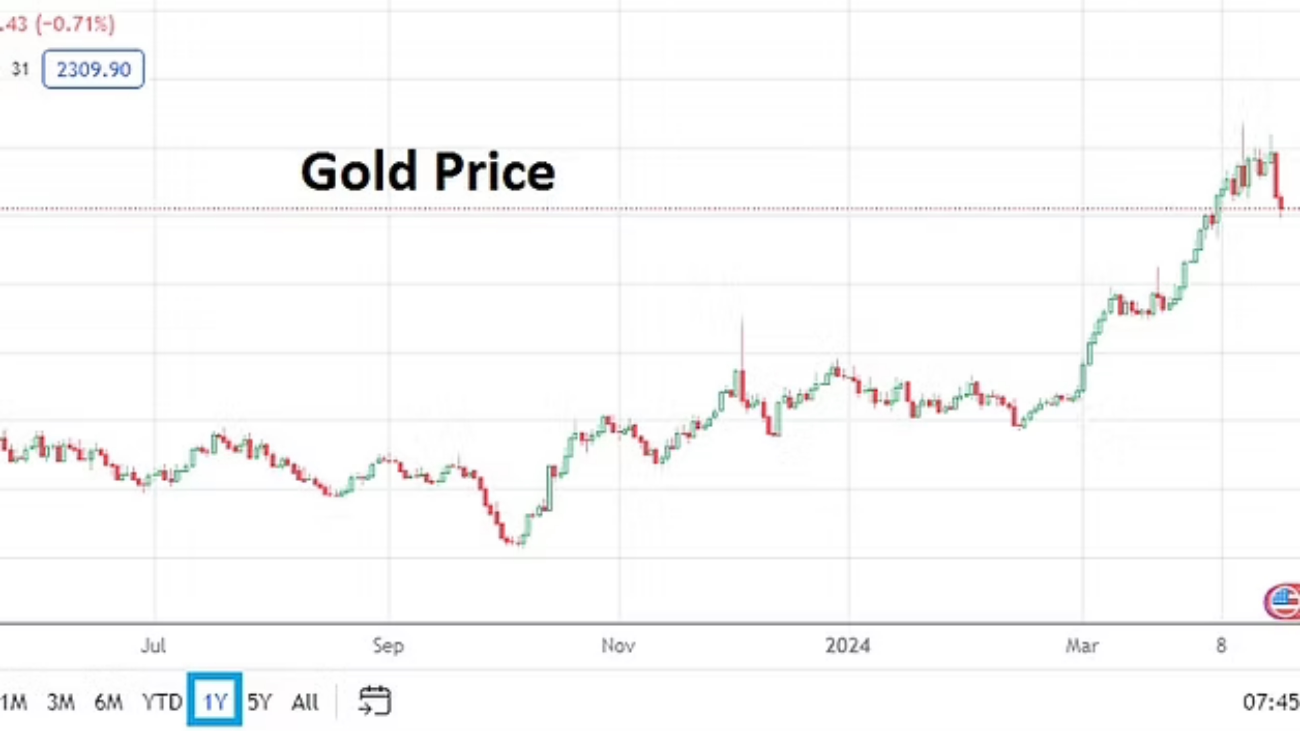
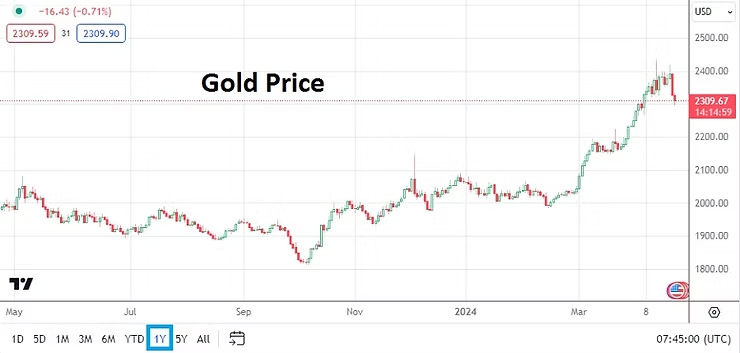
Gold One Year Chart as of 23rd April 2024

The price of Gold serves as a hedge against inflation. The value of Gold today roughly buys you the same things it bought you a thousand years ago, when compared to monetary units which fluctuate like the wind. Because cash in many cases throughout history becomes weakened, losing its value because of bad government policy which causes the people holding the ‘paper’ to lose confidence; and then creates the desire for the precious metal which has almost entered our conscious DNA as a source of value which doesn’t change.

We can speculate on what the Gold price will be today, tomorrow, next year, but we know the fluctuations will roughly equate into what our consciousness – logic – tells us what the main reserve currency that rules the land will be worth – in this case the USD.

For the time being, the USD acts as the reserve currency of the world and is weighed against the value of Gold – literally – remember Gold is valued per ounce in USD.

The ability of Gold to climb to record highs recently was put into question, because at the same time the USD was getting strong. This signaled to traders that a known speculative force in Gold was at play; yes, it could be said a speculative force was at play in the USD too, because of Forex and the Federal Reserve, but Gold rose the past month and a half dramatically while the USD also was gaining value.

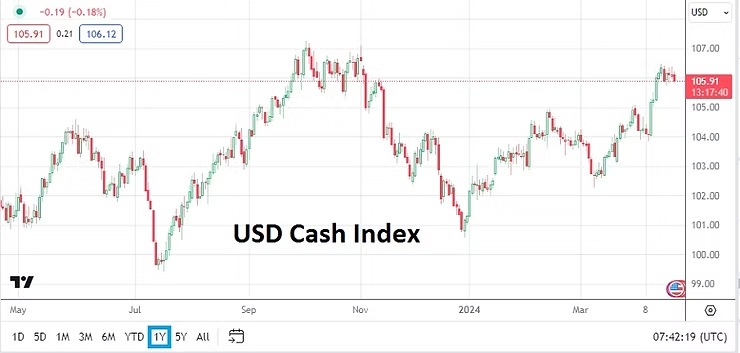
USD Cash Index One Year Chart as of 23rd April 2024

Thus, suddenly the inverse correlation of Gold and the USD which are literally weighed against one another was suddenly off balance. The USD was gaining and gold was rising, and one of them was likely ‘full of hot air’ – an imbalance.

Meaning Gold had become inflated in value perhaps, because of speculative forces. While folks could point to geopolitics, and central banks such as China and Russia and maybe Iran wanting Gold because they are ‘angry’ at the U.S and want to signal they do not believe in the USD. There is only so much money these speculative forces have, and they hold the USD as a store of value too, which means if they bet too much on Gold they can find their positions – weight – imbalanced.

The USD remains the world’s reserve currency, and the value of the greenback particularly as the Fed has come under pressure, via the weight of inflation, and had to admit they cannot cut interest rates until inflation erodes has made the reserve currency stronger again. The use of the USD is easier than using Gold. There is not enough Gold in the world to transact business to business, person to person physical exchange everyday. Thus Gold becomes a ‘store of value’ via inventories not only in secure facilities but our minds too.

The past couple of days have seen Gold perhaps lose value again as the counterweights have come back into focus. It was bound to happen as long as the USD remains the world’s reserve currency in which value can be distinguished versus the commodity.

Speculative forces do run out of power, and now after Gold flirted with the 2,400.00 plus level recently, maybe Gold should return to its values which were seen in late 2023, which is where the USD Cash Index is essentially standing technically. Lets also remember where U.S Treasury yields were during this time, long-term bonds are a measure of interest rates and outlook via the Federal Reserve – used as an insurance and investment vehicle by those looking to lock in ‘returns’. Yes, Treasuries can be speculated on too, but their values coincide with USD legitimacy and the Federal Funds Rate.

It is a thought, a speculative notion, let’s see what happens. What should the speculative price of Gold be now compared to the USD? Should it be lower, closer to the 2200.00 to 2100.00 USD levels? The casino will give us the answers.

postN51

AMT Top Ten Miscellaneous Shots for Friday the 3rd of Nov.

AMT Top Ten Miscellaneous Shots for Friday the 3rd of Nov.

10. NBA: Welcome to Victor Wembanyama’s world. VW’s 5th game as a Spur was historic last night.

9. South Africa: The Springboks Rugby World Cup victory is helping unifying the nation and giving all its citizens a hope for better days.

8. Book: The Gulag Archipelago by Aleksandr I. Solzhenitsyn.

7. Crypto: Sam Bankman-Fried found guilty on all counts. Yet, Bitcoin is near 34,600.00 USD per coin.

6. Risks: Signs of appetite as U.S equity indices have moved higher, and U.S Treasury yields have declined.

5. Gold: The precious metal still lingering near 2000.00 USD and may attract bearish speculative positions.

4. Middle East: Global financial institutions appear to have dealt with the noise.

3. U.S Jobs Reports: Non-Farm Employment Change numbers and Average Hourly Earnings inflation data will be published today and shake markets.

2. Federal Reserve: The U.S central bank may have reached the end of it interest rates hikes cycle.

1. USD: The world’s reserve currency remains suspiciously strong and if it is a relatively calm today and this weekend, day traders may begin to embrace selling wagers.

postN19

Broader Alliances: Sustaining Economic and Political Power

Broader Alliances: Sustaining Economic and Political Power

The following article is commentary and its views are solely those of the author.

If the United States decides to abandon its role as the premier global superpower and shall only be a Pacific and Atlantic power, withdrawing as defender of free seas, free trade and freedom in general, its democratic allies will have to start looking elsewhere for broader military alliances. This large group of nations would have to defend their interests against a revanchist China tied to Iran, Russia, North Korea and many of the Latin American countries – possibly including Brazil, and South Africa who have questionable politics and outlooks.

Eastern Mediterranean Alliance: A Strong Sea Power

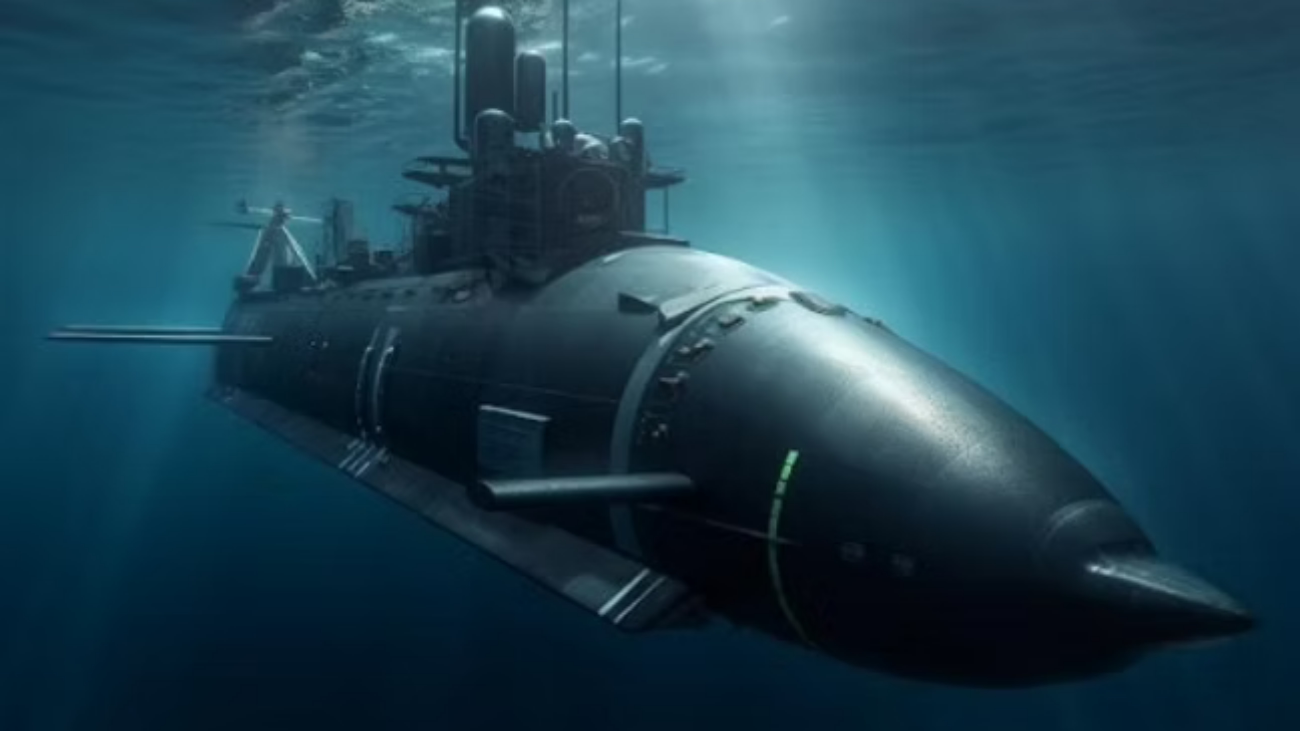
Here is a speculative, yet reasonable look at the future of the free world. Let’s start with the Eastern Mediterranean where the two major powers are Israel and Turkey. One cannot deny that both these countries outclass all others regarding military might in the region. Israel’s air force is second to none and its navy is becoming a strategic necessity as it needs to defend its natural gas fields miles offshore. It now has six submarines that are capable of projecting power anywhere in the Mediterranean and even into the Indian Ocean and Persian Gulf. Turkey is currently a NATO member, but it is not clear that this will outlast the first half of the 21st century.

There is currently an informal alliance among Israel, Greece and Cyprus (both NATO countries) via joint military exercises and intelligence sharing. The Israeli navy and air force train regularly with Greece and its special forces train in the Cyprian mountains with its army. It would be in all three countries interests to formalize a treaty – if not of mutual defense, at least of mutual aid during times of war. All three of these countries are democracies and all three have mutual economic interests.

A formalization of this alliance makes sense now and if there is a NATO collapse it turns into a necessity for Greece and Cyprus. Adding Egypt (although it would be the only non-democracy) to this group would only strengthen the alliance and keep Turkey at bay. A post-Erdogan Turkey that is comfortable with its Islamic character and its modern society could even join this grouping with Israel as a potential peacemaker between the historic Greek-Turkish rivalry.

This alliance without Turkey is a powerful force in the eastern Mediterranean, and this alliance with Turkey could neutralize a nuclear Iran. A Post-Hezbollah Lebanon which is in the interests of all of these alliance members (including Turkey and Egypt), could become a reality and another member.

A New Alignment: The United Border Nations

What about Eastern and Central Europe? Poland is rapidly becoming the major non-nuclear European military power. Within the next few years it will outshine Germany and the U.K and rival France. It is quite clear, nuclear weapons aside, Poland would probably defeat Russia in a number of weeks, if not days if a conflict were to ignite.

Whether the Russian-Ukrainian war ends in a Russian defeat or in some sort of face saving armistice, Russia will not lose its aggressive nature or nuclear capabilities and it will inevitably become aligned more closely with China and Iran because of its current political nature.

The important new alignment will be categorization of ‘countries bordering Russia’. A new alliance of Poland, Finland, Sweden, Norway and the Baltic states – Lithuania, Estonia and Latvia together would have the land, sea and air power necessary to deter and defeat, if necessary, any Russian imperialist expansion. Even with closer ties to China it would be difficult to imagine that, over the next 50 years, Russia would be a threat to this alliance. Adding Ukraine to this grouping would make a powerful force. Its joint population of over 100 million people, while not quite Russia’s 150 million – would be a formidable adversary, especially as the technological skills of these countries is first world and continuing to improve. Adding the other former Warsaw Pact countries like Czech, Slovakia, Romania, Moldova and Bulgaria can only increase its potency.

Unlike the Eastern Mediterranean alliance mentioned above, this would have to be based on a mutual defense treaty in order to properly deter any Russian-Chinese-Iranian attack. Linking up, informally with the ‘new’ Eastern Mediterranean Alliance would create a powerful grouping of free countries against any attempt by authoritarian adversaries. Adding an economic aspect to these border nations and an alliance with the Eastern Med group with free trade zones would create a strong challenge to any attempted Chinese hegemony.

Asian Border Nations Group: Potential Look Ahead at Potential

If we were to unite the Eastern Mediterranean and Border Alliances to an admittedly non-democratic Asian ‘stans nations, including Kazakhstan, Kyrgyzstan, Tajikistan, Turkmenistan and Uzbekistan with a joint population of around 80 million, we are beginning to see the creation of a multi-cultural alliance that extends from the Arctic Ocean through Central Europe, Northern Africa and into Asia.

The Crucial Partner in Order to Balance Power: India

Which leads us to the Indian Ocean; a dominant India can help control the sea lanes from the Persian Gulf to the Bay of Bengal and down to Australia. An Indian-Australian alliance, along with Israel would create a democratic economic and military force that would keep China and Iran from dominating the region. This would require an Indian navy that is not only large, but effective also because it would hold a main responsibility for patrolling the seas from the Persian Gulf up to Australia strongholds.

As India also reaches its potential as a global manufacturing giant, it will be a force to be reckoned with. Including into this potent mix of nations, is the possibility of adding authoritarian countries like Saudi Arabia and the other Gulf states; along with Thailand, Myanmar, Malaysia and Indonesia who have strong ‘western’ economic interests and would create a formidable bulwark against China’s imperialist Belt and Road project.

Without the need to project naval power worldwide the Unites States could use it massive naval, air and ground forces to take better control of the Pacific Ocean along with Japan, South Korea and Australia.

If we add countries like the Philippines and Vietnam, then China would be deterred from further aggression. The only other region that would fall under American responsibility would be the Atlantic Ocean – the shipping lanes to Europe, West Africa and the Mediterranean. Along with the UK and France there would be no challenger to the control of the Atlantic. This could also lead to a revival of the old Monroe Doctrine and maybe free South America from the destructive influences of Iran, China and Russia.

The Global Economy and Free Trade Zones with a Stable USD as Reserve Currency

What does all this mean for the global economy? The free world along with its less than free allies who fear China, Russia and Iran could still maintain a U.S dollar based world. Free trade zones amongst and between the various alliances along with a revival of manufacturing led by a technology revolution using AI, quantum computing, renewable energy and space exploration could lead to a global resurgence of free countries that could stop the authoritarian appetites of Russia, China and Iran in its tracks. This can only happen with a stable reserve currency the ‘West’ can rely upon which is the USD.

Potentially a U.S freed from being the sole defender of freedom in the world, would help get America’s fiscal house in order and allow it to focus on being a dominant economic power. Is there a future for the ‘free world’ without a United States that projects power globally? Currently, a U.S withdrawal from global military assertion would certainly cause the end of freedom (economic and political) in the world for many nations. However, with the new alliances described above and a fiscally responsible United States, freedom could yet make a comeback.

Disclaimer: the views expressed in this article are solely those of the author, and not necessarily the opinions reflected by angrymetatraders.com or its associated parties.