post309

India Insider: Nifty Defense Index Surges in 2025 Rearmament

India Insider: Nifty Defense Index Surges in 2025 Rearmament

2025 has marked a defining moment for defense equities, both globally and in India. The Nifty India Defence (Defense) Index, which tracks the country’s leading defense manufacturers, has surged sharply on the back of robust order flows, a structural policy shift, and increasingly volatile geopolitical conditions. This rise is not an isolated event but part of a broader global rearmament cycle that is reshaping the defense industrial landscape.

Nifty India Defence (Defense) Index One Year Chart as of 20th November 2025

India’s defense sector has been one of the standout performers in the domestic equity market. By mid-2025, the Nifty Defense Index had risen more than 25% year to date, outperforming most sectoral indices. This rally is primarily anchored in strong capital expenditure by the Government of India, which continues to accelerate indigenous military modernization. The Defense Ministry’s approvals which is running into tens of thousands of crores have expanded visibility for companies such as HAL, Bharat Electronics, Bharat Dynamics, and shipbuilding PSUs (Public Sector Undertakings). For investors, the nature of long durations within defense order books has provided earnings stability at a time when other manufacturing sectors have been grappling with cyclical softness.

The second driver has been a multi-year strategic shift toward import substitution. India’s reliance on foreign weapons systems has long strained its current accounts and created operational vulnerabilities. However, the ongoing indigenization push, reinforced by Production Linked Incentive schemes, procurement embargoes on foreign systems, and export incentives, has fundamentally realigned the sector. Defense exports have crossed record levels, and Indian firms are increasingly integrated into global supply chains for electronics, avionics, and ammunition.

Global Industrial Defense Rebirth

But the domestic story is tightly interconnected with developments abroad. The global defense market is undergoing its most significant expansion since the post 9/11 decade. Russia’s war in Ukraine, the Red Sea shipping crisis, conflict in the Middle East, and a renewed great power rivalry in the Indo-Pacific have pushed countries to reassess defense readiness. NATO’s decision in 2025 to raise defense spending targets from 2% of GDP to 5% by 2035 has far reaching implications. This commitment translates into trillions of dollars in additional defense outlays over the coming decade, making Europe one of the fastest-growing defense markets.

Companies such as Rheinmetall, BAE Systems, Lockheed Martin, and Northrop Grumman are already reporting record order inflows. Rheinmetall, Germany’s largest defense company, expects its revenues to quintuple by 2030, reflecting unprecedented demand for advanced artillery, ammunition, and combat vehicles. The United States, meanwhile, continues to channel significant funding into hypersonic, missile defense, and drone systems as competition with China intensifies.

India’s Edge in Rearmaments and Technology

This global rearmament wave has a direct spillover effect on India. International supply chain shortages particularly for semiconductors, propulsion systems, and munitions have created opportunities for Indian firms to plug capability gaps. With a cheaper cost base and growing technological sophistication, Indian defense manufacturers are emerging as viable exporters in segments such as UAVs, naval platforms, and electronic warfare systems.

In this environment, the rally in the Nifty Defense Index is not merely speculative exuberance, but a significant reflection of structural and synchronized global demand. As defense has evolved from a low beta sector to a strategic growth industry, India’s integration into the global defense economy positions its companies for sustained earnings expansion over the next decade.

307

India Insider: The Need for Quality Jobs and Improved Safety

India Insider: The Need for Quality Jobs and Improved Safety

Recent data released from the Ministry of Labor Statistics depicts a worrying aspect of India’s labor market. Every second urban young woman in Bihar and Rajasthan is unemployed. Nationally, one in four young women remains without work. This reflects deep structural issues in India’s workforce and the job market’s inability to provide high-quality employment.

Industries in urban India are not generating enough decent jobs to absorb educated youth, especially women. Even when jobs exist, they are often of poor quality, lacking social safety standards and sometimes damaging workers’ health and well being.

Via the National Statistics Office of India Unemployment Data

A recent piece in The Diplomat, a magazine covering the Asia-Pacific region with current affairs, highlighted how workers trade off their health and welfare well-being for the opportunity of precarious living. If an economist like Robert Gordon, who wrote “The Rise and Fall of American Growth“, were to look at their lives, it would remind him of the 19th-century United States.

Migrant workers from Bihar and Uttar Pradesh toil in textile recycling plants under hazardous conditions for just ₹5,000 ($58.00) a month. Women form a significant share of this workforce, often assigned trivial tasks in unsafe factories. Many have developed asthma and tuberculosis after prolonged exposure to dust and poor ventilation.

The Rise of the Informal Sector

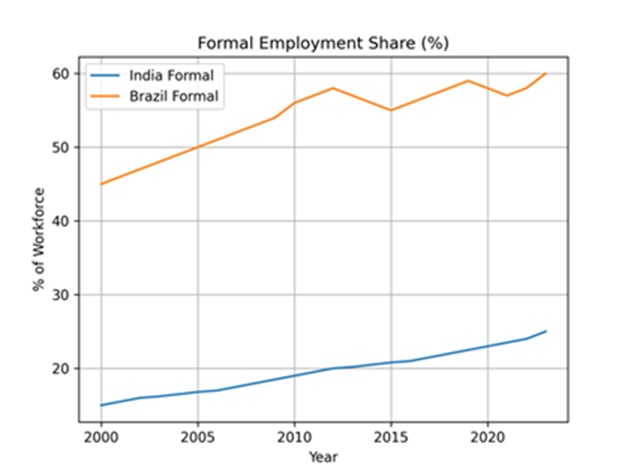
Formal workers generate an annual GVA (Gross Value Added) of ₹12 lakh, while informal workers produce just ₹1.4 lakh, according to the Annual Survey of Industries (ASI) and the Annual Survey of Unincorporated Sector Enterprises (ASUSE) 2022–23.

Neoclassical economics says wages reflect a worker’s productivity. But this logic collapses in economies like India’s, where a vast army like reserve of labor, keeps wages low – even when productivity rises.

Excess labor supply depresses pay across sectors, from private school teachers to gig workers. Many gig workers spend long hours to earn a modest income, without access to provident funds, health insurance, or paid leave. This precarity extends from India to the United States and Indonesia.

Statistics via Kuntala Karkun & Samriddhi Prakash, Pahle India Foundation

The Gap Between Law and Reality

India has strong labor codes, streamlined in 2020, yet they remain largely unenforced. Companies often ignore them due to cost pressures, effective lobbying, or weak state monitoring.

Economic growth without wage growth widens inequality and breeds social tension. For growth to be inclusive, wages must rise with GDP.

This demands more than redistribution. It requires the transformation of raising workers’ productivity, ensuring labor rights, and giving every worker their fair share of India’s prosperity.

Post306

India Insider: Reserve Bank of India Intervention is Limited

India Insider: Reserve Bank of India Intervention is Limited

After weeks of steady appreciation due to Reserve Bank of India intervention on the 15th of October, the Indian Rupee has now returned to the same 88.72 levels against the USD before the policy action was enacted. The RBI’s recent offensive against speculators may have calmed the market temporarily, but it reflects a reactionary and short-term approach to deeper structural pressures facing India’s external administrative policies regarding the USD/INR.

USD/INR Three Month Chart as of 5th November 2025

Despite the Reserve Bank of India’s efforts to influence the cash forward market, where Dollar shorts rose by 6 billion USD in September to $59 billion, fundamentals suggest that Rupee weakness is not purely speculative. It is a rational market adjustment due to rising trade barriers amid U.S tariffs on India’s merchandise exports. The added uncertainty regarding trade caused the Rupee to naturally absorb external shocks. Merchandise exports to the U.S fell 12% in September year on year, according to official India data, prompting some calls for government relief.

India’s Foreign Remittances & H1-B Visa Fee Hike

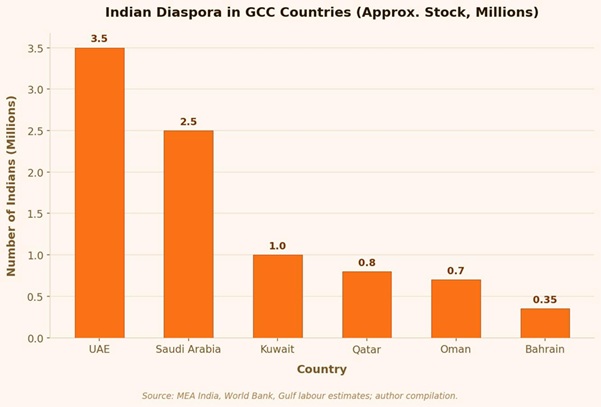
According to World Bank data, India received about 137.7 billion USD in personal remittances from abroad in 2024. From that amount, around $40 billion is coming from the United States. The Trump administration raised the cost of H1-B visa fees from below 10,000 USD to nearly $100,000. And there is now also an increased likelihood of measures aimed at limiting digitally delivered software services to the U.S from India. These combined measures would substantially reduce Dollar receipts via exports of technology driven software and IT services, as well as remittances from a reduction of workers on temporary U.S visas providing on site services to U.S clients. USD inflow has been crucial for India’s balance of payment’s stability.

Reduction of USD reserves when the trade deficit is already rising because of hikes caused by tariffs on India’s exports would widen the current account deficit. Concerns about a decrease in remittances leading to a potentially significant decline of India’s USD reserve ability is possibly discouraging the India Reserve Bank to voluntarily expend reserves to support the Rupee.

Service Exports Cushion India’s Balance of Payments:

India’s total service exports touched 400 Billion USD over the past year with a predominant amount coming from the U.S. In other words, India has had a $202 billion in services trade surplus over the last 12 months, which covered almost 114% of India’s merchandise trade deficit in 2024-25.

India’s goods trade deficit is matched by a services surplus, plus net foreign personal remittances. This USD equation is under threat because of prolonged paralysis from stubborn US and India trade negotiations debating Russian Oil usage and the U.S demand to allow agricultural products into India.

Foreign Investors Selling Indian Equities

In addition, the Indian Rupee is not getting support from investment portfolio inflows. A shortfall of AI related avenues in the nation’s tech sector, and perhaps because of valuations considered too rich, foreign Investors have pulled 17 billion USD so far this year. This sum is more than any other emerging market, which is eating away at the Reserve Bank of India’s FX reserves too.

Global and India-specific uncertainties spurred by the Trump administration’s actions are setting off a retreat of footloose portfolio capital invested into India’s equity and bond markets. If the Reserve Bank of India was confident that inflows of foreign capital would replenish reserves it would likely help the Indian Rupee, and thus investor confidence coming from abroad.

Policy Irony and the Limits of Intervention

The U.S. remains India’s largest export market, but new levies of 50% tariffs are hurting labor-intensive sectors such as textiles, leather, footwear, and gems & jewelry.

While concerns about imported inflation are valid, the benefits of a weaker Rupee should not be overlooked. A mild depreciation could boost India’s service exports, improve the balance of payments, and partly offset the effects of U.S. tariffs on merchandise exports.

A material improvement in U.S and India trade relations is needed. Until a restoration is achieved in relations and a merchandise surplus is possible, alongside healthy services and remittance inflows occurring again, the Rupee’s weakness is likely to persist. In the meantime, Reserve Bank of India interventions could prove to be a short term tactic that proves vulnerable mid-term to the influence of market forces known and unexpected.

post305

India Insider: Affluence Among the Few, Aspirations for Many

India Insider: Affluence Among the Few, Aspirations for Many

A recent report by Franklin Templeton highlighted that India’s per capita income will penetrate the $5,000.00 USD level by 2031, pushing the country into what some analysts consider an affluence trigger zone. Their article celebrates the consumer boom showing the rising sales of premium detergents, growing green tea consumption, and a surge in discretionary spending, as if prosperity has finally crossed over into a mainstream phenomena.

But a closer look reveals something else and a worthwhile critique of Franklin Templeton’s optimistic portrayal.

Who Actually Spends this Money ?

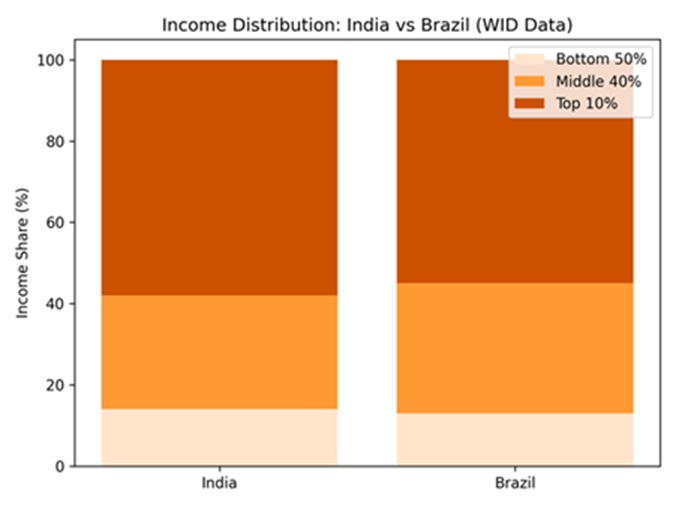
The Franklin Templeton report confidently attributes the wealth effect to rising equities, real estate and gold. Yet, with only 13 crore (130 million) demat accounts in a country of 143 crore people, how can equities be driving broad affluence? Even within those attributed accounts, activity is heavily concentrated in the top decile of income earners like urban professionals in finance, IT and export linked sectors; and over 70% of mutual fund assets under management come from the top ten cities.

The so called upper middle class that fuels premium consumption largely works in these sectors. For the rest of India – especially the 42% still dependent on agriculture – wages have barely kept pace with inflation. Several national surveys and analyses show real wage stagnation since 2015-2016. Data from the Labor Bureau and the National Sample Survey (NSSO) indicates that real wages for rural laborers had near zero growth between 2015-2016 and 2022-2023. In contrast, the period before 2015-16 showed much faster wage growth.

NSSO Survey data compiled by Idea India Magazine

The Concentration of Savings and Spending Power

The report itself concedes that the top 20% of households hold around 85% of India’s total savings. That’s roughly 26 crore people (260 million) driving most of the premium consumption, while the remaining 104 crore (1.04 billion) share only 15% of savings – a stark reminder that aggregate growth often hides skewed realities. And this is why rural households and lower-income urban families, meanwhile, are facing tighter budgets and are actually cutting back on discretionary spending.

Gold as a Survival Cushion

The report romanticizes gold as a symbol of wealth, but in rural India, the precious metal plays a very different role. Gold is not an indicator of luxury and status, but a financial safety net. In villages around Tiruvannamalai City of Tamil Nadu State. Where I have surveyed about 50 families, average holdings are often below 40 grams. When harvests fail or cash flows tighten, this gold is pledged or sold to fund essentials like health expenses, education or seeds for the next planting season.

Yes, some towns in India have higher gold holdings and savings, sharply due to offshore remittances especially in States like Kerala and Gujarat. This remittance led prosperity fuels local real estate and pushes up rents, but it’s a localized story, not a national one. Most rural communities still depend on seasonal income and informal borrowing.

The Uneven Reality Behind Growth

Premium brands are growing faster, but this signals income polarization, not inclusive growth. The per capita income maybe rising, but it’s an average skewed by the top 10-20% who hold multiple assets. For most, consumption is fueled by rising debt. Until wage growth broadens and rural incomes strengthen, India’s  consumption boom will remain the affluence of a few – not the prosperity of the many.

post303

India and the U.S Govt Shutdown: Quick Market Thoughts

India and the U.S Govt Shutdown: Quick Market Thoughts

President Trump has been ramping up his claims that India is no longer going to buy Russian oil, he made a statement regarding this belief yesterday once again. As the White House threatened to initiate tougher sanctions against India, there seems to have been some movement towards a reconciliation between the two powerful nations.

The Trump administration is clearly trying to limit the amount of purchases of Russian oil by India to increase economic pressures on Russia, and reportedly India may be starting to actually buy less oil. India has certainly not stopped buying Russian oil in a maximum ‘fait accompli’, but if the nation continues to show a willingness to purchase less energy resources from Russia, this will go a long way in preserving a good U.S and India association. A stronger relationship between the U.S and India can achieve a vital economic and military correlation for the both nations. Improved friendlier tones from New Delhi and Washington D.C appear to have reassured investors in the Indian equity markets via highs currently being seen on Nifty 50, which are now within sight of apex values from late September last year.

Nifty 50 One Year Chart as of 23rd October 2025

India is a vital and important part of U.S policy as it attempts to also create pressure on China too. By maintaining political and business dealings with India, the U.S can and should look upon this joint relationship as a vast long-term strategic interest. India understands this as well. The ability of India and the U.S to remain ‘friendly’ allies, and the prospect of creating a vigorous economic and military partnership should be one of the U.S government’s essential missions.

India does have strong connections to Russia the past handful of decades politically and economically via its non-aligned status. India will certainly maintain its dialogue and sometimes cooperative dealings with Russia. However, if India and the U.S maintain a solid relationship with the prospect of increasing their economic and political ties this could substantially change dynamics on the Asian continent.

U.S Government Shutdown Since the 1st of October

The U.S government has now been shutdown for over three weeks as Republicans and Democrats remain stubborn about compromise. Both sides have made the shutdown a political game. While each party claims they are doing what is best for the nation and preach to their collective voting bases, the stalemate could start to have uglier effects regarding wages not paid for many U.S employees on the 1st of November.

Dow Jones 30 One Year Chart as of 23rd October 2025

A lack of government salaries not being dispersed will cause an economic hit via consumer spending and create at a minimum some temporary damage for GDP numbers. Remarkably, and to be clear about this potential impact, Wall Street hasn’t seemed to care yet, but this could start to change. As the U.S economy rumbles powerfully forward without a major downturn in the major equity indices, politicians appear to be comfortable acting like spoiled children on both sides of the aisles engaged in accusing the other side of misdeeds.

Likely to start changing attitudes among Republicans and Democrats in the next two weeks are the coming Federal Reserve’s FOMC Statement during the end of October, and voting results via key political races in the first week of November.

Wall Street wants clarity regarding interest rate outlooks for November, December and early next year. Investors might not get a clear picture from the Fed next week, taking into consideration the Federal Reserve will not have up to date official U.S economic data because of the government shutdown. Meaning the Fed will likely issue a 25 basis point rate cut on the 29th of October and say it is uncertain about the coming few months because it does not have enough inflation, employment and GDP information to form a concrete opinion. The joke of coarse being the Fed seldom seems to have a strong opinion, but now can use the government shutdown as an excuse.

And now for contemplation, let’s look at the election in NYC for Mayor. A bona fide socialist may get elected in New York City who carries the historically misguided and dangerous wisdom of a Marxist. The economic and social practices of Marxism have proven utter failures for over one hundred years consistently. If NYC suffers a victory from the socialist candidate running as a Democrat, Wall Street and many financial institutions based in the city will not react favorably.

In the meantime, U.S equity indices remain elevated, cautious and within sight of record highs. The Nasdaq, Dow Jones and S&P along with other financial assets are producing choppy dangerous conditions for day traders who are attempting to wager on daily changes and suffering from the cautious behavioral sentiment being generated. Investors who look towards the mid and long-term are likely more comfortable, but are certainly keeping an eye on what is going to transpire over the next two weeks. Gold and Silver have come off their speculative highs. Forex continues to create volatile conditions as financial institutions appear unready to make bold predictions about what the Federal Reserve will do into January 2026.
post302

India Insider: Pharma and Earning Trust Thru Accountability

India Insider: Pharma and Earning Trust Thru Accountability

The pharmaceutical industry in India is a global powerhouse, often touted as “best in class.” Nearly 32% of India’s pharma exports go to the United States, and India’s products are renowned for their quality and affordability. Giants like Sun Pharma, Cipla, Dr. Reddy’s and Mankind Pharma cater to millions worldwide. Mankind Pharma, in particular, is celebrated for selling affordable essential medicines, ensuring access for lower-income communities.

The Opposite Side: A Fatal Flaw

Yet, within India, the same country with world class technology and research, exists a grim paradox: sub-standard drugs that have caused devastating human loss.

This is not a new problem. In 2022, toxic cough syrups made by two Indian companies were linked to the deaths of 70 children in The Gambia and 19 in Uzbekistan. According to the World Health Organization (WHO), the products contained excess levels of diethylene glycol (DEG).

A Killer Drug: New Tragedy 2025

The contamination has now hit home with horrifying consequences quite recently. As Frontline magazine detailed, in the Madhya Pradesh State, Rajesh Yaduvansi’s two-year-old daughter, Jayesha, was admitted to a local clinic on September 14th for pain and fever. After temporary relief, her condition worsened. By September 25th, doctors revealed her kidneys had stopped functioning. She was rushed to Nagpur, but tragically died on October 7th from acute kidney failure.

Jayesha was one of at least 24 children who has died since early September across Madhya Pradesh, mostly from Chhindwara and nearby tribal districts. Three more patients remain in critical condition. Most victims came from poor and tribal families. They are the victims of a lethal lapse in quality control.

The culprit was the toxic industrial solvent, diethylene glycol (DEG), which causes kidney failure when ingested. The contaminated cough syrup, Coldrif, was manufactured by Tamil Nadu State based Sresan Pharmaceutical.

Following the cough syrup deaths, authorities formed an SIT (Special Investigation Team) and raided the manufacturer, Sresan Pharmaceutical, near Chennai. The company’s owner, Ranganathan Govindan, has been arrested, and several Madhya Pradesh drug officials have been suspended or transferred.

The Solvent Issue: Cutting Corners

Cough syrups typically use propylene glycol as a solvent. This ingredient exists in two grades: industrial and pharmaceutical. The industrial version, which is cheaper, can contain dangerously high levels of DEG.

When manufacturers prioritize cost cutting and fail to ensure pharmaceutical grade purity, tragedy follows. This is a profit driven decision that ignores human life and can produce fatalities.

Regulatory Failures and Neglect

India aims to reach developed nation status economy by 2047, but this ambition will ring hollow if it neglects its own people.

The drug control system is fractured. The Central Drugs Standard Control Organization (CDSCO) issues drug licenses, while State authorities are responsible for essential quality checks. In Madhya Pradesh, accountability rests with the Drug Controller and Food and Drug Administration.

The system is fundamentally broken. According to K.R. Ashokan, a former President of the Indian Medical Association (IMA), fewer than 1% of drugs are tested for quality or impurities. Indian citizens face massive risks which are often unreported. While a pharmacovigilance system exists, its national reach is minimal and desperately inadequate for a country of 1.4 billion people.

The Central Government health care expenditure remains under 2% of its GDP and this is far too little for a nation aspiring for global leadership in pharmaceutical research.

A Call for Accountability

This catastrophe has shaken parents’ trust in the medical system, especially among the most vulnerable communities. India has the potential to be a world-class player, but without strong, centralized regulation and comprehensive preventive care, such incidents will continue.

We cannot bring back the 24 children who died due to cough syrup poisoning. This tragedy must serve as a necessary wake-up call, because no parent should ever lose a child to medicines that are meant to heal again.

post300

Gold: Not a Love Note but Recognition of Long-Term Importance

Gold: Not a Love Note but Recognition of Long-Term Importance

The U.S is now starting its second week of the government shutdown. Gold is near $4,190.00 as of this writing, which may be looked on as sign by some that some investors have bought into the precious metal because of a lack of faith in certain things. ‘Certain things’ being written in a way that points out the rather complex mix of perceptions that could quantify into all moving parts causing the bull run.

Gold Six Month Chart as of 15th October 2025

If you are a regular reader you will probably have figured out that I do not believe Gold is traversing higher because of a mere government shutdown. The precious metal has seen an upwards trend develop in earnest since the middle of October 2022 when it was trading around $1,640.00. Behavioral sentiment is important within Gold, and this has been the case for almost 6,000 years according to archeologists and historians.

In August 2011 Gold was near $1,900.00. In December of 2015 the precious metal was back to almost $1,000.00. This is written to show that in a little more than a four year period Gold lost nearly half its value in the relatively recent past.

This doesn’t mean I am writing to warn Gold is going to lose half its value suddenly and will be testing $2,000.00 in four years time. It points out that even though the precious metal is considered a hedge against inflation, that speculative elements are fantastically strong when large players buy and sell in unison and can cause periods in which Gold becomes overvalued and then experiences downturns.

Gold Five Year Chart as of 15th October 2025

We have seen this bullish show in Gold before. Milestone numbers are significant in the minds of the public, which often causes the thinking that they should have bought some gold in the past when it was cheaper. But interestingly enough for Gold is that it is almost always considered expensive by the general public. The value of fiat currency is highly correlated to the value of Gold in an unflattering way. While this is an obvious statement for many, it is important to note that we are all looking at the value of Gold while using hindsight.

Yes, I can hear influencers singing in unison in the background ‘do not forget about Bitcoin’, but I ask permission to do so. Hindsight is not always comfortable and I have been proven wrong about the digital currency frequently. However, I still remain somewhat optimistic that my bet on Gold is a better wager compared to Bitcoin regarding value in the future. And by future I mean for all-time. There is not enough foresight to know what Gold will be valued in one thousand years compared to Bitcoin. Yet, I remain much more confident about Gold being around than BTC in a millennium.

People can speak about a debasement of fiat currencies, including the USD. Like it or not the USD remains the dominant go to currency of global enterprise and this is unlikely to change over the next decade. The USD and other currencies are plagued by a constant loss of overall value due to inflation caused by a myriad of reasons. Rising prices in goods are unlikely to suddenly disappear, the costs of commerce and consumer products may start to gradually slow periodically, but the price of things seldom grows cheaper over the long-term.

Yes, the case can be made that by owning Gold it does not serve the economy well, because it is not an asset that is easily spent, but that is an argument for Adam Smith, John Maynard Keynes and Milton Friedman to enjoy in heaven. In the meantime down here on Earth, Gold can be speculated upon, bought and sold, and treated as a precious metal that will likely always be valued highly.

Gold Chart Prices since 1925

This is not a love note for Gold, it is meant as a way to say the precious metal is fairly priced considering the state of the world. $4,000.00 per an ounce of Gold could certainly turn into $5,000.00 in the not so distant future – like six months or one year depending on zeal. Speculative elements certainly aim for targets that psychologically please aspirations.

Day traders as always are faced with a dilemma. Looking for more upside and partaking in the bullish trend is a logical thought and perhaps even wager, but the use of leverage while battling the intraday and intraweek reversals in the marketplace make the ambition of profiting on Gold comparable to time spent at the casino. We know winners talk much louder about their money gained compared to the losers who vanish into the crowd and keep quiet.

So I write this as a warning, Gold may not be worth more one year from now than it is today. However, I will venture forth the notion that in ten years time Gold will be significantly valued higher than it is today. Will inflation suddenly be tamed globally, will confidence in fiat currencies emerge with a strong dose of optimism? No. Certain fiat currencies will do better than others via Forex. However, as a store of value Gold will likely remain an impressive asset to own.

post297

Significant Highs All Around as Speculation Grows Frothy

Significant Highs All Around as Speculation Grows Frothy

Gold, platinum, and the major U.S indices are all flirting with record values. Fast trading is being seen on all fronts, dangerous reversals are also being displayed and causing harm for day traders. The U.S government shutdown remains in full force. Not enough pain has been heard from the U.S public yet which would make politicians pause and actually try to negotiate a deal.

Milestone apex values have been experienced. Gold has produced the 4,000.00 USD per ounce level and sustained value, the Nasdaq 100 toppled 25,000.00 the past two days, but has moved lower for the moment. Conditions for day traders are swift and they need to be careful. And while the U.S government is shuttered, the Federal Reserve is still expected to announce their FOMC interest rate decision on the 29th of October. A Federal Funds Rate cut of 25 basis points is still anticipated.

Gold Three Month Chart as of 8th October 2025

Forex has seen jittery results as the EUR, GBP, JPY have struggled in recent trading versus the USD. And while some people may point to the stellar results and values within Gold and Bitcoin as evidence for safe haven wagers being placed, large speculators are playing a key ingredient in the broad markets too. Investors are certainly looking for value and have a belief that buying now represents a discount compared to what Gold and equity values will be over the long-term. However, day traders should also remember that a large amount of influence in the markets derives via behavioral sentiment, and as record highs are being challenged anxiousness grows regarding potential responses from speculative forces particularly when profit taking remains a part of wagering.

Nvidia Three Month Chart as of 8th October 2025

While questions and concerns are heard about a possible AI bubble being experienced and too much money being invested in equities like Nvidia, Oracle, Microsoft, etc., folks need to understand long-term investors are gearing their portfolios towards outlooks. Betting on these companies playing a significant role in technological advancements is a long-term viewpoint which works on optimism. Artificial intelligence is important, but the motor that runs AI infrastructure via semiconductors, big data distribution, servers and cybersecurity are crucial. The promise of quantum computing is also experiencing a surge of investment because of a belief in the future.

USD/JPY Three Month Chart as of 8th October 2025

And that is what day traders who are tempted to bet against the trends in the marketplace need to remember. Investors will not bet against Wall Street because of the government shutdown. In fact, they will certainly be heard joking that corporations run more effectively with less government intrusion.

This is not a simple puzzle. Complexity certainly needs to be considered regarding valuations in the EUR/USD, GBP/USD and USD/JPY. Intriguingly, day traders may want to take a look at the South African Rand too, because technically it continues to be strong against the USD, which is rather out of step and a rather interesting non-correlation. The broad Forex market has lost some its luster for day traders the past year because of a lack of perceived volatility across the board. But volatility may be on the way, the Japanese Yen certainly stands out and should be watched via the USD/JPY and JPY crosses in the coming days and weeks.

post294

India Insider: U.S Credit Crunch vs. Indian Banking Paralysis

India Insider: U.S Credit Crunch vs. Indian Banking Paralysis

When the U.S suffered a severe credit crunch in the early 1990s, the triggers were clear: the collapse of the leveraged buyout (LBO) boom, commercial real estate price corrections, and the failure of Savings and Loans (S&L) Associations, created the need for a $160 billion taxpayer bailout. Regulators, determined to act tough, declared many banks undercapitalized. The result was a nationwide squeeze from 1991 to 1993, where capital shortages – not liquidity, froze credit markets.

Reserve Bank of India Borrowing Rates 1935 to 2025

Fed Chairman Alan Greenspan slashed the Federal Funds rate to 3%, but banks couldn’t lend without capital. The unique twist was that, even as lending slowed, competition among borrowers pushed prime lending rates to 6%. This gave banks a fat 3–4% spread. Greenspan let this persist for nearly three years, enabling banks to earn profits equal to more than 10% of assets. With capital requirements at 8%, the windfall repaired balance sheets. By 1994, the U.S had exited the crisis and returned to strong growth.

India’s trajectory was very different. For decades, the country ran structurally high interest rates, which in theory should have allowed banks to recapitalize through spreads, just like the U.S. However, the reality was distorted by governance failures. Public sector banks (PSBs) , which dominate the system did not use their spreads to strengthen capital. Instead, politically connected lending to oligarchs and large industrial houses left the banks saddled with non-performing assets (NPAs).

I witnessed the aftermath up close in 2019 while working at Edelweiss Brokerage. Shadow banks were stressed, some private banks were crumbling, and PSBs were finally forced to acknowledge their bad loans. The selloff in the banking stocks were brutal that year, Catholic Syrian Bank’s IPO, one of the prominent South Indian banks went undersubscribed. To counter the slowdown, the government slashed corporate taxes from 30% to 22% to stimulate capital expenditure.

Unlike the U.S, India’s stress was on the asset side. Corporates were dragged into Insolvency and Bankruptcy Code (IBC) proceedings, where assets were monetized through painful restructurings. Piramal Finance bought DHFL at 30 cents on the dollar, and ArcelorMittal acquired Essar Steel at 90 cents. This was the hard clean up the system had avoided for years.

The NDA (National Democratic Alliance) government made the right call in restructuring the banking sector. Weak public sector banks were merged with stronger ones. Yes, it was costly. Households bore the burden via higher taxes, hidden charges, and high borrowing rates. But at least the problem was confronted.

The contrast is striking. The U.S endured a sharp three-year crunch, recapitalized its banks through spreads and market discipline, and bounced back quickly. India endured nearly a decade of paralysis, requiring taxpayer recapitalizations, corporate asset fire-sales, and systemic restructuring. The eventual stability allowed private sector banks to quietly capture market share from their weaker state-owned peers.

The lesson is simple: interest rate spreads can heal banks only if governance is strong. Without accountability, as India’s PSB saga shows, high rates merely tax households and businesses without fixing the system.

post293

Opportunity? Market Ambition as Day Trading Volatility Looms

Opportunity? Market Ambition as Day Trading Volatility Looms

The U.S government shutdown looks like it will take place at 12:01 am EST on Wednesday, this if Washington D.C politicians fail to agree to a funding gap. There have been significant shutdowns in the past, thus financial institutions though not in love with concept are adept at continuing to trade during the events. President Trump’s first term in office produced a long shutdown from the 22nd of Dec. 2018 until the 25th of January 2019. President Obama’s White House had a 16 day affair in 2013. And President Clinton’s administration dealt with a shutdown lasting 21 days.

S&P 500 Index Three Month Chart as of 30th September 2025

While the financial markets will certainly survive and long-term investors will likely remain rather sedate during this developing saga, day traders need to brace for volatility. Opportunities may develop if Forex, U.S equities and gold see reactions per perceived safe haven endeavors by some investors. However, wagering in markets when shifting tides are happening due to sentiment torrents could prove difficult for speculators. Timing the market and its gyrations caused by potential mood changes poses threats for small traders.

And that is why it will be important to actually remain patient in the coming days. The Democrats appear ready to try and score a political win against President Trump. But what would a win look like? The public is seldom fooled by the government shutdowns. While government offices shutter and economic data publication dates will be postponed, the rest of the world will move forward.

Day traders should not be tricked into panic. Nor should they react too fast based on fears that are not legitimate. The U.S major indices may languish during a government shutdown, but it is also conceivable that they may perform rather well. The Nasdaq 100, S&P 500 and Dow Jones 30 are all within sight of their highest realms. The USD may find some buying action, but just like trades that have already been digested into the market when the Federal Reserve’s FOMC decisions are anticipated and acted upon, speculators should be prepared for counter-intuitive moves. In other words do not be surprised if sudden reversals in Forex via the USD develop.

Traders looking for discounts to emerge will need to be careful, but if the equity markets were to suffer a strong downturn on heightened nervousness, having a longer-term approach to speculative positions could become worthwhile. Gold which is traversing within record values may prove to be a significant near-term barometer as a safe haven gauge in the coming days. But then again gold has been within a sincere bullish trend over the long-term, so buying if produced near-term needs to be looked at suspiciously. In other words, the bullish trend in gold while getting perhaps an additional dose of fuel to ignite higher because of the potential U.S government shutdown should also be treated carefully and not traded with blind ambition.

Gold Three Month Chart as of 30th September 2025

The potential of a U.S government shutdown is a big event, but it is intransigence that financial institutions and big investors do not want to see. As long as some aspects of communication are being shared transparently with the public regarding negotiations in Washington D.C, many markets are likely to remain rather unbothered. How long will the U.S government shutdown last this time? It might all depend on how long the Democrats believe they can get the most out of the shutdown if it adds to their political image.

Both the Democrats and Republicans will want to get through the coming days as unscathed as possible. Why? Because both want to retain their power. One question waiting to be answered during this conundrum is who will come out looking best? If the financial markets begin to suffer there will be a lot of finger pointing by both sides. And again, importantly, financial institutions are unlikely to be fooled. Investors want clarity, the markets will only suffer if big players feel the crisis in Washington can cause potentially long lasting damage.
post291

India Insider: Why is Gold Frequently Accumulated by Indians?

India Insider: Why is Gold Frequently Accumulated by Indians?

In a society like India in which I live gold hoarding is a fact of life. According to a recent report by the World Gold Council, Indian households are believed to hold around 25,000 tonnes of gold with a combined value of around $3 trillion USD.

Billionaire banker Uday Kotak applauded Indian women when he said they are ”the smartest fund managers in the world”. The precious metal has gained 42% in 2025 alone, and returned 700% in the last 20 years in Indian Rupee terms. In India consumers have a habit of monitoring daily gold prices. There is a gold festival in India called Aksayatritiyai, when gold is bought frequently in small grams but often also includes large purchases for religious sentiments. In Northern India, gold is bought during festival times like Dhanteras and believed to bring prosperity and good fortune.

It’s almost unthinkable for marriages to occur in India without gold. Many marriages have been postponed and even stopped if the requisite dowry is not given by a girl’s family. And there was a time in India when some families didn’t want to have a baby girl due to the excessive gold dowry they would be responsible for and have to give a boy’s family at the time of marriage. 

Adam Smith’s Case Against Gold:

Smith lashed out at gold for its lack of productiveness. He wrote in the The Wealth of Nations, “labour was the first price, the original purchase-money that was paid for all things. It was not by gold or by silver, but by labour, that all the wealth of the world was originally purchased; and its value, to those who possess it, and who want to exchange it for some few productions, is precisely equal to the quantity of labour which it can enable them to purchase or command.”

The act of hoarding, whether it is money or gold, depresses economic activity, as demonstrated by John Maynard Keynes in his ‘paradox of thrift’. Indeed, it was the Europeans by spending all the precious metals taken from the Americas which boosted economic activity, and ultimately sparked the rise of modern capitalism whereas Asians by hoarding ended up falling behind.

Ancient China Example:

In the past, China’s reliance on silver gave short-term stability but stunted long term growth. With no domestic silver, it depended on inflows from Spain and Japan, making its money supply hostage to global trade. Wars or disruptions cut silver inflows, draining liquidity while crippling tax collection. Unlike Europe, China clung to silver as ‘real’ money, while neglecting credit, banking and bonds. This rigid system weakened the nation’s fiscal capacity, leaving China unable to mobilize resources or industrialize effectively. In the end, silver ensured stability, but strangled flexibility and growth. Indian growth has been strangled too often because of an over-obsession towards gold.

Why Gold Prices are Moving Up?

The price of gold was relatively stable until the 2008 financial crisis and it’s been rising steadily ever since, doubling in 3 years from 2009 to 2012. After some broad consolidation, gold has been in a higher value band if you scrupulously study charts. Arguably, it is an influence due to lower interest rates that have helped gold prices move up for 15 years as inflation has been attempted to be camouflaged by Central Banks.

Accumulation of Central Bank Holding of Gold into 2024

Central Banks also accumulate gold for many reasons. One reason for this are rising bond yields that make existing fiscal obligations underperform for governments. Central Banks buy gold to diversify and hedge against risk. As the Official Monetary and Financial Institutions Forum – an independent body – noted recently, many European national bank systems endure massive losses because of quantitative easing. When the institutions try to undertake quantitative tightening, they are forced to sell at market prices, which deepen their balance sheets losses. Thus, Central Banks diversify into gold as a sacrosanct hedge against losses incurred and allows them to offset many liabilities. Gold has a long historical track record of working as a safeguard against inflation.

It’s also true that gold is often accumulated by Central Banks when hedging against geopolitical uncertainty. The Russia and Ukraine war offers intrigue regarding the nation of Kyrgyzstan, which China uses as a route for its exports to Russia, this due to Kyrgyzstan’s inherent ability to conduct trade via accessible routes. There is high plausibility that Kyrgyzstan might be converting Russian Ruble surpluses into gold.

Monetary Policy Matters for Gold:

Gold will remain vital for many years to come as a store of value and a safe haven. Buying the precious metal delivers investors and businesses a needed hedge against inflation. Protections against the lose of purchasing power within their own fiat currencies remains important for all people.

The Indian public and other societies need to remember, the value of gold within their own currencies often lies within the interest rate valuations sparked by Central Banks mechanisms which sometimes amount to magic shows and influence demand. While public buying of gold is important, it sometimes equates into mere speculation and does not always help economic activity.

post289

India Insider: Speculation, IPO Mania, and Capital Erosion

India Insider: Speculation, IPO Mania, and Capital Erosion

A speculative frenzy is reflected nowadays via India social media around quarterly results and IPOs. Animated talk about investment potential in India can be compared in some respects to the Dot-com bubble in the U.S which grew in stature into the late 1990’s and peaked in March of 2020 before imploding. Retail speculators in India rush into untested technology stocks hoping for quick profits, often without understanding the businesses. Avoiding a Dot-com like crash is important.

Hedge funds and institutions with their superior supply of capital often speculate across stocks, bonds, Forex and commodities as part of their strategies. However, retail investors should only purchase individual corporate stocks like pieces of businesses which they want to own when they have the ability. Market fluctuations lower can be used to buy quality companies when intrinsic value has been discounted allowing investors with limited funds to take advantage of stock volatility.

Charlie Munger, the right hand man of Warren Buffett, when asked what the secret of running Berkshire Hathaway Inc. was replied, “Warren likes to say, just tell us the bad news, the good news can wait. So people trust us in that (decision making process), and that helps prevent mistakes from escalating into disasters. When you’re not managing for quarterly earnings and you’re managing only for the long pull, you don’t give a damn what the next quarter’s earnings look like.” And this has proven to be advice that all investors can learn from.

Lessons from Yes Bank and Ola Electric:

Many speculative investors rely on technical charts using support and resistance patterns for trading decisions. This frequent buying and selling enriches brokers but rarely investors. Technical trading entices because it often is easier to look at a chart and feel that by glancing at past results you are able to predict the future, but this frequently proves to be incorrect. Fundamentals should always be a large part of investment decisions.

Yes Bank is a classic example. Investors assumed strong fundamentals in 2018, but allegations against founder Rana Kapoor revealed critical issues which proved to be damaging. The Reserve Bank of India stepped into the mess, forcing a consortium of banks to inject equity. Small investors who bought the dips blindly learned the cost of ignoring fundamentals and were hurt financially.
Yes Bank Share Value from 9th of August 2018 to 9th of August 2019 in India Rupees

Another example unfortunately is Ola Electric Mobility Ltd which highlights a similar trap. Ola’s 2024 IPO raised 75 billion Indian Rupees ($900 million USD) at a value of 76 INR per share. It was hailed as a ‘BYD of India’, and despite high valuation warnings, investors pushed share value towards 160 INR. Predictably as cash burn mounted and with no operating profitability, Ola Electrical Mobility value soon fell below the IPO price and speculators who dreamed big soon began to feel like they had lost. The Yes Bank and Ola Electric Mobility cases demonstrate the dangers of investing outside one’s circle of competence.

Ola Electric Mobility One Year Chart as of 17th September 2025

Valuations and Investor Behavior:

From October 2022 to October 2024, Indian markets moved significantly higher, stretching valuations beyond earnings. Even after U.S. Liberation Day tariffs triggered a pullback in India, investors continued pouring money into mutual funds through SIPs (Systematic Investment Plans), ignoring glaring fundamental problems. This raises concerns and creates doubts about whether SIP passive investing is wise without understanding individual businesses.

Investment becomes more intelligent when it is done with a business like approach. As Warren Buffett said, “the stock market is a device for transferring money from the impatient to the patient.” But patience should not mean overpaying for growth stories. Predicting future earnings is difficult, and paying lofty prices for stocks in the EV, battery, and micro-processing chip sectors based only on expectations can be dangerous.

When competition or innovation shifts, stock prices collapse as Ola Electric Mobility has shown. True investing is businesslike. It requires understanding, discipline, and buying below intrinsic values. Chasing hype, speculation, and every new IPO can lead to erosion of capital. Smaller investors can do better and they should desire to study fundamentals in order to make good decisions.