post287

Forex: Tomorrow is Known, October and Beyond are Uncertain

Forex: Tomorrow is Known, October and Beyond are Uncertain

The U.S Federal Reserve will cut its Federal Funds Rate by 25 basis points tomorrow. The big question all financial institutions would like some clarity about is whether the U.S Central Bank will strongly suggest that another cut of 25 basis points will need to take place in late October during the next FOMC meeting.

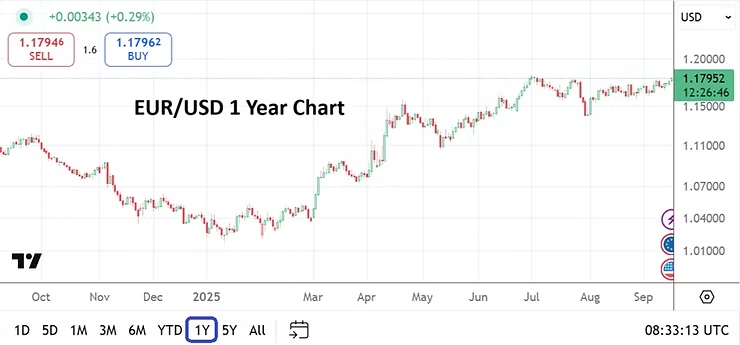
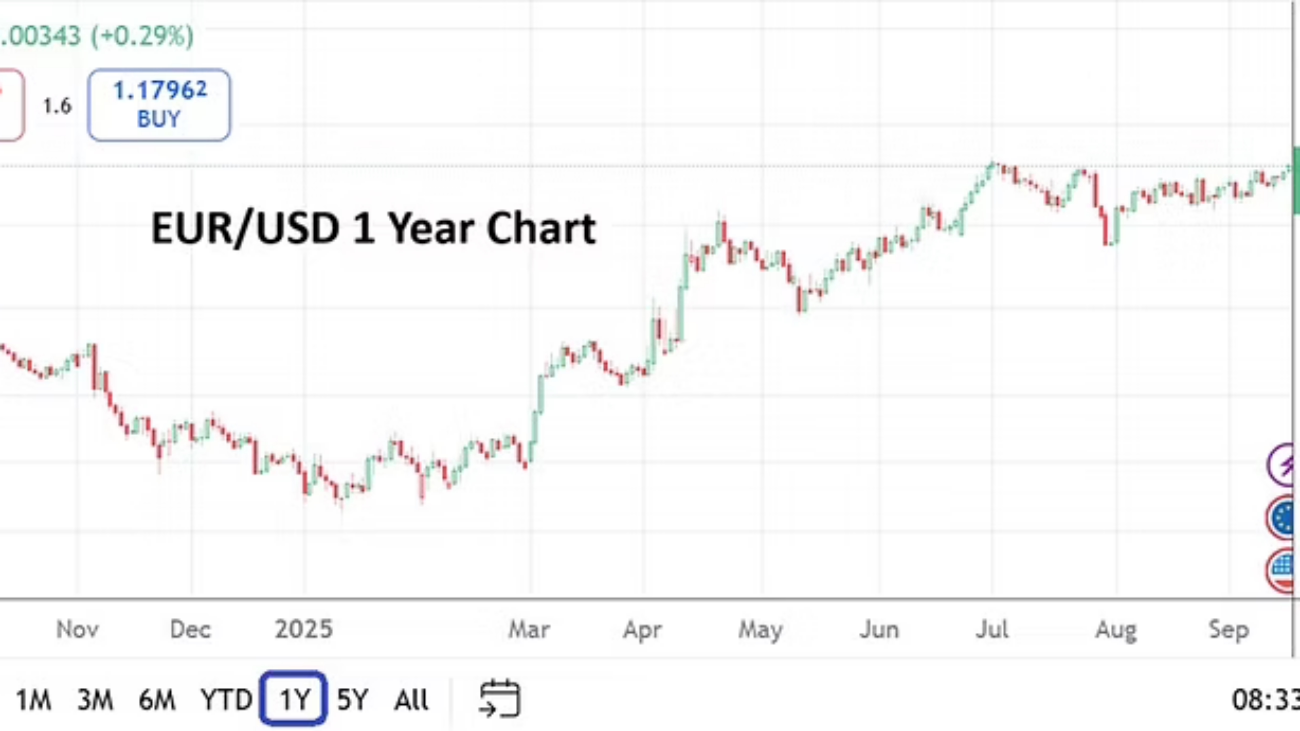
EUR/USD One Year Chart as of 16th September 2025

Forex has certainly seen the USD weaken because a definitive interest rate cut has already been factored into mid-term outlooks. Those who are betting on a 50 basis point cut tomorrow are spitting into the wind and most likely wrong. The Fed under Jerome Powell has proven time and again that it is cautious. The word uncertainly is likely to be heard on Wednesday, even as the Fed Chairman admits conditions warrant cutting interest rates further.

And this is where it will get tricky for day traders betting on conditions beyond tomorrow. Since the quarter of a point cut has been factored into Forex already, and the EUR/USD, GBP/USD and even the USD/JPY are bouncing up against technical inflection ratios for the time being, powerful reactions and dangers will ignite based on the perceptions generated about late October outlook. It is likely some large financial institutions have already priced a rate cut of 25 basis points into the USD already for their October outlooks, meaning some big houses have accounted for a 50 basis point cut mid-term.

It is probable some larger firms have remained conservative, and have not leaned into overly confident cash forward contracts for their corporate clients. This because they want to be certain the Fed is definitely setting the table for another interest rate cut in October.

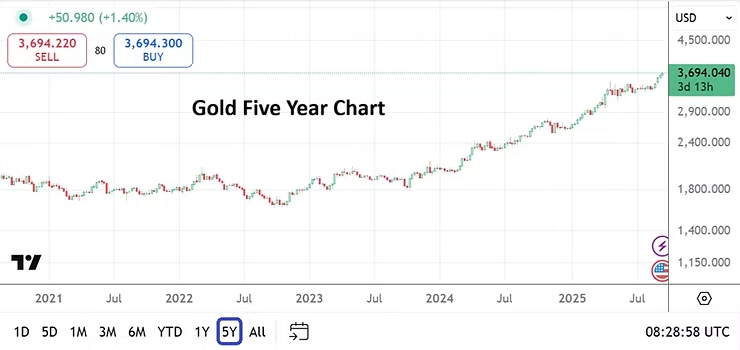
Gold Five Year Chart as of 16th of September 2025

Nothing is guaranteed and Fed Chairman Powell is likely to state this obvious point tomorrow. However, he may have to admit the jobs market looks weak. And he may have to also acknowledge, that although he and other FOMC members remain concerned about the threat of inflation, that for the moment it remains somewhat tame. This is where a secret ingredient in Forex trading tomorrow may fuel volatility. Inflation fears telltale signal is being seen in the current price of Gold which is within record territory and sight of $3,700.00 as of this writing, this even as the 10-Year U.S Treasury yields have decreased.

As a critic of the Federal Reserve’s conservative approach to cutting interest rates the past half year, I have to acknowledge that it is important that the Fed remains nimble, they cannot simply give into pressures from political circles. However and unfortunately, the Fed has been anything but nimble the past six months. The Fed should have cut interest rates by 50 basis points in total in the late spring and early summer, they did not. Now they are once again behind the proverbial curve and in a position in which they are being forced to be reactive instead of proactive.


Again the Fed has at its disposal high tech quantified data via its distinct Fed Districts to know the economic landscape and react at a quicker pace. It chooses not to do this efficiently, this was a feature of the Fed’s inability to accept that inflation was a danger almost four years ago and its snail like reaction which caused economic harm. Now the Fed finds itself in a position in which it should be admitting that it should have been cutting interest rates six months ago, while also knowing logically storm clouds are on the horizon regarding murky economic outlooks due to the threat of inflation actually increasing in the mid-term. Justification for a nimble Federal Reserve remains a pragmatic desire.

Here’s the thing, the Federal Reserve is going to cut the Funds Rate by 25 basis points tomorrow and say they are considering another cut in October. The Fed will probably also say after another cut in October, that they anticipate taking a way and see approach into the end of this calendar year.

Regarding the potential reactions of the EUR/USD, GBP/USD and USD/JPY tomorrow and into Thursday, volatility needs to be expected. The consolidation we have seen develop the past few days near important levels that seemingly are holding back large value moves will vanish for day traders. Small retail speculators in Forex need to understand what they view as massive moves are often considered simple small mathematical gyrations by financial institutions which are not only participating in the cash forward business via FX rates, but also taking part in hedging via futures trading through the likes of the Chicago Mercantile Exchange and other venues.

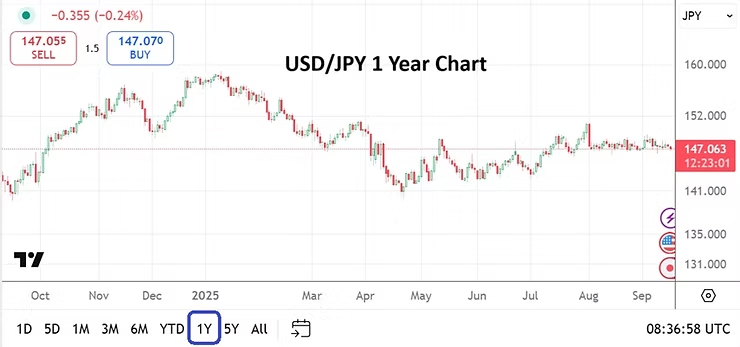
USD/JPY One Year Chart as of 16th September 2025

It needs to be noted the Bank of England will release its Official Bank Rate on Thursday along with its Monetary Policy Summary. And the Bank of Japan will issue its Policy Rate and Monetary Policy Statement on Friday. The BoE is not expected to change its borrowing rates on Thursday, and the Bank of Japan is expected to stand in place too. It should be pointed out that the Bank of Japan does have room to increase its borrowing costs, but the government of Japan appears to be married to maintaining a weaker Japanese Yen, much to the chagrin of some economists.

If the Fed admits they need to likely cut interest rates again in October this might spur on some USD weakness and create volatile conditions tomorrow and Thursday. However, if the Fed offers the phrase that they will take a wait and see approach after October, until further economic data can be accessed in November and December, then the USD may start to show signs of firming. The Fed’s interest rate is 4.50% today, by the end of Wednesday it should be at 4.25% with signs that by the end of October it will be 4.00%. Looking for more than those clues is speculative, financial institutions want answers like everyone else.

postN3.1

India Insider: Working with the West as it Deals with Others

India Insider: Working with the West as it Deals with Others

India’s Prime Minister Narendra Modi visited Tianjin, China for the 2025 Shanghai Cooperation Organization Summit in early September, which was attended by over twenty nations. Before India visited the conference in August, Washington D.C had already imposed a 50% punitive tariff on India’s exports. The initial tariff was a 25% duty, but included another 25% penalty because India purchases a large amount of Russian Oil, which the U.S seeks to reduce. An uneasy trade dilemma looms for India.

Many Western analysts quickly concluded that Prime Minister Modi was tilting India towards a stronger relationship with the Russian and Chinese camps, by potentially embracing warmer associations with Presidents Vladimir Putin and Xi Jinping, and defying Washington’s previous warnings.

Yet, the trade composition and the underlying reality highlights a different story. Despite India being positioned in the global South politically, the nation recognizes its higher value exports – which include textiles, gems and jewelry, apparel, and pharmaceuticals are primarily sold to the West. The United States clearly remains India’s biggest consumer. In essence President Trump holds a trump card.

In contrast, China’s total exports to the global South (excluding Western Europe, Australia, New Zealand, and North America) has doubled since 2015. Chinese exports to the U.S were $525 billion USD in 2024, but to the global South, China’s exports grew to nearly $1.3 trillion USD.

As Professor Michael Pettis accurately points out, “countries with expanding trade surpluses with the U.S, use their higher revenues to fund deficits with the rest of the world.”

India Exports More to the West:

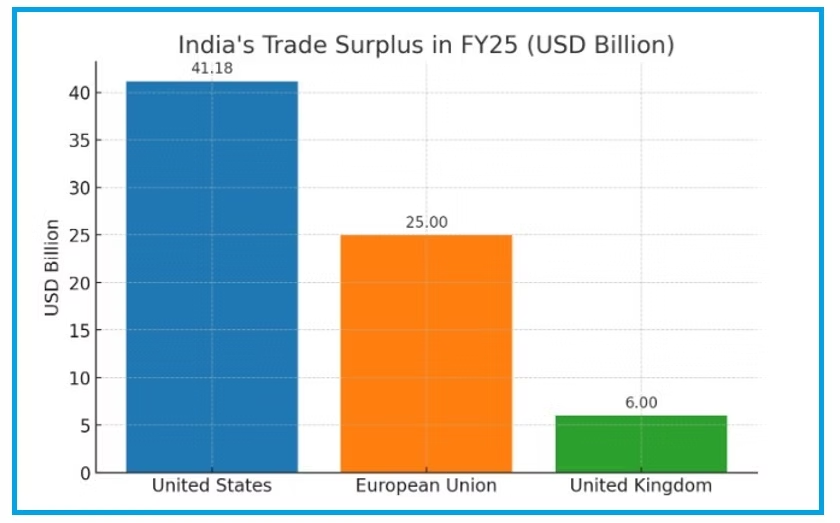
India’s trade surplus with United States, the European Union and U.K stands at $72.18 billion USD. If India wants to be competitive with China in terms of manufacturing, it should affiliate more astutely with the Western camp.

Dependence on Anti-Western Countries Hurts India’s Trade Balance:

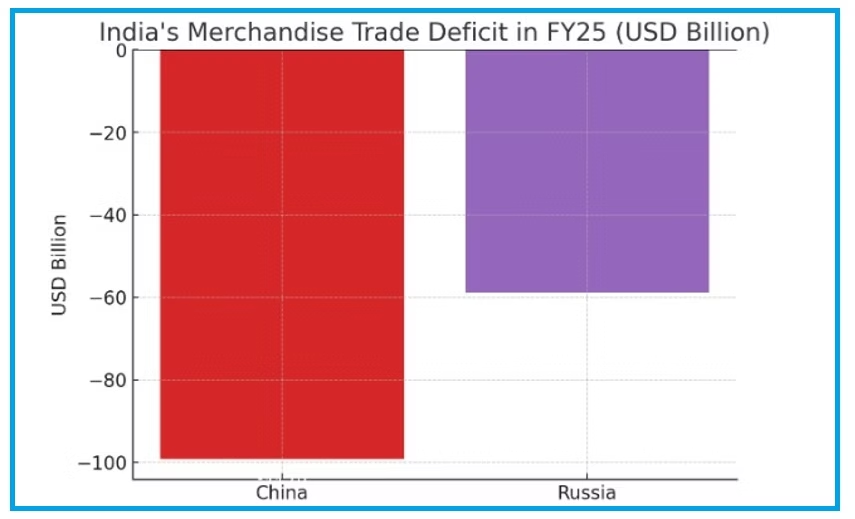
India’s combined trade deficit with Russia and China is approximately $158 billion USD, which demonstrates how much less India exports to these two countries. India’s overall merchandise trade deficit is $282 billion USD, with a deficit of almost 56% in total attributed to Russia and China.

Service Exports a Crucial Metric in India’s Balance of Payments:

India’s services exports stood at $383 billion USD in financial year 2025, earned primarily from the U.S and other Western countries. Washington has imposed tariffs on India’s tradable goods sector, while the nation’s non-tradable sector has been operating without much stress.

India’s overall trade deficit stood at minus $94.26 billion USD in financial year 2025. Without service exports (predominately from the software services sector), India’s current account deficit would be much larger and the Indian Rupee would face greater depreciation pressures.

India’s economic stability is precarious, equilibrium needs to be found. Solid domestic outcomes for manufacturing and a stable Rupee, including exchange rates, could be achieved with a well-defined calibration that looks West but does not weaken India’s stance as a non-aligned nation. New Delhi should focus on maintaining neutrality and strategic autonomy.

While India may shake hands with Presidents Vladimir Putin and Xi Jinping, an important economic lifeline runs firmly through Washington, Brussels, and London. Crucial negotiations are said to be taking place between Prime Minister Narendra Modi’s team and President Trump’s White House behind closed doors. New Delhi could become vulnerable if it does not find adequate solutions. President Trump has recently reiterated his friendship with the Prime Minister Modi, perhaps an agreement can be produced in the mid-term.

post279

Wolf of Wall Street: Greed, Bad Ethics, Sales and Notoriety

Wolf of Wall Street: Greed, Bad Ethics, Sales and Notoriety

Book corner: The Wolf of Wall Street by Jordan Belfort

I was just a greedy little bastard, and not just greedy for money but also for sex and for power and for the admiration of my peers and for just about anything else you can imagine. – Jordan Belfort

Welcome to The Wolf of Wall Street, exstockbroker and trader Jordan Belfort’s autobiographical paean to greed. Reading like a twisted success saga — like a Horatio Alger tale that went left instead of right — Belfort describes his life at the helm of Stratton Oakmont, a Long Island, NY brokerage house which he founded in 1989.

Equal parts shocking, drugged-up, zany, and hysterically funny, Belfort’s story — confession would be a more suitable word — tells how Stratton Oakmont gained notoriety for its widespread use of pump and dump schemes, an illegal practice whereby a stock’s worth is artificially inflated and then sold at a higher price.

Stratton Oakmont racked up plenty of victims and fortunately its tenure was brief. The FBI, the National Association of Securities Dealers (NASD) and the U.S Securities and Exchange Commission were on Belfort’s scent for years and would eventually shut it down in 1996. Belfort made a fortune but would serve 22 months in prison, where he began writing his memoirs, later to be shaped into this 2007 book. Wolf was a bestseller and Belfort wrote a followup two years later, Catching the Wolf of Wall Street, in which he tells his origin story and how he formed his crew, and also serves a sequel to the events of the first book.

In 2013, director Martin Scorsese released the film The Wolf of Wall Street, combining elements of both books. Scorsese shaped the film like a white-collar version of his earlier masterpiece, Goodfellas, with Leonardo DiCaprio portraying Belfort as a 1990s version of Henry Hill. The movie was a financial and critical success, and garnered accolades not only for DiCaprio’s performance — he won Best Actor at the Golden Globes — but also for Margot Robbie as Belfort’s wife and Oscarnominated Jonah Hill as his business partner (the names of the people upon which they were based were changed for the movie). Belfort himself has a bit part in the film.
 
A Jewish kid from middleclass Bayside, Queens, Belfort focuses Wolf on three areas: 1) his legal struggles 2) Stratton Oakmont and its excesses, and 3) his rampant drug use, physical ailments, and marital tensions — often weaving all three into the same scene.
 
In the first focus of the book, his legal struggles, one gets the impression that he enjoyed writing this part of the book the least, although that is understandable. Stratton Oakmont’s financial crimes broke a laundry list of federal and state regulations and before his arrest Belfort was forced to spend considerable time, money, and imagination in hiding them from the authorities.
 
Stratton Oakmont specialized in selling penny stocks, which are inexpensive stock shares from smaller companies. Although usually marketed to investors of more limited means, Stratton Oakmont marketed them to unsuspecting wealthier investors, making an insane amount of money in the process. A classic boiler room operation, brokers were trained to sell using slick, cuttingedge, highpressure tactics. The firm thrived on manipulation and deception, with an intense focus on closing deals no matter the ethical cost.
 
A significant portion of the book is dedicated to explaining Stratton Oakmont’s approach to stock price manipulation. Belfort’s traders would artificially drive up the stock price of a company during its Initial Public Offering (IPO), while retaining more shares of that company than SEC regulations permitted. Belfort uses the example of Steve Madden Shoes, a company he helped take public, to demonstrate this practice.
 
Belfort outlines how stock manipulation during an IPO works: He would invest heavily in a new business, like Steve Madden Shoes, and then leverage his controlling stake to take the company public. Belfort’s brokers would use aggressive tactics to inflate the stock price when selling to investors. Once the price reached a certain level, Belfort would sell enough of his shares to recover the cost of his initial investment — meaning he paid nothing for the remaining shares, which were now worth significantly more.
 
However, under SEC rules, an investment firm sponsoring an IPO is only allowed to hold a limited amount of stock in the company they are offering, but Belfort and Stratton Oakmont held far more Madden shares than the law allowed.
 
Belfort was also involved in money laundering, a scheme that began when he secretly traveled to Switzerland, a nation notorious for hiding money. The Swiss bankers he met with openly explained how the Swiss banking system hides vast sums of money and how they avoid cooperating with foreign institutions, like the U.S. SEC. Since the practice of issuing “numbered” bank accounts without names ceased after World War II, Belfort’s first step was to open accounts under the names of proxies, similar to those who held his stock. These individuals were tasked with smuggling large amounts of cash across the border, so Belfort relied on people he trusted who wouldn’t raise suspicion — including his wife’s elderly British aunt and a member of one of his drug dealers’ Swiss relatives.
 
As a sidenote, Belfort comes across as cynical to the whole stockbroking profession. He argues that stockbrokers, including himself, don’t truly produce anything of value and lack any specialized stock market knowledge. At their core, he says, they’re essentially just slick salesmen, especially after Belfort taught his crew highpowered sales scripts that drew customers into opening their wallets. With this training, Belfort says, even a high school or college graduate can be taught to talk like a stock market expert, which leads into the second focus of the book, the atmosphere at Stratton Oakmont.
 
In staffing Stratton Oakmont, Belfort eschewed licensed brokers (those who passed the Series 7 exam) and instead brought in a more impressionable team, a hardscrabble gang of local kids fired up to make big bucks. The place was awash in money and to reward the brokers for their highly stressful — and aggressive — jobs, Belfort spared no expense in keeping them happy. He cultivated a bacchanalian, partylike atmosphere, a sort of adult frathouse full of sex, hookers and drugs.
 
During his tenure at Stratton Oakmont, Belfort became known for his loud and proud persona. He would routinely motivate his troops by giving thumping, overthetop speeches (marvelously reenacted by DiCaprio in the movie), preaching like an evangelist about the glory of earning big money.
 
The book’s final focus is his drug use, physical ailments, and marital tensions, three issues that are tragically intertwined.
 
Belfort suffered from intense back pain and sleep problems, the latter which plagued him since childhood. As an adult, the chaotic and party-fueled atmosphere at Stratton Oakmont enabled him to indulge easily, and he would use a powerful cocktail of drugs to cope. He was particularly known for his abuse of Quaaludes, a hypnotic sedative drug which he used recreationally and frequently, often mixing them with alcohol or other substances, but it became a full-blown addiction. Besides Quaaludes, he also used cocaine, morphine, and other prescription medications.
 
Belfort reported frequent blackouts and memory loss due to mixing drugs, especially Quaaludes and alcohol. He often had no recollection of things he said or did while under the influence, sometimes waking up to damage, arrests, or people furious at him. He had multiple close calls with overdoses, particularly from taking too many sedatives or mixing drugs dangerously. In one story, he recalls almost choking to death on his own vomit after passing out. Longterm drug use left him in a nearconstant mental haze, affecting decision-making, mood, and impulse control.
 
Belfort describes in cringing details the most notorious effects of his Quaalude abuse, the loss of basic motor control. He described episodes where he was physically unable to walk, speak clearly, or even stand up — calling these “cerebral palsy phases.” There’s a wild (and comic) scene — later portrayed in the movie — where he attempts to crawl to his car while stoned out of his mind.
 
Belfort writes at length on his wives and family life, and herein lies the part which Belfort seems to have enjoyed writing the most.
 
Belfort met his first wife, a local Queens beauty, after college while working as a meat salesman. The business thrived for a while, thanks to Belfort’s silver-tongued persuasion abilities. But after overextending himself, the business went under, leaving him with a young wife and bills to pay. By all his accounts, his wife stuck by him through the lean times and he has not had (at least publicly) an unkind word to say about her. But Belfort ended up leaving her for a Londonborn and Brooklynraised model, Nadine Caridi, a stunning beauty whom he met at a party. His life with the Duchess — as he refers to her due to her birth country and British heritage — provides some of the most memorable scenes, and their life together became a bizarre mix of luxury, chaos, and toxicity (not to mention lust).
 
The two met when Belfort was already rich from Stratton Oakmont and their relationship quickly became intense. Marrying in the early 90’s, Belfort provided Caridi with a glam life of extreme wealth: yachts, mansions, exotic vacations, and nonstop partying. Belfort showered her with expensive gifts and built a lavish life for them and their children in one of the most expensive areas of Long Island. Their megamansion boasted a helicopter pad, a swimming pool, tennis courts, servants galore and a fleet of luxury cars.
 
But behind all the glamour, things became unstable. Belfort and Caridi had some intense, ugly shouting matches during their marriage, and they usually exploded over his drug use, infidelity, and parenting. Although Belfort loved his kids dearly, Caridi got especially furious when his reckless behavior endangered them. One of their biggest, most infamous fights was when Belfort, high on drugs, tried to kidnap their daughter and crashed his car into a pillar inside their property (also reenacted in the movie). Their marriage eventually broke down under the weight of Jordan’s addictions and criminal behavior, and they divorced in the early 2000’s.
 
How did it all end for Belfort? After getting cornered by the FBI, who had a strong case against him, Belfort was given a choice: either go to prison for decades, or cooperate and help bring down the dozens of brokers, business partners, and shady investors he worked with. To get a lighter sentence, he agreed to become an informant, wearing a hidden wire during meetings and conversations to secretly record people he worked with. However, a lot of his old friends and colleagues ended up getting arrested and betrayed by him — and he was absolutely hated by many in that world after that.
 
Belfort did easy time at Taft Correctional Institution in California, a lowsecurity federal prison of the type that is called “Club Fed” in popular culture because it is so relaxed and safe compared to the tough penitentiaries that house hardened convicts. While there, he had the odd coincidence of sharing a cell with Tommy Chong, of the classic Cheech & Chong stoner comedy duo. Chong was there for selling bongs online, and the two became friends. It was Chong who encouraged Belfort to write his memoirs. Interestingly enough, his writing style was influenced heavily by Tom Wolfe’s The Bonfire of the Vanities, which he read while there.
 
Belfort’s New York humor shines through the book and is the saving grace throughout the scenes where the crime and sleaze bubble through, although the vulgarity might not appeal to all readers. His antics, though tragic and costly, often come off as comedic, with a rhythm similar to stand-up comedy or a raunchy sitcom. It makes for enjoyable reading but one has to question his motives for portraying the incidents in such a manner.
 
For example, the infamous yacht story — one of the highlights of both the book and the movie and one which Belfort has retold ad nauseum in interviews and personal appearances —involved a hairraising incident where he ordered the captain of his yacht to sail through a 70knot storm, instead of avoiding it, off the coast of Sardinia.
The yacht was battered by massive waves that smashed its windows and hatches, flooding it. Despite the dire conditions, all 27 people on board were rescued by the Italian Navy, but the yacht was lost at sea. Belfort — and unfortunately later Scorsese — play it up as bumbling dark comedy, something that would fit in the first season of Breaking Bad or Michael Bay’s 2014 crime caper Pain and Gain. But after the movie was released, two of the men who were on board the yacht — friends of Belfort since childhood — were interviewed on a local Long Island radio show and told their side of the story. The real events, as they stated, were a horrific, PTSDinducing nightmare in which all aboard — crew included — thought they were about to die.
 

Another problem with the book is that it never actually defines itself. Is it a business book? A morality tale? A success story? A crime story? Is it fratire, the genre popularized by Tucker Max in I Hope They Serve Beer in Hell? It has elements of all of those, but they never truly come together into a cohesive whole. The business and legal sections are hard to follow for the average reader and Belfort didn’t seem interested — or patient enough — in describing the concepts in simpler terms. In fact, like a true salesman, at times he seems more interested in a carefully crafted portrayal of himself where even the self-deprecation — and there are loads of that — contain hints of braggadocio. One can hear him saying as he wrote the book, I had ballsI went for the brass ringI did things that you didn’t dare to do.

After the movie was released in 2013, Jordan Belfort experienced a resurgence in public attention and became a media favorite, interviewing endlessly in his thick, fasttalking Queens accent while regaling a new generation of fans with the stories behind the movie. In time, he eased into the role of elder statesman, becoming an indemand commentator on current financial affairs such as crypto and Wall Street. Belfort also rebranded himself as a motivational speaker and sales trainer, touring internationally and giving seminars on sales techniques, goalsetting, and entrepreneurship. His signature sales methodology, now marketed as the “Straight Line Persuasion” system, has become a core part of his training programs. He also created a podcast, The Wolf’s Den, where he interviews entrepreneurs, influencers, businessmen and others (although it is unclear as of this writing if the podcast is still active).

To his credit, he has shown remorse for his misdeeds and the effect his lifestyle had on his family and has repeatedly stressed the importance of ethics in business and sales. His speeches, as shown on YouTube, are enjoyable and engaging.
Unfortunately, the issue of restitution remains a sticky issue. Currently living in California, he was ordered some years ago to pay $110.4 million in restitution to victims of his stock fraud. However, critics and prosecutors accused him of not paying enough back, particularly in light of earnings from the film, books, and speaking engagements. Belfort has claimed he’s been steadily paying.


Despite the glamorized portrayal in the movie, many people — especially his victims — still view him with suspicion. He remains a controversial figure. Some see him as a charismatic redemption story, while others view him as an unrepentant fraudster profiting off his crimes. Read the book and decide for yourself.

If you want to read another Book Corner article, please visit this review by Evan Rothfeld:
https://www.angrymetatraders.com/post/rich-dad-poor-dad-what-the-rich-teach-their-kids-about-money

post278

Behavioral Sentiment: False Narratives and Noisy Realities

Behavioral Sentiment: False Narratives and Noisy Realities

The past handful of months in Forex have provided day traders problems if they have been trying to pursue steady trends. Constant flashes of rhetoric and news pervading tariff implications, U.S Federal Reserve interpretations from various media and analytical corners, and mixed economic data has caused a rather mired reality for speculators trying to operate.

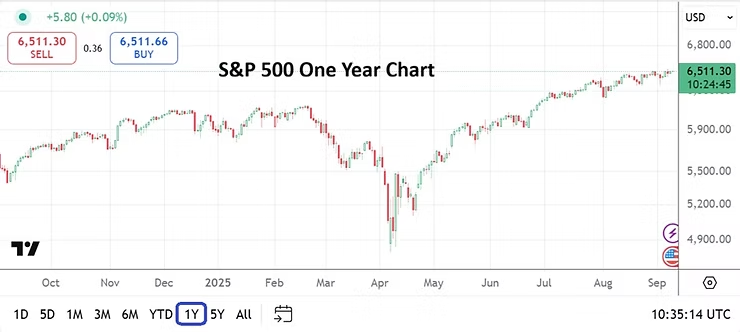
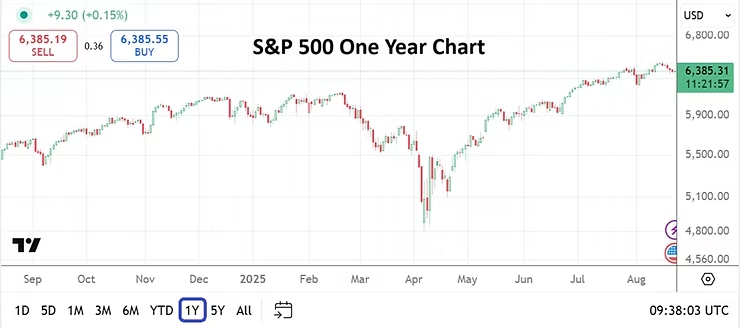
S&P 500 One Year Chart via Futures CFD Trading on the 9th of September 2025

However, if the noise is turned down by day traders and sometimes given less importance regarding potential influences, signals become visible and some perceptions can be looked upon as roadmaps. While many want to to throw their hands up and proclaim some sort of developing economic meltdown and a coming apocalypse, the major U.S indices are actually performing quite well as a barometer. The S&P 500 is continuing to challenge all-time values. Yes, the Nasdaq 100 and Dow Jones 30 are not marching in lockstep with the S&P 500 to new highs, but they are not far behind. The stock market has never guaranteed people an ability to constantly move upwards, but it does offer the potential to judge outlook and mid-term sentiment.

The USD has been extremely choppy since the start of this year, this as the Trump administration has taken over, but its trend towards weakness has been rather clear. The EUR/USD and GBP/USD have done reasonably well regarding mid-term strength. Yes, the USD/JPY has produced whipsaw movements and the Japanese Yen remains awkward, but this is a direct reflection of mitigating Japanese government policy (some may call it incompetence) regarding its ability to manage fiscal concerns, interest rates, and fight deflation and now inflation (which has been going on for a few decades).

Gold is traversing record heights and is showing signs of sustaining values above 3,600.00 as of yesterday. After languishing (albeit within elevated realms) near 3,350.00 the past handful of months with prevalent volatility, the precious metal has bolted out of its consolidation. And the likely reason for this is the anticipated Federal Reserve policy changes regarding interest rates. 10 Year U.S Treasury yields have also been pushed lower recently – this as financial institutions await a definite cut in interest rates by the Fed on the 17th of September. But folks who believe a 50 point basis reduction is coming late next week are likely wrong.

The Federal Reserve under Chairman Jerome Powell has been quite conservative, this will probably not change next Wednesday. It is more likely a cut of 25 basis points will take place on the 17th, and the FOMC Statement will offer the potential of another interest rate cut in October. Tomorrow’s PPI numbers and Thursday’s CPI results will influence the Fed’s coming meeting and mid-term outlook.

What we are left with is a broad market that is having a lot of noise applied to it by people with a variety of biases. Political bantering has reached a threshold in which it might be best to simply not pay attention to anything – but that is dangerous too. Yes, some people do talk sense, and some people do show signs of actually trying to engage in adult decision making regarding their insights, but it often feels like wanting to sound correct is more important than outcomes. Technical traders may be enjoying a quiet laugh at the expense of fundamental players right now.

However, economic data remains important. While rhetoric from the U.S White House and its opponents remains within a state of hyperbole, day traders should try to turn down the noise and pay attention to signals that long term investors continue to produce and take advantage of their sentiment. Stocks continue to be pursued and indices have done well, but volatility should be expected particularly into next week.
post277

India Insider: Women in Agriculture Need Manufacturing Power

India Insider: Women in Agriculture Need Manufacturing Power

India has long been a society that has neglected Women’s Empowerment. While various states pursue proactive policies to enhance the role of women in society, their inclusion in the job market and ability to have financial independence is still lacking.

Small Scale Farm in Tiruvannamalai, India

In the suburbs of Tiruvannamalai City, in Tamil Nadu, Mrs. Revathi runs an agricultural farm where she grows rice, flowers, and vegetables. She sells them to local commission agents or directly to customers from her farm. Mrs. Revathi, who lost her husband in 2019, has two daughters, both of whom are educated and working. One of the daughters is getting married. She said that although agriculture helps her family earn money, it does not lift them out of the poverty trap because of uneven flower cultivation. The land is becoming less and less suitable for irrigation – a matter that worries her greatly too. Flowers are one of the major sources of income for many farming families in Tiruvannamalai City in Tamil Nadu.

This is just a small example of the challenges faced by women working in agriculture.
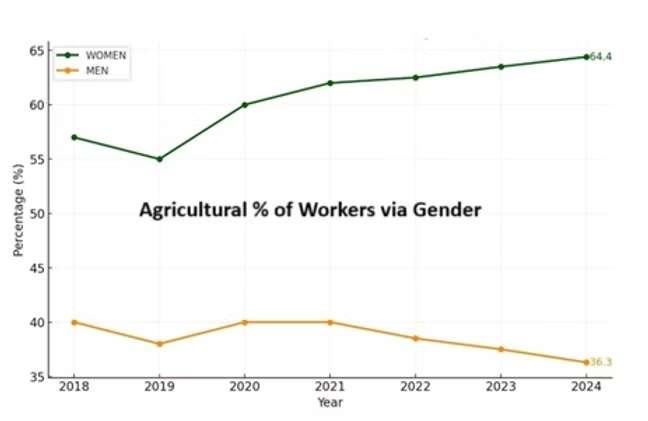
According to recent Periodic Labor Force Surveys, 64.4% of women in India work in agriculture, compared to only 36.3% of men.

Labor Workforce Percentage in India per Gender

Self employment and Access to Credit is not the Solution:

Many argue that self-employment and steady access to credit via microfinance institutions will help women become entrepreneurs and create movement up the social ladder. This is true in some cases, but many women struggle with raising families in their husband’s absence, and when working on farms where agricultural productivity is lopsided or unfit for growing vegetables or corn, times remain difficult.

First of all, why do women choose agriculture and remain small-time sellers? Because they are not able to find employment easily in formal sectors like manufacturing or other service oriented businesses.

Even within related agricultural sectors, women employed in vegetable processing plants, or value-added goods like masala manufacturing and tomato sauce production companies earn higher wages.

Unfortunately, low productivity and long spells of inactivity render agricultural workers significantly underemployed periodically. They are stuck, with nowhere else to go. Unlike in East Asian nations, which created mass employment through dynamic exports of manufactured goods, the Indian manufacturing sector’s low productivity makes it globally uncompetitive.

Manufacturing as a Solution for Women Empowerment:

Across Asia manufacturing has proven to be a powerful driver for upwards mobility. Incomes have risen, poverty has declined, and women are central parts of this transformation. In Vietnam, where a factory boom has been especially momentous, more than 68 percent of women and girls over 15 years of age are working for pay in some capacity, this according to data compiled by the World Bank. In China the rate is 63 percent, in Thailand 59 percent, and in Indonesia 53 percent of workers in manufacturing are women. Yet in India, less than 33 percent of women account for the workforce in recorded in official surveys.

In a pattern demonstrated in many industrializing societies, when more women gain jobs, families promptly invest further in education for girls. Manufacturing also lifts household spending power, fueling economic expansion that encourages investors to build more factories, providing additional jobs and reciprocal wealth creation. India is missing out on this dynamic manufacturing growth and is failing to broadly participate in the spread of improved industrialization which has helped bolster fortunes in many Asian economies and benefitted families. A vital component for a stronger Indian economy necessitates the empowerment of women.

post275

Nvidia: Short-Term Speculative Reactions Versus Investing

Nvidia: Short-Term Speculative Reactions Versus Investing

Nvidia is near 181.60 as of this writing, this after the company issued a quarterly report that beat expectations, but also pointed out that mid-term concerns may slow down the pace of some of its data driven business, and that China enterprise complications remain murky.

Nvidia Five Day Chart Early Morning as of 28th August 2025

Day traders should be certain they acknowledge the difference between a short and near-term wager on Nvidia compared to mid and long-term outlooks. Speculators who want to venture forth and gamble on Nvidia based on last night’s quarterly earnings report are free to do so. However, there is a distinct difference between betting on what today and tomorrow’s reactions in Nvidia will be compared to folks who are investing long-term in the company and believe that over the long haul it will remain a solidly profitable company that adds value to bottom lines.

In early August Nvidia was challenging the 185.00 ratio. As of this morning the stock is near the 181.60 mark. Nvidia faces headwinds currently in after hours markets because the company had the gumption to say it outperformed expectations in the last quarter, but put up a cautionary sign saying its data business may face some obstacles regarding growth, and outlooks for its China enterprise remains solid but could face some complications.

Reacting to Short-Term Temptations and Speculating:

For those who want to sell Nvidia based on the above ‘warnings’ today, they are free to try their luck. However, selling positions could quickly turn into buying opportunities. Nvidia like most equities is about considering reactions due to behavioral sentiment, short-term nervousness could rapidly shift to bullish perspectives in the eyes of investors, programmed trading software, and – yes – day traders.

Lower support for Nvidia technically when a five day chart is looked at may be 170.00 if someone is overly cautious. A look at a one month chart for day traders who have a bit more of an aggressive manner, may believe technical chart evidence suggests a lower move can be taken advantage of at 177.00, this if they are keen on waiting for a downturn to look for an opportunity to buy at lows.

Yes, perhaps some short sellers may target the mentioned values as places to cash out positions while speculating. But there is a chance Nvidia will not touch those lows. Perhaps bearish reactions – if they even happen – will fade quickly and additional bullish sentiment will continue to seep into Nvidia. Does anyone really think Nvidia is about to face a steep selling curve?

Tech Stock Consideration and Looking for a Barometer:

·       Some folks are talking about AI and its potential status as a bubble.

·       However, this is Nvidia we are talking about, even if there is a bubble in the AI sector, Nvidia long-term is a solid stock that will likely do well for years to come.

·       Short-term reactions seen the remainder of this week and perhaps over the next few weeks may be choppy, but this would include reversals in both directions.

·       Betting on a big downside in Nvidia looks to be wrongheaded.

·       Traders who are conservative and believe Nvidia is a good buy short-term after some selling happens, while looking for momentum higher – at least back to known resistance levels – may be making a solid wager.

Nvidia is one of the most important equities in the stock market. Some may justifiably say it is the most important at this moment. As a big driver of the Nasdaq 100, Nvidia has in many respects traded sideways since late July. This has been one of the reasons the Nasdaq 100 has faced headwinds too. The broader S&P 500 has been doing better than the Nasdaq 100 the past few weeks, this because tech stocks like Nvidia are facing some skepticism regarding just how high they can go. However, Nvidia as a stand alone company has excellent long-term prospects.

post274

India Insider: K-Shaped Economy via Growth and Inequality

India Insider: K-Shaped Economy via Growth and Inequality

ndia’s growth story remains inspiring, supported by the National Democratic Alliance (NDA) government’s policies that attract foreign capital into infrastructure projects. The last decade has seen improvements in railways, ports, bridges and highways. In Financial Year 2025 (1st April 2024 to 31st March 2025), gross Foreign Direct Investment inflows reached USD 81.04 billion, a 14% rise from the previous year, reflecting global investor confidence under the China+ strategy. However, net FDI shrank to just USD 353 million, its lowest on record, as significant divestments and profit repatriations offset the inflows.

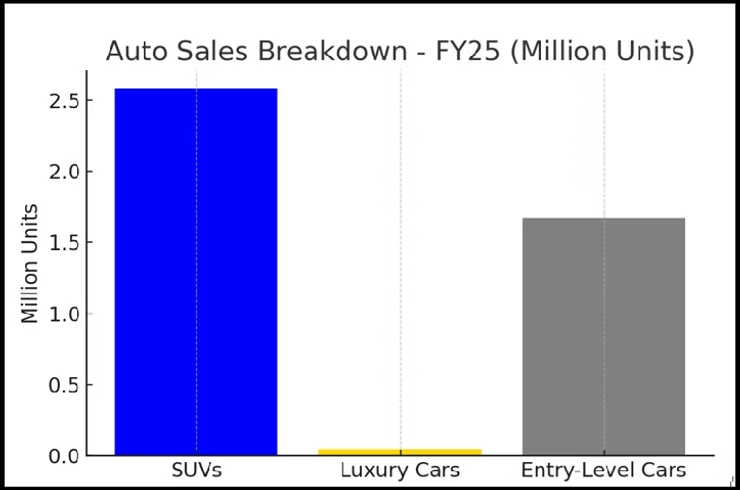
Auto Sales in India from 1st of April 2024 to the 31st of March 2025

India’s stock market has rallied recently, driven by strong corporate performance despite tariff-related jitters. Corporate capital expenditures by listed non-financial companies rose over 20% year-on-year to exceed 11 lakh crore ($125 billion USD) in FY25, surpassing the government’s capital expenditures of 10.5 lakh crore ($120 billion USD). This signals robust investment by large firms.

In contrast, the unlisted corporate sector, contributing two-thirds of corporate value added and holding most corporate debt, remains weak with falling profits and tax payments. The divergence comes from the markets they serve: listed firms cater to higher-income households, while unlisted firms rely on low and middle income consumers, where progress and recovery is slower. Corporate tax receipts remain healthy, but are largely driven by listed firms. Collections in FY25 reached 12.72 lakh crore ($145 billion USD), while net direct tax collections climbed to 22.26 lakh crore ($254.97 billion USD).

Consumer trends mirror this imbalance. Passenger vehicle sales hit a record 4.3 million units, led by SUVs and luxury cars, while entry level cars and two-wheelers saw subdued demand. The aspirational middle class, especially tech professionals in their late 20s and 30s, drives premium demand, leaving the mass market segments of the population behind.

Nearly half of the nation’s workforce remains in low productivity sectors contributing only a fifth of national income. Wage growth is stagnant in several States. Micro, medium and small enterprises struggle with credit, policy bottlenecks, and institutional constraints. This is India’s K-shaped economy as large corporates and affluent consumers thrive, while smaller businesses and lower-income groups lag. India’s booming economy hasn’t delivered progress for all quite yet.

The country remains the fastest-growing major economy in the world, above 6%. A crucial question is whether this astonishing growth will create mass employment and better equality. Unfortunately, without updated consumer expenditures data since 2011–12 due to the lack of a recent census, policymakers rely on capital expenditure and earnings trends to gauge consumption patterns which deliver incomplete insights. The next census for India is scheduled to be conducted in 2027. More transparency is needed statistically to help alleviate the K-shaped results via the Indian economy.

post273

China’s Economic Future: Speculation & Transparency Question

China's Economic Future: Speculation & Transparency Question

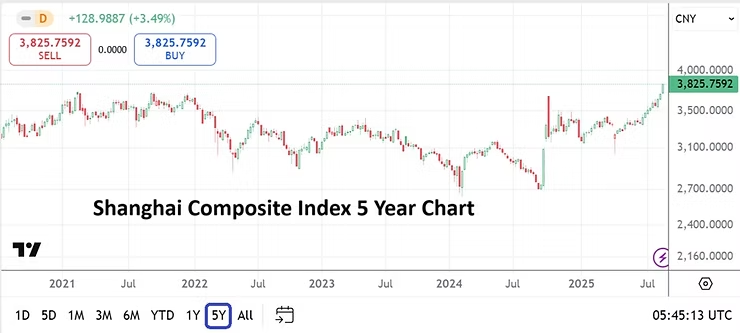
China’s economy has been underperforming for a handful of years. Growth has not only stagnated but has experienced a downturn, deflation has been experienced. Strong leadership from Xi Jinping has led to a firm approach regarding the management of China’s political and economic affairs. Until this year, Xi’s grip on power had grown significantly since he took office as the President and General Secretary of the Chinese Communist Party in 2012, but his control appears to be waning. Yet even as lackluster Chinese economic data has persisted, the Shanghai Composite Index (SSE 000001) has mirrored many global equity indices and done remarkably well since April of this year.

The SSE is near 3,826 currently. In early April the SSE was around 3,080, and in the middle of September 2024 the Shanghai Composite Index was close to 2,700, which was clearly within sight of long-term lows. The current heights of the SSE have not been seen since August of 2015. Yes, the Shanghai Composite Index was over 5,000 in April of 2015 and also in 2007. The point being that highs being traversed have not been seen in a long time. But is the positive speculation in the SSE a sign that economic conditions and political considerations in China are positive? Where is the transparency?

Shanghai Composite Index Five Year Chart as of 24th August 2025

China’s ability to create significant growth over the past four decades has transformed the nation into a global powerhouse economically and militarily. Yet, the past few years have begun to show cracks in the single handed approach to centralized decision making regarding the economy, government data presented has become suspicious. Rampant speculative forces in the SSE have been seen before. Is now the time to buy more Chinese equities or is it time to become cautious? Reliable statistics remain a troublesome aspect for investors.

China’s real estate market collapsed under the weight of too much building and speculative buying of apartments. Yes, inflated property and sudden deflation has been seen in capitalist countries in the past and will be witnessed again in the future. But the bubble in Chinese real estate and its crash also points out problems regarding a lack of transparency. While the Chinese government has tried to fix the fiscal problems caused by the real estate implosion, it has also created significant fractures within its banking system, which are confronting the Chinese government and public, and sometimes feels like a coverup trying to hide bad news. When will there be a recovery in the China real estate sector, is the worst of the crisis fixed?

Chinese political questions and some evidentiary circumstances point to intriguing considerations. There is evidence in China that a change of leadership is progressing. In the past couple of months small hints have been allowed to be published via China’s state media, the Xinhua News Agency. Rule changes have been made regarding decision making processes in the Chinese Communist Party, this was published by Xinhua in late June and republished by the South China Morning Post of Hong Kong in early July. While paraphrasing, both news entities expressed that rule changes meant Xi Jinping would officially have to delegate more decision making.

USD/CNY One Year Chart as of 24th August 2025

Speculation is growing beyond a mere whisper that the Chinese military has become a wildcard and a source of power that is potentially ready to help remove Xi Jinping. The military apparently is not supporting Xi and wants a more collective approach to decision making via the Chinese government. Yes admittedly, this information can be described as being from news services and podcasts that do not favor the Chinese government, but they seem to be singing in unison. It appears that China’s People’s Liberation Army have decided it is time for a change and is ready to play a role in the selection of new Chinese leadership.

The 80th Anniversary Victory Day Parade in Beijing will be held on the 3rd of September, what role will Xi Jinping play in the show of military force? Will it become apparent that Xi is merely a figurehead until an official decision is made on how the Chinese Communist Party will be led? Importantly, the 15th Five Year Planning Conclave for the Chinese Communist Party will be held in October and this is where a leadership change could take place including the official removal of Xi Jinping.

There appears to be – yes, via the dissident information heard, two factions within the Chinese Communist Party vying for power – hardliners and reformers. The army still hasn’t made it clear if they are backing the hardliners or the reformers. What is evident however via many publications, is that China’s PLA has decided along with other important leadership circles in China’s Communist Party that Xi had too much control and they want a more collective leadership.

Regarding the Chinese economy which has undergone a period of stagnation and lackluster results the past handful of years under Xi’s strong centralized approach, something big is about to happen which will have ramifications for the next five years. Who will lead China? The hardliners who are true believers in ideological communism or reformers who want China to move towards more of a market economy? This is a huge question. This type of political infighting has been seen in China during the past four decades and played a role in key leadership changes. It is not a conspiracy plot which is being sounded, it is the possibility of a transfer of power which happens cyclically in many nations when changes are warranted.

China’s Shanghai Index has done well recently. Perhaps this is a correlation reflecting optimism being sparked globally in equities in recent months. Or is it also possible that some folks in the know are betting on the reformists to take control of the Chinese government? Tariff concerns have seemingly been brushed to the side in China and something bigger is certainly at play. President Donald Trump is not the story here. Investors participating in China need to pay attention to the political changes that seem to be brewing. While speculation has certainly brought the Shanghai Composite Index to long-term highs, transparency from China is a concern economically and politically and there will be an impact if changes to leadership occur.

post271

Hard Truth: No Secret Sauce, A Possibly Unfriendly Reminder

Hard Truth: No Secret Sauce, A Possibly Unfriendly Reminder

Day traders face constant battles. Choppy conditions in markets lead many salespeople within brokerage firms to proclaim the ability to take advantage of technical shifts to their clients, but it is much easier to demonstrate what has taken place before compared to what is going to happen next. Technical trading via charts often looks good for those offering its charms until reality bites.

Day traders also have the disadvantage of fighting large market institutional forces that have completely different timeframes, deeper pockets, and perhaps even a fair amount of analyses they can use to validate their reasons for taking a position – not necessarily a correct position – but enough to provide insurance regarding their decision making.

S&P 500 One Year Chart as of 22nd August 2025

Institutional traders can fall back on the analyses they have at their disposal and point to it as the reason why they made a trade. Literally giving them an excuse to explain why things went wrong, so they can tell inquiring management when needed, this in order to protect their miscues. Institutional players do not get fired easily from their positions, they usually just wait a few years and shift to another company when too many bad trades have been made – that is a dirty little secret in the trading world.

Comparatively, day traders simply blow out their own accounts while losing money. Yes, sometimes they have to explain to their romantic partner why they can’t go on the trip they had been planning because there is a sudden lack of funds. Hopefully they didn’t wipe out too much money that they may have borrowed from family or friends, this via ambitions and proclamations that a coming trade was a once in a lifetime opportunity.

But wait, yes, there are speculators and large traders who do make money. These are the folks many allude to who are – in many peoples’ minds – sitting on a yacht in a lovely ocean locale and enjoying the fruits of their labors. They do exists and we should acknowledge this, even if we sometimes think they are merely lucky and one day will face a losing streak.

However, many of these anointed winners do not exists either. Beware of experts ladies and gentlemen. Influencers are often selling a dream they know a day trader desires. Commissions drive the brokerage business. Unfortunately, it is seldom profits made by an emerging victorious crowd via newly minted speculators that make brokerages money.

I am frequently warned that this is not what day traders want to read. They do not want to be reminded that 90% of their group usually loses most of their money, or at a minimum walks away with less money than they started. The U.S Fed’s Jackson Hole Symposium is now underway in Wyoming. Yet, most day traders will only be able to take advantage of this event by trying to ride on the sentiment tides created by large institutional traders in Forex. The headline: Fed Rhetoric and Jackson Hole, will be the talking point of the media today.

However wait a moment please, the retail brokerage business in the States must be pointed out as a reason for some positive momentum in the major U.S indices the past handful of years and needs to be watched regarding its sentiment. Reddit, X, Instagram, Quora and other social media sites can be monitored to gather this info. Behavioral sentiment is becoming important in the markets. While some institutional investors are showing caution via inquiries (polling) and actual market positions, some public cash appears to be supporting the S&P 500, Nasdaq 100 and Dow Jones 30 via purchases through reputable brokers who do buy the actual asset.

That is a contradiction of sorts compared to what has been written in previous paragraphs, but then again this is trading (and investing) we are discussing, so there are no straight lines, and often complexity rules. Perhaps you noticed that I didn’t say, institutional players are smarter than day traders. In many cases institutions and their managers merely have more money to wager with, and can do this without too much leverage and over much longer timeframes – giving them the ability to ride out financial storms and survive.

Under the current market circumstances the Fed is expected to cut interest rates in September by 25 basis points. But the U.S central bank is going to face a possible battle via murky data that will have to be factored into October, November and decisions beyond, meaning caution prevails. Trading choppiness in Forex will continue in the near term. The possibility that financial institutions may believe current pricing represents fair value is legitimate.

Let’s remember that the movements in Forex, stocks and indices, commodities, bonds and other assets always appear more volatile for smaller traders, because intraday price action and the absurd amount of leverage being used by many folks often leads to dangerous speculative circumstances.

Traders need patience, shouldn’t use too much leverage and allow for the ability to walk away from a losing trade with limited losses. Leaving enough cash in your account to participate again later can lead to other opportunities. There are no guarantees in trading. Good trading discipline is essential.

post270

India Insider: Strategic Balancing Act Comes with Risks

India Insider: Strategic Balancing Act Comes with Risks

On the 15th of August, India’s Independence Day, Prime Minister Narendra Modi announced a large reduction on Goods and Services Tax rates to boost domestic consumption. The Indian economy is certainly slowing, this as lackluster domestic consumption has prompted the Reserve Bank of India to cut the repo rates from 6.5% to 5.5% in 2025.

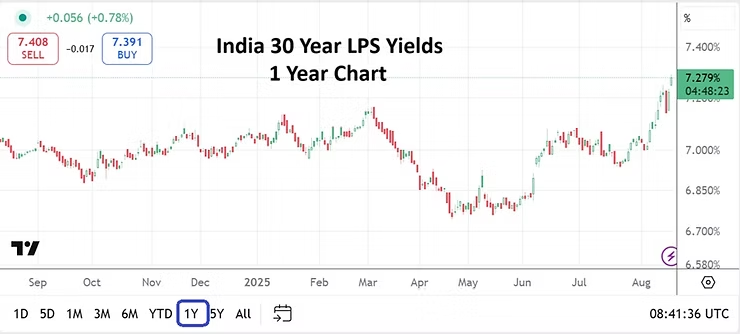
Indian Bonds 30 Year LPS Yields One Year Chart as of 19th August 2025

As trade deal discussions with Washington flounder, New Delhi is being forced to shift economic considerations towards China. The diplomatic relationship between India and China has grown colder, particularly since they clashed on the eastern border region in 2020.

Relying on China also comes with challenges for New Delhi. Since 2021, the trade deficit with China has expanded from $73.3 billion to $99.27 billion USD, showing that India still depends increasingly on China for significant importing needs.

According to Bloomberg, India’s major conglomerates have already established excellent relationships with Chinese suppliers of lithium ion batteries and EV components, although they try to discreetly tread under the radar in order to avoid the wrath of New Delhi government.

The fact is India can sustain its economy and maintain its geopolitical posture of non-alignment by practicing a multi-polar stance with Washington and Beijing. But despite clinching trade deals with the U.K and reviving trade negotiations with the E.U, New Zealand & Australia, and its deepening bilateral relationships with many central Asian nations and within BRICS, New Delhi’s major trading partner for exports remains the United States. Around 18% of India’s exports go towards the U.S, while 15% of imported goods come from China. The numbers do demonstrate an intriguing balance.

While India’s negotiations with the U.S have stalled and appear postponed indefinitely, other Southeast Asian countries, including Vietnam, Indonesia and the Philippines have secured lower tariffs with the Trump administration making them more competitive in the U.S. market. These nations are using the U.S for economic and military security, but they also rely on China for manufacturing and logistical needs.

India Faces Additional Challenges with Washington and Beijing:

Indian IT companies derive nearly 57% of their export revenues from U.S clients, making them heavily dependent on that market. And rapid advances in AI and the erosion of legacy outsourcing models are putting India’s traditional profit engines under pressure.

Meanwhile, China is not keen on helping India achieve expertise and manufacturing competitiveness which would threaten its own business model. China wants to make inroads by selling goods to the world’s largest consumer market, rather than technology transfers which would allow India to attain manufacturing supremacy.

Some economists warn that India’s own plans for mitigation of its current circumstances will likely be disinflationary. India’s bond results via yields clearly express concern about potential fiscal costs and difficulties. New Delhi’s focus has shifted towards appeasing domestic consumers, while trying to deal with uncertain foreign partners. Government capital expenditures have been declining since last year, signaling that both corporate and public investment confidence remains weak.

India’s neutrality is welcomed. It’s not anti-Western or pro-Western, and attempts to balance between the U.S and China while trying to forge new trade agreements and ties are a constant high-stakes game capable of creating strains economically and politically. The path forward with the U.S and China will remain complex and it must be worked on with precision in order to help achieve success.

post269

India Insider: Labor Productivity and Rising Household Debt

India Insider: Labor Productivity and Rising Household Debt

The desire for India to become a fast growing economy can be alluring, but without proper distribution of income and improved labor codes, this remains a major challenge to achieve. During coronavirus, acute problems were faced by those working in private enterprises. While some businesses and institutions supported their employees, many people were left behind without social protective measures.

According to Business Line newspaper analysis, from July 2022 to June 2023, an average salaried Indian male made 20,666 Rupees ($236 USD) and a woman made 15,722 Rupees ( $180 USD) per month.

Experience tells us that lower salaries in the rural areas are pervasive. Many private sector nurses, schoolteachers, and other service workers earn less than the international poverty line of $3 per day (around 250 Rupees per current Forex). Sometimes due to extensive workforce supply, some educated people must work blue collar service jobs additionally to make their ends meet.

Agriculture and Low Productivity:

Wage disparity and underemployment exists rampantly. Half of India’s labor force works in agriculture, where productivity is poor. In agriculture, farmers are both producers and consumers. There are barriers in food supply and demand for agricultural products. Farmers need access to local markets where their buyers can afford to purchase their produce. Without solid markets or better road infrastructure to reach them, many rural areas have less incentive to improve productivity.

As a result, many farmers produce low volumes. This is also one of the reasons why New Delhi is reluctant to permit U.S imports of agricultural and dairy products. Smaller farmers cannot afford to invest in education, which hinders their efforts to move into industries with higher wages. Without increasing labor productivity and better opportunities, most of the population will continue to work in agriculture.

Stagnant Wages, Informal Work and Problems in Micro-Finance:

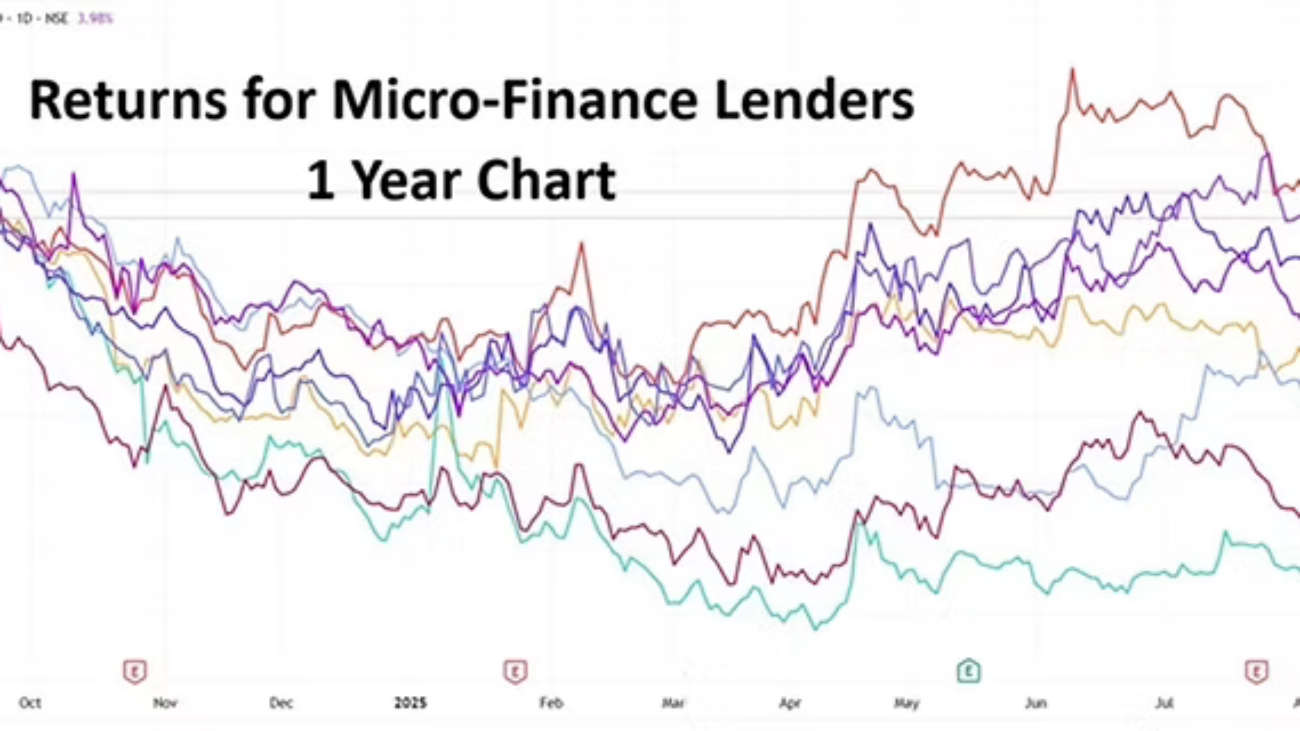
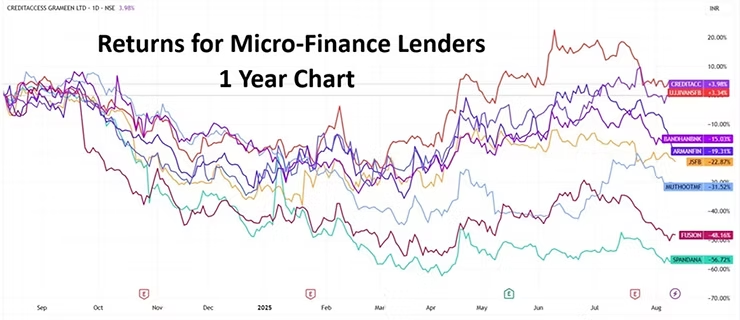
India’s Micro-Finance Lenders Culminative Returns Past Year

A large portion of the workforce is employed via informal and low-paying jobs. If wage growth does not keep pace with increased productivity, domestic consumption will remain weak, making the economy more fragile during global downturns. Drivers and gig workers provide some insights because of their inability to make ends meet. Minimum wage policies are lacking for many gig workers. Employees work higher hours in these enterprises. Yet another reason why Indian households prefer to prepare their children for government jobs.

India’s micro lending industry is under stress as delinquencies rise at an alarming pace. This has prompted the Reserve Bank of India to intervene and impose fines on lenders charging excessive interest rates. Loan disbursements shrank 13.5% year-on-year, and shares of some small finance banks have fallen, this as they have been forced to set aside higher provisions for bad loans.

Total loans outstanding in the industry are around 3.75 lakh crore rupees ($43 billion USD) in financial year 2025, with non-housing retail loans accounting for nearly 55% of total household debt. Small ticket loans were meant to ensure financial inclusion in underserved areas. The RBI defines microfinance as collateral-free loans to households with annual incomes of up to 3 lakh Rupees (approximately $3,400 USD).

But when wages do not rise in line with inflation, households begin to borrow to cover deficits, often at high interest rates. This creates risk for small finance banks when borrowers default, besides many consumers who are clearly struggling. A bank employee in Tamil Nadu has said loan disbursements are now scrutinized more closely, and applicants with monthly EMIs – equated monthly installments – above 10,000 Rupees ($115 USD) are no longer eligible for micro-loans.

Job creation in the Manufacturing:

Despite media portrayals of India’s manufacturing ascent, Harvard economist Dani Rodrik offered a compelling remark paraphrased here which points out obstacles ahead, ‘what made manufacturing a vehicle for transformational growth was its ability to generate productivity while drawing unskilled labor from traditional farming’. Rodrik seems to believe manufacturing remains a lower income sector in India due to its large work force and inability to transform efficiently, while also facing globalization problems from other Asian competitors.

The reason why manufacturing companies in India can pay lower salaries is because of high unemployment ratios and a steady supply of new graduates every year, making it easy to find new employees. Wages don’t see much improvement because workers are replaced easily. Many employees working in manufacturing actually have engineering and Masters’ degree backgrounds. Their average salary is around 15,000 Rupees a month ($170 USD), the same amount paid to low skilled employees who have technician diplomas.

India needs to work on improving core manufacturing capabilities, creating better infrastructure via land reforms and logistical capabilities. Implementing a fair minimum wage policy would also influence the economy via better household wages. Yes, inflation is a concern, but India’s aspiration to become a $10 trillion economy will remain hard to attain unless coordinated policy changes occur.

Notes: 1 USD = 87.5 Rupees

post267

Inflation Numbers from U.S and Fed Outlook, and Intel Corp.

Inflation Numbers from U.S and Fed Outlook, and Intel Corp.

Two key inflation reports will come from the U.S this week. Tomorrow the U.S CPI data will be published and the PPI results will be presented on Thursday.

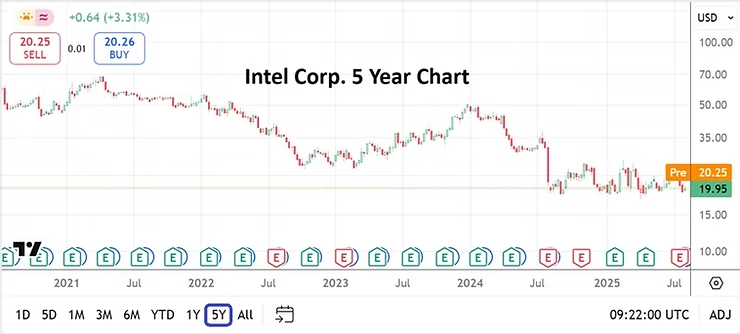
Intel Corp. Five Year Chart as of 11th August 2025

Via corporate news and perhaps effecting sentiment on Wall Street, Intel’s CEO Lip-Bu Tan is scheduled to visit the White House today. Intel Corp. closed around $19.95 going into the weekend. Intel has been a laggard in the stock market. It remains an important barometer, but its price action the past year has opened the door to consideration of the company as a takeover target – this if Intel’s boards allows its dissatisfaction of results to fester. A look at the five year chart of Intel printed above shows vast underperformance for shareholders.

Lip-Bu Tan became a target in the Senate last week because of his close business ties to China and companies there which have ‘security’ connections to the Chinese government. Intel should be watched this week. It is possible the company can produce a turnaround, but negativity makes it a questionable speculative short-term trade for pursuers. What could possibly go wrong as the Intel CEO meets with President Trump at the White House?

The USD has been weaker in Forex the past handful of days and major currencies are approaching values which clearly indicate financial houses are leaning into notions that the Federal Reserve will cut the Federal Funds Rate in September. The next Fed FOMC decision is due on the 17th of Sept. This is more than a full month from now, allowing financial institutions the ability to gamble on their cash forward positions and cause more volatility and price velocity in Forex. The fact that Donald Trump has added Stephen Miran as temporary Fed Governor adds to the ability and outlook that the Federal Reserve will become increasingly dovish. Tame inflation results from the Consumer Price Index tomorrow and the Producer Price Index on Thursday would help USD centric weakness become sustained.

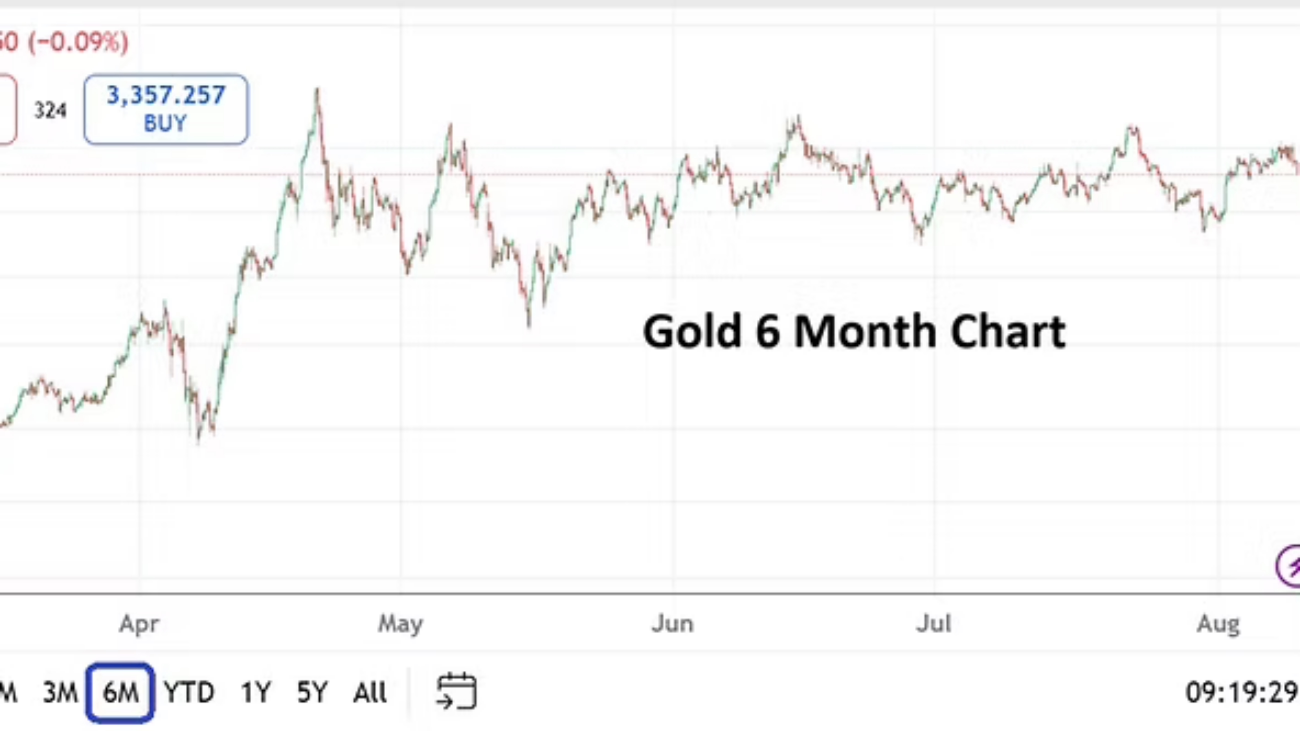
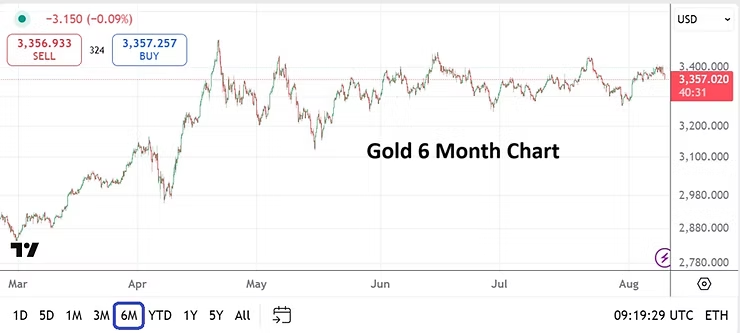
Gold Six Month Chart as of 11th August 2025

Gold near $3,355.00, Bitcoin around $121,500.00, GBP/USD close to 1.34580 as of this writing.

U.K will publish GDP reports on Thursday, last week the Bank of England lowered their Official Bank Rate to 4.00%