An Expanding Axis - Will Egypt and Pakistan Become Members?
Opinion: The following article is commentary and its views are solely those of the author. This article was first published the 26th of May via The Angry Demagogue.
China seems to be taking advantage of the transition from the Obama-Biden appeasement based foreign policy to the Trump commercial based system. Whereas Obama-Biden had no problem punishing allies that dared to oppose the US-EU appeasement and woke revolution, Trump is looking to create alliances based on commerce – and threatens allies that don’t go along. While the Obama-Biden policy failed utterly and arguably caused the wars in Ukraine and the Middle East, the Trump administration seems to be playing for time as it restructures the global security order.
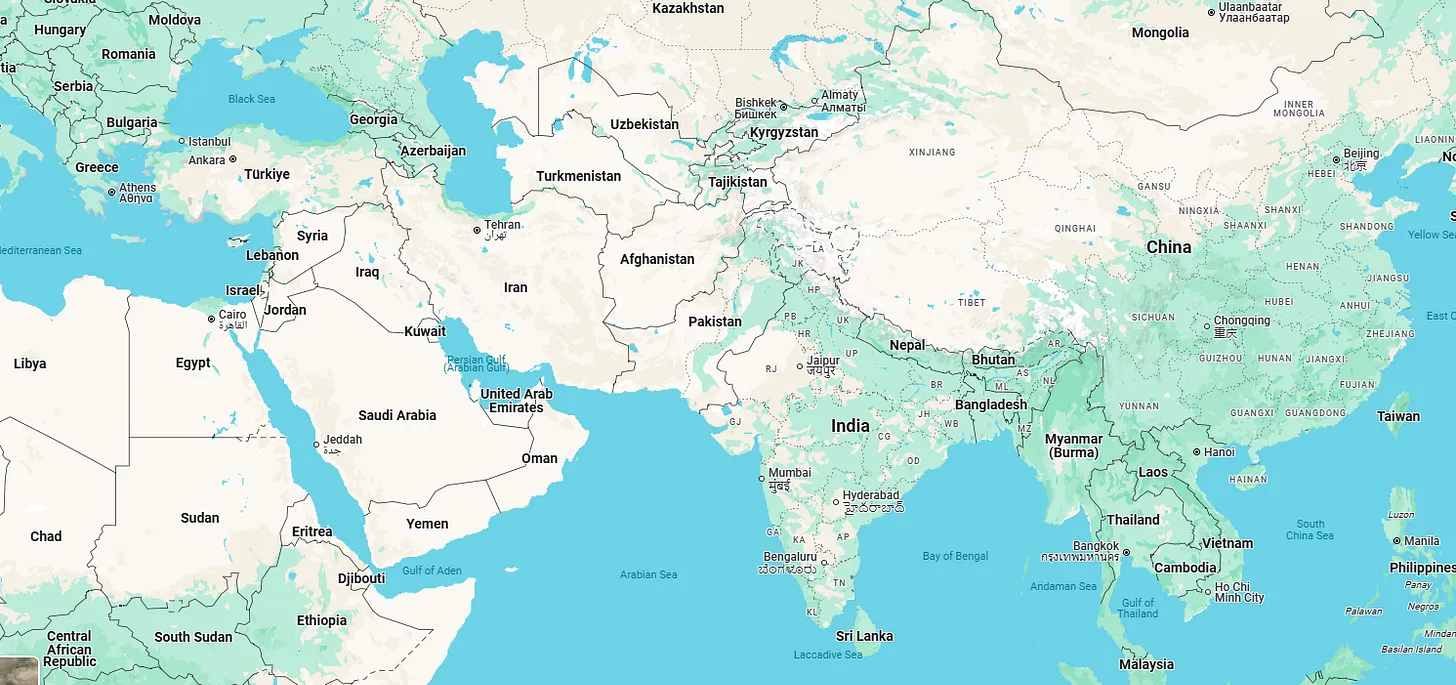
China however does not seem to care to wait and are stretching their sway not only in the South China Sea but westward towards the Middle East. The four member Axis – Russia, China, Iran and North Korea seems to be expanding to other countries with strong military dictatorships. Egypt and Pakistan will be the next members of the Axis. While much of China’s belt and road policy deals with bankrupting poor, weak countries, they seem now to concentrate on strong military dictatorships. Egypt and Pakistan are being pried from the western camp as we speak.
Pakistan has, for awhile not been firmly in the western camp. It was a cold war U.S ally as India, while democratic, sided with the Soviets on most international issues. While the US was busy in Afghanistan, the Pakistanis played double agent. Now that the U.S is not in the region and the U.S and India have become closer, Pakistan is now firmly in the Chinese camp.
In addition to Pakistan, Egypt becoming the next major member of the Axis.
Let’s take a few steps back and examine the burgeoning relationship between Egypt – a military dictatorship and Communist China. As we have written China and Egypt had joint military maneuvers that included deliberate violations of the Egyptian-Israeli peace treaty guaranteed by the United States. Egypt, in thumbing its nose not only at Israel but at the United States, allowed Chinese planes to approach the Israeli border in order to test Israeli reaction to a possible invasion. Multiple Chinese military cargo jets flew in undisclosed hardware in the days leading up to the maneuvers.
Three more Chinese Y-20 cargo planes landed in Egypt last week again, carrying unknown hardware. At least one of these planes came from Pakistan. Egypt also seems to be signing major arms deals with France as Macron reeks of desperation in his attempt to remain relevant – but a de Gaulle he is not, and he will not be able to create a force or policy independent of the U.S. Egypt will be glad to take advanced French weaponry while it creates a stronger alliance with China.
Back to Pakistan one has to wonder if the Pakistan-Indian flareup a prelude to what can happen in other theatres – or worse, a purposeful conflagration to test Chinese weapons systems in actual combat and keep the West on its back feet? According to most reports they were able to shoot down between 3 and 5 of France’s most advanced Rafal fighters without even entering Indian territory. The confrontation started with a heinous terrorist attack against Indians in Kashmir by a terror group associated with the Pakistani armed forces. India claims that Pakistan is directly involved in the attack. If so, this would not have been the first one.
The downing of the Indian French built Rafal fighters by Pakistan’s Chinese produced 10-C was, according to expert reports, not just or even mainly superior piloting but with a Chinese strategy and technology that includes all aspects of air power – including recognition of the target, locking on and attack from distances in what an American air expert called a perfect air based killing machine. This would seem to be the first real test of Chinese advanced air-power and it something that needed to be done before any invasion of Taiwan. This may not test their own pilots but it does test the strategy and the technology.
China has a main medium term goal here and it is not a secret. They are planning to take Taiwan by force and need to make sure their soldiers, sailors and hardware are up to the job. They have seen how poorly the Russian army has performed and have seen how Israel has dismantled Iran’s defenses and swatted away Iran’s offensive attacks. China has not fought a major war for decades and for all the advances they say they have made – all have been untested. Until now.
China will not risk a war with India itself but would be more than happy to have its proxy involved. Chinese fighters and their new “over the horizon” missiles are key in their plans to deter the U.S from defending Taiwan – or in defeating U.S naval airpower if the U.S does get actively involved. However, as close as French technology is to America’s it is not the same and the one country that seems to have taken U.S technology to the next level is Israel. How would Chinese weaponry due against American arms in the hands of an air force equivalent in skill and bravery to the American air forces? That has yet to be tested but that brings us back to Egypt. Is it in China’s interests for Egypt to make a major break with the U.S at China’s urging much as they made a break with the Soviet Union at America’s urging? Of course. Would that mean that China might help Egypt provoke a military confrontation with Israel in order to test Chinese arms and relieve pressure on Iran? Maybe.
On to Iran then, where it does not seem that the Americans or Israelis understand the nature of the Iranian-Chinese relationship. Not only does China get the bulk of its oil (subsidized) from Iran but they have just completed a rail link from Xinjiang, China to Teheran, Iran – running through four countries. This rail line can ship oil as well as other cargo, cutting into the American (and Indian) naval superiority around the Persian Gulf and Indian Ocean. The assumption by military planners has always been that the U.S can cut off Chinese access to oil, if necessary. That is no longer the case.
China is not standing still – they are expanding their axis of dictatorships to countries in which the army is in control. Pakistan and Egypt qualify. Iran, while a theocracy is controlled by the Iranian Revolutionary Guards. No matter the “deal” that the Trump administration negotiates with Iran they will not be pried away from Iran. China has more to offer an ideological dictatorship then commercial deals with the United States. What the alleged realists in foreign policy refuse to understand is that dictatorships have no interest in commercial success if it weakens their grip on power. They are interested in deals that enrich their regimes since that also strengthens their grip on their people.
The trillion of so dollars in deals that the U.S has now made with the Persian Gulf states ensures that America remains a player in the middle east. Those who think that the Mideast is a tertiary region at best – after Asia and South America – need to rethink their strategies. As China closes in on control of the world from the Pacific to the Mediterranean the U.S is left with just two military powers it can depend on – Israel and India – to help defend its old/new commercial interests. It is not only oil – it is not Boeing jets, Nvidia chips and many other products that are moving from the US to the Gulf as opposed from the Gulf to the U.S. The U.S is no longer a commercial client of the Gulf states but the country who needs to protect its clients. The relationship has changed but the security relationship has only gotten more important.
The addition of Egypt and Pakistan to the Axis means that the Chinese threat has expanded. They are not giving up on Taiwan, nor are they giving up on South America and the Pacific Ocean but rather, China is using its experience as a dictatorship to strengthen ties with other freedom hating countries. We can all pretend that values and culture don’t matter, but that doesn’t mean that they don’t. This Axis is one where the interest of each member is to stay in power, force its will on its people and enrich itself at the expense of its people. This is an Axis, not only of the unfree, but of those who need to eradicate freedom to “thrive”.
Disclaimer: the views expressed in this opinion article are solely those of the author, and not necessarily the opinions reflected by angrymetatraders.com or its associated parties.
You can follow Ira Slomowitz via The Angry Demagogue on Substack https://iraslomowitz.substack.com/