postN3.1

India Insider: Working with the West as it Deals with Others

India Insider: Working with the West as it Deals with Others

India’s Prime Minister Narendra Modi visited Tianjin, China for the 2025 Shanghai Cooperation Organization Summit in early September, which was attended by over twenty nations. Before India visited the conference in August, Washington D.C had already imposed a 50% punitive tariff on India’s exports. The initial tariff was a 25% duty, but included another 25% penalty because India purchases a large amount of Russian Oil, which the U.S seeks to reduce. An uneasy trade dilemma looms for India.

Many Western analysts quickly concluded that Prime Minister Modi was tilting India towards a stronger relationship with the Russian and Chinese camps, by potentially embracing warmer associations with Presidents Vladimir Putin and Xi Jinping, and defying Washington’s previous warnings.

Yet, the trade composition and the underlying reality highlights a different story. Despite India being positioned in the global South politically, the nation recognizes its higher value exports – which include textiles, gems and jewelry, apparel, and pharmaceuticals are primarily sold to the West. The United States clearly remains India’s biggest consumer. In essence President Trump holds a trump card.

In contrast, China’s total exports to the global South (excluding Western Europe, Australia, New Zealand, and North America) has doubled since 2015. Chinese exports to the U.S were $525 billion USD in 2024, but to the global South, China’s exports grew to nearly $1.3 trillion USD.

As Professor Michael Pettis accurately points out, “countries with expanding trade surpluses with the U.S, use their higher revenues to fund deficits with the rest of the world.”

India Exports More to the West:

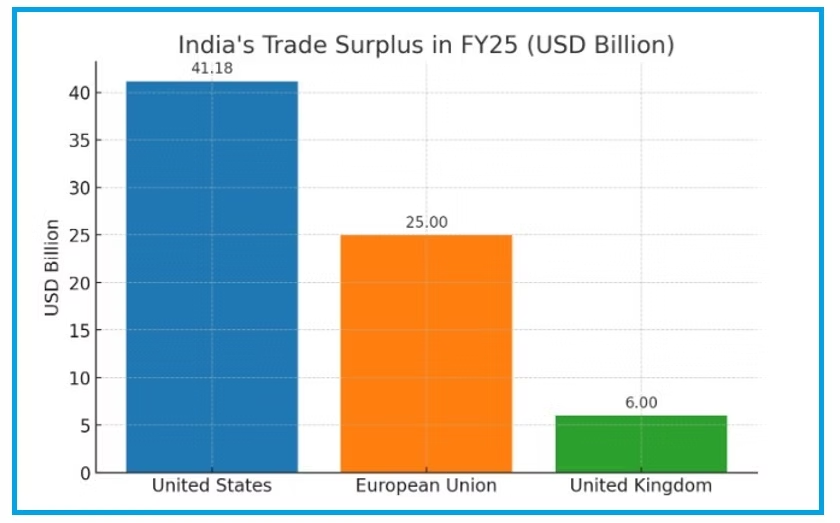
India’s trade surplus with United States, the European Union and U.K stands at $72.18 billion USD. If India wants to be competitive with China in terms of manufacturing, it should affiliate more astutely with the Western camp.

Dependence on Anti-Western Countries Hurts India’s Trade Balance:

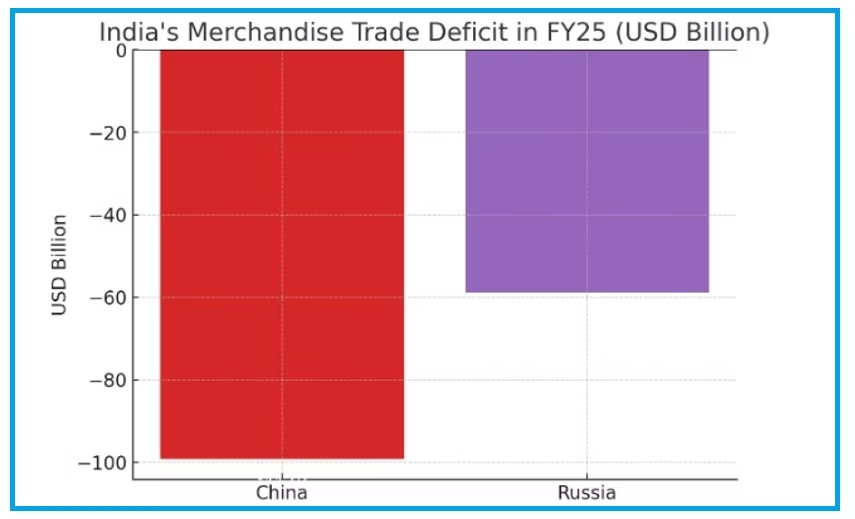
India’s combined trade deficit with Russia and China is approximately $158 billion USD, which demonstrates how much less India exports to these two countries. India’s overall merchandise trade deficit is $282 billion USD, with a deficit of almost 56% in total attributed to Russia and China.

Service Exports a Crucial Metric in India’s Balance of Payments:

India’s services exports stood at $383 billion USD in financial year 2025, earned primarily from the U.S and other Western countries. Washington has imposed tariffs on India’s tradable goods sector, while the nation’s non-tradable sector has been operating without much stress.

India’s overall trade deficit stood at minus $94.26 billion USD in financial year 2025. Without service exports (predominately from the software services sector), India’s current account deficit would be much larger and the Indian Rupee would face greater depreciation pressures.

India’s economic stability is precarious, equilibrium needs to be found. Solid domestic outcomes for manufacturing and a stable Rupee, including exchange rates, could be achieved with a well-defined calibration that looks West but does not weaken India’s stance as a non-aligned nation. New Delhi should focus on maintaining neutrality and strategic autonomy.

While India may shake hands with Presidents Vladimir Putin and Xi Jinping, an important economic lifeline runs firmly through Washington, Brussels, and London. Crucial negotiations are said to be taking place between Prime Minister Narendra Modi’s team and President Trump’s White House behind closed doors. New Delhi could become vulnerable if it does not find adequate solutions. President Trump has recently reiterated his friendship with the Prime Minister Modi, perhaps an agreement can be produced in the mid-term.

postR166

T20 World Cup 2024: New Cricket Contenders and Shifting Powers

T20 World Cup 2024: New Cricket Contenders and Shifting Powers

The 2024 T20 Cricket World Cup has unfolded as a fascinating saga of unexpected performances and shifting dynamics. Hosted jointly by the United States and the West

Indies, this year’s tournament has been a platform for emerging teams to shine and traditional powerhouses to stumble. Here’s a look at the highlights, surprises, and

predictions as the tournament enters the next phase of Super 8s.

The 2024 T20 World Cup has seen newer teams stepping up their game, bringing fresh excitement and proving that they are no longer mere participants but serious contenders on the global stage.

Nepal: Nearing a Historic Upset

Nepal’s match against South Africa was a nail-biter, showcasing their evolution at the international level. Despite being up against a seasoned and formidable South African side, Nepal pushed their opponents to the brink, almost clinching what would have been a historic victory. This performance underscored their potential and the growing depth in their cricketing skills.

Namibia: Close Calls and Narrow Losses

Namibia’s participation in the World Cup has been marked by tight contests and commendable efforts. They came close to winning on few occasions, showing that they are not far from breaking through to the next level. Their ability to compete closely with more established teams speaks volumes about their preparation and potential for future tournaments.

Scotland: Dominating Giants

Scotland has been a revelation, delivering top performances against some of the tournament’s biggest teams. Their matches against England and Australia were particularly impressive, where they played with confidence, proving that they are a force to be reckoned with in the T20 format.

USA: A Wild Card with a Wild Ride

As co-hosts, USA received a wild card entry into the tournament and seized the opportunity with both hands. They stunned Pakistan with a remarkable win and pushed India to their limits in a well contested match. Their spirited performances have been a breath of fresh air in the tournament. However, despite their on-field success, it remains uncertain whether these efforts will translate into a broader interest in cricket within the United States. The sport still predominantly attracts expatriate communities, and it will take more than a few wins to embed cricket deeply into American culture.

Oman, Uganda and Papua New Guinea: Learning the Hard Way

For teams like Oman, Uganda and Papua New Guinea, the World Cup has been a tough lesson in the rigors of international cricket. The disparity in skill and experience was evident as they struggled against seasoned opponents. However, participating in such a high-level tournament provides invaluable exposure and learning opportunities,

which are crucial for their development.

Netherlands, Canada and Ireland: A Nothing Tournament

Netherlands, Ireland and Canada have been on the Associate level circuit for a while. In fact, Ireland and Netherlands have played in past international tournaments and caused upsets. Who can forget Netherlands knocking out the giant South Africa at the last T20 world cup. Unfortunately, these 3 teams played mediocre cricket. Although not many expected them to win games, they were certainly expected to give a decent fight. That of course did not happen.

While emerging teams have shown promise, some traditional cricketing powerhouses have surprisingly struggled, failing to live up to their reputations.

New Zealand, Pakistan, and Sri Lanka: A Rough Road

New Zealand, Pakistan, and Sri Lanka have faced unexpected challenges, each failing to advance to the next round. Their early exits are a stark reminder of the unpredictable nature of T20 cricket, where even the most experienced sides can falter. These teams have not only lost games but also a bit of their aura as formidable opponents in the shortest format of the game.

Afghanistan and Bangladesh: Rising Up the Ranks

In contrast, Afghanistan and Bangladesh have played admirably, securing their spots in the next round. Their performances suggest a shift in the balance of power within the cricketing world. Both teams have shown resilience and skill, stepping into roles traditionally occupied by the likes of Pakistan and Sri Lanka.

England: Living Up to Expectations

England, known for their aggressive and adaptable T20 style, have lived up to their billing. They have performed consistently, leveraging their dynamic approach to secure


their place in the next stage of the tournament. Their ability to play fearlessly under pressure continues to make them a formidable T20 side.

The Dominant Forces

As the tournament progresses, the established giants continue to dominate, reaffirming their positions as the top teams in the world. India, South Africa, Australia, and the West Indies have each topped their respective groups, showcasing their strength and depth.

These teams possess a blend of talent, experience, and aggression that makes them formidable opponents.

India: Combining tactical acumen with explosive batting and a versatile bowling attack, India has consistently outperformed their rivals.

South Africa: Despite their scare against Nepal, South Africa’s robust team dynamics and skilled lineup have seen them through to the top.

Australia: Known for their relentless competitiveness, Australia has continued to display their dominance with powerful performances.

West Indies: Leveraging their home advantage, the West Indies have played with flair and confidence, making the most of familiar conditions.

The Home Advantage: West Indies have the Upper Hand

With the remaining games scheduled in the Caribbean, the West Indies have a significant home advantage. Their familiarity with local conditions, coupled with enthusiastic home support, positions them strongly as favorites to lift the trophy. While all four group leaders are strong contenders, the West Indies’ home advantage could be the crucial factor tipping the scales in their favor. Given their current form and the benefits of playing on familiar grounds, they are poised to be the team to beat in this year’s tournament.

The 2024 T20 World Cup has been a spectacle of emerging talent and unexpected twists. As newer teams rise and traditional powers recalibrate, the tournament highlights the dynamic and ever-evolving nature of T20 cricket. Whether this year’s surprises will lead to lasting changes in the cricketing landscape remains to be seen, but one thing is certain: the excitement and unpredictability of T20 cricket continues to captivate the fans.

postN77.1

Forex: Behind the Curtain as Speculative Deja Vu Strikes

Forex: Behind the Curtain as Speculative Deja Vu Strikes

Friday jobs reports came in stronger than anticipated on the surface, and this led to a roller coaster like ride for Forex traders as results were acted upon by financial institutions. However, a look behind the data shows ‘positive’ results were spurred on by part-time hiring and government influences leading to a notion that jobs numbers were not exactly a ray of sunshine regarding U.S economic health. The suspicious results cause a desire to look for ulterior motives, and to wonder if election year politics are playing a role in the U.S employment picture.

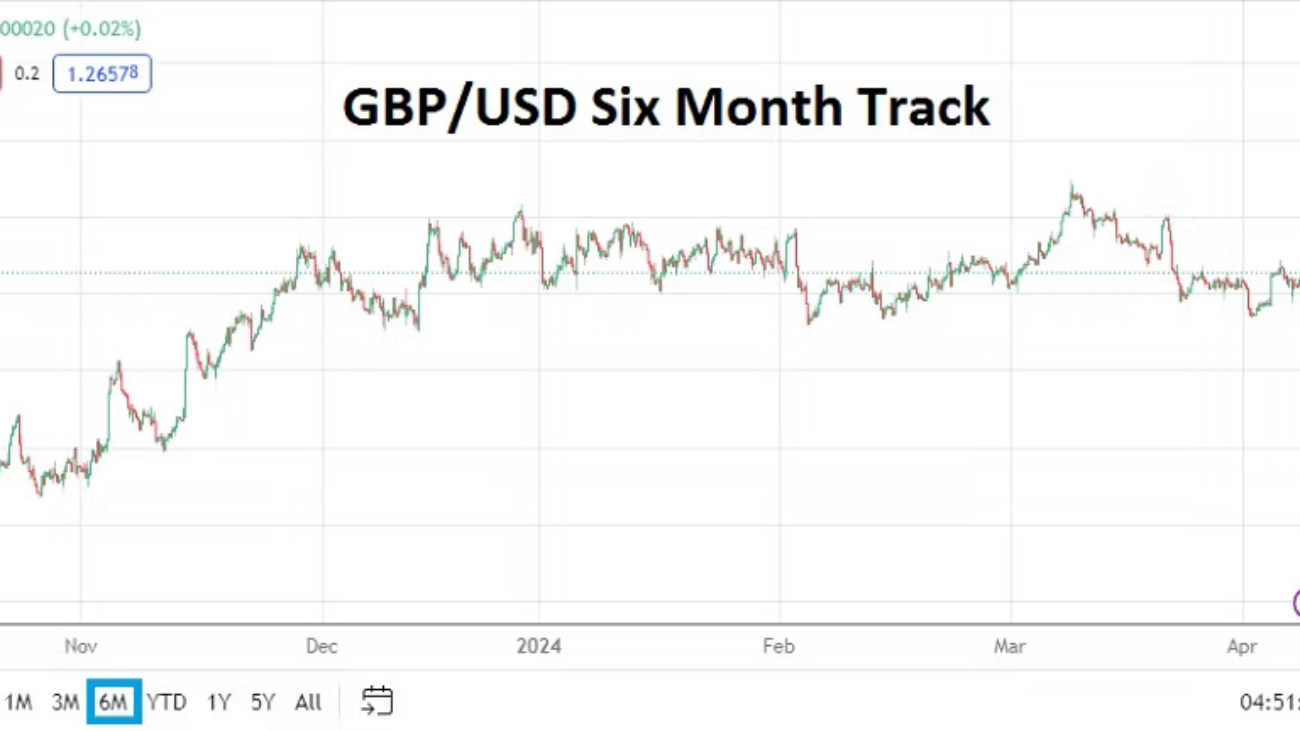
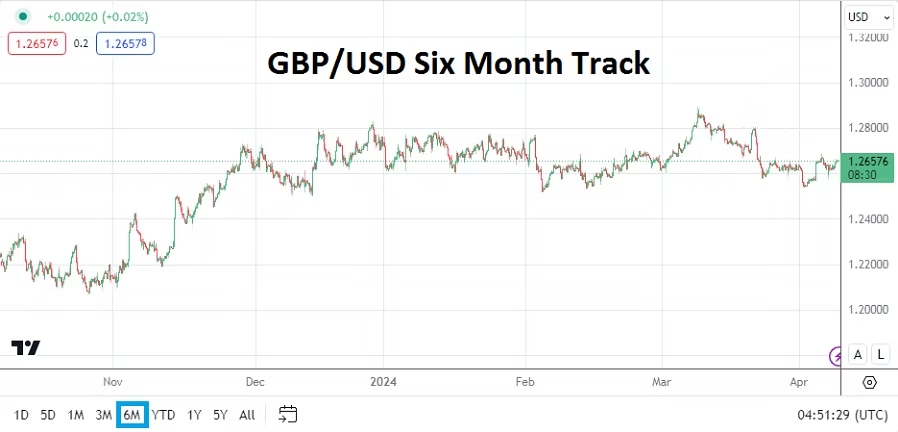
GBP/USD Six Month Chart as of 9th April 2024

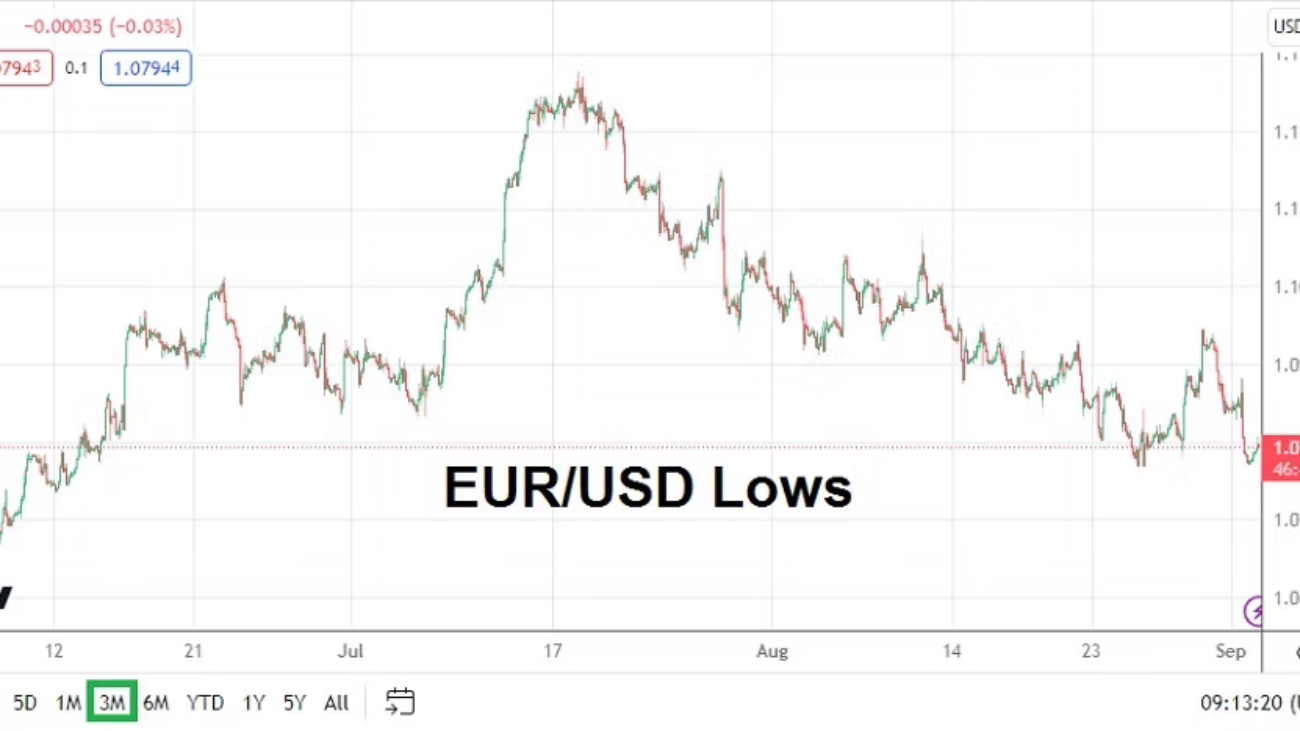
The GBP/USD and EUR/USD are rather insightful for technical and fundamental traders. The currency pairs are languishing as of today’s values near pricing that was seen in the second week of December. Since the ‘announcement’ from the U.S Federal Reserve on the 13th of December that a change in monetary policy would begin to occur in 2024, in actuality nothing has really happened, except government ‘speak’ trying to sound as if everything is understood and in control, while it is clearly not.

Economic data from the U.S and Europe has continued to be soiled by mixed results, and retail speculators looking for a trend to emerge have had to deal with choppy conditions. Financial institutions remain unclear about interest rate outlooks. The Fed while trying to ‘sound’ dovish rhetoric remains locked within a Google engine keyword mantra as they mutter the phrase ‘over time’ when trying to convince people that interest rates will ‘eventually’ be cut.

Last week leading up to the Non-Farm Employment Change numbers, many FOMC members were offering cautious tones about the Federal Funds Rate and warning it should not be changed yet. The implication of the Fed’s verbiage could lead some to suspect they have all practiced statements handed to them by their overlords who are concerned this is an election year and jobs are in jeopardy.

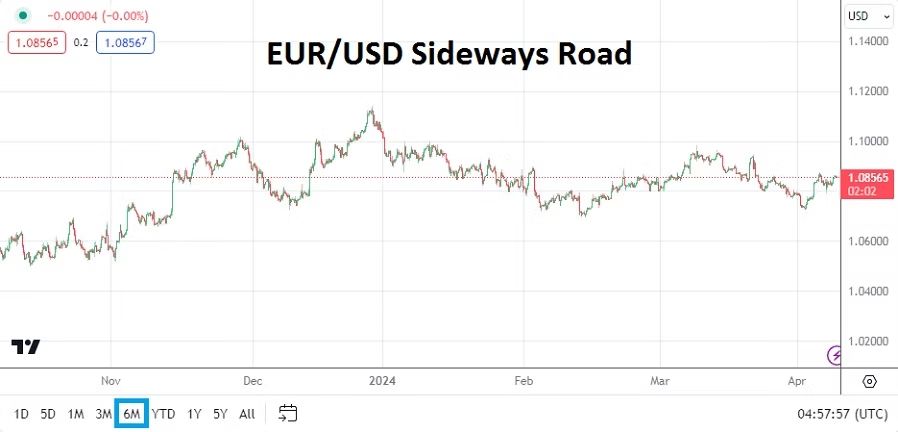
EUR/USD Six Month Chart as of 9th April 2024

Which leads us back to Forex and all financial assets, as investors try to swim waters which have left fundamental perspectives grasping at data which is not easy to decipher. U.S government policy is practicing fiscal spending that is causing massive debts, and perhaps influencing hiring data which may be more akin to putting lipstick on a pig. Many U.S voters seemingly lean towards electing officials who promise to hand out the biggest ‘social rewards’, while ignoring there will be a price to be paid down the road.

The Federal Reserve in the meantime tries to sound optimistic about inflation eroding, but concerns due to U.S government debt being accrued, and global geopolitical affairs combined with energy policy which is making it more expensive to maintain cheap transportation, efficient agriculture and manufacturing, shadow the Fed’s hopes. WTI Crude Oil remains over 86.00 USD per barrel. Gold is trading at record high values and above 2300.00 USD. Does anyone see the dangerous connections? Equity indices should be watched as a barometer this week.

USD/JPY Six Month Chart as of 9th April 2024

Monday, 8th of April, Japan Average Cash Earnings and Economic Watchers Sentiment – yesterday’s reports matched expectations regarding wages, but workers surveyed noted their concerns about incremental inflation which is being seen in Japan. The USD/JPY is challenging November higher values and the Bank of Japan has been widely criticized for not raising interest rates more aggressively. However, it is possible the BoJ wants the Japanese Yen to remain within its weaker price range to spark a stronger Japanese economy via exports.

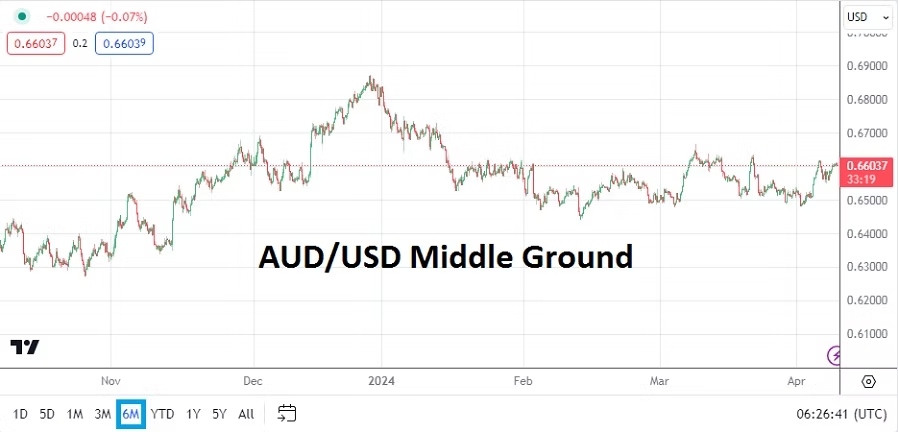
AUD/USD Six Month Chart as of 9th April 2024

Tuesday, 9th of April, Australia Westpac Consumer Sentiment – the results via the consumer reading came in negative. The AUD/USD like the GBP/USD and EUR/USD is traversing values tested in the second week of December 2023, leading to the feeling of deja vu.

Wednesday, 10th of April, U.S Consumer Price Index – you have heard this before, the inflation reports from the States are going to rattle the financial markets including Forex. The USD is certain to react. Data from the U.S has produced surprises aplenty in the past few months. The Consumer Price Index is important and day traders certainly need to pay attention.

Thursday, 11th of April, European Central Bank – the ECB is not expected to change its Main Refinancing Rate, but many analysts believe they should cut borrowing costs. However, the ECB will likely remain within the camp of choosing to ‘wait and see’. The ECB Press Conference with Christine Legarde has widely become regarded as an opportunity for political speech as much as an economic dialogue. Recent data from the European Union suggests the worst of the recessionary cycle is gone, but German Trade Balance numbers released on Monday were negative, highlighting hurdles remain. Inflation is a worry, and a cut to the interest rate might be able to help spur on economic activity while counting on lagging data to prove proactive policy should be implemented. But this likely is not going to happen and the EUR/USD will remain problematic.

Thursday, 11th of April, U.S Producer Price Index – these slew of reports should be watched carefully. If the data is stronger than expected it is likely a part of the residue caused by higher energy costs that have affected logistics and created more expensive raw materials which are needed to produce goods. It was the higher PPI reports last month that caused dramatic tidal shifts in Forex, speculators should brace for the potential of additional mayhem.

Friday, 12th of April, U.K Gross Domestic Product – last month’s GDP numbers from Great Britain came in slightly higher than expected with a 0.2% gain, this report is anticipating growth of only 0.1%. Traders should take a deeper look at the statistics upon publication and check for revisions to past months. The U.K economy has been struggling, the ‘growth’ results will affect the GBP/USD before going into the weekend.

postN51

AMT Top Ten Miscellaneous Musings for the 17th of November

AMT Top Ten Miscellaneous Musings for the 17th of November

10. Book: The Art of War by Sun Tzu.

9. Music: Pablo Casals playing Bach’s – The Six Cello Suites.

8. Cricket: India and Australia will meet in the World Cup Final this Sunday in a match between two of the world’s best squads.

7. Gold: The precious metal is trading within sight of its October highs and may find speculative buyers looking for potential upside via wagers.

6. Commerical Real Estate: WeWork bankruptcy knock on effects will cause additional strains in U.S market, this as the sector struggles with vacancies in this era of ‘remote’ employees.

5. Risk Appetite: U.S equity indices are at three month highs, U.S Treasury bond yields at one week lows as optimism grows in the outlooks of long-term investors.

4. Data Watch: Retail Sales numbers from the U.K, and U.S Housing Starts and Building Permits statistics will be released today.

3. USD: Dollar Index futures are trending lower and near values last seen in the third week of September as financial institutions brace for a weaker USD mid-term.

2. U.S Treasuries: Yields are incrementally declining, helping push the USD lower, and creating positive equities momentum, this as U.S bonds appear ready to sustain a cycle lower if investors can remain tranquil.

1. Federal Reserve: Inflation data via the CPI and PPI were weaker than anticipated, and the U.S Fed’s December FOMC Statement should begin to sound less agressive.

postN55

ICC Men’s Cricket World Cup 2023 – Thoughts and Predictions

ICC Men’s Cricket World Cup 2023 – Thoughts and Predictions

The 13th edition of the ICC Men’s Cricket World Cup is scheduled to commence in October 2023, featuring a total of 48 thrilling matches. This tournament holds the prestigious title of being the “flagship event of the international cricket calendar,” according to the International Cricket Council (ICC). India has the honor of hosting this edition, a choice that aligns well with India’s global prominence. This decision gains added significance in a year when India became the world’s most populous nation, and its GDP growth rate ranks among the fastest of any major economy.

The sport of cricket has expanded its footprint across the globe, being embraced by numerous countries. However, in this edition, only 10 teams will participate, a deliberate choice to maintain the intensity of the matches. Eight out of these 10 teams earned their spots through the super league performance, while the final two, Sri Lanka and Netherlands, secured their places via a “world cup qualifier tournament.” It’s important to note that there are no newcomers in this edition; all participating teams have previous experience at this level.

Based on performance rankings, four teams stand out as strong contenders for a spot in the semifinals: India (ranked 1), England (2), Pakistan (3), and New Zealand (4). However, it’s crucial to remember the disclaimer from financial investment products: past performance is no guarantee of future results. The eventual World Cup winner will likely be a team that doesn’t rely solely on star players, but boasts a balanced composition with multiple match-winners. In another analogy with the financial world, it’s akin to maintaining a diversified investment portfolio, a prudent allocation strategy that can weather various market conditions and risks.

India currently holds the top ranking and demonstrated their prowess by convincingly defeating Sri Lanka in the recent Asia Cup. Throughout the Asia Cup, diverse Indian players showcased their talents in different games, highlighting the team’s depth of match-winners and individuals capable of thriving under pressure. These qualities are pivotal during major tournaments, making India a favorite to claim the World Cup. Additionally, as the host nation, India enjoys the advantage of playing on home soil, further boosting their prospects in the tournament.

England enters the competition as defending champions, having triumphed in the thrilling 2019 World Cup finals against New Zealand, a match that ended in a tie. Ultimately, England secured victory based on a technicality. It’s essential to note that this outcome in no way diminishes England’s deserving win, as the result could have swung in either direction. Since then, England has maintained their dominant form, boasting a squad teeming with players capable of leading their team to victory. On paper, this team is arguably the most well-balanced, featuring a batting lineup that combines power hitters and run accumulators, as well as a versatile bowling attack capable of delivering both pace and swing or employing a slow, stifling approach.

Pakistan’s performance often oscillates, creating a roller-coaster of emotions for their dedicated fan base. On their best days, Pakistan can outclass the favorites, but they also exhibit a tendency to falter in tight contests. In the recent Asia Cup, despite being favored, they fell short of reaching the finals due to injuries to key players and lapses during critical moments. Pakistan’s success frequently hinges on the prolific scoring by their captain, Babar Azam, and the batting prowess of Mohammed Rizwan. In the bowling department, their reliance on superstars like Shaheen Shah Afridi and Haris Rauf is evident. This dependency on specific players presents a challenge to their World Cup aspirations.

New Zealand is somewhat of a statistical anomaly, consistently producing a remarkable number of world-class players from a relatively small population. They excel in identifying promising talent and nurturing it to create high-performance athletes. Furthermore, the New Zealand team is affectionately known as the ‘nice guys’ of cricket, celebrated for their amiable nature. Like Pakistan, the New Zealand team places considerable reliance on specific players, with the batting finesse of Kane Williamson and Tom Latham, combined with the lethal fast bowling of

Trent Boult, serving as a cornerstone of their success. The success of the team will depend on these star players maintaining their form throughout the tournament.

Two teams with contrasting World Cup histories deserve attention: Australia, a five-time champion, and South Africa, a team that has never reached the finals despite its quality. Australia, while not as dominant as in the past, continues to display a solid brand of cricket. The team is currently undergoing a transition, with younger players assuming leadership roles. Recent performances may not indicate peak form, so Australia lifting the cup would underscore their commitment to process and mental training.

South Africa finds itself in a similar situation to Australia, boasting numerous talented players but struggling to maintain consistent performance. Both Australia and South Africa appear to have individual excellence, but face challenges in cohesively functioning as a team.

In conclusion, India and England emerge as the front-runners for a coveted spot in the World Cup final. These two teams showcase a balanced roster with game-changing abilities. However, the question looms: can Pakistan’s star-studded lineup carry them to the summit, or will New Zealand’s proficient athletes secure another final berth? Could Australia recreate history, or will South Africa, long awaiting their breakthrough in a World Cup tournament, finally shine on the global stage? Alternatively, could an underdog team spring a remarkable surprise? Only time will tell. One certainty remains, though: winning a high-pressure World Cup tournament requires more than just physical fitness and mental resilience; it demands unwavering heart and determination.

postN49.1

Lack of Big U.S Data this Week but Fed Officials to be Heard

Lack of Big U.S Data this Week but Fed Officials to be Heard

There will be an absence of large trading volume in many markets today, because of the U.S and Canada Labor Day holiday celebrations. Results from forex markets should be considered with a healthy dose of skepticism by day traders. If you choose to participate today, using entry price orders may protect you against the possibility of price volatility due to quiet markets having the ability to create sudden jolts.

Day traders are advised to be on the lookout for potential surges to develop on Tuesday. U.S financial institutions returning to the markets in full could possibly react to economic data from the States that they may not have acted upon yet, this as outlooks may have been reconsidered over the Labor Day weekend. Equities and indices, U.S Treasuries, and gold should get plenty of attention this week as summer trading comes to an end.

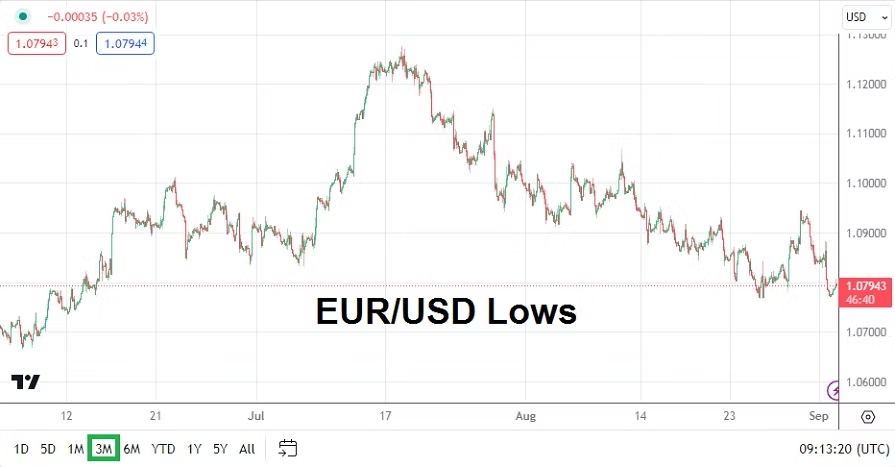
EUR/USD Three Months Chart as of 4th Sept. 2023

Monday, 4th of September, E.U ECB President Christine Lagarde – the ECB chief will be speaking in London later today. The ECB President might get the attention of EUR/USD traders who may still be scratching their heads regarding last week’s decline in the EUR and trying to figure out why it happened.

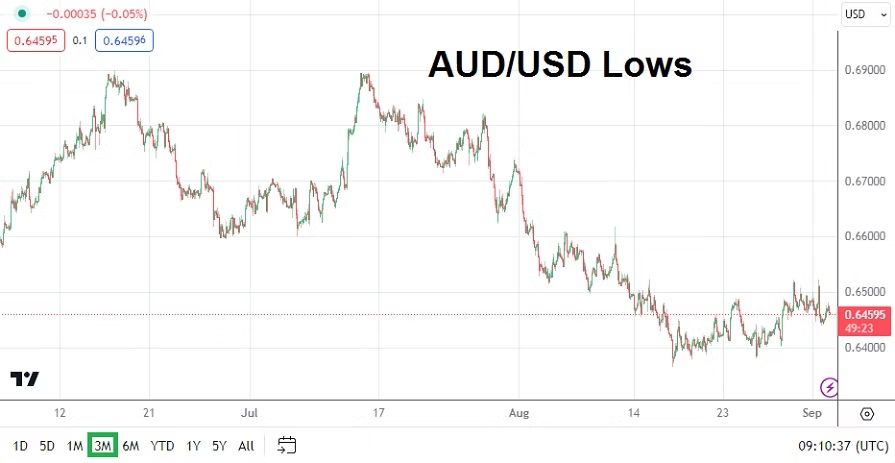
AUD/USD Three Months Chart as of 4th Sept. 2023

Tuesday, 5th of September, Australia RBA Cash Rate – the Reserve Bank of Australia is expected to hold its ground and make no major changes to interest rate policy. The AUD/USD is trading at lows the RBA has acknowledged are troubling. However, there seems to be little the RBA can really do except to wait out the U.S Federal Reserve’s rhetoric to change. As a note, GDP numbers will come from Australia on Wednesday.

Wednesday, 6th of September, Canada BoC Overnight Rate – the Bank of Canada is expected to keep its interest rate policy steadfast without any changes. The USD/CAD could react momentarily to the Bank of Canada’s Rate Statement.

Thursday, 7th of September, China Trade Balance – economic statistics from China have been troubling over the mid-term and there is no reason to think they are suddenly going to turn optimistic. China is receiving plenty of negative attention from ‘Western’ analysts, but the concerns expressed could be legitimate. Slumping growth, real estates problems, and the shadow of deflation are issues in China.

Thursday, 7th of September, U.S Federal Reserve Officials – several high ranking members from the Fed will be speaking at various conferences across the States. Following the lackluster economic data published in the U.S the past couple of weeks, comments from the Federal Reserve members should be given attention to see if they begin to acknowledge interest rate policy should turn more dovish. USD traders will certainly have the ability to spark Forex on Thursday if rhetoric from the ‘officials’ starts to change tone.

Friday, 8th of September, Japan Final GDP – the Gross Domestic Product numbers could prove interesting for USD/JPY traders. Growth is expected to show a gain of 1.4%. The GDP Price Index results should be watched and are expected to match last month’s number with a gain of 3.4%.

Saturday, 9th of September, China CPI and PPI – the inflation numbers will be of interest to investors. These data reports could prove more important than the Trade Balance results released earlier in the week. The USD/CNY should be monitored in the wake of these inflation (deflation) results.

postN24

Interest Rates, Fireworks, OPEC, Fed Minutes, and Jobs Data

Interest Rates, Fireworks, OPEC, Fed Minutes, and Jobs Data

Global day traders will certainly be able to work early this week, but they should note the 4th of July holiday in the U.S will deliver rather light volumes Monday and Tuesday. Markets in the U.S will be open on the 3rd, but speculators need to understand that price action may be flat and then experience sudden bursts of energy. Financial institutions in the U.S could be rather quiet until Wednesday.

Monday, the 3rd of July, European Manufacturing PMI – data will come from across Europe and is expected to show the sector remains rather lackluster. France, Germany, the U.K and others will issue reports.

Monday, the 3rd of July, U.S Manufacturing PMI via the ISM – the Purchasing Managers Index numbers are expected to produce a slight rise, but remain under the level of 50. However, any increase compared to last month’s outcome will be an additional sign the U.S economy is battling on and would give the U.S Federal Reserve another reason to lean towards an interest rate hike later this month.

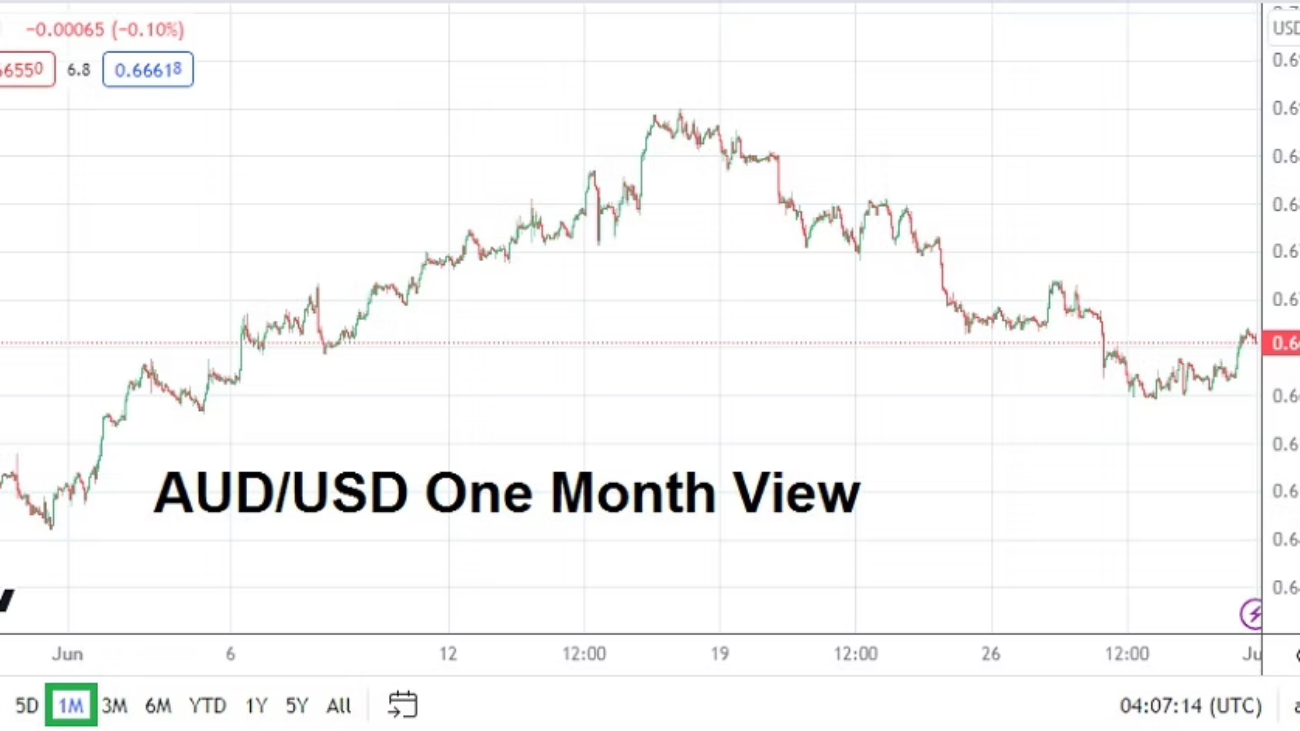
AUD/USD One Month Chart as of 2nd July 2023

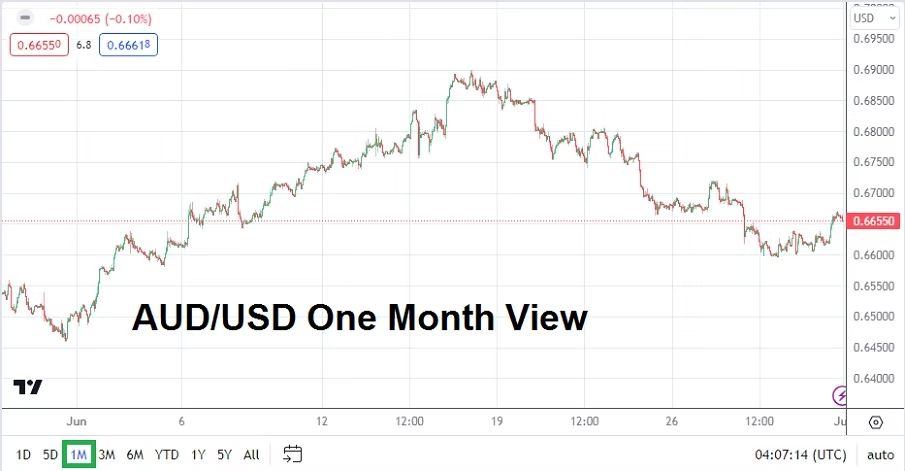
Tuesday, the 4th of July, Australia RBA Cash Rate and Statement – while some analysts assume no interest rate hike will be delivered in July because the CPI has shown a slight downturn, there seems to be rather large whispers another hike of 0.25% could be added from the Reserve Bank of Australia. AUD/USD traders certainly need to pay attention, and folks with limited funds should stay on the sidelines until the decision is released.

Tuesday, the 4th of July, U.S Independence Day – banking holiday.

Wednesday, the 5th of July, China Caixin Services PMI – economic data from China has certainly shown signs of downward pressure. A slight decrease is the expected result.

Wednesday, 5th of July, OPEC Meetings – the energy cartel will be conducting its official get together in Vienna, Austria and oil traders should be on alert for any news and decisions made public that could affect the energy sector.

Wednesday, 5th of July, U.S FOMC Meeting Minutes – the publication will provide insights into the Federal Reserve’s decision to ‘pause’ interest rate hikes last month, but could also add fuel to the notion the U.S central bank remains within an aggressive stance regarding inflation. Forex markets will react to the report.

Thursday, 6th of July, U.S Services PMI via ISM – the statistics will be monitored closely due to the rather positive outcome from the GDP report last week, which showed the U.S economy remains rather resilient. A positive outcome in the Services numbers will add further evidence for the Federal Reserve to remain hawkish.

Friday, 7th of July, U.S Jobs Numbers – the employment data will culminate as the week comes to an end with the Non-Farm Employment Change and Average Hourly Earnings figures. Yes, on the day before, Thursday, traders will also see the JOLTS numbers and weekly Unemployment Claims. However, it is the Non-Farm and wages data that financial institutions will largely react upon depending on the outcomes. Because it is a ‘holiday’ week in the U.S, the reports may find a muted response, but financial institutions will use the information to gauge their mid-term outlooks and position their assets including Forex and bonds.

postN19

Broader Alliances: Sustaining Economic and Political Power

Broader Alliances: Sustaining Economic and Political Power

The following article is commentary and its views are solely those of the author.

If the United States decides to abandon its role as the premier global superpower and shall only be a Pacific and Atlantic power, withdrawing as defender of free seas, free trade and freedom in general, its democratic allies will have to start looking elsewhere for broader military alliances. This large group of nations would have to defend their interests against a revanchist China tied to Iran, Russia, North Korea and many of the Latin American countries – possibly including Brazil, and South Africa who have questionable politics and outlooks.

Eastern Mediterranean Alliance: A Strong Sea Power

Here is a speculative, yet reasonable look at the future of the free world. Let’s start with the Eastern Mediterranean where the two major powers are Israel and Turkey. One cannot deny that both these countries outclass all others regarding military might in the region. Israel’s air force is second to none and its navy is becoming a strategic necessity as it needs to defend its natural gas fields miles offshore. It now has six submarines that are capable of projecting power anywhere in the Mediterranean and even into the Indian Ocean and Persian Gulf. Turkey is currently a NATO member, but it is not clear that this will outlast the first half of the 21st century.

There is currently an informal alliance among Israel, Greece and Cyprus (both NATO countries) via joint military exercises and intelligence sharing. The Israeli navy and air force train regularly with Greece and its special forces train in the Cyprian mountains with its army. It would be in all three countries interests to formalize a treaty – if not of mutual defense, at least of mutual aid during times of war. All three of these countries are democracies and all three have mutual economic interests.

A formalization of this alliance makes sense now and if there is a NATO collapse it turns into a necessity for Greece and Cyprus. Adding Egypt (although it would be the only non-democracy) to this group would only strengthen the alliance and keep Turkey at bay. A post-Erdogan Turkey that is comfortable with its Islamic character and its modern society could even join this grouping with Israel as a potential peacemaker between the historic Greek-Turkish rivalry.

This alliance without Turkey is a powerful force in the eastern Mediterranean, and this alliance with Turkey could neutralize a nuclear Iran. A Post-Hezbollah Lebanon which is in the interests of all of these alliance members (including Turkey and Egypt), could become a reality and another member.

A New Alignment: The United Border Nations

What about Eastern and Central Europe? Poland is rapidly becoming the major non-nuclear European military power. Within the next few years it will outshine Germany and the U.K and rival France. It is quite clear, nuclear weapons aside, Poland would probably defeat Russia in a number of weeks, if not days if a conflict were to ignite.

Whether the Russian-Ukrainian war ends in a Russian defeat or in some sort of face saving armistice, Russia will not lose its aggressive nature or nuclear capabilities and it will inevitably become aligned more closely with China and Iran because of its current political nature.

The important new alignment will be categorization of ‘countries bordering Russia’. A new alliance of Poland, Finland, Sweden, Norway and the Baltic states – Lithuania, Estonia and Latvia together would have the land, sea and air power necessary to deter and defeat, if necessary, any Russian imperialist expansion. Even with closer ties to China it would be difficult to imagine that, over the next 50 years, Russia would be a threat to this alliance. Adding Ukraine to this grouping would make a powerful force. Its joint population of over 100 million people, while not quite Russia’s 150 million – would be a formidable adversary, especially as the technological skills of these countries is first world and continuing to improve. Adding the other former Warsaw Pact countries like Czech, Slovakia, Romania, Moldova and Bulgaria can only increase its potency.

Unlike the Eastern Mediterranean alliance mentioned above, this would have to be based on a mutual defense treaty in order to properly deter any Russian-Chinese-Iranian attack. Linking up, informally with the ‘new’ Eastern Mediterranean Alliance would create a powerful grouping of free countries against any attempt by authoritarian adversaries. Adding an economic aspect to these border nations and an alliance with the Eastern Med group with free trade zones would create a strong challenge to any attempted Chinese hegemony.

Asian Border Nations Group: Potential Look Ahead at Potential

If we were to unite the Eastern Mediterranean and Border Alliances to an admittedly non-democratic Asian ‘stans nations, including Kazakhstan, Kyrgyzstan, Tajikistan, Turkmenistan and Uzbekistan with a joint population of around 80 million, we are beginning to see the creation of a multi-cultural alliance that extends from the Arctic Ocean through Central Europe, Northern Africa and into Asia.

The Crucial Partner in Order to Balance Power: India

Which leads us to the Indian Ocean; a dominant India can help control the sea lanes from the Persian Gulf to the Bay of Bengal and down to Australia. An Indian-Australian alliance, along with Israel would create a democratic economic and military force that would keep China and Iran from dominating the region. This would require an Indian navy that is not only large, but effective also because it would hold a main responsibility for patrolling the seas from the Persian Gulf up to Australia strongholds.

As India also reaches its potential as a global manufacturing giant, it will be a force to be reckoned with. Including into this potent mix of nations, is the possibility of adding authoritarian countries like Saudi Arabia and the other Gulf states; along with Thailand, Myanmar, Malaysia and Indonesia who have strong ‘western’ economic interests and would create a formidable bulwark against China’s imperialist Belt and Road project.

Without the need to project naval power worldwide the Unites States could use it massive naval, air and ground forces to take better control of the Pacific Ocean along with Japan, South Korea and Australia.

If we add countries like the Philippines and Vietnam, then China would be deterred from further aggression. The only other region that would fall under American responsibility would be the Atlantic Ocean – the shipping lanes to Europe, West Africa and the Mediterranean. Along with the UK and France there would be no challenger to the control of the Atlantic. This could also lead to a revival of the old Monroe Doctrine and maybe free South America from the destructive influences of Iran, China and Russia.

The Global Economy and Free Trade Zones with a Stable USD as Reserve Currency

What does all this mean for the global economy? The free world along with its less than free allies who fear China, Russia and Iran could still maintain a U.S dollar based world. Free trade zones amongst and between the various alliances along with a revival of manufacturing led by a technology revolution using AI, quantum computing, renewable energy and space exploration could lead to a global resurgence of free countries that could stop the authoritarian appetites of Russia, China and Iran in its tracks. This can only happen with a stable reserve currency the ‘West’ can rely upon which is the USD.

Potentially a U.S freed from being the sole defender of freedom in the world, would help get America’s fiscal house in order and allow it to focus on being a dominant economic power. Is there a future for the ‘free world’ without a United States that projects power globally? Currently, a U.S withdrawal from global military assertion would certainly cause the end of freedom (economic and political) in the world for many nations. However, with the new alliances described above and a fiscally responsible United States, freedom could yet make a comeback.

Disclaimer: the views expressed in this article are solely those of the author, and not necessarily the opinions reflected by angrymetatraders.com or its associated parties.

postN16.1

Week Ahead: Summer Begins with Questions Lurking for Traders

Week Ahead: Summer Begins with Questions Lurking for Traders

Monday, the 19th of June, China Foreign Direct Investment – data from China has been lackluster and last week’s announcement of a stimulus program from the government underscores economic concerns regarding growth.

Monday, the 19th of June, U.S banking holiday – for commemoration of Juneteenth.

AUD/USD Three Month Chart as of 18th June 2023

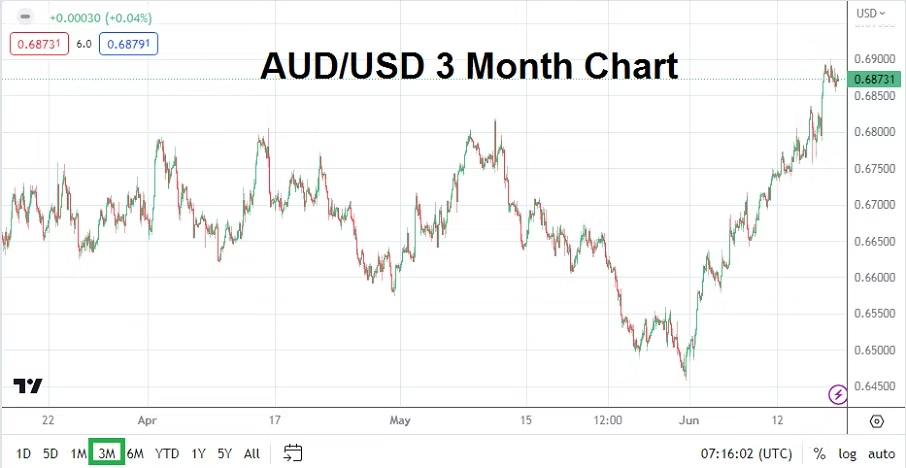
Tuesday, the 20th of June, Australia Monetary Policy Meeting Minutes – report from the Reserve Bank of Australia will interest AUD traders and those with an interest in Asian Pacific economics.

Tuesday, the 20th of June, U.S FOMC member John Willliams – as the President of the New York Federal Reserve, Williams, is a key member regarding policy. Taking into consideration last week’s pause, traders may want to pay attention to the New York Fed Presidents’s remarks to see if the pause in Federal Funds Rates seen last week is looked upon as a halt or a ‘skip’ by Williams. The difference between a pause and a skip may appear to be semantics, but a skip would mean an interest rate hike is coming in July. Williams is not going to say what is going to happen at the next Federal Reserve meeting, but he may give a hint regarding his opinion on what should be done.

GBP/USD Three Month Chart as of 18th June 2023

Wednesday, the 21st of June, U.K Consumer Price Index – the data will be important regarding inflation insights for Britain. The Bank of England is expected to raise their Official Bank Rate on Thursday by 0.25%. Another report showing stubborn inflation could set the table for a rather hawkish Monetary Policy Statement from the BoE.

Wednesday, the 21st of June, U.S Federal Reserve Chairman Powell testimony – the Fed Chairman will begin two days of speaking and taking questions. The first day will be before the House of Representatives and the second day in front of the Senate. Because a major election is coming in the U.S in 2024, this will be an opportunity for politicians from both sides of the aisle to get airtime and take a ‘stance’ while bludgeoning Jerome Powell. The Fed Chairman’s remarks could stir the markets slightly, but Powell will be as careful as possible not to put a scare into the financial sector.

Thursday, the 22nd of June, U.K Bank of England – the Official Bank Rate, Monetary Policy Summary and vote count from the Monetary Policy Committee will be released. A hike has been widely expected by GBP traders and has been factored into the British Pound already.

Thursday, the 22nd of June, U.S Existing Home Sales – the housing report will cause a few murmurs in the marketplace because it is seen as an extension of consumer health and interest rate policy in the U.S regarding behavioral sentiment. Existing home sales numbers have been dropping as people with homes have decided to stay put in their current residences. ‘Locked in’ interest rates are more attractive, instead of taking on a higher rate via a new purchase due to costlier mortgages because of more expensive borrowing fees.

Friday, the 23rd of June, E.U Manufacturing and Services PMI – the flash reports from the likes of Germany, France and the U.K should be watched. Manufacturing readings have been producing recessionary readings while Services data is expected to show incremental decreases too.

Friday, the 23rd of June, U.S Manufacturing and Services PMI – the flash reports via the Purchasing Managers Index data need to be monitored too from the States. The readings give a rather good insight regarding outlook of U.S business sentiment.

postN7

Risks Ahead: Tranquil Data Mixed with Loud Nervous Chatter

Risks Ahead: Tranquil Data Mixed with Loud Nervous Chatter

Last Friday finished with stronger than expected Non-Farm Employment Change numbers, which essentially collided with dovish rhetoric via two U.S Federal Reserve FOMC members from the middle of the week; this while inflation clearly remains stubborn in the U.S.

All of which sets up this coming week for nervous trading results and until the 14th of June, when the Federal Reserve’s Federal Funds Rate pronouncements will be brought forth. Plenty of talk about interest rates will be heard in the days ahead and traders should expect to hear debates as the chatter grows louder.

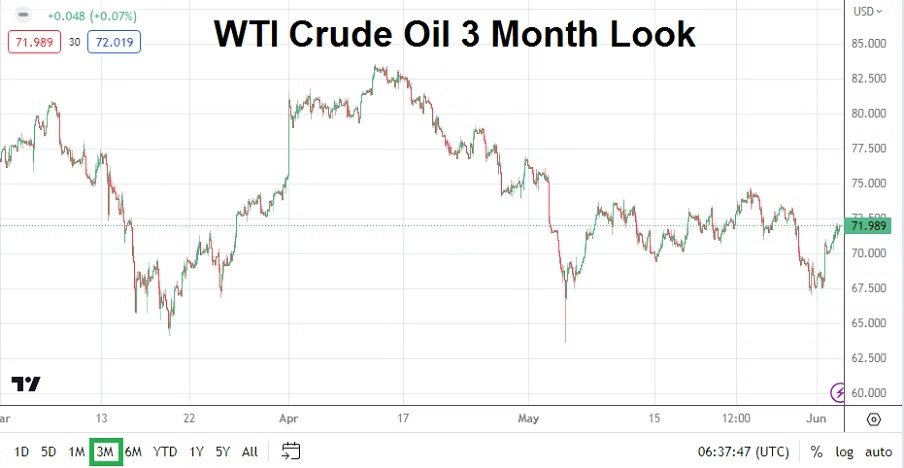
Commodity traders may be interested in the outcome of the OPEC+ meetings taking place this weekend. The cartel’s decisions regarding oil production will affect not only prices of Crude Oil futures, but is a direct reflection regarding global demand, which also tells us about the organization’s viewpoints regarding global economic conditions.

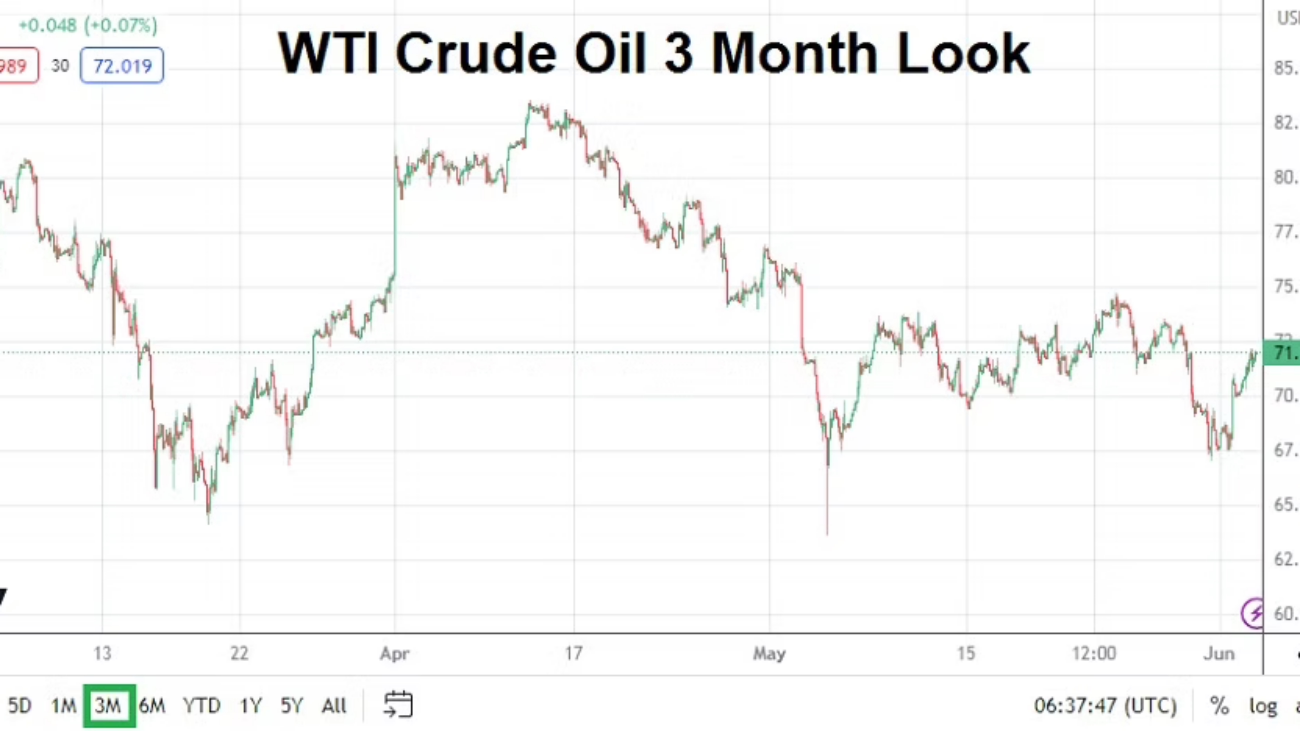
WTI Crude Oil Three Month Chart as of 4th of June 2023

Monday, the 5th of June, European Services PMI – Germany, France and Italy and will release their Purchasing Managers Index readings. The German outcome could prove interesting because the nation is suffering from recessionary pressures. The PMI results could affect the EUR/USD a bit. The U.K will also release their data too.

Monday, the 5th of June, U.S ISM Services PMI – this report will be of interest because some are expecting a better outcome compared to May’s results. A potentially strong reading could prove problematic and put more pressure on the Federal Reserve to raise interest rates next week.

Tuesday, the 6th of June, Australia RBA Rate Statement – the Reserve Bank of Australia surprised people with an increase of their Cash Rate last month. No increase is expected now, but the RBA’s rhetoric should be listened to as they comment about domestic and global economic conditions.

Wednesday, the 7th of June, Canada BoC Overnight Rate – Bank of Canada is expected to hold its borrowing costs in place, but inflation is still creeping into prices and the BoC’s Rate Statement may prove intriguing.

Thursday, the 8th of June, U.S Weekly Unemployment Claims – following in the footsteps of the stronger than expected jobs numbers last week, this report could get some media fanfare. However, it also may prove to be a lot of noise and have little real affect on market direction.

Friday, the 9th of June, China CPI and PPI – the inflation reports from China could prove interesting in wake of recent lackluster economic data from the nation. Last Thursday’s Caixin Manufacturing PMI results came in slightly better than expected, but data from China the week before was negative. The data from China gives investors and traders insights because of its importance as a global supplier of consumer products.

post28

Gut Feeling about Fed June Hike, Perhaps Wrong

Gut Feeling about Fed June Hike, Perhaps Wrong

I have a distinct feeling the U.S Federal Reserve is going to suggest via their FOMC Statement tomorrow that another increase of the Federal Funds Rate is likely going to happen in June. I could definitely be wrong, but my gut instinct is rumbling.

Inflation Remains a Sincere Problem Per the Fed’s Thinking

Wage data demonstrated last Friday via U.S Personal Income that inflation remains stronger than expected. Yesterday’s ISM Manufacturing Prices reading also spiked to 53.2 versus the expectation of only 49.4. The increases shown within these economic reports will not please the Federal Reserve.

While a hike tomorrow is nearly a certainty, the Forex market remains rather unimpressed with the potential for an increase on the 14th of June. Behavioral sentiment has shown a rather polite USD actually losing momentum the past few days. Caution has seeped into the USD today, but are financial institutions too relaxed regarding a potential hike by the Fed in June?

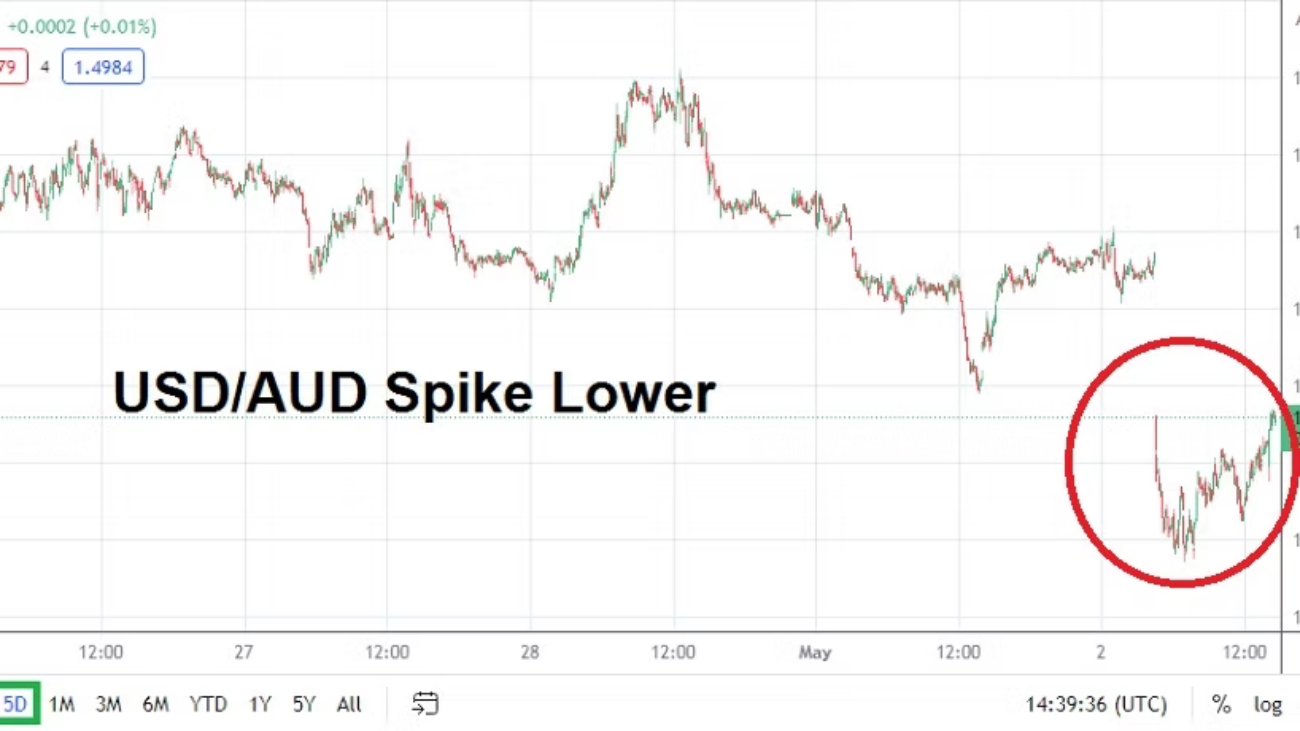
USD/AUD 5 Day Chart as of the 2nd May 2023

Reserve Bank of Australia’s Hike Earlier Today Caught Many Folks Unready

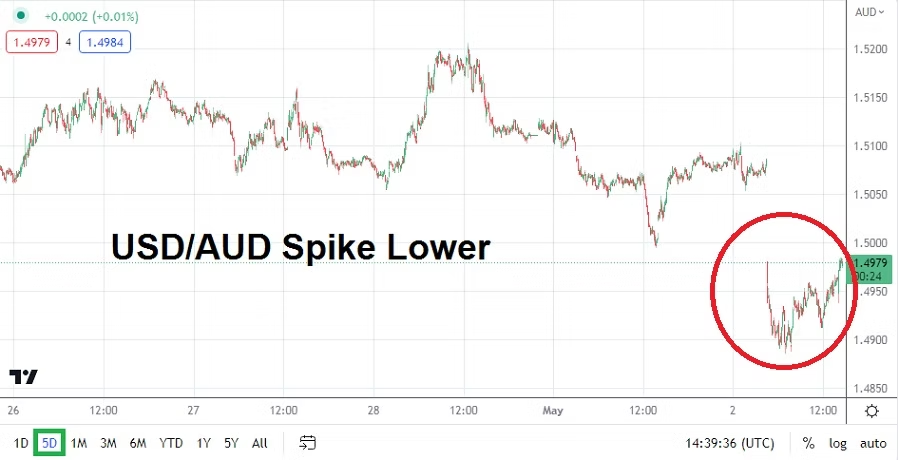
The Reserve Bank of Australia’s hike today, may be another sign the U.S Fed will not only hike tomorrow, but in June as well. What are the chances the Federal Reserve hinted strongly to the RBA, that if they wanted to protect the value of the AUD that an increase would be justified in order to guard against the Fed’s rhetoric to come? The Australian hike caught a lot of financial houses and day traders unprepared as the USD/AUD spiked lower this morning, for proof of the surprise simply look at the gap created downward today on the five day chart of the currency pair.

The RBA hiked their Cash Rate by 0.25% from 3.60% to 3.85% while sighting stubborn inflation as a main cause. Nothing is certain, but if the Federal Reserve’s FOMC Statement is rather strong tomorrow and says it will still consider a June increase perhaps we should not be shocked. Central banks do share information with one another.

Early February’s Rhetoric from the Fed wasn’t Treated Seriously at First Glance

Coincidentally, the Fed’s increase in early February was two days before the Non-Farm Employment Change and Average Hourly Earnings were reported on the 3rd of February. On the 1st of February the Federal Reserve warned that inflation remained stubborn, but the market didn’t take their words too seriously as the USD traded rather politely following the anticipated interest rate hike.

However, the USD gained violently the day after when Fed officials began to reiterate the strong tone from Fed Chairman Jerome Powell from the day before. And then stronger than expected jobs numbers followed on Friday. Note, that the Non-Farm Employment Change and Average Hourly Earnings will be published this coming Friday.

The Federal Reserve remains in a difficult position, a hike tomorrow will bring the Federal Funds Rate up to 5.25%, a June hike may not be welcomed by the broad financial markets, particularly equities in the near-term, but people may want to consider the possibility of it happening. Day traders should brace for strong price velocity developing. Tomorrow’s Forex action will be violent for speculators who are not ready, and if the Fed suggests a potential hike to 5.50% in June perhaps we should not be stunned.

post26.1

BRICS and a Potential New Currency Paradigm

BRICS and a Potential New Currency Paradigm

The BRICS nations are causing alarm in some ‘Western’ financial circles as they seek to strengthen their trading alliance reflecting their ability to be large producers and consumers. BRICS has a common goal of creating better trade and financial conditions for each other, and as a potential byproduct to possibly create an alternative to USD dominance.

While political crisis and global security concerns have grown the past few years and are causing uncertainty and instability, the strength of the USD has also caused inflationary problems for many nations including BRICS members. Cash reserve shortages of USD have become problematic and have been fueled measurably by decisions from the U.S government, Federal Reserve system and U.S Treasury. This has ignited many emerging market nations to seek dialogue about potential BRICS membership.

Alliance intrigue and concerns also shadow BRICS members often, the February 2023 naval exercise held between Russia, China and South Africa within waters near Cape Town raised anger in the United States and the European Union. The fact that the joint military exercise was held during the first anniversary of the Russian invasion of Ukraine did not go unnoticed. While no signed military alliance exists between these nations, it should be noted that Russia, China and South Africa also held a naval exercise in November 2019 also within proximity to Cape Town, South Africa.

USD/ZAR 1 Year Chart as of 28th April 2023

Formation and Agenda as Members Scoff at the ‘King Dollar.

The agenda of the BRICS nations often appears a desire to topple the dominance of the USD to those watching from outside, but is it realistic? Trading alliances are important certainly in order to create better economic stability. The BRICS potential effect on the USD is concerning, although not critically dangerous at this juncture the bloc needs to be monitored. In addition there are worries from some in the West that new military alliances could be formed, but historical and cultural differences within BRICS makes this rather questionable for the time being when contemplated in total.

BRIC was an acronym coined by then Goldman Sachs Chief Economist Jim O’Neill to identify potential opportunities for investors within emerging market nations. Members in this ‘bloc’ are countries that have begun to work in unison. About two months ago, Jim O’Neill reiterated the same refrain and alluded to the BRICS theme of suppressing USD strength and its reliance in global trade. BRIC (Brazil, Russia, India and China) was formed in 2009, and they added South Africa as a member in 2010 formally initiating BRICS. This coalition has met annually to discuss coordinated policies regarding trade, finance and investment opportunities. The next annual meeting will be held in August 2023 in South Africa. Vladimir Putin’s potential attendance at this year’s meeting is being monitored widely.

Plenty of discussions have already been articulated internationally about undermining USD dominance in global trade, but little effect has come to fruit in reality and the USD retains its moniker of ‘King Dollar’. However, countries being affected by the rise of inflation and the strength of the USD are becoming numerous and this has caused a diverse group of nations to seek conversations with BRICS leadership about being able to join the trading alliance. Iran, Algeria, Argentina, Mexico, Nigeria, Saudi Arabia, Indonesia, Pakistan, Egypt, Sudan, Syria, the United Arab Emirates, Bahrain, Turkey, Venezuela, Sri Lanka and Zimbabwe are some of the nations that have expressed interest in BRICS membership.

Impact of Sanctions on Russia and its Ability to Counter via BRICS

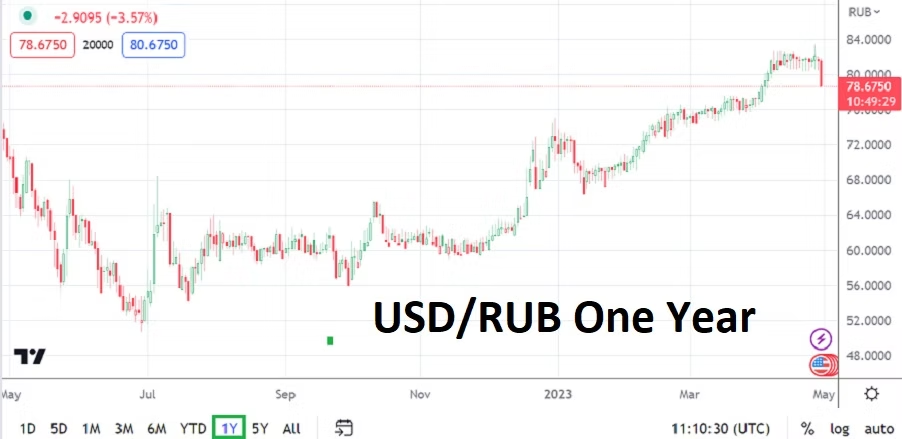
Russia has been waging a war with Ukraine for over a year and is currently under many Western sanctions. It’s been kicked out of the SWIFT banking system, which means it has limited opportunity to trade the RUB with Western countries. This in theory also limits the amount of USD that Russia can get its hands on.

Russia last year asked to be paid in Rubles (RUB) for gas and other energy purchases when dealing with E.U countries, trying to play a game of chess which largely failed. This while China too, tries to make the Yuan (CNY), a more significant currency in order to suppress USD dominance. China certainly has plenty of political and economic reasons to have the CNY emerge as a global power.

Russia has supposedly wanted to get out of Western currencies and especially the USD, this to punish the West, but will it work out and is it pragmatic? No. Russia’s attempts are high on rhetoric, but low on quantified changes thus far. The USD is far too dominant within the global banking system, and while incremental challenges to the USD have been tested, chipping away at USD strength remains difficult at best. The Kremlin has tried to inoculate itself from the pain caused to its trade balance because of sanctions, and create problems respectively for countries that oppose its invasion of Ukraine by cutting off gas supplies which were used for heating and to generate power for industrial purposes. Threatening to not allow grain to flow from Ukraine has also been a rather constant noise made by Russia.

Prices were capped on Russian energy via the G7 beginning in 2022 as a retaliatory move to limit revenues for Russia, and alternative gas agreements were sought by many European nations creating a loss of momentum for the Kremlin’s chess game. The Nord Stream pipeline was also damaged via sabotage. Russia used to supply Europe with 50% of its energy until sometime in 2021, it now provides less than 20% after Western sanctions. Russia has moved its eye towards other nations hungry for energy, ones that are not obligated to make transactions in USD, which brings BRICS into focus.


USD/RUB 1 Year Chart as of 28th April 2023

Inflation and a Strong USD have Caused Harm Globally

Inflation has caused problems across the globe following the impact of the coronavirus epidemic. The Federal Reserve, BoE and ECB have raised rates to try and cool inflation in their respective economies. This has made the USD attractive against emerging market currencies and caused capital outflows. An economic nightmare has occurred in Sri Lanka which is suffering from staggering political and economic problems the past two years, and nations like Pakistan and Egypt have been hit hard too by inflation’s impact and debt. USD reserves dwindled in these nations and they found it difficult to service their USD denominated debt in 2022, and troubles persist in 2023. Import without any USD reserves is difficult and sometimes impossible.

Russia and China as Major Players in ‘Their’ Bipolar World with ‘Friends’

Global trade is still dominated by the “King Dollar”. Almost 88% of global trade happens with the USD. The USD accounted for more than 71% of currency reserves at central banks in 2000, but has now declined to slightly below 59%. Oil and gas exports are important for Russia as these revenues constitute nearly 45% of its Federal Budget and it’s already been in deficit since February 2023, because oil revenues have slumped by half. Russia has a growing dependence on BRICS and is actively trying to get other nations to join the trading coalition, this because it has few other places to turn, and there appears to be no end in sight regarding the war with Ukraine.

Trading with other nations and signing currency agreements which would not include USD transactions is a long term goal of Russia and China, this if monetary values via the other nations currencies can remain firm. And then there is a wished for and ‘feared’ long-term dream of creating an alternative ‘super’ currency to compete against the USD.

Even before the escalation of fighting in the Russia and Ukrainian War, Russia was strongly advocating an end to USD dominance in global trade via rhetoric, particularly during previous BRICS Summits. We need to understand the political implications and complexities within BRICS, when talk of a decoupling from USD dominance news flares up. The U.S certainly keeps an eye on BRICS and so do other Western nations. At this moment South Africa has a delegation in Washington, D.C regarding the questionable South African policy behavior, particularly in light of recent military exercises with Russia and China, to try and smooth its U.S relationship. South Africa membership in AGOA, the Africa Growth and Opportunity Act, which grants special trade benefits to the nation and other members is being questioned strongly by U.S politicians. Getting kicked out of AGOA would cost South Africa billions of dollars in aid.
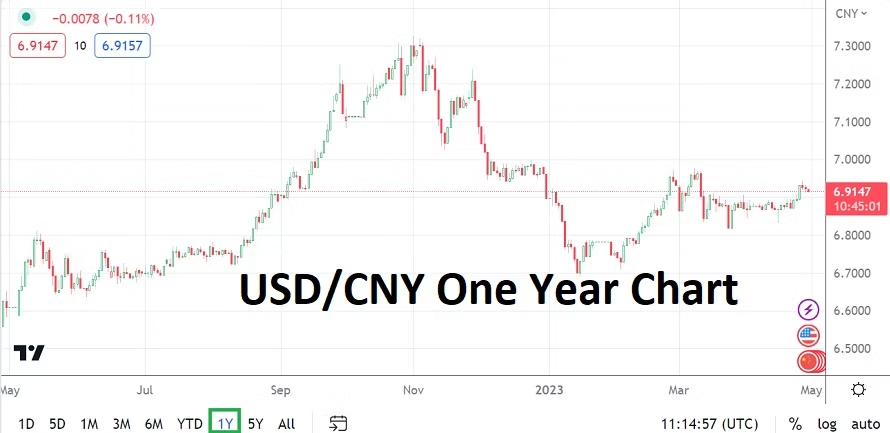
China and Russia seemingly want to create a bipolar power sphere, one in which U.S dominance is not so easy. Chinese President Xi Jinping and Vladimir Putin have met several times recently and are certainly collaborating regarding trade and investments. The developing news regarding the potential of BRICS enlargement shows that China and Russia maybe preaching multi-polarities such as their involvement with South Africa, but may actually be working towards a bipolar constellation of forces in which they would lead a broad alliance of countries in countering the preponderance of Western economies and potentially military might.

USD/CNY 1 Year Chart as of 28th April 2023


By allowing membership of BRICS to expand, U.S influence and the dominance of the USD would be lessened incrementally. A long game seems to be in play and if that is the case, the game of chess being played by Russia and China together against the West is complex and the U.S and its allies will need to be ready with a response if they want to protect the USD.

From the China point of view, the internationalization of the CNY is a positive. It has recently brokered a peace deal between Saudi Arabia and Iran, long-term arch rivals which surprised many in the West and seemingly caught the U.S unaware. China has also lent close to 1 trillion in USD value to Ghana, Pakistan, Nigeria and other smaller African countries. China is wielding power via trade and investment leverage into these respective nations strategically, pushing its global trade agenda even as Washington quietly threatens to punish China for backing Russia in the war with Ukraine.

Changing Role of China on the World Stage and BRICS

China’s role today is very different than in 2009 when BRIC was founded, this as the nation has become more secure regarding its stature globally. In the initial stages of BRICS there were talks about challenging USD dominance in global trade by member countries, but China vehemently avoided discussing this proposition openly to avoid conflict. The game has changed significantly regarding rhetoric, this as U.S – China relations have worsened as global trade, military security and corporate surveillance issues become more troubling. Political tensions with Taiwan as China rattles swords is a drama that nations are also watching attentively.

For China, the developing alliance with Russia has been a complex and sometimes slowly evolving plan historically, but one that has grown amidst tensions with Washington since the Trump presidency. The Russia and Ukraine war has accelerated the desire to break U.S led global dominance, and that means trying to break the USD internationally when it is possible. It is a long game and BRICS is part of this equation.

China and Russia view themselves at the vanguard in the struggle against Western global predominance, and they are eager to bring others on board. At the last summit of BRICS in June 2022, both Chinese President Xi Jinping and Russian President Vladimir Putin argued in favor of expanding into BRICS Plus. Beijing has become particularly interested with developing BRICS as a counterweight to the G7. While it has been difficult to establish a consensus on expansion among the current BRICS members, it appears to be a certainty that expansion is coming and the summit in South Africa this August will provide insights.

China is promoting the CNY in exchange for getting oil from Russia. The CNY is now ranked fifth regarding global transactions according to many banking sources. From the Kremlin’s point of view accumulating CNY reserves is good for Putin in the short-term; this creates more buying power for goods from countries that are friendly to Russia and China collectively and creates strategic momentum.

Yes, there are long-term historical complexities between Russia and China which will likely prove difficult politically to solve, but for the moment money is helping grease their wheels of diplomacy. Differences of opinion between Russia and China cannot be ruled out in these kinds of power games. Putin is an astute politician and liable to act in a surprising manner, this while trying to help Russia and its place among nations. Russia is certainly not keen on becoming a puppet state of China.
Trust is Almost a Four Letter Word for Some Economically and Politically

In his acclaimed book ‘Trust: The Social Virtues and the Creation of Prosperity’, the political economist Francis Fukuyama illustrates how degrees of trust in a society and indeed in a company can be decisive for prosperity and the ability to compete. In “low-trust” societies such as China, Russia and Italy, you cannot assume that everyone is willing to follow the rules. Members of these societies must frequently renegotiate ‘asserted’ rules, and often have to go to court to decide on matters. Ironically, one can see that this also applies to trading of the CNY.

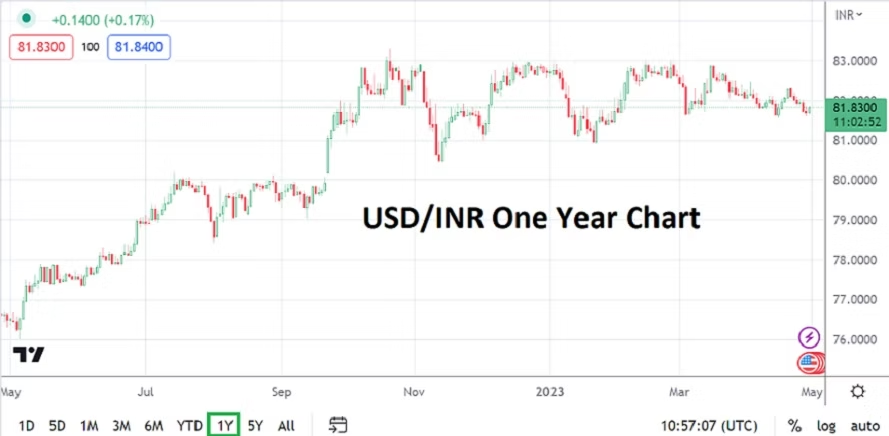
USD/INR 1 Year Chart as of 28th of April 2023

For instance, while China promotes the use of the CNY, countries like India are still using UAE Dirham (AED) for buying oil from Russia. BRICS still needs to sort out which currency they will use extensively for trade, this while many members try not to make enemies of other nations. South Africa exports are significantly more to the E.U, U.S and the U.K compared to Russia. Its share of exports to Russia are minuscule compared to the other three. Not only is South Africa risking free trade agreements with the U.S, E.U and U.K, but membership in key groups like AGOA as it tries to play on both sides of the fence politically is in jeopardy. Western observers are certainly watching South Africa and they will watch any other nation that joins BRICS. How long will the ANC led government of South Africa will be allowed to flirt with Russia and China militarily before it is stopped?

India has a Large Role in BRICS and is Growing in Stature

India is a vital member of BRICS, but also an important member of the QUAD alliance, the Quadrilateral Security Dialogue. Japan, Australia, the U.S and India are members and confer over trade and security. India is the largest democracy in Asia – and the world – and a Western advocate in South East Asia, even as China plays a dominant role in geopolitics. While BRICS wishes may be good for conducting bilateral trade among members, it is not necessarily good for global trade and political understandings. Complications from long-term political and historical disagreements between India and China cannot be discounted either.

Is the Indian Rupee (INR) or CNY more relevant for international trade? Use of the INR and the CNY needs coordination with other countries many times. Australia is a good example regarding the ability to trade INR internationally. If Australia and India agree to make their payments for exports and imports in their respective nation’s currencies, trade can be conducted rather well, but then Australia would have to find another nation for its ‘extra’ INR, because it would likely suffer due to trade imbalances. It would be important for another country outside of India to agree to take INR from Australia for other trades. Potentially some Gulf countries could be open to these types of INR transactions. A bigger group of BRICS nations would help India certainly.

Saudi Arabia has recently agreed to sell oil for CNY, but shoring up CNY in their coffers has long-term implications. This as Saudi Arabia wrangles politically with the U.S occasionally. Saudi Arabia has demonstrated a desire to take on a seemingly more neutral tone and perhaps wants to limit its exposure to the strength of the USD, particularly if the U.S tries to make a weapon of the USD via political policy. Thus, India as the most populated nation in the world and a growing economic sphere of importance, has to make careful considerations moving forward as it positions its economic stature for complexities that will develop. India and Saudi Arabia may have visions of becoming great ‘neutral’ economic powers moving into the next one hundred years.

The Indian Government has made economic deals with Egypt, Sri Lanka and Malaysia for bilateral INR trade, but still no pure INR trades of significance have materialized according to official banking data. There are multiple headwinds for BRICS nations to overcome USD dominance in international finance. Whenever exchanges of INR or CNY to other currencies for trade settlement are needed, they need to first change the base currency to USD to buy RUB or AED. Few exporting countries will accumulate CNY without a total need. Holders of these currencies would likely dump the INR and CNY for USD via Forex.

China Economic Transparency is Lacking and the Future of India in BRICS

China doesn’t make it easy for foreigners to own assets in their nation. The China government does not want massive trade deficits and free capital flows are restricted with force. Who would invest in China and risk having their money being stuck in the nation without guarantees? China continues to ramp up its oversight and aggressive tactics of supervision of foreign owned companies that have operations in the nation.

Now and into the foreseeable future, the Chinese government will control transactions of CNY with an iron fist. The United States will likely remain the predominant place for trade because of its huge economy, and as a nation that allows many other countries and foreign citizens to own and invest their assets within it boundaries. There is still something to be said for transparency. Any new nation or coalition trying to challenge U.S government debt instruments are likely to fail. The U.S continues to be a place where nations can hold ‘safe assets’ with a guaranteed return of interest for the long-term. No country equals the asset size and security of U.S Treasury Bonds. On that basis alone, there will be a no challenge to the USD in the near future.

Liquidity remains an issue for capital flows and convertibility within BRICS. A lot of hard work via transparent trade agreements will have to be signed to get these issues resolved. Plenty of questions exist regarding China’s economic data and its reliability because of a lack of oversight from ‘recognized’ outside agencies which are often forbidden.

India is still having border issues with China and these problems remain unresolved. India’s role of leadership in G20 is hard to ignore despite its alliance with BRICS. The Indian government has advised traders not to speculate in CNY. This shows that strained relationships between China and India remain and a lack of trust regarding clarity continues. In the U.S, New Delhi is considered an important partner, one that can be trusted regarding the growing rivalry between the U.S and China. Prime Minister Narendra Modi, said last year, “this is not an era for wars”, and this shows India wants stability and wants to play a global role in diplomacy.

There is a definite strategy for BRICS to grow with the nations of the Middle East and others. Using their currencies for mutual trade arrangements could eventually work out, but it will take a long time for this to change the dynamics of USD dependence and dominance.

However, we shouldn’t forget that almost 40% of the world’s population lives in Asia. Yet, even if oil producing nations will trade in a BRICS backed currency basket, which has been dreamed about for a long time, China’s leader Xi didn’t highlight this goal while in Moscow or in Saudi Arabia during recent summits. China is certainly playing a long game, but it also shows they remain cautious and vulnerable to the strength of the USD globally. If Xi wanted to cause the greatest pain to the United States, he would liberalize his financial sector and make the CNY a true competitor to the USD with complete economic transparency, but that would take him in the direction of free markets and levels of openness that are likely the opposite of China’s domestic ambitions. A strong due diligence of the Chinese economy, is something Chinese leadership likely wants to avoid for the foreseeable future.

BRICS: A Multi-Polar World and Avoiding Confrontation

Many developing countries will want to avoid a confrontation consisting of China and Russia on one side, and Western powers on the other side. India has overtaken China regarding population numbers, and will likely become the world’s third largest economy before the end of this decade. India will become a strong voice in favor of a multi-polar world. Arguably, ideas of a more multi-polar world are being worked towards in pragmatic ways, but the BRICS coalition will not develop their own asset backed common currency unless they can resolve issues regarding trade and monetary agreements with transparency. It is a matter of trust.