postR182

Risk Analysis Review: Warning about Coronavirus in Feb. 2020

Risk Analysis Review: Warning about Coronavirus in Feb. 2020

Below is a risk analysis note written in February of 2020 regarding the risks and potential implications of coronavirus as seen by Robert Petrucci on financial markets. The letter was sent to a senior associate who was a Chief Investment Officer for a firm. After speaking to the senior associate on the phone, feeling as if his thoughts were dismissed without heed and told he was too concerned about coronavirus, Mr. Petrucci sent the following to the CIO:

Thanks for asking about my thoughts.

What worries me is the opportunity for the virus to be a catalyst. The reactions in the E.U by government talking heads reminds me a lot of the financial crisis in 2007 when people publicly disregarded the potential domino effect which was becoming apparent. 

The Coronavirus imo is a potential domino which could take down the remainder of a fragile architecture. Meaning the ill-conceived philosophy and work of central banks in Asia and Europe have left them with little regarding ammunition should they need to fire an economic gun. If Europe and Asia buckle the US will be left limping too.

Psychologically the markets appear vulnerable, but as you rightly point out the higher realms of the Indices have been waiting for a bit of a sell off for a long time and the selling underway may be more of a reaction and mere trigger which has been long overdue. 

However, I wonder about the ‘clever’ algorithms which have been developed and trade also due to human bias. What concerns me more than what is taking place in China is what is happening in Italy right now. 

Italian governments have a long political history of ineptitude and disregard of reality regarding numbers which are staring them in the face, particularly with budgets and a long tradition of corruption and its destructive force on transparency. If Italy continues to spike higher infection numbers and continue to escalate then I believe the E.U is in for trouble. The inaction of Italy and its reliance on the tourism business will make it hard for them to accept shutting down major airports and cities which enjoy the fruits of international visitors year round. 

Also, I must add and circling back to China that it is not known yet if another outbreak may suddenly appear in another zone if someone dealing with this asymmetrical virus is unaware of their affliction. 

Which brings me back to the springboard, worst case scenario I fear is a major outbreak in the E.U including Germany. If we see signs of spikes statistically across Europe the next two weeks it will be devastating economically for the next quarter financially. 

As you say, things will certainly bounce back, they always do, we must look at the long term. Investors need to keep a stiff upper lip and protect themselves as you have done in many regards with Indices, US ten year bonds and some gold. 

The question for me now is what happens the next ten business days across the U.S and Europe and how the world handles this virus. Worst case is pandemic and bad Central Bank formula, which have been in place the past twelve years with cheap money. The desire to keep everything steady may in fact lead to miscalculations which have not been planned for and cause reactions in the markets which cannot be checked this time around. I do not believe we are at a Black Swan point yet, but it does worry me that the E.U politicians and even some U.S politicians seem to have their head in the sand or look like deer stuck in the headlights.

Robert Petrucci 26 Feb 2020

postN17

Fed Caught Again in Reactive Stance waiting for ‘Good’ News

Fed Caught Again in Reactive Stance waiting for 'Good' News

Let’s recall that about two and a half years ago the U.S Federal Reserve was still calling inflation transitory and claiming that price pressures would subside quickly as the onslaught of coronavirus decreased. Nearly all financial institutions could see the Fed was merely being stubborn, and that is a polite way of putting it, instead of being realistic.

It would be nice to give the Fed the benefit of the doubt now, and say the Fed have better information and know how to quantify the outlook of the U.S economy in a more dynamic fashion. However, being skeptical of the U.S Federal Reserve and its ability to miss signs plainly in front of them is a full time job for many analysts and it pays well.

As said by many before, many members of the U.S Federal Reserve have the profound disadvantage of not having the experience of ‘skin in the game’. Many Fed officials have worked as paid bureaucrats their entire lives and have literally ‘studied’ their way to the top of the central banking world, without having firsthand knowledge regarding the daily chore of running businesses. Most Fed officials have no dirt under their fingernails.

The Fed is clamoring now to return the U.S inflation level to 2.0%, and there is a large amount of disagreement about how this number is interpreted via different economic gauges. The Federal Reserve has a poor track record as stated above for being able to know what is actually ahead. They have been very aggressive regarding raising interest rates the past year and a half, and now they are finding it difficult to say they are done. This tough talk could be an attempt by the Fed to create headwinds for those considering proclaiming the U.S central bank should become ‘dovish’ by speaking tough about potential pitfalls to come, this even though the Fed plainly missed dangerous road signs a few years ago which helped agitate the problems being dealt with at this moment.

What could go wrong you ask? A credit crunch for banks and consumers.

However, business people know all about potential crisis if they have enough experience. Paying employees wages, finding additional good employees, landing a space that charges a reasonable amount for rent, hoping taxes remain sane, and hoping your shop is not shoplifted into poverty are some obstacles business owners face nowadays in the U.S. The rising costs of wholesale prices has not completely disappeared, but things may be getting better via economic data. Maybe this will be proven wishful thinking, but outlook is important and should be considered.

The rising costs of doing business is then passed along to consumers. The Federal Reserve seemingly doesn’t understand that it has made it more expensive to accomplish positive business results for small owners of enterprise in the U.S, and the Fed seems to forget that over 44% of the American economy is powered by what can be called family owned companies. The Fed certainly doesn’t mention that it is hard enough for small U.S business to survive over the long haul, with a number of nearly 65% becoming failures after ten years statistically.

So while the Federal Reserve talks a great game about managing interest rates via their monetary policy and the Federal Funds Rate, they often forget about the problem small business owners face. Having said that, the higher interest rates the Fed has sparked because of its slow reaction to what they perceived as transitory inflation two years ago – is having a bad effect on bigger businesses too. This because big corporations no longer enjoy ‘free money’ from their banks. Money has become harder to attain.

Once again it has been proven that everyone looks like a genius when the U.S economy is sailing smoothly, but when obstacles develop and people have to quantify solutions to real problems, suddenly it is harder to produce profitable results. The U.S government has created massive deficits by using huge amounts of cash stimulus to protect economic growth in the U.S over the past five years. In fact because of the quantitative easing after the financial crisis of 2007, it can be argued the U.S has used stimulus for more than 15 years to make sure the U.S economy is ‘stable’. Politicians like to keep their jobs because there is little else they can do in the real world.

The Federal Reserve by increasing the Federal Funds Rate has made U.S Treasuries a feeding frenzy and yields have increased substantially. The higher rates of interest the U.S government will have to pay down the road on existing U.S Treasuries is not a small problem mathematically. However, for the time being the Federal Reserve and U.S government seem to be less concerned about what they are potentially putting on the shoulders of future generations of U.S citizens, and trying to keep the U.S population tranquil. Luckily for many American homeowners, U.S mortgages are still mostly being paid out via the lower interest rate amounts agreed upon a couple of years ago and beyond. New home sales and existing home sales are sputtering in the U.S, because many people do not want to pay the higher interest rates that now need to be signed upon for mortgages and paid.

What the U.S Federal Reserve needs to do is to state publicly that it is not going to raise interest rates over the mid-term, and that it is going to allow the free market to work itself out via enterprise with supply and demand ratios taking center stage and being allowed to work. And lastly, that if inflation conditions as expected continue to improve by decreasing, that the Federal Reserve will consider lowering interest rates in the first part of 2024.

However, the Federal Reserve is worried that if it does sound too positive, businesses will start to gamble on a better outlook and this will raise existing inflation which has been stubborn. But again, the Federal Reserve often doesn’t understand how smaller U.S businesses work. To get out of the current economic mess the U.S Federal Reserve needs to be pro-active and not reactive. Also, the ‘ruling’ U.S government has to cut back on stimulus programs with promises of a ‘free lunch’ for all and return to looking at numbers realistically. Fiscal responsibility is an idea that can actually be practiced.

post18

We Have Seen This Show Before Friends

We Have Seen This Show Before Friends

Another day, week, month and year – another financial crisis causing havoc. We have seen this show before, and experienced traders should make sure friends who are ‘newbies’ are prepared for what is going to happen next. And what is next is: unknown.

People who believe they can profit from the current mess in the markets need to have deep pockets to sustain choppy conditions and a time parameter that allows for volatile prices until the results targeted are achieved. Day traders need to have very narrow goals, because if they do not cash out of the market quickly, then they should expect to get burned by the price velocity which will ensue.

Sharks Eating the Minnows as Crony Capitalism Flourishes

The demise of Silicon Valley Bank and Signature Bank are unpleasant surprises, but not shocking, and not to sound too matter of fact or contradictory, but the handwriting has been on the wall. The aggressive stance by the Federal Reserve finally caused enough nervousness in the stock markets to make certain equities shake and the banking sector has proven vulnerable. It is easy for many corporations to make money when it is cheap, but when ‘and not so suddenly’ borrowing costs, inflation and bonds chaos combine and deliver mayhem then profitable outcomes become more difficult, and for some – impossible. Corporate investors do not look kindly on mid-term and long-term projections which hint of negative growth implications. Investors tend to punish these equities.

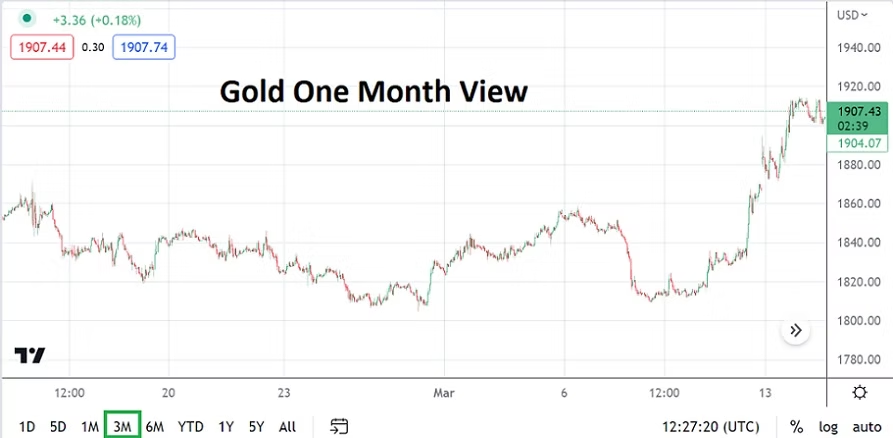
Gold One Month Chart

What comes over the next week and month will likely anger many people. Capitalism is good, it is even great. However, a dark and evil shadow lurks when crony capitalism starts to have an upper hand. The insolvency of Silicon Valley Bank raises the prospect for crony capitalism to be witnessed by all. Suddenly the U.S Treasury, Federal Reserve and government have emerged to save the skin of depositors within a bank which up until last week was heralding its ability to be a ‘lone wolf’; merrily disregarding sound investment principles and saying they knew better. It is only my opinion, but it stinks of contradiction that both the U.S Federal Reserve and Silicon Valley Bank have made vast mistakes and now are being allowed to cover their tracks and protect members of their ‘club’. Both Fed and Silicon Valley Bank officers need to be held accountable, but do not count on this result producing more than scapegoats.

Rising interest rates which are causing ‘import inflation’ has been a worry expressed by some economists and they can still be heard, but obviously not given enough attention. The Fed has marched to its own drummer and disregarded ‘the street’ for its own ideals and statistics viewed from its ‘ivory tower’ where it could not be held accountable.

Inflation is stubborn, yes, but it is a result of chaos via global commerce from the effects of difficult supply and logistics problems caused by coronavirus. Inflation became problematic two years ago and it was essentially disregarded for about nine months, until the Fed and others admitted rising prices was a concern. Hopes of transitory inflation have faded into oblivion. But I digress…..

Nervous Financial Institutions Battling as Federal Reserve Wavers

A sin bin of mistakes has collected and is now being exposed. Many financial houses were surprised when the Fed came out on the 1st of February and sounded so aggressive talking about inflation while increasing the Federal Funds rate again. Then jobs numbers came out on the 3rd of February, along with Average Hourly Earnings and showed the U.S economy was stronger than expected. The USD began to find strength again, and inflation data then added an extra punch by coming in strong again in February via the CPI results.

Btw, Consumer Price Index will be published today too from the U.S, and this will cause a reverberation for those attempting to day trade among waters filled with nervous financial houses who have their programmed algos ready to take advantage of hectic markets. Volatility the next handful of trading days is set to be wild. The Fed is not likely to raise interest rates by half a basis point on the 22nd of March, but if CPI numbers are stronger than anticipated today, this could cause a tremor and fear. Even if the Fed pauses for the moment, the prospects of raising interest rates again in the near future unless the banking sector shows it cannot sustain another round of Federal Fund increases is troublesome. Nothing like a complete lack of clarity for short-term traders to cause bedlam and a complex gauntlet of inflation statistics to make the Federal Reserve squirm.

Traders have to understand that if they are going to attempt to wager on the markets in the near-term that they are taking a huge risk. The use of leverage could provide solid profits on a winning bets via Forex, commodities or CFD wagers, but it could also wipe a trader completely out if they are caught by a violent wave. And the U.S Federal Reserve is not here to protect small traders, they frankly do not consider your results very much and likely believe you should not be wagering.

What the U.S government and its institutions like the Fed, Treasury and FDIC want to do is guard against systemic risks for the larger speculators – corporate traders, banks, hedge funds, V.C’s, etc. to make sure they do not go belly up and cause a global financial sink hole and long-term ruptures. The financial crisis of 2007 and 2008, the coronavirus pandemic starting in 2020 and the ongoing Ukrainian war have tested the markets and were likely enough for most of us to voice troubles. Now the prospects of a far-reaching banking crisis and illiquidity adding fuel to the fire are quite a combination of risk events usable as costly teaching moments. Do we seriously need another teaching moment however?

We are the little people and nobody sees us. We may yell, we may bellow our angst towards the system, but the system treats us as an afterthought. Day traders should keep this in mind as they bet in the coming days, because more gyrations are likely as a metaphoric ‘country club for institutional risk takers’ is given sanctuary. This as we minnows look up, shaking our heads in disbelief while our trading accounts flounder.