Dear Father Dear Son 20260420

Dear Father, Dear Son: Two Lives….Eight Hours – A Review

A Hard and Personal Story About His Father - Written by Larry Elder

Book corner: Dear Father, Dear Son: Two Lives…Eight Hours by Larry Elder.

Hard work wins. You get out of life what you put in. You can’t always control the outcome, but you can control the effort. No matter how hard you work or how good you are, sometimes things will go wrong. Character is about how you react when they do. – Randolph Elder

Is it possible to reconcile with an abusive parent? In Dear Father, Dear Son: Two Lives…Eight Hours, Larry Elder seems to think so.

In the book, Elder – an African-American conservative best known for his sharp-edged columns and radio commentary – steps away from politics to tell a far more personal story: that of his father, Randolph Elder, and their fractured relationship.

Sober, hardworking, and honest, Elder Sr was unwavering in his commitment to provide for his family. Yet he was also volatile and harsh, with a hair-trigger temper that often erupted into severe physical discipline, ultimately driving a wedge between him and his sons. By the age of fifteen, Elder had stopped speaking to his father altogether – a silence that lasted a full decade.

The heart of the book centers on a pivotal moment: at age twenty-five, Elder returns home intending to confront his father over the pain of his upbringing. Instead, the two talk for eight hours – an encounter that gives the book its title. During that conversation, his father shares the story of his life, revealing the struggles and experiences that shaped him. In seeing the man behind the stern exterior, Elder leaves with a profoundly altered perspective – one marked not by anger, but by understanding, admiration, and, ultimately, love.

Elder structures the book into three broad sections, with the first focusing on his childhood in Los Angeles during the 1950s and ’60s, where he navigates a home life dominated by his perpetually angry and sullen father. He paints a vivid picture of a tense, fearful atmosphere, where even the smallest, most innocent slip-up – a careless remark, a minor inconvenience, or a mild infraction – would trigger his father’s fury. Whether at home or on rare family outings, the specter of corporal punishment was always looming. The family’s attempts at joyous outings were frequently overshadowed by his father’s unpredictable moods, which drained the life from otherwise memorable experiences. A trip to Disneyland, for example, soured when his father, following a bumpy ride, developed a crick in his neck. Similarly, a visit to a Dodgers game was marred by his father’s annoyance at the behavior of other fans. Even the most typical childhood blunders—like his younger brother getting lost at a drive-in theater while returning from the concession stand – were not enough to spare his father’s wrath.

The book’s middle section – its heart and core – revolves around the pivotal incident from which the title is drawn. As a teenager, Elder worked in his father’s diner for the important pocket money it provided. He loathed the experience, particularly his father’s constant barking of orders and the demeaning, impatient way he was treated – especially humiliating because it all played out in front of the diner’s patrons. At 15, an explosive argument with his father pushed Elder to quit on the spot, and the two didn’t talk for ten full years.

From there, Elder threw himself into his studies, eventually finding success in law school and a thriving legal career in Cleveland. Yet the unresolved bitterness festered inside him, an emotional weight he couldn’t shake. Ten years later, the resentment became unbearable, and he made the difficult decision to return to Los Angeles for a confrontation. He showed up at the diner just before closing time, surprising his father. Elder Sr., surprised but composed, sat down with his son and listened, offering no protest, only quiet attention. In a moment of unexpected calm, he shared his own life story, asserting that, despite their turbulent relationship, he had been a better father to Elder than his own father had been to him.

Born in backwoods Georgia in 1915, he never knew his real father; his mother raised him with a series of boyfriends, one of who was a man named Elder. This man never married his mother and, even worse, was an alcoholic who physically abused the two.

One day, after coming home from school and making too much noise, young Randolph got into an argument with his mother and her then-boyfriend. His mother sided with her boyfriend, who threw the boy out of the house – never to return. He was 13 years old, an African-American with little schooling and even less money in one of the poorest and most racist areas in the country. The Great Depression began a year later.

Forced to fend for himself, he left school and took any work he could find. After stints as a yard boy (sleeping at night in barns), shoeshine boy, and cook, he eventually secured a prestigious position as a Pullman porter, then the largest private employer of African-American men in the country. It was through this job that he first visited California. Struck by its more tolerant atmosphere and temperate climate, he promised himself he would return someday.

After Pearl Harbor, he joined the Montford Point Marines, a unit comprising the first African-Americans to serve in the US Marine Corps. Promoted to staff sergeant, he served honorably in Guam as the head of a mess hall crew. But when he was discharged, he found that even with his considerable experience, no one would hire him as a cook. Desperate, he went to an unemployment office in Chattanooga, Tennessee, where a white clerk told him to use the “proper door.” Obediently, he stepped out into the hall and went through the “colored only” entrance – only to end up face-to-face with the same clerk. “Now, how may I help you?” she asked. So, he decided to take up his promise to return to California.

Facing similar obstacles to securing employment as a cook – although out in the Golden State the racism was more polite – he got a job as a janitor at Nabisco. After buying a home in working middle class LA, he was determined to ensure his wife would be a stay-at-home mom for his three rambunctious sons, knowing what could await them if they returned after school to an empty and parentless home. Embodying an almost Nietzschean philosophy towards hard work – Elder describes his father as highly disciplined, indefatigable and seemingly intolerant to pain – Elder Sr worked two full-time jobs and did extra work as a private cook on the weekends, averaging only a few hours’ sleep each night for many years. In addition, after being passed over for promotion due to his limited schooling, he went to night school for his GED. Later, in the early 1960s, at the age of 47, he owned and operated his own diner in the Pico-Union neighborhood of LA, wakening at 4:00 AM every morning. He ran the diner successfully for thirty years until his retirement.

After hours of listening to his father’s story, Elder felt his resentment and pain give way to a growing sense of admiration. Despite enduring profound poverty and racism, his father was neither bitter nor angry. He never saw himself as a victim, nor did he harbor hatred toward others. Instead, he lived with quiet discipline and purpose – resourceful, self-controlled, and relentlessly focused on his goals. He avoided vices, kept to himself, and spent carefully rather than frivolously. Elder was struck by one small but telling detail: his father carried a worn copy of Ten Rules for Success by A. G. Gaston in his wallet (see here), which he passed on during their conversation.

In seeing all this, Elder came to recognize not the harsh, distant figure of his youth, but a resilient, responsible, and humble man—one who believed that hard work could overcome most obstacles and who had simply tried, in his own imperfect way, to pass those values on to his sons.

As the eight hours pass – marked by countless cups of coffee – the two begin to speak not as estranged figures, but as equals: with honesty, warmth, and even humor. In that time, they quietly build a new, deeply affectionate father–son bond. Elder comes to understand that, though his father never expressed it outright, his love and pride in him had always been there. From that moment on, and for the next thirty-five years until his father’s death, they remained inseparable.

In the third section of the book, Elder describes the aftermath of the reconciliation. He describes helping to patch up his parents’ difficult marriage and getting them to revive their strained communication, and so visits to his parents’ home began to take on a lighter, warmer and more joyous tone. Elder describes the outings and conversations that he and his father took together where they shopped and watched movies. Later, he would play an active part in consoling his father after his mother’s passing.

Because of Elder’s public profile, his father slowly acquires a kind of celebrity of his own: he receives a standing ovation at one of Elder’s speeches and is even interviewed by Morley Safer on 60 Minutes.

As his father’s memory begins to fade, the book unfolds some of its most touching moments. Elder explains the iPhone to his father repeatedly due to Elder Sr’s dementia, each time patiently and gently. And in the book’s final passage, as Elder Sr. lay in bed preparing for sleep, Elder sits by his bedside and reads aloud from a book about the Montford Point Marines as his father listens quietly before drifting off. After lights out, Elder stares at his father from the hallway with love and admiration.

Dear Father, Dear Son: Two Lives…Eight Hours is a deeply moving and quietly powerful work. At just 247 pages, it remains a quick read, yet its emotional resonance lingers long after the final page. In less careful hands, the story might have slipped into mawkish sentimentality, but Elder keeps the narrative grounded, lucid, and unsparing. His father would have it no other way.

Note to readers: Randolph Elder passed away in 2011, and lived long enough for his son to read a copy of the book to him. He was posthumously awarded the Congressional Gold Medal in 2013 for his military service.

Copy and paste the text from AMT that you want to share

post279

Wolf of Wall Street: Greed, Bad Ethics, Sales and Notoriety

Wolf of Wall Street: Greed, Bad Ethics, Sales and Notoriety

Book corner: The Wolf of Wall Street by Jordan Belfort

I was just a greedy little bastard, and not just greedy for money but also for sex and for power and for the admiration of my peers and for just about anything else you can imagine. – Jordan Belfort

Welcome to The Wolf of Wall Street, exstockbroker and trader Jordan Belfort’s autobiographical paean to greed. Reading like a twisted success saga — like a Horatio Alger tale that went left instead of right — Belfort describes his life at the helm of Stratton Oakmont, a Long Island, NY brokerage house which he founded in 1989.

Equal parts shocking, drugged-up, zany, and hysterically funny, Belfort’s story — confession would be a more suitable word — tells how Stratton Oakmont gained notoriety for its widespread use of pump and dump schemes, an illegal practice whereby a stock’s worth is artificially inflated and then sold at a higher price.

Stratton Oakmont racked up plenty of victims and fortunately its tenure was brief. The FBI, the National Association of Securities Dealers (NASD) and the U.S Securities and Exchange Commission were on Belfort’s scent for years and would eventually shut it down in 1996. Belfort made a fortune but would serve 22 months in prison, where he began writing his memoirs, later to be shaped into this 2007 book. Wolf was a bestseller and Belfort wrote a followup two years later, Catching the Wolf of Wall Street, in which he tells his origin story and how he formed his crew, and also serves a sequel to the events of the first book.

In 2013, director Martin Scorsese released the film The Wolf of Wall Street, combining elements of both books. Scorsese shaped the film like a white-collar version of his earlier masterpiece, Goodfellas, with Leonardo DiCaprio portraying Belfort as a 1990s version of Henry Hill. The movie was a financial and critical success, and garnered accolades not only for DiCaprio’s performance — he won Best Actor at the Golden Globes — but also for Margot Robbie as Belfort’s wife and Oscarnominated Jonah Hill as his business partner (the names of the people upon which they were based were changed for the movie). Belfort himself has a bit part in the film.
 
A Jewish kid from middleclass Bayside, Queens, Belfort focuses Wolf on three areas: 1) his legal struggles 2) Stratton Oakmont and its excesses, and 3) his rampant drug use, physical ailments, and marital tensions — often weaving all three into the same scene.
 
In the first focus of the book, his legal struggles, one gets the impression that he enjoyed writing this part of the book the least, although that is understandable. Stratton Oakmont’s financial crimes broke a laundry list of federal and state regulations and before his arrest Belfort was forced to spend considerable time, money, and imagination in hiding them from the authorities.
 
Stratton Oakmont specialized in selling penny stocks, which are inexpensive stock shares from smaller companies. Although usually marketed to investors of more limited means, Stratton Oakmont marketed them to unsuspecting wealthier investors, making an insane amount of money in the process. A classic boiler room operation, brokers were trained to sell using slick, cuttingedge, highpressure tactics. The firm thrived on manipulation and deception, with an intense focus on closing deals no matter the ethical cost.
 
A significant portion of the book is dedicated to explaining Stratton Oakmont’s approach to stock price manipulation. Belfort’s traders would artificially drive up the stock price of a company during its Initial Public Offering (IPO), while retaining more shares of that company than SEC regulations permitted. Belfort uses the example of Steve Madden Shoes, a company he helped take public, to demonstrate this practice.
 
Belfort outlines how stock manipulation during an IPO works: He would invest heavily in a new business, like Steve Madden Shoes, and then leverage his controlling stake to take the company public. Belfort’s brokers would use aggressive tactics to inflate the stock price when selling to investors. Once the price reached a certain level, Belfort would sell enough of his shares to recover the cost of his initial investment — meaning he paid nothing for the remaining shares, which were now worth significantly more.
 
However, under SEC rules, an investment firm sponsoring an IPO is only allowed to hold a limited amount of stock in the company they are offering, but Belfort and Stratton Oakmont held far more Madden shares than the law allowed.
 
Belfort was also involved in money laundering, a scheme that began when he secretly traveled to Switzerland, a nation notorious for hiding money. The Swiss bankers he met with openly explained how the Swiss banking system hides vast sums of money and how they avoid cooperating with foreign institutions, like the U.S. SEC. Since the practice of issuing “numbered” bank accounts without names ceased after World War II, Belfort’s first step was to open accounts under the names of proxies, similar to those who held his stock. These individuals were tasked with smuggling large amounts of cash across the border, so Belfort relied on people he trusted who wouldn’t raise suspicion — including his wife’s elderly British aunt and a member of one of his drug dealers’ Swiss relatives.
 
As a sidenote, Belfort comes across as cynical to the whole stockbroking profession. He argues that stockbrokers, including himself, don’t truly produce anything of value and lack any specialized stock market knowledge. At their core, he says, they’re essentially just slick salesmen, especially after Belfort taught his crew highpowered sales scripts that drew customers into opening their wallets. With this training, Belfort says, even a high school or college graduate can be taught to talk like a stock market expert, which leads into the second focus of the book, the atmosphere at Stratton Oakmont.
 
In staffing Stratton Oakmont, Belfort eschewed licensed brokers (those who passed the Series 7 exam) and instead brought in a more impressionable team, a hardscrabble gang of local kids fired up to make big bucks. The place was awash in money and to reward the brokers for their highly stressful — and aggressive — jobs, Belfort spared no expense in keeping them happy. He cultivated a bacchanalian, partylike atmosphere, a sort of adult frathouse full of sex, hookers and drugs.
 
During his tenure at Stratton Oakmont, Belfort became known for his loud and proud persona. He would routinely motivate his troops by giving thumping, overthetop speeches (marvelously reenacted by DiCaprio in the movie), preaching like an evangelist about the glory of earning big money.
 
The book’s final focus is his drug use, physical ailments, and marital tensions, three issues that are tragically intertwined.
 
Belfort suffered from intense back pain and sleep problems, the latter which plagued him since childhood. As an adult, the chaotic and party-fueled atmosphere at Stratton Oakmont enabled him to indulge easily, and he would use a powerful cocktail of drugs to cope. He was particularly known for his abuse of Quaaludes, a hypnotic sedative drug which he used recreationally and frequently, often mixing them with alcohol or other substances, but it became a full-blown addiction. Besides Quaaludes, he also used cocaine, morphine, and other prescription medications.
 
Belfort reported frequent blackouts and memory loss due to mixing drugs, especially Quaaludes and alcohol. He often had no recollection of things he said or did while under the influence, sometimes waking up to damage, arrests, or people furious at him. He had multiple close calls with overdoses, particularly from taking too many sedatives or mixing drugs dangerously. In one story, he recalls almost choking to death on his own vomit after passing out. Longterm drug use left him in a nearconstant mental haze, affecting decision-making, mood, and impulse control.
 
Belfort describes in cringing details the most notorious effects of his Quaalude abuse, the loss of basic motor control. He described episodes where he was physically unable to walk, speak clearly, or even stand up — calling these “cerebral palsy phases.” There’s a wild (and comic) scene — later portrayed in the movie — where he attempts to crawl to his car while stoned out of his mind.
 
Belfort writes at length on his wives and family life, and herein lies the part which Belfort seems to have enjoyed writing the most.
 
Belfort met his first wife, a local Queens beauty, after college while working as a meat salesman. The business thrived for a while, thanks to Belfort’s silver-tongued persuasion abilities. But after overextending himself, the business went under, leaving him with a young wife and bills to pay. By all his accounts, his wife stuck by him through the lean times and he has not had (at least publicly) an unkind word to say about her. But Belfort ended up leaving her for a Londonborn and Brooklynraised model, Nadine Caridi, a stunning beauty whom he met at a party. His life with the Duchess — as he refers to her due to her birth country and British heritage — provides some of the most memorable scenes, and their life together became a bizarre mix of luxury, chaos, and toxicity (not to mention lust).
 
The two met when Belfort was already rich from Stratton Oakmont and their relationship quickly became intense. Marrying in the early 90’s, Belfort provided Caridi with a glam life of extreme wealth: yachts, mansions, exotic vacations, and nonstop partying. Belfort showered her with expensive gifts and built a lavish life for them and their children in one of the most expensive areas of Long Island. Their megamansion boasted a helicopter pad, a swimming pool, tennis courts, servants galore and a fleet of luxury cars.
 
But behind all the glamour, things became unstable. Belfort and Caridi had some intense, ugly shouting matches during their marriage, and they usually exploded over his drug use, infidelity, and parenting. Although Belfort loved his kids dearly, Caridi got especially furious when his reckless behavior endangered them. One of their biggest, most infamous fights was when Belfort, high on drugs, tried to kidnap their daughter and crashed his car into a pillar inside their property (also reenacted in the movie). Their marriage eventually broke down under the weight of Jordan’s addictions and criminal behavior, and they divorced in the early 2000’s.
 
How did it all end for Belfort? After getting cornered by the FBI, who had a strong case against him, Belfort was given a choice: either go to prison for decades, or cooperate and help bring down the dozens of brokers, business partners, and shady investors he worked with. To get a lighter sentence, he agreed to become an informant, wearing a hidden wire during meetings and conversations to secretly record people he worked with. However, a lot of his old friends and colleagues ended up getting arrested and betrayed by him — and he was absolutely hated by many in that world after that.
 
Belfort did easy time at Taft Correctional Institution in California, a lowsecurity federal prison of the type that is called “Club Fed” in popular culture because it is so relaxed and safe compared to the tough penitentiaries that house hardened convicts. While there, he had the odd coincidence of sharing a cell with Tommy Chong, of the classic Cheech & Chong stoner comedy duo. Chong was there for selling bongs online, and the two became friends. It was Chong who encouraged Belfort to write his memoirs. Interestingly enough, his writing style was influenced heavily by Tom Wolfe’s The Bonfire of the Vanities, which he read while there.
 
Belfort’s New York humor shines through the book and is the saving grace throughout the scenes where the crime and sleaze bubble through, although the vulgarity might not appeal to all readers. His antics, though tragic and costly, often come off as comedic, with a rhythm similar to stand-up comedy or a raunchy sitcom. It makes for enjoyable reading but one has to question his motives for portraying the incidents in such a manner.
 
For example, the infamous yacht story — one of the highlights of both the book and the movie and one which Belfort has retold ad nauseum in interviews and personal appearances —involved a hairraising incident where he ordered the captain of his yacht to sail through a 70knot storm, instead of avoiding it, off the coast of Sardinia.
The yacht was battered by massive waves that smashed its windows and hatches, flooding it. Despite the dire conditions, all 27 people on board were rescued by the Italian Navy, but the yacht was lost at sea. Belfort — and unfortunately later Scorsese — play it up as bumbling dark comedy, something that would fit in the first season of Breaking Bad or Michael Bay’s 2014 crime caper Pain and Gain. But after the movie was released, two of the men who were on board the yacht — friends of Belfort since childhood — were interviewed on a local Long Island radio show and told their side of the story. The real events, as they stated, were a horrific, PTSDinducing nightmare in which all aboard — crew included — thought they were about to die.
 

Another problem with the book is that it never actually defines itself. Is it a business book? A morality tale? A success story? A crime story? Is it fratire, the genre popularized by Tucker Max in I Hope They Serve Beer in Hell? It has elements of all of those, but they never truly come together into a cohesive whole. The business and legal sections are hard to follow for the average reader and Belfort didn’t seem interested — or patient enough — in describing the concepts in simpler terms. In fact, like a true salesman, at times he seems more interested in a carefully crafted portrayal of himself where even the self-deprecation — and there are loads of that — contain hints of braggadocio. One can hear him saying as he wrote the book, I had ballsI went for the brass ringI did things that you didn’t dare to do.

After the movie was released in 2013, Jordan Belfort experienced a resurgence in public attention and became a media favorite, interviewing endlessly in his thick, fasttalking Queens accent while regaling a new generation of fans with the stories behind the movie. In time, he eased into the role of elder statesman, becoming an indemand commentator on current financial affairs such as crypto and Wall Street. Belfort also rebranded himself as a motivational speaker and sales trainer, touring internationally and giving seminars on sales techniques, goalsetting, and entrepreneurship. His signature sales methodology, now marketed as the “Straight Line Persuasion” system, has become a core part of his training programs. He also created a podcast, The Wolf’s Den, where he interviews entrepreneurs, influencers, businessmen and others (although it is unclear as of this writing if the podcast is still active).

To his credit, he has shown remorse for his misdeeds and the effect his lifestyle had on his family and has repeatedly stressed the importance of ethics in business and sales. His speeches, as shown on YouTube, are enjoyable and engaging.
Unfortunately, the issue of restitution remains a sticky issue. Currently living in California, he was ordered some years ago to pay $110.4 million in restitution to victims of his stock fraud. However, critics and prosecutors accused him of not paying enough back, particularly in light of earnings from the film, books, and speaking engagements. Belfort has claimed he’s been steadily paying.


Despite the glamorized portrayal in the movie, many people — especially his victims — still view him with suspicion. He remains a controversial figure. Some see him as a charismatic redemption story, while others view him as an unrepentant fraudster profiting off his crimes. Read the book and decide for yourself.

If you want to read another Book Corner article, please visit this review by Evan Rothfeld:
https://www.angrymetatraders.com/post/rich-dad-poor-dad-what-the-rich-teach-their-kids-about-money

postR173

Rich Dad, Poor Dad: What the Rich Teach Their Kids About Money

Rich Dad, Poor Dad: What the Rich Teach Their Kids About Money

Book corner: Rich Dad, Poor Dad: What the Rich Teach Their Kids About Money That the Poor and Middle Class Do Not! by Robert T. Kiyosaki

Every now and then a book comes along which leads to a major shift in how Americans think. Uncle Tom’s Cabin changed perceptions about slavery. The Jungle woke the nation to the horrific labor and sanitary practices in factories. The Feminine Mystique shed new light on feminism and women’s roles in society. All those books struck deep into society’s conscious and led to major changes.

Robert Kiyosaki’s Rich Dad Poor Dad: What the Rich Teach Their Kids About Money That the Poor and Middle Class Do Not! might not echo the social justice that his revolutionary predecessors strived for. But this 1997 best-seller packed no less of a wallop. Hitting the bookstores just as the twentieth century was coming to a close, Kiyosaki’s book changed how Americans – and others around the world – think about personal finance.

Rich Dad Poor Dad is not an instructional book as one would expect in a college course, with Kiyosaki running through facts, charts and figures. A Japanese-American born and raised in Hawaii, Kiyosaki uses his own life and background to tell a simple, almost fable-like story. The “Poor Dad” in the title refers to Kiyosaki’s biological father, Ralph Kiyosaki, who worked as a educator most of his life. By all accounts a good father and an honest man, he was a big believer in standard, traditional education, wanting the younger Kiyosaki to be a good student and then go to college in order to get a good job – in other words, as Kiyosaki puts it, to be an employee. But he had little financial education, which is what Kiyosaki explains is knowledge of business, investing, accounting, entrepreneurship, real estate and all other related subjects whose knowledge one can use to make money and be financially independent – to be an employer in contrast to an employee. Kiyosaki explains that although his Poor Dad made a decent salary, he was able to save little of it due to his lack of financial education and poor career decisions later left him broke.

The ”Rich Dad” in the title is the father of Kiyosaki’s buddy Mike, a man of limited standard education but excellent and well-developed financial education. A savvy entrepreneur with his hand in many businesses, he was approached by the two pre-teens for lessons on getting rich. Rich Dad put them to work in his general store for little money, but provided something more valuable – lessons on business and entrepreneurship that would form the foundation of Kiyosaki’s life and career. The book is structured around the conversations he had with his Rich Dad and the advice he was given, and the contrast in mentality to his Poor Dad.

As Kiyosaki explains, the drive for financial education consumed him and drove his decisions well into adulthood. A mediocre student, he nonetheless graduated from the Merchant Marine Academy, and then as a US Marine, served honorably in Vietnam as a helicopter pilot. Kiyosaki was eligible to work in the maritime industry after the war, a job that would bring excellent pay, conditions, steady work and several months of vacation a year. But he instead enrolled at Xerox’s sales school – considered the best of its kind in the country – seeing it as a major key in his financial education. His need for independence was so strong that in later years, during hard times, he and his then-wife Kim slept in their car rather than the accept the charity of friends’ guest rooms.

Besides the lack of financial education in the school system – an issue that Kiyosaki raises several times throughout the book – Kiyosaki challenges conventional beliefs. He rails against purchases that are liabilities instead of assets, even arguing against home ownership. He discusses the mindset of money and wealth creation and how ordinary people – due to society’s conditioning to be employees – are held back by limiting beliefs. To be successful in wealth creation and to take control of your financial destiny, Kiyosaki argues, one must take calculated risks; inspired by his Rich Dad, he says that one must not think I can’t afford this but instead What do I need to do to be able to afford this?

In one of the few diagrams in the book, Kiyosaki introduces the cash flow quadrant (of which he would later base an entire book), which categorizes individuals as employees, self-employed, business owners, or investors. He discusses the advantages and/or disadvantages of each quadrant.

Kiyosaki hit a raw nerve in the personal finance-hungry public, turning him into an international finance guru. It has to this date sold anywhere from thirty to forty million copies and is noted as the bestselling personal finance book of all time. He – and Kim, who has a series of similarly-themed books intended for women – have subsequently published an entire series of finance books, each with its own spin, such as real estate, investing, gold/silver, multi-level marketing, etc. These include two collaborations with Donald Trump, Why We Want You to Be Rich and Midas Touch: Why Some Entrepreneurs Get Rich — And Why Most Don’t. Kiyosaki also markets a board game, Cashflow, that attempts to teach the basics of financial education and how to exit what he calls the “rat race”, which is his description of the sometimes grueling life of dependency that employers place upon their employees and the financial mediocrity that ensues.

Rich Dad Poor Dad is not without controversy. Two of Kiyosaki’s businesses prior to his turning full-time to financial education went bankrupt, fueling claims that he is not as savvy as his image projects. Some experts and competing finance writers claim that he gives poor, substandard – even dangerous – advice. Another claim regards the identity of the “Rich Dad”. His name is not revealed in this book nor the follow-ups in the series and Kiyosaki was silent about this issue for several years, leading to accusations that the book is complete fiction. He has since revealed the identity of the man, plus his friend referred to as “Mike”. Kiyosaki explained that many years ago, upon the book’s initial publishing, the family requested anonymity, to which he respectfully complied.

Another claim, not without merit, is that this book gives little advice in general beyond the series of anecdotes and soundbites. Kiyosaki has not refuted that, and has claimed that it is the intention of the book to raise these issues and to simply convince people of the need – and to direct them onto – the path of financial education.

The book is worth reading. You won’t come away with the knowledge to pick stocks, examine real estate, understand tax laws or read a financial statement. But you’ll be immediately reaching for books that do – and that, according to Kiyosaki, is the intention.

If you want to read another Book Corner article, please visit this review by Evan Rothfeld: https://www.angrymetatraders.com/post/dangerous-and-unpredictable-duties-during-the-vietnam-war

postN68

Mets, New York City, and the Most Astounding Baseball Season

Mets, New York City, and the Most Astounding Baseball Season

Book corner: They Said it Couldn’t be Done by Wayne Coffey

In 1969, the Apollo 11 moon landing and the 400,000-strong Woodstock concert weren’t the only miracles in the United States. Wayne Coffey’s They Said it Couldn’t be Done focuses on major league baseball, where the New York Mets – a team with a losing record since its founding and who came in ninth place in the National League the year before – won the World Series to become baseball’s champions. Who says that miracles don’t happen?

Coffey is an experienced sportswriter, having written about hockey (The Boys of Winter: The Untold Story of a Coach, a Dream, and the 1980 U.S. Olympic Hockey Team), plus soccer, football, and basketball. In They Said it Couldn’t be Done, he tells the story of the championship ’69 year.

Coffey describes the history of the team. The Mets grew from the wake that was left in New York baseball when two of its three major league teams – the Brooklyn Dodgers in 1957 and the New York Giants in 1958 – relocated to California (referenced by the line “California baseball” in Billy Joel’s hit We Didn’t Start the Fire), leaving the southern boroughs without a team of their own. Created as one of two National League expansion teams in 1962 (the other being the Houston Colt 45s, later renamed as the Astros), the Mets played in the Giant’s old homestead, the Polo Grounds in upper Manhattan, until moving to Shea Stadium in Flushing, Queens in 1964.

A word about expansion teams. These teams usually comprise older players whose baseball chops have begun to erode, together with lesser-skilled players who – to put it mildly – weren’t the top prospects upon entering the league. The Mets went 40-120 their first year, a losing record for the twentieth century (and so far for the twenty-first). For the boys in Flushing, the early-to-mid-60s were a ballplaying comedy of errors, a farce with endless losing streaks, blowout games, and (as one can guess) a horrendously poor level of play. Fans would turn up to the game and watch dropped balls, outfield collisions, and balls careening off gloves. But the fiercely loyal New York fans stuck with them, taking the team to their hearts. In fact, an endearing and fun aura surrounded the young team, viewed by the fans as goofy but lovable losers.

As Coffey explains, the change began in mid-decade. Older players retired or were traded, and younger and more skilled players joined the team, such as the nimble shortstop Bud Harrelson. In 1967, two pitchers were introduced who would have a major role in the Mets future win, the left-handed Jerry Koosman and the right-handed Tom Seaver. These players – and others – were hungry for winning and were offended by the stigma of mediocrity that surrounded the team. In 1968, former Dodger star Gil Hodges began his tenure as manager, replacing the old-timer Casey Stengal. Coffey describes Hodges’ character and managerial style, and how it affected the team for the better. A decorated US marine in World War 2, and a man of the highest integrity, Hodges was calm, methodical, unflappable, with an uncanny knack for eliciting the maximum performance of his players, who respected him greatly. The ’68 team might not have even reached .500 (meaning the number of wins equals the number of losses), but for those watching closely, there were seeds of future victory being sown, as shown by good performances from catcher Jerry Grote, outfielders Cleon Jones and Ron Swoboda, and others.

Even with all the young and eager talent, the Mets began the ’69 season still outgunned in the National League, posting a losing record for the first month. But in May, they went .500 for the first time since their founding, and at the end of the month lurched ahead after a winning streak. Coffey describes the additional winning streaks in August and September where, trailing the Chicago Cubs for most of the year, the Mets edged out the Windy City boys to win, in champagne-drenched excitement, the National League East division. On this backdrop, the bulk of the book – the ’69 post-season – begins.

Going up against the Atlanta Braves in the National League Championship was frightening. Even though the Mets won more regular season games, the Braves – with powerful hitters such as Orlando Cepeda and top slugger Hank Aaron, and a pitching staff led by the right-handed All-Star Phil Niekro – were still favored to win. But in an unpredicted upset, the Mets swept the Braves, three games to zero, scoring a cumulative 27 runs compared to the Braves’ 15.

Defeating the Braves was one thing. Defeating the American League championship Baltimore Orioles in the World Series was another. With bat-wielding gladiators such as Brooks Robinson, Boog Powell, Paul Blair, and Frank Robinson, the Mets were going up against a baseball-playing war machine with almost no weak spots. Their pitching staff included four starters who won 20 games apiece, such as left-handed Mike Cuellar and Dave McNally, and right-handed Jim Palmer. Palmer, considered today one of the best pitchers ever, was still young when he took the mound against the Mets, turning 24 on the day of Game 4. But he already had five seasons under his belt, and was an experienced postseason warrior, including a World Series pitching duel in 1966 against the mighty Sandy Koufax.

The Mets went on to defeat the Orioles, four games to one, playing like lions in a World Series that has become legendary. Coffey describes these games – as he does with the Braves – in play-by-play detail, but does a good job of leaving out anything of lesser importance while highlighting the important plays, the latter including Ron Swoboda’s gravity-defying catch in Game 4 that saved the game for the Mets. A writer of lesser skill might over-indulge the reader, or conversely, skimp too much on details. Coffey is able to walk that fine line between the two, and the book’s climax bounces along at an exciting pace, with a breezy, page-turning feel. Coffey did his homework well, by conducting scores of interviews with the key players and obviously watching all the championship and World Series games (all are currently available on YouTube, for anyone interested). He includes interesting commentaries at various points, telling us what the players were thinking, analyzing their moves, and putting various key at-bats in context.

Coffey fills up the book with light vignettes of Met fans of the era, such as Howie Rose, the popular Mets sportscaster, and describes the season’s impact on New York society in general. He also delves into the background and personal stories of many players, including the hardships they endured – such as that of veteran third basemen Ed Charles, an African-American who came up from the Jim Crow South – to make it to the major leagues.

The classic baseball expression, “it ain’t over ‘til it’s over”, truly symbolized the ’69 Mets. They Said it Couldn’t be Done is a great read. Baseball fans will love the book but so will fans of any sport.

If you want to read another Book Corner article, please visit this review by Evan Rothfeld: https://www.angrymetatraders.com/post/dangerous-and-unpredictable-duties-during-the-vietnam-war

postN45

Dangerous and Unpredictable Duties During the Vietnam War

Dangerous and Unpredictable Duties During the Vietnam War

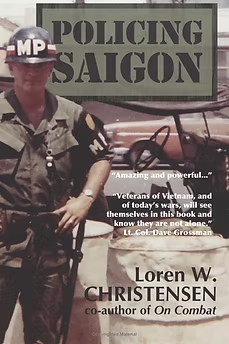
Book Corner: Policing Saigon, written by Loren Christensen.

War stories have always fascinated the public, ranging from Erich Maria Remarque’s

World War One novel All Quiet on the Western Front, to Alistair MacLean’s World War Two thriller The Guns of Navarone, up to the more recent American Sniper,

Chris Kyle’s autobiography of his combat experience in Iraq. Ex-cop and noted martial artist Loren Christensen throws his hat into the ring with Policing Saigon, the story of his

year as a military policeman patrolling the capital city of South Vietnam during the Vietnam War. Told mostly as a series of vignettes, Policing Saigon is at times dark-humored, shocking, sad, grisly, and even touching. (A note about terminology – in 1975 Saigon was renamed Ho Chi Minh City, and in 1976 South Vietnam merged with North Vietnam to become simply Vietnam.)

A cop in Portland, Oregon for 25 years, and a karate practitioner since his teens, Christensen is known mostly for a series of well-regarded policing and martial arts books. In Policing Saigon, he tells his story slowly and methodically. Growing up in suburban Washington state, his goal in college in the late 60’s was to break into radio and theater. Christensen took the initiative of enlisting, viewing the military police as an experience to draw upon for the acting world and incorrectly thinking that MP volunteers don’t receive overseas assignments (he notes that he was lied to by the recruiter).

After basic training, Christensen went through the range of military police courses such as language school and dog training. But after landing in Saigon in 1969, the 23-year old quickly realized that he was unprepared for the tough and thankless job. The MPs worked 12-hour shifts, seven days a week that often went hours into overtime in a sprawling, stifling hot and dirty city, hit hard by the war. The roads were clogged with haphazard and unregulated traffic that resulted in frequent accidents, some of which Christensen witnessed and some in which he was involved. The city was known for wretched poverty and was full of beggars, often children forced by their parents. The pollution was so severe – and the humidity was so brutal – that he developed both respiratory and fungal infections that took months into his discharge to heal.

The job was dangerous and unpredictable. The military police were hated by everyone, especially by those that were sympathetic to the Vietcong. The hate extended even to American GIs, since the MPs were often called in to arrest violent and drunken soldiers letting off steam on leave from the jungle. Christensen and his partners were also frequently called in to arrest AWOL (absent without leave) GIs, who flocked to Saigon in staggering numbers. He writes that in his tenure the number of AWOL soldiers never dipped below eighteen hundred. The American soldiers did not always go quietly and often resisted arrest, sometimes turning the scene into a brawling and bloody mess where the MPs needed backup.

As Christensen writes, the military police were also sitting ducks for all forms of terror, the perpetrators of which were impossible to catch. Snipers were liable to pick at them from nearby rooftops or windows, or bombs could be placed quickly and inconspicuously inside the military jeeps – even by children. Their job sometimes had them chasing thieves down dangerous, narrow, and winding alleys, frazzling their nerves and keeping them on edge. Even worse, as he writes, off-duty MPs were often unable to truly relax. Nighttime brought the sounds of artillery from the war’s front lines, serving as an uneasy and troubling background noise. Other MPs reacted to the stress of the war and their job in a number of ways. One of his early roommates casually kept a live python in a locker, mere meters from Christensen’s bed. Another inexplicably began shooting from the MP barrack’s balcony towards a truck transporting America’s allies, the South Vietnamese soldiers.

Crime against the American soldiers was rampant. Christensen writes that gangs of local thieves devised creative ways to steal from the American supply trucks, fueling the black market. Riding on motorbikes behind and alongside the trucks, they performed gravity-defying gymnastics while in motion as they would grab merchandise off the vehicle and speed off before unsuspecting driver realized what happened. Other crimes involved hookers. Sex-starved soldiers on leave would follow a hooker down an alley for a quick hookup and would instead be robbed. Others would actually engage in the act in the hooker’s room, while under the bed an unseen partner-in-crime (sometimes the girl’s mother) would reach out and pluck a few bills from the unsuspecting soldier’s wallet.

There are touching moments in the book, if one can call it that. Christensen isn’t a touchy-feely guy and his descriptions of these interactions come across as matter-of-fact and straight-forward. He writes of his admiration for the mainstream Saigon residents, mostly decent people trying hard to eke out a living. He notes their survivors’ mentality, and describes as they shrug off hardships and get back on their feet. In another chapter, he writes of meeting a group of cute Vietnamese kids, friendly and smiling to the MPs. But they were basically homeless street urchins living a hard life, sadly sleeping in a nearby cemetery. He writes of saying goodbye to his parents before shipping out to the army, facing an unknown future. And in one of the book’s most touching moments, he writes of his homecoming a year later, sitting quietly in his childhood room, the horrors of the war behind him.

Christensen was discharged in mid-1970 and less than 48 hours later was back home, a transition that was so fast it was jarring. He writes of his difficulty in adjusting to civilian life, suffering from PTSD until the return to martial arts would quiet his soul. He would later draw upon his MP experience for his police career, viewing it at five years’ experience combined into one year. A brown belt in karate at the time of his service, he realized that a more realistic and practical street-fighting style was needed, which he later taught privately and also to the police and military.

Christensen would be the first to admit that this not a book of heroics. This is not Band of Brothers or The Sands of Iwo Jima. But he took his job and his service in an unpopular war very seriously. The book clocks in at over 300 pages but his stories will hook you in. A worthwhile and moving read.

If you want to read another Book Corner article, please visit this review by Evan Rothfeld: https://www.angrymetatraders.com/post/ten-more-ok-now-twenty-finish-thirty-next-run-the-hill.