post266

India Insider: Manufacturing Strategy to Create Rural Jobs

India Insider: Manufacturing Strategy to Create Rural Jobs

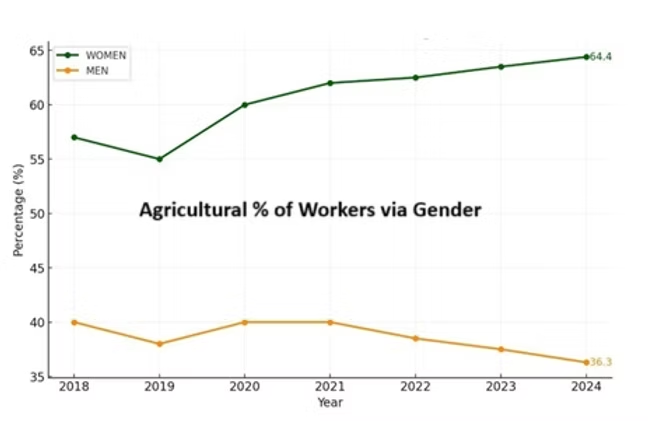
Across much of India’s rural landscape, manufacturing remains scarce and finding a solution for this remains a priority. While some towns do have small scale industries that offer jobs, this is still limited. As of financial year 2023, agriculture accounts for only 16% of India’s GDP, down sharply from around 35% in the 1990s, due to a structural shift toward services and manufacturing.

A large share of rural families still depend on agriculture, often engaging in farming and irrigation with modern equipment. However, marketing their produce remains a persistent challenge. Meanwhile, many rural workers are engaged in low-wage trade and commerce, often in informal settings such as small shops and roadside businesses. These roles typically offer limited income and little upward mobility. Falling real wages have pushed many to migrate to India’s urban centers or venture overseas to Singapore, Malaysia, and the Gulf countries in search of better livelihoods, aided by favorable exchange rates.

Capitalism and Efficient Manufacturing

Adam Smith, in his seminal work The Wealth of Nations wrote that, ‘it is not by gold or silver, but by labor that all the wealth of nations is created’. This fundamental idea underpins the modern economic thought that wealth is not derived merely from money, but from the productive capacity of people.

When capital is invested in a capitalist enterprise, it generates profits for the owner, provides wages for employees, and delivers returns (such as dividends) for shareholders. But this cycle of value creation depends on active and efficient enterprise, particularly manufacturing which has been missing or underdeveloped in many parts of rural India.

Unlike countries such as the United States, where people readily relocate across States, India faces some unique challenges. Like the European Union, India is a union of diverse linguistic and cultural regions. It is uncommon for a small business owner from Himachal Pradesh to directly access markets in Tamil Nadu or Karnataka due to language barriers, cultural differences, and logistical constraints. These frictions further isolate rural producers from wider markets.

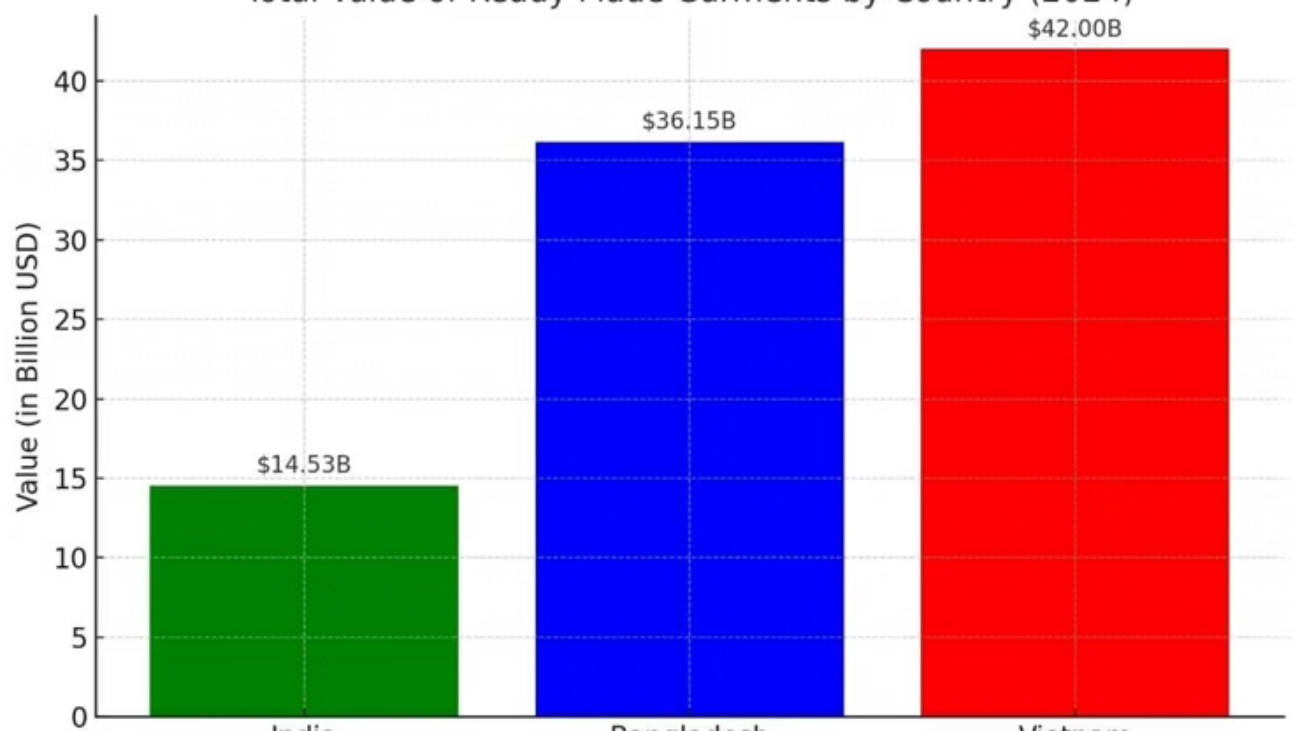
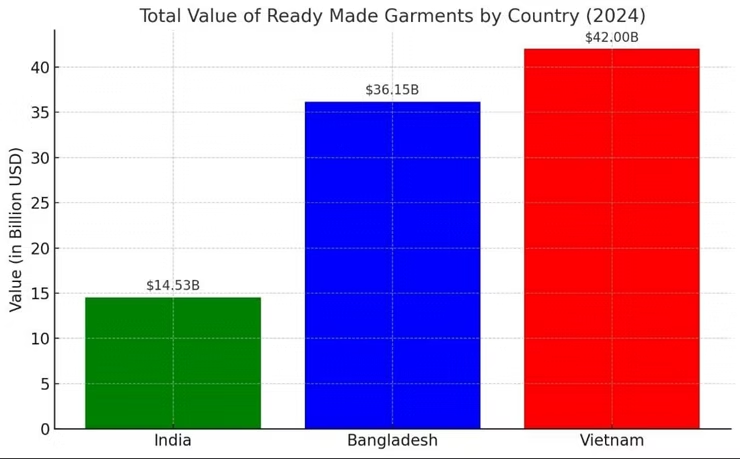
Garment Industry Values in India, Bangladesh and Vietnam

Strategic Solutions and the Role of State Governments

To revive rural economies, business people along with their state governments must identify and invest in strategic sectors that create jobs and add value. Kerala is a fine example: as one of India’s top spice-producing States, Kerala has the potential to establish local industries focused on spice processing, packaging, and export. Coordination between agriculture and manufacturing can generate employment, stimulate local economies, and enhance foreign exchange earnings.

Albert Hirschman, a development economist, highlighted this approach through his theory of unbalanced growth and economic integration. He argued that certain industries have strong reciprocal connections with other parts of the economy. By prioritizing sectors with good synergy potential, developing countries can achieve significant growth even with limited resources.

Growing competition from countries like Bangladesh and Vietnam which both enjoy favorable trade agreements do pose new challenges, this must be taken seriously by India and create a focus on forward looking international commerce. There will always be competition from distant enterprises and nations, this must be accepted and planned for via commercial insights.

Within India is Tiruppur, a city in Tamil Nadu, known as the ‘Manchester of South India’ due to its vibrant textile industry. The city has created an ecosystem of manufacturing that consistently offers higher real wages compared to other towns in the region. It has successfully shifted labor from agriculture to industry, thereby increasing productivity and income. It is a bright example and defines one way to make progress.

Protecting New Industries and Creation of Success

In his book How Rich Countries Got Rich and Why Poor Countries Stay Poor, economist Erik Reinert argues that nations develop not just by doing what they are currently good – such as agriculture or mining, but by nurturing industries that can become more productive long-term. Typically manufacturing and technology sectors lead to greater innovation and economic resilience.

Reinert provides numerous examples, like South Korea’s emerging growth in steel and its automotive industries, and Ireland’s rise in information technology where specific protections and support for young industries has led to long-term prosperity.

India’s rural transformation cannot rely on New Delhi alone. State governments along with business people must take the lead by identifying sectors that have the potential to foster high growth and employment. Helping to create local value chains, investing in infrastructure, training, and market access will build resilience in these communities. By encouraging small-scale manufacturing and leveraging regional strengths, the country’s rural areas can become engines of economic growth.

post262

India Insider: Booming GDP & Fragile Foundations of Growth

India Insider: Booming GDP & Fragile Foundations of Growth

India’s economic footprint on the global stage is expanding significantly each year. As the world’s largest democracy, the nation achieved a remarkable 7.4% GDP growth rate January to March of this fiscal year. Yet, beneath this impressive headline, job creation remains tepid, overshadowed by slowing foreign direct investments (FDI) and lower corporate investments from India’s domestic market.

Despite Prime Minister Narendra Modi’s initiative to attract manufacturing into India and boost jobs, the manufacturing share of GDP has stubbornly clung to 16% for the last decade. While India’s services sector accounts around 55% of GDP, the IT and allied services sectors contributes a mere 3-4% of total employment. Even after the last two decades in which India’s Asian neighbors have shifted labor force out of agriculture and into high scale manufacturing, 45% of India’s workforce still are employed in agriculture and aligned services constituting only 15-17% of GDP.

Speculative Capital, Excessive Credit and Rising Financial Risk

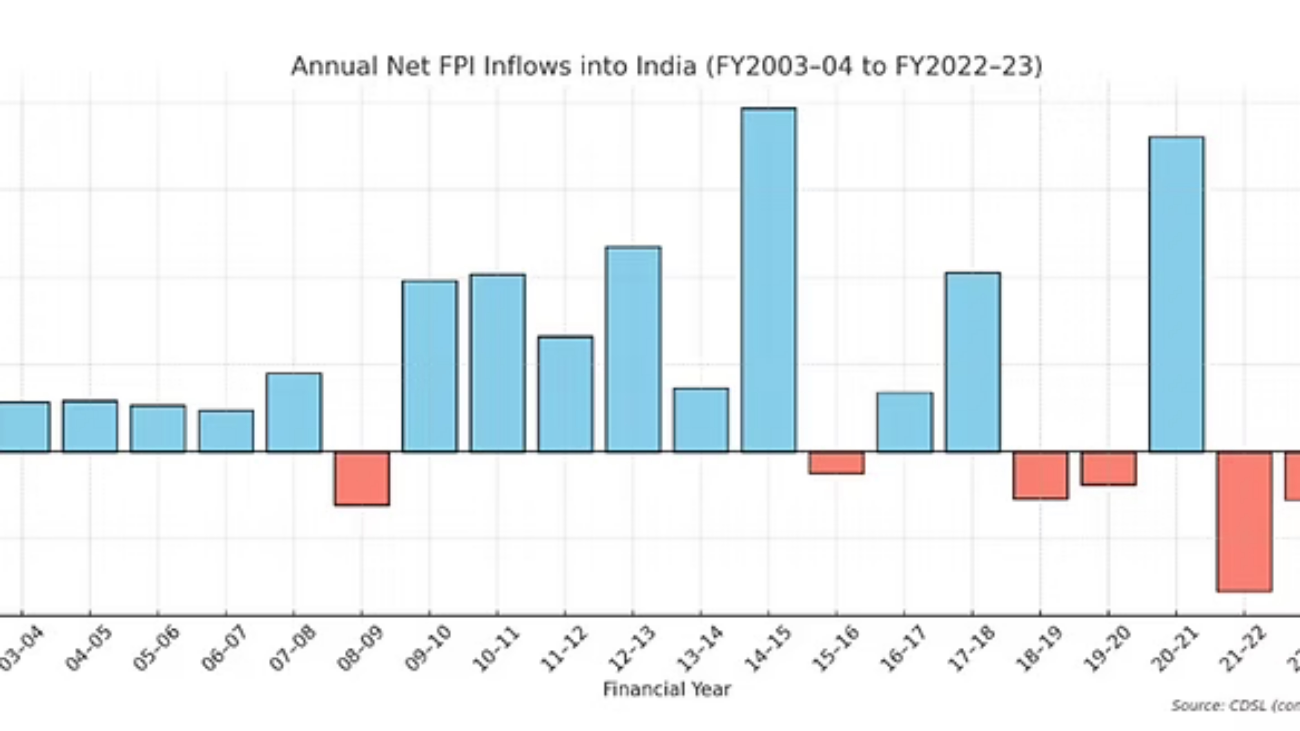
Between 2003 and 2023, India attracted approximately $275 Billion USD from foreign capital inflows, encompassing mostly equity and debt foreign portfolio investments. These capital injections are speculative in nature, primarily chasing returns in financial markets, rather than being directly invested into long-term productive infrastructure like manufacturing and export oriented industries.

Foreign Portfolio Investment into India 2003 to 2023

Interestingly, India’s public sector banks especially between 2008 and 2015 aggressively lent to infrastructure, real estate and capital intensive projects. The state owned banks tried to fill the gap left behind by private investors. A substantial share of these loans later turned into non-performing loans, exacerbating a duel crisis as corporate and bank balance sheets came under severe stress within a few years. The government of India stepped in and injected 3.1 lakh crore Rupees ($45 Billion USD) to recapitalize the struggling banks, and also orchestrated mergers of weaker banks with stronger banks. India’s citizens helped cover these costs via higher taxes and hidden banking charges.

Reserve Bank of India: FX Reserves and Liquidity Dynamics 

As of financial year 2025, the RBI’S Foreign Exchange Reserves stand at around $696 billion USD. While a stronger reserve buffer is crucial for maintaining external stability, the Reserve Bank of India’s purchase of foreign currency to build reserves leads to problems with domestic Rupee liquidity and creates liabilities for the RBI’s balance sheet. Unless it’s not fully absorbed via Open Market operations, it will end up as excess liquidity in the banking system.

Post 2020 and the Covid19 pandemic, loose monetary policy and excess liquidity within the banking system has culminated with more reckless lending. Unsecured retail credit particularly in personal loans, credit cards and consumer finance is troubling. Non-banking financial companies (shadow banking) and fintech enterprises also expanded rapidly into this segment and now pose risks.

India Falling into Debt Trap 

Per a recent survey conducted by the RBI,  household financial savings have sharply declined to a five decade low of 5.1% of GDP in FY2023, down from 11.5% in 2021. Concurrently, household liabilities have risen, particularly in the unsecured credit segment.

Delinquencies in small ticket personal loans and “Buy Now, Pay Later“ programs are on the rise, prompting the RBI to intervene recently with tightening of personal loan norms in late 2023. This dynamic suggests that excessive credit creation, unaccompanied by productive or real income growth, is fueling a fragile boom in consumption backed predominately by debt especially among middle and lower income groups.

Lower Net Foreign Direct Investment amid Higher Repatriation

Even with coordinated efforts from the likes of Apple, Foxconn (Hon Hai Technology Group) and other electronics companies setting up facilities, and the assembly of manufactured goods like iPhones as part of the “China Plus“ strategy, a more comprehensive method of doing business and improved proactive FDI policy is needed. Overall results are still falling short. Evidence shows many companies continue to choose Vietnam and Mexico over India, which is clearly reflected in the lower net FDI figures in India’s Balance of Payments. In financial year 2024-25, net FDI fell 96% to $353 million USD, caused by a surge of money being repatriated out of India led by foreign companies, and also increased foreign investments by Indian companies to other nations, per the Hindu magazine.

The irony is that India needs foreign capital to finance its current accounts deficit, long-term capital investment would boost jobs and increase wages. As the central Indian government practices an austerity drive and its corporations show an unwillingness to invest, India needs higher foreign capital at this crucial juncture. How will India achieve this task? Without better employment and raising wages, India’s celebrated growth faces risks from underlying cracks.

post246

An Expanding Axis – Will Egypt and Pakistan Become Members?

An Expanding Axis - Will Egypt and Pakistan Become Members?

Opinion: The following article is commentary and its views are solely those of the author. This article was first published the 26th of May via The Angry Demagogue.

China seems to be taking advantage of the transition from the Obama-Biden appeasement based foreign policy to the Trump commercial based system. Whereas Obama-Biden had no problem punishing allies that dared to oppose the US-EU appeasement and woke revolution, Trump is looking to create alliances based on commerce – and threatens allies that don’t go along. While the Obama-Biden policy failed utterly and arguably caused the wars in Ukraine and the Middle East, the Trump administration seems to be playing for time as it restructures the global security order.

China however does not seem to care to wait and are stretching their sway not only in the South China Sea but westward towards the Middle East. The four member Axis – Russia, China, Iran and North Korea seems to be expanding to other countries with strong military dictatorships. Egypt and Pakistan will be the next members of the Axis. While much of China’s belt and road policy deals with bankrupting poor, weak countries, they seem now to concentrate on strong military dictatorships. Egypt and Pakistan are being pried from the western camp as we speak.

Pakistan has, for awhile not been firmly in the western camp. It was a cold war U.S ally as India, while democratic, sided with the Soviets on most international issues. While the US was busy in Afghanistan, the Pakistanis played double agent. Now that the U.S is not in the region and the U.S and India have become closer, Pakistan is now firmly in the Chinese camp.

In addition to Pakistan, Egypt becoming the next major member of the Axis.

Let’s take a few steps back and examine the burgeoning relationship between Egypt – a military dictatorship and Communist China. As we have written China and Egypt had joint military maneuvers that included deliberate violations of the Egyptian-Israeli peace treaty guaranteed by the United States. Egypt, in thumbing its nose not only at Israel but at the United States, allowed Chinese planes to approach the Israeli border in order to test Israeli reaction to a possible invasion. Multiple Chinese military cargo jets flew in undisclosed hardware in the days leading up to the maneuvers.

Three more Chinese Y-20 cargo planes landed in Egypt last week again, carrying unknown hardware. At least one of these planes came from Pakistan. Egypt also seems to be signing major arms deals with France as Macron reeks of desperation in his attempt to remain relevant – but a de Gaulle he is not, and he will not be able to create a force or policy independent of the U.S. Egypt will be glad to take advanced French weaponry while it creates a stronger alliance with China.

Back to Pakistan one has to wonder if the Pakistan-Indian flareup a prelude to what can happen in other theatres – or worse, a purposeful conflagration to test Chinese weapons systems in actual combat and keep the West on its back feet? According to most reports they were able to shoot down between 3 and 5 of France’s most advanced Rafal fighters without even entering Indian territory. The confrontation started with a heinous terrorist attack against Indians in Kashmir by a terror group associated with the Pakistani armed forces. India claims that Pakistan is directly involved in the attack. If so, this would not have been the first one.

The downing of the Indian French built Rafal fighters by Pakistan’s Chinese produced 10-C was, according to expert reports, not just or even mainly superior piloting but with a Chinese strategy and technology that includes all aspects of air power – including recognition of the target, locking on and attack from distances in what an American air expert called a perfect air based killing machine. This would seem to be the first real test of Chinese advanced air-power and it something that needed to be done before any invasion of Taiwan. This may not test their own pilots but it does test the strategy and the technology.

China has a main medium term goal here and it is not a secret. They are planning to take Taiwan by force and need to make sure their soldiers, sailors and hardware are up to the job. They have seen how poorly the Russian army has performed and have seen how Israel has dismantled Iran’s defenses and swatted away Iran’s offensive attacks. China has not fought a major war for decades and for all the advances they say they have made – all have been untested. Until now.

China will not risk a war with India itself but would be more than happy to have its proxy involved. Chinese fighters and their new “over the horizon” missiles are key in their plans to deter the U.S from defending Taiwan – or in defeating U.S naval airpower if the U.S does get actively involved. However, as close as French technology is to America’s it is not the same and the one country that seems to have taken U.S technology to the next level is Israel. How would Chinese weaponry due against American arms in the hands of an air force equivalent in skill and bravery to the American air forces? That has yet to be tested but that brings us back to Egypt. Is it in China’s interests for Egypt to make a major break with the U.S at China’s urging much as they made a break with the Soviet Union at America’s urging? Of course. Would that mean that China might help Egypt provoke a military confrontation with Israel in order to test Chinese arms and relieve pressure on Iran? Maybe.

On to Iran then, where it does not seem that the Americans or Israelis understand the nature of the Iranian-Chinese relationship. Not only does China get the bulk of its oil (subsidized) from Iran but they have just completed a rail link from Xinjiang, China to Teheran, Iran – running through four countries. This rail line can ship oil as well as other cargo, cutting into the American (and Indian) naval superiority around the Persian Gulf and Indian Ocean. The assumption by military planners has always been that the U.S can cut off Chinese access to oil, if necessary. That is no longer the case.

China is not standing still – they are expanding their axis of dictatorships to countries in which the army is in control. Pakistan and Egypt qualify. Iran, while a theocracy is controlled by the Iranian Revolutionary Guards. No matter the “deal” that the Trump administration negotiates with Iran they will not be pried away from Iran. China has more to offer an ideological dictatorship then commercial deals with the United States. What the alleged realists in foreign policy refuse to understand is that dictatorships have no interest in commercial success if it weakens their grip on power. They are interested in deals that enrich their regimes since that also strengthens their grip on their people.

The trillion of so dollars in deals that the U.S has now made with the Persian Gulf states ensures that America remains a player in the middle east. Those who think that the Mideast is a tertiary region at best – after Asia and South America – need to rethink their strategies. As China closes in on control of the world from the Pacific to the Mediterranean the U.S is left with just two military powers it can depend on – Israel and India – to help defend its old/new commercial interests. It is not only oil – it is not Boeing jets, Nvidia chips and many other products that are moving from the US to the Gulf as opposed from the Gulf to the U.S. The U.S is no longer a commercial client of the Gulf states but the country who needs to protect its clients. The relationship has changed but the security relationship has only gotten more important.

The addition of Egypt and Pakistan to the Axis means that the Chinese threat has expanded. They are not giving up on Taiwan, nor are they giving up on South America and the Pacific Ocean but rather, China is using its experience as a dictatorship to strengthen ties with other freedom hating countries. We can all pretend that values and culture don’t matter, but that doesn’t mean that they don’t. This Axis is one where the interest of each member is to stay in power, force its will on its people and enrich itself at the expense of its people. This is an Axis, not only of the unfree, but of those who need to eradicate freedom to “thrive”.

Disclaimer: the views expressed in this opinion article are solely those of the author, and not necessarily the opinions reflected by angrymetatraders.com or its associated parties.

You can follow Ira Slomowitz via The Angry Demagogue on Substack https://iraslomowitz.substack.com/ 

post238

Trump: Will He or Won’t He Day and Uncertainty for Investors

Trump: Will He or Won't He Day and Uncertainty for Investors

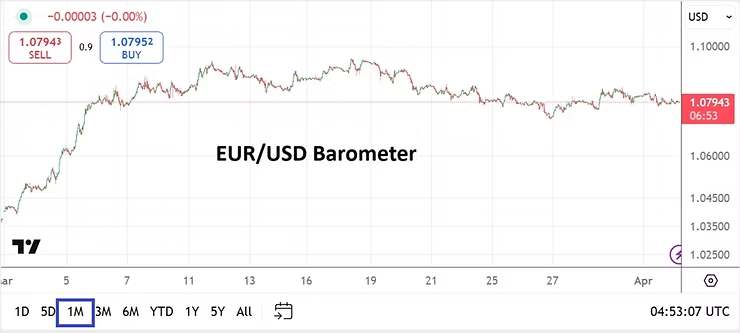
EURUSD One Month Chart as of 2nd April 2025

Liberation/Tariff Day will blow onto the global financial shores this morning. President Trump and his team are certain to take a victory lap as they announce their decisions regarding actions being imposed on commodities and products. Nations who are on the other end of the drama will be braced for the rhetoric and policies. Investors, trade ministers, financial institutions will have to sift through the pronouncements and consider their outlooks amidst uncertainty.

Trading today will be rough for smaller speculators. Choppy conditions should be expected as behavioral sentiment twists according to shifting winds and interpretations. President Trump is likely to announce aggressive penalties, but he may also try to soothe those who have worried about being punished. As an example, Trump has said recently that India has acted upon many of the White House’s wishes. Mexico, Canada, the European Union and China are likely to be mentioned as the U.S President speaks later today. Will a public scolding take place again?

Equities have faltered the past month, Forex has been volatile and commodity prices have also reflected fragile sentiment as outlooks became grey. The tariff policies announced today will affect all aspects of the financial world. Day traders thinking about wagering on the outcome should be patient and wait for the reactions which unfold from Asia, Europe, Africa, and the Americas. Wall Street will certainly be a barometer, along with the EUR/USD, USD/MXN, USD/JPY, GBP/USD, USD/SGD and gold.

While President Trump declares this is a great and magnificent day for the U.S, it will be of keen interest if an olive branch is offered to trading partners. After talking tough the past few months, financial institutions would like to hear words of optimism from the White House. If belligerence is heard and punitive actions are enacted, which are considered unproductive by investors and financial institutions the broad markets will show their disdain promptly.

President Trump’s skills as a negotiator will be judged today. The White House must play towards its constituency and show they are putting America First, but will the President also display he is cognizant that international trade provides benefits? Trump will point to his claim that he is merely putting tariffs on those who have treated the U.S unjustly and use levies against U.S goods.

It will be an important day for the Trump Presidency, because in many respects the global audience watching will decide whether or not the U.S sees itself as part of the global fabric or seeks a position which is isolationist. Brazil will look on the tariff theater intently, its position as a trading center may find increased demand from a host of nations.

Predicting the results: On the 3rd of February a fast and dangerous Forex market developed which witnessed USD centric strength exhibited with spikes in many currency pairs. In early March reactionary trading was displayed in equity indices, Forex and bonds too. Today will see wide spreads emerge in Forex with near-term resistance and support levels proving vulnerable.

Equities which sold off in March via the Nasdaq 100, S&P 500, Dow 30 and the Russell index are certainly hoping for a dose of cheer. The question is if Trump will deliver a positive message. The likelihood is that today’s events will not be the last of the tariff tirades and some proposed actions remain under deliberation. Today is unlikely to produce final results and the broad markets are probably going to be choppy as outlooks stay mitigated and absent of clear resolutions.

Gold Three Month Chart as of 4th April 2025

Day traders should think safety first today. Gold remains within record territory. If unpredictability rules near-term and the reactions of investors and financial institutions create fast conditions, the precious metal and bonds will find takers. Uncertainty breeds cravings for risk adverse assets.

post224

The Greatest Rivalry: India vs Pakistan: Netflix Doc. Review

The Greatest Rivalry: India vs Pakistan: Netflix Doc. Review

The India-Pakistan cricket rivalry is one of the most intense and storied in the history of sports. This 3-part Netflix documentary delves into this historic cricket rivalry, focusing primarily on the 1999 and 2004 tours. While it provides an engaging look at these high-stakes encounters, the series feels somewhat incomplete, as it largely skips over the period before 1999 and rushes through the events post-2004, condensing nearly two decades into the final 10 minutes of the last episode.

The Greatest Rivalry: India vs. Pakistan – A Review of the Netflix Cricket Documentary

One of the more thought-provoking moments comes from Pakistani journalist Osman Samiuddin, who draws a cultural comparison by noting that Pakistan’s savings rate lags India’s. He suggests this reflects differing life philosophies – Pakistanis living more in the present versus Indians planning more for the future. Indian journalist Ayaz Memon describes the 1999-2004 era as a clash between Pakistan’s world-class bowlers and India’s formidable batsmen. However, the reality is that both teams were evenly matched during this period, adding to the intensity and unpredictability of their contests.

The documentary effectively captures the electrifying atmosphere whenever these two nations face off, highlighting the high emotions and record TV ratings. Indian cricket legends like Sunil Gavaskar, Kris Srikanth, and Sourav Ganguly provide insightful commentary, but it’s Virender Sehwag who takes center stage for his pivotal role in the 2004 series. On the Pakistani side, Shoaib Akhtar, at the peak of his career, is a key figure, alongside Javed Miandad, Waqar Younis, and Inzamam-ul-Haq. John Wright, the coach of the Indian team in 2004, also shares some noteworthy behind-the-scenes anecdotes.

The series makes a commendable effort to keep political tensions at bay, but the deep-rooted rivalry between the two nations inevitably influences the narrative and the emotions of fans on both sides.

A brief segment touches on the Indian Premier League (IPL), cricket’s biggest moneymaker, noting that Pakistani players participated in the inaugural 2007 tournament. However, the 2008 Mumbai terror attacks led to a political fallout, resulting in the exclusion of Pakistani players from the IPL. This absence has deprived the league of some exceptional talent and the unique buzz that a cross-border rivalry would have generated. The documentary provocatively suggests that had Pakistani players continued in the IPL, the fierce on-field competition might have evolved into a more sporting rivalry, possibly softening fan perceptions across borders.

The timing of this documentary is particularly relevant, with the 2025 Champions Trophy starting this week (Feb 19) in Pakistan. However, citing player safety concerns, India has opted to play all its matches at a neutral venue in Dubai. This decision underscores the ongoing political tensions that overshadow cricketing ties. The documentary leaves viewers pondering whether a day will come when sports can take precedence over politics, allowing fans in both countries to once again experience the thrill of live, cross-border cricket.

Overall, while the documentary provides a nostalgic and thrilling account of one of cricket’s most storied rivalries, a more balanced historical perspective and deeper exploration of the post-2004 era would have made it even more compelling.

postR192

Impolite Opinion: BRICS Long-Term Plans & Implications Part 1

Impolite Opinion: BRICS Long-Term Plans & Implications Part 1

The global Forex market is spastic and many major currencies are traversing within weaker whipsaw value ranges against the USD. The currency pairs are trading in price bands seen before the Fed cut its Federal Funds Rate by 0.50 basis points on the 18th of September. And there is still one and a half weeks of assured volatility that will be demonstrated. Crucial U.S data is on the schedule in the coming days via the Advance GDP and Non-Farm Employment Change statistics, and the U.S Presidential election is edging closer. Israel and Iran continue to play a game of cat and mouse in the Middle East, which thus far has led to a controlled chaos and not worldwide bedlam. Financial institutions have plenty of reasons to be apprehensive.

Expansion of BRICS Feels Inevitable

Now let’s turn our attention to a tectonic foundational shift building in global trade and geopolitics. Attention on short-term behavioral sentiment which is fragile and has a less than clear mid-term perspective, needs long-term considerations too. Investors are required to contemplate possible dangers that are hiding in open sight and will pose a problem in the future.

The BRICS 2024 Summit was conducted this week in Kazan, Russia. This included the new member nations of Egypt, Ethiopia, Iran and the United Arab Emirates. I am not here to give you a major recap on what took place behind closed doors. I wasn’t invited. But we should look at some of the results and statements made and what they imply strategically.

The BRICS attendees to this year’s conference included powerful dignitaries from approximately 36 nations. One major result of this BRICS conference was to award Partner State status to 13 countries including Algeria, Turkey, Malaysia, Indonesia, Vietnam, Thailand, Nigeria, Uganda, Kazakhstan, Uzbekistan, Belarus, Cuba and Bolivia. Saudi Arabia was invited last year and has not made their full participation official yet, but they attended this year’s conference as an invited guest. The trend appears clear, we are entering a new paradigm in which long-term thinking by the BRICS nations could out maneuver the short-term nonchalance of the West and this has implications for the USD long-term.

There were high level meetings between leaders of BRICS countries including China, India and Russia. Perhaps, more importantly was Vladimir Putin’s bold statement about BRICS desire to start its own grain exchange. Putin also advocated for the creation of a BRICS cartel in other commodities such as metals, including gold. Gemstones such as diamonds and emeralds could develop into a sizeable entity too. This needs to be taken seriously by the West.

Credence must be given because the BRICS nations already are among the largest producers of grains, legumes and oilseeds. The scope of commodity production and supply capabilities by BRICS could certainly turn into a painful thorn in the side of existing large trading companies. And a potentially coordinated energy sector via Iran, Saudi Arabia, Nigeria, Russia and others must be taken into account.

Russia and China as Friends of the Underdogs

Historical entanglements put Western nations like France and others in a vulnerable spot diplomatically as they try to maintain alliances with many BRICS nations. France serves as a good example of diminishing Western influence. France remains on the ground overtly in Africa while dealing with vestiges of a colonial past. But France’s influence in Africa is under stress and their ability to use the continent as a source of power and financial gain is being confronted. France still maintains the Presidential Council for Africa, but France is likely perceived by many of the participants as a wolf dressed in sheep’s clothing. Coups in French influenced African nations have a bloody and present history when political diplomacy does not go well.

Exploiters of the past in many African nations are looked upon with derision and scorn. Russia and China are often viewed as friendly countries who helped fight along the side of certain African nations who sought and achieved independence. The ability to create ascendancy in Africa by Russia and China needs to be looked at within a prism that suggests additional spheres of power will develop in BRICS. Many nations that dealt with colonial statuses in the past are rightfully intent on shaking off the notion of being considered laggards.

The West certainly knows in no uncertain terms it cannot return to colonialism. However, African governments should make sure they are not replacing old masters for new. While some might say it is wishful thinking – and I am still on the fence contemplating the notion – on the part of Russia and China to create powerful commodity cartels, if achieved this actually could prove to be an emphatic first step in attempting to secure a new and powerful currency by backing it with a foundation of intrinsic value. Brazil and South Africa would be a big part of this underpinning too. Russia and China’s foray into Africa via their military and money lending excursions, and the already created organizational and trade structures which exists within BRICS opens the door for the perceived underdogs to battle together against the power of Western riches.

A competition is certainly underway between the West and BRICS. What exactly is the U.S doing in Angola? The planed visit of Joe Biden in the first week of December, which was supposed to take place in mid-October was postponed due to the recent hurricanes. Will the U.S presidential visit be anything more than a sideshow, particularly if the Democrats do not win the election on November the 5th? Angola has a massive amount of Crude Oil and is an OPEC member. American energy companies and other Western corporations are active commercial participants in the African nation. However, China has a firm financial stake in Angola via infrastructure projects too. The political and financial implications between BRICS and the West is a growing dynamic, one that will be further discussed in Part 2.

postR171

Triumphant Victory Marks End of Era for Indian Cricket Greats

Triumphant Victory Marks End of Era for Indian Cricket Greats

A Farewell to Legends: Kohli, Sharma, and Jadeja Retire from T20 Internationals

In a significant shift for Indian cricket, three stalwarts have announced their retirement from T20 internationals following the conclusion of the recent T20 World Cup. Virat Kohli, Rohit Sharma, and Ravindra Jadeja, each a pillar, have decided to step back from the shortest format of the game. Their retirements mark the end of an era and leave an indelible void in the Indian cricket team.

The Impact of Kohli, Sharma, and Jadeja

These three players have been instrumental in countless victories for India, bringing their unique talents and personalities to the field. Kohli, with his exceptional fitness and fiery passion, has been a cornerstone of the Indian batting lineup. Sharma, renowned for his elegant stroke play and ability to anchor innings, has often been the linchpin in crucial matches. Jadeja, with his all-round prowess and agility, has contributed significantly with both bat and ball, not to mention his spectacular fielding.

Their departure from T20 internationals is not just a loss of talent but a great shift in the team’s dynamics. Kohli’s fervent celebrations and on-field energy, Sharma’s cool-headed leadership, and Jadeja’s versatility will be sorely missed by fans and teammates alike.

The Perfect Farewell

For Kohli, Sharma, and Jadeja, winning the T20 World Cup was a dream and they achieved that in 2024 edition. Their commitment to this goal was unwavering, and with India’s triumphant win, they decided that retiring on the high note of a World Cup victory was the perfect way to bow out. This victory, fulfilling a long-held aspiration, was the ultimate peak of their careers, making it a fitting moment to conclude their illustrious journeys in T20 cricket.

The Kohli Phenomenon

Among the trio, perhaps the most striking figure is Virat Kohli. His presence on the field has been synonymous with passion and intensity. Kohli’s fitness standards have set a benchmark in modern cricket, inspiring countless young athletes. His emotional celebrations, especially after pivotal moments, have captured the hearts of fans worldwide.

Kohli’s relationship with the media and fans has been a rollercoaster, reflective of the intense scrutiny Indian cricketers face. Loved and critiqued with equal intensity, he has navigated the ups and downs with poise. Off the field, Kohli has also emerged as a social media powerhouse, engaging millions of followers with his dynamic presence. He is not just a cricketer; he is a brand, masterfully managed and perpetuated, resonating with fans far beyond the cricketing sphere.

The Future of Indian Cricket

As Kohli, Sharma, and Jadeja bow out of T20s, the Indian team stands on the brink of a new chapter. There is no shortage of emerging talent ready to fill their shoes in terms of runs and wickets. However, replicating the aura and legacy of these veterans is another challenge altogether.

The question now is whether the next generation can cultivate the same level of charisma and connection with fans that Kohli has achieved. Will there be a new player who can stir the same depth of emotion, embodying both the love and critique that Kohli so adeptly managed?

As Indian cricket moves forward, the legacies of Kohli, Sharma, and Jadeja will undoubtedly continue to inspire. Their contributions have not just been in numbers but in the very spirit of the game, setting standards and creating moments that will be treasured by cricket enthusiasts for years to come.

postR166

T20 World Cup 2024: New Cricket Contenders and Shifting Powers

T20 World Cup 2024: New Cricket Contenders and Shifting Powers

The 2024 T20 Cricket World Cup has unfolded as a fascinating saga of unexpected performances and shifting dynamics. Hosted jointly by the United States and the West

Indies, this year’s tournament has been a platform for emerging teams to shine and traditional powerhouses to stumble. Here’s a look at the highlights, surprises, and

predictions as the tournament enters the next phase of Super 8s.

The 2024 T20 World Cup has seen newer teams stepping up their game, bringing fresh excitement and proving that they are no longer mere participants but serious contenders on the global stage.

Nepal: Nearing a Historic Upset

Nepal’s match against South Africa was a nail-biter, showcasing their evolution at the international level. Despite being up against a seasoned and formidable South African side, Nepal pushed their opponents to the brink, almost clinching what would have been a historic victory. This performance underscored their potential and the growing depth in their cricketing skills.

Namibia: Close Calls and Narrow Losses

Namibia’s participation in the World Cup has been marked by tight contests and commendable efforts. They came close to winning on few occasions, showing that they are not far from breaking through to the next level. Their ability to compete closely with more established teams speaks volumes about their preparation and potential for future tournaments.

Scotland: Dominating Giants

Scotland has been a revelation, delivering top performances against some of the tournament’s biggest teams. Their matches against England and Australia were particularly impressive, where they played with confidence, proving that they are a force to be reckoned with in the T20 format.

USA: A Wild Card with a Wild Ride

As co-hosts, USA received a wild card entry into the tournament and seized the opportunity with both hands. They stunned Pakistan with a remarkable win and pushed India to their limits in a well contested match. Their spirited performances have been a breath of fresh air in the tournament. However, despite their on-field success, it remains uncertain whether these efforts will translate into a broader interest in cricket within the United States. The sport still predominantly attracts expatriate communities, and it will take more than a few wins to embed cricket deeply into American culture.

Oman, Uganda and Papua New Guinea: Learning the Hard Way

For teams like Oman, Uganda and Papua New Guinea, the World Cup has been a tough lesson in the rigors of international cricket. The disparity in skill and experience was evident as they struggled against seasoned opponents. However, participating in such a high-level tournament provides invaluable exposure and learning opportunities,

which are crucial for their development.

Netherlands, Canada and Ireland: A Nothing Tournament

Netherlands, Ireland and Canada have been on the Associate level circuit for a while. In fact, Ireland and Netherlands have played in past international tournaments and caused upsets. Who can forget Netherlands knocking out the giant South Africa at the last T20 world cup. Unfortunately, these 3 teams played mediocre cricket. Although not many expected them to win games, they were certainly expected to give a decent fight. That of course did not happen.

While emerging teams have shown promise, some traditional cricketing powerhouses have surprisingly struggled, failing to live up to their reputations.

New Zealand, Pakistan, and Sri Lanka: A Rough Road

New Zealand, Pakistan, and Sri Lanka have faced unexpected challenges, each failing to advance to the next round. Their early exits are a stark reminder of the unpredictable nature of T20 cricket, where even the most experienced sides can falter. These teams have not only lost games but also a bit of their aura as formidable opponents in the shortest format of the game.

Afghanistan and Bangladesh: Rising Up the Ranks

In contrast, Afghanistan and Bangladesh have played admirably, securing their spots in the next round. Their performances suggest a shift in the balance of power within the cricketing world. Both teams have shown resilience and skill, stepping into roles traditionally occupied by the likes of Pakistan and Sri Lanka.

England: Living Up to Expectations

England, known for their aggressive and adaptable T20 style, have lived up to their billing. They have performed consistently, leveraging their dynamic approach to secure


their place in the next stage of the tournament. Their ability to play fearlessly under pressure continues to make them a formidable T20 side.

The Dominant Forces

As the tournament progresses, the established giants continue to dominate, reaffirming their positions as the top teams in the world. India, South Africa, Australia, and the West Indies have each topped their respective groups, showcasing their strength and depth.

These teams possess a blend of talent, experience, and aggression that makes them formidable opponents.

India: Combining tactical acumen with explosive batting and a versatile bowling attack, India has consistently outperformed their rivals.

South Africa: Despite their scare against Nepal, South Africa’s robust team dynamics and skilled lineup have seen them through to the top.

Australia: Known for their relentless competitiveness, Australia has continued to display their dominance with powerful performances.

West Indies: Leveraging their home advantage, the West Indies have played with flair and confidence, making the most of familiar conditions.

The Home Advantage: West Indies have the Upper Hand

With the remaining games scheduled in the Caribbean, the West Indies have a significant home advantage. Their familiarity with local conditions, coupled with enthusiastic home support, positions them strongly as favorites to lift the trophy. While all four group leaders are strong contenders, the West Indies’ home advantage could be the crucial factor tipping the scales in their favor. Given their current form and the benefits of playing on familiar grounds, they are poised to be the team to beat in this year’s tournament.

The 2024 T20 World Cup has been a spectacle of emerging talent and unexpected twists. As newer teams rise and traditional powers recalibrate, the tournament highlights the dynamic and ever-evolving nature of T20 cricket. Whether this year’s surprises will lead to lasting changes in the cricketing landscape remains to be seen, but one thing is certain: the excitement and unpredictability of T20 cricket continues to captivate the fans.

postR196

AMT Top Ten Miscellaneous Blossoms for the 31st of May 2024

AMT Top Ten Miscellaneous Blossoms for the 31st of May 2024

10. European Supremacy: The NBA Championship between Boston and Dallas is set to begin on the 6th of June. If the Dallas Mavericks win, it will mean Giannis Antetokounmpo in 2021, Nikola Jokic in 2023, and Luka Doncic in 2024 were victors, and are cementing the terrain as the best players.

9. Brisk Breeze: The need for ‘chill’ among AI and server companies isn’t only about attitude. The advent of quantum computing will add to the wintry demands. Vertiv, Asia Vital Components, and Auras Technology are a few of the enterprises in the industrial environment sector helping deliver precision cooling for the technologies to work efficiently.

8. Glitches: Stalled data within the S&P 500 and Dow Jones 30 for their index calculations took place yesterday for nearly one hour, but individual trading within companies via stock prices appears to have been unaffected. Futures trading for the two indices weren’t affected. On Monday the 18th of March, Nasdaq suffered a tech problem that stopped pre-market trading for a couple of hours.

7. OPEC: The cartel will conduct a one day online meeting this coming Sunday. Production levels will be discussed, among other issues. The price of WTI Crude Oil as of this writing is below 78.00 USD per barrel. While news remains stuck in hyperbole from the Middle East, the price of Crude Oil has declined since the first week of April.

6. Conviction: Donald Trump was found guilty in a NYC courtroom yesterday, but the verdict is certain to be appealed. The law of unintended consequences could come into play from the U.S as reactions generate. The perceived notion that ineffectual and non-credible leadership is mounting in the U.S, lends credence to some people around the globe regarding dwindling American exceptionalism.

5. Results: South Africa voting counts will be finalized sometime this weekend, India’s election count will be known on the 4th of June. The unknown outcomes are affecting the USD/ZAR and USD/INR, and more volatility in the currency pairs should be expected early next week.

4. Coincident: GDP results came in around their expectations yesterday. Growth numbers produced a gain of 1.3%, while the GDP Price Index showed a 3.0% climb. The data produced does show the U.S economy is slowing and is another ripple to be considered by analysts and traders.

3. USD/JPY: The Bank of Japan appears to be betting on weaker U.S data to continue, and potential dovish Fed rhetoric on the 12th of June to propel the USD/JPY lower, thus helping the BoJ to remain on the sideline and avoid an intervention for the moment. The BoJ will release their Policy Rate decision on the 14th of June and many eyes will be on the central bank’s Monetary Policy Statement.

2. Inflation: The Core PCE Price Index report outcome today is anticipated to be around the 0.3% ratio. The Federal Reserve pays plenty of attention to this publication and if the number meets the expectation or comes in below it, this could cause a repeat of the Fed’s dovish December 2023 FOMC Statement. Financial institutions have already begun wagering that the Federal Funds Rate could be cut this summer and later again this year. Many assets will react to today’s inflation report.

1. Behavioral Sentiment: Nervous price action has been seen in the equity indices and Forex this week. Investors may have felt they got a little ahead of their risk appetite curve and now appear to be waiting on more solid impetus to reconfirm their outlooks. Choppy price action has certainly been fueled by U.S Treasury yields which increased earlier this week. Losses in the S&P 500, Dow 30 and Nasdaq the past handful of days are now waiting for buyers to reemerge. The question day traders may want to consider is if financial institutions and large investors believe assets will cost less next week, or if prices have now hit worthwhile support levels which will spur on buying today?

post203

AMT Top Ten Miscellaneous Missiles for the 19th of April 2024

AMT Top Ten Miscellaneous Missiles for the 19th of April 2024

10. Fusion: The U.S Senate presented legislation yesterday which creates guidelines allowing the Nuclear Regulatory Commission to authorize commercial investment and research of fusion energy. Significant strides are being made in the technology and the U.S government is preparing for the newest developments.

9. Cup of Joe: Your cafe is going to get more expensive. Robusta and Arabica coffee both remain at higher values having hit apex prices respectively this Wednesday and Thursday. And Cocoa remains ‘comfortably’ above 11,000.00 USD per metric ton this morning.

8. United Arab Emirates: The UAE has been hit by heavy weather, suffering its biggest rainfall in 75 years. It was reported that over 14 centimeters of rain fell this Tuesday in Dubai, which is the equivalent to one and a half year’s worth of typical accumulation in the city.

7. India Elections: The vote in the world’s biggest democracy has begun as millions decide on the the Lok Sabha. The election process will take place for nearly a month and a half with the results formally being presented on 4th of June. The Bharatiya Janata Party is expected to win a majority in the House of the People, thus likely re-electing Narendra Modi as the country’s Prime Minister.

6. Gold: The precious metal remains within sight of record values with the price around 2,388.00 USD per ounce. Today’s earlier ratios touched the 2,420.00 vicinity.

5. Cone of Silence: Israel and Iran have remained mum on military counterstrike action scuttlebutt, which was heard this morning throughout global media. The silence from the two nations did not stop the Nikkei 225 Index from dropping over 1000 points upon the news.

4. Bitcoin Halving: A coding change is anticipated to occur soon in Bitcoin which will affect ‘mining’ parameters for the digital asset. The code change will double the amount processing needed to create one BTC, making it twice as expensive for Bitcoin operators. Day traders tempted to wager on BTC/USD over the next couple of days need to be careful. BTC/USD is near 64,560.00 at the moment of this report.

3. Fear Factor: Price of WTI Crude Oil is near 82.70 USD per barrel. Large energy traders continue to show they are experienced in geopolitics, remaining relatively calm as Middle East concerns are being brandished.

2. While Flag: U.S Fed Chairman Jerome Powell conceded that inflation remains stubborn earlier this week. Stagflation is not being discussed openly by the Fed, but it is likely raising concerns among global central bankers. The USD has returned to very strong levels as financial institutions brace for the possibility of U.S interest rates remaining high into the late summer.

1. Behavioral Sentiment: Equity indices, Treasury yields and Forex are within the midst of nervous seas as central banks and geopolitical concerns create storms. Speculators should make sure they pay attention to the waters they traverse with their bets, which could prove dangerous to navigate in the near-term.

post195

Cricket: Indian Premier League an Entertainment Juggernaut

Cricket: Indian Premier League an Entertainment Juggernaut

In the realm of cricket, where passion meets spectacle, one tournament stands out above all others: the Indian Premier League (IPL). Since its inception, the IPL has not just captured the imagination of cricket enthusiasts but has also redefined the landscape of the sport. With each passing year, its popularity has soared to new heights, transcending boundaries, and uniting fans in a celebration of cricket and entertainment.

The meteoric rise of the IPL is perhaps most evident in its television viewership, which has witnessed a remarkable surge year after year. In 2024, the tournament has reached

unprecedented heights, with the first 10 games alone commanding a staggering viewership of 350 million, as reported by the official broadcaster. This milestone underscores the IPL’s status as a global sporting phenomenon.

However, beyond the numbers also lies another pulsating heartbeat of the IPL: the electrifying atmosphere of its live in-person matches. Recently, I had the privilege of attending an IPL game, and what I witnessed was nothing short of extraordinary. The stadium pulsated with energy as fans from all walks of life converged to witness their cricketing heroes in action. From passionate chants to colorful banners, every corner of the stadium exuded a palpable sense of excitement and camaraderie.

What struck me the most was the inclusivity of the IPL experience. It wasn’t solely about cricket; it was a vibrant tapestry of emotions, where families, friends, and strangers united to bask in the excitement of the game. Whether it was the hawkers peddling team merchandise outside the stadium, the bustling metros filled with fervent fans, the thunderous applause following a boundary, or the collective breath held in anticipation before a wicket, each moment felt like a communal journey, transcending barriers of language, gender, and age.

At its core, the IPL represents more than just a cricket league; it embodies the spirit of modern India – a dynamic blend of tradition and innovation, of passion and entertainment. The league’s success can be attributed to its ability to constantly evolve and adapt to always entertain the audience. From introducing innovations like strategic time-outs and impact players, the IPL has consistently raised the bar for sports entertainment.

Moreover, the IPL’s impact extends beyond the boundaries of the cricket field. It has become a catalyst for economic growth, tourism, and fostering talent at the grassroots level. Through its various initiatives, the league has endeavored to promote inclusivity, diversity, and social responsibility, making a positive difference for many lives.

As the most-watched cricket league globally, the IPL continues to captivate hearts and minds, reaffirming its status as a cultural phenomenon. With each season, it pushes the boundaries of excellence, offering fans an unparalleled blend of athleticism, excitement, and entertainment. As I left the stadium that day, surrounded by the echoes of cheers and applause, I couldn’t help but marvel at the enduring legacy of the IPL is building – a testament to the power of sport to unite, inspire, and transcend.

Ibrahim Mirza also wrote: https://www.angrymetatraders.com/post/icc-men-s-cricket-world-cup-2023-thoughts-predictions which can be read in Angry Meta Traders. For more go to our Sports and Cricket sections.

post 183

An India-Israel Alliance: Prospects to Serve Global Freedom

An India-Israel Alliance: Prospects to Serve Global Freedom

Opinion: The following article is commentary and its views are solely those of the author.

We wrote a few weeks ago in response to Nassim Taleb’s claim that Israel was fragile due to its over-dependence on the United States, and we came to the conclusion that in general he was correct although not in every aspect Is Israel a Fragile Country?.

Also, we compared Israel’s fragility with that of other free or status-quo countries (as opposed to revolutionary countries like Russia, Iran and China) and thought that Israel was certainly not more fragile than other free countries in difficult neighborhoods.  We then gave a general outline of how the free-status-quo world might look should we actually see the end of America’s commitment to global freedom The Day After Pax Americana.  

I would like to examine in a more detailed way about Israel and India and how their potential relationship could be a model for this world. With the U.S reluctantly and belatedly responding to attacks from Iranian backed groups in Syria, Iraq and Yemen and their stubborn resistance to attacking Iran itself each free or status-quo country needs to look into its own defense. The U.S also needs to see how it can help midwife these alliances so as to guarantee a free world after their voluntary end to the Pax Americana.

Israel will need  to expand its reach and move towards a more anti-fragile existence without damaging the all important U.S relationship. We can’t underestimate the importance of the U.S relationship to Israel and how important it is to maintain and even expand it – but as the U.S political landscape is changing and as the elite part of the younger generation is, for some reason, excusing violence against Jews in general and Israel in particular, Israel needs new strategic partners if it is to thrive and move at least part of the way towards anti-fragility.

Israel’s relationships with the Arab world, the Abraham Accords along with its older peace treaties with Jordan and Egypt are dependent upon dictators remaining in power. The most vocal and belligerent voice against Israel by a government in the (non-Iranian influenced) Arab comes from Jordan and the most vocal and belligerent non-governmental voice in the (non-Iranian influenced) Arab world probably comes from Egypt. These treaties are all important and they are based upon the self interest of the current rulers of the countries (which is a good thing), but no one can know how long they can last and how firm they really are.

Israel also has a strong and growing relationship with Greece and Cyprus in the eastern Mediterranean and have joint military exercises together. Their navies and air forces train together and even their ground forces have joint exercises but neither of those two countries have the economic, military or diplomatic heft that Israel needs.

If Israel is looking for a second strong ally but one that itself lives in a dangerous neighborhood then the place to turn to is India. With the largest population in the world, a democratic government and a growing economy, India is the ideal strategic ally for Israel. Both are countries that live in dangerous neighborhoods, are working democracies and have experience dealing with terrorism. India, under with the premiership of Narendra Modi already has a strong relationship with the Israeli military. Israel has sold more than $600 million worth of military equipment to India (second only to Russia) and the two militaries have cooperated on anti-terror policy. The Israeli navy also reportedly has close ties to the Indian navy including submarine exercises in the Indian Ocean. Israel already has nearly $5 billion in trade with India (import and export) and it is time for Israel to start purchasing basic military supplies from India. India has five domestic manufacturers of the standard 155 mm artillery shells and it has large small arms industry – this should be an alternative to total dependence on the U.S for this standard equipment.

There is now a consensus in the country that Israel needs to broaden its military manufacturing and acquisition and the best way to do this would be to expand its relations with India. In order for this to make sense the time has come for Israel to say a very big “thank you very much” to the United States for the $3.9 billion in military aide it gets annually and instead purchase directly from the U.S and other sources.   India could also help in building factories in Israel – which could even be operated by Indian nationals through Israel’s guest worker program.

The military cooperation should be expanded to the air-force as well as ground forces.  There ought to be joint officer training, just as there is now with the U.S and some European countries. There should be a process in place that will eventually lead to a freedom of the seas treaty in the waters between India and Israel’s Gulf of Eilat. This should include cooperation between naval, air and anti-missile forces. 

The foreign worker program should also be expanded. Israel is trying to free itself from dependence upon Palestinian labor – from both Gaza and the West Bank – and India and Israel have been talking about an expanded guest worker program. Currently there are Indian citizens working as aides to the elderly and disabled and that needs to be expanded to construction and agriculture. 

Israel is a small country with around 10 million people and due to its large birthrate and legal immigration there is a lack of new housing construction in the country. The guest worker program in place with countries like Philippines, Thailand, Sri Lanka and others allows workers to work for up to five years and earn much more than they can earn in their home countries. They are provided with the same health care as Israeli citizens (paid for by their employers) and are even given pension benefits which they take with them when they return to their home countries. Israel could probably host up to 100,000 Indian workers a year.  

Scientific and student cooperation should be increased. This will not only help both countries develop important technology in areas such as healthcare and biotech, but will help India and Israel retain some of the scientists that would otherwise emigrate to the U.S and U.K. The exchange programs at university science and technology departments could lead to the creation of world class companies in the respective fields. 

Finally, cooperation regarding the capital markets could help both countries develop world class markets. India has the potential to be a global financial center in the coming decades and Israel, while far from being a financial powerhouse could be a link to European markets and investors with the time zone 1-2 hours ahead and close connections with those markets. 

The United States will be Israel’s main ally for the next few decades but it will be healthy for both countries if Israel was able to share interests – political, diplomatic, cultural and military with another major country. While France was that country until 1967 no European power has the position or the disposition to ally with Israel. India is democratic and attained its independence at the same period Israel did and from the same (then) major colonial power.  Also, both countries have overcome their socialist beginnings to thrive on the global economic stage. 

Now is the time for Israel and India to take the next step on the road to a true alliance. If we have truly reached the end of the Pax Americana, then this can be an example to the rest of the free-Status-quo world on how to manage without the vast power that is the United States. If somehow America shows the will to continue to lead the free world an Israel-India alliance will only contribute to the freedom that a continued Pax Americana protects. It would be helpful in any future conflict in the Pacific and the alliance could expand to the Gulf countries, East Africa and maybe even Egypt. 

Economically and technologically the obvious expansion would be towards South Korea and Japan. Militarily, it could aide and potentially replace the U.S naval presence in the Persian Gulf and allow it to concentrate its forces more in the Pacific. We are not talking here of a relationship that will replace the U.S military tomorrow or even next year. 

This is a long term process and requires the governments, corporations and individuals in both countries to be aggressive in turning a relationship into an alliance.  And it will require the cooperation and encouragement of the United States which will have to agree to support this and similar alliances even if it does not agree with all the tactics used in a moment of crisis.     

It is time to start looking forward and to stop depending on the goodwill of the American people as America, too faces major fiscal, strategic and military challenges of its own. 

Disclaimer: the views expressed in this opinion article are solely those of the author, and not necessarily the opinions reflected by angrymetatraders.com or its associated parties.

You can follow Ira Slomowitz via The Angry Demagogue on Substack https://iraslomowitz.substack.com/