postN104

India Insider: Weakening the MNREGA Employment Guarantees

India Insider: Weakening the MNREGA Employment Guarantees

When the Mahatma Gandhi National Rural Employment Guarantee Act was enacted in 2005, it was conceived as more than a poverty-alleviation program. It was a direct intervention in India’s rural labor market. By guaranteeing employment on demand at a statutory wage, MNREGA established what the agrarian economy had long lacked – a credible wage floor.

For India, where nearly half the workforce remains trapped in agriculture and align activities often involuntarily, this mattered enormously. Rural labor markets are structurally weak in India. They are seasonal, informal, and dominated by excess labor. In such conditions, wages do not rise organically. MNREGA altered that balance by providing an outside option. A worker who could demand public employment could also refuse exploitative private wages. That is why rural real wages rose meaningfully during the first decade of MNREGA’s implementation.
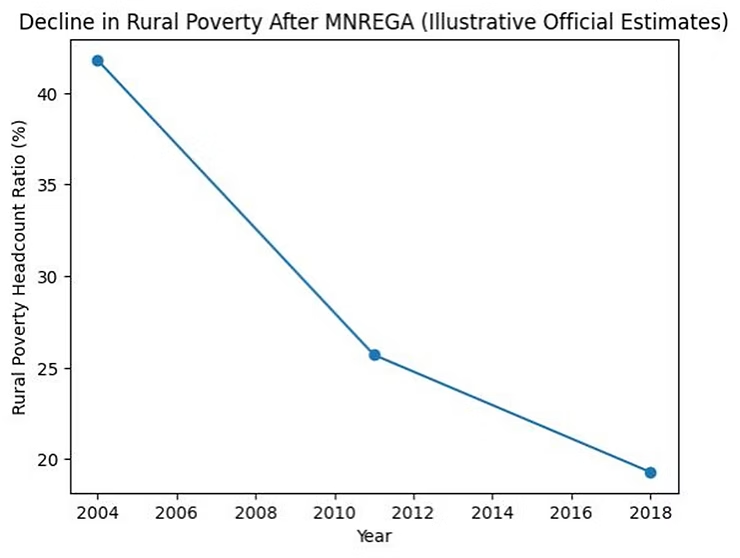
MNREGA Rural Poverty Data from 2005 to 2018

The figure above illustrates the broader context in which MNREGA operated. Rural poverty declined sharply after 2005, falling from over 40 per cent in the mid 2000s to below 20 per cent by the late 2010s. While this decline reflects multiple forces like overall growth, structural change, and social programs, micro-level studies consistently find that districts and households with higher exposure to MNREGA experienced significantly larger gains in consumption and poverty reduction compared to areas where the program was weakly implemented.

The scheme also acted as a counter cyclical stabilizer. During droughts, agrarian distress, or macro slowdowns, MNREGA expanded automatically, injecting purchasing power into rural areas. This supported consumption, reduced distress migration, and softened downturns. In macroeconomic terms, MNREGA transferred income to households with the highest marginal propensity to consume, precisely where fiscal multipliers are strongest.

Despite its strong design, MNREGA has long suffered from implementation weaknesses. Chronic delays in wage payments undermined its credibility as a reliable source of income. Corruption has generated fake muster rolls, ghost workers, inflated material bills, and substandard asset creation. Social audits which meant to be the backbone of accountability were uneven across states while effective in some.

Technological reforms such as Aadhaar linked payments, and digital attendance reduced certain leakages but introduced new problems, including worker exclusion, authentication failures, and further payment delays. The result was not only fiscal leakage, but a weakening of MNREGA’s core economic function which had promised a dependable wage floor.

Yet instead of fixing these implementation failures, a new policy chose to change the promise itself. In December 2025, this shift became explicit with the passage of the VB-G RAM G Act, 2025 in Parliament, replacing the Mahatma Gandhi National Rural Employment Guarantee Act with a redesigned rural jobs framework.

Under MNREGA, employment was a legal right, if work was demanded, it had to be provided. The new framework reverses this logic altogether. Employment now depends on budget limits, administrative approvals, and notifications from the center, not on demand. What was once automatic is now conditional.

This change also quietly shifts risk onto States. With limited revenue powers and tight borrowing limits, States responded by rationing work and delaying payments. As a result, the employment guarantee weakens, rural workers lose bargaining power, and wages come under pressure. What appears as fiscal control for the central government to rein on capital expenditures on paper thus becomes wage suppression in practice for rural workers.

Almost half of India’s workforce, around 46 per cent, still depends on agriculture and allied rural activities for employment, even though agriculture produces a much smaller share of the country’s total output. This gap between employment and output signals very low productivity in rural work and a large pool of surplus labor. For most of these workers, moving out of agriculture is difficult. They face barriers because of a lack of skills, weak urban job absorption, high migration costs, and social constraints. As a result, the ability to bargain for higher wages is structurally limited.

In such an economy, rural labor markets tend not to be competitive. Employers often face many workers competing for few jobs, while workers have few alternative sources of income. This creates conditions close to monopsony, where employers have disproportionate power in setting wages. In the absence of an institutional counterweight, wages tend to settle near subsistence levels rather than reflecting productivity or broader economic growth.

The consequences are visible in wage outcomes. Daily wages in rural areas stagnate or decline in real terms, failing to keep pace with inflation. Over time, this suppresses labor incomes relative to profits and rents, leading to a further decline in labor’s share of national income. In effect, weakening the employment guarantee shifts income distribution away from workers and back toward employers, reinforcing existing structural inequalities in the economy.

Copy and paste the text from AMT that you want to share

postR189.1

Hurricanes, Wars, U.S Election and Inflation Reports Noise

Hurricanes, Wars, U.S Election and Inflation Reports Noise

Between hurricanes, wars, the coming U.S election what could possibly go wrong for day traders? Oh wait, the U.S will also issue their Consumer Price Index reports today to throw some fuel onto the Federal Reserve outlooks of financial institutions. As the loud headlines get attention and try to scare us, it should be noted that markets have actually behaved rather calmly this week. Perhaps volatility was already traded heavily into assets the past week and a half, and tranquility is returning. However, there is the possibility that experienced smart money has simply positioned investments and speculative endeavors, and now await outcomes via objectives in order to react.

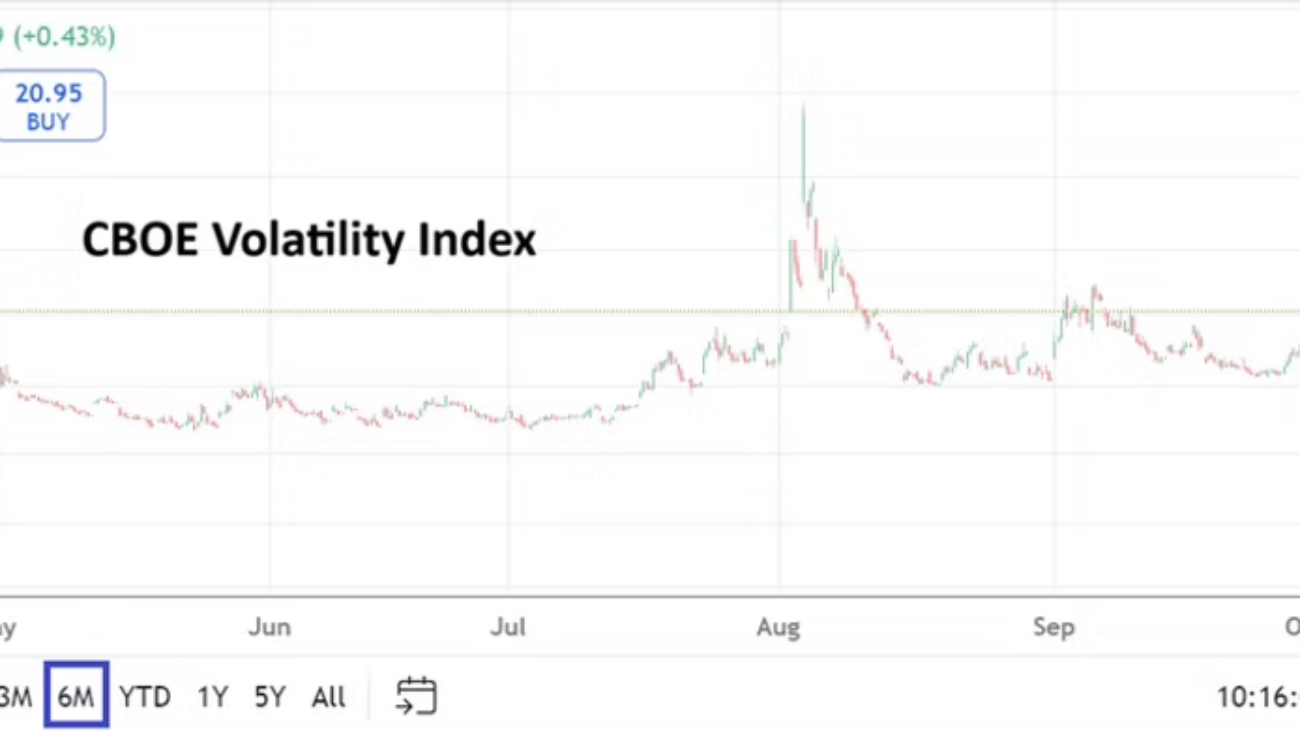
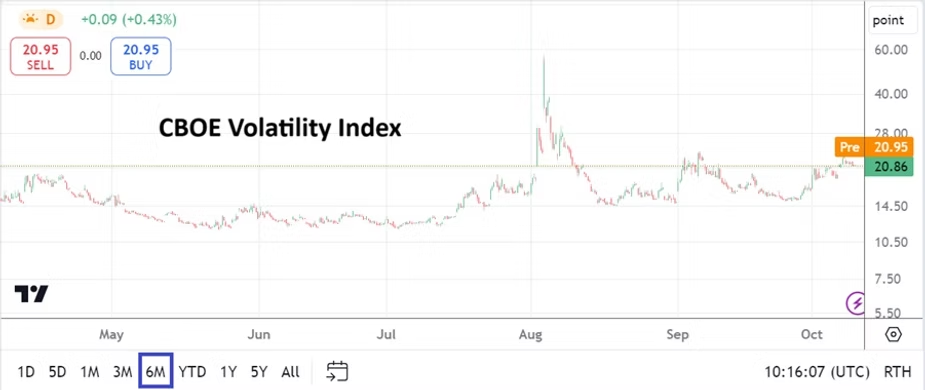
CBOE Volatility Index Six Month Chart on the 10th of October 2024

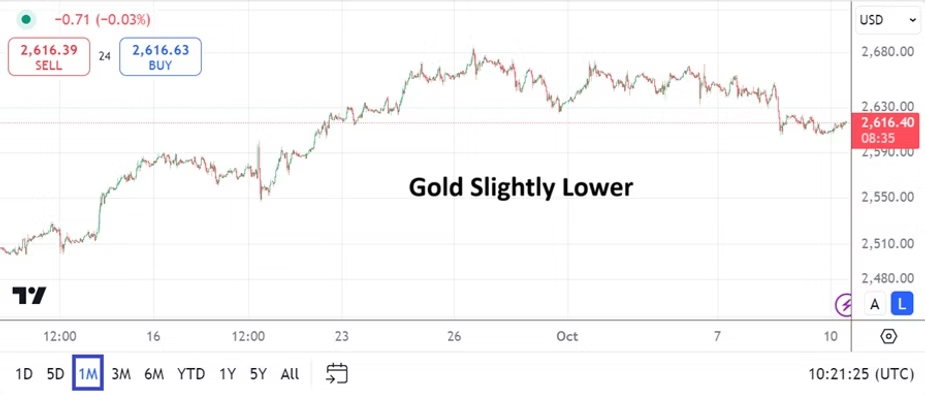
The Chicago Board Options Exchange’s Volatility Index (VIX) has risen since the last week of September, but remains within known realms. Gold while definitely within the higher levels of its long-term price range has ebbed lower during the same timeframes. And WTI Crude Oil while flirting with short-term highs today, actually remains within the known realms of its six month range. In other words while short-term day traders potentially get caught up in fearmongering rants and tremble, financial institutions continue to trade with an outlook that remains rather tame mid-term.

Gold One Month Chart on the 10th of October 2024

Financial institutions were dealt a perplexing blow last Friday when the U.S Non-Farm Employment Change hiring numbers came in stronger than anticipated. However, what is not getting enough attention is another revision downwards to the previous month’s totals did happen. Today’s Consumer Price Index statistics and tomorrow’s U.S Producer Price Index results are expected to show that inflation remains under control. If the coming data meets estimates or can show a slight decrease this could ease the fear of some financial institutions regarding what’s coming next from the Federal Reserve. If higher inflation numbers are displayed this would spark more volatility.

WTI Crude Oil Six Month Chart on the 10th of October 2024

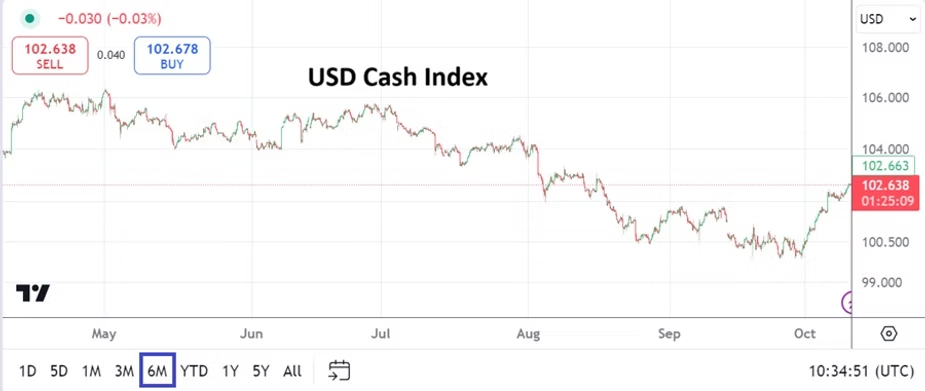
Certainly, USD selling got ahead of itself by the end of September. Day traders need to understand there are seldom one way avenues in Forex. Intraday reversals aside, when equilibrium and outlooks do not mesh via the insights of financial institutions, volatility occurs. The buying of the USD since September’s end has been noteworthy, but it was not entirely unexpected. The CPI and PPI reports from the U.S on the calendar will provide impetus. Let’s see if the markets remain calm as a swirl of other risk events linger in the air. Risk adverse tendencies have caused caution in the broad markets.

USD Cash Index Six Month Chart on the 10th of October 2024

Traders need to know there will be one more jobs report from the U.S on the 1st of November. There are some people around us that no doubt believe the U.S government is showing better than expected jobs numbers to try and ramp up support for certain political candidates. However, if analysts do their jobs well enough and point to the revisions downwards that have been consistently seen, this could help alleviate fear of conspiracies.

The Fed is still in a position to cut the Federal Funds Rate by another 0.25 on the 7th of November. Yes, the FOMC Statement is coming only two days after the U.S election, so the Fed’s decision which will be garnered during meetings on the 6th and 7th will carry some significance depending on who has been elected U.S President. While U.S economic data has been mixed via a combination of jobs numbers which had been faltering until last week, and consumers suddenly showing greater confidence and manufacturing sentiment in important sectors with improved optimism, interest rates are still high. The Federal Reserve has a dilemma and likely will want to try continuing to incrementally cut borrowing costs when they have the opportunity.

Day traders should not be too concerned with what will happen a few weeks away, particularly when they are interested in the results of trades consisting of a few minutes, half hour, and other limited durations. But they should always understand their positions in Forex, equity indices, commodities, and elsewhere have little to no effect on the real marketplace. Day traders need to be able to catch onto the technical trends and behavioral sentiment being created by larger players and financial institutions.

postN17

AMT Warning: Many Brokers Do Not Care if you Lose your Money

AMT Warning: Many Brokers Do Not Care if you Lose your Money

Sounds like the title has been written wrong doesn’t it? Reads as if the editor clearly doesn’t understand the nature of the financial markets and how they work. Certainly anyone who offers their services to you would like to see you make money, or so you would like to think if you are an idealist who remains innocent and trusts all people.

Unfortunately, the title of this artcle which has lured you into reading this WARNING is not wrong. It has been written as cautionary advice for new and even experienced speculators. Many of the ‘financial’ websites and people you are considering to engage with via their day trading platforms and ‘expert’ systems are not worthy. Many do not care if you make money and some in fact are planning on ripping you off.

Blackjack Betting and Sitting at the Table with Too Much Leverage

Volatility is in the eye of the beholder, brokers like when day traders without deep pockets use leverage, because they expect their ‘clients’ to get wiped out. Yes, brokers are not your friends in many cases, in fact they are rooting against you in the back rooms of their trading operations. Why? Because they are not actually putting your trade into the cash markets, they are allowing you to trade virtuallly. Think of it as entering a casino.

The casino wants you to bet outrageous sums of money, because they know statistically most gamblers will lose. Again, you have been warned. Your use of leverage is music to the ears of your broker, because they know the volatility of the market will knock you out of a trade if your margin trading is too high and the slightest of technical reversals will produce a losing position for you. Then they will ask you if you want to make another wager. You can continue to sit at the ‘blackjack’ table or walk away.

Learn To Trade Without Getting Ripped Off

The first thing you might want to ask and acknowledge when you begin to trade is how much money can be lost? The answer is all of your money. If the answer being given to you is that there is minimal risk and that you are guaranteed profits – immediately close the website you are looking at and find another. Guaranteed profits equates into assured losses for unsophisticated traders most of the time.

If you are speaking to someone on the phone and the person keeps asking you how much money you want to make, please hang up the phone and speak to someone else. Self proclaimed gurus should be shunned. As someone once said, people tend to use the word guru, because the word charlatan takes too long to spell.

Yes, even in the most reputable and best of companies who provide trading platforms, you are going to lose money sometimes. The art of speculating and successsful trading is a delicate balance between losing money and making money. It is probable if you are a new trader, that unfortunately you are going to lose money and you will become uncomfortable. Sure you could get lucky or be a prodigy who is supremely talented, but you should understand many folks lose money in the beginning. There is a learning curve for day traders and you need good teachers. You also need a calm emotional state of mind.

Finding a Pro to Trade for You

You might want to consider letting someone that you trust and who has a proven track record with verifiable clients you can authenticate to invest your money. However to have a pro trade for you, the amount of money as a minimum you will need for them to consider trading your cash is likely sizeable. It doesn’t seem like a fair question from a social perspective, but are you wealthy enough to allow someone to trade for you?

If you find a person that is reputable to trade for you, make sure they have explained their modus operandi and you agree with their outline. In other words have them discuss their plan of attack and how they perceive complexities within the markets. What sectors do they invest in, what is the break down via percentages regarding the amounts of money they put into various financial assets? Asking questions may seem a bit impolite, but reputable fund managers and family offices should not get flustered by your questions, and they should have answers that are easy to understand. Do not let them talk over your head with fancy words and equations. Clear and concise language is necessary.

You shoud ask how often they rebalance their portfolios and if they issue a quartertly report. Importantly, ask for an example of transparent accounting which shows transaction fees that will be charged in full, including services they are charged by other financial providers within your account. Commission and banking fees can add up quickly. And then ask the magic question regarding drawdowns, and what are the allowable losses in a trade and in an account that can happen before they have to stop trading. You should get clear explanations regarding all of your inquiries.

But You Likely Still Want to Trade for Yourself

If your emotions do not let you take into consideration that there are going to be negative days, perhaps declines for weeks and bad months – simply put, trading isn’t for you. Learning to handle your money and investing should not be a speculative adventure, this is not about having fun. Oh you will certainly experience thrills, but you should try your best to limit crises. Risk management is a way to curb the elements of gambling which every day trader is undertaking.

Will you become a professional investor? What is a professional investor? Nothing like semantics and flattery to get the juices of a prospective investor going. Do not be fooled by flattery. Do not be fooled by the fact that you have a degree. There are folks who do not have high school graduation certificates looking to take advantage of you, some of them are great traders and will eat you alive. Education at the best of colleges or universities is no guarantee you will become a good trader. There is a difference between paper trading and having skin in the game.

The marketplace is waiting for you to enter and anticipates taking your money. Brokers are trying to get you to come to their trading platforms because they want to make money from your transactions and wagers if they are not reputable. These brokers actually do not believe you will make money. Until you prove you know what you are doing you will be treated like a ‘mark’. When you do prove you know what you are doing you will be treated differently in more ways than one, and it might prove difficult to withdraw your winnings.

Trust is Important, but Facts and Regulations Help

You must deal with people and companies you trust. Make sure to do a deep examination of the folks you are about to forge a trading association. Trading virtually via digitalized CFD and Forex houses that are not regulated can lead to financial disaster. And ask where your broker is regulated, and then check on the mandates of the entity and government which has written the rules for brokers – are they legitimate supervisors and who do the regulations favor? There is a lot of work involved before you trade, you must practice due diligence.

AngryMetaTraders wants you to understand the game of trading. We talk about sports often because the world of trading can be closely compared. If you are good and lucky, perhaps the world of investing awaits your success. If you suffer a learning curve like many, you can compare yourself to an athlete that must train to beat the best. You will need patience and dedication. Surround yourself with reputable firms and people to asssociate your speculative endeavors with in order to get solid results long-term.

postN32

Profits: Business Ethics in an Age of Subjective Expediency

Profits: Business Ethics in an Age of Subjective Expediency

This article was originally written in the summer of 2006, Jeremy Blatch suggests current business governance remains shadowed by the same concerns.

Most of us in business today, be we entrepreneurs, professionals or key employees, recognize that our customers, clients and staff require us to act in their best interests and that our actions should reflect this.

A code of practice or some kind of ethical standard or guideline will be needed to ensure some degree of accountability and consistency. In this we encounter the first hurdle, as the degree to which corporate and governmental governance is superimposed by regulatory bodies on business, varies between industries, businesses, professional sectors and political divides.

The effectiveness to which this is policed in reality depends on the will of those in supervision, and the willingness of those in business to conform to requirements. Many areas are of course not covered by statutory regulation and getting on with the daily running of a business requires constant decisions which often involve a degree of ethical consideration. In reality any ethical stance is at best subjective and open to subversion and expediency in the quest for profitability, which after all is the main reason for being in business in the first place.

Service providers that fail to make a profit irrespective of the quality of service that they offer will inevitably cease to be able to provide that service. But at what cost do we surrender integrity for the expediency of justifying a decision on the grounds of corporate strategy or profitability. And at what point does adopting a rigid ethical stance become a statement of moral judgment? Moralizing about the world and the problems faced by modern society has never been wise. Morality is also a subjective term, often influenced by personal experience and strongly held beliefs, but not necessarily shared.

When some of the world’s most successful entrepreneurs met recently in Monaco at the invitation of the BBC World Service and the international accountants, Ernst Young, to debate how to ‘feed the starving and save the planet’, there was broad agreement that amongst most people there is a distrust of corporate motives and skepticism of Corporate Social Responsibility, currently a trendy buzz word amongst the business elite.

Is not the sole responsibility of companies to make money, but at what costs? Does it really matter how they make money, after all is a woman with a starving child going to refuse a plate of food because it has been purchased with money from the sale of narcotics? If we have a view against investing in armaments, are we prepared therefore to open our borders to anyone who wishes to attack us for any reason, or do we wish for a society in which the strongest take all and those with weapons will be strongest?

Someone receiving a pension has strong views on the tobacco or gambling or arms production or certain drugs, and whilst they are quite happy to receive the pension income and rejoice at the level of payment, are they also prepared to self-select how the investment is managed? Business is fraught with hypocrisy in this area.

Google have weakened their ethical case by caving in to the demands of China for expediency. Brands like Nike and Gap are having their reputations challenged by allegations of sweat shop labor despite spending millions on marketing a different image. Yet people still keep buying their trendy brands. Walmart the most successful US retailer attracts more shoppers than any other store despite allegations of a poor record of employee relations. Does anyone care? Shoppers go where they can find the best quality at the keenest price.

One can make a difference in society without trying to gain the ethical high ground or slipping into moral judgment by simply giving away something you don’t need, to those who most need it. We have witnessed this last week two instances of philanthropist ‘walking the walk’ not just ‘talking the talk’ with Warren Buffet, one of the most successful investors of this century, donating much of his personal wealth to the Bill and Melina Gates Family Foundation. This injection of cash now gives the Gates Foundation around USD 30 billion, more than three times the total amount of charitable donations in the U.K, putting them with Andrew Carnegie, Henry Ford and John D Rockefeller, as the hitherto best known philanthropists of modern times.

A few days after the very public announcement of Warren Buffet’s donation, a U.K hedge fund has emerged as one of the U.K’s most generous philanthropists with a donation of around GBP 50m to charity assisting children in poverty. The Investors Forum, registered in Gibraltar, was created to give a highly professional service to investors covering the wider investment process. It comprises of an association of firms and banks committed to acting professionally, whilst giving something back to those most in need.

A unique investment concept called the “Solidarity Fund” will hopefully be launched from Gibraltar, which will give both corporate and individual investors the opportunity to make money whilst directly helping those in need. In today’s business world making a profit is essential for survival, but how we make it and what we do with it will determine what sort of people we are, and ultimately what legacy we will leave behind.

Jeremy Blatch is the Founder and Consultant of Ein Harod Family Office. You can find more of his articles at www.ehh.gi

postN4

The Ten Commandments of Business and How to Break Them

The Ten Commandments of Business and How to Break Them

Book Corner: Ten Commandments of Business and How to Break Them, written by Bill Fromm

When Fromm wrote this book in the early 1990s, he was the president of Barkley and Evergreen (now Barkley), a Kansas City-based advertising agency and was a known and respected veteran in the advertising field. The book describes his personal philosophy of managing employees and dealing with customers, which, according to this book, breaks the mold of standard – and sometimes stodgy – corporate culture. Fromm provides a quick and interesting read, (the book clocks in at a tight 170 pages) with each “commandment”, or rather lesson, backed up with snippets from his personal experience.

Fromm writes about eliminating the tendency to hide behind memos and reports, calling it the “CYO” (cover your ass) culture. He states that the most effective form of communication is face-to-face. Same for suggestion boxes – he says to get rid of them. If your employees cannot comfortably speak their minds, then your company has a serious communication problem that must be dealt with on its own before you start taking suggestions. Fromm also tackles the modern management culture: when you separate the company into “officers” and “enlisted men” with layers of bureaucracy, perks, privileges (such as reserved parking for management) and physical barriers, you end up instead with an “us vs. them” attitude where the company is two teams, not one. And, as Fromm says, the company must be one team, not two.

Overall, Fromm places a heavy emphasis on treating employees with respect and class, resulting in what he says are happier and more productive workers. The most memorable example is his insistence that business cards be given to everyone, regardless of position – even the custodian. It makes the employees feel special and provides great advertising for the company. He gives the example of summer interns who were given business cards, and when polled later about their experience at the company, all the interns listed the cards as one of the most memorable experiences there. Fromm also stresses the importance of company events and fun meetings as enjoyable means to build and maintain morale.

In addition to culture and morale, Fromm writes about profits, marketing, customers, and more. Not every one of Fromm’s commandments is applicable to every company, and not every company needs to adhere to every commandment to be successful. But in a world where the successful reach their achievements by putting radical spins on standard thinking, Fromm’s book has much food for thought.

post33.1

Spiral Downward of South African Rand as Confidence Weakens

Spiral Downward of South African Rand as Confidence Weakens

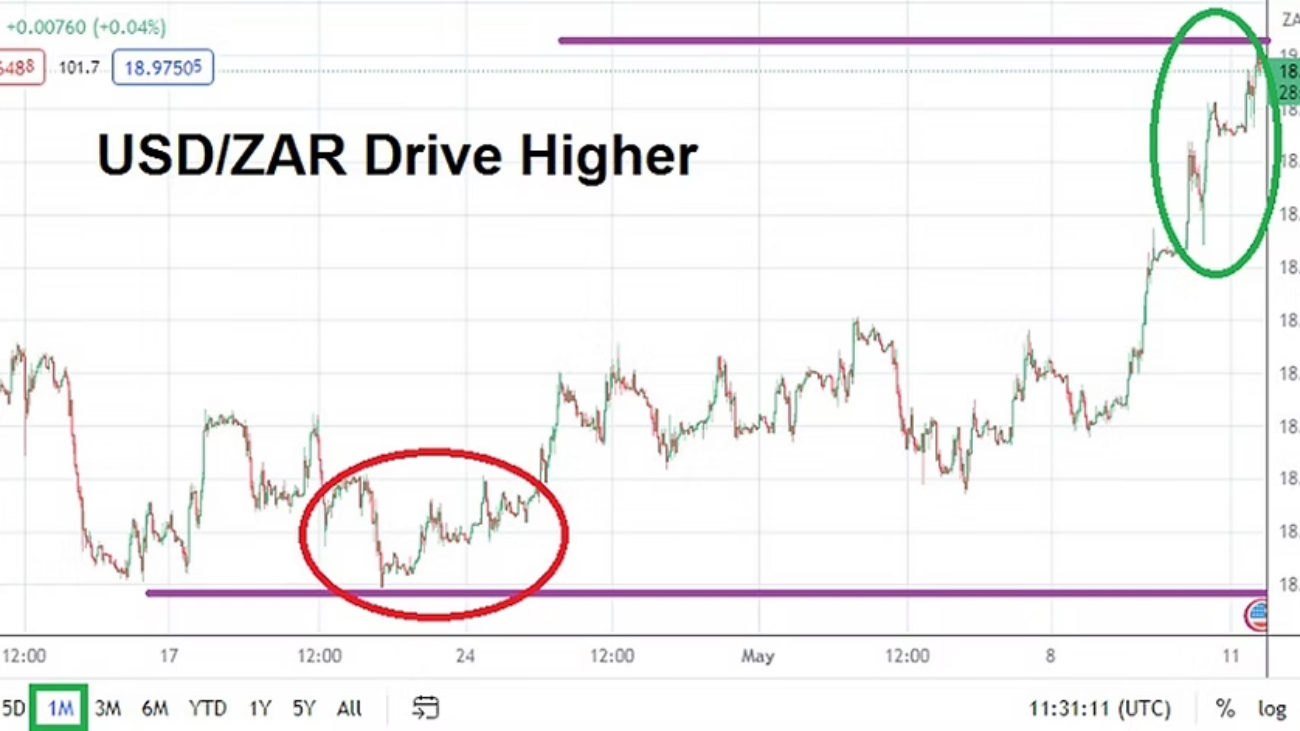
The USD/ZAR has hit a bad milestone today as the bullish trend of the currency pair has toppled the 19.00000 mark momentarily, this as the USD has shown weakness against many other major currencies in the past week because financial institutions are positioning for a more dovish tone from the U.S Federal Reserve as they wager the U.S central bank may pause its interest rate hikes. In other words, the South Africa Rand is trading in the wrong direction.

The USD/ZAR is now languishing near the 19.00000 ratio as behavioral sentiment continues to show signs of nervous exhaustion regarding the perceived political ineptness of the South African government. Nearly one month ago on the 14th of April, the USD/ZAR was slightly below 18.00000.

USD/ZAR One Month Chart as of 11th May 2023

South African Government is Perceived as Corrupt and Ineffective and this Hurts the USD/ZAR

The non-correlation of the USD/ZAR to the broader Forex market is not happening because financial institutions believe in the overall long-term strength of the USD, it is happening because dark shadows loom over the South African Rand. The darkness hovering over the Rand is occurring because of mismanagement within the South African political system, and it’s inability to deliver a reliable electricity supply to citizens and businesses domestically due to a combination of corruption and criminal activity.

The people of South Africa have plenty to be proud of because their country is one of the most beautiful in the world geographically, and it has abundant natural resources. The nation has been a pioneer regarding science and commercial enterprise in the past. However, political opportunism and neglect have led to a quagmire that has muddled the nation’s infrastructure into a nightmarish state. Loadshedding – which is the South Africa government’s term for rolling blackouts, continues to get worse and winter is approaching. Outages of electricity have steadily hit Stage 6 lately with worse loadshedding feared on the horizon. There looks to be little respite coming as electrical stoppages are happening two to three times a day, and communities are going without electrical power for up to four hours during each halt of energy. These rolling blackouts also happen daily, it is not like they are only happening once a week. Businesses of all sizes are being hurt because of a lack of production. Businesses that burn diesel via generators to power their enterprises are suffering financially due to the high costs and a dramatic loss of profits.

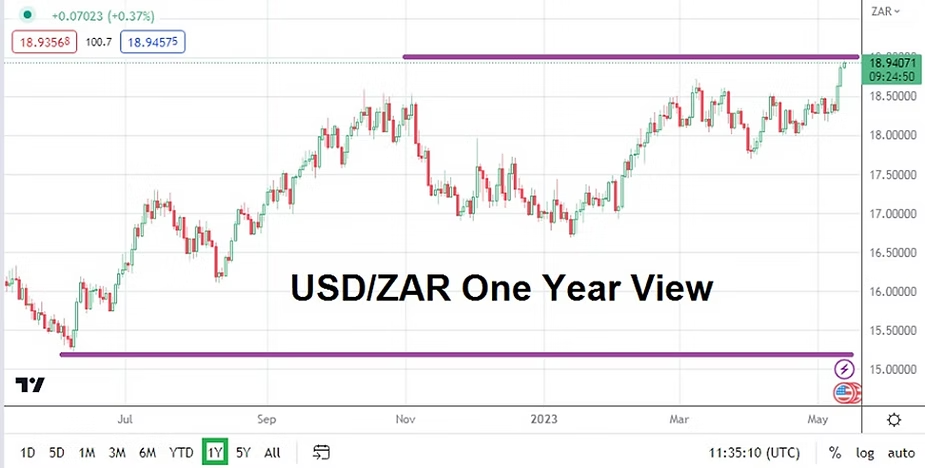
USD/ZAR One Year Chart as of 11th May 2023

Long-Term Outlook is in Question as USD/ZAR suffers from Political Peril

The loss of value in the USD/ZAR has been going on for a long time and no technical charts are inspiring confidence. The South African Rand which used to be considered among the best currencies within developing nations is now compared unfavorably. Mismanagement of the economy within South Africa has led the Rand to be associated to the likes of the Turkish Lira. Financial institutions have little reason to trust the effectiveness and long-term value of the South African Rand until concrete political changes are made, which end alleged corruption and cronyism and that seemingly look blindly on criminal activity within crucial infrastructures.

USD/ZAR Five Year Chart as of 11th May 2023

The South African Rand is not the Argentine Peso in terms of misdeeds and mismanagement, but there is a growing fear that political ineffectiveness, a lack of transparency and a poor reputation are making economic conditions worse. The last and only time the USD/ZAR traded above the 19.00000 level before was at the height of coronavirus. Yes, the value of the USD/ZAR improved from that apex of late March 2020, and the currency pair touched the 13.45000 ratio in late May of 2021. However, nearly two years later the USD/ZAR has returned to a value that shows a supreme lack of confidence exists regarding the outlook for the South Africa economy, this as Gold trades above 2000.00 USD per ounce.