
SpaceX 20260810

With SpaceX IPO, Elon Musk’s New Problem is the End of Easy Money

Private Companies Can Raise Capital at Negotiated Valuations, Public Companies Have to Raise Capital at Market Valuations

For years, Elon Musk benefited from something most corporate leaders can only dream of: easy access to practically unlimited private funding at hefty valuations determined by himself. All he had to do was build the proper narrative and convince a few large investors that his own valuation was the right one.

The SpaceX IPO fundamentally changed the process. It doesn’t mean Musk can no longer raise money. Surely, he can. But what changes is the ease, flexibility, and discretion with which he can do so.

When SpaceX was private, raising billions of dollars was relatively straightforward. Musk could approach a small group of investors, give a valuation, issue new shares, and obtain fresh capital without having to expose every detail of the transaction. He didn’t even have to convince all of them. If only a few believed his narrative, the company could raise money at an enormous valuation even while showing continuously negative operating cash flow.
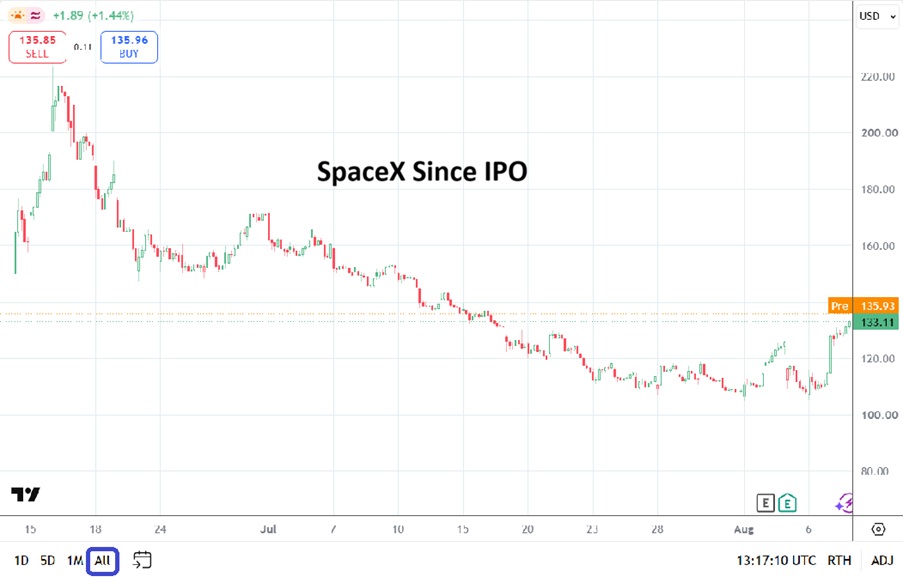
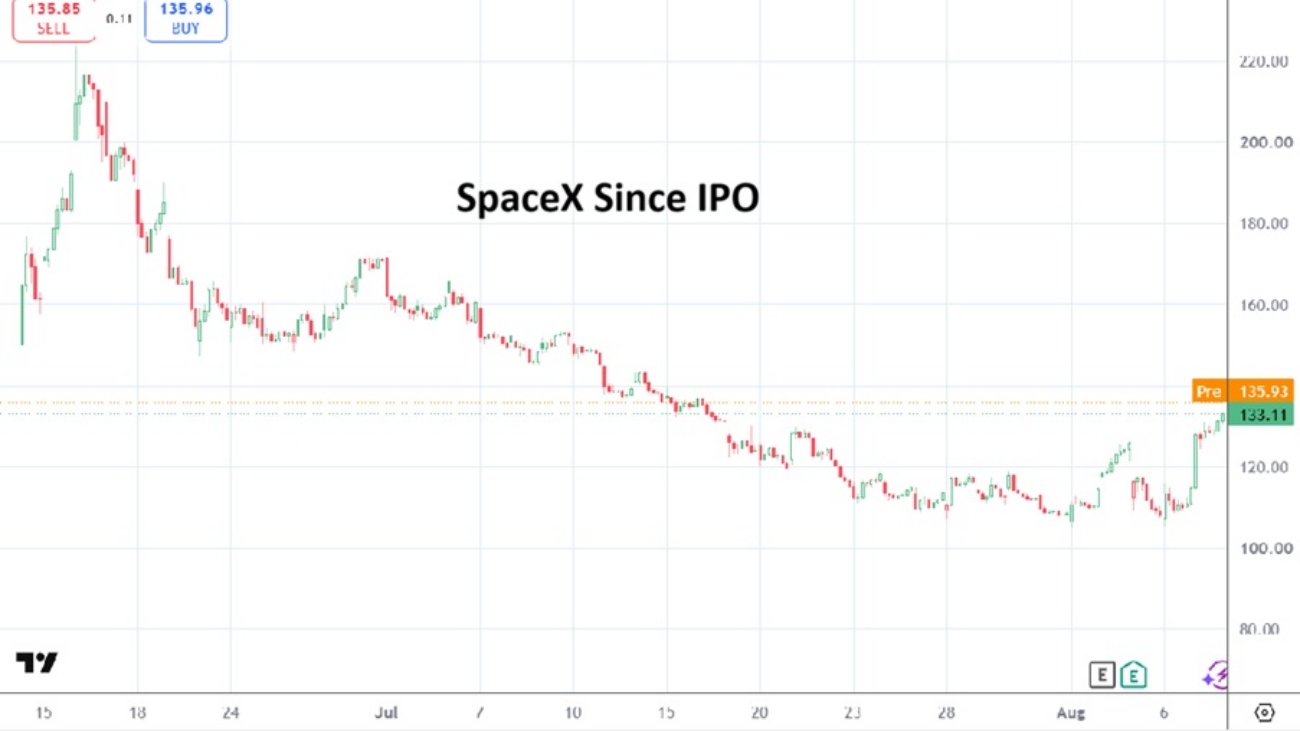
SpaceX (SPCX) Chart Since IPO as of 10 August 2026

That mechanism becomes much more difficult now that SPCX is publicly traded.

A public company has a market price every second of every trading day. Any new equity issuance is immediately visible. Investors know exactly how many shares are being created, at what price, and why the company needs the money. If the market suspects a company is raising capital because its existing operations cannot finance its ambitions, the stock can fall dramatically. And that creates a fundamental difference.

A private company can raise capital at a negotiated valuation. A public company has to raise capital at a market valuation.

The pressure on Musk is mounting. Every quarter he needs to deliver. Every quarter he needs to find a new narrative to prevent the stock price from collapsing.

Let’s imagine SpaceX needs $10 billion funding. When it was private, Musk could potentially raise the money from institutional investors at a valuation agreed upon with those investors. The transaction itself could even reinforce the perception that SpaceX is worth more.

As a public company, however, the calculation is completely different. If SpaceX is trading at a $1.5 trillion valuation and announces a $10 billion equity offering, investors immediately ask why the company needs the money, whether its cash flow is sufficient, and whether further dilution is coming. And if the stock falls 20% following the announcement, the company would have made its financing problem much worse than before.

This problem is particularly critical because SpaceX is a highly capital-intensive business. Its only profit comes from Starlink. But Starlink cannot finance all the other negative-cash-flow businesses by itself, mainly Starship launches and AI ambitions.

Starlink is the only cash-generating asset inside the group, and it cannot become the piggy bank for the entire group, including Tesla.

How can we forget that, earlier this year, SpaceX came to the rescue of Tesla by buying up all the unsold Cybertruck inventory, at hefty margins for Tesla, which then “beat expectations” thanks to the trick?

Would such a move be accepted by the market now that SpaceX is publicly traded?

When SpaceX was private, the boundaries between Musk’s various ventures were much less visible to the public markets. Capital could move through a relatively complicated ecosystem of private companies and investors.

Now that SPCX is public, the shareholders would question every move, knowing that they are not necessarily willing to see their company become a financing vehicle for every project associated with Elon Musk.

With the SpaceX IPO, Elon Musk played his last Ace card. Now he’s left with a handful of weak cards to try to win the game. He can still bluff that he’s got another Ace hidden in his sleeve, but it’s not clear the market will believe him this time.

Private markets gave Musk something extraordinarily valuable: financial flexibility. Public markets are now forcing him to operate without it.

But Elon Musk’s financing problems aren’t limited to the SpaceX IPO. Like any capital-intensive venture, he also has to contend with the Fed’s ill-considered policy of keeping interest rates high, supposedly to fight inflation that stems from supply shocks.

Because of the Fed, every additional percentage point of interest represents billions of dollars transferred from productive investment to debt servicing. Money that could finance AI chips, data centers, engineers, research laboratories, or new factories instead goes to creditors!

The Fed might believe it is fighting inflation, but it is in fact raising the cost of winning the AI race for companies like SpaceX. 

It’s surprising that Elon Musk isn’t openly denouncing the Fed’s absurdity of keeping interest rates high, when his own companies are among those suffering most from it.

SpaceX’s recent $25 billion bond offering is a perfect illustration. The company issued five tranches, including $3.5 billion of senior notes carrying a 6.65% coupon and maturing in 2056. If the Fed’s rate were closer to 2%, the company’s borrowing costs would be at least half their current level. This bond offering is costing SpaceX somewhere around $1.5 billion a year in interest expense, that could have been slashed by half had the Fed acted quickly in reducing interest rates.

And this is precisely where the Fed’s policy becomes relevant to Musk’s financing problem.

High interest rates make borrowing far more expensive for Musk. At the same time, restrictive monetary policy makes investors more demanding about equity valuations and makes long-duration growth stories more vulnerable to changes in discount rates. They also make car loans much more expensive for potential buyers, which significantly affects Tesla sales.

Musk therefore faces a particularly uncomfortable combination: Equity financing is more visible and potentially dilutive. Debt financing is expensive. Private financing is no longer available on the same scale.

The SpaceX IPO, on top of the Fed’s mistake of keeping interest rates high, is putting significant financial stress on the “richest man in the world” as he urgently needs to find new imaginative ways to fund his highly capital-intensive ventures.

And this is without even considering the probability of a 2008-like financial crash triggered by the bursting of the AI bubble. How would Elon Musk manage to sort himself out this time in case of such financial collapse?


Copy and paste the text from AMT that you want to share

Share:
postR196

AMT Top Ten Miscellaneous Complexities for the 14th of June

AMT Top Ten Miscellaneous Complexities for the 14th of June

10. International Tech Research: Universities and institutions around the world are developing innovative systems to deliver a quantum future. Cal-Berkeley, MIT, Cambridge, the Barcelona Supercomputing Center, the Institut Polytechnique de Paris, and the Cleveland Clinic are only a few of the places in the ‘West’ that investors should monitor for developments, Asia is also very focused on high speed computing.

9. Musk Schedule: The tech mogul has had a busy week. His Tesla stock option compensation package was approved by shareholders yesterday. In 2018 Musk negotiated a package with Tesla that included a massive compensation agreement via stock options if he met valuation targets over a 10 year period. He achieved the valuation goals within only a few years. Musk also formally dropped his lawsuit against OpenAI and Sam Altman in recent days, this after the enterprise released emails showing Musk backed OpenAI’s pursuit of profits in the past. Around 2015 Musk invested about 45 million USD into OpenAI.

8. Muted Data: The U.S Consumer Sentiment and Inflation Expectations numbers will be released today via the University of Michigan. However these numbers are likely not going to impact financial assets in the U.S. The Fed and CPI results from the States published this past Wednesday will dominate the investing narrative. Searching for meaning regarding why assets move in a particular direction is the media’s job, but perceived realities always remain open to complex interpretations as real time prices are exhibited. Day traders need to be cautious of revisionist history.

7. Petrol Dollar: Saudi Arabia has not reconfirmed its commitment to transact Crude Oil exports with USD. The formal agreement reached in 1974 has expired. Forex traders should not panic about this development yet. Speculators should note that Saudi Arabia is likely to still demand most of their payments in USD since they can count on the valuation of the currency to remain relatively tranquil compared to other instruments like China’s Yuan. What the absence of an agreement between the U.S and Saudi Arabia does indicate unfortunately, is that U.S foreign policy continues to look vulnerable.

6. Optimism: A South Africa government coalition agreement could be formalized soon and create a better economic outlook for the nation. While geo-political concerns remain, and the ANC is not a 100% friendly philosophical match with the Democratic Alliance and some of the other political parties which will be involved, it appears a working agreement can be reached. The question in South Africa is if transparent fiscal and anti-corruption mandates can be accomplished while diverse political outlooks will be heard and demanded from different factions. For the moment, financial institutions seem to like what they are hearing and the USD/ZAR has edged lower in the past week.

5. Highly Valued: Gold is over 2300.00, BTC/USD is near 67,000, and Cocoa is within sight of 11,000. Speculative large players remain active, and traders looking to take advantage of short and near-term fluctuations in these commodities need to remain vigilant. Cocoa, while extremely dangerous to trade, has outperformed gold and Bitcoin recently. Investors in gold think long-term, and Bitcoin influencers preach ‘hold on for dear life’ as non-believers shake their heads in disagreement. However, daily gyrations influenced by large players can still wreck havoc on those looking for short-term wagering opportunities.

4. Zombie Fed: Cautiously optimistic undertones were served from Jerome Powell as expected this past Wednesday, but intriguingly Powell admitted some government data remains open for interpretation, particularly the suspiciously strong headline jobs numbers which are being questioned. The Fed now says its outlook is for one interest rate cut this year. Financial institutions likely believe the Fed remains too reactive. The U.S GDP has shown signs of struggling, and CPI numbers have begun to erode. Crude Oil prices remain under 80.00 USD. However, the Fed seems intent on still pumping the brakes in order to kill off inflation via the high Federal Funds Rate. It would help if the U.S govt stopped spending cash recklessly, and the U.S Treasury stopped printing money.

3. Equities: U.S political concerns as the election approaches will create more analysis paralysis than normal. Short-term behavioral sentiment may sound nervous, but a bullish trend and risk appetite remain evident. Day traders may be able to take advantage of technical trading via support and resistance in CFDs, but fundamentally financial institutions appear inclined to count on equity indices achieving record highs.

2. 157.000 – 158.000: Today’s BoJ decision to remain stuck in the mud has created more financial institutional dismay in some quarters, and the the Japanese Yen will be punished occasionally against the USD. But the folks at the BoJ are not stupid and likely anticipated the USD/JPY move higher which ensued. The BoJ is obviously preserving its ‘soft devaluation’ of the JPY in order to maintain an export advantage for the U.S and European consumer markets. The question is if and when the BoJ will buy billions worth of JPY in order to punish bullish USD/JPY Forex speculators occasionally.

1. Volatile Near-Term: EUR/USD and GBP/USD price action has been boiling. France and the U.K have crucial elections in the coming weeks, after policies in both nations have led to a lack of confidence in the ruling governments. The ruckus outcome from the E.U Parliament voting have created an intriguing complication. Oddly enough, the U.K may be the left’s torch bearer in the coming year, while other European nations drift towards the right. Can centrists create a middle ground? Volatility and the search for equilibrium via financial institutions may create a lot of opportunities for Forex day traders in the coming weeks in the EUR/USD and GBP/USD as reversals and trends are sought.

postN51

AMT Top Ten Miscellaneous Wonders for the 12th of April 2024

AMT Top Ten Miscellaneous Wonders for the 12th of April 2024

10. Free Press: Brazil and the Lula de Silva government are cracking down on dissent in social media. ‘X’ – formerly Twitter – led by Elon Musk is fighting back and refusing to cooperate as Brazilian ‘leadership’ attempts to intimidate the ‘loyal opposition’ in the legislature.

9. GROOT: Nvidia is working on ‘humanoid’ robotics. Project GROOT was presented by Jensen Huang at the GTC Conference. The synergy between machine learning, semiconductors and robotics is an evolution taking place before our eyes. Tesla is involved in similar research as it works on Optimus.

8. Hot Chocolate: Speculation in Cocoa has brought the commodity above 10,400.00 USD per metric ton as of this writing. Questions about gravity and hypersonic speculative values are logical at this juncture.

7. Seclusion: Do humans still need each other? People are relying on their mobile devices for social interactions. Robotics with AI capabilities will make our existence potentially more lonely. Open source software DOBB-E will be part of this future as household chores are taken care of by ‘machines’.

6. Iran: Those with holiday excursion plans which include Teheran this weekend may need to check on ticket availability due to the possibility of flight cancellations.

5. Fed Liberty: President Joe Biden this week spoke about an interest rate cut coming from the Federal Reserve this year, yet Consumer Price Index statistics are demonstrating escalating expenses. Current U.S government leaders may want to spend less on ‘vote buying’ via student loan forgiveness and think about conservative fiscal practices. Why should Americans who choose not to attend universities pay for those who did via higher taxes? Are Fed and Treasury officials still independent?

4. Risk Averse: Gold is within sight of 2,400.00 USD this morning. In the meantime U.S bond yields have inverted completely except for the 30-Year issue. Financial institutions are showing nervous behavioral sentiment.

3. USD Centric: Forex has seen reactive trading this week as financial institutions begin to conclude the U.S Federal Reserve’s monetary policy ‘over time’ will remain disturbingly difficult and full of doublespeak.

2. Caution: Mixed results are flourishing in the major U.S stock indices as the Nasdaq 100 and S&P 500 touch late March values, and the Dow Jones 30 has returned to February levels. Higher than anticipated interest rates are causing turbulence.

1. Energy Illusions: As the prices of food, transportation and housing escalates isn’t it time governments start to question their ‘green’ policies which are making the costs of energy production more expensive? We all want a clean planet, but logical strategies must be applied to create efficient use of resources.

postN87

AMT Top Ten Miscellaneous Raindrops for the 2nd of February

AMT Top Ten Miscellaneous Raindrops for the 2nd of February

10. Risk Appetite: WTI Crude Oil almost serene around 74.00 USD, as bombastic rhetoric remains loud involving the Middle East.

9. South Africa: President Cyril Ramaphosa expected to announce the country’s election date when delivering the State of the Nation Address on 8th of February.

8. Tesla: Negative media coverage and an always defiant Elon Musk gravitate towards each other, share price is around 188.88 USD.

7. China: Shanghai Composite Index (SSE) hovering near 2,730 as of this moment.

6. Gold: After near-term lows a challenge of highs as USD has gotten slightly weaker.

5. Central Banks: All bark and no bite yet, as financial institutions desire interest rate cuts from Federal Reserve, European Central Bank and Bank of England.

4. India: Nifty 50 Index near 21,865 as of this writing, it has gained more than 101% over the last five years – yes, plus one-hundred and one percent.

3. Forex Reactions: Recent short-term volatility and reversals seen as expected, patience still needed as USD mid-term outlook remains weaker.

2. U.S Equities: S&P 500, Nasdaq 100 and Dow Jones 30 have produced nervous results but still near record highs, as U.S Treasury yields have edged lower this week.

1. Data: U.S Non Farm Employment Change and Average Hourly Earnings today, this as some major corporations shed employees but labor market remains rather tight. Broad markets will react to the outcomes.

postN87

AMT Top Ten Miscellaneous Flakes for 19th of January 2024

AMT Top Ten Miscellaneous Flakes for 19th of January 2024

10. Music: Come On, Come Over performed by Jaco Pastorius. The bass playing on this song is magnificent.

9. Cybersecurity: Prospect of quantum computing is making Central Banks nervous, quantum development will impact blockchain and make current payment systems vulnerable and perhaps obsolete. Post-quantum cryptography development is vital.

8. Frigid Weather: Tesla owners have dealt with battery power failures as winter temperatures have plummeted in Chicagoland and elsewhere. EV energy solutions need to improve.

7. China: Over the past 11 months FDI (foreign direct investment) has dropped more than 10% in the nation, an estimated short fall of 145.51 billion USD. China’s Foreign Direct Investment release has seemingly been pushed off to next week. Shanghai Composite (SSE) near 2832.28.

6. Energy Sector: WTI Crude Oil still priced politely as ‘interactions’ with Houthis flare. Natural Gas values remain near lows while North America suffers from a deep freeze.

5. Risk Assessment: Iran and Pakistan, although expressing ‘brotherly love’ for each other, have exchanged missiles across their respective border aimed at extremists.

4. U.S Treasuries: Inversion has almost ended completely, 5-Year Notes up to 30-Year Bonds yields have returned to ‘norms’.

3. Gold: Price of the precious metal near 2027.00 USD having bounced higher after challenging the 2000.00 vicinity on Wednesday.

2. Data: Consumer Sentiment reading via University of Michigan on the schedule today, this could provide impetus to markets that appear to be waiting for the next big push.

1. FX Volatility: USD strength has pushed the greenback towards important mid-term resistance in Forex as many day traders are likely still fighting the trend.