Alphabet 20260724

The Not So Coincidental World of Google and WTI Crude Oil

Energy and Commodities in a World Where Legacy and Infrastructure Collide

Google (Alphabet) finished yesterday’s trading near $ 317.69, as of this moment WTI Crude Oil is around $88.50. It might seem rather odd to pair the two into the same paragraph, but this is not a coincidence. Both are now relevant regarding energy costs for consumers and produce an abundance of legacy products the world over. And oddly enough their one year charts almost look as if they are dancing in step.

Google is facing headwinds in recent trading as questions surround its capability to produce revenues because of its push into Artificial Intelligence and always growing need for more data center power. AI which has been an abundant source of bullishness in the Nasdaq 100 and had a knock-on effect into the S&P 500 the past couple of years has become shadowed by concerns of turning into a commodity. 
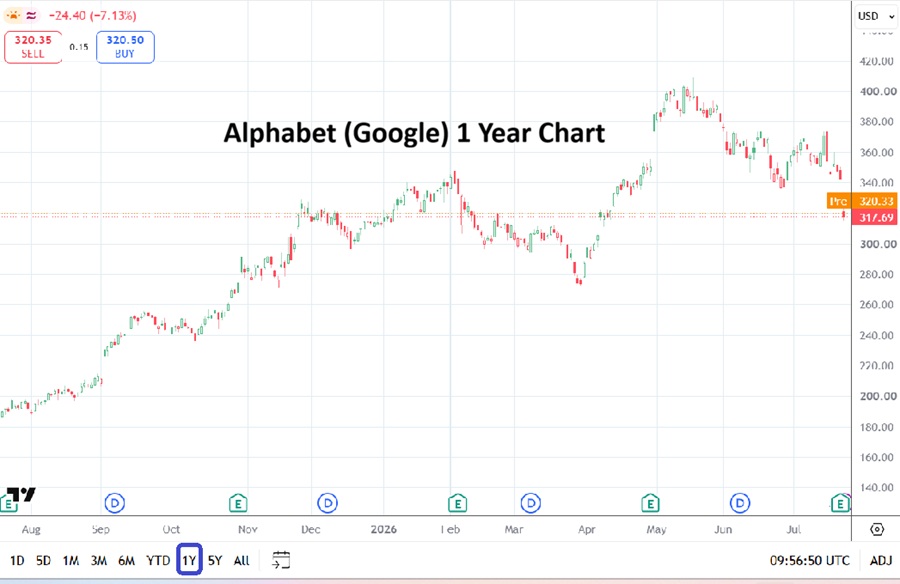
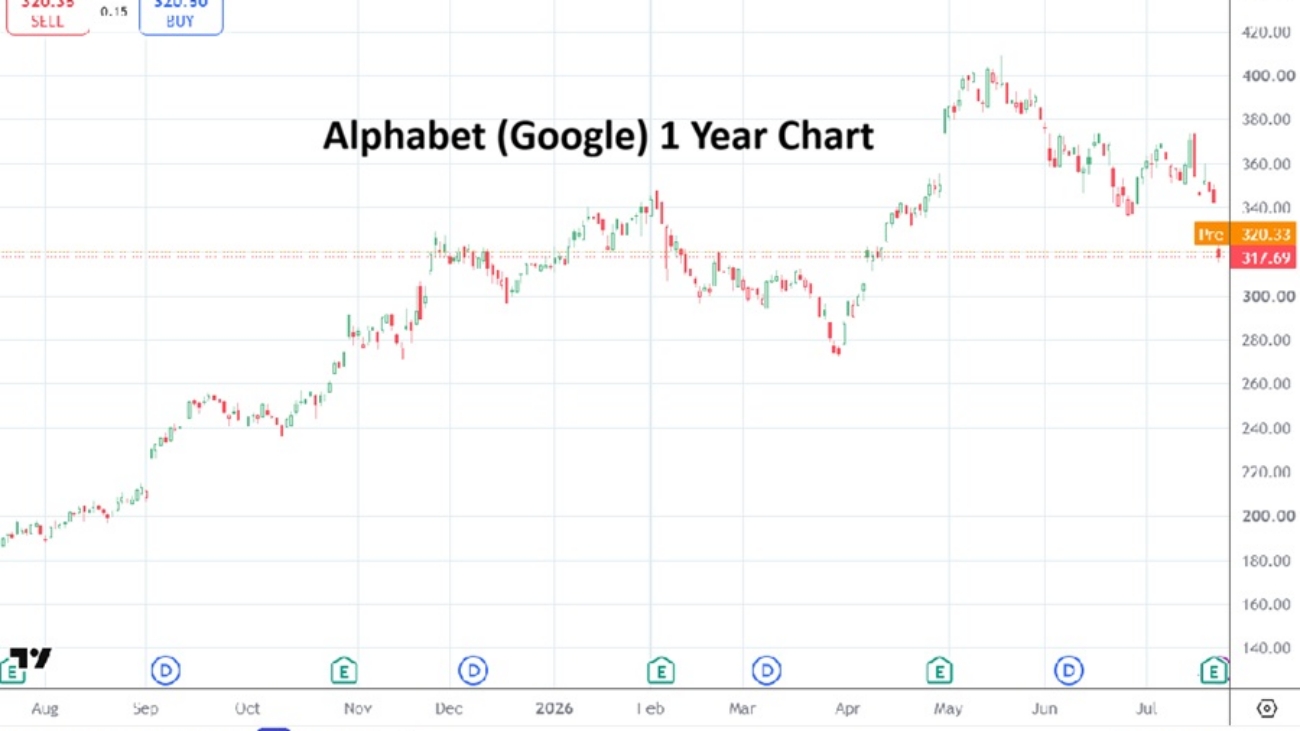
Alphabet (Google) One Year Chart as of 24 July 2026

As competition in the AI sector increases this is creating pressure on prices in order to allure customers away from competing brands. China is also stepping into the world of Artificial Intelligence and it will certainly use its ability to produce less expensive products moving forward. Profit margins are being fought over by competing companies

Google is not a poor company, but there are growing doubts about its debt and revenue ratios. The costs to power its worldwide data ability for its users and its investment into AI via Gemini and its DeepMind technology does not have a particularly easy solution. Estimates from a variety of sources claim that Google has reduced its staff between 1,500 to 3,000 through employee reductions and reorganization, this as the company needs to pile more cash into infrastructure.

The onslaught of other companies able to produce AI which is seen as more robust and capable have also caused a marketing headache for Google, which has an effect on behavioral sentiment. GOOGL was trading at apex levels only two months ago when it was traversing above the $400.00 mark. The downturn thus far has been bad, but not catastrophic. 
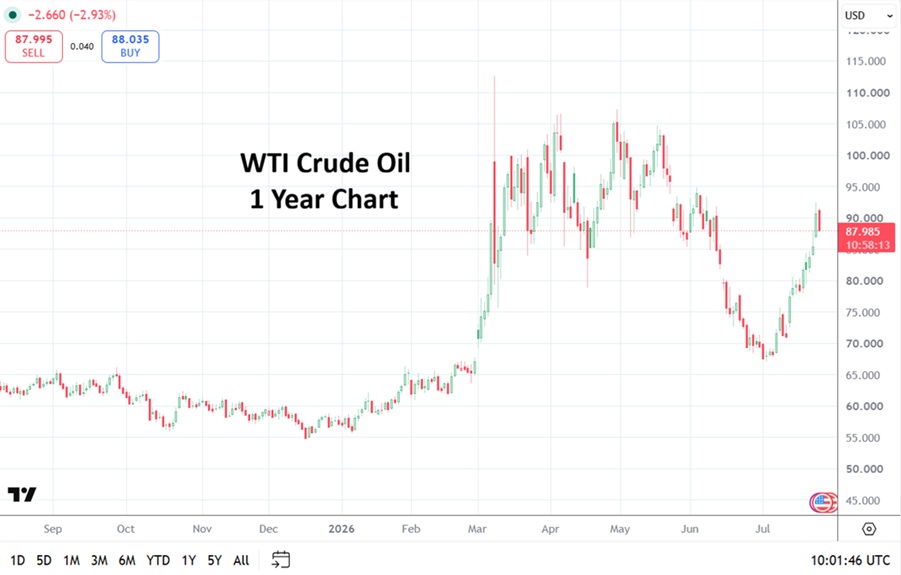
WTI Crude Oil One Year Chart as of 24 July 2026

While nervous sentiment can be blamed on the situation in the Middle East the past handful of months, the downturn which has occurred for Google and other important companies on the Nasdaq 100 involved or seen as having an ancillary association with AI needs to be considered a legitimate reaction because of worries surfacing regarding the ability to simply pay for all of the research and infrastructure. 

In order to power AI it is becoming clear that energy costs are part of investing frameworks. Concerns about an AI bubble started to gather an audience last fall and the rumblings have grown louder, yet it can be said the ability of Google and many other companies to gain the past year in value still outweighs this current downturn experienced the past couple of months.

The Iranian war which is ongoing, appears to be entering a phase in which financial institutions are having to succumb to the notion of higher prices not only for WTI Crude Oil but other energy resources with a mid-term viewpoint. While there is abundant supply of Crude Oil worldwide, the current problems surrounding navigation and logistics are causing pandemonium in a consistent manner via WTI’s price as Middle East nations try to ship to their clients. This is causing many Asian nations to look elsewhere for their energy, Brazil has seen an increase in orders. And because of the upwards trend in fuel costs again, the Federal Reserve will have to look hard at inflation data and play a game of interest rate mania, which investors will have to calculate into their outlooks regarding debt ratios.

What does this have to do with Google and AI?

People like nations will search for the easiest and most cost efficient pathway to access their needs. Anthropic, OpenAI, Kimi K3, Microsoft Copilot, DeepBlue Technology, Meta, Sakana AI, IBM, Nvidia are only some of the companies involved in sourcing software and providing hardware to users. Many nations are involved in this AI chase and understand the importance of cybersecurity, data sharing and the problems surrounding the costs to power all of these machines.

Many of these companies above including Google are searching for a holy grail via energy supply and discussing the financing and building of energy infrastructure including nuclear capabilities. But as Google and other companies search for more energy to fuel their dependence on powering their systems for clients, they continue to be confronted by a growing wave which will eventually drown some of the companies in debt that they will not be able to recover from.

I am not forecasting an apocalypse, but I am suggesting not all of these companies which we think of as part of our everyday lives will survive this fight. Legacy companies eventually parish, just like many start ups. The realization that many companies are merely providing what the public is starting to see as necessity is a simple competitive evolution. BlackBerry, Nokia and Motorola are examples of giants falling.

It appears many investors are starting to ask hard questions about costs compared to future earnings in AI. The allure of the next big thing, which AI has been part of the past couple of years, is running into well-practiced investment cycle as froth erodes and financial institutions start to look at the accounting of the companies they are being asked to consider as long-term endeavors. Not all that glitters is gold will certainly start to create a patina on many of the so-called AI companies as they are forced to prove their worth as suppliers of a commodity.

The AI world has run into the time honored financial realization that many exotic tastes soon turn into another form of vanilla. The next big thing is always being anticipated and hoping to attract the deep pockets of investors. Certainly many of the big companies including Google are going to survive the current headwinds. but real profits could become harder to attain. Investors and speculators should not be surprised that reality has a tendency to reduce momentum.  Entropy is part of the investment world, investors and speculators always have to be ready for new disruptions and systems to emerge.

Copy and paste the text from AMT that you want to share

AI Aluminium 20260624

The Great Compression Part 2: The Intelligence Trap

AI Aluminum

On June 17th, the U.S. Air Force handed Anduril Industries a contract for its FQ-44 autonomous combat drone, making it the first new entrant to win a U.S. fighter aircraft program since the 1970s. The Silicon Valley startup beat Lockheed Martin, Northrop Grumman, and Boeing – companies that between them have defined American air power for generations – to the target. Anduril, a defense technology firm founded in 2017, did not win on relationship or on legacy: it won on AI-native architecture.

The shift this represents is psychological as much as commercial. Defense procurement is arguably the most bureaucratic, relationship-driven, clearance-protected industry on earth. If AI-native vertical integration can break this barrier, anything is now open for re-negotiation.

The Great Compression Part Two: The Intelligence Trap

The compression of the human intermediary layer across the economy – the subject of this series’ opening piece – raises a question that is both philosophical and financial: if the old middlemen are disappearing, and if the AI models replacing them are themselves becoming commodities, where does value go?

What made the Air Force announcement structurally significant was a detail that went largely unnoticed: the service deliberately separated the drone hardware from its AI software, specifying that the intelligence layer could be upgraded or replaced independently of the platform. By doing so, the Air Force drew a line that the market is still catching up to – and then immediately complicated it. The aircraft is the delivery vehicle. The intelligence tier is what matters, except that intelligence is also commoditizing fast.

The commoditization signal had already arrived earlier this month, when Google cut the price of its AI plan by nearly 40% overnight. OpenAI is reportedly considering steep token-price cuts as competition with Anthropic intensifies. The models themselves are beginning to resemble a capital-intensive utility more than a premium software business. As intelligence becomes cheaper, the investment question shifts to what models cannot easily access: proprietary data, regulated workflows, institutional trust, and the systems that turn AI output into real-world action.

The answer, in the most durable cases, is proprietary domain data combined with deep sector integration. Anduril is not a defense company that adopted technology: it’s a technology company that chose defense as its vertical. Palmer Luckey, who sold Oculus to Meta when he was just 21, founded Anduril alongside veterans of Palantir with a specific thesis: Silicon Valley had abandoned defense, leaving a widening gap between what the military needed and what the traditional primes could deliver.

Where Lockheed and Boeing run bid-led organizations optimized for cost-plus contracting cycles measured in decades, Anduril built a product-first company that moves at software speed, focused on cheap, autonomous, attritable systems designed to be deployed and lost without catastrophic cost. The competitive edge that results has nothing to do with which model runs underneath it. It is purpose-built architecture, mission-specific design, and the kind of deep operational embedding that no generalist technology company can shortcut and no traditional prime can easily imitate.

Palantir built the same competitive edge a decade earlier, at the intelligence level. Their forward-deployed engineers embedded themselves inside classified environments, building proprietary data structures around defense and intelligence that competitors cannot access, let alone replicate. The model is almost beside the point. What matters is the institutional trust above it and the data structure underneath it.

The same logic plays out in banking, and the psyche shift there is equally striking. JPMorgan Chase is not an obvious candidate for AI leadership – a 150-year-old Wall Street institution steeped in regulatory obligation and institutional conservatism. Yet it has become arguably the most digitally aggressive major bank outside the fintech world, spending north of $17 billion annually on technology and deploying AI across trading, risk, legal document review, and client services. JPMorgan’s AI advantage over any fintech competitor is not compute – it is 150 years of proprietary transaction data, credit history, and market intelligence, combined with the institutional will to deploy it at scale. Many large banks sit on comparable reserves; few have built the machine to turn them into a competitive weapon. The model commoditizes; the data does not – but only in the hands of someone with the commitment to exploit it.

The pattern across defense, banking, and every sector where this is playing out is consistent: the prize migrates to whoever owns the scarce position that generic models cannot substitute for. Right now the prize sits with domain data and deep sector integration. What’s forming above it is agentic orchestration – systems that coordinate networks of specialized AI agents across high-stakes workflows: routing battlefield targeting decisions, flagging fraud across millions of simultaneous transactions, managing the exception-handling that no single model can resolve alone. Palantir’s AIP platform is the most mature example of this emerging tier, and it is no coincidence that the same company that mastered domain-specific data is now positioning for that orchestration tier. Salesforce’s Agentforce is building toward the same position from the enterprise side. The race for this trophy is not yet decided, but the companies that already own those domain data advantages are the natural favorites to own the control plane above them.

The stack, in other words, keeps moving upward. Value migrates to the next bottleneck, then the next. And below all of it – the models, the sectors, the orchestration layer – something has to hold the weight. Every control plane needs a floor. What that floor looks like, who owns it, and why it may be the most durable investment thesis of the AI era is the subject of the next piece.

Copy and paste the text from AMT that you want to share

post264

India Insider: Concern IT Empire is at Risk in Age of AI

India Insider: Concern IT Empire is at Risk in Age of AI

When China’s DeepSeek announced its Generative AI program as a rival to U.S based ChatGPT, the world paid close attention. In fact, Nasdaq bellwether stock Nvidia, the world’s most valuable company, took a hit because the DeepSeek product was made with less expensive chip processors compared to ChatGPT’s infrastructure, which uses Nvidia’s GPU technology.

In North America and Europe, DeepSeek’s rollout was met with much surprise and intrigue. And the true ‘poster child’ of India’s post-liberalization era, the IT (Information Technology) sector has been facing its own challenges and was also caught off guard. India’s IT sector employs some 5.3 million people and helps maintain its current account balance sheet by earning crucial foreign exchange reserves. The top four major IT companies have a combined market cap of $300 billion USD, larger than India’s richest man Mukesh Ambani’s Reliance Industries, which stands around $238 billion USD.

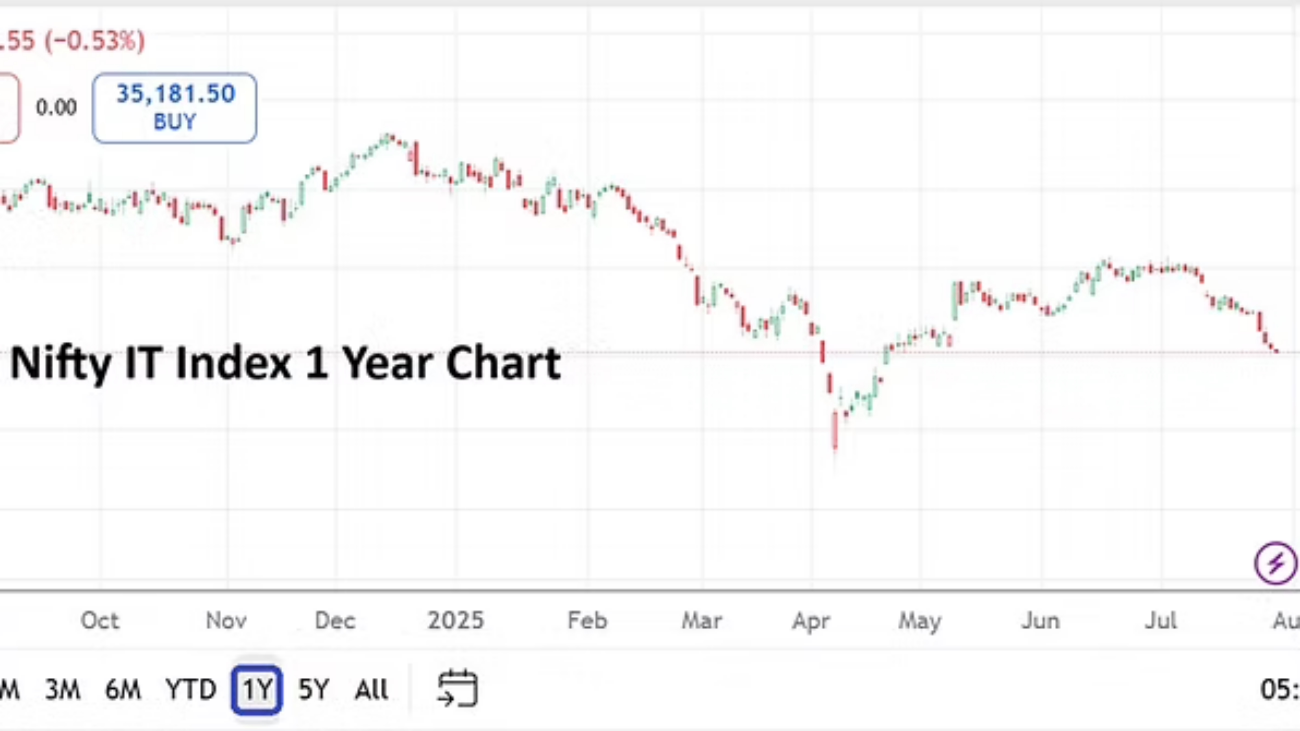
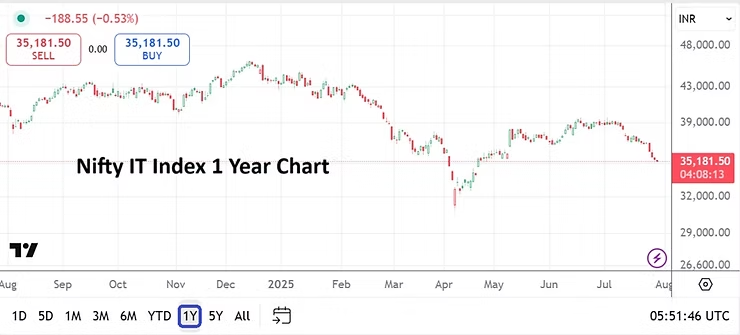
Nifty IT Index One Year Chart as of 29th July 2025

India’s IT Business Model and Artificial Intelligence

Indian IT companies operate on a model of software servicing for offshore clients, typically via medium to long-term contracts. Their business operations are embedded across the globe thanks to affordable pricing and the quality of services provided by Indian software engineers. Now, this model is being threatened by the rise of Generative AI and taking it lightly would be a serious mistake by India.

Shares of major IT companies ­- TCS, Infosys, Wipro, and HCL have delivered lackluster returns since their post pandemic rally. Since Covid high valuations amid deal pessimism were a concern. Now those worries are amplified by AI and the disruption it brings to their business models. Software exporters remain the worst performers, the Nifty IT index is down 18% year-to-date, underperforming the broader index consequentially.

The recent release of Q1 fiscal year 2026 numbers from these four IT companies have been met with skepticism regarding forecasted outlook. Analysts noted that Indian IT firms are grappling with margin pressures amid persistent macroeconomic headwinds and rising threats from AI-driven productivity improvements. In response, companies have started to protect their margins with layoffs, TCS (Tata Consultancy Services) shed around 2% of its workforce this past weekend which could affect more than 12,000 jobs.

Time For India’s IT Sector to Become Proactive

Pricing models that IT companies charge customers are changing from long to short-term flexible contracts like ‘pay as you go’ over traditional fixed annual licensing models. Despite changing CEOs in several of these companies over the last few years, animal spirits are failing thus far to innovate AI products that can enhance the bottom line. Instead, companies prefer share buybacks and paying stellar dividends to appease the shareholders rather than to invest in R&D especially when their core model is under threat.

Hang Seng Index One Year Chart as of 29th July 2025

The euphoria surrounding India’s $5.4 trillion equity market is cooling in 2025, amid concerns over slowing earnings growth, elevated valuations, and tariff related uncertainty. At the same time, sentiment towards Hong Kong’s listed Chinese shares are improving with global fund managers rapidly reallocating capital to that market. The Hang Seng Index has delivered an impressive 27% return year-to-date. Meanwhile, India’s stock market still lacks depth for investors seeking meaningful exposure to the booming Artificial Intelligence theme.

Indian IT companies excel at scaling and delivering AI solutions for global clients, but they do not own the core models, platforms, or consumer data needed to become true AI disruptors like China’s tech giants. The industry contributes approximately 7.5% to India’s GDP and remains the primary employment avenue for engineering graduates. It’s time for India’s IT sector to proactively address the growing AI threat posed by global competitors.

postN87

AMT Top Ten Miscellaneous Viewpoints for the 29th of Dec.

AMT Top Ten Miscellaneous Viewpoints for the 29th of Dec.

10. Book: Cargill: Trading the World’s Grain by Wayne G. Broehl, Jr., a book that folks interested in physical commodities may find interesting.

9. Music: A Night in Tunisia played by Charlie Parker and Miles Davis on The Complete Savoy & Dial Master Takes.

8. NBA: Detroit Pistons have now lost 28 straight basketball games. Will the team get a participation trophy at the end of this season?

7. Post-Quantum: While ‘Artificial Intelligence’ grabs headlines, ‘post-quantum cryptography’ is a phrase and reality that corporations will need to learn increasingly.

6. Behavioral Sentiment: Risk appetite has remained firm during this holiday week, which may spark additional optimistic trading banter in January as trends are wagered upon.

5. U.S Treasuries: Yields have continued to move lower, and dovish outlooks regarding the U.S Federal Reserve inside many financial institutions may increase speculative zeal.

4. Gold: The precious metal remains near highs and the price of 2100.00 USD is hovering above, will this level start to be challenged and penetrated?

3. JPY and NZD: Both currencies remain bullish as they recover from long-term USD strength, this while mid-term price realms are being firmly challenged. Technical traders with long-term outlooks may want to start examining one year charts.

2. U.S Equities: S&P 500 on the cusp of record highs, the Nasdaq 100 is at apex values – while the Nasdaq Composite remains bullish, and the Dow Jones 30 continues to create new heights.

1. 2024: A prosperous and peaceful New Year is wished for all.

postN51

AMT Top Ten Miscellaneous Thoughts for the 8th of December

AMT Top Ten Miscellaneous Thoughts for the 8th of December

10. Book: A History of Venice by John Julius Norwich.

9. Music: Gram Parsons (featuring Emmylou Harris) playing Ooh Las Vegas.

8. Artificial Intelligence: Speed and processing advances will continue to make AI a buzzword in 2024, this as quantum computing looms in the distance.

7. Trading Volumes: Speculators should note there are about two full weeks of trading left before ‘thin’ holiday markets will begin to be seen. Meaning financial institutions while being cautious, will also start to position their assets according to their outlooks for early next year.

6. Energy Sector: WTI Crude Oil, Brent, Natural Gas and Unleaded Gasoline continue to challenge support levels as long-term lows remain in sight.

5. China: Important inflation numbers via Consumer Price Index statistics will come from the nation early Saturday, negative results are expected.

4. Risk Appetite: Optimism continues to be encouraging within behavioral sentiment, this as U.S equities remain near highs, the USD leans towards a mid-term outlook with potential weakness, and gold stays above 2000.00 USD per ounce.

3. USD/JPY: Bearish momentum continues in the currency pair, price velocity built speed yesterday and this morning’s trading has been dynamic.

2. Data: U.S jobs numbers will be released today, the Non-Farm Employment Change and Average Hourly Earnings reports will create reactions. However, unless the results are surprising, this data may simply work as an affirmation for existing risk appetite.

1. Federal Reserve: The Fed’s next FOMC Statement will be on the 13th of December, this knowledge will shadow the broad markets today and early next week.