Markets Say 20260407

What Do the Markets Say?

Ambivalence Rules the Day

Opinion: The following article is commentary and its views are solely those of the author. This article was first published the 7th of April via The Angry Demagogue.

There is nothing we capitalists like saying more than “the markets say….”. What we mean is that the amorphous group of individuals and institutions that together form some sort of consensus as to the value of “things” taking everything known by the individuals involved into consideration. Since no one can know everything, the idea is that the market represents the sum of knowledge of everyone who has money to invest – or, as we like to say, “skin in the game”.
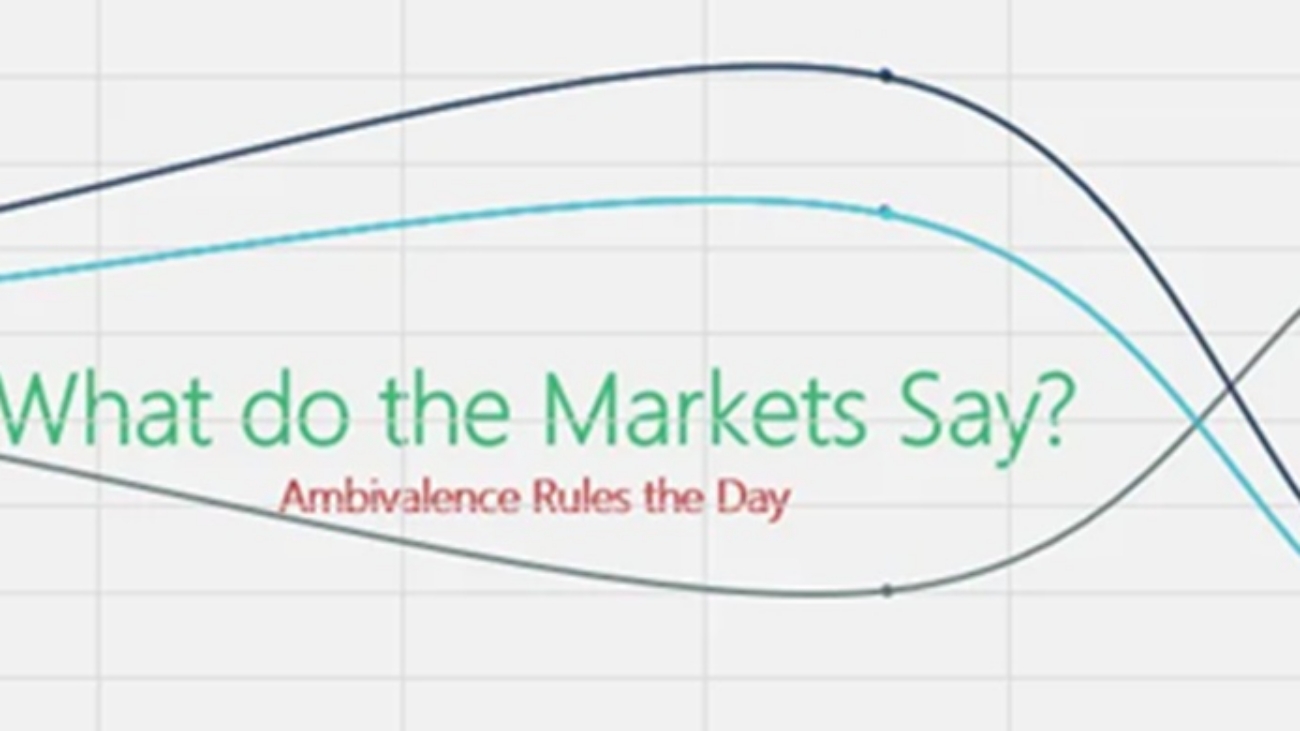
Below is a graph from the start of the war until April 2, of oil, gold, 10-Year U.S Treasury yields, American and European stocks. Each should tell us something and in general all together they should be saying the same thing. However – that is not the case here considering we are in the midst of a major Middle Eastern war, with China and Russia watching with interest and Western Europe squirming with unease.
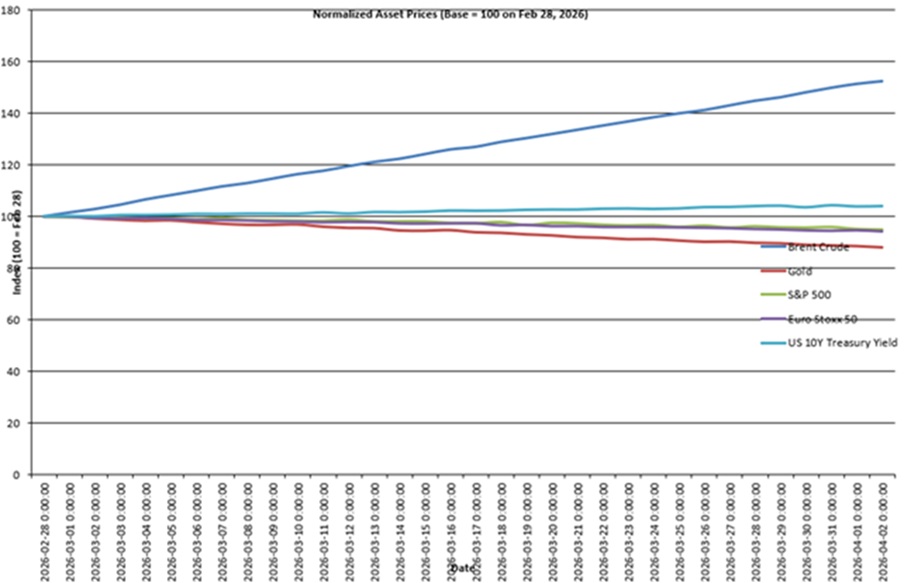
Normalized at 100 via ChatGPT as source.

Those items that signify a flight to safety are the price of gold and the U.S Treasury yields, while those that signify a faith in the future of the economies are the index levels of the U.S and European stocks. A commodity that is directly affected, oil in this case, is expected to rise and it has, by over 50% since the start of the war.

While one would expect the price of U.S Treasuries to rise considerably as it is considered a “safe haven” by investors, it has risen just 4% as yields dropped from 4.31% to 4.13% (with bonds, prices and yields moving inversely. A rise in bond price is a decline is their yield – meaning they earn less for the bondholder). Gold, the other safe haven, though has dropped by nearly 12% since the start of the war. True enough, the price of gold has skyrocketed over the past year, but still while there is a reason why gold might underperform U.S Treasuries, it is odd that it has underperformed stocks on both sides of the Atlantic, in spite of the 50% increase in the price of oil – forcing up energy prices for industry. Stocks in the U.S have dropped by just 4.95% while in Europe the decline is just 5.8%. Neither number is one an investor wants to see in just six weeks, but all things considered the war has not caused a lack of confidence in the economies of the EU or the U.S.

People might claim that gold has lost its safe haven luster over the years, but that is not the belief of governments as India and China have been buyers of vast stores of gold and France decided to repatriate all of their gold reserves. They still see it as necessary.

So, what are the markets telling us about this war and the future of domestic and global economies? Regarding Iran, the supposed victors in this “quagmire”, the Iranian Rial has dropped 96.8% in 2026 and has moved from 0.00002378 to the dollar to an incredible 0.00000076 (that means that 1 million Iranian Rial equals 76 cents) the market speaks in one voice – no confidence.

Regarding the rest of the world the markets are not really telling us much of anything because there has not been a rush to safe havens as usually happens in wars and happened during Covid, nor has there been supreme confidence. The markets are, shall we say, ambivalent.

That volatility is high and that they move drastically on each Trumpian proclamation is more a sign that the algorithms that control the very short term market trends are mostly chasing the same thing. When X happens, sell Y is a race to the bottom by unthinking and unsophisticated (in spite of AI) analysis until that race causes the “when Y hits a certain price, buy it” or “when Z happens then buy A” algorithms kick in. After a few days or weeks, we can start to see trends as long as we ignore the record highs or lows. However, there is nothing other than “wait and see” ambivalence in the current market data.

While this does not necessarily mean that the “markets” are in support of the war, but neither does it see a debacle of any sort. The Libyan bombing campaign of 2011 lasted seven months with no real Western interests involved and the Kosovo ariel campaign of 1999 lasted around 3 months and involved humanitarian but not economic interests. The 6 weeks of this war, so far, is not at a level of “quagmire” for the markets.

If the markets are telling us anything now it is that while oil may stay high for awhile, the world is not heading south due to the war. This can change– for good or bad – but the markets themselves are not currently taking a stand either way. They are not telling us we are in for a rough ride. While we believe that this war will reshape global politics and alliances and create an economic boon for the victors, no one can be sure who will end up on top and who will suffer once the war winds down.

The defeatists around the western world could do worse than listen to what the markets are not telling us.

Disclaimer: the views expressed in this opinion article are solely those of the author, and not necessarily the opinions reflected by angrymetatraders.com or its associated parties.

You can follow Ira Slomowitz via The Angry Demagogue on Substack https://iraslomowitz.substack.com/

Copy and paste the text from AMT that you want to share

postR173

Rich Dad, Poor Dad: What the Rich Teach Their Kids About Money

Rich Dad, Poor Dad: What the Rich Teach Their Kids About Money

Book corner: Rich Dad, Poor Dad: What the Rich Teach Their Kids About Money That the Poor and Middle Class Do Not! by Robert T. Kiyosaki

Every now and then a book comes along which leads to a major shift in how Americans think. Uncle Tom’s Cabin changed perceptions about slavery. The Jungle woke the nation to the horrific labor and sanitary practices in factories. The Feminine Mystique shed new light on feminism and women’s roles in society. All those books struck deep into society’s conscious and led to major changes.

Robert Kiyosaki’s Rich Dad Poor Dad: What the Rich Teach Their Kids About Money That the Poor and Middle Class Do Not! might not echo the social justice that his revolutionary predecessors strived for. But this 1997 best-seller packed no less of a wallop. Hitting the bookstores just as the twentieth century was coming to a close, Kiyosaki’s book changed how Americans – and others around the world – think about personal finance.

Rich Dad Poor Dad is not an instructional book as one would expect in a college course, with Kiyosaki running through facts, charts and figures. A Japanese-American born and raised in Hawaii, Kiyosaki uses his own life and background to tell a simple, almost fable-like story. The “Poor Dad” in the title refers to Kiyosaki’s biological father, Ralph Kiyosaki, who worked as a educator most of his life. By all accounts a good father and an honest man, he was a big believer in standard, traditional education, wanting the younger Kiyosaki to be a good student and then go to college in order to get a good job – in other words, as Kiyosaki puts it, to be an employee. But he had little financial education, which is what Kiyosaki explains is knowledge of business, investing, accounting, entrepreneurship, real estate and all other related subjects whose knowledge one can use to make money and be financially independent – to be an employer in contrast to an employee. Kiyosaki explains that although his Poor Dad made a decent salary, he was able to save little of it due to his lack of financial education and poor career decisions later left him broke.

The ”Rich Dad” in the title is the father of Kiyosaki’s buddy Mike, a man of limited standard education but excellent and well-developed financial education. A savvy entrepreneur with his hand in many businesses, he was approached by the two pre-teens for lessons on getting rich. Rich Dad put them to work in his general store for little money, but provided something more valuable – lessons on business and entrepreneurship that would form the foundation of Kiyosaki’s life and career. The book is structured around the conversations he had with his Rich Dad and the advice he was given, and the contrast in mentality to his Poor Dad.

As Kiyosaki explains, the drive for financial education consumed him and drove his decisions well into adulthood. A mediocre student, he nonetheless graduated from the Merchant Marine Academy, and then as a US Marine, served honorably in Vietnam as a helicopter pilot. Kiyosaki was eligible to work in the maritime industry after the war, a job that would bring excellent pay, conditions, steady work and several months of vacation a year. But he instead enrolled at Xerox’s sales school – considered the best of its kind in the country – seeing it as a major key in his financial education. His need for independence was so strong that in later years, during hard times, he and his then-wife Kim slept in their car rather than the accept the charity of friends’ guest rooms.

Besides the lack of financial education in the school system – an issue that Kiyosaki raises several times throughout the book – Kiyosaki challenges conventional beliefs. He rails against purchases that are liabilities instead of assets, even arguing against home ownership. He discusses the mindset of money and wealth creation and how ordinary people – due to society’s conditioning to be employees – are held back by limiting beliefs. To be successful in wealth creation and to take control of your financial destiny, Kiyosaki argues, one must take calculated risks; inspired by his Rich Dad, he says that one must not think I can’t afford this but instead What do I need to do to be able to afford this?

In one of the few diagrams in the book, Kiyosaki introduces the cash flow quadrant (of which he would later base an entire book), which categorizes individuals as employees, self-employed, business owners, or investors. He discusses the advantages and/or disadvantages of each quadrant.

Kiyosaki hit a raw nerve in the personal finance-hungry public, turning him into an international finance guru. It has to this date sold anywhere from thirty to forty million copies and is noted as the bestselling personal finance book of all time. He – and Kim, who has a series of similarly-themed books intended for women – have subsequently published an entire series of finance books, each with its own spin, such as real estate, investing, gold/silver, multi-level marketing, etc. These include two collaborations with Donald Trump, Why We Want You to Be Rich and Midas Touch: Why Some Entrepreneurs Get Rich — And Why Most Don’t. Kiyosaki also markets a board game, Cashflow, that attempts to teach the basics of financial education and how to exit what he calls the “rat race”, which is his description of the sometimes grueling life of dependency that employers place upon their employees and the financial mediocrity that ensues.

Rich Dad Poor Dad is not without controversy. Two of Kiyosaki’s businesses prior to his turning full-time to financial education went bankrupt, fueling claims that he is not as savvy as his image projects. Some experts and competing finance writers claim that he gives poor, substandard – even dangerous – advice. Another claim regards the identity of the “Rich Dad”. His name is not revealed in this book nor the follow-ups in the series and Kiyosaki was silent about this issue for several years, leading to accusations that the book is complete fiction. He has since revealed the identity of the man, plus his friend referred to as “Mike”. Kiyosaki explained that many years ago, upon the book’s initial publishing, the family requested anonymity, to which he respectfully complied.

Another claim, not without merit, is that this book gives little advice in general beyond the series of anecdotes and soundbites. Kiyosaki has not refuted that, and has claimed that it is the intention of the book to raise these issues and to simply convince people of the need – and to direct them onto – the path of financial education.

The book is worth reading. You won’t come away with the knowledge to pick stocks, examine real estate, understand tax laws or read a financial statement. But you’ll be immediately reaching for books that do – and that, according to Kiyosaki, is the intention.

If you want to read another Book Corner article, please visit this review by Evan Rothfeld: https://www.angrymetatraders.com/post/dangerous-and-unpredictable-duties-during-the-vietnam-war

postN82.1

Risks Ahead and Turkey as the USD Gets Speculative Attention

Risks Ahead and Turkey as the USD Gets Speculative Attention

The USD stumbled last week as inflation numbers via the Consumer Price Index and Producer Price Index both came in slightly below expectations. Yes, inflation is still dangerous in the U.S, but an erosion of momentum has certainly been hoped for by financial institutions, and they clearly took advantage of the CPI and PPI reports and helped a selloff of the USD build momentum.

The Federal Reserve is now highly anticipated to begin lowering the noise of its aggressive rhetoric, and actually start to sound more neutral when December’s FOMC Statement is delivered. Yes, this is speculative and things can change, but financial institutions like speculators position their assets based on outlooks.

Equity markets in the U.S also showed that there is growing risk appetite which wants to be part of the moves higher in the major indices. The NASDAQ 100, the Dow Industrials 30 and S&P 500 have all sustained upwards movement and are at three month highs with additional upwards targets clearly in sight. However, before day traders try to hop onto the higher trajectory they should remember the speculative timeframes of institutional investors are different than their own. Fear of missing out could feed into buying momentum, but caution is needed.

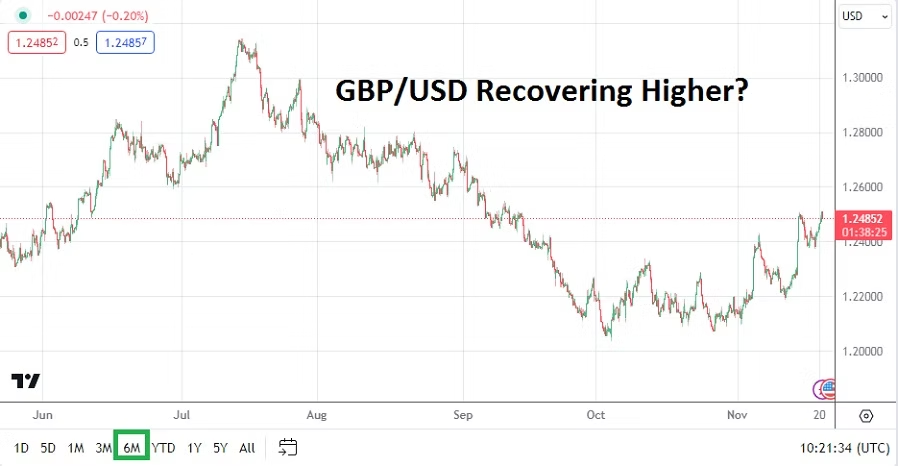
GBP/USD Six Month Chart as of 20th November 2023

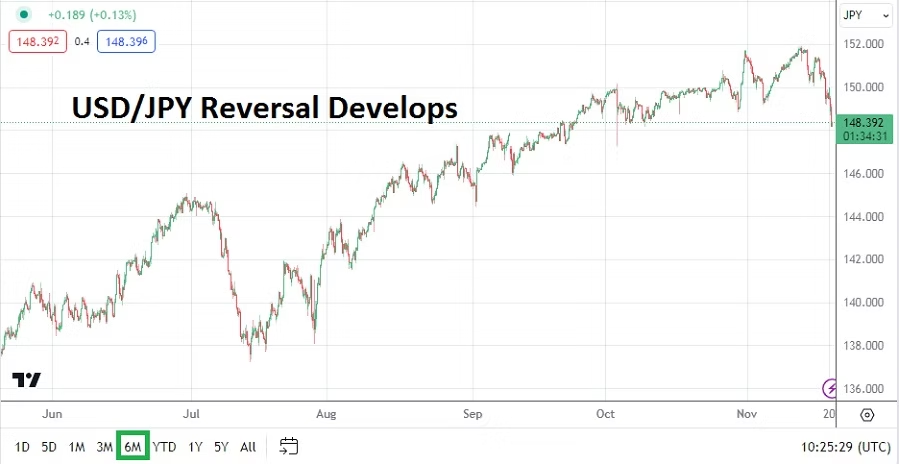
The GBP and JPY look to be intriguing opportunities for traders with a capacity to hold positions over the mid-term. Having struggled since July of this year, financial institutions are likely looking at these two currencies as having been oversold. Many other major currencies are all rather speculatively attractive at this time, but again, day traders should not wager blindly and keep realistic targets for their short-term wagers.

USD/JPY Six Month Chart as of 20th November 2023

The U.S will celebrate its Thanksgiving holiday this Thursday. Volumes across the broad markets will begin to drop significantly on late Wednesday, and full trading will not return until Monday or Tuesday of next week until the U.S turkey meals have been digested. Meaning that while risk appetite has certainly begun to creep in the broad markets again, forecasts this week should be treated carefully. Day traders should watch momentum today and tomorrow, if the USD remains weak going into Wednesday, this could signal further weakness in the USD is anticipated. Yet, the dangers of near-terrm reversals exists and speculators should not get over confident.

U.S Treasury yields remain near their five day lows. The price of gold is range trading below its highs made late last week, this as the USD has shown weakness and risk adverse global concerns have also become more calm. Trading results later this week should be viewed suspiciously, price velocity when unbalanced positions are executed often leads to spikes during the Thanksgiving holiday, like the Christmas holiday which will follow in a little more than a month.

Monday, 20th of November, Germany PPI – the inflation data has already been published and the Producer Price Index came in at minus -0.1%, which was below the estimate. Global economic data the remaider of today will be rather light, and behavioral sentiment being generated from U.S markets should be watched.

Tuesday, 21st of November, U.S FOMC Meeting Minutes – this report which will be published late on Tuesday for many global traders, may provide evidence to previous thoughts regarding the outlook for the U.S economy regarding inflations impact on monetary policy. Meaning that if there are signs that FOMC members were already talking about the notion that inflation was eroding last month and was expected to continue to decline further – this could feed into weaker USD outlooks mid-term.

Wednesday, 22nd of November, E.U ECB Financial Stability Review – this report will have limited impact because Forex will remain USD centric. The EUR, like the GBP and JPY, is showing signs of a recovery based on the notion of having been oversold. Traders should be cautious about the EUR/USD later this weeek because of the U.S holiday and expect volatility.

Wednesday, 22nd of November, U.S Core Durable Goods Orders, and Revised Consumer Sentiment via University of Michigan – both these reports may fall on a U.S marketplace that is preparing to escape for the long holiday weekend. Last week’s weaker than anticipated Retail Sales numbers will combine nicely with the Consumer Sentiment reading, but again its affect may be muted. If the Core Durable Goods Orders number meets expectations or comes in with a slightly less than expected statistic, this could help continue to create weaker USD outlooks.

Thursday, 23rd of November, U.K and E.U Flash Manufacturing and Services PMI – the reports from Great Britain and the European Union are expected to show stable results, but also that purchasing managers remain unimpressed by the prospect of future demand over the mid-term in Europe.

Friday, 24th of November, Germany Business Climate via ‘ifo’ – this report is expected to be better than last month’s outcome. If the result is stronger than expected this could help the EUR/USD going into the weekend.

Friday, 24th of November, U.S Flash Manufacturing and Services PMI – both reports are expected to be slightly weaker than the last month’s numbers. U.S trading will be limited before going into the weekend. Yes, many markets will be open but volumes will be sparse. This could set the table for a reaction early next week if financial institutions believe they can take advantage of Forex, equity and commodity markets that became unbalanced during the Thanksgiving holiday celebrations.

postN50

Trading Tactics to Add to Your Risk Management Knowledge

Trading Tactics to Add to Your Risk Management Knowledge

Retail traders seeking quick speculative positions are not the masters of the financial world. Institutions which day traders are hoping to reflect are the real shakers of the markets. Understanding your actual place in the world of trading is crucial, accepting this point and putting ego to the side will create a better grasp of behavioral sentiment as you interpret combinations of fundamentals and technical perceptions and merge them into your risk taking.

Making your decisions with the acknowledgement of your place in the trading world is important. Your 10,000.00, 50,000.00 and 100,000.00 USD value based positions are very small fish in a large ocean. Your trades are very unlikely to affect market direction in any meaningful manner. The more leverage you use makes your available ‘margin’ prone to failure.

Risk analysis is vital for day traders, guarding you money should be a fundamental aspect of your tactical decisions. Deep pockets are not luxuries most day traders have.

If you happen to have a solid amount of money to speculate with it will assist you, but you will still need to practice solid risk taking strategies.

Plenty of rich folks have lost all of their money trading, that isn’t written to make you feel better, it is written as a warning and highlights that speculating is dangerous when not done with a solid plan of action. Once a trade is placed your work than immediately doubles via responsibility, because you have ‘skin in the game’ and need to manage your emotions and thinking as the markets move.

Metallgesellschaft and Barings Bank are two prime examples of two institutional traders who made vital mistakes with risk management and lost everything in the 1990’s. Protecting cash reserves are vital for all. Metallgesellschaft and Barings did not supervise their traders and ‘hoped’ that all things would work out in the end, because they had the false notion institutionally that their capacity to hold onto positions that were not profitable would eventually turn into positive results. Their losing trades caused the destruction of their enterprises.

Most speculators by nature are optimists. After all day traders are gambling on the movement of assets they believe they have a correct perspective regarding future direction of value. In order to wager a trader needs to feel confident regarding their outlook, otherwise they would not pursue currency trading. The same can be said for equities and indices, commodities and all other financial assets. False hope can destroy the efforts of all traders and they must be alert to perspectives which can lead to detrimental results as they trade.

Too much leverage, no real insights about direction, and trading based on ‘noise’ that influences and causes you to make unwise decisions are dangers. It might be boring to constantly be told to be careful, a bit like a parent warning you when you were little to act in a certain way. Good risk management while day trading is vital for surviving and finding success.

Do not be stubborn. In trading no matter if it is Forex, CFDs with equities, indices, commodities or cryptocurrencies you should not ‘marry’ your position blindly. If your trading position begins to show signs of potentially failing and you have concluded you are wrong – end the trade asap.

However, at the same time do not make your decisions based on emotions which may create whipsaw reactions regarding your choices. Having solid goals before going into a trade will help you eliminate emotional stress.

Have price targets and a strategy for getting in and out of trades. If the trade is going in your direction, then protect your profits by either cashing out of the trade, or raising your stop loss to a place that you are actually still going to make money. Some trading platforms may allow you to raise your stop losses – this is called a ‘trailing stop’. If you are lucky enough to catch a trend at the correct time and it is being sustained, using a ‘trailing stop’ is a solid risk management tactic and can protect your profits.

If the trend in your position starts to reverse against you, do not cancel your ‘trailing stop’ because you think the reversal is a momentary cycle. Trading floors are littered by people who had substantial gains and then watched them vanish, all because they thought the market would reverse in their chosen direction again. Folks dream about owning a castle when all they need is a comfortable home. Cancelling stop loss orders is a sure way to the poor house.

Immodest ambitions can ruin your trades when you become stubborn, unrealistic and emotional. Make sure you stay ‘grounded’ and are pursuing trades because you believe in them, and not because you are looking for price action to fill up a boring day with wagers than make no sense.

postN6

Federal Reserve Noise as Short and Long-Term Clarity Fades

Federal Reserve Noise as Short and Long-Term Clarity Fades

There is a storm in the Forex markets currently and it will persist tomorrow. Today is a good day to talk about the difference between short-term trading and long-term investing. Short-term outlooks typically are top heavy with technical interpretation, and behavioral sentiment mixed with fundamentals when speculators are pursuing the marketplace looking for quick profits. Loud short term thunderbolts coming from various components that affect trading are significant. Yesterday’s noise had an impact.

Long-term investment is done with a focus on patience, conservative outlooks regarding fundamentals and potential behavioral sentiment that could develop and encapsulate attitudes within a chosen asset. Day traders are often ready to bet on what is going to happen in a matter of minutes, hours and perhaps a day. If a so called day trader has to be in a position longer than a couple of days, they often find that they are not emotionally prepared to wait for outcomes.

There is also the problem regarding a lack of enough cash in many trading accounts. Short term traders often do not have enough money to carry positions for a significant duration, sometimes overnight transaction fees charged by their brokerage platforms are too expensive. The availability of limited money is a liability and creates unprofitable propositions, unless an extreme amount of leverage is being used. Most short term traders lose their money when trying to apply excessive leverage. Dangers abound for day traders.

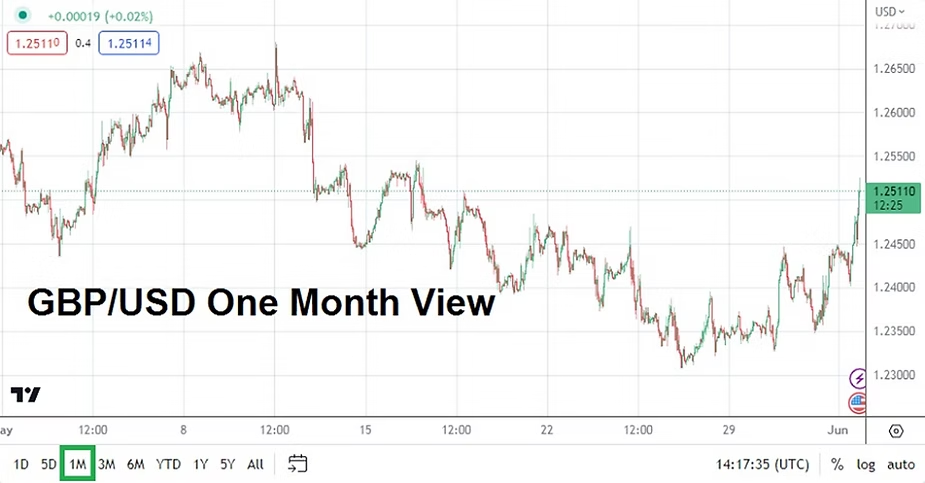
GBP/USD One Month Chart as of 1st of June 2023

Important U.S Data is on the Schedule Tomorrow which may not be mere Noise

Tomorrow the Non-Farm Employment Change number will be published, but the Average Hourly Earnings report will be a crucial part of the data brought forth too. Short-term traders like wagering on the jobs outcome and trying to ride its impetus, hoping a prosperous wave delivers them to the shore with profits. If the Average Hourly Earnings report comes in stronger than anticipated tomorrow, this could send Forex markets into a volatile and dangerous session as it mixes with yesterday’s Federal Reserve ‘dust’ which is still in the air causing problems.

Federal Reserve Dust Storm Caused by Jefferson and Harker Yesterday

Two members of the Federal Reserve’s FOMC committee, Philip Jefferson a Federal Reserve Board of Governors member and Patrick Harker the President of the Federal Reserve Bank of Philadelphia, suggested on Wednesday that keeping the Federal Funds Rate in place on the 14th of June would be a good idea.

Philip Jefferson has been nominated by President Biden to take the powerful seat of Vice-Chair of the Federal Reserve, but he has not been appointed to the position yet officially. The position of Vice-Chair is a key job within the Fed which creates a rather strong voice regarding policy historically. Jefferson’s voice could make a difference in the next two weeks. However, even with Patrick Harker joining Jefferson’s rhetoric yesterday, among them are a handful of other FOMC voting members who have expressed loud concerns about inflation and made it clear in their opinions, that staying aggressive regarding interest rate policy is important.

Clarity remains difficult to visualize regarding what the U.S Federal Reserve will do near and mid-term. However, the Federal Reserve has been exceptionally good at creating choppy Forex conditions much to the detriment of short-term traders, which is supposedly not part of the Fed’s mandates.

Forex Markets have been Stirred and Tomorrow’s Data could Shake Conditions More

Wednesday’s comments from the two Federal Reserve members briefly stirred global Forex and the broad marketplace. Short term traders likely got caught in the momentary flashes of hysteria caused by the comments of the two gentlemen.

Arriving closely behind the comments by the Fed officials yesterday was the U.S JOLTS Job Openings report, which is viewed suspiciously by many professionals in the investment world because its numbers are sometimes suspected of being inflated by ‘headhunters’. However yesterday’s JOLTS results showed a huge increase in available employment options and caused another temporary reaction in Forex – in many ways counteracting the Fed voices.

Meaning tomorrow’s Non-Farm Employment Change numbers, and the inflation report via the Average Hourly Earnings will cause a loud buzz before and after their publication. This as the rhetoric from Fed members Jefferson and Harker mixes into the statistical outcomes.

The USD has been strong in the broad markets the past few weeks against many major currencies. This as evidence has grown the Federal Reserve may feel pressured into increasing the Federal Funds Rate in June in order to fight inflation. Tomorrow’s job reports will be essentially a week and half before the interest rate decision on the 14th of this month.

Short-term traders will likely bet on what will happen tomorrow and will continue to speculate in the coming two weeks regarding what the Federal Reserve will do. This while long-term players position their portfolios based on outlooks that can deal with the ‘dust’ in the air momentarily, knowing they should remain patient. Long-term investors do not always make money, but yesterday’s brief fireworks caused by the Federal Reserve officials weren’t quite as troubling for investors with a broader horizon who don’t flinch with fear from short-term murmurs.