postN87

AMT Top Ten Miscellaneous Bits of Clarity for the 19th of April 2026

In a World Filled with Bread and Circuses, Now a Dose of Transparency

10: The Risk Reward Show: Sommer and Petrucci will return to the airwaves this coming week, via sources like Spotify and YouTube, with their podcast starting after a long break (absence).

9. Hardball: Major League Baseball is back and the sport continues to attract more fans and growing attention with its quicker games, a new computerized strike zone, and maybe even more dislike of the Los Angeles Dodgers. Yes, Shohei Ohtani remains a dominant and positive force in the baseball world.

AMT Top 10 for the 19th of April 2026

8. Populism: Politicians on both sides of the Atlantic continue to display a wide display of nonsensical rhetoric and bold asinine actions equating into empty spectacles. An example from the Left is Zohran Mamdani the mayor of New York City with his socialist platform, which is certain to fail and equate into more people and companies leaving NYC for less expensive and friendlier tax environments. And from the Right Italian Prime Minister Giorgia Meloni who talks a tough game but consistently falls short of backing up her words when she senses she could lose control of her power base. The putrid smell of trying to please voters with rotting bread and circuses prevails.

7. Speculation: Gold finished Friday’s trading near $4,837.50, Silver around 80.78. Bitcoin is close to $75,570.00. 

6. AI: While the Artificial Intelligence hangover has been widely discussed for a handful of months, health continues to be seen via Nvidia which closed above $201.00 going into this weekend, and Anthropic PBC which appears to be aiming for an IPO in late 2026 or early 2027. At this moment Anthropic has an estimated valuation of 800+ billion USD. If Nasdaq is able to secure a listing with Anthropic it will immediately factor into the Nasdaq 100. Are some investors betting on upside now which they believe will be seen when Nasdaq reorganizes its index?

5. Optimism: India, South Africa, Brazil and other emerging markets have experienced Forex volatility like all nations the past month and half due to the Iranian war. However, in the past two weeks the Indian Rupee, South African Rand and Brazilian Real have performed better as global markets have calmed. The ZAR and BRL have actually outperformed major currencies over the past handful of months showcasing existing optimism within financial institutions dealing with these currencies.

4. Money for Something: Lefarge, a French company specializing in concrete, was found guilty this past week of paying ISIS (Daesh) and other terrorists groups money in the years from 2012 into 2014, this in order to maintain their business operations in Syria. While Lafarge claims they paid the money to keep their operating staff safe, a French court ruled Lafarge was buying not only safe passage to allow employees to work, but also paying for physical resources needed from quarries that were controlled by the terrorists. Critics of Lafarge point towards the company’s massive infrastructure investments leading up to 2012 and a decision to seek profits no matter the costs of dubious morality. Some Lafarge former senior executives involved have been sentenced to prison including Bruno Lafont and Christian Herrault. Lafarge and Holcim (a Swiss conglomerate) merged officially in July of 2015.

3. WTI Prices: The value of the world’s most famous Crude Oil went into the weekend near $83.30 via futures markets. The commodity is certain to open with volatility early on Monday, this as folks weigh in via their existing behavioral sentiment which will range from speculative perceptions to insights they hold to be true (but that could prove false). WTI Crude Oil challenged 79.00 USD momentarily on Friday, before sparking upwards as cautious attitudes likely ignited doubts about what would happen this weekend in the Middle East regarding potential developments. Wagering on WTI in the coming days for day traders may be akin to spins of the roulette wheel.

2. Apex Heights: The winning streak and surge upwards for the Nasdaq 100, S&P 500 and Dow 30 via gains have caught some investors by surprise and standing on the sidelines. Some large financial institutions may find they have to explain why they did not participate in the rally which has unfolded since late March. The S&P 500 has gone up around 9.5% during this time.

1. Straight Talk: The Hormuz and whether or not the strait is open for oil tankers will remain a catalyst for all global assets until clarity is gained. In the meantime a whirlwind of noise and threats from President Trump, the U.S White House and Iran will remain a menace for all traders – small and large. Is the Strait of Hormuz open or closed?
Copy and paste the text from AMT that you want to share

postR168

AMT Top Ten Miscellaneous Missiles for the 21st of June 2024

AMT Top Ten Miscellaneous Missiles for the 21st of June 2024

10. Say Hey Kid: Baseball legend Willie Mays passed away earlier this week. He was a beloved player on the New York and San Francisco Giants in the 1950s, 1960s, and early 1970s. He might have been the best five tool baseball player of all-time.

9. AI Apocalypse: Talk about selling Nvidia shares to cash out of the super hot Artificial Intelligence tech boom on Wall Street might be considered the safe thing to do in order to protect profits. However, betting on the existing ‘machine learning’ gold rush in the stock markets to possibly end soon, thus turning into a ‘dot com’ like bubble bursting in the spring of 2000 could be misguided. The ‘dot com’ exuberance essentially started in 1995 and ran for almost five full years. The Artificial Intelligence surge may still have a lot of room to run.

8. Simmering Crypto: Bitcoin, Ethereum, and Binance Coin all remain at lofty prices, but they have lost value since touching highs in the first week of June. Trading volume of cryptos – including BTC/USD – is still below its peak of 2021 and early 2022. While the introduction of ETF products for Bitcoin has gotten institutional money involved, many individual ex-traders remain cautious. Former illustrious speculative plays like Dogecoin and Shiba Inu have turned into niche wagering cesspools.

7. Hezbollah Poker: Hassan Nasrallah delivered a surprise statement earlier this week when he proclaimed if there is an escalation between Hezbollah and Israel, that Cyprus could be attacked by missiles. The U.K still maintains sovereign military bases at Akrotiri and Dhekelia on the island of Cyprus. Direct fire from Hezbollah on an E.U member nation would be a major intensification of the Middle East conflict. Nasrallah may believe the rather limited response by the West to the Houthis attacks in the Red and Arabian seas, makes his threats on Cyprus an objective guise to get the West to pressure Israel to hold their fire.

6. Commodity Watch: WTI Crude Oil price is over 81.00 USD as of this writing and Gold is near 2365.00 per ounce. The price of energy needs to be watched because of its potential impact of inflation. WTI prices have been rather tame the past two and half months, but have climbed the past week. The precious metal remains within sight of highs and has been lingering within an elevated range since the middle of April. Cocoa for those interested is back below 10,000.00 USD per metric ton.

5. Shifting Sentiment: The Mexican Peso and Brazilian Real have lost value as politics in Mexico and Brazil are causing nervousness among financial institutions. The governing political parties in both nations are trying to reach for new powers, and the selloff of the two currencies against the USD have been clear. Morena, the leftist political party governing Mexico, is seeking controversial judicial reform which is seen as an attempt to gain more political influence. Lula da Silva’s Workers’ Party is attempting to take the head of the Central Bank of Brazil, Roberto Campos Neto, to court to try and muzzle his fiscal viewpoints. The USD/MXN is near 18.31650 and the USD/BRL is around 5.4539 as of this writing. Rand traders who have seen a bearish USD/ZAR trend emerge the past week and a half because of renewed optimism in South Africa might find the spats in Mexico and Brazil intriguing.

4. Euro Barometer: The first French election will be held on the 30th of June, the second on the 7th of July. The contest is shaping up as a election between the Left and Right. Political coalitions are being formed rapidly. The attempt to coalesce on the Left is an obvious sign that politicians feel threatened with the prospect of sweeping losses. Media noise is certain to boom and be exaggerated in the coming days as warnings about this election potentially affecting all of humankind litters the airwaves. Macron and other politicians may find tough days ahead as they apologize for policy failures and get punished via the election outcomes. The EUR/USD is close to 1.06931 for the moment.

3. China Woes: Economic data from the housing sector continues to show a downwards trajectory regarding home values in the nation, and it is having an impact on consumers as their net worth suffers and affects spending habits. Not only are property values still dropping at a rapid pace, but recent Factory output data has come in below expectations. China is tentatively scheduled to release Foreign Direct Investment numbers soon.

2. Summer Doldrums: Investor behavioral sentiment appears to be in a wait and see mode as as more impetus is awaited and large players grow cautious. The U.S will issue PMI manufacturing and services data today, but the results will have a limited effect. The U.S Juneteenth holiday which was celebrated on Wednesday and the return of traders yesterday did not rejuvenate optimism. The Nasdaq Composite and S&P 500 lost some ground. While the Dow 30 did gain slightly yesterday, the index has been treading water compared to the Nasdaq and S&P over the past month.

1. Geriatric Debate: Next Thursday the 27th of June, President Biden and former President Trump will debate. The televised event will be watched by American voters and the world. Not only will the debate deliver potential impetus to financial assets if there is a clear winner, but it may provide a large wagering environment for betters who gamble on which Presidential candidate will be the first to go off script. People in the U.S desire a discussion about the economy, foreign policy and immigration, this while hoping for a lack of mishaps, hyperbole and demagoguery which is unfortunately quite likely.

postN68

Mets, New York City, and the Most Astounding Baseball Season

Mets, New York City, and the Most Astounding Baseball Season

Book corner: They Said it Couldn’t be Done by Wayne Coffey

In 1969, the Apollo 11 moon landing and the 400,000-strong Woodstock concert weren’t the only miracles in the United States. Wayne Coffey’s They Said it Couldn’t be Done focuses on major league baseball, where the New York Mets – a team with a losing record since its founding and who came in ninth place in the National League the year before – won the World Series to become baseball’s champions. Who says that miracles don’t happen?

Coffey is an experienced sportswriter, having written about hockey (The Boys of Winter: The Untold Story of a Coach, a Dream, and the 1980 U.S. Olympic Hockey Team), plus soccer, football, and basketball. In They Said it Couldn’t be Done, he tells the story of the championship ’69 year.

Coffey describes the history of the team. The Mets grew from the wake that was left in New York baseball when two of its three major league teams – the Brooklyn Dodgers in 1957 and the New York Giants in 1958 – relocated to California (referenced by the line “California baseball” in Billy Joel’s hit We Didn’t Start the Fire), leaving the southern boroughs without a team of their own. Created as one of two National League expansion teams in 1962 (the other being the Houston Colt 45s, later renamed as the Astros), the Mets played in the Giant’s old homestead, the Polo Grounds in upper Manhattan, until moving to Shea Stadium in Flushing, Queens in 1964.

A word about expansion teams. These teams usually comprise older players whose baseball chops have begun to erode, together with lesser-skilled players who – to put it mildly – weren’t the top prospects upon entering the league. The Mets went 40-120 their first year, a losing record for the twentieth century (and so far for the twenty-first). For the boys in Flushing, the early-to-mid-60s were a ballplaying comedy of errors, a farce with endless losing streaks, blowout games, and (as one can guess) a horrendously poor level of play. Fans would turn up to the game and watch dropped balls, outfield collisions, and balls careening off gloves. But the fiercely loyal New York fans stuck with them, taking the team to their hearts. In fact, an endearing and fun aura surrounded the young team, viewed by the fans as goofy but lovable losers.

As Coffey explains, the change began in mid-decade. Older players retired or were traded, and younger and more skilled players joined the team, such as the nimble shortstop Bud Harrelson. In 1967, two pitchers were introduced who would have a major role in the Mets future win, the left-handed Jerry Koosman and the right-handed Tom Seaver. These players – and others – were hungry for winning and were offended by the stigma of mediocrity that surrounded the team. In 1968, former Dodger star Gil Hodges began his tenure as manager, replacing the old-timer Casey Stengal. Coffey describes Hodges’ character and managerial style, and how it affected the team for the better. A decorated US marine in World War 2, and a man of the highest integrity, Hodges was calm, methodical, unflappable, with an uncanny knack for eliciting the maximum performance of his players, who respected him greatly. The ’68 team might not have even reached .500 (meaning the number of wins equals the number of losses), but for those watching closely, there were seeds of future victory being sown, as shown by good performances from catcher Jerry Grote, outfielders Cleon Jones and Ron Swoboda, and others.

Even with all the young and eager talent, the Mets began the ’69 season still outgunned in the National League, posting a losing record for the first month. But in May, they went .500 for the first time since their founding, and at the end of the month lurched ahead after a winning streak. Coffey describes the additional winning streaks in August and September where, trailing the Chicago Cubs for most of the year, the Mets edged out the Windy City boys to win, in champagne-drenched excitement, the National League East division. On this backdrop, the bulk of the book – the ’69 post-season – begins.

Going up against the Atlanta Braves in the National League Championship was frightening. Even though the Mets won more regular season games, the Braves – with powerful hitters such as Orlando Cepeda and top slugger Hank Aaron, and a pitching staff led by the right-handed All-Star Phil Niekro – were still favored to win. But in an unpredicted upset, the Mets swept the Braves, three games to zero, scoring a cumulative 27 runs compared to the Braves’ 15.

Defeating the Braves was one thing. Defeating the American League championship Baltimore Orioles in the World Series was another. With bat-wielding gladiators such as Brooks Robinson, Boog Powell, Paul Blair, and Frank Robinson, the Mets were going up against a baseball-playing war machine with almost no weak spots. Their pitching staff included four starters who won 20 games apiece, such as left-handed Mike Cuellar and Dave McNally, and right-handed Jim Palmer. Palmer, considered today one of the best pitchers ever, was still young when he took the mound against the Mets, turning 24 on the day of Game 4. But he already had five seasons under his belt, and was an experienced postseason warrior, including a World Series pitching duel in 1966 against the mighty Sandy Koufax.

The Mets went on to defeat the Orioles, four games to one, playing like lions in a World Series that has become legendary. Coffey describes these games – as he does with the Braves – in play-by-play detail, but does a good job of leaving out anything of lesser importance while highlighting the important plays, the latter including Ron Swoboda’s gravity-defying catch in Game 4 that saved the game for the Mets. A writer of lesser skill might over-indulge the reader, or conversely, skimp too much on details. Coffey is able to walk that fine line between the two, and the book’s climax bounces along at an exciting pace, with a breezy, page-turning feel. Coffey did his homework well, by conducting scores of interviews with the key players and obviously watching all the championship and World Series games (all are currently available on YouTube, for anyone interested). He includes interesting commentaries at various points, telling us what the players were thinking, analyzing their moves, and putting various key at-bats in context.

Coffey fills up the book with light vignettes of Met fans of the era, such as Howie Rose, the popular Mets sportscaster, and describes the season’s impact on New York society in general. He also delves into the background and personal stories of many players, including the hardships they endured – such as that of veteran third basemen Ed Charles, an African-American who came up from the Jim Crow South – to make it to the major leagues.

The classic baseball expression, “it ain’t over ‘til it’s over”, truly symbolized the ’69 Mets. They Said it Couldn’t be Done is a great read. Baseball fans will love the book but so will fans of any sport.

If you want to read another Book Corner article, please visit this review by Evan Rothfeld: https://www.angrymetatraders.com/post/dangerous-and-unpredictable-duties-during-the-vietnam-war

postN25

Revitalizing Cricket in the USA: Rise of Franchise Cricket

Revitalizing Cricket in the USA: Rise of Franchise Cricket

Cricket, with a rich historical presence in the United States, has struggled to gain a large following compared to other sports like baseball. However, recent efforts to promote the game have emerged, including the establishment of franchise-based cricket leagues. Here’s a brief history of cricket in the USA, the challenges it has faced, and the introduction of new leagues and cricket franchises as a catalyst for potential growth.

AngryMetaTraders.com Cricket Coverage

Early Presence and Decline:

Cricket has a long history in the United States, dating back to the 18th century, with the first recorded match taking place in 1751 in New York. During the 19th century, the sport enjoyed significant popularity, attracting large crowds to matches. However, the rising prominence of baseball, another bat-and-ball sport, and the exclusion of the USA from the Imperial Cricket Conference in 1909 led to cricket’s diminishing relevance within the country.

Perseverance through Immigrant Communities:

Cricket has managed to endure in the USA primarily due to immigrant communities from cricket-playing nations such as India, Pakistan, and the Caribbean islands. The USA now has a national cricket team recognized by the International Cricket Council (ICC), largely composed of players from these immigrant communities.

Franchise Cricket – A New Approach:

In recent years, the concept of franchise cricket has gained traction in the United States as a means to stimulate interest in the sport. Franchise-based leagues have played a pivotal role in popularizing cricket globally, attracting international players, unearthing local talent, and delivering captivating cricketing action to fans. Indian Premier League (IPL) is one of the most lucrative cricket leagues globally. Similar leagues have become popular in other countries like Australia (BBL), Pakistan (PSL), England & Wales (The Hundred), Bangladesh (BPL), West Indies (CPL) and many more.

Using this model in the USA, two franchise cricket leagues have emerged: Minor League Cricket (MiLC) and Major League Cricket (MLC). The MiLC was launched in 2020 and focuses on regional talent development, providing local players and youth (via cricket academies) with a platform to compete at a higher level. However, MiLC’s impact beyond immigrant communities may be limited as the players are still largely composed of immigrants from cricket playing nations.

MLC’s Potential:

The inaugural year of Major League Cricket is set to begin the 13th of July 2023, featuring six franchise teams with international players competing in matches scheduled in Texas and North Carolina. There are some big names who have invested in the MLC, ranging from tech CEOs like Satya Nadella to Bollywood stars like Shahrukh Khan, and venture capitalists among others. These investors will eventually turn into franchise owners. Although the launch of MLC has garnered attention in the cricketing world, its long-term success depends on factors such as attracting sponsorship, generating advertising revenues, and establishing loyal fan bases.

Measuring Success and Building Cricket Culture:

While cricket faces stiff competition from popular sports like baseball, football, and basketball in the United States, the investors and stakeholders in MLC probably understand the challenges ahead. Success should not solely be measured by financial returns, but also by providing opportunities for American cricketers to shine on an international stage. As interest grows, the hope is that cricket will gradually find its way into elementary schools, recreation programs, and the wider U.S sporting landscape.

Growth of USA Cricket and Sustainability:

Cricket’s journey in the United States has been marked by historical significance, challenges, and recent endeavors to popularize the sport. The introduction of franchise cricket leagues like MiLC and MLC brings new opportunities for growth and development, both for players and the overall cricketing culture in the USA. While cricket may never rival the popularity of established American sports, the passion and efforts invested in franchise cricket aim to build a sustainable future for the game, in order to create a lasting impact on the playing fields of the United States.

If you want to read more about cricket, please go to this article by Ibrahim Mirza: https://www.angrymetatraders.com/post/cricket-destined-to-be-a-fountain-of-joy-money-in-india

post30

Pay Attention to Mid-Size Banking Noise

Pay Attention to Mid-Size Banking Noise

About a week and a half ago the U.S Federal Reserve ‘admitted’ they made a mistake regarding their oversight of Silicon Valley Bank. In essence, the Fed used the sports phrase that sprung to life in the early 2000’s by baseball players who said, “my bad”, as if by admitting when they made a mental error on the field it would soon be forgiven. “What a good guy”, some folks would say as a player took responsibility, but their team would lose the game.

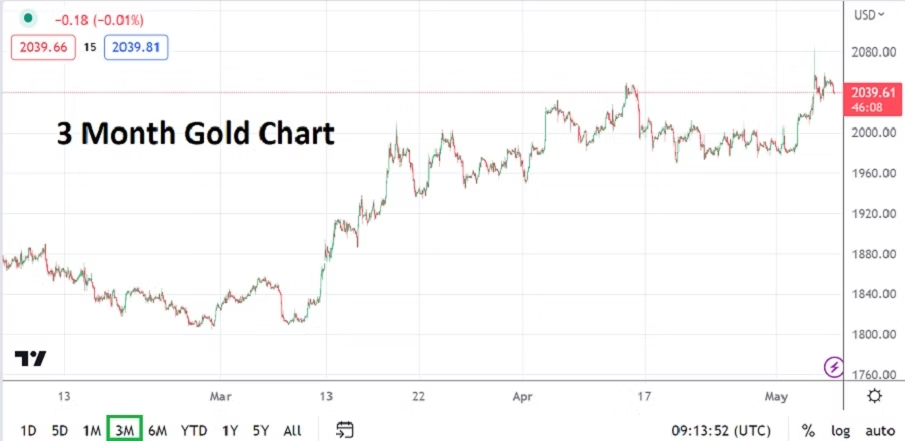
Gold 3 month chart as of 5th May 2023

The question for the Fed is what will they say when other so-called mid-size and smaller banks start to crumble from duress? The Federal Funds Rate was increased again this week by an expected 0.25% and the corporate banking sector in the U.S is under strain. Many banks are seeing share values on Wall Street disappear as they watch their trading screens with alarm.

Let’s not get caught up in hyperbole, or scare mongering, but these banks and the Federal Reserve have simply proven again they have no real grasp regarding risk analysis and what to do when the proverbial ‘fluff’ hits the fan. It is easy to point fingers now, yes, but the writing has been on the wall. It is much easier to make money for a bank when money is cheap. Little to no interest rates allowed banks to be speculative – compared to an environment when the lending rate is high and folks do not borrow, or pay back slowly. Deposits are also dwindling because bonds and other assets have become attractive for ‘clients’ who want to park their money elsewhere to earn better returns. The middle class and lower class are under pressure and small businesses are too as mid-size banks get nervous.

In the FOMC Statement this week which was somehow a unanimous decision – no dissension is a bad sign ladies and gentlemen – the Fed stated “The U.S. banking system is sound and resilient. Tighter credit conditions for households and businesses are likely to weigh on economic activity, hiring, and inflation…..” However, they also pointed out that inflation remains ‘elevated’. And let’s dissect the banking is sound statement, the Federal Reserve did not elaborate. They surely cannot mean the mid-size and smaller banking sector which is losing value almost daily because of struggling corporate share values are sturdy. Financial houses of various types are clearly betting these banks will come under immense weight because interest rates remain high.

Oh, and borrowing costs can still go higher, because let’s face it, inflation is not going away soon. The Fed has helped ramp up inflation by creating ‘import inflation’ as they have ‘killed’ foreign currencies values. If you are a fan of body language watch Fed Chairman Jerome Powell answer questions during the Fed Press Conference from this Wednesday the 3rd of May, when pushed on details regarding the mid-size banking sector and the future of interest rates. He didn’t put his hand up in the air and say, “my bad”, but it would not have been surprising, however it did look like he wanted to walk off of the field. The stadium packed with depositors within mid-sized and smaller banks should be prepared to show their disdain. Middle America should be unwilling to take this loss.

No historical events are exactly similar, but the Fed and its continued ability to put on ‘blinders’ as the corporate mid-size banking sector in the U.S potentially cracks, smells eerily similar to what happened during the financial crisis of 2007 and 2008 when rumors became strong whispers and then turned into a nightmare. Please say hello to the possibility of another massive bailout from the U.S government, because J.P Morgan, BlackRock and other ‘banking’ mammoths do not have enough capital to keep everyone liquid and safe.

Nervous behavioral sentiment is rising its head and looking out over a dangerous landscape. Middle America should be prepared to react to the potential that their neighborhood banks might be in trouble. And the U.S had also better get ready for the very ugly word ‘stagflation’.