Indian Diaspora 20260325

India Insider: Why the Gulf Remains a Vital Economic Lifeboat

Indian Expat Labour and Recalibration Realities

The skyline of Dubai, once a symbol of untouchable prosperity, now sits under a shadow of regional recalibration. As Reuters recently noted, Dubai has successfully transitioned to a non-oil economy, with oil accounting for less than 2% of its GDP. It is now a powerhouse of trade, high-end real estate, and financial services. 

However, its “backyard” – the Strait of Hormuz – remains a strategic bottleneck. With 20% of global seaborne crude passing through this narrow vein, the recent tensions in March 2026 have forced a shift in perception: the Gulf is no longer an insulated sanctuary, including Dubai where millions of Indians work and earn for their families in India.

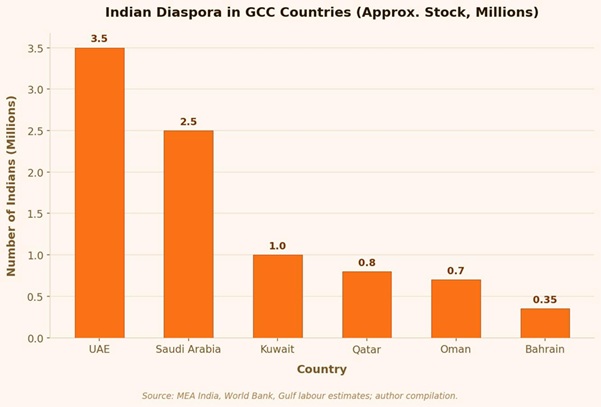
Indian Diaspora Gulf Representation

The scale of this “labour export” is enormous. As of early 2026, approximately 9.5 to 10 million Indians live and work across the GCC (Gulf Cooperation Council) countries. To put that in perspective, that is nearly the entire population of a country like the UAE, made up solely of Indian expats.

A Remittance Driven Economy

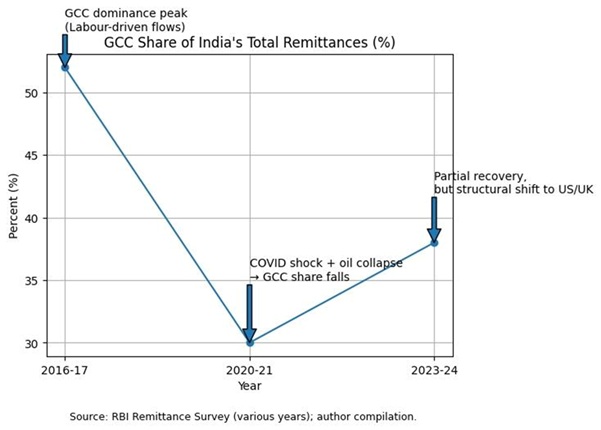
As per Government data sources, India remains the world’s top remittance recipient, with total inflows hitting a record $135.4 billion in the last fiscal year. And despite a rise in high-skilled migration to the US and UK, the GCC remains a juggernaut, contributing roughly 38% of India’s total remittances.

For states like Tamil Nadu, Kerala, and Maharashtra, which receive nearly 50% of these total inflows, it is a macroeconomic stabilizer that funds the current account deficit and keeps the Rupee from a freefall.

India’s Labour Market Paradox

But here is the real question, if people return to India due to the crisis in the Middle East, are there any “good quality” jobs waiting for them in India? The honest answer is no.

Youth unemployment remains elevated, particularly among graduates. Engineers in mechanical and construction fields face limited opportunities. Outside IT, and to some extent automobiles, there are not enough stable, high-paying jobs.

So people adjust. You will find postgraduates working in delivery jobs and informal sectors. I have personally spoken to Amazon delivery workers who told me they hold M.A degrees, or that they had worked in Dubai or Singapore before Covid and are now trying to leave again. This is becoming norm nowadays.

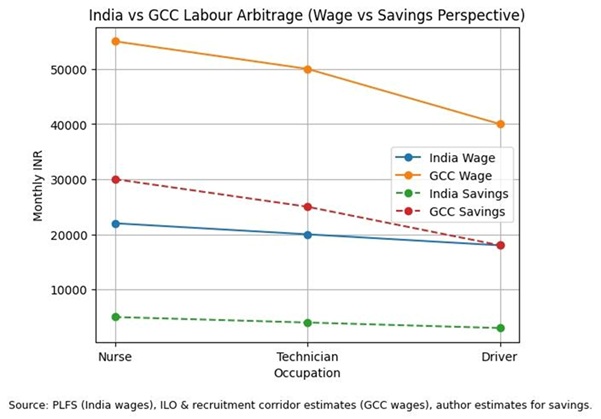
Indian National Wages and Savings Compared to Expat GCC Averages

In many towns in India, migration itself has become an economic model. People move to Singapore, Malaysia, or the Gulf, and the money they send back drives real estate, consumption, and local business activity. In many such regions, the labour market feels tight, not because jobs are available, but because the workforce has already left.

The wage gap explains everything. A nurse or lab technician in India may earn ₹15,000–₹20,000 per month. The same person can earn close to ₹80,000 in the Gulf. A private school teacher in Villupuram city in Tamil Nadu state earns around ₹8,000.

While nominal wages are  2–2.5x higher in GCC, the true driver of migration is savings arbitrage , which can be 5–6x higher.

This reflects structural differences in labour productivity and capital intensity.

India has a large pool of educated labour. But instead of becoming an advantage, it has turned into a wage suppressing force. There is always someone willing to work for less. As a result, wages remain low and bargaining power stays weak.

Percent of India’s Remittances From The GCC

At the same time, we are told growth is strong. Yes, the labour force participation is rising, but inequality is also increasing. A large share of employment remains informal and unstable. Inflation continues to erode purchasing power, and disposable incomes remain under pressure.

Right now, for many Indians, prosperous conditions are easier to find outside the country. Yes, the Gulf has risks. However, geopolitical tensions will come and go, and these are short-term disruptions.

Structurally, GCC economies will stabilize and grow again, and when they do, the flow of Indian labour will continue to pursue these opportunities. Because until India creates enough high-quality jobs at scale, migration will not slow down.

Copy and paste the text from AMT that you want to share

post224

The Greatest Rivalry: India vs Pakistan: Netflix Doc. Review

The Greatest Rivalry: India vs Pakistan: Netflix Doc. Review

The India-Pakistan cricket rivalry is one of the most intense and storied in the history of sports. This 3-part Netflix documentary delves into this historic cricket rivalry, focusing primarily on the 1999 and 2004 tours. While it provides an engaging look at these high-stakes encounters, the series feels somewhat incomplete, as it largely skips over the period before 1999 and rushes through the events post-2004, condensing nearly two decades into the final 10 minutes of the last episode.

The Greatest Rivalry: India vs. Pakistan – A Review of the Netflix Cricket Documentary

One of the more thought-provoking moments comes from Pakistani journalist Osman Samiuddin, who draws a cultural comparison by noting that Pakistan’s savings rate lags India’s. He suggests this reflects differing life philosophies – Pakistanis living more in the present versus Indians planning more for the future. Indian journalist Ayaz Memon describes the 1999-2004 era as a clash between Pakistan’s world-class bowlers and India’s formidable batsmen. However, the reality is that both teams were evenly matched during this period, adding to the intensity and unpredictability of their contests.

The documentary effectively captures the electrifying atmosphere whenever these two nations face off, highlighting the high emotions and record TV ratings. Indian cricket legends like Sunil Gavaskar, Kris Srikanth, and Sourav Ganguly provide insightful commentary, but it’s Virender Sehwag who takes center stage for his pivotal role in the 2004 series. On the Pakistani side, Shoaib Akhtar, at the peak of his career, is a key figure, alongside Javed Miandad, Waqar Younis, and Inzamam-ul-Haq. John Wright, the coach of the Indian team in 2004, also shares some noteworthy behind-the-scenes anecdotes.

The series makes a commendable effort to keep political tensions at bay, but the deep-rooted rivalry between the two nations inevitably influences the narrative and the emotions of fans on both sides.

A brief segment touches on the Indian Premier League (IPL), cricket’s biggest moneymaker, noting that Pakistani players participated in the inaugural 2007 tournament. However, the 2008 Mumbai terror attacks led to a political fallout, resulting in the exclusion of Pakistani players from the IPL. This absence has deprived the league of some exceptional talent and the unique buzz that a cross-border rivalry would have generated. The documentary provocatively suggests that had Pakistani players continued in the IPL, the fierce on-field competition might have evolved into a more sporting rivalry, possibly softening fan perceptions across borders.

The timing of this documentary is particularly relevant, with the 2025 Champions Trophy starting this week (Feb 19) in Pakistan. However, citing player safety concerns, India has opted to play all its matches at a neutral venue in Dubai. This decision underscores the ongoing political tensions that overshadow cricketing ties. The documentary leaves viewers pondering whether a day will come when sports can take precedence over politics, allowing fans in both countries to once again experience the thrill of live, cross-border cricket.

Overall, while the documentary provides a nostalgic and thrilling account of one of cricket’s most storied rivalries, a more balanced historical perspective and deeper exploration of the post-2004 era would have made it even more compelling.

post203

AMT Top Ten Miscellaneous Missiles for the 19th of April 2024

AMT Top Ten Miscellaneous Missiles for the 19th of April 2024

10. Fusion: The U.S Senate presented legislation yesterday which creates guidelines allowing the Nuclear Regulatory Commission to authorize commercial investment and research of fusion energy. Significant strides are being made in the technology and the U.S government is preparing for the newest developments.

9. Cup of Joe: Your cafe is going to get more expensive. Robusta and Arabica coffee both remain at higher values having hit apex prices respectively this Wednesday and Thursday. And Cocoa remains ‘comfortably’ above 11,000.00 USD per metric ton this morning.

8. United Arab Emirates: The UAE has been hit by heavy weather, suffering its biggest rainfall in 75 years. It was reported that over 14 centimeters of rain fell this Tuesday in Dubai, which is the equivalent to one and a half year’s worth of typical accumulation in the city.

7. India Elections: The vote in the world’s biggest democracy has begun as millions decide on the the Lok Sabha. The election process will take place for nearly a month and a half with the results formally being presented on 4th of June. The Bharatiya Janata Party is expected to win a majority in the House of the People, thus likely re-electing Narendra Modi as the country’s Prime Minister.

6. Gold: The precious metal remains within sight of record values with the price around 2,388.00 USD per ounce. Today’s earlier ratios touched the 2,420.00 vicinity.

5. Cone of Silence: Israel and Iran have remained mum on military counterstrike action scuttlebutt, which was heard this morning throughout global media. The silence from the two nations did not stop the Nikkei 225 Index from dropping over 1000 points upon the news.

4. Bitcoin Halving: A coding change is anticipated to occur soon in Bitcoin which will affect ‘mining’ parameters for the digital asset. The code change will double the amount processing needed to create one BTC, making it twice as expensive for Bitcoin operators. Day traders tempted to wager on BTC/USD over the next couple of days need to be careful. BTC/USD is near 64,560.00 at the moment of this report.

3. Fear Factor: Price of WTI Crude Oil is near 82.70 USD per barrel. Large energy traders continue to show they are experienced in geopolitics, remaining relatively calm as Middle East concerns are being brandished.

2. While Flag: U.S Fed Chairman Jerome Powell conceded that inflation remains stubborn earlier this week. Stagflation is not being discussed openly by the Fed, but it is likely raising concerns among global central bankers. The USD has returned to very strong levels as financial institutions brace for the possibility of U.S interest rates remaining high into the late summer.

1. Behavioral Sentiment: Equity indices, Treasury yields and Forex are within the midst of nervous seas as central banks and geopolitical concerns create storms. Speculators should make sure they pay attention to the waters they traverse with their bets, which could prove dangerous to navigate in the near-term.