postN74

India Insider: Growth Without Development an Inequality Trap

India Insider: Growth Without Development an Inequality Trap

An India and Latin America Comparison

India’s strong headline growth reflects a rapid expansion of aggregate output. Yet this growth often coexists with weak job creation, uneven human capital formation, and persistent inequality. This coexistence is not a temporary anomaly. It reflects a deeper political & economic structure in which inequality itself constrains development, rather than merely emerging as a byproduct of slow growth.

This mechanism is similar to Latin America. In unequal political economies, rising income concentration encourages elites to exit from public systems like education, healthcare, transport, and social insurance. Once affluent groups no longer depend on public provision, political incentives to strengthen these systems weaken fiscal capacity erodes, public services deteriorate, and inequality becomes self-reinforcing.

Latin America’s experience illustrates this dynamic clearly. Despite periods of high growth driven by industrialization, commodity booms, or financial liberalization, many countries failed to build universal public systems. Elites relied on private schools, private healthcare, and offshore financial arrangements, while the majority depended on chronically underfunded public institutions. The result was a narrow tax base, weak state capacity, and growth that was volatile and socially shallow.
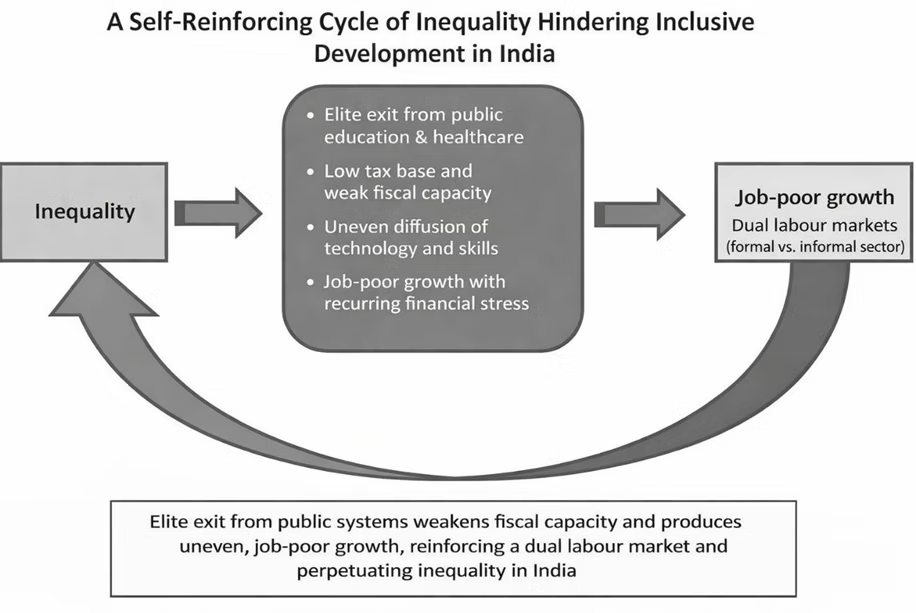
Figure concept adapted from book, “The cost of Inequality in Latin America” by Diego Sanchez-Ancochea

India increasingly shows signs of a similar trajectory. Public spending on health remains around 1.2 – 1.4 percent of GDP. Government expenditures on education is around 3 percent of GDP, which is low not just by OECD standards, but comparative to many middle income Latin American economies. Out of pocket healthcare costs account for roughly 45 – 50 percent of total health spending in India, among the highest shares globally. These figures point to a systematic private substitution over public provisions, a hallmark of elite exit.

Implications of Elite Leaving Public Systems

Withdrawal from public systems has direct implications for growth quality. When education and healthcare remain uneven, the diffusion of skills and productivity across the workforce is limited. Growth then concentrates in capital intensive or skill intensive enclaves, while large segments of the labor force remain trapped in low productivity informal employment. India’s employment elasticity of growth has remained structurally low, estimated at below 0.2 in recent decades, meaning that even high output growth generates relatively few jobs.

This structural weakness is reinforced by the nature of Indian capitalism. Like much of Latin America, India’s growth model rewards scale, access, and regulatory navigation more than technological risk taking. Firms that can manage land acquisition, compliance complexity, market concentration, and political connections earn higher returns than those that invest in frontier innovation. Private investment in research and development remains modest: total R&D spending in India is around 0.6 – 0.7 percent of GDP, with a particularly weak contribution from the private sector. By contrast, East Asian economies that achieved solid employment growth invested 2.0 – 4.0 percent of GDP in R&D during their catch up phases.

This outcome produces poor job growth and entrenched dual labor markets, which is also another Latin American hallmark. A relatively small formal sector benefits from capital strengthening and productivity gains, but the majority of workers remain in informal employment with stagnant wages and weak social protection. Gradually this weakens domestic demand and increases reliance on credit, exports, or asset inflation to sustain growth. Latin America’s history also shows that such growth patterns are inherently fragile.

India Vulnerability and Structural Risks

Narrow tax bases limit counter-cyclical policies. High inequality constrains mass consumption. Credit expansion often substitutes for income growth, increasing financial vulnerability. India has thus far avoided repeated balance of payments or sovereign debt crises, but the underlying structural risks look similar to Latin America. Growth looks strong on paper, yet remains vulnerable to shocks and has been slow to translate into broad based societal gains.

India differs from economies that have escaped their inequality traps, like East Asia and Northern Europe, because of poor development sequencing. These successful regional giants expanded universal public education, healthcare, and social insurance early, before inequality became politically entrenched. Elite dependence on public systems sustained fiscal capacity and productivity diffusion, allowing growth to create gainful employment.

India’s Social and Economic Dualism

India’s economic liberalization grew before consolidating universal public provisions. As growth has accelerated, inequality has widened and the exit of elites has deepened from public centers. An opportunity to create inclusive institutions during this early growth phase is missing for parts of the society.

The implication is clear. High growth alone does not guarantee development. When inequality weakens public systems and limits fiscal capacity, this discourages technological risk taking and produces inadequate job growth. Output expansion becomes narrow and periodically fragile. Latin America’s experience is a warning. Without building strong public institutions and reshaping incentives toward broad based innovation, India risks portraying impressive headline growth while vast disparity persists.

postR173

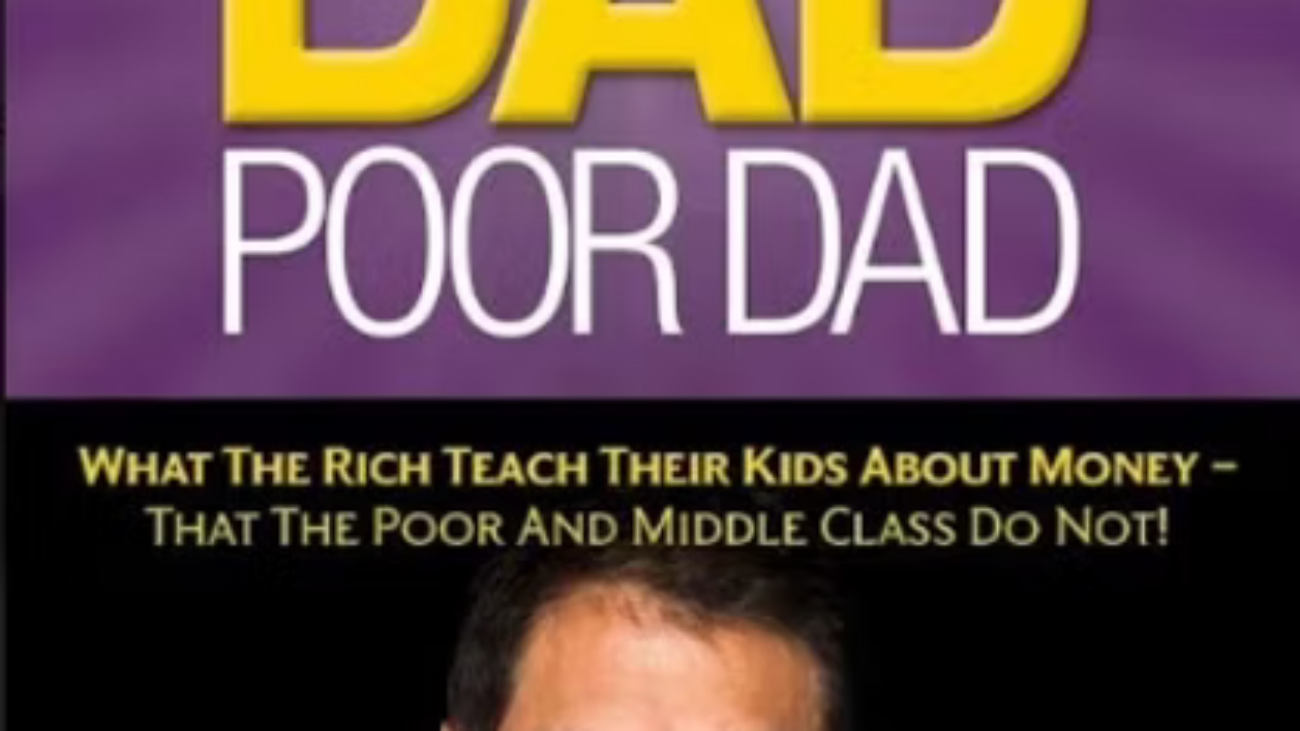
Rich Dad, Poor Dad: What the Rich Teach Their Kids About Money

Rich Dad, Poor Dad: What the Rich Teach Their Kids About Money

Book corner: Rich Dad, Poor Dad: What the Rich Teach Their Kids About Money That the Poor and Middle Class Do Not! by Robert T. Kiyosaki

Every now and then a book comes along which leads to a major shift in how Americans think. Uncle Tom’s Cabin changed perceptions about slavery. The Jungle woke the nation to the horrific labor and sanitary practices in factories. The Feminine Mystique shed new light on feminism and women’s roles in society. All those books struck deep into society’s conscious and led to major changes.

Robert Kiyosaki’s Rich Dad Poor Dad: What the Rich Teach Their Kids About Money That the Poor and Middle Class Do Not! might not echo the social justice that his revolutionary predecessors strived for. But this 1997 best-seller packed no less of a wallop. Hitting the bookstores just as the twentieth century was coming to a close, Kiyosaki’s book changed how Americans – and others around the world – think about personal finance.

Rich Dad Poor Dad is not an instructional book as one would expect in a college course, with Kiyosaki running through facts, charts and figures. A Japanese-American born and raised in Hawaii, Kiyosaki uses his own life and background to tell a simple, almost fable-like story. The “Poor Dad” in the title refers to Kiyosaki’s biological father, Ralph Kiyosaki, who worked as a educator most of his life. By all accounts a good father and an honest man, he was a big believer in standard, traditional education, wanting the younger Kiyosaki to be a good student and then go to college in order to get a good job – in other words, as Kiyosaki puts it, to be an employee. But he had little financial education, which is what Kiyosaki explains is knowledge of business, investing, accounting, entrepreneurship, real estate and all other related subjects whose knowledge one can use to make money and be financially independent – to be an employer in contrast to an employee. Kiyosaki explains that although his Poor Dad made a decent salary, he was able to save little of it due to his lack of financial education and poor career decisions later left him broke.

The ”Rich Dad” in the title is the father of Kiyosaki’s buddy Mike, a man of limited standard education but excellent and well-developed financial education. A savvy entrepreneur with his hand in many businesses, he was approached by the two pre-teens for lessons on getting rich. Rich Dad put them to work in his general store for little money, but provided something more valuable – lessons on business and entrepreneurship that would form the foundation of Kiyosaki’s life and career. The book is structured around the conversations he had with his Rich Dad and the advice he was given, and the contrast in mentality to his Poor Dad.

As Kiyosaki explains, the drive for financial education consumed him and drove his decisions well into adulthood. A mediocre student, he nonetheless graduated from the Merchant Marine Academy, and then as a US Marine, served honorably in Vietnam as a helicopter pilot. Kiyosaki was eligible to work in the maritime industry after the war, a job that would bring excellent pay, conditions, steady work and several months of vacation a year. But he instead enrolled at Xerox’s sales school – considered the best of its kind in the country – seeing it as a major key in his financial education. His need for independence was so strong that in later years, during hard times, he and his then-wife Kim slept in their car rather than the accept the charity of friends’ guest rooms.

Besides the lack of financial education in the school system – an issue that Kiyosaki raises several times throughout the book – Kiyosaki challenges conventional beliefs. He rails against purchases that are liabilities instead of assets, even arguing against home ownership. He discusses the mindset of money and wealth creation and how ordinary people – due to society’s conditioning to be employees – are held back by limiting beliefs. To be successful in wealth creation and to take control of your financial destiny, Kiyosaki argues, one must take calculated risks; inspired by his Rich Dad, he says that one must not think I can’t afford this but instead What do I need to do to be able to afford this?

In one of the few diagrams in the book, Kiyosaki introduces the cash flow quadrant (of which he would later base an entire book), which categorizes individuals as employees, self-employed, business owners, or investors. He discusses the advantages and/or disadvantages of each quadrant.

Kiyosaki hit a raw nerve in the personal finance-hungry public, turning him into an international finance guru. It has to this date sold anywhere from thirty to forty million copies and is noted as the bestselling personal finance book of all time. He – and Kim, who has a series of similarly-themed books intended for women – have subsequently published an entire series of finance books, each with its own spin, such as real estate, investing, gold/silver, multi-level marketing, etc. These include two collaborations with Donald Trump, Why We Want You to Be Rich and Midas Touch: Why Some Entrepreneurs Get Rich — And Why Most Don’t. Kiyosaki also markets a board game, Cashflow, that attempts to teach the basics of financial education and how to exit what he calls the “rat race”, which is his description of the sometimes grueling life of dependency that employers place upon their employees and the financial mediocrity that ensues.

Rich Dad Poor Dad is not without controversy. Two of Kiyosaki’s businesses prior to his turning full-time to financial education went bankrupt, fueling claims that he is not as savvy as his image projects. Some experts and competing finance writers claim that he gives poor, substandard – even dangerous – advice. Another claim regards the identity of the “Rich Dad”. His name is not revealed in this book nor the follow-ups in the series and Kiyosaki was silent about this issue for several years, leading to accusations that the book is complete fiction. He has since revealed the identity of the man, plus his friend referred to as “Mike”. Kiyosaki explained that many years ago, upon the book’s initial publishing, the family requested anonymity, to which he respectfully complied.

Another claim, not without merit, is that this book gives little advice in general beyond the series of anecdotes and soundbites. Kiyosaki has not refuted that, and has claimed that it is the intention of the book to raise these issues and to simply convince people of the need – and to direct them onto – the path of financial education.

The book is worth reading. You won’t come away with the knowledge to pick stocks, examine real estate, understand tax laws or read a financial statement. But you’ll be immediately reaching for books that do – and that, according to Kiyosaki, is the intention.

If you want to read another Book Corner article, please visit this review by Evan Rothfeld: https://www.angrymetatraders.com/post/dangerous-and-unpredictable-duties-during-the-vietnam-war