South African Rand 20260327

G7 Snub for South Africa and other Troubles for the South African Rand

USD Centric Strength and Global Anxiety Weighing on Value of Rand

The USD/ZAR is still above 17.00000 in early trading this morning, this as USD centric strength manifests globally due to anxiety which clearly exudes because of the ongoing Iranian war. The USD/ZAR is near the 17.11000 realm, with wide spreads via bids and asks.

The price of Gold is close to $4,450.00 and Palladium is around $1,395.00 – this after touching apex marks in late January when the $2,100.00 level was breached.
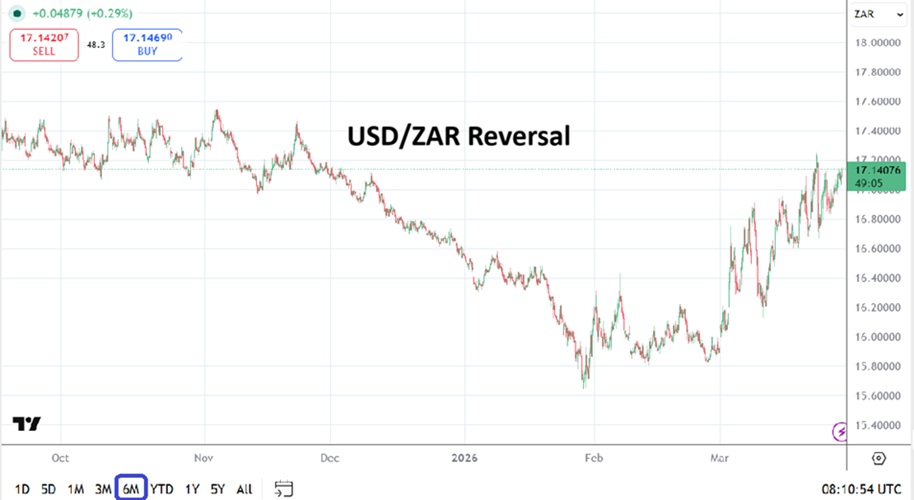
USDZAR Six Month Chart as of 27th March 2026

These metals are important for South Africa, but their daily values do not effect the USD/ZAR like they did in the past because of other complexities. The USD/ZAR which had enjoyed a stellar bearish trend and touched lows of 15.68000, late in January, could be correlated to the decrease in value to the precious metals by some, but this is likely false narrative.

When the larger picture of pure behavioral sentiment within the Forex broad market is looked upon other factors are a certainty. The South African Rand, in a rather healthy manner, is largely dependent on financial institutions outlooks regarding the USD, 10-Year U.S Treasury yields, and what the U.S Federal Reserve outlook projects.

The U.S central bank, which many people including myself, was thought to be in position in which the Federal Funds Rate would be lowered in the coming months, now faces complications due to what may become chronic higher energy costs through the mid-term if the war in the Middle East persists and inflation due to logistics, manufacturing and agriculture are effected.

The USD/ZAR near the 17.0000 is a good barometer of South African financial institutional attitudes. Yesterday’s news that South Africa will be excluded from the G7 meetings in France, which will be held in June, will not make folks in South African financial spheres content. However, these same people within the machines of corporate finance in South Africa have grown used to the vagaries of mismanagement, corruption and perceptions these cause for the nation. While some South African government officials initially said France had been pressured by the U.S to disinvite South Africa from the G7 summit, they have changed their tune this morning and are trying to downplay the exclusion as insignificant.

Thus, we return back to the USD/ZAR and near-term considerations. While the currency pair has shown the tendency to reverse lower when marks above 17.10000 have been challenged the past few weeks in March, this morning’s early trading which is sustaining higher values is troubling. The consideration that nervousness among global investors remains skittish at best is unsettling. Those who are making short and near-term wagers on the USD/ZAR are likely concerning themselves with the upcoming weekend and its unknowns. From a trading perspective, folks are usually cautious about taking speculative positions over the weekend when they fear there is a possibility of bad news.

The USD/ZAR is touching important resistance above, if calm doesn’t return to the broad markets across various international assets today, the currency pair may find itself testing higher realms as next week begins.

Looking for downside in the USD/ZAR may prove difficult to attain later today. Traders should keep their eyes on other gauges and watch the U.S 10-Year Treasury yields which are near 4.45% (highs that haven’t been seen since July of 2025), WTI Crude Oil prices and the major U.S equity indices which are in correction territories.

From a betting perspective, if U.S 10-Year yields escalate and the price of energy ebbs upwards today in commodity markets, and there is more trouble on the Nasdaq 100 and S&P 500, this will be problematic. The USD has been volatile, but has certainly shown a tendency to get stronger in recent weeks. A higher USD/ZAR above the 17.20000 is not out of the question.


Copy and paste the text from AMT that you want to share

postR196

AMT Top Ten Miscellaneous Fragments for the 24th of May 2024

AMT Top Ten Miscellaneous Fragments for the 24th of May 2024

10. IP vs. AI: OpenAI has agreed to pay News Corp., the mass media company, for the rights to ‘farm’ data and written content from publications like the Wall Street Journal and other notable brands. OpenAI will compensate the media giant around 250 million USD over the next five years. Question, does this legally imply that all Artificial Intelligence companies will eventually have to pay for ‘scraping’ Intellectual Property from all resources they take information?

9. Memorial Day: The U.S will observe its commemoration for fallen soldiers this coming Monday. The long holiday weekend will affect financial markets later today with lighter than normal trading, and volumes will be very thin in Forex and many commodities early next week.

8. India: The 6th phase of India’s national election will be held tomorrow. The 7th and final polling date is the 1st of June. There are murmurs that Prime Minister Narendra Modi’s Bharatiya Janata Party is losing some ground and will not be able to attain a super majority in the Lok Sabha.

7. Moment of Lunacy: The United Nations observed a moment of silence for Iran’s deceased President and Foreign Minister who died earlier this week in a helicopter crash, while failing to mention the majority of citizens in Iran who live unwillingly under the Iranian Islamic Republic’s oppression.

6. 29th of May: The South Africa election will be held next Wednesday. After governing the nation since 1994, the African National Congress appears to have a fight on its hands to sustain power without having to use a coalition. Dangers abound regarding potential political alliances which might have to be formed. The USD/ZAR will certainly endure volatility in the days ahead, and geopolitical influences should be monitored in the weeks to come. Can a tranquil compromise be attained?

5. FOMC Meeting Minutes: Wednesday’s publication of the Federal Reserve’s decision making process rumpled some feathers in financial institutions regarding the central bank’s laser focus on inflation. However, traders should not have been surprised. While the outlook for the Federal Funds Rate has seemingly shifted within financial institutions to hopes of a more dovish policy, equity indices and Forex will continue to amplify a battle between short and mid-term speculative and investment positions that gyrate on power generated from fundamental economic reports and technical perspectives.

4. Gold: The precious metal is near 2,340.00 USD as of this writing, this after attaining an all-time record value around $2,450.00 per ounce this past Monday. Risk appetite is certainly high in the financial markets. Day traders need to understand large speculative forces can move commodities and other assets with lightning speed when big volumes and changes to behavioral sentiment collide.

3. Data and the G7: Today’s Consumer Sentiment and Inflation Expectations readings should be watched from the University of Michigan. Weaker than anticipated results could solidify a bearish trend for the USD. However, traders should also keep in mind the G7 meetings taking place as they monitor global events, they should also remember to eliminate the hyperbole that may come from some politicians today and tomorrow in Italy as pronouncements come from the conference.

2. U.S Debt Burden: As the U.S election draws closer, investors are likely to hear more about the growing U.S debt which is certainly increasing too rapidly. 34 trillion USD in public debt is owed by the U.S government. It is a monumental number and growing larger on a daily basis. The U.S must start to get its fiscal house in order. The ratio of 124.7% of U.S debt to Gross Domestic Product is eye catching, it is still less than many major countries but still troubling. Japan’s ratio is about 263%. However, the U.K’s ratio is less and standing at 85.4%.

1. Devaluation: USD/JPY as of this writing is hovering near 157.000. There has been talk among financial institutions regarding the belief that China is quietly devaluing the USD/CNY to gain an advantage in export ability. But little mention has been made of Japan’s devaluation of the Japanese Yen to accomplish the same goal. The USD/JPY remains in remarkably high territory and the currency pair needs to be treated carefully by day traders as the Bank of Japan maneuvers policy to accomplish economic goals.