postN72

U.S National Security: USD Reserve Currency Importance

U.S National Security: USD Reserve Currency Importance

Opinion: The following article is commentary and its views are solely those of the author. This article was first published the 23rd of December via The Angry Demagogue.

We would like to start going through the U.S administration’s National Security Strategy released last month. There is a lot in there – much of it the same as in past administrations and much of it different. The tone of course is full Trump and while the introductory parts try to make it into a revolutionary document it does in fact build upon much of what has been American foreign policy for decades. One thing it most certainly gets right is that American foreign policy since the end of the Cold War has not found its compass. From a unitary world to one dependent upon global organizations, from a sharing of goals with western Europe to a pivot to Asia, from the war on terror and the middle east to Russia-Ukraine, the United States has struggled to find its way in the post-Cold War world.
We however will concentrate today on one aspect of the strategy, the third bullet in part III – “What Are America’s Available Means to Get What We Want?”. The third bullet point speaks of America having “The world’s leading financial system and capital markets, including the Dollar’s global reserve currency status” – a point that no one with any knowledge of global capital markets can not accept. The end of the bullet point – the Dollar’s global reserve currency status – is the most important because it underscores America’s leadership and essentially allows the United States of America to finance its military and its welfare state. The U.S Dollar as the “reserve currency” means that nearly all the world’s goods are quoted and therefore sold in Dollars.

Why is that important to the United States? Because the U.S government depends on its ability to issue Treasury bonds and bills at will – something no other government can do. It can do this because for another country to buy oil or copper or titanium or corn or soybeans from a country that is not their own– they need access to Dollars. Saudi Arabia and the other gulf states quote the price of oil in U.S Dollars and demand payment in U.S Dollars. The Saudis can deposit those Dollars in American banks or in what is called Eurodollar deposits in foreign banks (there are some 13 trillion Dollars in Eurodollar accounts globally). The Eurodollar accounts are essentially promises by the bank to give U.S Dollars to the holder when he makes a withdrawal. This strengthens the U.S capital markets and allows investors to have better and more investment choices. It is not only America’s often superior companies that bring profits to 401k’s and pension funds but the liquidity and vastness of America’s capital markets that can list domestic and foreign corporations. The reserve currency leading to the advanced capital markets allows the world – and America – to do this.

The U.S Treasury market is so liquid because every country needs Dollars in order to trade. They need to have enough dollar reserves since no one actually wants their own currency. In Israel, for example, local gas companies cannot buy oil with Israeli Shekels, since what will Azerbaijan, for example, do with them? There are only so many products that Israel can sell them. They need Dollars so that they are free to buy other commodities or other products.

The U.S Dollar as a reserve currency also is a break on inflation since the price of oil and other commodities is always in U.S Dollars. A weak or strong U.S Dollar influences the inflation rate in non-USD countries. A weak Israeli Shekel, South African Rand or Chinese Yuan does not influence the price of gasoline in the United States.

In short – as the Trump Administration understands well, the dollar as a reserve currency is a luxury the U.S cannot give up. The lack of the USD as a reserve currency could cause the Dollar to collapse and along with it the price of U.S Treasuries. As UST prices drop, their yields will rise and the cost of financing the U.S government will make interest payments on debt to rise well beyond its already absurd figure of over 4% of GDP – while debt itself is 120% of GDP. The U.S government currently pays over $1 trillion in debt service (interest payments on its bonds and bills). By contrast, the U.S defense budget for 2024 was $836 billion (about 3.3% of GDP).

We need to ask ourselves what can challenge the USD as the reserve currency and what could happen that would encourage the world to change? While the E.U had dreams of making the Euro an alternative reserve currency, the lack of growth in the E.U’s economy and population have put that dream to rest. The only other country that could theoretically replace the United States as the global economic go to country could be China. While in the long run, China’s lack of openness would probably mean that the Yuan would not last long as the reserve currency, that does not mean that they couldn’t jolt the global economy just enough to force it to use the Yuan to buy oil and other commodities.

China is already cornering the market on rare earth minerals and it making inroads in Africa where it mines all sorts of commodities from gold to copper to platinum and so many others (Africa has about 30% of global mineral reserves). That in itself is not enough to rock the global markets and cause a change in how the world does business.

Oil though, is that one thing that could allow China to challenge the USD as the reserve currency, even if it just presents the Yuan as an alternative.

How could that happen?

A Chinese takeover of Taiwan, by whatever means it uses would give the Chinese Communist Party control not only of the South China Sea but also allow its noisier and inferior (to America’s) submarine fleet to enter the Pacific and patrol it freely. The Chinese Navy, with a base on the “other” side of Taiwan would give it control of the north-south sea lanes that Japan and South Korea are dependent upon. Essentially, Chinese control of Taiwan would put Japan, South Korea, Vietnam and the Philippines at the mercy of the Chinese Navy. China could blockade these countries but that would be an act of war and then involve the navies of those countries and possibly the United States. It would affect the global economy negatively but it would not cause a change in world’s reserve currency. But, what if China works out a deal with Saudi Arabia to quote and sell their oil in Yuan (or the Chinese Petro-Yuan it wants to create) and then tells these countries, especially industrial powerhouses and energy poor Japan and South Korea that it will allow the passage of oil as long as they purchase the oil in Yuan?

Russia is already trying to get India to pay it for its oil in Yuan, to some success. Adding economies the size of Japan and South Korea would mean that any country that wants to buy oil could buy it in Yuan instead of Dollars. Once in Yuan, these countries would need to use the Yuan to buy Chinese products, deposit cash there and buy Chinese treasury bills. If China were to combine that with demands that all chips made in Taiwan also be sold in Yuan, the U.S Dollar would suddenly and forcefully no longer be the only reserve currency in the world.

Obviously, the way to stop this from happening is by stating outright that the United States will not tolerate a Chinese takeover of Taiwan. It is true, that the Strategy claims that the US “will also maintain our longstanding declaratory policy on Taiwan, meaning that the United States does not support any unilateral change to the status quo in the Taiwan Strait” but in practice the administration has criticized Japan’s tough talk on China instead of leaving it be. A strong silence on Prime Minister Takaichi’s remarks on China would have served the purpose of keeping the status quo more than telling her to tone down her rhetoric. There is a strong “no intervention ever” strain in the country and the President must make the case that that is not an option if the United States wants to maintain its leadership position, way of life and general prosperity.

In short, the threat to the Dollar as the reserve currency heads right through Taiwan. For those who think that the investment the U.S makes in keeping the Dollar where it is, is too expensive, just think of going on vacation and having the change to Yuan before you leave the country, wondering how much to change because of currency fluctuation and how much fun it is to return with hundreds of dollars in banknotes that you can’t use. Imagine your credit card bill on such travels and wondering how you went 15% over budget but didn’t get anything extra for it. Now imagine the national economy working that way.

Disclaimer: the views expressed in this opinion article are solely those of the author, and not necessarily the opinions reflected by angrymetatraders.com or its associated parties.

You can follow Ira Slomowitz via The Angry Demagogue on Substack https://iraslomowitz.substack.com/ 

postN5

USD/INR: Stubborn Higher Range and Risky Speculative Wagers

USD/INR: Stubborn Higher Range and Risky Speculative Wagers

The USD/INR has remained within the higher level of its one month price range as behavioral sentiment remains difficult to gauge. As of this writing the USD/INR is near the 82.7200 ratio, but readers are urged to check this price against live market action as they read to compare conditions.

The Broad Forex Market is Nervous and so is the USD/INR

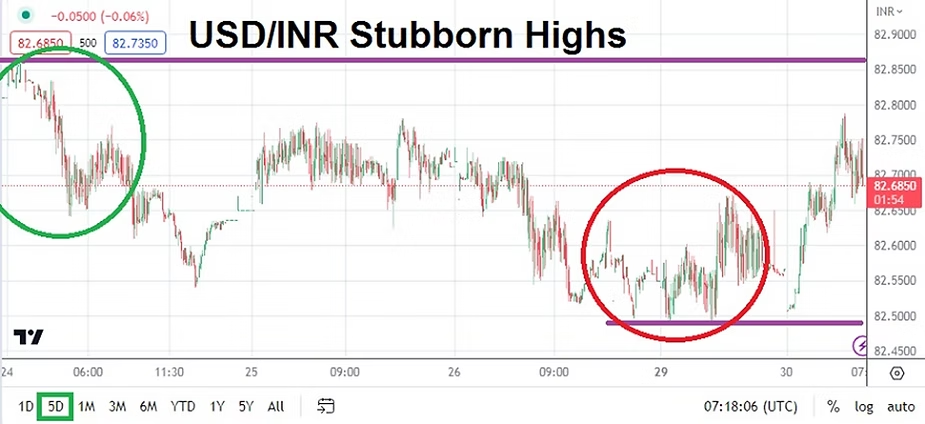
While many traders of the USD/INR who have been tempted to be sellers of the currency pair might be taking it personally that their perceived price targets have not been accomplished, they should note the broad Forex market has been difficult for most global speculators. The price action the USD/INR is experiencing currently comes from impetus due to nervous behavioral tendencies being generated from conflicting sentiment. The price range between 82.5000 and 82.8500 since the 18th of May has been rather persistent with momentary outliers.

USD/INR Five Day Chart as of 30th May 2023

Fear of the U.S Federal Reserve remains rather strong in Forex, this has affected the USD/INR because of concerns the U.S central bank might increase the Federal Funds Rate on the 14th of June. Inflation remains durable and is showing few signs of vanishing. The higher consumer prices in the U.S are a thorn in the side of the Federal Reserve which is intent on trying to put a dent into rising prices. If U.S data continues to show inflation is pushing ahead a rate increase could happen, and the higher prices in the USD/INR likely reflect this has been priced into the currency pair.

Federal Reserve policy can certainly be debated and fingers pointed at their wrong conclusions and decisions made the past two years. The current circumstances for the Fed has put it in a very difficult position. The lack of a clear outlook for financial institutions is leading to a lot of risk adverse trading since the 9th of May. Also concerns about the U.S debt ceiling did not calm many nerves the past few weeks, although the crisis seemingly has found a compromise which is likely to be approved tomorrow in Washington.

High U.S Interest Rates and More Corporate Banking Woes as a Potential

Higher interest rates are hurting U.S corporate banking particularly in the mid and small sized sectors of the industry. If these banks continue to suffer, their problems will create a credit crunch for many in the U.S middle class, which could have a big effect on consumer spending.

Higher interest rates via the increasing Federal Funds Rate are hurting the corporate banking sector because it makes it harder to lend money, and some clients are taking their money out of deposits to seek better returns elsewhere – like Treasury Bonds. The increased interest rates in the U.S also hurt many global currencies like the USD/INR because global financial institutions sometimes seek the better paying U.S bonds, which are also seen as more trustworthy long-term investment vehicles.

Thus, while the Fed is projecting tough talk about the potential of raising interest rates in June, and warning the mid and long-term outlook is cause for concern as inflation shows its ugly head, financial institutions are demonstrating nervous behavioral sentiment. The strong rhetoric from the U.S Fed and its lack of clarity regarding real direction has left the USD/INR and many other major currency pairs in awkward choppy positions with highs being tested. Until U.S economic data shows inflation is under control and growth is slowing down substantially, the Fed may have to continue to be rather hawkish sounding, which will not help the USD/INR selloff strongly in the near-term. In other words traders considering selling should be conservative with the USD/INR and not be overly ambitious with their targets.

Today the CB Consumer Sentiment reading is coming from the U.S, a lackluster report with negative data would actually help the USD/INR. Also this coming Friday jobs statistics will be published. While many folks will watch the employment outcome from the Non-Farm Employment Change, the Average Hourly Earnings could be more important and provide insights regarding inflation which could prove crucial. A rise in wages is not the outcome the Federal Reserve wants to see.

Warning: Use Entry Price Orders when Trading the USD/INR when Possible

Traders should also note that short-term wagers on the USD/INR should be done with entry price orders to make sure they are not caught and hurt by the large spreads which might be offered by their brokers – the spread is the differential between the ‘bid and ask’ price. Frequently a trader will be given a price fill that leaves them feeling like they have been cheated. Speculators frequently try to target short-term price goals with quick hitting bets, but bad price fills make these types of wagers difficult to get a positive result – when only a handful of pips in either direction can hurt a trader because too much leverage is being used.

USD/INR traders who are buyers should understand they will most likely be given the sell price of the ‘bid and ask’ when seeking upwards direction, and sellers of the currency pair are likely to get the ‘buying’ price of the spread – thus making a chosen wager on direction further away and difficult to achieve profits. Using an entry order which pinpoints a chosen price to enter a trade is vital. A trader should not expect to get a price fill which is ‘geared’ towards their chosen direction. Also, spreads in the USD/INR are wider than many major currency pairs because the amount of volume in the Indian Rupee cash market tends to be thinner, leaving more room for the technological capabilities of Forex brokers to provide less than attractive pricing.

post41.1

Risk Friday: To Freeze or Reduce is not the Correct Question

Risk Friday: To Freeze or Reduce is not the Correct Question

The U.S debt ceiling debate in actuality, is a vote to legally increase the amount of debt the U.S government can spend. Approval of the debt ceiling vote will give a green light to the government to be a larger debtor without consequence. Other than eventually not being able to pay its bills in the future, what’s the problem some might ask. And let’s not consider potential downgrades from S&P, Fitch Ratings and others for the moment.

Here are the Problems Ahead for the U.S

U.S debt dominoes have grown heavy and are getting harder to stand back up, but those with the ability to spend simply do not care because they will never be held responsible. The U.S government seems to have forsaken capitalism and have entered the plundering stage, where the government believes it can ‘find’ enough revenues from higher taxes and the selling of long-term Treasury bonds while remaining the big man on campus.

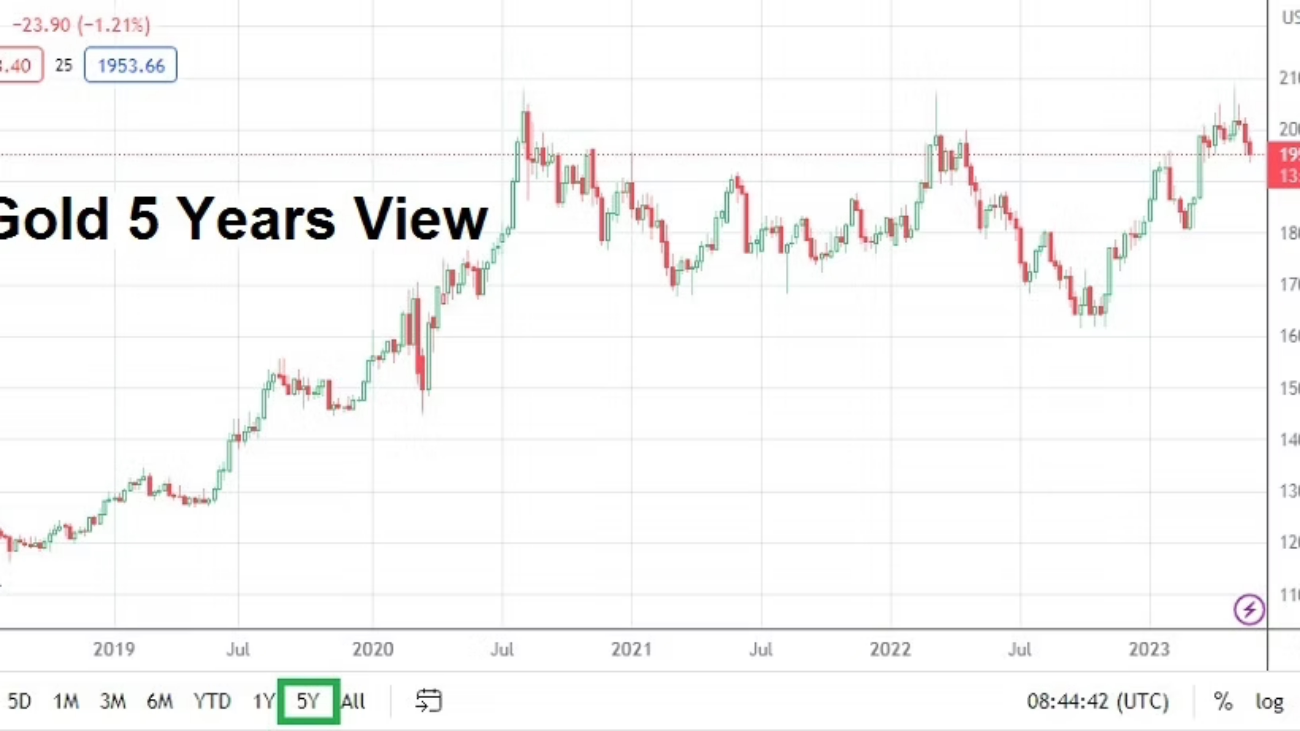
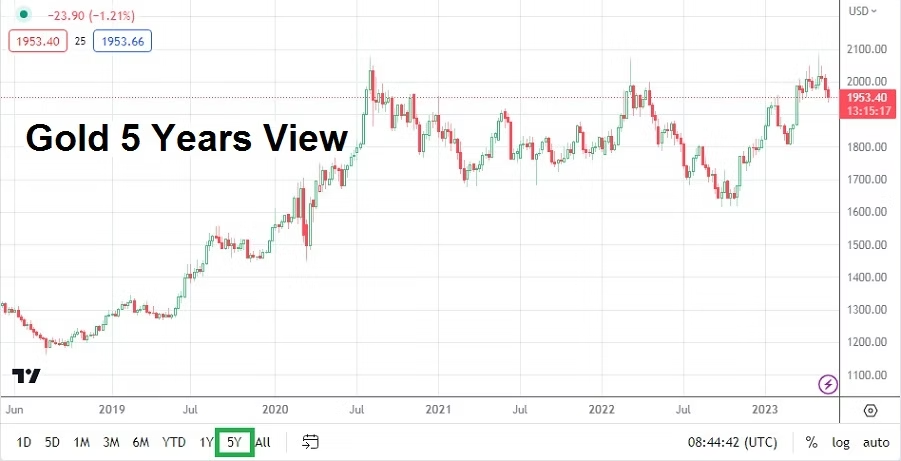
Gold Five Years Chart as of 26 May 2023

Higher taxes frequently stymie businesses and make it harder to hire employees because the expenses become too big. As an example for what the future could look like in the States turn your eyes to Chicago, where elected city leadership is considering implementing a ‘head tax’ in which businesses would need to pay a fee on each person it employs. The tax situation is getting so ridiculous in Chicago, that long time economic juggernauts like the Chicago Mercantile Exchange are grumbling and threatening to leave because of “ill-conceived” policies.

Likewise, the U.S government seemingly doesn’t understand that spending cannot be replenished by tax collection alone. Actual cuts to spending need to take place. It is called reducing the deficit. The naive will eventually be made to see the light painfully.

The Ramifications for the U.S could be Economically Untenable

U.S interest rates which have been raised the past year and a half, have affected mid and small sized banks and the amount of money the U.S government has to pay on maturing bonds because of higher borrowing costs. Fitch Ratings has recently whispered publicly they may be forced to downgrade U.S debt offerings, this if the U.S government doesn’t increase the amount of money it is legally allowed to owe. Pause for a second here, do you see the absurdity in this clown show? In other words a rating service company is OK with the debtor being allowed to ‘borrow’ more money from itself that it does not have – in order for that same debtor to be allowed to ‘promise’ it can repay its debt at a later time.

The U.S government keeps allowing debts to grow and creating entitlements as if this has no effect on inflation. Quantitative easing and stimulus packages initiated by the U.S government artificially kept the Gross Domestic Product figures looking positive and the equity markets happy for more than a handful of years. However, the proverbial ‘can’ has been kicked down the road so many times it is ready to disintegrate. The debt problem is simply being passed down to the children and grandchildren of the U.S, or so the current leadership seems to hope. But what if the debt problem explodes now? This generational problem is systematic globally, other governments practice equally bad or worse fiscal policy. Politicians do not like to walk around with empty hands.

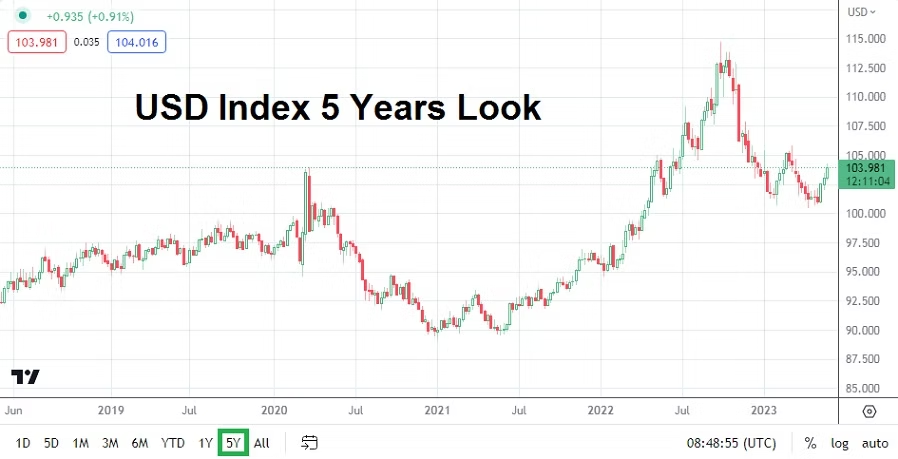
USD Index Five Years Chart as of 26 May 2023

The Clock is Ticking Loudly and Some Investors are Paying Attention

The clock is ticking in the U.S and unless they can prove expenses can be managed better, they are on a perilous road to becoming a regular nation among others, that is looked upon with scorn and derision because they cannot pay their debts. The dominance of the USD will be punished and shattered if they do not stop the nonsense. The dollar’s status as the reserve currency of the world has been slipping incrementally for a couple of decades and this will continue if the U.S government does not seize the problem and find solutions. A failure to show budgetary sanity and decrease expenditures will eventually cause something many U.S citizens do not want, relegation to the status of a ‘regular’ nation. The attitude of, “I remember when” could become a refrain heard in the U.S sooner rather than later.

The U.S is in a precarious place and sunshine in many respects is not on the horizon. Financial institutions supposedly believe the U.S debt ceiling will be taken care of in the coming days or weeks. However, a debt ceiling agreement is not the correct bandage for a broken leg, the problem is much larger. Debt should not be allowed to continuously grow. If the situation gets worse, some nations sitting on the geopolitical fence may shift their alliances depending on the ability of mutual relationships to help deliver economic stability.