WTI Crude Oil 20261104

AMT Commodities Corner: Can Blue Wave Change Momentum of Black Gold?

President Trump's Reaction to Election Defeat Matters for WTI Crude Oil

A blue Democratic Party wave has hit the U.S in the past day and early this morning as votes are still being counted and clearly show a definitive victory for the Democrats. The manner in which President Trump reacts to the election defeat will influence the price of WTI Crude Oil greatly, because his handling of the Iranian situation will now be confronted by new political obstacles. The current price of WTI Crude Oil cash is near $97.00 as of this writing.

In the past few days WTI Crude has come off of fearful highs which challenged values above $106.00 last Friday on the 30th of October. In early trading this morning the price of WTI Crude Oil cash has lowered slightly, but has begun to show slight signs of consolidation again. Some speculators may be eyeing a renewed testing ground around the $96.00 ratio with some lower momentum being seen. However, before speculators rush into a wave of additional selling they should note that WTI Crude Oil remains within a cautiously priced realm as large players clearly remain worried about potential impacts if the Iranian situation worsens.
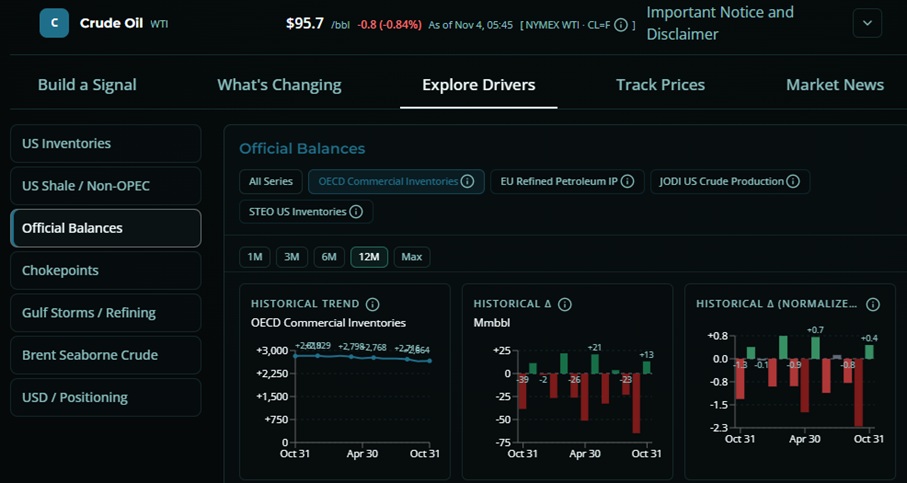
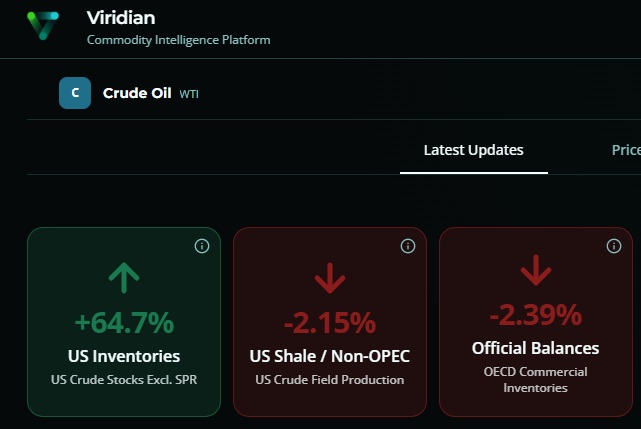
WTI Crude Oil Price and OECD Commercial Inventories via Viridian Commodity Intelligence on the 4th November 2026

And here is where things will get tricky in the near-term for retail traders as they try to weigh their perceptions and anticipate the reaction of the bigger forces in the energy market that will move values. The outcome of the U.S mid-term elections last night may cause some large players in WTI Crude Oil to feel more optimistic about a possibly quicker conclusion to the Iranian war which has been staunchly in the headlines since late February. 

However, key factors remain unanswered regarding consequences, and short-term notions must be compared to mid-term timetables. What will President Trump’s immediate reaction rhetorically be regarding ‘his’ election defeat and what he now views as viable as he presses forth against Iran? How will energy demand and inventories be influenced in the coming weeks? For instance the OECD (Organization for Economic Co-operation and Development) commercial inventories reporting via Viridian Commodities Intelligence shows supply remains low among member nations. Meaning that a perceived escalation to come in Iran could create more headwinds and sustain negative outlooks. Suggesting fears which still exist about the Iranian situation may be priced into WTI Crude Oil because supply for the OECD nations remains vulnerable.  
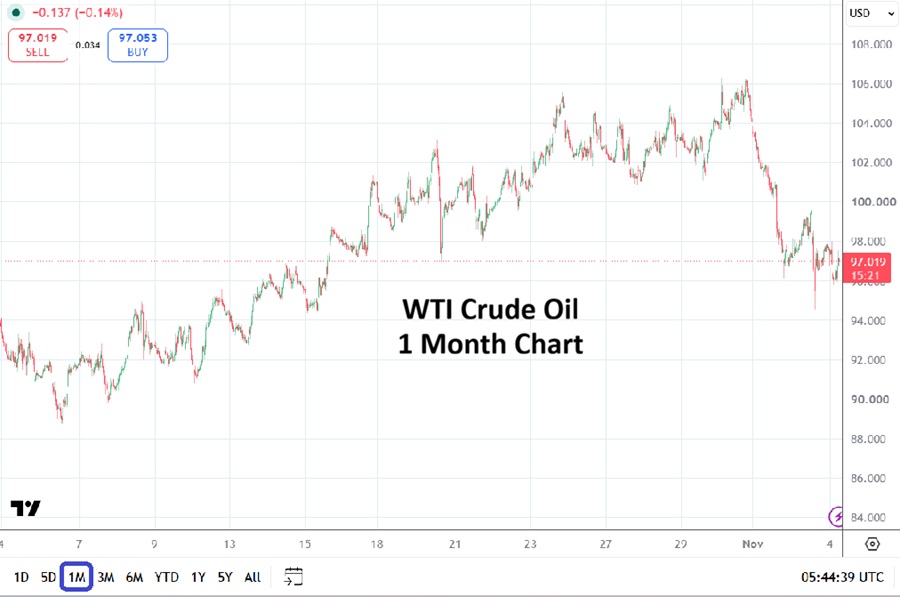
WTI Crude Oil One Month Chart as of 4th November 2026

Prices today and tomorrow should be watched carefully. A psychological test for large players in WTI Crude Oil will be factored by President Trump’s reactions to the strong Republican loss of power in the U.S House of Representatives and Senate. President Trump is still the Commander in Chief of the U.S military and his loss of Congressional backing may not stop him from escalating military conflict with Iran near-term. 

Will President Trump sound more pragmatic and put his ego to the side and offer the Democrats an olive branch? Or will the President use the time between now and the 3rd of January – when the new Congress will be sworn in constitutionally to take advantage of his lame-duck window which will start to be felt in an increasingly harsh manner. Note that the 3rd of January 2027 falls on a Sunday, so the official swearing in date for Congress may be changed by a few days depending on what agreements are made.

President Trump is on the clock and in essence the Iranian war is too. The price of WTI Crude Oil which has been a swift speculative playground since February of this year is set for more dynamic price action. Short and near-term traders who want to ride the momentum of larger players in WTI Crude Oil should expect plenty of velocity the remainder of this week. 
Copy and paste the text from AMT that you want to share

Share:
Gold forecast 20261028

AMT Commodities Corner: The Fed, Energy Inflation, Forex, Gold, Politics and Coffee

The Need for Confident Sounding Policy From Fed Chair Kevin Warsh

Forgive me please if the following appears to be a vacuum trying to suck a complex web of risk events and their effects on the speculative nature of commodities and Forex. Yet, the state of the world means that technical and fundamentals are clashing significantly and it would be foolish to make believe influences do not exists. Today the Federal Reserve will deliver its FOMC Statement (and the word statement is emphasized because no interest rate hike is expected). 

However, considering the surprise delivered from Brazil via its election results on Sunday and reactions in the Ibovespa and USD/BRL afterwards, it might be wise too brace for the potential of additional dynamics. But I do not want to digress, because price action and velocity are natural parts of the financial world and in fact act as a barometer regarding how economic and political outlooks are converging.

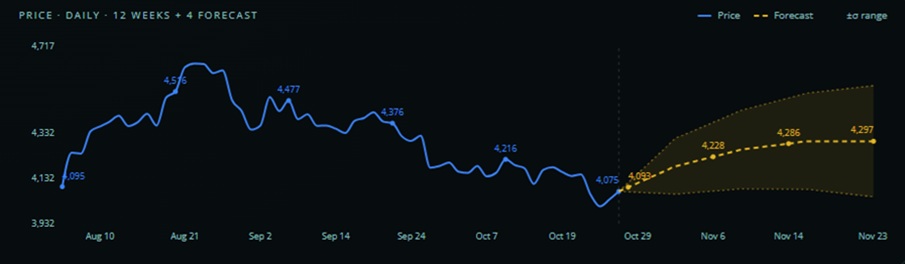
Gold Price as of 28th October and Viridian Commodity Forecast

Fed Chairman Kevin Warsh remains under a bright light. He didn’t exactly take the helm of the U.S central bank in the most tranquil of times. Thus, it is difficult to blame him quite yet for the mess and quandary the Federal Reserve finds itself trying to navigate. Energy costs remain high and will so for the foreseeable future. The Iran war looks a long way from being solved in the coming month (‘months’ may be the more appropriate word choice), although saber-rattling and outright military escalation may in fact be coming sooner rather than later. This depending on President Trump and his loud threats and ability to follow up on his rhetoric and negotiation methods, and or the ability of the Iranian and all other factions converging on a compromise (which doesn’t looking forthcoming). 

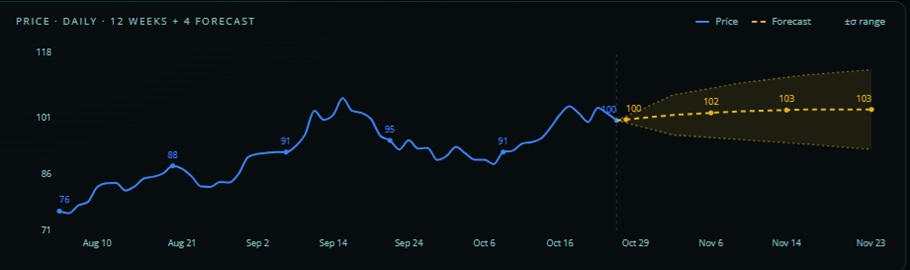
Meaning if WTI Crude Oil remains at its current price levels over $100.00 consistently, this as war drums bang it will not be a surprise. According to Viridian Commodity Intelligence based on shipping and supply and other logical predictions which factor in higher prices as as caution reigns, support levels in the Crude Oil sector will likely remain durable until an end game is reached with results large players feel comfortable within – including nations – and good luck trying to achieve this type of solution folks. Which brings us back to Fed Chairman Kevin Warsh and other FOMC officials who understand inflation is being caused by geo-political upheavals creating higher energy costs. There is little the Fed can do to fight expensive fuel costs and the effect on logistics, manufacturing and agriculture remains a losing game until a conclusion of the Iranian quagmire is attained. 

WTI Crude Oil Price as of 28th October and Viridian Forecast

Thus, even as the Fed has shown no signs of raising interest rates today, the next FOMC decision on the 9th of December will remain under the same storm clouds. The energy situation is not likely to have been fixed by then. Warsh must deliver a determined policy stance and tell the public (and investors) that he remains confident in the U.S economy as it faces inflation caused by energy prices; the economy may be challenged in the mid-term but no additional interest rate hikes are planned. Except for the problem, Kevin Warsh has not expressed this viewpoint forcefully yet – creating USD centric strength in the meantime.

Gold Recovery Coming Or Wishful Biased Thoughts?

A bold Federal Reserve stance would potentially help ease U.S Treasury yields too. The prevailing fragility in equity indices may also press more investors into U.S bonds which would supposedly help yields come down a bit too. And this brings up the specter of gold which is producing a battle for value near the $4,050.00 mark as of this writing and has gone below $4,000.00 recently. Even in the wake of global risk events the price of the precious metal has looked strained (nixing notions of a safe haven momentarily). USD centric price action has created headwinds against gold, along with the elevated U.S Treasury yields. However, support levels have looked reasonably stable near $4000,00 and the price of the commodity appears undervalued from my (possibly gold bug) eyes. 

USD/JPY Implications and Gameplan

Forex will remain tricky short and near-term, particularly for the USD/JPY, as the the Fed makes its rhetoric stance today and the Bank of Japan speaks on Friday. Japanese Yen traders may have taken advantage of oversold conditions which appeared late last week, but retail traders should note that volatility will remain a steady diet as large players speculate and seek additional momentum waves over the next two and half days.

The higher realms of the USD/JPY are not likely to disappear anytime soon. However, retail traders need to be wary of actual interventions from the Bank of Japan in order to counter blind buying of the currency pair by large players and financial houses based on their poor outlooks for the Japanese Yen based on their lack of confidence in BoJ policy.

Coffee Trading and the USD/BRL

From the commodity standpoint both WTI Crude Oil and gold have definite causation and in some sense their trading realms feel as if they are known for speculators who have the ability to tackle risk taking with solid tactics. The same cannot be said exactly for Coffee, which could face complications and shock waves potentially in the coming days and weeks as growers and producers, wholesalers and their large buyers have to deal with the potential of a weakened Brazilian Real. 

The BRL was trading near 5.0500 in a relatively calm and bearish trend within the USD/BRL into last Friday and all seemed like it would remain tranquil after the weekend. And then came the early Monday surprise (for many – including myself) via results from the Brazilian election in which Lula da Silva won another term as President. The USD/BRL before Forex trading begins today is near 5.3500. Coffee traders may be bracing for some shockwaves if the value of the currency pair doesn’t recover to lower ground in the coming days and week. No Brazil is not the sole producer of Robusta (and Conilon) and Arabica Coffee, but its influence in markets remains important – even if solid supply is known to exists in other global locales.

Copy and paste the text from AMT that you want to share

Share:
CrudeOil 20261021

AMT Commodities Corner: WTI Crude Oil’s $100.00 Cautious Price Realm

Large Players and Retail Traders Awaiting More Noise in WTI Crude Oil

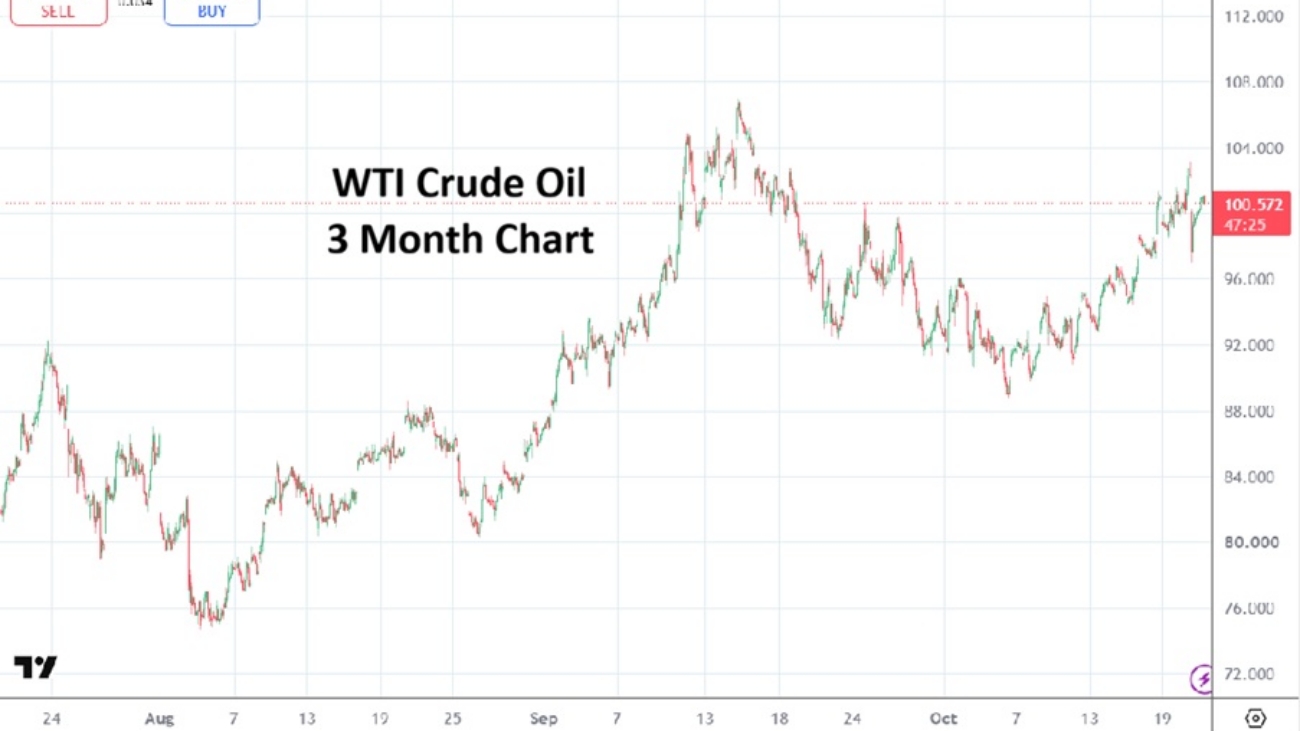
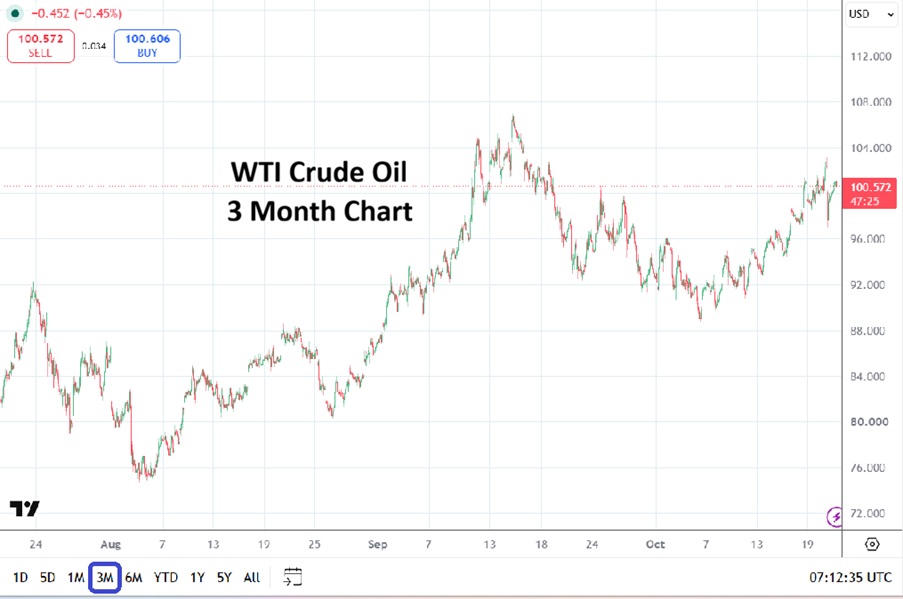
WTI Crude Oil continues to float around the $100.00 mark via cash as a plethora of information and rumors converge into noise that large players and retail traders must distinguish between. The price of the commodity remains seemingly frozen in a higher range that has become almost tight. An air of cautiousness surrounds WTI Crude Oil as nearly all participants brace for additional impetus which will shake value. Near-term wagering considerations appear to be leaning into the potential of negative developments which could ignite more upwards trajectory.

WTI Crude Oil Three Month Chart as of 21st October

Inventory and Transits Confronted by Potential of Military Resumption

While there is evidence of solid supply coming out of the Hormuz Strait, nervousness surrounding the almost promise like rhetoric of additional military action in the Middle East has the WTI Crude Oil market on a nervous edge. U.S supply of WTI Crude Oil is showing better inventory numbers, however the OECD Commercial Inventory numbers appear to be faltering via information gathered from Viridian Commodities Intelligence.

OECD Commercial Inventories Data via the Viridian Commodity Intelligence on the 21st October

This highlights the assumption that logistics remain challenging to Europe and Asia and are creating higher energy costs globally as ordering remains concerned about delivery. Besides the inventory worries being felt, the anxiousness from the overwhelming shadow being cast over the Middle East regarding a resumption of intense military conflict is certainly supporting durable higher prices. However, the rather well-traversed $100.00 ratio in WTI Crude Oil remains difficult to pursue regarding short-term momentum technically for speculators who are simply trying to profit on a chosen direction.

What If Scenarios and Rhetoric and Threats From the U.S White House

Intraday pricing remains dynamic and retail traders are vulnerable to actions being generated by the constant whirlwinds of behavioral sentiment ambushing WTI Crude Oil. The current price in the cash market near the $100.550 realm must be given respect. While some traders may look at the current price and believe resistance will kick in and push values lower, rhetoric coming from the U.S White House continues to threaten that more military action is being planned for against Iran. Whether this is a negotiating tactic of President Trump to try and make the Iranian leadership capitulate can be debated until we are all blue in the face.

Furthermore, the emergence of Saudi Arabia as a hotspot in the Middle Eastern conflict has grown significantly. The military attacks from the Houthis of Yemen towards and into Saudi Arabia has certainly added to the upwards price in WTI Crude Oil as supply nervousness has turned from thoughts about a potential hazard into an actual realization regarding the consequences of escalation. As WTI traverses its higher values, traders need to understand the sticky inflated realm is factoring a ‘what if’ scenario.

Programed Algo Trading Versus Sentiment Shifts in WTI Crude Oil

With WTI Crude Oil traversing above $100.000 steadily, retail traders who have the ability to react quickly via their ordering skills could take advantage of quick swings in prices technically as support and resistance levels are tested. Yet, the danger of using a stop loss order in WTI Crude Oil has to be thought out wisely, because even as sentiment drives the market it is still being traded by algo systems geared towards values that coders target as saturated levels where they believe orders are congested.

In other words, algo systems will aim for targets until their programed coding has been achieved per momentum shifts. Yesterday’s high above $103.000 was met by a swift reversal lower which took WTI Crude Oil close to $97.000 before kickstarting upwards again. The lower prices were met by a wave of influencers it should be pointed out that exclaimed good news had overtaken the nervous sentiment which has been dominating the energy sector. However, sustained optimism has been and remains in short supply. The positive sounding influencers’ social media posts quickly disappeared.

Coming Elections and Lack of Optimistic Sunshine

Peace could come in our time. Yes, things could go quiet and get serene. However, betting on the emergence of optimistic sunshine shining brightly on the WTI Crude Oil market in the near-term is a far-flung bet. The U.S mid-term elections are on the 3rd of November. 

There should be little doubt in speculators mindsets that rhetoric towards Iran via the U.S White House is going to continue the next week and a half. Threats about the possibility of sudden military action taking place now remains part of the mix too, but because of the U.S election (and Israel’s vote on the 27th of October) it seems unlikely there will be an escalation near-term unless Iran strikes first.

Ultra-Cautious Highs and Fast Moving Price Differentials

Wagering on WTI Crude Oil in the short and near-term should be done with solid emotional fortitude. The commodity continues to move quickly. Price differentials of 5.00 USD in a single day have become almost regular and this means leverage needs to remain conservative, particularly by traders who do not want to use nearby stop losses so they are not kicked out of positions before magic strikes. WTI Crude Oil is going to remain volatile and likely going to sustain its known higher price realm which is ultra-cautious.

Copy and paste the text from AMT that you want to share

Share:
Singapore Dollar 20260911

Conflicted Trading: Singapore Dollar and Federal Reserve Considerations

USD/SGD: Conflicting Desires From the Federal Reserve and Financial Institutions

The world of Forex is about to grow murkier in the coming days as shadows loom over financial institutions regarding their near-term decisions as they try to gain clarity regarding what appears to be confused and concerning mid-term outlooks for speculators and investors.

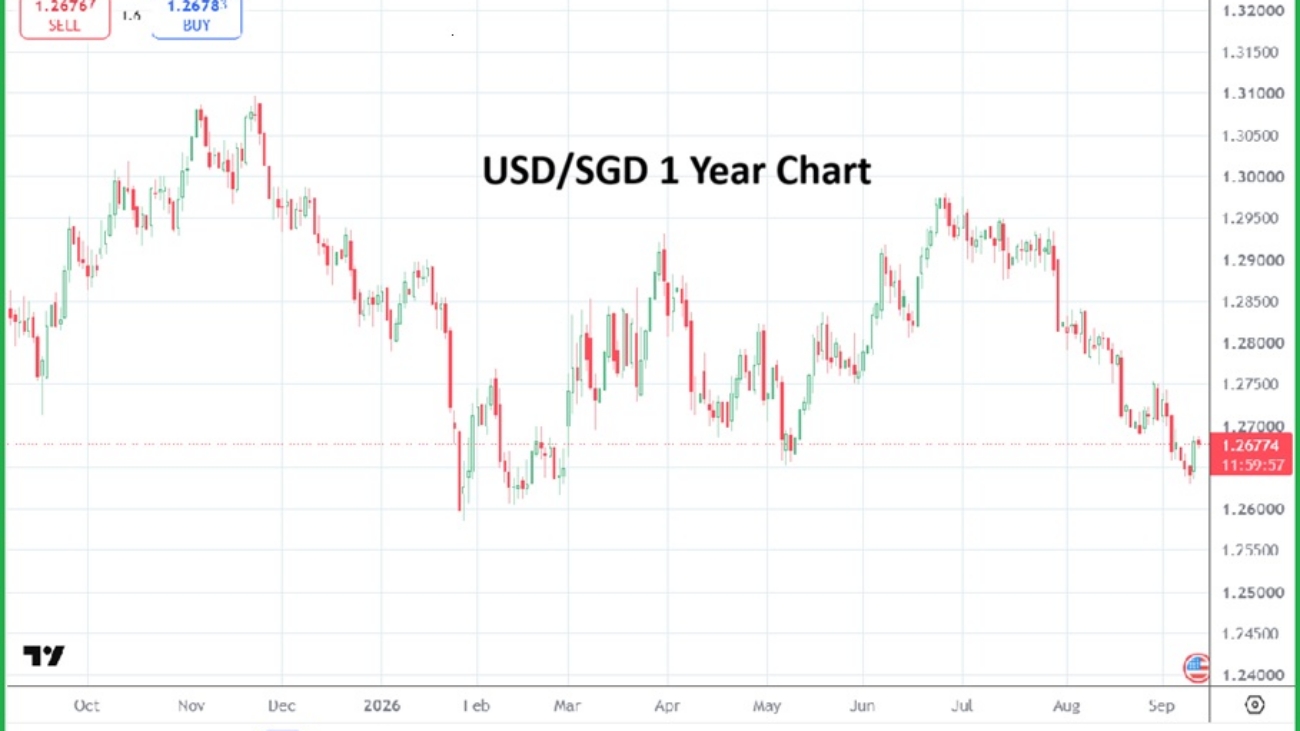
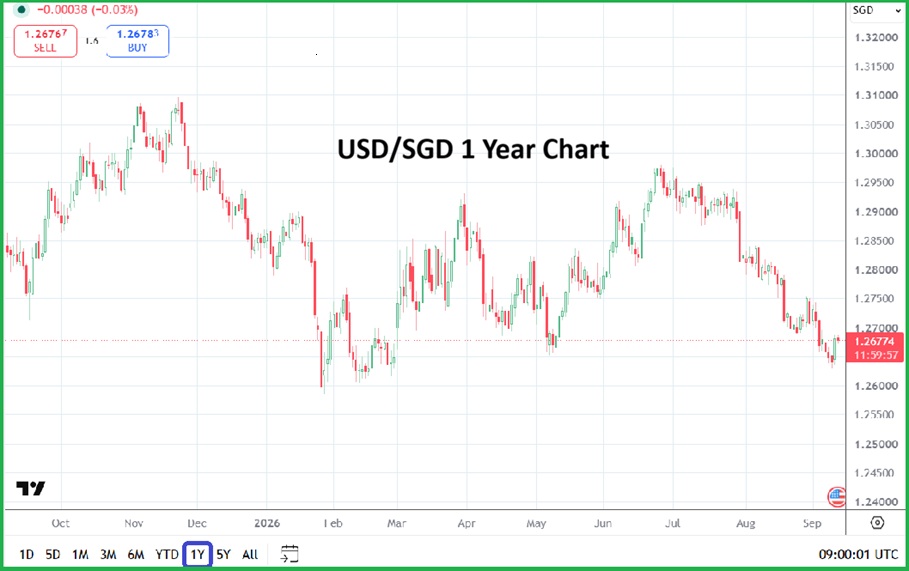
The USD/SGD is traversing near the 1.26776 vicinity as of this writing. The currency pair is trading within a long-term historical lower realm in which the 1.26000 level was challenged from mid-January until the first week of this year. This past Wednesday the USD/SGD traded near the 1.26280 mark. Previous to the current ratios and lows seen in early 2026, the Singapore Dollar traded around the 1.24475 level in June of 2014. The USD/SGD challenged 1.20000 level in early August of 2011 – yes, 25 years ago.

USD/SGD One Year Chart as of 11th September 2026

Here Come The Risk Events: Inflation, BRICS, Iranian War and the U.S Fed

Now that we have alerted technical traders about the long-term depths of the USD/SGD being flirted upon once again, it needs to be pointed out that a parade of risk events are standing in front of global Forex today and next week. First up today is the U.S Consumer Price Index inflation data. This weekend the 18th BRICS Summit will be conducted in New Delhi, India as geopolitics and trade talks will get plenty of attention. Next Wednesday the U.S Federal Reserve will issue its FOMC Statement and Federal Funds Rate decision – which may produce a climax for theatrical trading in the coming week.

While it feels almost needless to say, the Iranian War has not relented. The price of WTI Crude Oil is around $100.65 per the cash market. The sustained highs achieved in the past couple of days do not show many signs of suddenly relenting. WTI Crude Oil was around $86.50 around the 1st of September, the USD/SGD was near 1.27200. To create a bit more alarm regarding the risk horizon going into this weekend the U.S 10-Y Treasury yields lurk around 4.945%, the 30-Y Bond yields are close to 5.355% – none of this sits well with the U.S White House, nor Treasury. In the midst of this investment noise, the price of Gold is close to $4,345.00, which still looks cheap considering current circumstances.

Crude Oil supplies remain anxious globally and inflation is certainly causing angst for citizens and a variety of government policies. Singapore will report August inflation data on the 23rd of September, July’s inflation data came in around 2%, with energy costs being the culprit for higher prices in many cases. The USD/SGD was near 1.29500 around the 14th of July. Prices for energy have not gone lower and the likelihood of them turning cheaper soon remains unlikely.

USD/SGD Correlations and Current Sentiment

USD centric action since the first week of July has showed weakness against many major currencies including the Singapore Dollar. Let’s put the USD/JPY to the side because of the intervention via the Bank of Japan and input of the U.S Treasury and Federal Reserve collectively. The USD/SGD is correlating to the broad market. Risk averse decisions have been prevalent in stock markets. The U.S major indices while remaining near higher altitudes are showing cautious behavioral sentiment.

The USD/SGD certainly went lower in January and early February of this year, but this occurred as doses of optimism were filling the air and in the absence of the Iranian war. Yet, the downturn in the USD/SGD has been formidable since highs around 1.29900 were seen on the 24th of June. In late November of 2025 the currency pair flirted with the 1.31000 level. 

Federal Reserve and Treasury Battle with Reality

The U.S Treasury and Federal Reserve will not tell the U.S public that the USD loss of value is an invisible tax. Nor does President Trump want Crude Oil prices to remain high because Americans are certain to get angry about more expensive gasoline prices, particularly if they remain elevated after being promised costs will come down. Reality may prove painful for all parties in the coming months.

Which leaves us with the Federal Reserve’s interest rate decision this coming Wednesday and how it decides to decode the current anxious inflation concerns. Will the Fed try to explain that they still believe – due to the U.S intended Iranian war policy and its belief they will win in the coming months – that the Federal Funds Rate remains situated properly at around 3.50-3.75%? Delivering the important question regarding what exactly has been traded into the USD/SGD. Have financial institutions traded an interest rate increase into the currency pair already?

It certainly feels like long-term investors who believe the Federal Reserve will have to raise interest rates to fight against stubborn inflation have refused to buy Treasuries cheaply and thus forced yields upwards the past months. So what does the Federal Reserve do as an ‘independent’ institution knowing that U.S White House and Treasury desires may not match policy coordination? It is the 40+ trillion USD debt question.

Will Fed Chair Kevin Warsh actually dare to raise the current borrowing rates and say that it is quite possible the rate can be lowered again in the mid-term? Or does he admit that as feared by many financial institutions that two to three interest rate hikes will be needed per old school economic thoughts, which may actually make the current circumstances of average Americans much worse with higher borrowing costs created across the board as a side effect?

Fed Chairman Kevin Warsh has not exactly proven efficient while addressing journalists and Fed watchers quite yet. His speech this coming Wednesday on the 16th will be crucial for the broad markets. The USD/SGD is trading within its lower realm, but durable support technically does lurk. Jittery Forex trading awaits for all.

Will the Federal Reserve be bold enough to actually NOT increase the current Federal Funds Rate and talk about the risks to the U.S economy because of potential recession concerns; this as the mid-term elections lurk in November and President Trump watches and doesn’t want talk about a slowdown in the U.S economy heard from what he considers his administration. However, the Fed is independent and can do as it wants in theory.

At this point the Federal Reserve and Treasury should make sure the drama is coordinated because many eyes will be focused on the coming show. And the end result over the near-term will be volatile Forex and a USD/SGD that reacts with price velocity depending on the immediate reactions from financial institutions as they judge the path ahead which will likely remain unclear. 

Copy and paste the text from AMT that you want to share

Share:
AMT Top 10

AMT Top Ten Miscellaneous Post-Labor Day Notes and Tantrums

Higher Hopes and False Victories Welcome Nervous Investors Back After the Holiday

10. We Thought You Won – Part One: Apologies to Western Michigan University who had a victory stolen from them on Saturday in Ann Arbor. The Big Ten should not only be embarrassed, but they should be investigated. Big time college football suffered a black eye this past weekend. Folks wondering why WMU is not making a bigger stink regarding the added time and decision to repeat the last play of the game which ultimately cost WMU the contest against the Wolverines, should understand they will not. Because WMU needs to play against the University of Michigan to receive big pay days, which often are hard to find. WMU received 1.5 million USD for the game on Saturday and are scheduled to play against Big Blue again on the 1st of September, 2029.

9. Not Dead Yet: Bitcoin is trading near $78,800. After flirting with lows around the $58,100 vicinity in late June, BTC/USD has created momentum upwards. However, the elevator still can go down. Strategy via MSTR is near $142.00 per share. Michael Saylor survives and influencers are boisterous and breathing a bit easier – for now.

AMT Top 10 Miscellaneous Post-Labor Day Notes and Tantrums, 8th of Sept. 2026

8. Bad Brains: Tucker Carlson forayed into another absurd path when his recent guest, Jess Elofson, declared that Algebra is not needed and those who use it are ‘good little goy-slaves’. Carlson averages almost 57 million views to his podcast and social media outlets on a weekly basis.

7. NVDA: Nvidia is priced near $230.00 and the Nasdaq 100 finished Friday’s trading around 29,544. The Nasdaq 100 traded above 30,700 on the 3rd of June. Nvidia’s high touched the $236.00 level in the middle of May. Summer saw choppy reversals in the Nasdaq and S&P and values while elevated have run into cautious headwinds. Now that Labor Day is complete and summer ambivalence will be dusted off, where will the stock markets go? Iran lingers, inflation via higher energy costs looks problematic, mid-term election worries, AI infrastructure expenditures are concerning and bond yields all weigh on investment mindsets. Additional risk events are coming quickly down the road, Consumer Price Index data will be released this Friday and the Fed’s FOMC interest rate decision is next Wednesday on the 16th.

6. Reversal City: The USD/JPY is traversing below the 154.000 mark currently. The Bank of Japan and the U.S Treasury/Fed interaction regarding intervention and rhetoric about protecting the Yen’s value has apparently scared off buyers of the currency pair for the moment. Will bullish speculators now stay away from the USD/JPY for good? Doubtful.

5. Rhetoric Alone: Fed Chairman Kevin Warsh has found it difficult to convince the investment community that his lack of interest rate guidance is a good idea. Instead, the lack of clarity delivered from the Fed has led to higher Treasury yields. While Scott Bessent tried to fight the higher yields a couple of weeks ago, Treasuries are still smoldering and threaten to become a more dangerous fire. Investors and traders want more tangible proof that interest rate and monetary policies are structurally solid.

4. September 11th: This Friday will mark the 25th anniversary of terrorists attacks on the World Trade Center, Pentagon, and plane crash near Shanksville, Pennsylvania. 

3. Upwards: WTI Crude Oil price have shown plenty of nervous behavioral sentiment higher this past week. WTI Crude Oil is now over $94.00 in the cash market. Reports indicate that shipping via the Hormuz Strait has decreased again, this as military escalation appears ready to potentially increase as a reportedly desperate IRGC led Iran and frustrated U.S White House collide.

2. Post-Summer Guillotine: Danger lurks over the global marketplace, this as risk analysts, traders and investors appear to be converging into the same cautious direction. Forex, stock markets, bond yields, and key commodities are flashing bright yellow waring slow signals. Contrarian investors and speculators may be enjoying the current financial landscape. Value plays and volatile trading opportunities may feel appealing, but risk management is going to prove useful.

1. We Thought You Won – Part Two: After saying over the past handful of months that Iran had lost the war and just hadn’t surrendered yet, via Truth Social yesterday President Trump wrote that “when we WIN the war with Iran” that gasoline prices in the U.S would plummet. While observers are used to President Trump’s seemingly infinite capability to utter contradictory statements, yesterday’s appraisal of the current situation in the Middle East may be realistic, but it can also be observed as disquieting. There appears to be more trouble down the road.

Copy and paste the text from AMT that you want to share

Share:
WTI CrudeOila 20260902

Bad Timing for President Trump May Equal Good Trading Opportunities

You Don't Have to be a Buyer in the Current Marketplace in Order to Profit

There are moments when the markets are calm and then there are these times. It is beginning to look like increasingly bad timing for President Trump and his administration’s hope to keep WTI Crude Oil prices in check and silence the chatter about inflation. 

Instead of a de-escalation based on tranquil conditions in the Middle East, investors were smacked in the face again last night. However, while this may be a bad time to be an investor unless they are looking for value plays, traders may actually have more opportunities in the current market circumstances as long as they manage their risks appropriately.

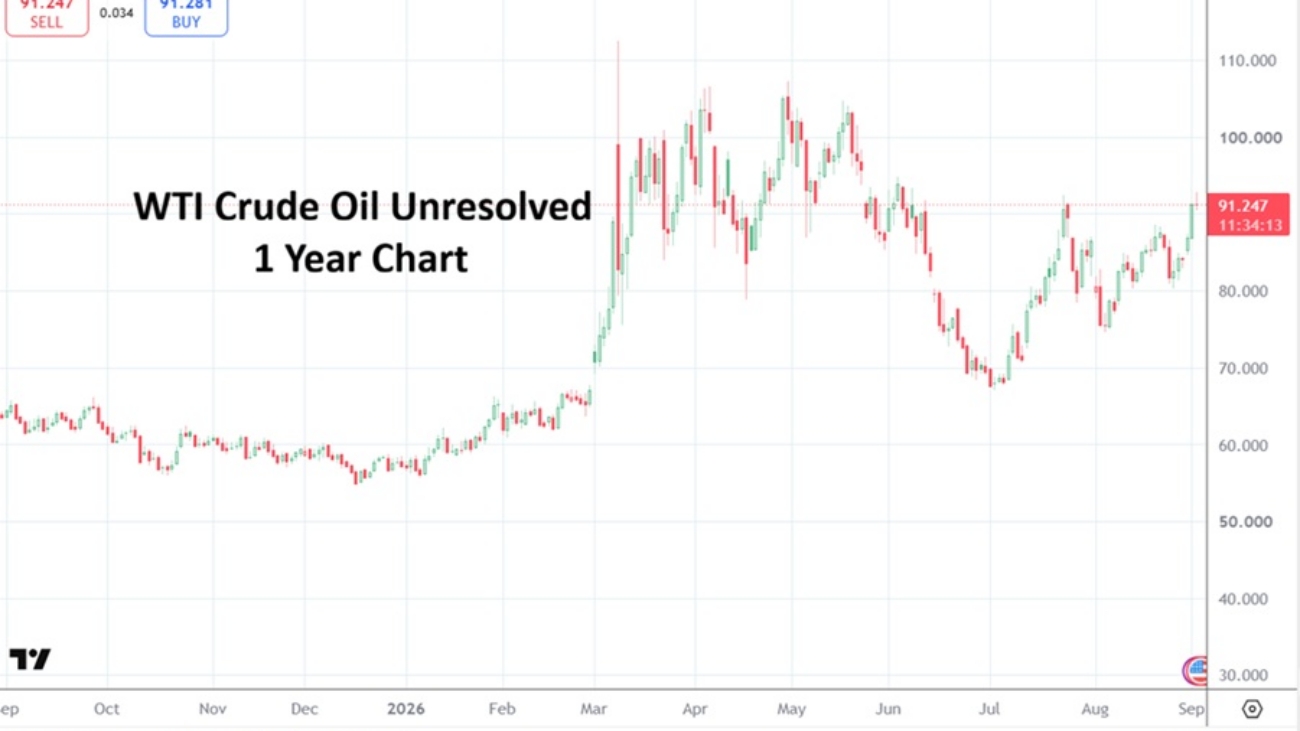
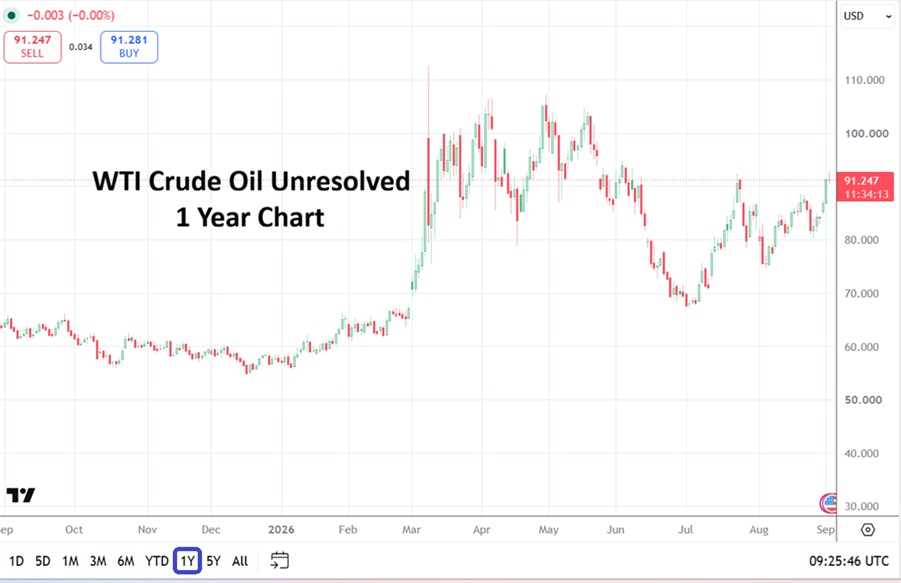
WTI Crude Oil jumped higher last night and while the commodity has outdone itself since late February regarding price velocity, last night’s performance likely felt volatile even for experienced large players who have solid intel on the ground regarding Middle East shipping and supplies. The energy sector has been more akin to the soft commodities regarding reversals the past handful of months, Coffee, Cocoa and Crude Oil have offered colorful price ranges. But that is not how WTI Crude Oil is supposed to work.

WTI Crude Oil 1 Year Chart as of 2 September 2026

Inflation concerns will not go away quietly as long as WTI Crude Oil remains highly valued. Fed Chairman Kevin Warsh may in fact be putting on a show for the public – that he is his own man and can express his concerns regarding inflation no matter what President Trump thinks – when in fact he may simply be laying a framework to work in tandem with Treasury Secretary Scott Bessent and lower interest rates in order to create less pressure on Treasury yields. However, this planned (or conspiratorial) thinking may be hard to actually produce in reality on the 16th of September when the Fed’s FOMC has to show its cards once again. As long as WTI Crude Oil remains above $90.00, “Houston we have a problem,” murmurs may be heard loud and clear.

If Treasury yields remain tilted upwards because investors are refusing to buy them at cheaper rates, it will start to infect the Nasdaq 100, S&P 500 and the Dow 30 more and create cautionary skirmishes which may produce deeper downsides in stock markets.

Iran wouldn’t want to cause President Trump problems, correct? Why would Iran want higher Crude Oil prices to ensnarl President Trump into a morass of political battles in the U.S and make life difficult for the Republicans during the mid-term elections? Does the IRGC have folks who understand the dynamics of U.S politics? Yes they do and it is a 100% certainty they would like to be a pain in President’s Trump’s aspirations.

We are left to deal with the ever-changing events that seem to be quite good at repeating themselves. Financial institutions are not only nervous about their mid-term outlooks, they are wary about the near-term too. Forex, commodities, bond yields, Wall Street and other global stock markets will struggle to make solid gains until clarity develops.

What will clarity look like? It will be optimistic banter in which rhetoric from different mouths and geographies is actually believed by the adoring crowds. Results do not have to be good, but outcomes need to be able to be forecasted and planned, allowing investors to seek their cash preservation and fortunes in a variety of assets (and show their overseers that they used adequate risk management in case things go wrong). 

Gold has done well recently, although it seems to have hit some resistance lately. However, if inflation tranquility is not achieved and if President Trump’s circumstances grow more dire, the precious metal will continue to offer speculative plays upwards. 

Investors are restless. Making 6 to 8% profits a year looks rather boring after plenty of solid years of upwards traction. Folks aren’t used to powerful financial storms and they forget about lingering troubled periods in which simple profits can prove comforting as broad markets struggle. 

Day trading is dangerous. However, those with solid risk taking tactics and those who aren’t married to the notion that markets only go up, but are willing to bet that markets (assets of many classes) can go lower too – now have an opportunity to test their technical perspectives and understanding of behavioral sentiment. 

Realistic targets using take profits and making sure stop loss protection still allows for a trade to move until goals are met is important when volatility is ripping price realms to shreds. Forex instability appears to be increasing as USD centric attitudes remain convoluted. Does Fed Chair Kevin Warsh have enough power to fight against an interest rate hike on the 16th of September, will the price of WTI Crude Oil cooperate, will President Trump’s wishful thinking about Iran come true? Results may not match what is wanted by the guardians of the marketplace. Contrarians may see the current market and global political situation as a time to seek value and help inflate markets, but they might be spitting into the wind. 

Maybe the AI concerns about infrastructure costs and corporate cash needs are baseless. Perhaps the deficit being created by the U.S and many other nations is simply idle chatter by risk analysts who are too nervous. Maybe there is a secret pill for all of us to become optimistic about all things.

It is a good time for traders to remain realistic and target exaggerated price movements in assets that offer opportunities in distressed offerings. You do not have to buy the marketplace to profit ladies and gentlemen.

Copy and paste the text from AMT that you want to share

Share:
Singapore Dollar 20260818

Forex: Compressed Tight Realms Signaling Nervous Reactions

Sentiment Storms as Financial Institutions Remain Unsure about Outlooks

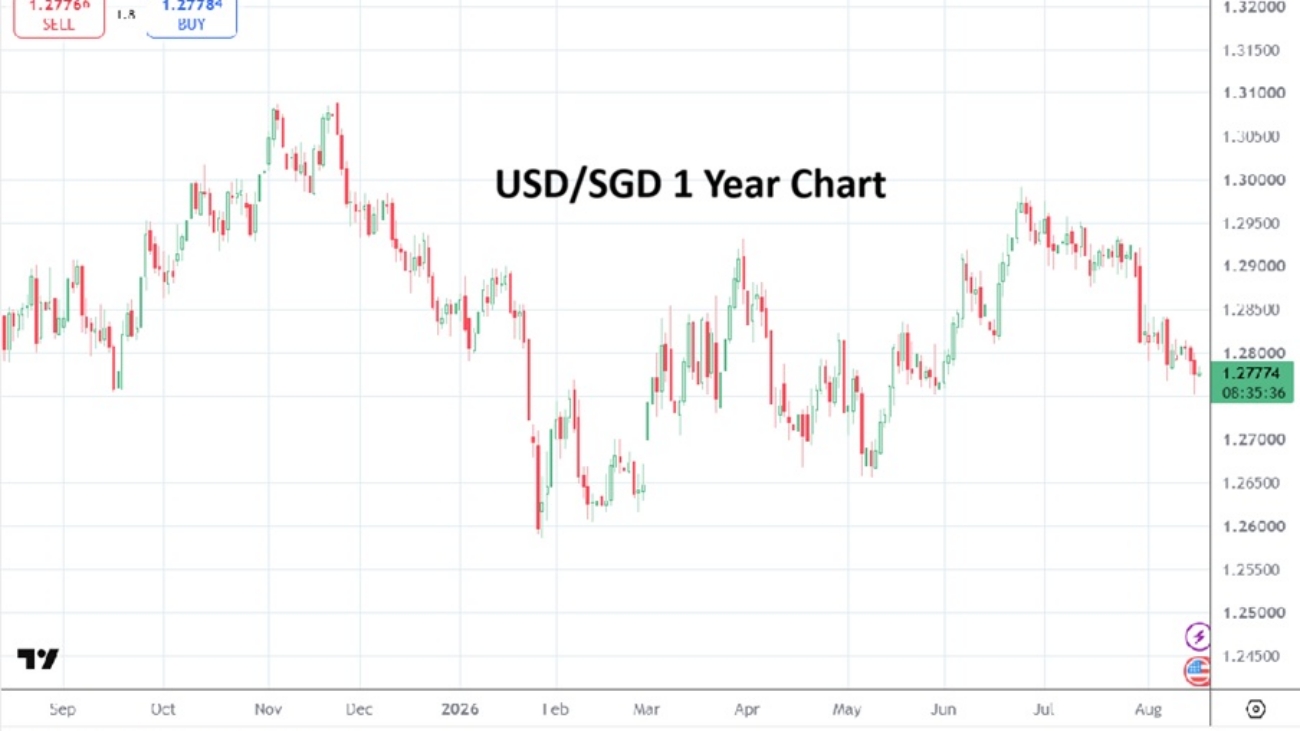
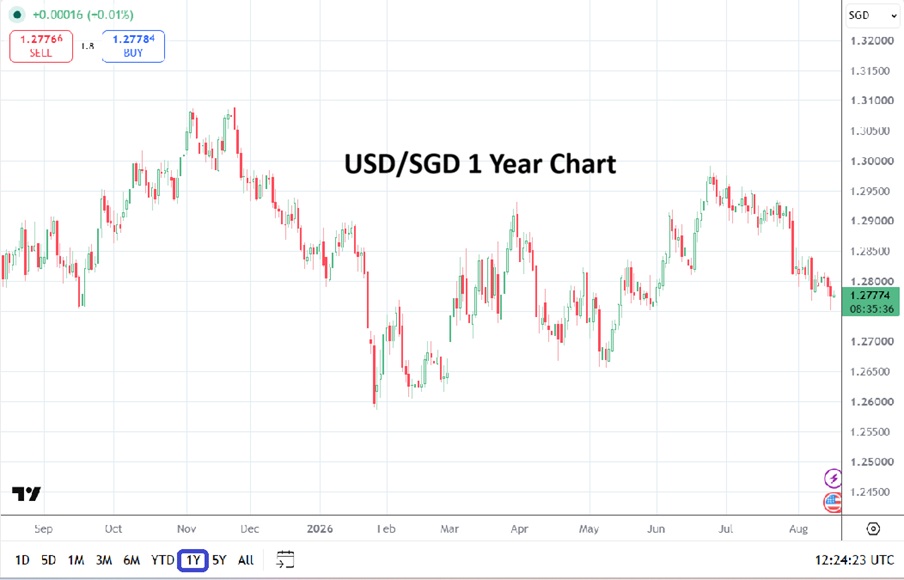
Price action in the USD/SGD has continued to demonstrate a rather significant turn downwards since the last week of June. The price of the currency pair is near 1.27800 as of this writing and is traversing near values seen the 1st of June and towards the end of the first week of March. Importantly, the USD/SGD has also seen recent lower depths and was below 1.27000 in the second week of May.

The USD/SGD traversed deeper ratios in late January when the 1.26000 vicinity was challenged and these levels were sustained until the middle of February. On the 26th of February the USD/SGD was near the 1.26500 mark. Now that the above numbers have been established, let’s discuss why this is potentially important for Forex traders as developing trends surface.

The past few years of trading have seen a compression of Forex deviations, in other words the FX market has grown more tame. However, the Bank of International Settlements (BIS) now reports that over 9.6 trillion USD in value is traded daily. This is a stark increase compared to 2022 when Forex saw an average daily market around 7.5 trillion – meaning there has been a 28% increase over the past four years.

USD/SGD One Year Chart as of 18 August 2026

The scope of volume is presented not to cause fear, but to show Forex traders what is at stake and the size of the marketplace and its potential for sudden jolts of volatility if it is established. 

Turning our attention to the new Fed Chairman Kevin Warsh and his preference to not give concrete forward guidance is important. U.S Treasury yields are dangerously high (the 30-Y yield is near 5.31%), and the military conflict between Iran and the U.S  continues to fester. Threats remain on the horizon which need observation, insights that prove correct regarding how these bits of information will influence the Fed Chair and the impact on the USD could prove significant for financial institutions.

Large players have reasons to be critical about a lack of clarity and this might spark more choppiness in Forex – even though value realms are said to be in a compressed state. This opens the door for technical traders who may have a better gauge on existing behavioral sentiment of the Forex markets compared to fundamental traders who have too many tea leaves to interpret which are moving rapidly as the cup gets shifted. Technical traders may have a good sense of where algo trading is directing its velocity per current Forex sentiment. 

While some analysts make a case for an increase to the Federal Funds Rate because of inflation concerns, what happens if they are wrong? And what if large players are now discounting their initial fears regarding higher interest rates and are actually starting to position themselves for the Fed Funds Rate to remain the same or be lowered in the mid-term? Is this one of the reasons why the USD has become weaker recently?

What if the new Fed Chairman Kevin Warsh proves stronger than people believe and has the ability to talk lower interest rates into reality? The U.S Treasury faces a huge and expensive task trying to pay off the yields of the high flying 10-Year and 30-Year bonds. What if Treasury Secretary Scott Bessent who has a solid relationship with Fed Chair Warsh proves influential? Read AMT’s Charles Najjar’s article on his thoughts about why the Fed should aim for a 2% Fund Rate: https://www.angrymetatraders.com/why-the-us-fed-should-lower-interest-rates-to-2/

Yes, the Middle East situation remains troubling from a mid-term economic viewpoint regarding the implications on WTI Crude Oil prices and ancillary energy costs globally. Inflation must be battled, but is raising the Federal Funds Rate going to help decrease the cost of energy or lessen its demand? Mostly likely no.

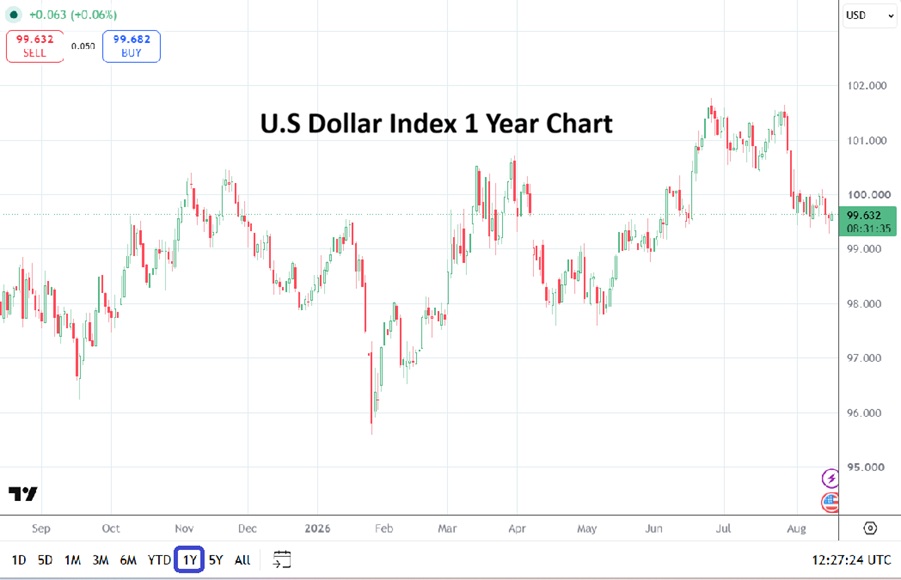
U.S Dollar Index One Year Chart as of 18 August 2026

The gold market has started to show signs of price velocity the past couple of weeks. The precious metal is trading near $4,395.00 as of this writing. Investors with a long-term window and troubled perspectives about the health of the USD have plenty of reasons to be more comfortable holding gold compared to staying in cash. 

U.S equities have been doing well via indices, but nervous shadows are hovering (maybe they always are). And this is why diversification is always important via long-term investment. Equities, bonds, gold and a small proportion for speculative purposes – this for those who want to try and increase their wealth while maintaining a status quo regarding preservation of wealth.

However, from a speculative standpoint, the Forex market is starting to show signs of alarming behavior, some may even call it a lack of correlation caused by storms forming. Yes, we know the USD/JPY is within its own environment as the BoJ and U.S Treasury/Fed play tag team trying to scare folks away from buying the currency pair. However, putting the JPY to the side for the moment, USD centric weaker positions are showing ability to sustain trends. 

The USD/SGD is a prime example of this momentum. The Fed’s Jackson Hole Symposium begins on the 27th of August and ends on the 29th  and all the major central banks will be attendance. Financial institutions will be keen to hear discussions about U.S bond yields, U.S and Japan currency interventions, but importantly will also want to monitor what Kevin Warsh and his cast of FOMC officers have to say about U.S interest rates. And it has to be known given the past two months from the new Fed Chair, he may remain rather quiet regarding outlook. 

And that might be good for the Forex market and spark some opportunities for traders to find an advantage. Because if nothing new or convincing comes out of the Jackson Hole meetings that financial institutions can decipher regarding their mid-term outlooks, perhaps the near-term will produce more volatility.  The next Federal Reserve FOMC meeting decision will be on the 16th of September. Do not expect interest rates to be raised.

Copy and paste the text from AMT that you want to share

Share:
US Dollar Index 20260804

Apologia: Confronting Market Opinions and Pointing Out Wrongs

The Markets Can and Will Harm You, Can You Survive?

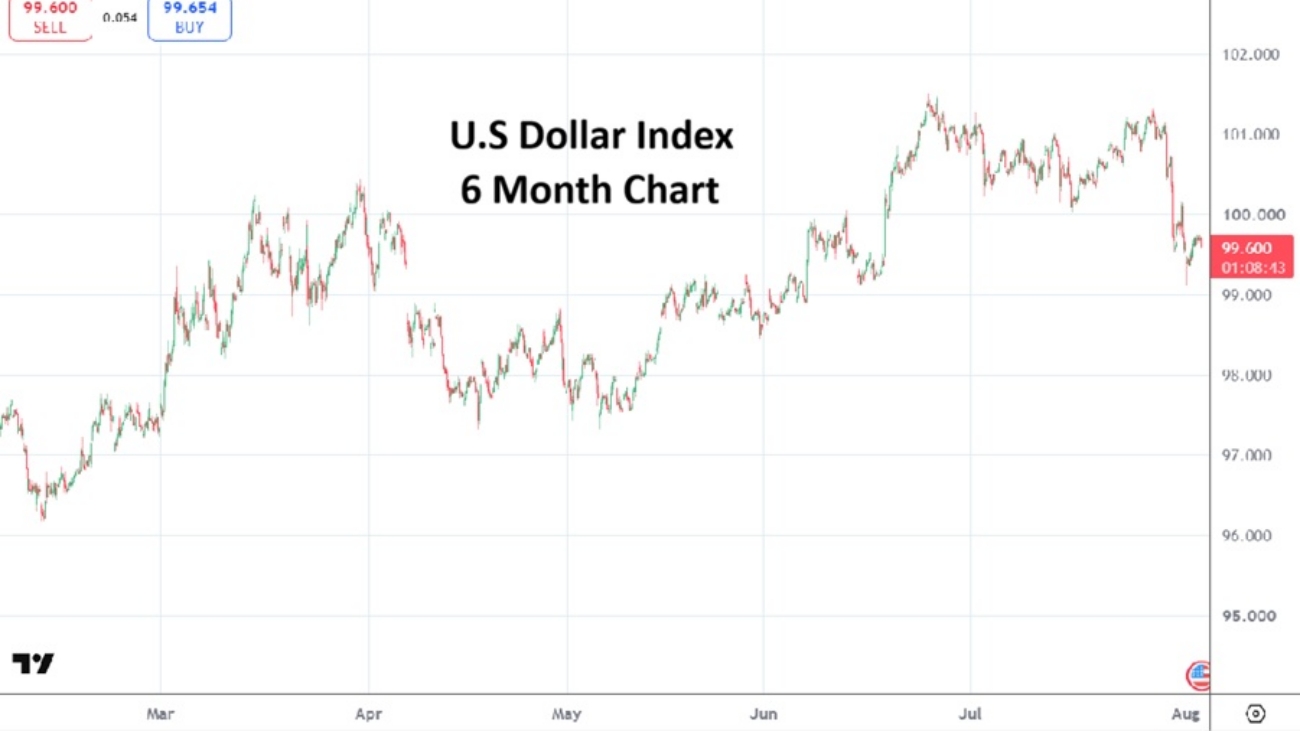
The U.S Dollar Index is back to where it was trading on Friday the 13th of March. (Yes, a Friday the 13th). Literally a week and half after the Iranian war started from a trading perspective. We are almost half a year into the war and many are still acting surprised by surges which churn on a daily basis in WTI Crude Oil and a host of other assets including bonds, equities – indices, and Forex. 

A large group of people are acting as if the USD selloff sparked across the Forex board on Friday was doomsday and had evil intentions. But what if the Trump administration actually wants a weaker USD? What if all they need to do is to get Wall Street to kick into gear and create higher values to change behavioral sentiment in Treasury yields? It is not so easy to fool professionals is it?

The narrative that the N.Y Fed via orders from the U.S Treasury was selling USD to strengthen the JPY became a conspiracy masterclass in over-reaction. Particularly because the BoJ had intervened twice already this year prior to Friday’s action – why is nobody pointing to that? It doesn’t mean, by the way, that the BoJ suddenly knows what they are doing, but it doesn’t mean that the financial end of the world is near. We need to get over our own fears.

Fed Chairman Kevin Warsh may be new on the job, he may be nervous, but he is not a schoolboy, and likely has a plan of action. I agree it sometimes is not easy to discern what Warsh wants exactly, but the USD is now weaker and maybe Scott Bessent and Donald Trump do not mind. I didn’t call Bessent and Trump the Fed Chair’s boss please note – he is independent after all. Cough, cough.

Everyone Has An Opinion, Many of Them Are Wrong

I have a good friend who constantly tells me to make sure I give an opinion, he will know who he is when I say he has proven to be the worst trader I have ever known. Hello there, Mr. Bad Trader if you are reading. Part of the reason he is so bad at trading is because he has never understood who he is as an individual participant in the marketplace.

U.S Dollar Index Six Month Chart as of 4 August 2026

His ego will not let him admit to himself he is wrong. This is not an easy thing to do for anyone. When is the last time you were able to admit you were wrong about a market position and turn around on a dime and be willing to take a loss? 

My friend doesn’t seem capable of understanding he is not an investor, he is a trader. While his outlooks about the market often prove correct, his timeframes constantly complicate matters. He has never had the temprament to be an investor, he is too impatient. He always used too much exposure via leverage and he remained unwilling to change his sails even when the winds clearly told him he was about to get wrecked. My friend no longer trades.

I am certain he would be willing to trade someone else’s money, but he has no funds to risk on his own. And I kid you not when I say he has attempted to prove the marketplace wrong more times then can be counted and still thinks he will eventually be proven correct. 

So when was the last time you were able to change your mind about an opinion you held? When was the last time you said to yourself and aloud, “I am wrong and I misunderstood the circumstances.” And do you know why you were wrong?

We listen to analysts tell us why the marketplace is going to sink, we also pay attention when they say an asset is going to the moon. Analysts are never held accountable because they are able to say things like past results do not guarantee future results. They also get to point to risk disclaimers, have a look at ours angrymetatraders.com/risk-disclaimer, protecting their opinions about the markets put forth. So why should you pay attention to someone who has no skin in your game? Because it is important to get other viewpoints, once in a while you may actually be able to allow yourself to admit that your perspective is only one of many.

The broad markets have been unkind the last six months in many ways to retail speculators. Investors have gotten hurt, but they will likely survive or at least find a job elsewhere if they cannot improve their results in the coming months to hide their failures at their current firms. This is not a polite game you are playing as a retail trader. Your brokers’ no doubt love you and talk to you about the markets and your participation like it is a sporting event. ‘Even the great ones fail once in while,” have you heard this one? 

Yesterday I stumbled upon someone’s post on LinkedIn discussing a theory and ability to only aim for a half a percent of gain everyday as if that small target somehow made it achievable – all the time. Like compound interest they subtly suggested, half a percent gained everyday would show the level of control you would have in the marketplace and allow you to make millions of dollars within a few years. Good news, isn’t it?

However, many of us know, it just isn’t that easy. While it is a great notion to remain focused and not be too ambitious while trading, buying someone else’s system for a lot of money or being charged their management fee is a little like being chewed on slowly by a vulture. 

Where is the optimism? Where is the golden secret that will allow you to become a better trader? I don’t have any, except to say diligence, determination and knowing when you are wrong and need to get out of a position is vital. We all want to find the big wave and ride momentum in order to profit. 

Sometimes the markets look like they offer riches for the brave, but sometimes they turn into a pile of ashes. No matter how hard influencers want to praise certain assets they cannot shine a turd into gold. Sometimes the turds are merely garbage and need to be treated like fertilizer, allowing for something else to grow its in its place. Maybe that is replacement theory. Maybe it is meaningless. But this is a game with hard rules, risk management and knowing when you are wrong are among some of the more important early lessons that should be sustained.

A lot of smaller players are angry at larger players in the marketplace, the reason for this has a lot to do with survivability. Small traders like my friend are no longer able to speculate, big players who are frequently part of larger financial institutions simply go home and wait for another day. Those are my opinions, take them or leave them. Tomorrow is a new day and may offer more clarity, for the moment I suggest being careful in the broad markets.

Copy and paste the text from AMT that you want to share

Share:
10Y Treasury Yields 20260728

Thoughts on Kevin Warsh, the Fed and USD, Energy, Nasdaq 100, USD/JPY and Bitcoin

Fed’s Rate Announcement Tomorrow and Underlying Market Conditions as Folks Talk

Tomorrow’s FOMC rate decision from the Federal Reserve continues to cause some angst in the investment community as folks try to decipher Fed Chairman Kevin Warsh’s disdain for tea leaf reading. What is being missed by seemingly a lot of the crowd is the open signal from Warsh that he prefers to keep his outlooks rather muted, this because he appears to be focused on the mid and long-term economic picture.

Simply put, I do not think the Federal Reserve is going to raise interest rates tomorrow, nor will the Fed Chair give too much indication about his thoughts for mid-September. It might be stated in the Fed Press Conference afterwards that the costs of energy is being watched, but that is too obvious. Count on it being recorded that the Federal Reserve will watch data and react accordingly. In the meantime, financial institutions may demonstrate volatile overplayed USD centric positions which look overbought looking into the mid-term, as they still worry about the near-term.

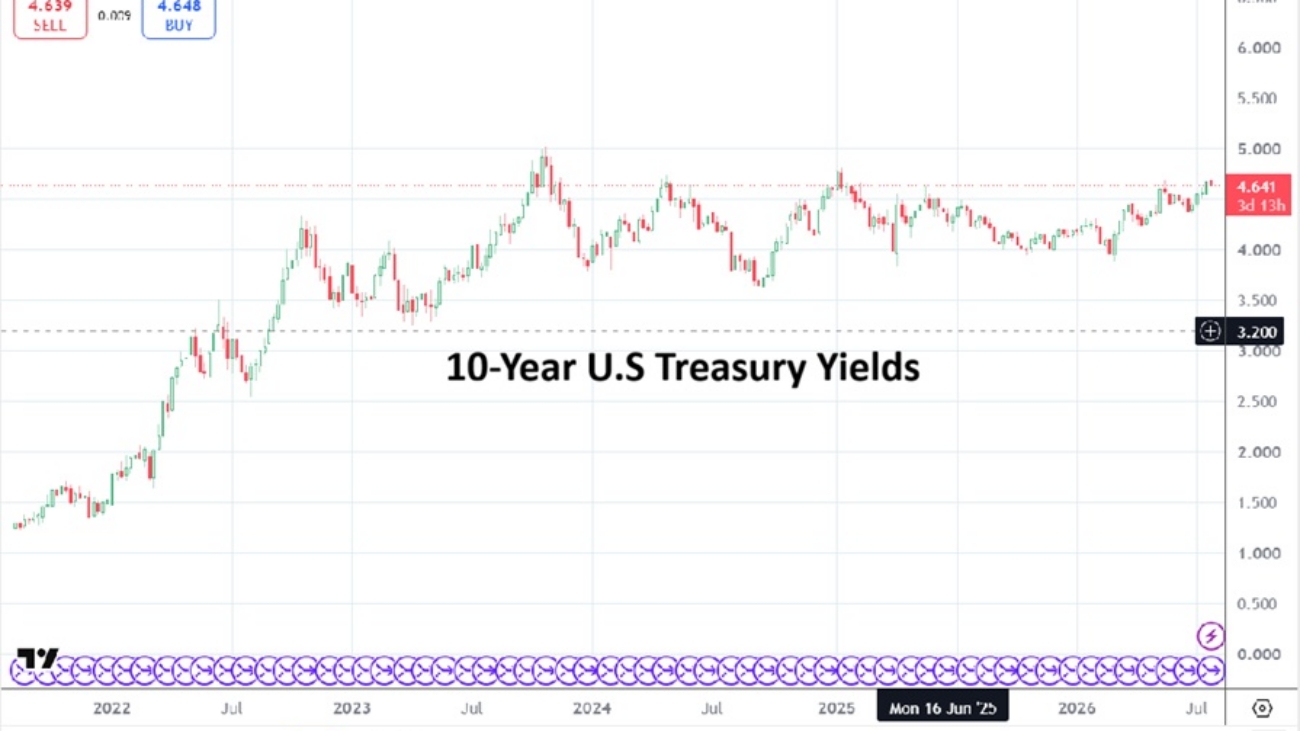
10-Year U.S Treasury Yields Five Year Chart as of 28 July 2026

Political Questions and the Cost of Energy as the Fed Reacts

Let’s for a moment dive into politics. Does anyone think that Kevin Warsh doesn’t speak to Treasury Secretary Scott Bessent who has been a long-time associate? And does anyone think Bessent doesn’t have the constant voice of President Donald Trump in his ear? 

The mid-term elections are nearing ladies and gentlemen. The de-escalation in the Iranian situation certainly has something to do with nations expressing wishes for less military action to the White House. Israel, the UAE, Kuwait, Bahrain, Iraq, Qatar, Saudi Arabia, Pakistan and Turkey are trying to influence positions as President Trump considers his next moves regarding alliances and resources. However, the situation may have something to do with the price of WTI Crude Oil too and its effect on U.S manufacturing and surprise, surprise the Federal Reserve. 

Does anyone else remember that the last de-escalation also started just before the Federal Reserve’s last FOMC meeting in June? I am not being a conspiracy fanatic, just pointing out that lower WTI Crude Oil prices do help the case for a Fed outlook which looks at the costs of energy in a pro-active manner, one which might include the U.S economy and internal White House discussions with politicians who represent voters who have the power of creating a backlash. Lower interest rates equate into lower borrowing costs for consumers.

The Fed’s Impact on Equities and Forex (and the USD/JPY)

So if the Fed does not raise tomorrow, nor gives an indication of what it will do in September and offers a stance of ‘we are vigilant and will watch the economy’ will that help sentiment on the Nasdaq 100 which is starting to have the look of a patient with a bad cold who can’t quite seem to get rid of a cough? Microsoft and Meta step into the limelight tomorrow with earnings reports, Amazon and Apple follow on Thursday.  The combination of the Fed and important quarterly earnings will impact Nasdaq sentiment and other equity indices.

It appears analysts of financial institutions are starting to discuss CAPEX – capital and expenditures – openly. And this is creating shadows as investors weigh the costs of energy and infrastructure against stated profit projections. However, let’s not throw the baby out with the bath water, the Nasdaq 100 has a gain of 20%+ over the past year (July to July), and since March the index has still gained 12%+. The war in Iran (excuse me, conflict) has not had a meaningful impact it appears on the outcome of the Nasdaq 100 via sentiment generated. But the shadow of expenditures, debt and revenue is getting louder bandwidth and speculators need to remain cautious in the indices.

Back to the Fed and Forex, the USD has been strong, you are allowed to say extremely strong if you have been betting on downside incorrectly. The USD/JPY is almost in nosebleed terrain, currently 163.830. The Bank of Japan will announce their interest rate policy very early Friday (for those of us not in Asia) and let’s see if the ‘independent’ Bank of Japan is taking a cue from their government which is clearly interested in continuing to build stronger export ratios. Has the Bank of Japan given up the so-called stated fight to keep the JPY within a solid stance? This is doubtful externally, and Japan is certainly not going to allow the USD/JPY to traverse wildly higher, but it may not consider the 165.000 mark as the end of the world. Beware of saber-rattling from the BoJ in the coming days.

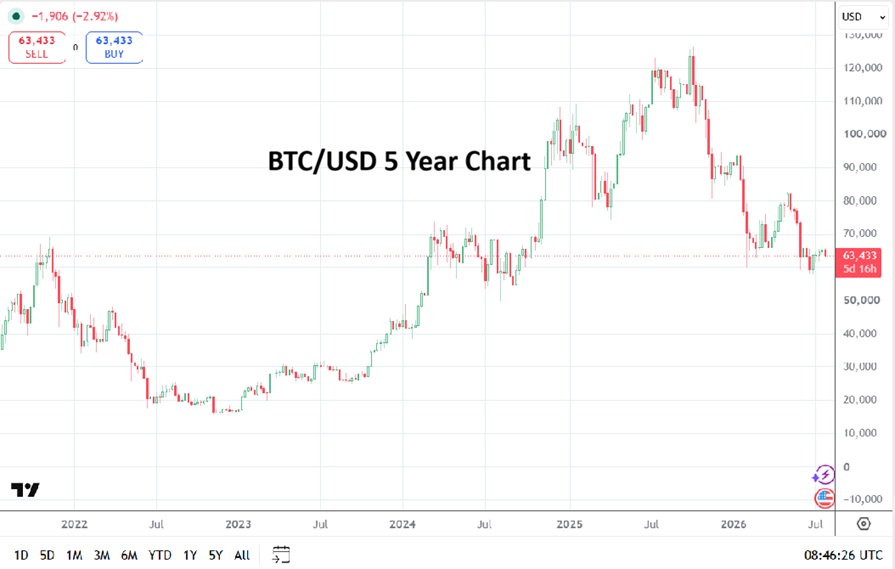
Bitcoin Five Year Chart as of 28 July 2026

Doubts and Remarks Regarding Bitcoin Below $64K

On a last note, the world of cryptocurrency remains interesting and stormy. It appears from watching the awkward statements from influencers and crypto (including Bitcoin) media outlets the past couple of months, as they attempt to explain their pain and convince others that everyone should buy at these lower values that more troubles are coming. 

What are the influencers, crypto media’s and importantly financial institutions’ actual skin in the game relative to those who have lost interest in Bitcoin and the digital market worth? Are influencers and large institutions like BlackRock hoping to pawn off their suffering ‘asset’ holdings to the public, while trying to convince us that today’s cheap prices represent buying opportunities? Is the wave of slanted influence and panic-like banner waving a hope to save themselves in order to cash out of a sinking market, this while hoping someone else takes their place in lifeboats that face a difficult voyage to safe harbors? 

BTC/USD is near $63,4000 now. Yes, we know, we have been told plenty of times before that all the Bitcoin winters eventually turn into summer again. Blossoms will create the sweet scent of profit we are assured, but what if the winter becomes an ice age? What if Michael Saylor and his ability to produce complex financial statements and instruments for MicroStrategy and Strategy equity shares continue to make little mathematical sense? What if all the investors into Bitcoin and cryptocurrencies are left holding the bag and find themselves covered by permafrost? The tundra currently looks harsh. Will the Bitcoin crowd who has been so adamant about being free of regulatory controls and mismanaged central banks cry openly for bailouts from the U.S Treasury with USD? Now that would be entertaining.

Copy and paste the text from AMT that you want to share

Alphabet 20260724

The Not So Coincidental World of Google and WTI Crude Oil

Energy and Commodities in a World Where Legacy and Infrastructure Collide

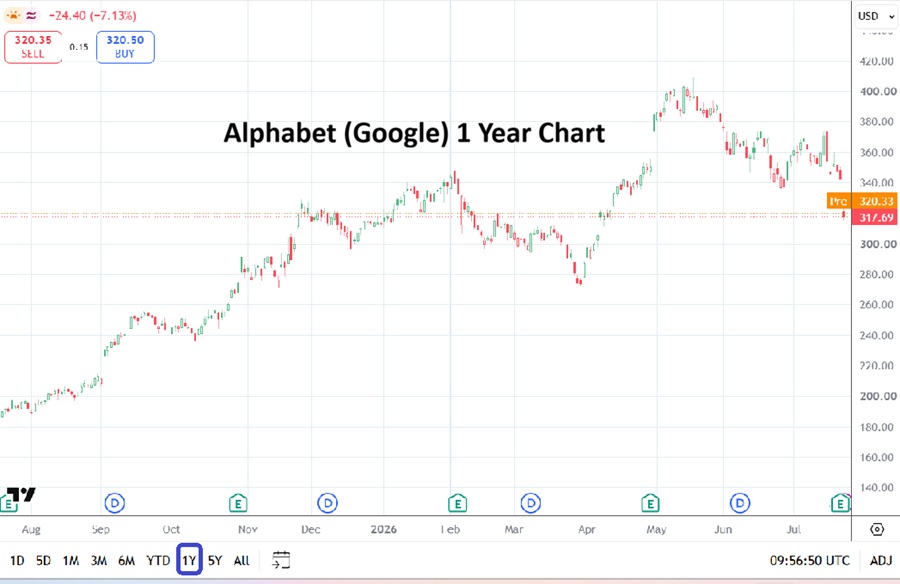
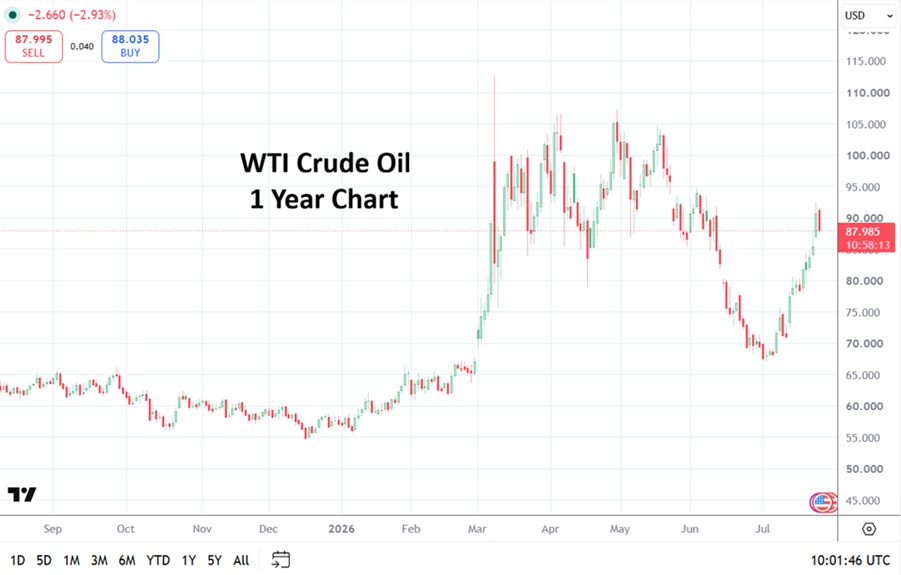
Google (Alphabet) finished yesterday’s trading near $ 317.69, as of this moment WTI Crude Oil is around $88.50. It might seem rather odd to pair the two into the same paragraph, but this is not a coincidence. Both are now relevant regarding energy costs for consumers and produce an abundance of legacy products the world over. And oddly enough their one year charts almost look as if they are dancing in step.

Google is facing headwinds in recent trading as questions surround its capability to produce revenues because of its push into Artificial Intelligence and always growing need for more data center power. AI which has been an abundant source of bullishness in the Nasdaq 100 and had a knock-on effect into the S&P 500 the past couple of years has become shadowed by concerns of turning into a commodity. 

Alphabet (Google) One Year Chart as of 24 July 2026

As competition in the AI sector increases this is creating pressure on prices in order to allure customers away from competing brands. China is also stepping into the world of Artificial Intelligence and it will certainly use its ability to produce less expensive products moving forward. Profit margins are being fought over by competing companies

Google is not a poor company, but there are growing doubts about its debt and revenue ratios. The costs to power its worldwide data ability for its users and its investment into AI via Gemini and its DeepMind technology does not have a particularly easy solution. Estimates from a variety of sources claim that Google has reduced its staff between 1,500 to 3,000 through employee reductions and reorganization, this as the company needs to pile more cash into infrastructure.

The onslaught of other companies able to produce AI which is seen as more robust and capable have also caused a marketing headache for Google, which has an effect on behavioral sentiment. GOOGL was trading at apex levels only two months ago when it was traversing above the $400.00 mark. The downturn thus far has been bad, but not catastrophic. 

WTI Crude Oil One Year Chart as of 24 July 2026

While nervous sentiment can be blamed on the situation in the Middle East the past handful of months, the downturn which has occurred for Google and other important companies on the Nasdaq 100 involved or seen as having an ancillary association with AI needs to be considered a legitimate reaction because of worries surfacing regarding the ability to simply pay for all of the research and infrastructure. 

In order to power AI it is becoming clear that energy costs are part of investing frameworks. Concerns about an AI bubble started to gather an audience last fall and the rumblings have grown louder, yet it can be said the ability of Google and many other companies to gain the past year in value still outweighs this current downturn experienced the past couple of months.

The Iranian war which is ongoing, appears to be entering a phase in which financial institutions are having to succumb to the notion of higher prices not only for WTI Crude Oil but other energy resources with a mid-term viewpoint. While there is abundant supply of Crude Oil worldwide, the current problems surrounding navigation and logistics are causing pandemonium in a consistent manner via WTI’s price as Middle East nations try to ship to their clients. This is causing many Asian nations to look elsewhere for their energy, Brazil has seen an increase in orders. And because of the upwards trend in fuel costs again, the Federal Reserve will have to look hard at inflation data and play a game of interest rate mania, which investors will have to calculate into their outlooks regarding debt ratios.

What does this have to do with Google and AI?

People like nations will search for the easiest and most cost efficient pathway to access their needs. Anthropic, OpenAI, Kimi K3, Microsoft Copilot, DeepBlue Technology, Meta, Sakana AI, IBM, Nvidia are only some of the companies involved in sourcing software and providing hardware to users. Many nations are involved in this AI chase and understand the importance of cybersecurity, data sharing and the problems surrounding the costs to power all of these machines.

Many of these companies above including Google are searching for a holy grail via energy supply and discussing the financing and building of energy infrastructure including nuclear capabilities. But as Google and other companies search for more energy to fuel their dependence on powering their systems for clients, they continue to be confronted by a growing wave which will eventually drown some of the companies in debt that they will not be able to recover from.

I am not forecasting an apocalypse, but I am suggesting not all of these companies which we think of as part of our everyday lives will survive this fight. Legacy companies eventually parish, just like many start ups. The realization that many companies are merely providing what the public is starting to see as necessity is a simple competitive evolution. BlackBerry, Nokia and Motorola are examples of giants falling.

It appears many investors are starting to ask hard questions about costs compared to future earnings in AI. The allure of the next big thing, which AI has been part of the past couple of years, is running into well-practiced investment cycle as froth erodes and financial institutions start to look at the accounting of the companies they are being asked to consider as long-term endeavors. Not all that glitters is gold will certainly start to create a patina on many of the so-called AI companies as they are forced to prove their worth as suppliers of a commodity.

The AI world has run into the time honored financial realization that many exotic tastes soon turn into another form of vanilla. The next big thing is always being anticipated and hoping to attract the deep pockets of investors. Certainly many of the big companies including Google are going to survive the current headwinds. but real profits could become harder to attain. Investors and speculators should not be surprised that reality has a tendency to reduce momentum.  Entropy is part of the investment world, investors and speculators always have to be ready for new disruptions and systems to emerge.

Copy and paste the text from AMT that you want to share

SIngapore Dollar 20260717

Thoughts on the USD/SGD, Cautious Broad Market Sentiment and the Weekend

USD/SGD: Currently a Hope and Prayers Barometer in Global Forex

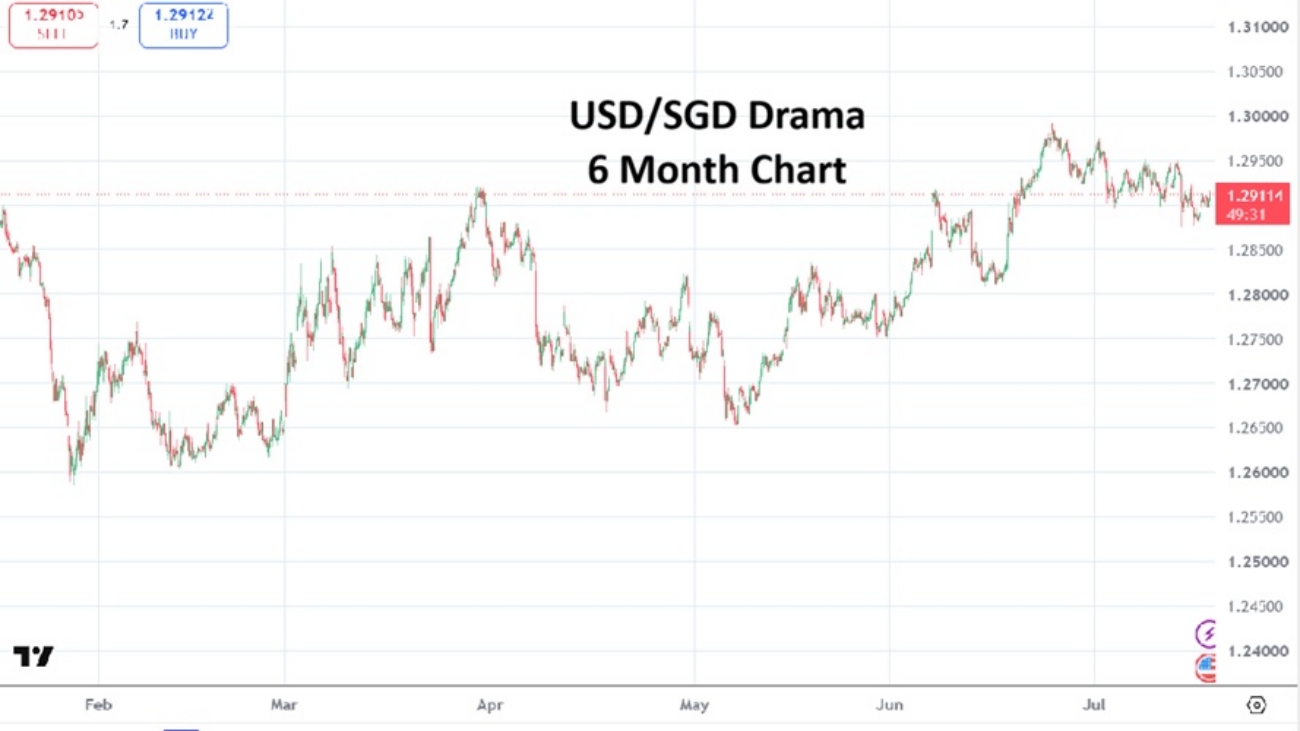
The USD/SGD is near the 1.29110 vicinity as of this writing. Financial institutions apparently have combined their cautious outlooks in the broad Forex market as USD centric strength continues to leak into sentiment, while their instincts technically demonstrate that over the mid-term currencies like the Singapore Dollar should be stronger and the USD/SGD is supposed to show some bearish activity.

For dramatic purposes let’s call this current phase of Forex trading including the USD/SGD as the hope and prayers act. The Singapore Dollar has sustained highs, but it has traversed lower over the past few weeks. On the 24th of June the USD/SGD was near the 1.29940 ratio. Let’s be clear, for small speculative Forex traders broad market wagering on USD direction remains dangerous.

USD/SGD Six Month Chart as of 17th July 2026

Fed Chairman Keven Warsh and His Desire to Introduce New Data

During the recent testimony of Fed Chairman Kevin Warsh in Washington D.C he made it clear he is keen on introducing AI tools into interpretations regarding Federal Reserve policy. However, he also said that AI will not be relied upon alone. From a coding perspective, Warsh essentially said proactive data will become part of the Fed’s thinking with proper supervision: some of you may want to call this a stack developer’s job.

At the same time while refusing to tip his cards regarding his stance on interest rates too much, Forex markets responded by selling the USD in incremental bouts. Intraday trading flared in its usual manner, but started show a core belief that Warsh is demonstrating dovish sentiment regarding interest rates.

USD/SGD as a Forex Barometer and Near-Term Behavioral Sentiment

The USD/SGD serves as a solid barometer of the Forex market. It offers perspectives on Asian sentiment, but also shows how global financial institutions are leaning. The escalation of firepower in the Middle East the past week and into today has caused reactions in the USD/SGD, but somewhat politely.

Having been able to trade below the 1.29000 mark on Tuesday and Thursday of this week, the currency pair is trading near values seen on the 8th of June and 18th. A lack of clarity remains a theme in Forex. The USD/SGD is the 10th biggest Forex pair via transactional averaged volume, so traders should give it attention even if they do not pursue.

Wall Street Remains Nervous and the Tense Weekend to Come

Going into this weekend Forex traders have created downside pressure on the EUR/USD and GBP/USD. The USD/JPY remains stubbornly above the 162.300 ratio. Nervous selling on the Nasdaq 100 via futures trading has been seen today and it looks as if Wall Street will be in for another bumpy ride. The wishful thinking drama in the financial markets is being confronted by the reality of a potentially loud weekend of military conflict between Iran and the U.S, and a seemingly unconvinced marketplace that doesn’t want to demonstrate risk appetite.

WTI Crude Oil prices via futures trading are above $80.00. Having been able to sustain values above the 1.29100 mark in the USD/SGD signals that bearish mid-term perspectives still need additional impetus to create more selling, but this doesn’t appear a wise speculative bet going into the weekend.

A cautious stance over the coming hours should be anticipated as folks wonder what the coming weekend will bring. At least there is the World Cup championship on Sunday (New York time) to take our minds off of concerns. However, Monday will not react to the trophy being raised, but to behavioral sentiment that will takes its cue via today’s finish on Wall Street and noise generated via the Strait of Hormuz this weekend.

Copy and paste the text from AMT that you want to share

WTI Crude Oil 20260701

What Am I Missing About USD Centric Strength?

Being Wrong About USD Direction and Betting Against the Trend

Help me out here folks, I am perplexed. I seem to be missing something about the USD centric strength, it looks very overbought to me. Where is all the buying sentiment coming from? The FOMC meeting outcome on the 17th of June has certainly sparked USD centric buying stamina as financial institutions seem to have fallen into a strict line and priced in a Federal Reserve interest rate hike this year.

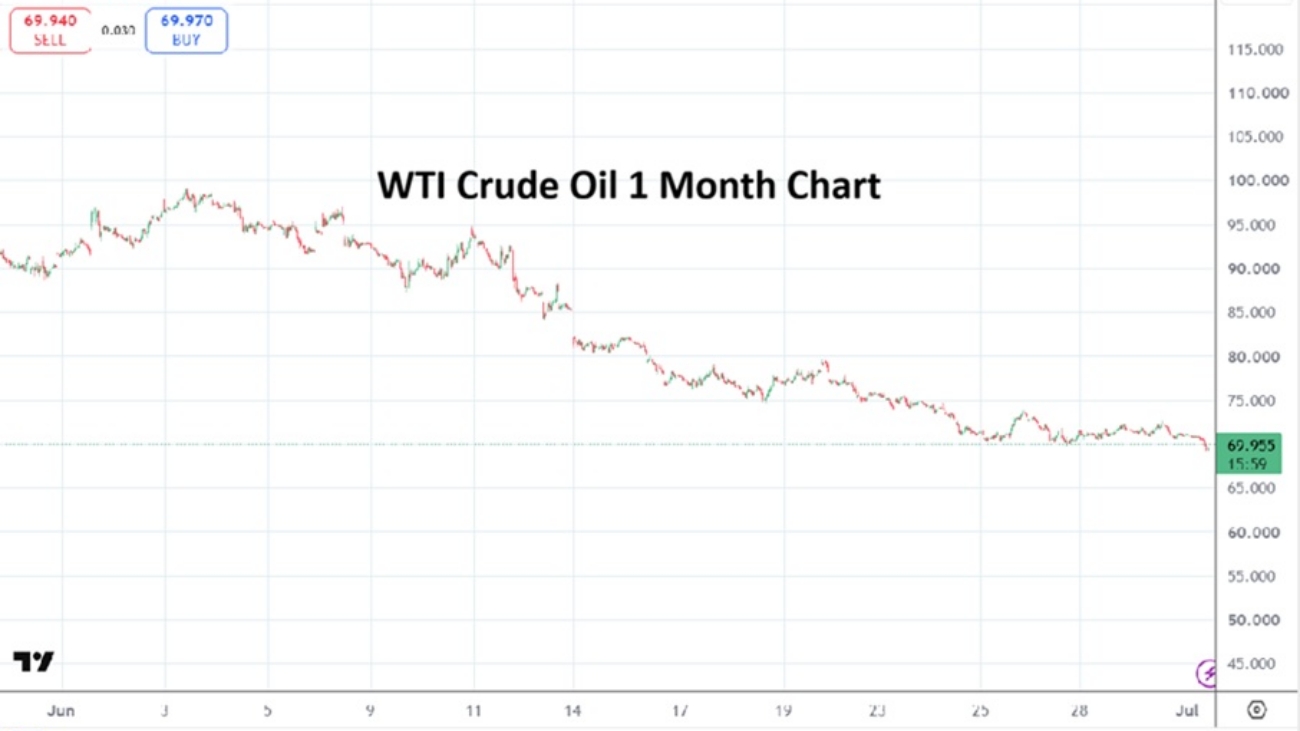
However, the price of WTI Crude Oil was near $80.00 on the 17th of June. And on the 3rd of June the price of WTI Crude Oil was within sight of $100.00. Meaning that we have seen the price of energy trend lower. The agreement between the U.S and Iran, although fragile, has held and the current price of WTI Crude Oil is close to $69.70.

WTI Crude Oil One Month Chart as of 1st July 2026

While concerns about inflation certainly remain, costs should actually start to erode for logistics, fertilizers for agriculture, and manufacturing. Job numbers are solid, growth has been rather steady and shown signs of improvement. If inflation starts to behave and financial institutions change their thinking about interest rates to come, perhaps they will ease off on their borrowing costs.

Also, let’s note that as expected the new Fed Chairman Kevin Warsh has made it clear he will take a more proactive stance regarding interest rates. Evidence for this comes via Warsh’s decision not to participate in the dot forecast that FOMC members use, his absence from the Fed’s ‘prediction market’ game was notable, but many analysts seem to have missed the importance.

In my opinion, Warsh’s decision not to participate in the Fed’s dot plot quarterly signal chart shows the new Chairman wants to create the capability of changing his mind regarding the Federal Funds Rate as needed. The decision not to ‘anonymously’ show what his beliefs are looking forward will allow him to steer the Federal Reserve per forward looking economic data points instead of being held accountable – and possibly blamed – for changing his mind if a shift of opinion is needed.

So again, why is the USD so strong across the Forex board? The USD/JPY is trading well above 162.660+, the EUR/USD is near 1.13900, the GBP/USD around 1.13247 and the USD/SGD is sustaining value at mid-term highs close to 1.29660. While financial institutions appear to have priced in an interest rate, and may also be nervous about volatility in U.S equity indices, the cautious approach has created in my opinion an overbought USD.

As the Independence Day holiday approaches, Forex traders should be careful. If ever there was a time for the Bank of Japan to intervene and cause chaos it might be when USD Forex volume is minimal. Large USD traders may start vanishing in the coming days before the long holiday weekend, and the absence of U.S banks this coming Monday will also factor into the markets.

Selling the USD looks like a speculative bet certainly, particularly because its trend has proven rather strong the past few weeks. Let’s see what happens, but I suspect some downside pressure via USD centric price action is going to be generated.

Copy and paste the text from AMT that you want to share