
post240

Market Volatility Shelf Life Doesn’t Have an Expiration Date

Market Volatility Shelf Life Doesn't Have an Expiration Date

Updated: Apr 11

An associate in the financial world just wrote to me that “all bets are off”. Perhaps that is a solid way to think about the present speculative and investment situation. The tumultuous wave of hysteria in equity indices, Forex, commodities and U.S Treasuries are evident to everyone. President Trump’s tariff policies released last week lacked precision via perspectives for many investment institutions who suddenly had their mirage of calm destroyed. The realization that President Trump was undertaking what he had promised caught many by surprise who thought he was bluffing. Trump’s ‘Art of the Deal’ tactics are now being confronted by middlegame chess strategies from opponents.

While the broad markets have boiled and folks look for calm to return, the prospect that current volatility has the potential to carry a long shelf life with no expiration date has to be considered. Yes, the financial world will become serene again. The return of semi-tranquil trading has been seen in the Nasdaq, S&P 500 and Dow 30 the past couple of days – only because the losses and gains depending on the index have been moderate compared to last Thursday’s and Friday’s results.

Yet the shadow of more violent trading remains crystal clear. China and the U.S are now exchanging loud threats which include higher tariffs and retaliatory measures. The USD/CNY is under scrutiny as devaluation by China appears an evident threat. And U.S Treasuries are being watched as some contemplate that China is undertaking a selloff of U.S bonds. Higher U.S yields on long-term Treasuries will create pressure via the amount of debt the U.S will be obligated to pay.

Vice President J.D Vance’s peasant comments about China were not helpful on Tuesday. Why must a hornets nest must be stirred up? China has now been hit with a 104% tariff from the U.S, this while China has vowed to ‘fight till the end’ in its media. Asian markets are selling off cautiously this morning as tensions reignite. Forex pairs such as the USD/SGD, USD/ZAR and USD/BRL should be watched as a barometer not only by currency traders, but by those who want metrics regarding how global economic sentiment and credibility of policies are being contemplated. Risk adverse trading in emerging markets will cause harm and has the earmarks of looking like a stiff penalty for nations trying to develop and raise their standards of living.

While the start of this week has been smoother in relative terms compared to last week, the lack of a comprehensive end game is still missing. There is merit to treat current circumstances with cautious respect. The mid-term outlook remains highly questionable as President Trump and his negotiation gambits are tested publicly.

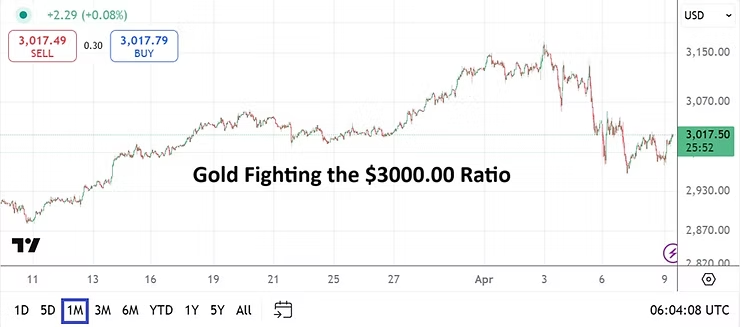
Gold One Month Chart as of 9th April 2025

Gold has stumbled back to the 3000.00 USD level, WTI Crude Oil is down and these two commodities are intriguing as a looking glass into the hearts of large players. Are people selling gold short-term because they believe inflation will lessen because of a recession which some are forecasting, or is it merely a speculative move? Gold certainly carries an important risk adverse power and its lower move showed be looked upon skeptically.

WTI Crude Oil One Month Chart as of 9th April 2025

Is WTI Crude Oil selling off because there is a belief there will be less demand due to fear tariff policies will influence a stumbling global economy? This viewpoint is plausible, the price of the commodity falling below 60.00 USD is a warning that large players are not comfortable with their outlooks and view downside risks as legitimate. The energy selloff in the past couple of hours is a negative barometer for what potentially is in store the remainder of the day in the broad markets.

The lack of finesse exhibited during these tariff negotiations is not palatable, the taste in the mouths of financial institutions has them worried. And outlooks via talking heads and analysts must be treated carefully by traders, this as they try to digest the onslaught of information and complex economic scenarios. Importantly, day traders should avoid getting caught up in the deleveraging talks surrounding the notion that large financial institutions will now pull money out of their U.S based investments in companies via stocks and Treasuries. Traders need to consider the bias of the people they are listening to and reading, and consider the scope and might of the U.S economy mid and long-term. There will be value found after the massive selloffs.

As a side note Warren Buffett has let it be known for a while he is sitting on a large amount of cash via Berkshire Hathaway. And folks should note that the annual meeting for Berkshire Hathaway is on Saturday the 3rd of May, which means people should get ready for insights from Buffett and his legions of admirers in the coming weeks. Certainly, Buffett’s comments and potential actions will be watched carefully.

The U.S Federal Reserve has taken a wait and see approach to the Trump tariff implications. Calls for an immediate cut of the Federal Funds Rate have not caused Fed Chairman Jerome Powell to shift his cautious stance yet. The coming days could bring a different attitude from the Fed if equity markets and U.S Treasuries perform badly. In the meantime some central banks have said they might become more proactive – the Reserve Bank of New Zealand cut its interest rate by 25 basis points this morning to 3.50% and said it will continue to cut their Official Cash Rate if tariff policies create more negativity.

The consideration by financial institutions regarding the beginning of a paradigm shift of the global economy is justified. However, the ramifications of the Trump tariff policies have a long way to go before these present days will be able to be pointed to as the moment the world decided that it no longer wants to participate in the U.S marketplace. That notion seems farfetched. The USD remains the world’s reserve currency, its corporations remain extraordinarily large and valuable, and U.S Treasuries as they absorb current volatility and see yields moving higher in the 30 Year bonds cannot be viewed as an economic apocalypse – yet. Yes, the warning signs are meaningful and the Trump White House will need to respond diligently.

Again, the past week of trading has seen vast disarray, but we have been here before. It is important to recognize that current circumstances however do remain dangerous, this because we are still in the midst of the crisis. At some point, egos will have to be put to the side. The Trump White House will have to negotiate with China. China may be vulnerable, but so is the U.S. Why be belligerent and show no respect to each other? The remainder of this week’s trading will produce more whipsaw results. Selling looks to be in vogue once again this morning. Behavioral sentiment and understanding its power need to be contemplated as folks await sunnier days.

post235

Predicting the Federal Reserve and President Trump’s Rhetoric

Predicting the Federal Reserve and President Trump's Rhetoric

Financial institutions have grown accustomed to the rather fierce rhetoric from President Trump in the early days of his second term. Financial institutions have also become quite used to the recent overly cautious statements from the Federal Reserve. This Wednesday the Fed’s FOMC Statement will be delivered and there will be no change to the Federal Funds Rate. The current ‘main’ borrowing rate offered by the Fed is 4.50%.

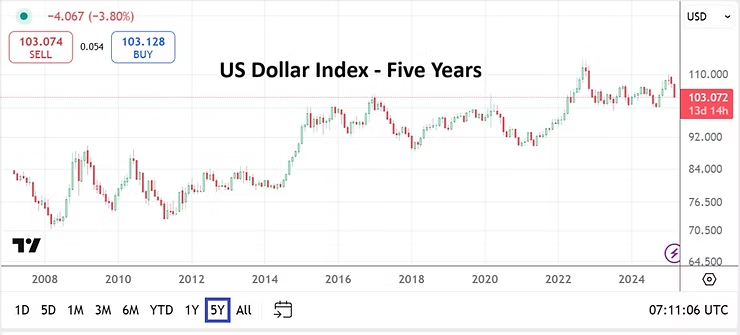
US Dollar Index Five Year Chart as of 18th March 2025

This Wednesday Fed Chairman Jerome Powell will speak about the recent CPI and PPI numbers which came in below expectations. This typically would be a good signal regarding weaker inflation. And Powell might also mention that energy prices in the U.S have started to erode. WTI Crude Oil is now trading in a sustained manner below the 70.00 USD threshold, and this will influence the potential of less inflation. It is a good development for the U.S and Federal Reserve.

However, Powell is unlikely to express the unease and anxiousness the Federal Reserve has regarding President Trump, this because the Fed certainly doesn’t want to get into an open confrontation with the White House.

The U.S Treasury is now being run Scott Bessent who was selected by President Trump. Bessent ran the Key Square Group and is well respected in financial circles, which includes vast experience in top financial institutions. Powell though perceived as pragmatic by many analysts, may not be within President Trump’s trusted inner circle like Bessent and Commerce Secretary Howard Lutnick, the former Chairman and CEO of Cantor Fitzgerald. Lutnick is perceived as a workhorse who get things done and is smart.

The Fed’s likely cautious FOMC Statement will not be enough to appease President Trump this week. While some may think Trump’s attention will be elsewhere, those who have come to understand Trump know his capability to react quickly to events should be taken seriously.

What will Bessent and Lutnick think about the Fed’s FOMC Statement and stance? Powell is not a trained economist, do Bessent and Lutnick trust Powell? One thing for certain is that Janet Yellen who served as the Fed Chairwoman before Powell, and the Treasury Secretary before Bessent is not part of the inner circle in the White House.

Powell’s loyalties may be questioned, and eyes should be kept on Trump later this week to see how the President responds to the rather cautious Federal Reserve. The Fed will certainly not want to say aloud it is waiting like everyone else regarding the effects of tariff negotiations and their implications. Powell wants to keep his job. Trump certainly wants lower interest rates. Bessent and Lutnick certainly want lower interest rates too, but like Powell these two may prove pragmatic and know inflation needs to erode further. The Treasury and Commerce secretaries may want to test chicken and egg questions. Will these two gentlemen push Trump to proactively push for lower interest rates in a louder fashion?

Day traders will have to wait to see how financial institutions react to tomorrow’s FOMC Statement – which has already been accepted as being a ‘no interest rate cut event’. And it is probably being discussed in the White House that the Fed may want to wait until early this summer – June? – to consider another interest rate cut. Which means the Fed may not be cutting interest rates mid-term, while the ECB and BoE may have to be more dovish and remain active via interest rate cuts if their economies continue to show recessionary trends.

Meaning that risk premium which was factored into the stronger USD centric buying since the Trump election on the 5th of November until the peaks in mid-January and early February, and have now reversed lower – needs to be watched technically and weighed in combination with behavioral sentiment.

Intriguingly the US Dollar Index is around levels it stood at on the 5th of November (Election Day 2024). It is also near values seen on the 15th of October. (Did financial institutions start to bet on a stronger USD around this time because of a more cautious Fed outlook and the potential Trump was going to win the election?) Raising the question, if financial institutions envision the USD can technically be weaker and attain values seen in late September and early October when the US Dollar Index was testing support levels which have held since April of 2022. The US Cash Index which stands around the 103.070 level now, was trading near 90.00 in the spring of 2021.

Trump wants lower interest rates, the Fed wants to wait on cutting the Federal Funds Rate until they have clarity regarding the results of tariff negotiations. There will be a collision between Jerome Powell and Donald Trump, the only question is when it will happen. The US Dollar Index has been lower historically. Trump, Bessent and Lutnick may not want to say it out loud, but a weaker USD in the global economy would help U.S exporters. A weaker USD may not convey the strong populist rhetoric of MAGA, but it may be economic hardware the Trump administration actually seeks. To sustain a weaker USD, inflation levels will have to erode, and interest rates will have to be lower (and another myriad of complex events have to happen), until then rhetoric and risk premium will factor into USD Forex trading for financial institutions and speculators.

post233

Stock Market Narrative and Looking for a Trump Silver Lining

Stock Market Narrative and Looking for a Trump Silver Lining

S&P 500 One Year Chart as of 14th March 2025

U.S stock markets have been hit on the nose in recent weeks, the major indices have put in rather consistent declines since the 19th of February, and the selling frenzy and particularly noise have grown worse since the start of March. Narrative regarding tariffs and a lack of clarity have certainly had a negative effect. The notion that there is a part of the media that wants to see a downturn in the markets and blame President Trump could also be factoring into concerns and fragile sentiment among indices participants. I am not blaming the media for the downturn, just pointing out that there are some entities which are not unhappy about the recent selling in the stock markets, this because it fits comfortably into their narratives.

While the bearish decline on the S&P 500, Nasdaq 100, and Dow 30 have all been easy to see, defining the dynamics of the downturn, and reactions from day traders and investors are complicated. The stock markets are not guaranteed to always go higher. This may sound naive, but people have gotten so used to the notion that U.S indices always go up that they forget about the potential for downturns. Yes, the stock markets have turned negative, but a one month decline is not uncommon historically. And some of the folks rooting against Donald Trump may want to take that into consideration.

Risk premium has certainly been factored into the markets which has influenced equities, but has created forceful moves in Forex too. Risk adverse tension because of persistent rhetoric about tariffs and their impact on behavioral sentiment cannot be discounted. However, the stock markets are still higher over the past year.

The Trump Effect is certainly being pointed at by many as the cause for the sudden downturn, but it should be remembered that all-time highs occurred after Trump won the election. Yes, the selloff has definitely happened too, and stock markets are now traversing values seen before the election. And support levels are being looked at with caution and more selling could lead to a test of psychological ratios which pressure market confidence further. Yet, it should also be remembered the S&P 500 at this time last year was around the 5,150 ratio compared to its current mark near 5,565.

Day traders have been hard pressed to find momentum with solid wagering opportunities, particularly if they have been in search of a bullish trend in recent weeks. The belief that U.S indices always go up eventually is a solid reference, but in the short-term can cause expensive losses for stubborn betters. Investors certainly have an easier time with stock indices if they practice the long-game and do not worry about the daily and monthly gyrations when their money is parked in indices. The use of leverage when betting on the daily results of stock markets can become ultra expensive for speculators, particularly when upside bias is being counted upon.

WTI Crude Oil One Year Chart as of 14th March 2015

Data this week from the U.S has actually been positive regarding lower inflation, both the CPI and PPI reports released the past two days has shown a slow down in costs. Yet, these results have little to do with President Trump, since he has only been in power less than two months. However, the lower WTI Crude Oil prices being achieved at this moment will start to factor into weaker inflation and will benefit the U.S economy.

The U.S Federal Reserve will have to be watched, because Fed officials seemingly continue to be among the crowd worried about tariff knock-on repercussions. But it should be remembered during Trump’s first term in office, there were tariff concerns too and inflation was tame. It will take a few months to still see results via inflation under this Trump administration, but if energy prices remain stable and low, this can mitigate circumstances while the tariff winds blow and their effects are waited upon. Interest rates from the Federal Reserve, U.S taxes on the public will continue to come under scrutiny. The likelihood of Trump and the Federal Reserve locking horns regarding interest rates seems to be a certainty in the coming months.

U.S stock markets have proven dangerous for bullish perspectives the past handful of weeks, but the viewpoint that markets have been too discounted will certainly start getting the attention of large players. U.S Treasury yields remain a barometer, but short-term results do not always correlate. Speculators without deep pockets may want to continue to watch from the sidelines.

Traders should also remember there is the ability to short U.S indices, but this brings up the healthy question about when will price support start to become a factor. It is nearly impossible to pick the precise moment financial assets will stage a turnaround for day traders, but history does indicate that bullish sentiment will start to be seen. Betting on a continued downturn could prove more expensive in the end, compared to speculating on upside.

Trading is not easy. It takes a lot of stamina to endure price movements that do not go according to plans. The financial markets are proving difficult for many. We are likely not out of the woods yet because clarity remains problematic, investors who have longer timeframes are likely anxious too. Price velocity needs to be given attention, markets can certainly go lower. However, at some juncture equities will start to look cheap to important long-term players. Behavioral sentiment among investors will likely also start to acclimate to the Trump Effect.

postR196

AMT Top Ten Miscellaneous Frights for the 28th of October

AMT Top Ten Miscellaneous Frights for the 28th of October

10. MLB Concern: Baseball executives are hoping the Yankees can start to make the World Series more competitive this evening. The Los Angeles Dodgers have won the first two games of the championship battle. Significant hopes for a drama filled, seven game World Series would be dampened badly if the Yankees do not win tonight. Television ratings which were expected to be high could suffer appreciably if the Yankees go down three games to none. A non-competitive championship would mean a loss of revenue.

9. Israel and Iran: The Middle East saga is at number nine, and hopefully doesn’t become number one. A dangerous game of poker is being played by the participants. If Iran decides to up the ante once again, it would be a dangerous decision, because it appears Israel has positioned itself via this weekend’s retaliation to be more aggressive if need be.

8. WTI Crude Oil: The ability of the energy to move below 70.00 USD upon this morning’s trading is a sign the Middle East conflict remains tranquil in the minds of large participants in the oil sector. However, if Iran decides to test Israel again directly, Iran may find that its oil infrastructure is vulnerable. As the price hovers below 68.00 USD during this writing, it appears buyers who bought speculative positions the past few weeks might be capitulating.

7. BRICS: The inclusion of 13 additional nations as Partner States to the international organization led by Russia, China and India shows the entity sees itself as a growing alternative geo-political force and trading sphere with real power. The West should be paying attention, but often seems like it is not concerned about the potential strength of BRICS, and instead makes believe the group is a fallacy and much ado about nothing – this is a mistake by the West.

6. North Korea: The potential of North Korean combat troops entering the Ukraine – Russia war is a dangerous notion. However, it opens the door for Ukraine and South Korea to offer surrendering deserters the possibility of being allowed into South Korea, if soldiers can prove they are not spies. Unfortunately, the temptation of desertion by enemy troops could prove to be wishful thinking because North Korean soldiers will have intense supervision at all times; the threat of being shot as a liable traitor is a likely constant menace.

5. Gold: Record values continue to be seen, the price of the precious metal as of this writing is near 2,732.00. Noted as a store of value, gold is also seen as a safe haven by its buyers. Now may be the time to consider behavioral sentiment as a main driver because of anxiousness in the global marketplace. Speculative forces are certainly involved in the move higher too. With so many risk events shadowing, it may be very unwise for day traders to bet against the rise of gold near-term.

4. U.S Data and the Fed: Advance GDP numbers will be published this Wednesday, the Core Personal Consumption Expenditures Price Index will be seen this Thursday, and on Friday the Non-Farm Employment Change statistics will be presented. Fireworks should be anticipated by day traders. The combination of these reports, the approaching U.S election, and the Federal Reserve’s FOMC Meeting decision on the 7th of November will be enough to make most analysts hearts beat faster.

3. USD/JPY: Japan’s election results today now require a coalition government because the ruling Liberal Democratic Party has lost its majority. The Bank of Japan has a meeting this Thursday and is expected to hold its BoJ Policy Rate in place. The Japanese Yen has returned to values above the 153.000 level as of this writing. While many major currencies have lost value against the USD since the end of September, the USD/JPY needs to be watched as a dynamic combination of risks abound. Political gridlock, inflation, and lackluster economic data in Japan are not ingredients which will provide financial institutions with optimism in the near-term. The historically cautious attitude of the Bank of Japan will be severely tested in the coming weeks.

2. U.S Election: There is a little more than one week to go before the Presidential vote begins. While many folks are focused on the White House, the race for the Senate looks to be a stiff competition too. Republicans are hoping to regain the majority in the Senate and retain their power in the House of Representatives. Financial institutions are apprehensive about the outcomes for Congress, which will have an important role in fiscal and regulatory management. The Democrats appear to be nervous. Noise from the campaign trail and media will become heightened over the next seven days. Top bureaucrats in offices like the SEC, CFTC, FCC and other agencies know their jobs are on the line.

1. Market Volatility: U.S economic data, the coming election, and the Fed means the next week and a half of trading in the global markets are going to be packed with violent firework displays. Day traders who do not have experience should watch from afar, because the coming price action can cause fast losses for those caught on the wrong side. Trading sentiment is fragile, this is evident via the choppy results seen in equities, Forex, many commodities, and rising U.S Treasury yields. Over stating the obvious for the moment about risk management is a public service.

postR196

Top Ten Miscellaneous Slogans for the 21st of October

Top Ten Miscellaneous Slogans for the 21st of October

10. Evil Empires: The Yankees and Dodgers will square off in the World Series with their ultra expensive rosters competing for the championship. Maybe this is exactly what the U.S needs so people can take their minds off of U.S election concerns. A contest between Los Angeles and New York is a big selling card. TV ratings should soar as Shohei Ohtani, Juan Soto, Mookie Betts, and Aaron Judge battle for the supremacy of baseball.

9. Vision: SpaceX achieved magical results as a Falcon 9 rocket booster was caught by ‘chopsticks’ as planned for and engineered. Elon Musk proved again that his preposterous ramblings are frequently correct. SpaceX is in a solid position to provide logistics for outer space exploration and development, but to also create new business endeavors as it evolves. The implied value of SpaceX mid-2024 was estimated to be around 200 billion USD.

8. 2017: Bitcoin was around 1,000.00 USD in January of 2017. The price of the digital asset is now approximately 68,500. The perception and betting that a Trump victory may be putting a spring in the step of the cryptocurrency market is intriguing. Bitcoin trades based on behavioral sentiment and not intrinsic value. Trump has spoken about crypto favorably time to time. A more welcoming SEC and CFTC regarding crypto could help values. For those looking for further correlation to BTC/USD and Trump, when he left office in January of 2021, Bitcoin was near 31,000 USD.

7. Downturn: Environmental, social and governance investing has taken a hit compared to results from the past couple of years as outflows from investment vehicles led by the likes of BlackRock and others make noise. ESG has lost its luster as the race for superior profits has run into headwinds and analysts question values and revenues. What will happen over the next few years, particularly if ESG investing finds that it has fewer friends in the U.S halls of power?

6. Data: U.S economic statistics will be rather lacking this week, the highlight may be the Flash Manufacturing PMI numbers on Thursday. Some may try to make the weekly Unemployment Claims a spectacle too, particularly brokers who may be trying to entice day traders into Forex positions. However, the rather calm seas regarding data will turn tumultuous next week because U.S Advance GDP, Core Personal Consumption Expenditures, and the Non-Farm Employment Change results are all on the schedule.

5. Underwater: WTI Crude Oil started to flirt with the 70.00 USD mark last Tuesday, and after a few days of remaining within a rather tight range, support was proven vulnerable. As of this writing WTI is near 69.65. The lack of an attack on Iranian oil infrastructure by Israel has seemingly calmed the energy sector. Fearmongering and bombastic rhetoric have not caused WTI Crude Oil to sustain highs. The commodity is within the lower elements of its long-term price range technically.

4. 24 Carat: Record values in gold are being traversed. As of this writing the precious metal is near 2,734.00 per ounce. Gold was around 1,200.00 USD in January of 2017. Inflation, speculation and concerns about central banks are likely helping gold shine. Some may say the rise in value is a derivative of safe haven investing. Day traders may view the price as speculatively high and dangerous because of its intraday volatility, but long-term gold bugs know the historical track record of the precious metal and its ability to preserve wealth.

3. FX: Major currencies paired against the USD are finding increasingly choppy waters near-term. The USD/JPY is dangerously close to the 150.000 mark, the USD/MXN is within sight of 20.00000, and the GBP/USD is hovering above 1.30000. The EUR/USD is battling too and scuffling below the 1.09000 ratio. With no major data coming this week, but major risk events approaching on the horizon, now is the time for Forex traders to remain cautious and not get too ambitious. Forex may provide technical traders with the ability to wager on perceived support and resistance near-term. But soon, a huge wave of volatility is going to hit currency speculation and financial institutions are certainly getting prepared for the storm.

2. Tick Tock: The U.S election is only a bit more than two weeks away. This may be the last week for any huge surprises which could sway the decisions of voters. Harris and Trump and campaigning hard and receiving intense media coverage. Early voting is underway, but November the 5th is the date everyone is focused on. When the clock strikes November the 6th in the U.S, global investors will react.

1. Behavioral sentiment: Key market barometers will continue to get plenty of attention in the coming days. U.S indices serve as a heat check regarding the potential outcome of the U.S election. Equities are near highs and this seems to be a rather solid indication risk appetite remains the dominant feature. While some will not want to hear it, this likely means many folks in the investment world are starting to believe Donald Trump might win the U.S election.

postR190.1

Interest Rate Cuts and Cautious USD Centric Gusts in Forex

Interest Rate Cuts and Cautious USD Centric Gusts in Forex

U.K inflation data this morning came in well below estimates, which almost assures the Bank of England will cut their Official Bank Rate on the 7th of November by at least 0.25 basis points. Tomorrow the European Central Bank will announce its Main Refinancing Rate and it is widely anticipated a 0.25 cut will be made official.

The downturns in the EUR/USD and GBP/USD are easy to see via three month technical charts, but both pairs remain above lows seen over the mid-term. However, the choppy and consistent selling in both currency pairs the past few weeks have likely caused pain for any day trader who has remained stubbornly bullish.

EUR/USD Three Month Chart as of 16th October 2024

Questions surrounding the Federal Reserve remain murky and this is creating USD strength and cautious selling in other currencies. After a rather dovish sounding round of rhetoric from Jerome Powell and a 0.50% basis point decrease in mid-September, financial institutions clearly have become more guarded about the ability of the Fed to remain aggressively dovish. Will the Fed will cut by another 0.25 on the 7th of November and then say they believe they are done being dovish until additional data backs up their stance? Is there a capability the Fed will still cut the Federal Funds Rate by 0.50 over the next handful of month as once envisioned?

GBP/USD Three Month Chart as of 16th October 2024

However, there is a chance the Fed will not cut in November and some analysts have banged their drums regarding this idea. But the Producer Price Index results last Friday did show that inflation remains under control. So I hold to the notion the Fed will cut by another 0.25 in November. Let’s see.

On Thursday the 10th of October the U.S Consumer Price Index statistics were slightly hotter than hoped for and this certainly caused some of the USD centric storms now thrashing financial institutions and day traders. It should also be mentioned that on the 4th of October the Non-Farm Employment Change numbers came in better than expected. But revisions lower in the jobs data the past handful of months needs to be remembered, and, yes, there will be another jobs report on the 1st of November. Which will be followed on the 5th by this little thing known as the U.S Presidential Election. So caution will be a solid instrument for day traders and possibly financial institutions over the next three weeks. The stronger move by the USD since the end of September has caught many folks off guard.

Gold Three Month Chart as of 16 October 2024

Gold is trading near record high levels this morning, but intriguingly WTI Crude Oil has calmed down and is challenging near-term lows. U.S Treasury yields have come down slightly to start this week. The point being that while Forex and gold have seen volatility because of interest rates uncertainty, risk taking actually appears rather solid. Yesterday did see selling in U.S equity indices, but there is no denying U.S stocks remain within sight of ultra-highs. And I might be about to sound contradictory soon, and my own personal bias needs to be carefully given consideration by myself and you the reader. Because while I feel rather comfortable about the higher values in the major U.S indices, I do not feel the same way about Chinese equities currently.

Shanghai Composite Index (SSE) Three Month Chart as of 16th October 2024

The Shanghai Composite Index has traded a little lower again, but this follows a massive swing upwards after Chinese stimulus intervention. But the U.S equity indices and the Chinese markets are not correlated. Perhaps mentioning the Shanghai Composite Index here is wrong, but the stimulus the Chinese government provided may prove to be window dressing on a storefront that suffers from poor economic infrastructure. Day traders in Asia and elsewhere who are betting on upside in Chinese equities need to be very careful, in fact they should be quite suspicious. Economic data from China to start this week has remained lackluster. On Friday GDP, Industrial Production, Retail Sales and New Home Prices data will come from China.

Major currencies which did very well against the USD since July have struggled the past few weeks as clouds have emerged regarding U.S interest rate outlooks. However, at some point day traders and financial institutions may believe the USD has sold off too much during this wave of caution. The JPY, GBP, and EUR have all lost value during this time. As always day traders need to remember they will find it hard to pick the correct time a strong reversal starts to take place. And it should be remembered because of the risk events lined up Forex volatility may rage a while longer. Certainly the outcome of the U.S election will be a factor in the days ahead and may create sideways trading outcomes in many assets until a winner is known.

USD/JPY Three Month Chart as of 16th October 2024

But the global markets will remain open and trade. While shouts of danger should be listened to and given heed, tomorrow’s ECB meeting and outcome will be a good start to the parade. If the ECB plays the expected song and cuts the Main Refinancing Rate by 0.25 this will prove interesting, because financial institutions have already priced in the rate cut in most cases and they will wonder if their outlooks regarding the Fed and BoE are correct. The U.S will release data tomorrow with Retail Sales and weekly Unemployment Claims. On Friday housing sector results will come from the U.S also. These reports will provide USD impetus into the markets as the near-term is considered and wagered upon.

postR196

AMT Top Ten Miscellaneous Interpretations on the 13th of Oct

AMT Top Ten Miscellaneous Interpretations on the 13th of Oct

10. Language: The French word histoirie includes both history and story via its English interpretation. The French usage conveys the acknowledgement that history is often subjective and a story written with an opinion which may or may not be the correct narrative.

9. Subway Series: New York baseball fans will be in an uproar this coming week as the Mets play the Los Angeles Dodgers, and the Yankees face the Cleveland Guardians. The potential of a crosstown World Series will have NYC holding its collective breath. New York fans shouldn’t celebrate too soon, because the Dodgers are dangerous and the Guardians will be competitive.

8. Free Press: CBS News in the U.S has been widely condemned this past week. Video released shows ’60 Minutes’ explicitly edited an interview with Kamala Harris. Also, a recorded and ‘leaked’ staff meeting from CBS management has come to light in which Tony Dokoupil, a news anchor, is reprimanded for asking critical questions to writer Ta-Nehisi Coates.

7. Barometers: Gold went into this weekend near 2,656.00, WTI Crude Oil closed around 75.45 on Friday, and U.S Treasury yields increased this week and are now challenging values last seen in the third week of August. Intriguingly, the major U.S equity indices continue to flirt with highs. Broad market results appear to be walking a tightrope as financial institutions seem to be waiting for November and U.S election outcomes. However, long-term investors who are diversified maybe cynical of this thought, and believe buy and hold remains the best policy.

6. Buy or Sell: Negativity surrounding Boeing via workers who are on strike, layoffs, a potential corporate bonds downgrade, production delays, and court decisions are still shadowing. In December of 2023, Boeing was near 265.00 USD per share value. Prices were near 158.00 this time last year, and as of this weekend Boeing is close to 151.00. The bad news surrounding Boeing has been a thorn in the side of investors. Boeing is a major corporation in the U.S and relied upon militarily and for global public aviation. What is the downside potential for Boeing the next year compared to upside capabilities long-term?

5. Crypto: The SEC has filed charges against Cumberland DRW LLC, claiming the crypto exchange has been acting as an unregistered dealer. https://www.sec.gov/enforcement-litigation/litigation-releases/lr-26151 It appears the SEC is growing more aggressive via confrontations with U.S based cryptocurrency exchanges. The U.S election result will play a role in the future leadership and direction of the SEC, and could have an affect on cryptocurrency values. BTC/USD is near 62,700.00, ETH/USD around 2,465.00, BNB/USD about 575.00 at the time of this writing.

4. Tranquility: Stronger USD centric price action continues to create some downwards motion for other major currencies, but price velocity was not as violent last week compared to previous days since the end of September. Fragile sentiment in financial institutions is still stirring. The ECB rate decision this week will come Thursday and a 0.25 basis point cut is expected. Traders need to remember that a change to the European Central Bank’s Main Refinancing Rate has likely been priced into the EUR/USD. What needs to be heard now is ECB rhetoric and that is likely to remain guarded. Price velocity in Forex remains a danger for retail traders this coming week.

3. U.S Election: There are only three weeks left until the U.S vote. Day traders need to understand financial institutions will grow more cautious as the election approaches. Speculators may want to try and wager on the outcome of the election, but unless a definitive result is predictable beforehand, it will be hard to take advantage of political winds which are swirling. It will be nearly impossible for day traders to hold onto a position over the next few weeks unless they have deep pockets, use no leverage, and have the patience of a saint.

2. Make or Break: China will release important economic data this week. Trade Balance and Foreign Direct Investment numbers are tentatively scheduled to be released on Monday, along with New Loans reporting. This coming Friday New Homes Sales, GDP, and Retail Sales figures will be released. China is trying to stimulate the economy with billions of cash, but critics suggests this will not work. The Shanghai Composite Index is near the 3,217 mark, on the 30th of September the SSE was near 3,675. Before the China stimulus was released the Shanghai Composite was near 2,755. Bullish SSE momentum has run into headwinds since the beginning of October, China may be pressured to try and create more stimulus, but will it produce a lasting positive result? Traders caught up in the buying frenzy in late September are likely getting more nervous about declines. The USD/CNY is near 7.066. Chinese economic data should be monitored this week.

1. Interest Rates: The Federal Reserve via the CPI and PPI inflation reports still appears able to cut another 0.25 basis point from the Federal Funds Rate on the 7th of November. While the Consumer Price Index data showed a slight tick up in a few categories, Friday’s Producer Price Index met expectations via the core monthly report and the broad monthly outcome came in less than anticipated. The November interest rate decision is important regarding consistency per the Fed’s messaging the past two months, and mid-term behavioral sentiment outlook among financial institutions. U.S Retail Sales and Housing numbers will be published this week.

postR188.1

Trading Risks: Easy to be Nervous Now, But Calm is Needed

Trading Risks: Easy to be Nervous Now, But Calm is Needed

Simply put it is too easy to be nervous when contemplating the markets if you are a day trader. Today the Non-Farm Employment Change data will be published in the U.S and the Middle East conflict continues to reverberate. However, if a speculator looks at the markets they will see risk adverse trading has produced rather predictable results in many assets.

Gold remains within its higher known price realm, and WTI Crude Oil is trading around 74.00 USD after President Joe Biden for some odd reason felt it was necessary to discuss publicly potential targets Israel may pursue against Iran. Also, Biden’s influence on the decision making in the Middle East appears to be fleeting and this is making financial institutions additionally anxious.

WTI Crude Oil Five Day Chart as of 4th of October 2024

The employment numbers from the U.S today are vital regarding the Federal Reserve’s interest rate decision for November. If today’s jobs statistics come in weaker than expected this could help the USD lose some ground in Forex against major currencies. However, there is also the prospect that headwinds via concerns from the Middle East will keep a steady diet of risk adverse trading a driver for behavioral sentiment going into the weekend. Forex remains dangerous for day traders in the near-term.

Traders who believe more volatility will come because of the ramifications in the Middle East can certainly pursue assets like gold and WTI Crude Oil. Correlations with risks that are flourishing as potential conflict brews is not a foolish wager, but it is also difficult for speculators to pursue these trades via CFDs offered by many brokers, this because day traders may have to hold onto their positions too long in order to take advantage of potential moves. If a speculator can pursue options positions via future markets, this could prove to be a solid tool, provided strike prices are not outrageously expensive and the prospect of time erosion is not too fast.

Gold Five Day Chart as of 4th of October 2024

This is not an easy time to be a day trader and those that are nervous should choose to remain on the sidelines. U.S Treasury yields have increased this week as behavioral sentiment has become jittery. It is important to remember however that short-term reactions are frequently not related to long-term outlooks. Treasury yields have come down significantly in the mid-term and remain within the lower part of their range. The same can be said for equity indices this week. The notion that the world will not spin out of total control should be considered. Risk adverse trading will certainly begin to gravitate towards optimism at some point, it is only a question of time.

The point for day traders is this, it is easy to be nervous. Watching television all day and looking at smartphones for updates on developing sagas does not help create calm. Large institutional traders have been within these volatile waters before. Yes, large players also have to remain diligent, but they will certainly do their best to remain realistic. Short-term price velocity often leads to reversals and you can be assured large financial institutions will take advantage of this insight.

If today’s U.S jobs numbers meet or come around expectations this would be a welcome result for markets which appear to be standing on fragile ground. Traders while looking at today’s Non-Farm Employment Change numbers and Average Hourly Earnings statistics should also be mindful of downward revisions to previous reports which have occurred almost consistently for a handful of months. Initial trading reactions to the publication of jobs data are often met with sudden reversals due to revisions in numbers being spotted a few moments later by analysts.

USD/JPY Five Day Chart as of 4th October 2024

As for the Middle East, financial institutions and traders are all in the same boat. Patience and deep breaths are needed. The trillion dollar question lurking, is there an end game that is viable and can restore calm, or will retribution and hatred cause the conflict to spiral out of control?

The volatility seen in Forex the past handful of days, including the USD/JPY, have caused dynamic results. There is no denying risk adverse trading has taken hold of the marketplace. The trifecta of U.S jobs numbers today, tensions in the Middle East, and the approaching U.S election have set the table for a tumultuous meal. At some point day traders may want to walk away from the table to avoid indigestion and return only when tranquility has been restored.

postR187.1

Trading with Tomorrow in Mind as Risk Adverse Emotions Grow

Trading with Tomorrow in Mind as Risk Adverse Emotions Grow

Speculators by nature have to be optimistic about perceived outcomes. As risk adverse conditions hit global markets both financial institutions and traders are still engaged with tomorrow and the days ahead. Tomorrow is definitely going to happen. Calmer heads at some point will prevail. Current nervousness will subside. Thus far today relatively tranquil trading has been seen as prices remain within known technical equilibriums.

Gold Six Month Chart as of 2nd October 2024

While people contemplate the tensions from the Middle East the markets remain quite active. Gold as of this writing is near 2,650.00 USD per ounce. And WTI Crude Oil is trading around 72.00 USD per barrel. The value of Gold has been in a strong bullish trend the past year it could be argued, and WTI has been bearish throughout the mid-term.

WTI Crude Oil Six Month Chart as of 2nd October 2024

While saber rattling in the Middle East threatens to escalate, financial institutions are still gearing towards Friday’s Non-Farm Employment Change numbers. The data is expected to come within the grasp of last month’s hiring figures, but Average Hourly Earnings are expected to drop slightly. If the jobs numbers come in weaker this could spark USD centric weakness. That is if risk adverse trading moderates.

USD Cash Index Six Month Chart as of 2nd October 2024

The past day has seen heightened nervousness, but it must be pointed out that value realms are still maintaining rather optimistic outlooks regarding the Fed’s ability to remain dovish. What needs to happen now for the markets to turn tranquil are jobs reports on Friday to confirm outlooks, and for Israel and Iran not to engage in an all encompassing war. A look at the USD Cash Index shows a slight uptick, but it is definitely maintaining lower realms.

While risk adverse trading can be blamed for the results seen in the markets the past couple of days, it should also be pointed out that cautious perspectives are being practiced by some financial institutions who simply may believe values via USD centric weakness may have been overdone in the near-term. While many financial houses certainly believe the USD is bound to be weaker mid-term because of the Federal Reserve, do not mistake their short-term trading with their long-term outlooks.

Many people believe banks do not bet on the direction of Forex. But a look at the cash forward trading that banks do for their commercial clients demonstrates banks have skin in the game, and are trying to protect themselves via a multitude of layered hedging which still amounts to speculation.

Leaving us with the final point, day traders need to protect their accounts too by understanding market conditions. Volatility in the near-term is almost a certainty. Speculators should be careful not to get caught up in the amplitude of fear that is being generated by media sources looking to gain viewers. Betting blindly on outcomes because of fear will lead to costly mistakes. Eliminate the noise.

Optimistic attitudes frequently win. Day traders need to remain patient, keep an eye on developing news from the Middle East, but understand that U.S economic data results still provide the most navigable winds. Impetus will move gold, WTI Crude Oil, the USD, and equity indices via dynamic thrusts over the next few days.

postR196

AMT Top Ten Miscellaneous Salvos for the 29th of September

AMT Top Ten Miscellaneous Salvos for the 29th of September

10. Profit: OpenAI has announced plans to become a money making corporation. Founded in 2015 the artificial intelligence company had the stated goal of creating ‘safe and beneficial’ technologies via its foundation, and now will face the slings and arrows of investors and potential critics. The AI boom the past two years has produced many new competitors. Can Sam Altman, the CEO of OpenAI, sustain the momentum generated or will negative organizational impetus turn the company into an also-ran?

9. Softs: Cocoa, Coffee and Sugar all remain volatile and playgrounds for day traders who like casino experiences via CFDs. Cocoa is again over 9,000 USD, Sugar touched February highs this past week as it shows signs of extreme speculation, and Coffee Arabica surged to record prices on Thursday and Friday. Over exuberance however is not being created by day traders, it is the work of large institutional traders who are in control. While the ‘softs’ may look overbought it would be unwise to bet against trends while big players pursue bullish notions. Massive money is being made in these commodities, but losses are also being felt by those who wager incorrectly.

8. Escalation: Risks in the Middle East have become a focal point, this as the region appears to have generated more must watch television. The noise which the media seemingly craves is hard to escape. Market participants cannot be blamed for maintaining vigilance as sabers rattle, especially after Friday’s events in Beirut when Hassan Nasrallah, the Hezbollah leader, was eliminated by Israel. However, experienced traders who are also strategic analysts have seen this show before and may turn the channel knowing there will be reruns in the future.

7. WTI Crude Oil: Prices closed within the lower elements of the commodity’s long-term depths. Traders did have a chance to react to Friday’s developing news from Beirut, but the energy sector remained calm. The price of WTI was around 68.57 going into this weekend, after trading at highs earlier in the week. For all the talk about fear of escalation from the Middle East, the price of Crude Oil remains within a remarkable bearish stance as large traders appear to be more concerned about lackluster economic growth globally.

6. Apex Gold: The price of the precious metal flirted with 2,685.00 momentarily on Thursday. The price of gold going into this weekend finished near 2,658.00 USD. Sustained highs have certainly continued to catch the attention of short-term speculators, but they need to be aware the commodity does remain susceptible to sudden spikes. While alluring, gold remains dangerous for day traders.

5. Countdown: The U.S Presidential vote is slightly more than 5 weeks away. Interestingly, the Fed will announce their Federal Funds Rate decision only two days after the election results. Will the outcome of the vote change the Fed’s perspective on interest rates? Financial institutions will definitely brace for the outcome of the U.S vote. Cautious winds will start to prevail as the 5th of November draws closer.

4. China: A huge stimulus package from the Chinese government has been initiated, but talk regarding potential effects and outcomes are being debated. The notion that the Chinese economy is be driven too much with a top to down centralized approach is being vocalized by some worried ‘outside’ observers. The USD/CNY is trading near 7.0105. The Shanghai Composite is near 3,087, this after massive gains via a reversal upwards which was sparked from lows around 2,691 which were seen on the 18th of September.

3. Risk Appetite: U.S equity indices continue to challenge record values in the Dow 30 and S&P 500. Yes, the Nasdaq remains beneath its highs, but is still within sight of all-time heights. Trading this week will work under the shadow of the jobs numbers coming this Friday. Financial institutions have produced rather positive behavioral sentiment and do not seem like they are ready to back away from this stance. Are some large market participants starting to quietly bet on the possibility of a Trump victory which they believe would be good for U.S stocks?

2. Forex: USD centric notions remain the impetus in foreign exchange. The USD Cash Index is within the lower boundaries of its long-term values as it trades near July 2023 realms. If the USD Cash Index moves lower it would then start to technically be within price calculations not seen since the spring of 2022. Action in the USD/JPY and GBP/USD, and other major currency pairs have been volatile, choppy conditions should be expected this week for traders leading into Friday’s key data.

1. Jobs Numbers: Last week’s GDP statistics met expectations, while inflation numbers via the Core PCE Price Index came in slightly below estimates. The growth and inflation outcomes set the table for the Non-Farm Employment Change and Average Hourly Earnings which will be reported on the 4th of October. If the employment numbers continue to trend lower and there are additional negative revisions this coming Friday, this could propel USD selling. Financial institutions are trying to figure out if the Fed will cut by 0.25% or 0.50% in November. The Fed was aggressively dovish when they cut the Federal Funds Rate by 0.50% on the 18th of September, but the U.S central bank might want to be cautious in November following the election and wait for all the dust to settle and cut by only 0.25%. Thus allowing for another interest rate cut in early 2025 if needed. The broad markets are in a reflexive mode for the time being, this Friday’s data will be important and cause an immediate reaction that day traders will notice.

postR185.1

Fed Plays Catch Up and Sets a Calm Table for Day Traders

Fed Plays Catch Up and Sets a Calm Table for Day Traders

The Fed essentially played a game of catch up on Wednesday when they cut the Federal Funds Rate by 0.50%. The interest rate cut was bigger than AMT expected because of the Fed’s rather cautious stance the past handful of years. However, the move by the FOMC was certainly justified and welcomed, and now financial institutions have been given what most thought was bound to happen, a roadmap to at least a 0.75% Federal Funds Rate cut over the next six months. Longer term many believe the Fed will continue to be aggressively dovish if U.S economic conditions cooperate.

USD/JPY One Year Chart on the 20th of Sept. 2024

Traders certainly seem to be leaning into the notion another 0.25% will be trimmed by the Federal Reserve in November. And this sets the table for day traders to now face potentially calmer market conditions that react solely to economic data, geopolitical events and the occasional flashes of news. The U.S presidential election will certainly be a big event on the 5th of November. Long-term investors are likely feeling rather tranquil and have not been surprised. Behavioral sentiment over the next month should be easier to gauge.

USD Cash Index One Year Chart on the 20th of Sept. 2024

So what happens near-term? The Bank of Japan today, like the BoE yesterday, stood in place. The USD/JPY is trading near 142.300 as of this writing. The GBP/USD is near 1.32890. Gold is hovering near 2,600.00 and WTI Crude Oil is approximately 72.00 USD. Perhaps short-term traders should keep one eye on the Middle East this weekend, but for the moment it doesn’t appear a major escalation is about to ignite in the region. Yes, there is saber rattling, but composure may actually prevail. Those looking for a sudden emergence of a strong USD trend may find that headwinds keep the greenback within the lower realms of the USD Cash Index.

Gold One Year Chart on the 20th of Sept. 2024

Next week’s U.S GDP numbers on Thursday the 26th, and the Core PCE Price Index results on Friday the 27th will get plenty of attention. What the Fed and financial institutions would like to see are stable economic numbers which do not spark fears of a recession. The almighty ‘soft landing’ being pursued by the Federal Reserve is likely being hoped for too by financial institutions via their mid-term outlooks.

The Federal Reserve is supposed to be an independent entity not associated with the Executive Branch of the U.S government regarding oversight. There has been some bantering about the potential that the Fed cut by 0.50% before the U.S elections and Powell proclaimed the U.S economy is doing well to help the Democrats, but this is unlikely. Conspiracy thinking aside, the broad markets are now going to be a barometer regarding economic outlook based on data such as growth, jobs numbers and inflation; clarity regarding a more dovish Fed has been delivered in many respects, data has to justify their decision moving forward.

Day traders may have the ability to follow their technical charts and gather behavioral sentiment perspectives over the next month serenely by watching barometers like gold and U.S Treasury yields. As the U.S election draws closer financial institutions may start to position for potential outcomes, but with polls indicating a tight race currently they would be foolish to bet on one particular outcome. Meaning the broad markets including equity indices, Forex, U.S Treasury yields and even commodities may be moving within fairly priced equilibriums for the moment.

As the Dow 30 and S&P 500 move within record heights, the Nasdaq 100 is slightly below its all-time highs. Yet, it should be remembered the Nasdaq 100 still has done remarkably well the past year and although not at an apex level has the potential to scale upwards quickly. Optimism for the moment seems to be driving the financial markets and day traders should keep this in mind. However, speculators should remember risk management is essential, not over leveraging ideal, and keeping realistic price targets remains always important.

postR161.1

Market Trading Risks: Speculative, Anxious Impatient Results

Market Trading Risks: Speculative, Anxious Impatient Results

Monday’s trading provided a solid oversight for day traders to observe market conditions in commodities, Forex and equities. Financial institutions appear to be leaning towards a belief the U.S Federal Reserve will have to become more dovish, but financial institutions and other large players are worried about shadows being caused by inflation concerns and timeframes which are likely sparking nervous wagers.

Via the commodities, results saw Gold come down from highs on Friday which approached the 2,380.00 USD perch, and drop to lows around 2333.00 yesterday. The precious metal remains within sight of record values, this as questions persist about USD direction, and speculative forces bet. WTI Crude Oil meanwhile climbed from a selloff late Friday and into yesterday’s opening while challenging the 77.75 USD vicinity, and as of early Tuesday is now over the 79.00 mark again.

Also within the volatile world of commodities it needs to be mentioned that Cocoa which regained a portion of its higher price values last week and finished Friday above 9,000.0 USD per metric ton, fell swiftly in yesterday’s trading session and is now traversing 7,357.0 USD. Cocoa has enjoyed a spectacularly wide ride of maneuvering via market forces. The commodity is still valued within loftier heights when compared to its historical averages, and demonstrates the speed and danger (and opportunity) of price velocity.

Cocoa Three Month Chart on the 14th of May 2024

Further signs of risk appetite and fragile notions are being exhibited via U.S equity indices, which produced sideways price action yesterday as important economic data awaits and will certainly churn short-term and mid-term perspectives. The S&P 500 is again within sight of record levels, while investors of it and the Dow Jones 30 and Nasdaq 100 all brace for this week’s data which will affect their risk outlooks.

S&P 500 Index Three Month Chart on the 14th of May 2024

Monday, 13th of May, New Zealand Inflation Expectations – yesterday’s quarterly result came in slightly below the previous report. The decrease of inflation concerns likely helped the NZD/USD spark Monday’s climb above 0.60300 briefly. This morning’s early trading is seeing sideways action as U.S inflation reports are anticipated and the currency pair ebbs around 0.60180.

GBP/USD Three Month Chart on the 14th of May 2024

Tuesday, 14th of May, U.K Average Earnings Index, a gain of 5.7% has just been posted. This result will make GBP/USD traders nervous because it highlights that inflation remains sticky in Britain. While last week’s GDP numbers from the U.K showed an improvement, the growth certainly was not spectacular. The range of the GBP/USD remains choppy and bullish day traders targeting higher ratios on the belief the currency pair remains in oversold territory need to consider their timeframes and bias. While the 1.26000 may look like a logical target, it will take weaker U.S inflation and USD centric price action to get there.

Tuesday, 14th of May, U.S Core Producer Price Index – last month’s core report matched expectations. However, the PPI numbers occasionally spell trouble in Forex. Higher inflation results from the U.S would certainly kickstart volatility for all major currency pairs today.

Wednesday, 15th of May, U.S Consumer Price Index – this reading could prove to be the prime mover for financial assets this week because of its potential affect on behavioral sentiment. The Federal Reserve watches this number because of the influence it has on the American public. Forex will react to this report and if it is weaker than anticipated this would create weaker USD centric price action. The U.S will also report Retail Sales and the Empire State Manufacturing Index statistics on Wednesday.

USD/JPY Three Month Chart on the 14th of May 2024

Thursday, 16th of May, Japan Preliminary Gross Domestic Product – last month’s report came in with a gain of 0.1%. This GDP data carries an expectation of minus -0.4%. Traders who like fundamentals should pay attention to revisions within the statistical pages. The Bank of Japan remains in a curious and suspicious predicament. After two interventions, the USD/JPY has climbed incrementally once again. The BoJ is certainly keeping their eyes on the USD/JPY and know financial institutions are still wagering against the Japanese Yen.

Day traders should be extremely cautious with the USD/JPY because the BoJ has the ability to strike with a massive blow when not expected. Risk management is essential for speculators wagering on this currency pair. Evidence of speculative interest in the USD/JPY correlates to the notion that while the USD has been weaker against many major currencies recently, the Japanese Yen remains within a weaker and elevated price range.

Friday, 17th of May, China Industrial Production and Retail Sales – economic dark clouds continue to cascade on Asia’s largest economy. The industrial numbers will be watched by investors certainly, but the overall health of Chinese consumers will likely be the focal point. The USD/CNY remains within bullish terrain, but the Shanghai Stock Exchange’s SSE Index has done well since its lows in the first week of February.