WTI Crude Oil 20260428

Shift To Economic War Against Iran to Deprive Funds to Regime and IRGC

What If Everyone Is Looking At The Wrong Things About Iran?

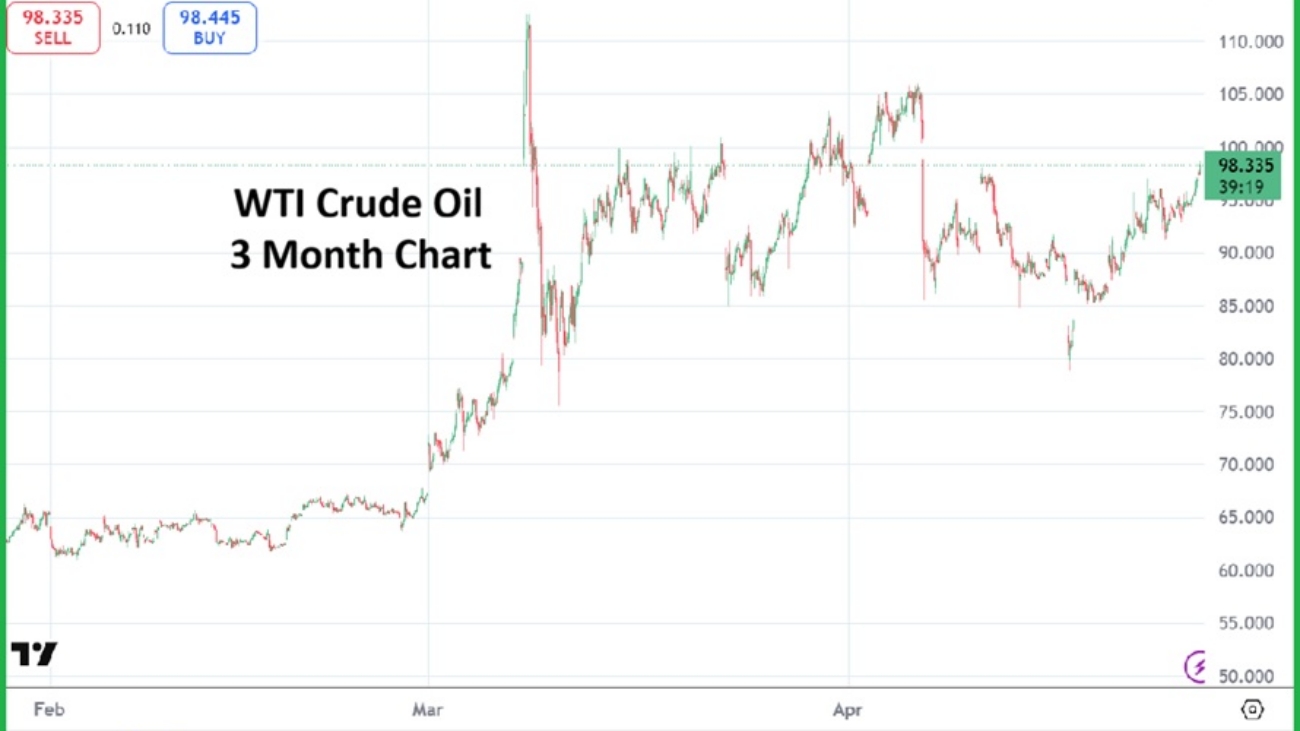
The current futures price for WTI Crude Oil is above $98.00. The cash price for the commodity is above $103.00. While many people continue to fret about what endgame strategy the U.S White House is conducting, what if we are seeing it play out in real time via the price of Crude Oil? Is it possible that President Trump has a coordinated plan to starve the Iranian regime and the IRGC of its much loved and needed money? It appears this is the case.

WTI Crude Oil Futures Three Months Chart on the 28th of April

Simply put, the Iranian Revolutionary Guard Corps is a mafia. They stay in power using the tool of fear brought upon by their ability to be ruthless to the Iranian citizens. They are a terrorist organization in the truest sense. If you disagree with that assessment, you are free to do so. However, facts when they are studied point to the conclusion Iran is a terrorist state led by its regime and the IRGC. 

Iran has made massive amounts of money via its energy products for decades. The shutdown of the Hormuz Strait, or at least the inability to export Crude Oil freely, is putting a strain on global energy prices, and it is causing a major fracture in the main financial export of Iran. 

The U.S has not only shut down easy navigation in the Hormuz Strait, but it is also going after Iran’s cryptocurrency operations. The ability to receive and transfer digital money by Iran is being strangled. What if President Trump is not only listening to the opinions of his military officers, and Secretary of State Rubio and Vice-President Vance, but also Treasury Secretary Scott Bessent who has an abundance of financial knowledge about how money flows internationally and how to create obstacles.

If the IRGC is not able to pay its own members, and other adherents to the Iranian regime are only slowly reimbursed, the apparatus of the IRGC will certainly lose its influence. The inability to pay allies that exists merely because they are employed or corrupted by the IRGC likely is starting to cause fractures regarding loyalties. 

China needs Iranian oil too. And evidence is starting to be speculated upon that China is facing tough decisions about acquiring Crude Oil from other sources. China will not be happy about having to pay higher costs, this because discounted Iranian oil that has abundantly been used is no longer available. 

Equities via the major U.S indices have done incredibly well since the end of March. The Nasdaq 100 has seemingly forgotten about AI overbought concerns, the S&P 500 is within apex territory and the VIX is acting as if sunny days are in the forecast. Forex has been volatile, but the value of the USD is within known realms.  However, the price of WTI Crude Oil is high and it has gotten higher since the 17th of April when futures prices briefly flirted with the $80.00 realm – this before going into a weekend. And this is a clue that something is afoot, beside larger players speculating on what their outlooks are for WTI Crude Oil in the mid-term.

The weekend of the 18th and 19th of April witnessed talk of an end to the Iranian war fall short; and heard President Trump essentially declare the ceasefire is still on but with the caveat that the U.S would create a blockade in the Hormuz Strait. While the semantics of a blockade can be debated, the U.S has caused shipping problems for tankers that were supposed to ship Iranian Crude Oil. The U.S clearly decided to create economic distress for Iran.

The Iranian regime still stands, but its leadership is rather shaken. The IRGC is controlling a lot of the decision making for the time being, and it appears the U.S White House is trying to make the IRGC weaker by ending their financial lifelines. It appears that it has been figured out that an economic war which includes starving Iran of cash is the most certain way to create revolts inside of the nation. When the influence of money is eroded, and temptations via other spheres of power suddenly sound tempting and can be joined, this is when shifts in authority and leadership can occur. 

While many analysts wonder about the lack of an obvious endgame being announced by the Trump administration, maybe it is already being played out. President Trump has a large ego and he is happy to extoll the virtues of his ‘tremendous’ policies frequently, but he also has shown the ability to remain quiet when it comes to plans of action and carrying them out. Yes, this can be argued into the late hours by pro-Trump and anti-Trump people. But maybe Trump is simply telling the truth when it comes to the U.S having time on its side regarding the Iranian ceasefire and the Strait of Hormuz. Maybe the clock is ticking on the eroding cash pile the Iranian regime and IRGC has within its grasp.
Copy and paste the text from AMT that you want to share

India Rupee 20260416

Progression Upwards for Indian Rupee and Catalysts

USD/INR Persistent Trajectory Remains in Force and Mid-Term Concerns

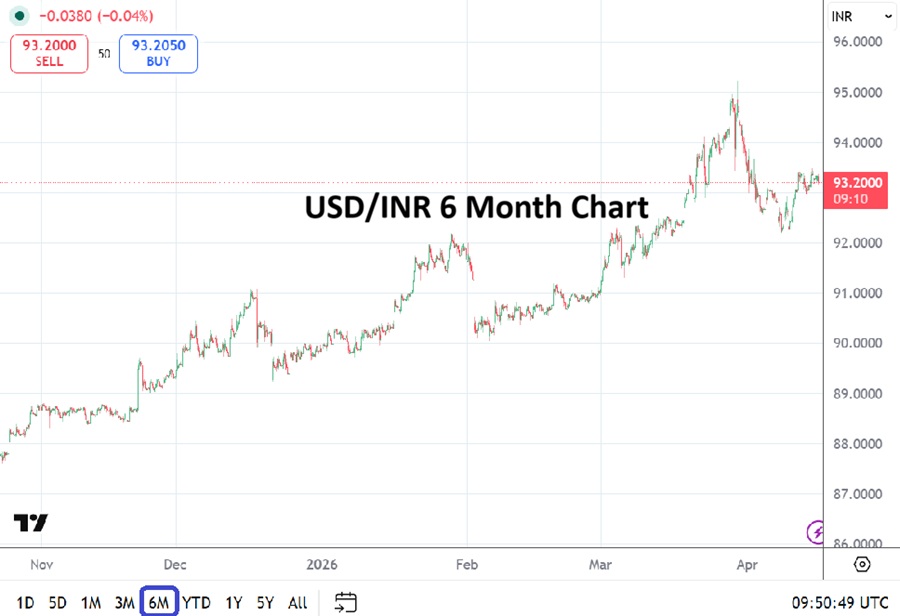
As of this writing the USD/INR is within the 93.2000 vicinity. The price of Gold is around $4,810.00 and Silver close to 79.50. Importantly, WTI Crude Oil is trading around $89.25. Global markets have turned in solid performances the past two weeks, this has been a two step progression for most investors. 

Indian financial institutions began to digest their worries regarding the Iranian war late in March – perhaps acknowledging the risks and ramifications, while adjusting outlooks. Then on Tuesday the 7th of April the establishment of a ceasefire was announced. However, after hitting a low of around the 92.2200 realm on the 8th of April, the USD/INR is back within higher ratios.

USD/INR Six Month Price Chart as of 16th April 2026

Yes, the USD/INR had been traversing above the 95.0000 ratio late in March, so it can be said the Indian Rupee has gotten stronger. Yet, there will not be many willing participants who will join a parade with the belief this lower trend can be sustained. The bullish trajectory of the USD/INR is not going to vanish.

On the 24th of October 2025, the USD/INR was near 87.7500. At this time last year the currency pair was close to 85.5000. A persistent and long-term move higher has been the theme in the USD/INR. Weakness in the Indian Rupee has been part of India’s economic story rather consistently for a handful of years. 

Narendra Modi has been in power since 2014, he is serving his third term as Prime Minister. His political party the BJP clearly has its chosen people within the Reserve Bank of India.

The government’s position of allowing the Indian Rupee to be weaker is not something they will want to state out loud as part of their mandate, but it is clearly not bothering them.

The pursuit of creating a stronger industrial and manufacturing base for India, including IT and software via good exchange rates for international clients is seen as a cornerstone to build demand. The quality of work and technology provided by the Indian workforce is good and this allows global clients to foster solid relationships with Indian companies.

However, the rise of the USD/INR to above the 95.0000 level in late March was a warning sign, that sometimes price velocity in Forex can become dangerous. And the Iranian war although enjoying a week and half of less noise, still could escalate into a problematic scenario for India that could cause additional concerns in Indian financial institutions who are trying to gauge their mid-term outlooks.

The USD/INR is an important part of this economic math and the prospect that higher energy costs, or in a worst case scenario – shortages incur hardship for Indian citizens and companies is an actual concern.

The current situation in the Hormuz Strait and availability of Crude Oil is significantly important for India. So is supply of LNG (liquefied natural gas) which Qatar, Oman and the UAE play a role. The supply of energy presents a glaring dark shadow for the prospects of the Indian economy should there be shortfalls. 

The 93.5000 resistance level has been durable since early April in the USD/INR. Stability of the exchange rate is crucial for a wide range of business in India, including banking and financial institutions active in the Bombay stock market – particularly since a weaker India Rupee opens the door to Forex concerns for foreign investors who do not have the ability to hedge if they are exposed via the INR too much. Foreign investors are needed in the Nifty indices to help values.

The near-term is likely going to remain a difficult path for the USD/INR and its outlook. The positive sentiment which has prevailed the past couple of weeks has been welcome and certainly stable conditions are hoped for so equilibrium can be kept. However, if the Iranian situation manifests into open military conflict again, or if there is a disruption of supply of energy that cannot be easily solved by India – then the USD/INR could once again face price velocity upwards that is uncomfortable.

While China may be getting the headlines regarding potential ramifications of its Crude Oil supply being threatened, India is estimated to have consumption that is ranked as the 3rd biggest globally. India’s ability to get a supply of energy from a diversified stable of sources is a key for the nation moving forward. 

The USD/INR will continue to move higher, the question is how fast? A slow steady rise in the currency pair – again, this will not be a spoken mandate by the Indian government – will continue. The fear of a rapid debasement is a concern. Financial institutions in India need steady emotions and are certainly hoping for the Iranian war to conclude with a sliver of optimism. 

Copy and paste the text from AMT that you want to share

Universe 20260409

Foreign Exchange and Reading Through the Noise

Brief Clarity, Constantly Interrupted: What Does Copernicus Have To Do With FX?

This article was first published the 7th of April on LinkedIn by the author.

I have spent most of my professional life in foreign exchange markets – an environment that rewards the ability to read signal through noise. And yet the older I get, the more I find myself drawn to a question that no Reuters terminal can answer: why do intelligent, well-resourced people, working inside some of the most information-rich institutions ever created, still systematically misread reality?

I think the answer has less to do with the quality of our data, and more to do with the nature of our frameworks.

The Ptolemaic Trading Floor

In the sixteenth century, Copernicus did not discover new stars. He did not build a better telescope. He simply stood in a different place and looked at the same sky – and from that different vantage point, the complexity that had been accumulating for centuries suddenly resolved into something simpler and more true.

The philosopher Thomas Kuhn, writing about this in The Structure of Scientific Revolutions, made a point that has stayed with me. The Ptolemaic astronomers were not stupid. They were brilliant people doing extraordinarily sophisticated work, and their model of the universe – with its epicycles and equants – was genuinely good at predicting where the planets would be. By their own measures, they were succeeding. But the framework was self-sealing. Every anomaly became a problem to be patched rather than a signal that the whole edifice needed replacing. The epicycles kept accumulating.

I recognise that trading floor.

The VAR models, the correlation assumptions, the ratings frameworks that failed simultaneously in 2008 did not fail because the mathematics was wrong within the model. They failed because the model had pre-decided what reality looked like, and reality declined to cooperate. The framework had accumulated its own epicycles – its own patches and exceptions and special cases – and nobody had stood back to ask whether the whole structure still made sense.

This is what the economist Herbert Simon called bounded rationality – the idea that we make decisions within limits of information, time, and cognitive capacity. But I think there is a deeper form of boundedness that Simon’s original formulation didn’t fully capture. It is not just that we lack information within a given framework. It is that the framework itself determines what counts as information in the first place. The boundary is not cognitive – it is epistemological. The frame has pre-decided what reality looks like, and we optimize furiously within it, never suspecting there is anything outside.

This is framework-induced bounded rationality. And financial markets are one of its purest expressions.

The Filmiest of Screens

William James, writing in 1902, described something that has always struck me as one of the most quietly radical observations in the history of psychology:

“Our normal waking consciousness, rational consciousness as we call it, is but one special type of consciousness, whilst all about it, parted from it by the filmiest of screens, there lie potential forms of consciousness entirely different. We may go through life without suspecting their existence; but apply the requisite stimulus, and at a touch they are there in all their completeness.”

James was writing about mystical experience. But I think he was also describing something that every trader knows intuitively – that there are moments of genuine clarity, where the market’s structure becomes briefly, luminously obvious, and then the noise closes back in. Not constant confusion, but brief clarity, constantly interrupted.

What interrupts it? I think James gives us a clue, though the fuller answer comes from a tradition he was only beginning to encounter.

The Deluded Self and the Distracted Market

The Yogācāra school of Buddhist philosophy, developed in the fourth and fifth centuries, offers one of the most sophisticated maps of consciousness ever produced. It describes eight layers of awareness, from the basic sense consciousnesses up through something far more interesting – the seventh consciousness, called kliṣa-manas.

Kliṣṭa-manas is the layer of mind whose function is to construct and defend a sense of self. But the Yogācāra tradition makes a more precise and more troubling point than simply calling it deluded. By the time information reaches the seventh consciousness, it has already passed through the sense consciousnesses and the discriminating mind – each stage filtering, selecting, and coloring what gets through. The seventh consciousness is not distorting clean data. It is working with inputs that are already biased, and it has no way of knowing this. It constructs its picture of reality from pre-processed material, and then defends that picture as if it were direct perception. Try telling a QANON follower to get a vaccine jab.

The parallel to institutional behavior in markets is uncomfortable in its precision. Risk committees, house views, investment mandates – these are the kliṣṭa-manas of the trading floor. They exist, at least in part, to protect the institution’s sense of itself. The risk manager who cannot recommend a position that contradicts last quarter’s framework. The economist whose forecast must remain defensible to the committee. The trader who holds a losing position because admitting the loss means admitting the thesis was wrong. These are not failures of analysis. They are the seventh consciousness doing exactly what it was built to do.

And into this environment, the attention economy arrives as accelerant. Social media does not simply distract – it feeds kliṣṭa-manas directly. Likes, outrage, identity, tribal affiliation – all of it strengthens the self-constructing layer and weakens the capacity for clear perception. The signal-to-noise ratio in markets was already difficult. We have now built an entire industrial infrastructure for generating noise that feels like signal, because it flatters the self that is doing the perceiving.

Standing in a Different Place

The Yogācāra tradition does not stop at the seventh consciousness. Beneath it lies the ālaya-vijñāna — the storehouse awareness, a kind of ground-level consciousness before the self-construction begins. It is not a mystical concept, or not only that. It is a description of what perception might be like before the defending ego has finished processing it.

The best risk-takers I have encountered in markets seem to access something like this, in their better moments. A capacity to see the position as it actually is, without the framework that produced it colouring the perception. To hold a view lightly enough to abandon it when the evidence changes. Copernicus looking at the same sky and seeing something different – not because he had more data, but because he had momentarily freed himself from the inherited frame.

James was right that these states are parted from ordinary consciousness by the filmiest of screens. The Eastern traditions – Buddhist and Vedantic – have spent two and a half millennia developing systematic methods for thinning that screen. Western psychology, for all its extraordinary achievements, has been slower to take this seriously, often treating consciousness itself as a problem that better neuroscience will eventually dissolve. It may be that, in this respect, we are in the position of the medieval scholars encountering Arabic science – not lacking intelligence, but working within a framework that makes certain questions difficult to even formulate.

What This Has To Do With FX

Markets are reflexive. The moment enough participants adopt the same model, the model changes the thing it was measuring. The framework that produced clarity attracts capital, the capital erodes the edge, and you need a new framework. Brief clarity, constantly interrupted – not as a pathology, but as the structural condition of the thing itself.

The question is not how to achieve permanent clarity, which is probably neither possible nor desirable. The question is whether we can develop the capacity to notice when we are inside a framework rather than seeing through it – to feel the epicycles accumulating before the model breaks.

That capacity, I suspect, is less a matter of better data or faster processing, and more a matter of the quality of attention we bring to the screen. Which means the most important professional development available to a markets practitioner might not be in a CFA curriculum.

I am aware of the irony of writing this on LinkedIn, which is itself a highly effective delivery mechanism for kliṣṭa-manas. The seventh consciousness is nothing if not adaptive.

Note: The author works in foreign exchange markets and thinks too much.

Copy and paste the text from AMT that you want to share

Markets Say 20260407

What Do the Markets Say?

Ambivalence Rules the Day

Opinion: The following article is commentary and its views are solely those of the author. This article was first published the 7th of April via The Angry Demagogue.

There is nothing we capitalists like saying more than “the markets say….”. What we mean is that the amorphous group of individuals and institutions that together form some sort of consensus as to the value of “things” taking everything known by the individuals involved into consideration. Since no one can know everything, the idea is that the market represents the sum of knowledge of everyone who has money to invest – or, as we like to say, “skin in the game”.

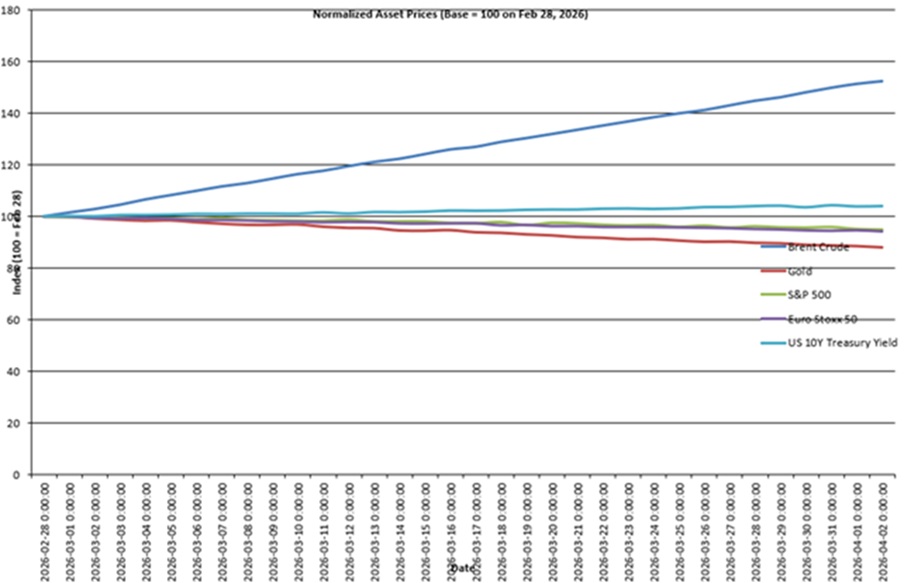
Below is a graph from the start of the war until April 2, of oil, gold, 10-Year U.S Treasury yields, American and European stocks. Each should tell us something and in general all together they should be saying the same thing. However – that is not the case here considering we are in the midst of a major Middle Eastern war, with China and Russia watching with interest and Western Europe squirming with unease.

Normalized at 100 via ChatGPT as source.

Those items that signify a flight to safety are the price of gold and the U.S Treasury yields, while those that signify a faith in the future of the economies are the index levels of the U.S and European stocks. A commodity that is directly affected, oil in this case, is expected to rise and it has, by over 50% since the start of the war.

While one would expect the price of U.S Treasuries to rise considerably as it is considered a “safe haven” by investors, it has risen just 4% as yields dropped from 4.31% to 4.13% (with bonds, prices and yields moving inversely. A rise in bond price is a decline is their yield – meaning they earn less for the bondholder). Gold, the other safe haven, though has dropped by nearly 12% since the start of the war. True enough, the price of gold has skyrocketed over the past year, but still while there is a reason why gold might underperform U.S Treasuries, it is odd that it has underperformed stocks on both sides of the Atlantic, in spite of the 50% increase in the price of oil – forcing up energy prices for industry. Stocks in the U.S have dropped by just 4.95% while in Europe the decline is just 5.8%. Neither number is one an investor wants to see in just six weeks, but all things considered the war has not caused a lack of confidence in the economies of the EU or the U.S.

People might claim that gold has lost its safe haven luster over the years, but that is not the belief of governments as India and China have been buyers of vast stores of gold and France decided to repatriate all of their gold reserves. They still see it as necessary.

So, what are the markets telling us about this war and the future of domestic and global economies? Regarding Iran, the supposed victors in this “quagmire”, the Iranian Rial has dropped 96.8% in 2026 and has moved from 0.00002378 to the dollar to an incredible 0.00000076 (that means that 1 million Iranian Rial equals 76 cents) the market speaks in one voice – no confidence.

Regarding the rest of the world the markets are not really telling us much of anything because there has not been a rush to safe havens as usually happens in wars and happened during Covid, nor has there been supreme confidence. The markets are, shall we say, ambivalent.

That volatility is high and that they move drastically on each Trumpian proclamation is more a sign that the algorithms that control the very short term market trends are mostly chasing the same thing. When X happens, sell Y is a race to the bottom by unthinking and unsophisticated (in spite of AI) analysis until that race causes the “when Y hits a certain price, buy it” or “when Z happens then buy A” algorithms kick in. After a few days or weeks, we can start to see trends as long as we ignore the record highs or lows. However, there is nothing other than “wait and see” ambivalence in the current market data.

While this does not necessarily mean that the “markets” are in support of the war, but neither does it see a debacle of any sort. The Libyan bombing campaign of 2011 lasted seven months with no real Western interests involved and the Kosovo ariel campaign of 1999 lasted around 3 months and involved humanitarian but not economic interests. The 6 weeks of this war, so far, is not at a level of “quagmire” for the markets.

If the markets are telling us anything now it is that while oil may stay high for awhile, the world is not heading south due to the war. This can change– for good or bad – but the markets themselves are not currently taking a stand either way. They are not telling us we are in for a rough ride. While we believe that this war will reshape global politics and alliances and create an economic boon for the victors, no one can be sure who will end up on top and who will suffer once the war winds down.

The defeatists around the western world could do worse than listen to what the markets are not telling us.

Disclaimer: the views expressed in this opinion article are solely those of the author, and not necessarily the opinions reflected by angrymetatraders.com or its associated parties.

You can follow Ira Slomowitz via The Angry Demagogue on Substack https://iraslomowitz.substack.com/

Copy and paste the text from AMT that you want to share

South African Rand 20260327

G7 Snub for South Africa and other Troubles for the South African Rand

USD Centric Strength and Global Anxiety Weighing on Value of Rand

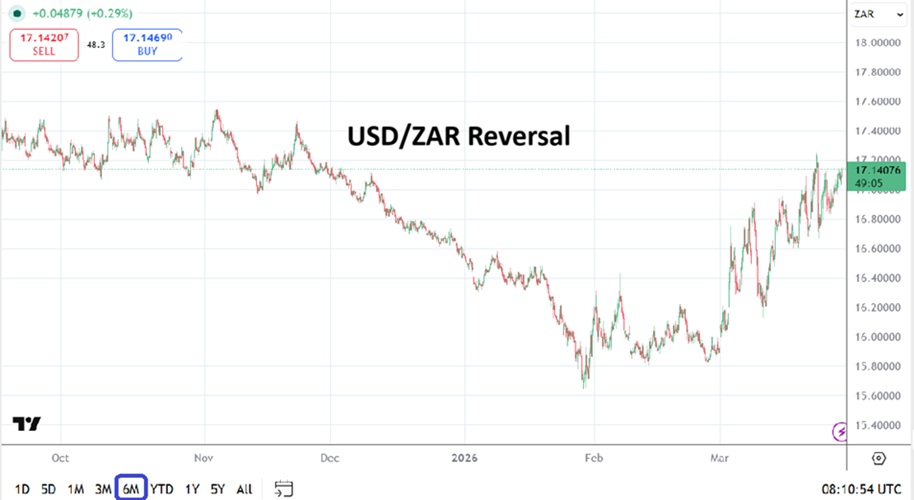
The USD/ZAR is still above 17.00000 in early trading this morning, this as USD centric strength manifests globally due to anxiety which clearly exudes because of the ongoing Iranian war. The USD/ZAR is near the 17.11000 realm, with wide spreads via bids and asks.

The price of Gold is close to $4,450.00 and Palladium is around $1,395.00 – this after touching apex marks in late January when the $2,100.00 level was breached.

USDZAR Six Month Chart as of 27th March 2026

These metals are important for South Africa, but their daily values do not effect the USD/ZAR like they did in the past because of other complexities. The USD/ZAR which had enjoyed a stellar bearish trend and touched lows of 15.68000, late in January, could be correlated to the decrease in value to the precious metals by some, but this is likely false narrative.

When the larger picture of pure behavioral sentiment within the Forex broad market is looked upon other factors are a certainty. The South African Rand, in a rather healthy manner, is largely dependent on financial institutions outlooks regarding the USD, 10-Year U.S Treasury yields, and what the U.S Federal Reserve outlook projects.

The U.S central bank, which many people including myself, was thought to be in position in which the Federal Funds Rate would be lowered in the coming months, now faces complications due to what may become chronic higher energy costs through the mid-term if the war in the Middle East persists and inflation due to logistics, manufacturing and agriculture are effected.

The USD/ZAR near the 17.0000 is a good barometer of South African financial institutional attitudes. Yesterday’s news that South Africa will be excluded from the G7 meetings in France, which will be held in June, will not make folks in South African financial spheres content. However, these same people within the machines of corporate finance in South Africa have grown used to the vagaries of mismanagement, corruption and perceptions these cause for the nation. While some South African government officials initially said France had been pressured by the U.S to disinvite South Africa from the G7 summit, they have changed their tune this morning and are trying to downplay the exclusion as insignificant.

Thus, we return back to the USD/ZAR and near-term considerations. While the currency pair has shown the tendency to reverse lower when marks above 17.10000 have been challenged the past few weeks in March, this morning’s early trading which is sustaining higher values is troubling. The consideration that nervousness among global investors remains skittish at best is unsettling. Those who are making short and near-term wagers on the USD/ZAR are likely concerning themselves with the upcoming weekend and its unknowns. From a trading perspective, folks are usually cautious about taking speculative positions over the weekend when they fear there is a possibility of bad news.

The USD/ZAR is touching important resistance above, if calm doesn’t return to the broad markets across various international assets today, the currency pair may find itself testing higher realms as next week begins.

Looking for downside in the USD/ZAR may prove difficult to attain later today. Traders should keep their eyes on other gauges and watch the U.S 10-Year Treasury yields which are near 4.45% (highs that haven’t been seen since July of 2025), WTI Crude Oil prices and the major U.S equity indices which are in correction territories.

From a betting perspective, if U.S 10-Year yields escalate and the price of energy ebbs upwards today in commodity markets, and there is more trouble on the Nasdaq 100 and S&P 500, this will be problematic. The USD has been volatile, but has certainly shown a tendency to get stronger in recent weeks. A higher USD/ZAR above the 17.20000 is not out of the question.

Copy and paste the text from AMT that you want to share

post213

Federal Reserve Expected to Sound Guardedly Cautious Tmrw

Federal Reserve Expected to Sound Guardedly Cautious Tmrw

EUR/USD Five Day Chart as of 17th December 2024

Large traders are clearly bracing for the Fed tmrw as Forex produces volatile tight ranges. A rate cut is expected, but cautious Fed rhetoric will likely follow.

Forex has been a dangerous wagering ground for retail traders since the end of September. Financial institutions which clearly were betting on a more dovish Federal Reserve starting in early summer becoming a central theme into 2025 have been proven half right, this as the Fed has cut interest rates and is expected to do so tomorrow. However, being half right leaves the door open to also being half wrong, and financial institutions have reacted to this by becoming aggressive buyers of the USD since late September as perspectives have changed. The strong USD trend the past two months plus has hit some speculators hard.

The election of Donald Trump added a strong dose of impetus for USD buyers, this as the President-elect’s tough rhetoric regarding tariffs caused reactions and fear of unknown consequences. In the past couple of weeks more tranquil Forex trading has emerged and the USD finally started to give back some of its gains, yet the USD versus most major currencies, like the EUR/USD, remains within the the stronger elements of it range. While the Fed is expected to lower its Federal Funds Rate tomorrow by 0.25 to 4.50% tomorrow, traders need to remember this has been priced into Forex already. Tranquil trading the past two weeks indicates financial institutions have readjusted their outlooks to the incoming White House administration.

Now it is time to see if the U.S Federal Reserve has started to adjust their outlooks to what a Trump Presidency means. And financial institutions are keen to better understand the outlook of the U.S central bank. Inflation numbers while traversing lower are still rather stubborn and this may will not help the Fed’s mid-term mindset regarding interest rate cuts. GDP in the U.S has remained steady, and there is the potential the economy in the States will improve under Trump. Unemployment numbers while showing signs of weakness have not been terrible either. So while the Fed’s current Federal Funds Rate is higher than normal taking into consideration the historic average the past ten years, they still may not feel they have enough ability to cut interest rates too much more without sparking inflation.

A January rate cut seems unlikely at this time. If the Fed does sound guardedly cautious tomorrow, retail traders may see the USD get initially weaker due to the Fed rate cut, but then see a storm emerge and USD centric strength reappear all in the same day – perhaps in the span of minutes. Speculators need to understand that financial institutions have already baked tomorrow’s interest rate cut into the cake. So it isn’t the rate cut tomorrow that is important if it happens (if it doesn’t then that’s another story); it is what the Fed says and traders should expect them to be very cautious – because per the recent trading of the USD and a barometer it appears financial institutions are bracing for a more vigilant Fed.

Just like he has with many folks he views as uncompromising before, Donald Trump may begin to feel Federal Reserve Chairman Jerome Powell is not on his side regarding interest rate policy. If the Federal Reserve chooses to sound hesitant to cut interest rates in early 2025, it will be rather intriguing to see President-elect Trump’s response. Could a confrontation between the White House and Federal Reserve be in the cards over the next six months?

postR195

Impolite Opinion: BRICS and a Western Loss of Power Part 2

Impolite Opinion: BRICS and a Western Loss of Power Part 2

BRICS Future Members and Potential Strangleholds

The West is moving too slowly as if stuck in an abyss of indifference, this while BRICS adds members, including the prospects of Saudi Arabia, Malaysia and others to participate. The ability of BRICS to work alone via trade agreements and increase collective strength is growing.

Some BRICS nations have expressed their perspectives the West is an antagonist that practices unfair trade and environmental colonialism. The West is accused of attaining important resources from the developing world, destroying the habitats of these nations as minerals are mined, food is grown and harvested, and energy is sought and produced that create degraded ecosystems. The West is cited for keeping their landscapes pristine, while using the ‘cheap’ land and labor of the underprivileged to procure needs. And as the West has increased their reliance on commodities attained from afar, they have become vulnerable to the threat of a potential stranglehold on resources controlled by BRICS like rare metals.

BRICS will certainly attain additional nations via the FOMO adage. The enticement of membership and ability to cease underdog statuses and stop being mere supply conduits to richer nations is appealing. Mexico is said to be considering potential BRICS inclusion, and we are probably not far away from a European State asking to join.

The Power of Commodity Prices and BRICS Influence

The West must engage and rethink associations and to make sure countries are not treated as lower tier. If nations like Mexico join the BRICS dynamic, and newly created cartels strengthen economic practices and policies of the organization, the prospects could eventually lead to the creation of a new fiat currency. For the moment BRICS has wisely pushed this goal to the side, but the idea of a unified currency is certainly being discussed openly. An increase of BRICS economic power derived from robust trade would tempt financial institutions to consider start buying bonds if offered as investments.

The West must ask what the dangers are if a needed commodity supply is controlled by a BRICS cartel that could suddenly initiate boycotts and trade limitations upon those BRICS does not agree. Food, energy, and mineral scarcity if controlled by nations not seen as allies of the West would be dangerous. Economic power within BRICS would certainly turn into geopolitical strength. The ability of developing nations to have a collective economic voice and create supply dynamics within commodities would ignite hazards for the West.

BRICS, U.S Government and USD Reserve Currency Status

While the West worries about domestic issues such as creating a politically correct happy tent for everyone, the larger powers within BRICS are engaged in the big picture which might be uglier but may carry more importance long-term. Because a lot of BRICS political power comes from more authoritarian stances, they are able to plan policy not only with five, but ten and twenty year outlooks. Western leadership needs to be willing to engage in a complex world and make sure nations that are not seen as natural bedfellows are treated with respect and brought under an economic umbrella that allows them to engage on equal terms.

The long-term future of the USD as a reserve currency is coming under increasing doubt, the trading of the currency in Forex is slowly and surely losing its footing via incremental percentage changes that point to deterioration. A void in solid leadership in the U.S and unrestrained spending are making the tasks harder for the Treasury and Federal Reserve to protect the strength of the USD. Fiscal deficits are one thing, 35.6 trillion USD of debt is another matter. How long can the U.S carnival sell tickets and expect people to be entertained in a magic act that prints money and backs it with increasingly vulnerable bonds? The U.S needs to change its fiscal policies efficiently.

There are ways of looking at this per different perspectives, but if BRICS does achieve its economic aim of creating more equitable trading coalitions, it could sustain alliances which the West may not be comfortable and actually be susceptible. The phrase that money talks and nonsense walks should be kept in mind regarding BRICS. The promise of fair trade among its members is important, but the ability to be unified politically and create economic transparency is important too. Many of the nations who are members of BRICS have not practiced solid economic policies and are still looked upon as suspicious fiscally.

Gold and a Decoupling of the USD

Importantly, we must begin to ask if financial institutions have figured a lot of what is mentioned above out and started to position themselves. Financial institutions and nations may be starting to look for a balance between the world’s reserve currency which is the USD, and the ambition stated by China’s Xi Jinping at the latest BRICS summit to create an alternative financial system.

If this alternative financial system includes BRICS as one of its foundations, and is based on organized cartels which use commodities as a backbone a new paradigm will be introduced. And if BRICS evolves and has the means to introduce a new currency along the lines of the EUR with a coalition of associated nations, the West will be faced with competitive questions. This new currency – let’s calls it the BRICS Unit (as reported by others), if it can trade calmly and with significant volume, and also offer innovation like a digital currency would change the balance of global power. The potential lose of status for the USD as the world’s reserve currency would weaken the U.S immeasurably. We have seen this show before via the GBP and the Britain.

A battle between a legacy reserve currency and an innovative upstart which wants to become a reserve currency could cause mayhem – potentially leading to a winner or all currencies losing confidence. Folks thinking ahead of the curve may already be putting money into gold because it is a historical store of value. Can the rise in gold seen the past year be quantified via not only a fear of inflation, speculation, and concerns about central banks, but also a reaction because of a looking glass into the future that does not trust the outlook of the USD? It is just a theory, but what if safe haven buying of gold signals a decoupling is taking place with the USD as its status weakens?

It should be added that the lack of a declared currency by BRICS as of yet, shows a level of political maturity and understanding of the current economic landscape. BRICS has shown the ability to take a long view and not act impulsively. A coalescing of commodity strength via gold, crude oil and other resources with organized cartels and solidified trading would give the BRICS Unit more credence upon its birth, but patience will be needed. And, like the EUR, the BRICS Unit could suffer from internal political strife, and particularly if the West wakes up and takes action to engage nations who are sitting on the economic fence and offers beneficial trading agreements.

The Western method of nonchalance that all will be well is naive. However, BRICS still face hurdles. Grievances could prevail in BRICS and cause it to falter and perish, some member nations which have had difficult relationships will need to put their distrust aside. An example of potential problems could come from Egypt and Ethiopia that have a long history with each other, both have massive populations and centuries of political intrigue when dealing with each other. However, BRICS represents the thinking of realpolitik vs. the winsome misguided aspirations of some Western nations with leaders who have their collective heads in the sand. The West needs to advocate collective interests, which includes freedom, solid enterprise agreements and large consumer markets. The West needs to focus on the competition emerging with BRICS. Pretending the danger doesn’t exist amounts to negligence and a potential lose of economic power the West cannot afford.

If you have not read Part 1, here is the link:

postR196

AMT Top Ten Miscellaneous Interpretations on the 13th of Oct

AMT Top Ten Miscellaneous Interpretations on the 13th of Oct

10. Language: The French word histoirie includes both history and story via its English interpretation. The French usage conveys the acknowledgement that history is often subjective and a story written with an opinion which may or may not be the correct narrative.

9. Subway Series: New York baseball fans will be in an uproar this coming week as the Mets play the Los Angeles Dodgers, and the Yankees face the Cleveland Guardians. The potential of a crosstown World Series will have NYC holding its collective breath. New York fans shouldn’t celebrate too soon, because the Dodgers are dangerous and the Guardians will be competitive.

8. Free Press: CBS News in the U.S has been widely condemned this past week. Video released shows ’60 Minutes’ explicitly edited an interview with Kamala Harris. Also, a recorded and ‘leaked’ staff meeting from CBS management has come to light in which Tony Dokoupil, a news anchor, is reprimanded for asking critical questions to writer Ta-Nehisi Coates.

7. Barometers: Gold went into this weekend near 2,656.00, WTI Crude Oil closed around 75.45 on Friday, and U.S Treasury yields increased this week and are now challenging values last seen in the third week of August. Intriguingly, the major U.S equity indices continue to flirt with highs. Broad market results appear to be walking a tightrope as financial institutions seem to be waiting for November and U.S election outcomes. However, long-term investors who are diversified maybe cynical of this thought, and believe buy and hold remains the best policy.

6. Buy or Sell: Negativity surrounding Boeing via workers who are on strike, layoffs, a potential corporate bonds downgrade, production delays, and court decisions are still shadowing. In December of 2023, Boeing was near 265.00 USD per share value. Prices were near 158.00 this time last year, and as of this weekend Boeing is close to 151.00. The bad news surrounding Boeing has been a thorn in the side of investors. Boeing is a major corporation in the U.S and relied upon militarily and for global public aviation. What is the downside potential for Boeing the next year compared to upside capabilities long-term?

5. Crypto: The SEC has filed charges against Cumberland DRW LLC, claiming the crypto exchange has been acting as an unregistered dealer. https://www.sec.gov/enforcement-litigation/litigation-releases/lr-26151 It appears the SEC is growing more aggressive via confrontations with U.S based cryptocurrency exchanges. The U.S election result will play a role in the future leadership and direction of the SEC, and could have an affect on cryptocurrency values. BTC/USD is near 62,700.00, ETH/USD around 2,465.00, BNB/USD about 575.00 at the time of this writing.

4. Tranquility: Stronger USD centric price action continues to create some downwards motion for other major currencies, but price velocity was not as violent last week compared to previous days since the end of September. Fragile sentiment in financial institutions is still stirring. The ECB rate decision this week will come Thursday and a 0.25 basis point cut is expected. Traders need to remember that a change to the European Central Bank’s Main Refinancing Rate has likely been priced into the EUR/USD. What needs to be heard now is ECB rhetoric and that is likely to remain guarded. Price velocity in Forex remains a danger for retail traders this coming week.

3. U.S Election: There are only three weeks left until the U.S vote. Day traders need to understand financial institutions will grow more cautious as the election approaches. Speculators may want to try and wager on the outcome of the election, but unless a definitive result is predictable beforehand, it will be hard to take advantage of political winds which are swirling. It will be nearly impossible for day traders to hold onto a position over the next few weeks unless they have deep pockets, use no leverage, and have the patience of a saint.

2. Make or Break: China will release important economic data this week. Trade Balance and Foreign Direct Investment numbers are tentatively scheduled to be released on Monday, along with New Loans reporting. This coming Friday New Homes Sales, GDP, and Retail Sales figures will be released. China is trying to stimulate the economy with billions of cash, but critics suggests this will not work. The Shanghai Composite Index is near the 3,217 mark, on the 30th of September the SSE was near 3,675. Before the China stimulus was released the Shanghai Composite was near 2,755. Bullish SSE momentum has run into headwinds since the beginning of October, China may be pressured to try and create more stimulus, but will it produce a lasting positive result? Traders caught up in the buying frenzy in late September are likely getting more nervous about declines. The USD/CNY is near 7.066. Chinese economic data should be monitored this week.

1. Interest Rates: The Federal Reserve via the CPI and PPI inflation reports still appears able to cut another 0.25 basis point from the Federal Funds Rate on the 7th of November. While the Consumer Price Index data showed a slight tick up in a few categories, Friday’s Producer Price Index met expectations via the core monthly report and the broad monthly outcome came in less than anticipated. The November interest rate decision is important regarding consistency per the Fed’s messaging the past two months, and mid-term behavioral sentiment outlook among financial institutions. U.S Retail Sales and Housing numbers will be published this week.

postR182

Risk Analysis Review: Warning about Coronavirus in Feb. 2020

Risk Analysis Review: Warning about Coronavirus in Feb. 2020

Below is a risk analysis note written in February of 2020 regarding the risks and potential implications of coronavirus as seen by Robert Petrucci on financial markets. The letter was sent to a senior associate who was a Chief Investment Officer for a firm. After speaking to the senior associate on the phone, feeling as if his thoughts were dismissed without heed and told he was too concerned about coronavirus, Mr. Petrucci sent the following to the CIO:

Thanks for asking about my thoughts.

What worries me is the opportunity for the virus to be a catalyst. The reactions in the E.U by government talking heads reminds me a lot of the financial crisis in 2007 when people publicly disregarded the potential domino effect which was becoming apparent. 

The Coronavirus imo is a potential domino which could take down the remainder of a fragile architecture. Meaning the ill-conceived philosophy and work of central banks in Asia and Europe have left them with little regarding ammunition should they need to fire an economic gun. If Europe and Asia buckle the US will be left limping too.

Psychologically the markets appear vulnerable, but as you rightly point out the higher realms of the Indices have been waiting for a bit of a sell off for a long time and the selling underway may be more of a reaction and mere trigger which has been long overdue. 

However, I wonder about the ‘clever’ algorithms which have been developed and trade also due to human bias. What concerns me more than what is taking place in China is what is happening in Italy right now. 

Italian governments have a long political history of ineptitude and disregard of reality regarding numbers which are staring them in the face, particularly with budgets and a long tradition of corruption and its destructive force on transparency. If Italy continues to spike higher infection numbers and continue to escalate then I believe the E.U is in for trouble. The inaction of Italy and its reliance on the tourism business will make it hard for them to accept shutting down major airports and cities which enjoy the fruits of international visitors year round. 

Also, I must add and circling back to China that it is not known yet if another outbreak may suddenly appear in another zone if someone dealing with this asymmetrical virus is unaware of their affliction. 

Which brings me back to the springboard, worst case scenario I fear is a major outbreak in the E.U including Germany. If we see signs of spikes statistically across Europe the next two weeks it will be devastating economically for the next quarter financially. 

As you say, things will certainly bounce back, they always do, we must look at the long term. Investors need to keep a stiff upper lip and protect themselves as you have done in many regards with Indices, US ten year bonds and some gold. 

The question for me now is what happens the next ten business days across the U.S and Europe and how the world handles this virus. Worst case is pandemic and bad Central Bank formula, which have been in place the past twelve years with cheap money. The desire to keep everything steady may in fact lead to miscalculations which have not been planned for and cause reactions in the markets which cannot be checked this time around. I do not believe we are at a Black Swan point yet, but it does worry me that the E.U politicians and even some U.S politicians seem to have their head in the sand or look like deer stuck in the headlights.

Robert Petrucci 26 Feb 2020

postR196

AMT Top Ten Miscellaneous Complexities for the 14th of June

AMT Top Ten Miscellaneous Complexities for the 14th of June

10. International Tech Research: Universities and institutions around the world are developing innovative systems to deliver a quantum future. Cal-Berkeley, MIT, Cambridge, the Barcelona Supercomputing Center, the Institut Polytechnique de Paris, and the Cleveland Clinic are only a few of the places in the ‘West’ that investors should monitor for developments, Asia is also very focused on high speed computing.

9. Musk Schedule: The tech mogul has had a busy week. His Tesla stock option compensation package was approved by shareholders yesterday. In 2018 Musk negotiated a package with Tesla that included a massive compensation agreement via stock options if he met valuation targets over a 10 year period. He achieved the valuation goals within only a few years. Musk also formally dropped his lawsuit against OpenAI and Sam Altman in recent days, this after the enterprise released emails showing Musk backed OpenAI’s pursuit of profits in the past. Around 2015 Musk invested about 45 million USD into OpenAI.

8. Muted Data: The U.S Consumer Sentiment and Inflation Expectations numbers will be released today via the University of Michigan. However these numbers are likely not going to impact financial assets in the U.S. The Fed and CPI results from the States published this past Wednesday will dominate the investing narrative. Searching for meaning regarding why assets move in a particular direction is the media’s job, but perceived realities always remain open to complex interpretations as real time prices are exhibited. Day traders need to be cautious of revisionist history.

7. Petrol Dollar: Saudi Arabia has not reconfirmed its commitment to transact Crude Oil exports with USD. The formal agreement reached in 1974 has expired. Forex traders should not panic about this development yet. Speculators should note that Saudi Arabia is likely to still demand most of their payments in USD since they can count on the valuation of the currency to remain relatively tranquil compared to other instruments like China’s Yuan. What the absence of an agreement between the U.S and Saudi Arabia does indicate unfortunately, is that U.S foreign policy continues to look vulnerable.

6. Optimism: A South Africa government coalition agreement could be formalized soon and create a better economic outlook for the nation. While geo-political concerns remain, and the ANC is not a 100% friendly philosophical match with the Democratic Alliance and some of the other political parties which will be involved, it appears a working agreement can be reached. The question in South Africa is if transparent fiscal and anti-corruption mandates can be accomplished while diverse political outlooks will be heard and demanded from different factions. For the moment, financial institutions seem to like what they are hearing and the USD/ZAR has edged lower in the past week.

5. Highly Valued: Gold is over 2300.00, BTC/USD is near 67,000, and Cocoa is within sight of 11,000. Speculative large players remain active, and traders looking to take advantage of short and near-term fluctuations in these commodities need to remain vigilant. Cocoa, while extremely dangerous to trade, has outperformed gold and Bitcoin recently. Investors in gold think long-term, and Bitcoin influencers preach ‘hold on for dear life’ as non-believers shake their heads in disagreement. However, daily gyrations influenced by large players can still wreck havoc on those looking for short-term wagering opportunities.

4. Zombie Fed: Cautiously optimistic undertones were served from Jerome Powell as expected this past Wednesday, but intriguingly Powell admitted some government data remains open for interpretation, particularly the suspiciously strong headline jobs numbers which are being questioned. The Fed now says its outlook is for one interest rate cut this year. Financial institutions likely believe the Fed remains too reactive. The U.S GDP has shown signs of struggling, and CPI numbers have begun to erode. Crude Oil prices remain under 80.00 USD. However, the Fed seems intent on still pumping the brakes in order to kill off inflation via the high Federal Funds Rate. It would help if the U.S govt stopped spending cash recklessly, and the U.S Treasury stopped printing money.

3. Equities: U.S political concerns as the election approaches will create more analysis paralysis than normal. Short-term behavioral sentiment may sound nervous, but a bullish trend and risk appetite remain evident. Day traders may be able to take advantage of technical trading via support and resistance in CFDs, but fundamentally financial institutions appear inclined to count on equity indices achieving record highs.

2. 157.000 – 158.000: Today’s BoJ decision to remain stuck in the mud has created more financial institutional dismay in some quarters, and the the Japanese Yen will be punished occasionally against the USD. But the folks at the BoJ are not stupid and likely anticipated the USD/JPY move higher which ensued. The BoJ is obviously preserving its ‘soft devaluation’ of the JPY in order to maintain an export advantage for the U.S and European consumer markets. The question is if and when the BoJ will buy billions worth of JPY in order to punish bullish USD/JPY Forex speculators occasionally.

1. Volatile Near-Term: EUR/USD and GBP/USD price action has been boiling. France and the U.K have crucial elections in the coming weeks, after policies in both nations have led to a lack of confidence in the ruling governments. The ruckus outcome from the E.U Parliament voting have created an intriguing complication. Oddly enough, the U.K may be the left’s torch bearer in the coming year, while other European nations drift towards the right. Can centrists create a middle ground? Volatility and the search for equilibrium via financial institutions may create a lot of opportunities for Forex day traders in the coming weeks in the EUR/USD and GBP/USD as reversals and trends are sought.

postN1

BoJ and Fed are today’s Forex Bogeymen, and Job Numbers Lurk

BoJ and Fed are today's Forex Bogeymen, and Job Numbers Lurk

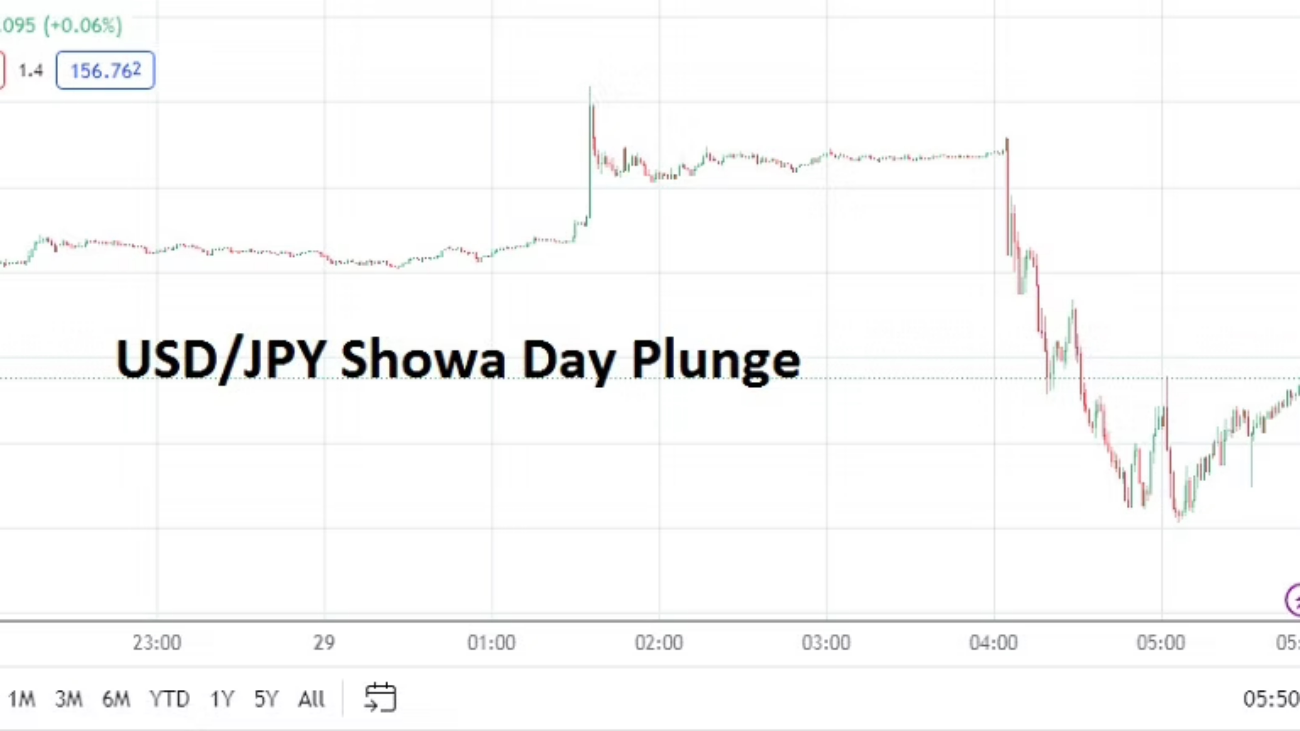
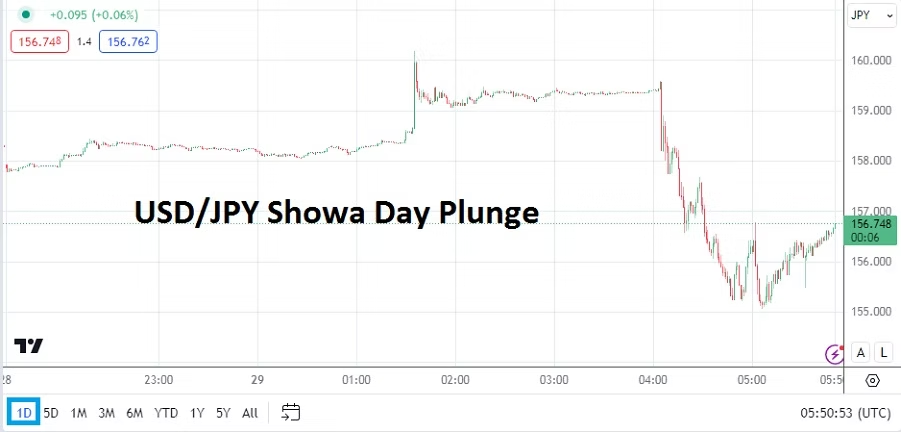
While the Showa holiday is being observed in Japan, the BoJ has apparently reacted with an intervention after seeing the USD/JPY race to new highs in the wake of the central bank’s decision to hold its Policy Rate at 0.10% on Friday. If in fact the Bank of Japan has acted when most Japanese financial institutions are celebrating a long holiday weekend, the reaction to the intervention will be noteworthy when Japanese currency traders return to their desks tomorrow. The question obviously becomes whether large players in the JPY will continue to wager against the Bank of Japan’s current monetary policy or if the apparent intervention will make them cautious.

USD/JPY One Day Chart as of 29th April 2024

U.S data this past Thursday turned in rather clumsy statistics starting with the Advance Gross Domestic Product growth results which showed the American economy is slowing. However, the GDP Price Index came in slightly higher than anticipated. This caused some tremors in Forex. Friday was followed by additionally troublesome readings when the University of Michigan’s Consumer Sentiment outcome was weaker than expected, but the U of M Inflation Expectations gauge was higher than the previous month’s report.

USD Cash Index Five Day Chart as of 29th April 2024

The USD began to show signs of weakness in many major currency pairs last week. Perhaps the expectation that the worst of Federal Reserve outlook has now been absorbed is playing into the Forex results. However, the past four months of trading have produced a continuous choppy wagering landscape for speculators and clarity still does not exist.

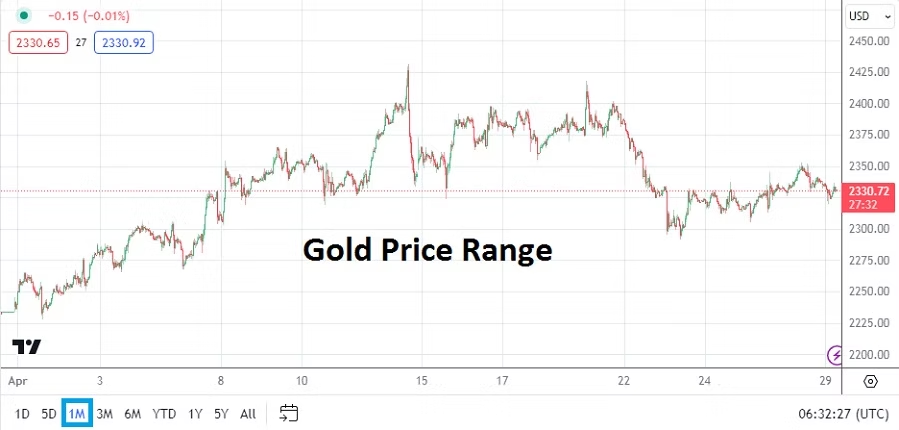
Gold One Month Chart as of 29th April 2024

Suspicion of the Bank of Japan’s intervention this morning and the creeping shadow from the U.S Federal Reserve which is scheduled to deliver their FOMC Statement this Wednesday have created trading bogeymen in many financial assets. The strains in the major equity indices, Treasuries and Forex are prime examples. While day traders try to find fair market value technically and financial institutions seek equilibrium, most observers likely have nervous behavioral sentiment as they consider mid-term prospects. The past month of speculative trading in Gold has produced record highs, but ran into resistance the past week as questions arise about USD inverse correlations not being technically efficient recently.

Monday, 29th April, Germany – Consumer Price Index – the inflation results from Germany should be given attention. The number will certainly affect sentiment surrounding the ECB and the EUR/USD, however the report should not cause an earthquake.

USD/CNY One Month Chart as of 29th April 2024

Tuesday, 30th April, China Manufacturing PMI – the nation has been making claims via government officials the economy is showing signs of a rebound. Yet, disturbing consumer data continues to be seen. The manufacturing statistics from China though will also reflect demand in what is generally accepted as a recessionary period for many global spheres. Traders of the USD/CNY should pay attention to the outcome, the currency pair has incrementally climbed and there are rampant whispers about China undertaking a policy to weaken the Chinese Yuan to spur economic growth.

Wednesday, 1st May, U.S Federal Reserve Funds Rate and FOMC Statement – the Fed will not change its interest rate this week. What will be noteworthy is how Fed Chairman Powell presents this month’s FOMC Statement rhetorically as he is asked questions during his Press Conference. We are certain to hear words mentioned like ‘lagging data and positive signs regarding the potential of weakening inflation’. The question financial institutions want to know is how long will they have to wait for a change to the Federal Funds Rate. The Fed is likely to try sounding cautiously optimistic, but will it be believed? Forex will react to the Fed’s policy meeting pronouncements, but no major surprises should be expected. Some observers may find interesting evidence regarding the future for Fed’s policy via the price of WTI Crude Oil which is hovering near 83.00 USD per barrel as of this writing, because stable energy prices are a key factor regarding inflation.

Thursday, 2nd May, U.S Weekly Unemployment Claims – the jobs data which will start to be delivered late this week will get attention. Forex traders however will be swimming within the riptides already created by the Federal Reserve’s policy.

Friday, 3rd May, U.S Non-Farm Employment Change Numbers and Average Hourly Earnings – these reports will cause a reaction. What financial institutions will be on the hunt for is weaker than anticipated hiring. The inflation numbers from the wages report will be a factor too. The USD traded with a slight decline in Forex last week, those who believe the greenback has been too strong and are inclined to remain sellers should pay attention to the U.S jobs numbers. If the headline hiring number is stronger than anticipated, analysts will rush to the back pages of the statistics to see if part-time hiring is still outpacing full-time employment.

post203

AMT Top Ten Miscellaneous Picks for the 26th of April 2024

AMT Top Ten Miscellaneous Picks for the 26th of April 2024

10. Salk Institute: Work known as the Harnessing Plants Initiative is focused on optimizing the ability of plants to help combat climate change, sometimes via root systems in order to help reduce carbon dioxide. Problematically when plants die they do release carbon dioxide too. One key to the HPI project maybe altering the affects of Suberin. The Salk Institute received 50 million USD last year from the Hess Corporation to fight climate change.

9. Anticipation: Chicago is celebrating today after landing quarterback Caleb Williams and wide receiver Rome Odunze as hoped. However, as the August 2024 Democratic National Convention approaches, trepidation for the potential of nasty demonstrations is building.

8. Quantum Investing: Oak Ridge National Laboratory has announced a successful test using the H1-1 computer via Quantinuum to study the spread of disease via quantum mathematical models. Honeywell International Inc. owns a large stake in Quantinuum which is a stand alone company valued at approximately 5 billion USD.

7. Speculative: Gold is near 2348.00, the price is below values seen last week, but remains high via some perspectives as the USD creates havoc.

6. Forex: Whipsaw volatility has been seen in foreign exchange as financial institutions fight to get a proper gauge on their mid-term outlooks. Equilibrium will continue to be fought over today.

5. Fixed Income: U.S Treasury yields are battling within higher ground as investors look for guaranteed returns as behavioral sentiment remains fragile. And there is a likelihood the next four days of trading will continue to produce a whirlwind.

4. Equities: Major U.S indices continue to grapple with headwinds caused by a murky economic outlook. Retail traders speculating via CFD’s should remain careful. Patience is a key for the S&P 500, Nasdaq Composite, and Dow 30. Trying to ‘time’ the indices for short-term wagers is dangerous because technical trends are vulnerable.

3. Data: U.S Core Personal Consumption Expenditures Price Index statistics will be released today, inflation via the GDP Price Index came in higher than expected yesterday. Forex will react to the PCE results which is anticipated to have a gain of 0.3%. Financial institutions do not need another scare today. The Revised University of Michigan Inflation Expectations reading should also be given attention which will be published afterwards.

2. BoJ: The Bank of Japan is clearly playing a game of truth or dare with Forex. Having held interest rates at merely 0.10% earlier today, the USD/JPY climbed comfortably above 156.000 and is presently near the 156.540. The BoJ will remain in the news as the USD/JPY trades around a 34 year high. As financial institutions clamor for a higher interest rate, the BoJ apparently is more concerned with creating dynamic export demand and growing Japan’s economy, believing it can keep inflation under control. Speculators need to be on alert for an intervention from the Bank of Japan, but cannot count on one either.

1. Analysis Paralysis: The Federal Reserve was served an intriguing dose of results via the lower than expected growth numbers from the Gross Domestic Product yesterday, while digesting a higher GDP Price Index. Jerome Powell has stressed caution and patience. However, yesterday’s stubborn inflation numbers with waning growth creates the prospect for stagflation. This is an important political year because of the upcoming U.S elections in November. Next Wednesday the Fed’s FOMC Meeting pronouncements will be made. There will not be a change to the Federal Funds Rate on the 1st of May. It is the FOMC Statement’s vocabulary which will get attention. Today’s inflation reports will play a role in next week’s Fed meeting. Day traders may want to tune out political noise from pundits today which will certainly be sounded. The inflation numbers globally are tricky, and have created overthinking by investors and central banks which remain mostly reactive.