AMT Top 10

AMT Top Ten Miscellaneous Insights on the 18th of May, 2026

Valuations and Drinking, Bad Storms and Politics Amidst the Resilient Nature of People

10. Resilience: The Western Cape of South Africa endured strong storm conditions last week. One of the hardest hit areas was the Cape Winelands District, but electricity and water have been widely restored. And a collective of people have proven working together can produce solid results when needed. 

9. Spencer Who: The Los Angeles mayor race is growing intriguing. A reality star turned social influencer threatens to become an influenza for his opponents. This as Spencer Pratt’s campaign gets noticed for its entertaining social media videos. This has caused many folks to ask what has happened to the state of politics and meaningful policy. But if NYC can elect a socialist, why can’t L.A elect an influencer and make some people feel sick?

AMT Top 10 Miscellaneous Insights for the 18th of May, 2026

8. Two Trillion: SpaceX early investors have agreed to allow a five for one stock split, meaning the company (and Elon Musk) are now aiming for a potential doubling of its worth when its IPO is initiated – on Nasdaq – in the second week of June. Some very serious accountants will be kept busy trying to show how SpaceX will produce enough revenue over the next twenty years in order to make a 2 trillion USD valuation palpable to future investors.

7. Drunk: Brown-Forman Corporation will begin its trading near $26.28 on the NYSE today. The company is the majority owner of Jack Daniels and other alcohol related enterprises. The value of Brown-Forman Inc. in June of 2021 was around 80.00 per share. The sobering phase of the public – particularly among young drinkers – to avoid bars and clubs, and instead stay on their mobile phones has hurt share values in many alcohol related companies. There are also concerns that too many drink companies now exists. Before Brown-Forman becomes the life of the party again, it appears some competition will have to go dry.

6. Deals: Prime Minister Modi visited Abu Dhabi a few days ago, and one of the results was an agreement to purchase and store energy reserves on a large scale in the United Arab Emirates. Modi also confirmed India’s strong connection to the UAE politically. While always trying to maintain a non-aligned stature, India appears to be moving closer to an increasingly important alliance with the UAE – which has also aligned with Israel strategically. The potential of these three nations acting together will ruffle feathers in a few noteworthy Middle Eastern and Asian countries.

5. Populists: President Trump’s tendency to say outlandish things and then suddenly turn around and show a willingness to negotiate terms has always been part of his art of the deal composite. However, saying what people want to hear and then turning on a dime and not delivering is also a symptom of populism. Trump isn’t the only politician suffering from this flaw. What do politicians really think, and how differently would they act if a they didn’t need votes for themselves or backers to remain in power?

4. Wall Street: After attaining apex highs early last week, the three major indices have taken a step backwards. Near-term concerns are effecting outlook as financial institutions balance risk averse tactics to long-term belief that sunnier days will prevail. While the Dow 30 didn’t set a record last week, the ability of the index to climb above 50,000 was noticeable. Equity markets appear tentative as this week begins and folks seemingly wait for more thunder and its potential effects.

3. Emirates: The UAE was attacked by drones yet again yesterday, this time at the Barakah nuclear facility. The hit has been downplayed, but highlights that military conflict with Iran remains very possible across the region. It is doubtful conversations are being conducted with polite undertones behind closed doors. The U.S, Israel and other nations are watching Iran – and Iran is watching them. The price of WTI Crude Oil remains a key barometer regarding the markets and concerns about the war igniting in full once more. Prices of oil remain sustained above $101.00 per barrel in the futures markets. The UAE might not want to be a focal point, but it isn’t backing down either.

2. Hawkish: The U.S Federal Reserve may have to actually consider raising interest rates before they can realistically discuss the notion of cutting borrowing costs, particularly if energy prices remain elevated and spark a sustained inflation threat over the mid-term. The USD started to show renewed strength the past few trading sessions in Forex, this as financial institutions compare their near-term anxiousness to growing concerns about mid-term ramifications regarding higher fuel costs.

1. Ego vs. Hubris: The U.S and China summit held largely in Beijing this past Thursday and Friday matched competing politicians and ideologies. In one corner U.S President Trump spoke with a rather inflated sense of himself while he detailed policy objectives and his perspectives. In the other corner Xi Jinping, the President of China, might have displayed some hubris as he warned the U.S about the Thucydides Trap. Xi expressed his belief that China is the emerging super power and that the U.S is a declining nation. However, China’s economy is known to be suffering because of a myriad of complex reasons, and could face more headwinds if energy prices and supplies remain hard-pressed.
Copy and paste the text from AMT that you want to share

US Cash Index 20260424

Upcoming Weekend Nervousness: Does Anyone Know What is Going On?

Preaching Caution and Looking Like a Fool to Those Who Want to Profit

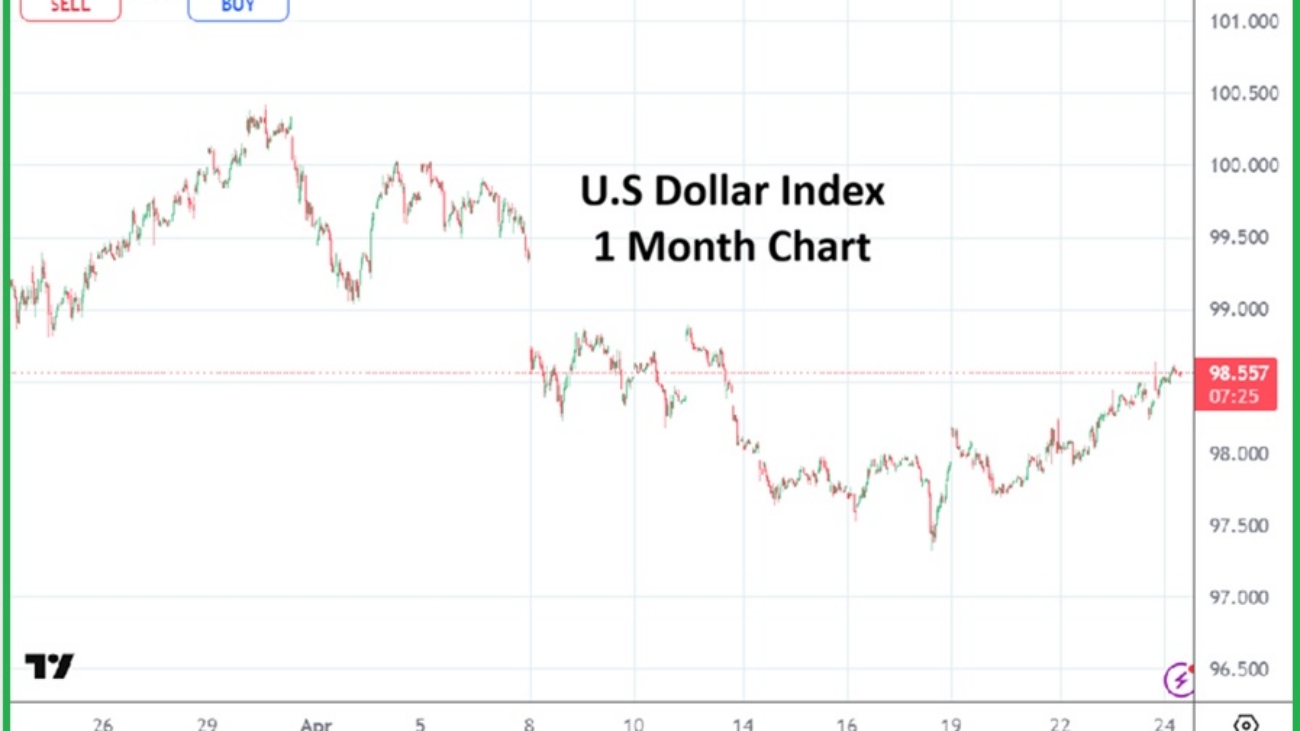
Can someone please tell the rest of us what is going on? Global markets via Forex this morning are demonstrating additional USD centric strength which developed yesterday. The price of WTI Crude Oil is above $94.00. Gold is languishing and around 4,675.00 USD. And although the 3 major U.S stock indices are all within their higher realms – one thing stands out – folks are uneasy.  But then again, the markets never move in one direction only, and perhaps current results can be interpreted as profit taking by those on winning sides.

U.S Dollar Index One Month Chart on the 24th April 2026

I would love to be the person to tell you what is going to happen, but as this weekend looms making short and near-term bets still appears a fool’s game. Yes, it is easy to make predictions, but being correct is more difficult. Retail traders are suffering more than most market participants, this as leverage and a lack of funds to remain in a position through violent reversals destroy plenty of trading accounts.

There is talk of manipulation via chat rooms regarding the price of WTI Crude Oil. The usual dialogues can be seen – largely based on conspiracies via large players trying to blow out smaller traders. However, these types of forum chatter are mostly wrong. Large players are getting hurt too in the energy markets. Anyone who is taking a position in order to speculate on a quick hitting foray in WTI is betting on their perceptions. 

The problem is that unless there is inside knowledge of what the next words out of President Trump’s mouth are going to be, or that from Iranian officials – any pursuit of WTI Crude Oil at this juncture is a ‘vibe’ trade. What is going to happen from Saturday and into Sunday is an unknown quantity. Folks holding positions into this weekend need to understand they are wagering. And some may find they are quite profitable afterwards, while others grimace and find themselves on the wrong side of the next surges higher or spikes downward. Intraday trading volatility in nothing new however.

The USD/JPY is near 159.600 as of this writing. The EUR/USD is close to 1.16820. While a tourist traversing foreign lands may not find the Forex incremental shifts in value mesmerizing or of interest, FX traders who do not have deep pockets are likely wondering why risk adverse conditions are prevailing suddenly. But as a risk analyst, I must say that conditions simply may have been perceived to have been oversold in the USD by financial institutions, this as the Fed looms on the horizon.

However, my task as a risk analyst the past two months has been like a carnival barker, because while it has been easy to say that a show is happening within the big tent of speculation, I have been hard pressed to predict short and near-term directions correctly. Perhaps I fret too much. The optimistic thunder claps upwards in the stock markets since the 31st of March have been astounding to many. Hopefully it has been prosperous for day traders, but the likelihood is that financial institutions are the ones who are profiting more via their pension funds purchases for institutional clients.

This coming week the U.S Federal Reserve will make their FOMC decision public. This will be Jerome Powell’s swan song at the Fed. The Chairman is being faded out by the U.S White House mid-May. And somewhere when he is all alone, Jerome Powell may be having a quiet laugh to himself. The Fed will not act this week. Rates will remain the same – unless there is some bizarre move in the global markets over the next handful of days. Yet, Powell’s remarks will be listened to for warnings. While it is not in Powell’s nature to issue a ‘I told you so’ quote, and he is likely content to walk away from the Federal Reserve quietly, it would be captivating if Powell looked into the cameras and pointed fingers. 

But because Jerome Powell like most others, likely has no clue what is going to happen next internationally he will remain mostly mute (cautious as always).

And here we meet again, wondering what the next 72 hours hold. Will the Iranian ceasefire remain observed? Is it even a ceasefire in reality? The Strait of Hormuz remains a linchpin for military action by the U.S Navy and Iranian Revolutionary Guards via a cascade of ship seizures. Maybe that continues to be the key, WTI Crude Oil prices remain a crucial barometer. USD centric prices via Forex action seems to be a reflection of fear or positive thinking in the energy sector depending on the prevailing tides.

Last week there was so much optimism folks were talking about WTI prices potentially hitting $75.00 and lower, now this hope seems to be wishful thinking. Global markets will remain fast and dangerous, that is easy to say and is right, but telling you which direction assets will move, that is a bit different.

And there is the old standard test I use when an opinion is definitely asked for: if someone were to put a gun theoretically to my head and ask me what I think, I would venture to say things will remain quiet and optimism will seep into the markets before the close this weekend. However, I don’t like to play fool’s games, so I will leave now and wish you luck via your own perspectives because the near-term remains more speculative than normal for day traders – even if strict risk management is used. 

Copy and paste the text from AMT that you want to share

India Rupee 20260416

Progression Upwards for Indian Rupee and Catalysts

USD/INR Persistent Trajectory Remains in Force and Mid-Term Concerns

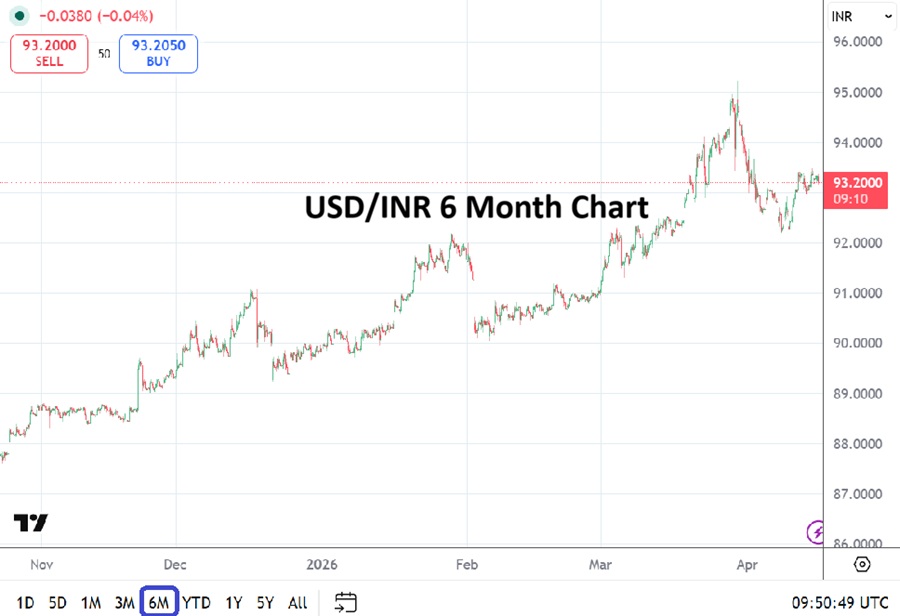
As of this writing the USD/INR is within the 93.2000 vicinity. The price of Gold is around $4,810.00 and Silver close to 79.50. Importantly, WTI Crude Oil is trading around $89.25. Global markets have turned in solid performances the past two weeks, this has been a two step progression for most investors. 

Indian financial institutions began to digest their worries regarding the Iranian war late in March – perhaps acknowledging the risks and ramifications, while adjusting outlooks. Then on Tuesday the 7th of April the establishment of a ceasefire was announced. However, after hitting a low of around the 92.2200 realm on the 8th of April, the USD/INR is back within higher ratios.

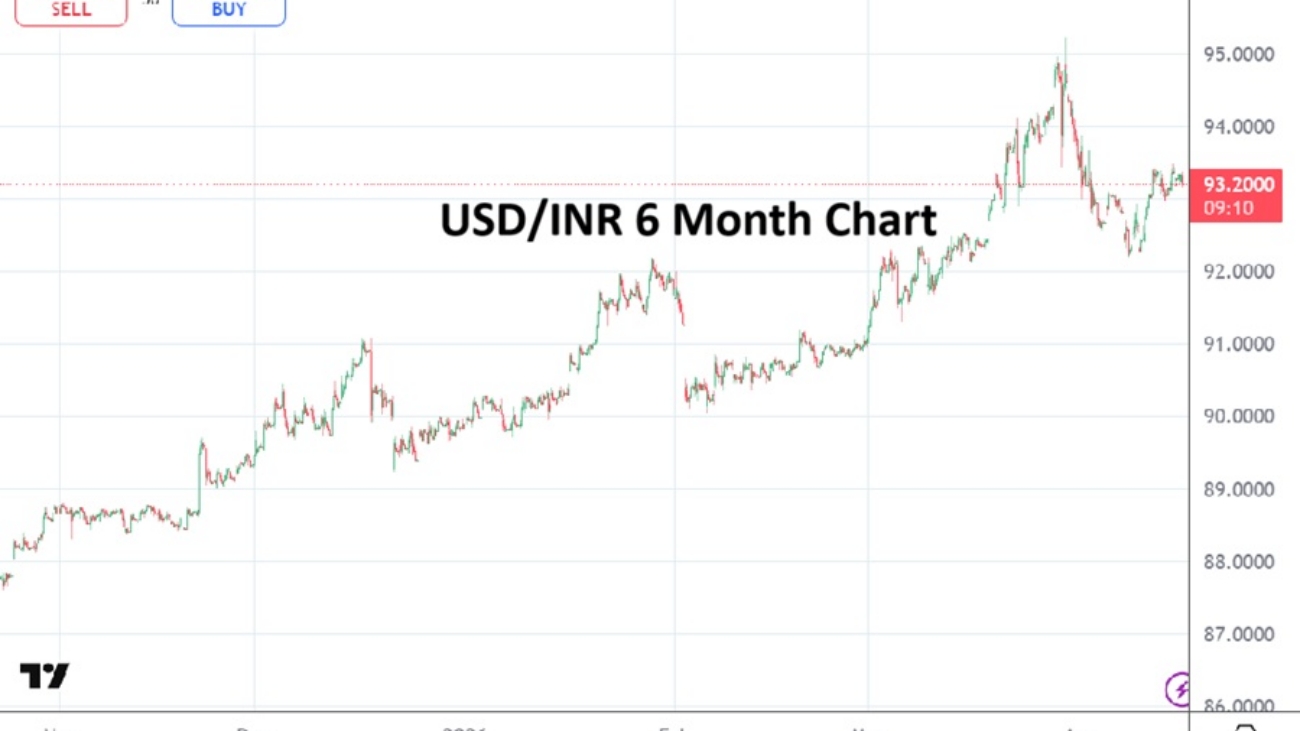
USD/INR Six Month Price Chart as of 16th April 2026

Yes, the USD/INR had been traversing above the 95.0000 ratio late in March, so it can be said the Indian Rupee has gotten stronger. Yet, there will not be many willing participants who will join a parade with the belief this lower trend can be sustained. The bullish trajectory of the USD/INR is not going to vanish.

On the 24th of October 2025, the USD/INR was near 87.7500. At this time last year the currency pair was close to 85.5000. A persistent and long-term move higher has been the theme in the USD/INR. Weakness in the Indian Rupee has been part of India’s economic story rather consistently for a handful of years. 

Narendra Modi has been in power since 2014, he is serving his third term as Prime Minister. His political party the BJP clearly has its chosen people within the Reserve Bank of India.

The government’s position of allowing the Indian Rupee to be weaker is not something they will want to state out loud as part of their mandate, but it is clearly not bothering them.

The pursuit of creating a stronger industrial and manufacturing base for India, including IT and software via good exchange rates for international clients is seen as a cornerstone to build demand. The quality of work and technology provided by the Indian workforce is good and this allows global clients to foster solid relationships with Indian companies.

However, the rise of the USD/INR to above the 95.0000 level in late March was a warning sign, that sometimes price velocity in Forex can become dangerous. And the Iranian war although enjoying a week and half of less noise, still could escalate into a problematic scenario for India that could cause additional concerns in Indian financial institutions who are trying to gauge their mid-term outlooks.

The USD/INR is an important part of this economic math and the prospect that higher energy costs, or in a worst case scenario – shortages incur hardship for Indian citizens and companies is an actual concern.

The current situation in the Hormuz Strait and availability of Crude Oil is significantly important for India. So is supply of LNG (liquefied natural gas) which Qatar, Oman and the UAE play a role. The supply of energy presents a glaring dark shadow for the prospects of the Indian economy should there be shortfalls. 

The 93.5000 resistance level has been durable since early April in the USD/INR. Stability of the exchange rate is crucial for a wide range of business in India, including banking and financial institutions active in the Bombay stock market – particularly since a weaker India Rupee opens the door to Forex concerns for foreign investors who do not have the ability to hedge if they are exposed via the INR too much. Foreign investors are needed in the Nifty indices to help values.

The near-term is likely going to remain a difficult path for the USD/INR and its outlook. The positive sentiment which has prevailed the past couple of weeks has been welcome and certainly stable conditions are hoped for so equilibrium can be kept. However, if the Iranian situation manifests into open military conflict again, or if there is a disruption of supply of energy that cannot be easily solved by India – then the USD/INR could once again face price velocity upwards that is uncomfortable.

While China may be getting the headlines regarding potential ramifications of its Crude Oil supply being threatened, India is estimated to have consumption that is ranked as the 3rd biggest globally. India’s ability to get a supply of energy from a diversified stable of sources is a key for the nation moving forward. 

The USD/INR will continue to move higher, the question is how fast? A slow steady rise in the currency pair – again, this will not be a spoken mandate by the Indian government – will continue. The fear of a rapid debasement is a concern. Financial institutions in India need steady emotions and are certainly hoping for the Iranian war to conclude with a sliver of optimism. 

Copy and paste the text from AMT that you want to share

Indian Diaspora 20260325

India Insider: Why the Gulf Remains a Vital Economic Lifeboat

Indian Expat Labour and Recalibration Realities

The skyline of Dubai, once a symbol of untouchable prosperity, now sits under a shadow of regional recalibration. As Reuters recently noted, Dubai has successfully transitioned to a non-oil economy, with oil accounting for less than 2% of its GDP. It is now a powerhouse of trade, high-end real estate, and financial services. 

However, its “backyard” – the Strait of Hormuz – remains a strategic bottleneck. With 20% of global seaborne crude passing through this narrow vein, the recent tensions in March 2026 have forced a shift in perception: the Gulf is no longer an insulated sanctuary, including Dubai where millions of Indians work and earn for their families in India.

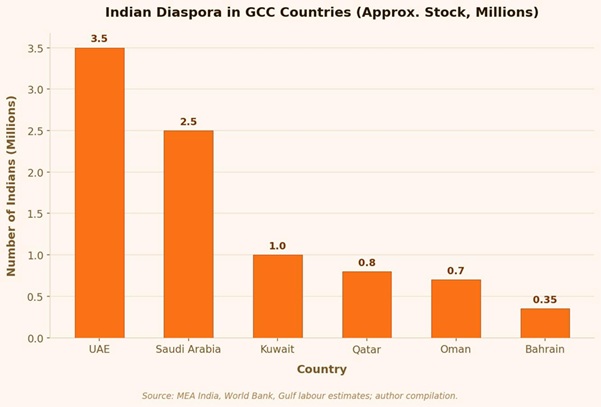
Indian Diaspora Gulf Representation

The scale of this “labour export” is enormous. As of early 2026, approximately 9.5 to 10 million Indians live and work across the GCC (Gulf Cooperation Council) countries. To put that in perspective, that is nearly the entire population of a country like the UAE, made up solely of Indian expats.

A Remittance Driven Economy

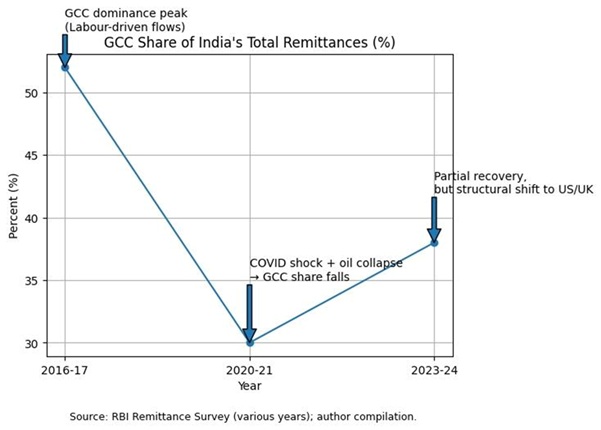
As per Government data sources, India remains the world’s top remittance recipient, with total inflows hitting a record $135.4 billion in the last fiscal year. And despite a rise in high-skilled migration to the US and UK, the GCC remains a juggernaut, contributing roughly 38% of India’s total remittances.

For states like Tamil Nadu, Kerala, and Maharashtra, which receive nearly 50% of these total inflows, it is a macroeconomic stabilizer that funds the current account deficit and keeps the Rupee from a freefall.

India’s Labour Market Paradox

But here is the real question, if people return to India due to the crisis in the Middle East, are there any “good quality” jobs waiting for them in India? The honest answer is no.

Youth unemployment remains elevated, particularly among graduates. Engineers in mechanical and construction fields face limited opportunities. Outside IT, and to some extent automobiles, there are not enough stable, high-paying jobs.

So people adjust. You will find postgraduates working in delivery jobs and informal sectors. I have personally spoken to Amazon delivery workers who told me they hold M.A degrees, or that they had worked in Dubai or Singapore before Covid and are now trying to leave again. This is becoming norm nowadays.

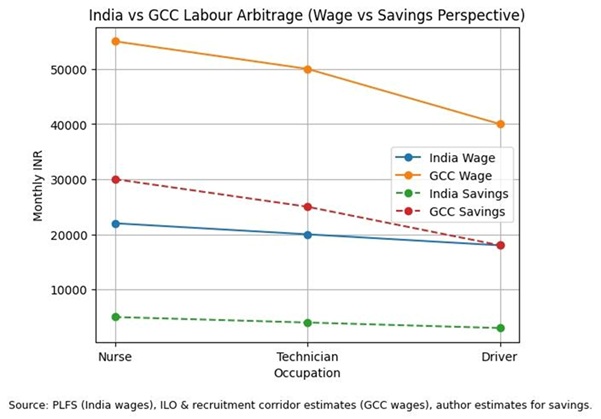
Indian National Wages and Savings Compared to Expat GCC Averages

In many towns in India, migration itself has become an economic model. People move to Singapore, Malaysia, or the Gulf, and the money they send back drives real estate, consumption, and local business activity. In many such regions, the labour market feels tight, not because jobs are available, but because the workforce has already left.

The wage gap explains everything. A nurse or lab technician in India may earn ₹15,000–₹20,000 per month. The same person can earn close to ₹80,000 in the Gulf. A private school teacher in Villupuram city in Tamil Nadu state earns around ₹8,000.

While nominal wages are  2–2.5x higher in GCC, the true driver of migration is savings arbitrage , which can be 5–6x higher.

This reflects structural differences in labour productivity and capital intensity.

India has a large pool of educated labour. But instead of becoming an advantage, it has turned into a wage suppressing force. There is always someone willing to work for less. As a result, wages remain low and bargaining power stays weak.

Percent of India’s Remittances From The GCC

At the same time, we are told growth is strong. Yes, the labour force participation is rising, but inequality is also increasing. A large share of employment remains informal and unstable. Inflation continues to erode purchasing power, and disposable incomes remain under pressure.

Right now, for many Indians, prosperous conditions are easier to find outside the country. Yes, the Gulf has risks. However, geopolitical tensions will come and go, and these are short-term disruptions.

Structurally, GCC economies will stabilize and grow again, and when they do, the flow of Indian labour will continue to pursue these opportunities. Because until India creates enough high-quality jobs at scale, migration will not slow down.

Copy and paste the text from AMT that you want to share

postN50

Clear Betting Environment Is a Winning Proposition for Brokers, Not Day Traders

Things Unlikely To Get Easier for Retail Speculators Remainder of Week

I would like to offer day traders encouragement under the current market circumstances. However, the reality is that the next handful of days will remain difficult for retail traders who do not have comfortable amounts of cash to absorb when intraday chaos occurs. On the other hand as an ex-risk manager for a brokerage house, I can state that CFD providers are singing joyfully because they are making profits from the wild fluctuations in equity indices, Forex and commodities.

Gasoline and Burning Cash Continues

A case in point are the results via the future markets, this via CFD offerings by brokers’ platforms yesterday for the S&P 500 and Nasdaq 100. Early nervousness saw an electric amount of selling get demonstrated and then suddenly a reversal higher, this as President Trump caused a thunderous optimistic reaction as he spoke about the potential of a deal with Iran in the coming days. The dose of optimistic risk taking lasted a couple of hours.

Not only did U.S equity indices bolt higher, but WTI Crude Oil prices slid lower, and Forex suddenly saw the USD losing strength. Here’s the thing, some day traders certainly made money as waves of momentum carried their wagers into positive terrain, but many speculators were likely knocked out of the their trades with sudden loses. CFD trading using leverage has always been a casino, this is not going to change. But the volatility seen the past three weeks has likely not created great wealth for retail traders. Some have gained certainly, but I can guarantee you brokers are making more money via the intraday swings and volatility that knock smaller traders out, this as leverage causes fluctuations that expose too much risk and cause folks to lose money.

Again, this is the nature of the beast. Day traders wanting to participate in the markets have to acknowledge the risks that will confront them. It is a warning worth noting once again as a war rages in the Middle East. 

Markets in the best of times are difficult. Risk management is constantly needed. While the thrill of trading is fantastic, without solid tactics speculating equates into gambling. Think of brokers as bookies, they gear the market via wide spreads, transaction fees including overnight charges to favor themselves. Brokers are certainly glad to pay out winners so others are enticed and bring more business, but strategic day traders who use well practiced methodology are watched closely by brokers – because these folks (good traders who are careful) are a threat for brokers bottom lines – profits are king.

Trading and fundamental notions are proving dangerous too during these loud times. Gold for instance which was trading at all-time highs in January (along with silver – but that is another speculative story) is now traversing near $4,425.00. The precious metal was testing the $5,600.00 vicinity in late January. So how did this long heralded safe haven metal actually see a selloff become stronger since the start of the Iranian war when it was around $5,200.00 on the 27th of February?

IMO, it shows that speculative fervor in gold was fever pitched in January, and even though a war has broken out and caused widespread anxiety in the broad markets (which in theory is supposed to make gold more valuable), the volatile nature of wagering – yes gambling – on the markets including gold, often is a crapshoot. Folks who bought gold as a speculative endeavor have now cashed out their profits, those who believe gold is a safe haven and are buying based on this belief will need another round of speculative fuel to induce significant gains like those made in January. The market sometimes runs out of participants when things get too cautious. In other words, if there are not enough buyers, selling momentum takes over.

And to put a finishing touch on this piece, let there be no doubt that brokers were likely relieved that the one way avenue upwards for gold (and silver) seen into January has now turned into a volatile betting battle. The point here, if I am able to make one is this, market conditions are rough and will remain extreme in the coming days. Folks need to be cautious, the markets are not your friend, they are a tool for making money (or losing it).

Copy and paste the text from AMT that you want to share

Iran Pt One 20260316

Iran: What Victory Looks Like, Part 1 – The Economy

Ridding the World of the Islamic Republic Price Premium

Opinion: The following article is commentary and its views are solely those of the author. This article was first published the 16th of March via The Angry Demagogue.

There has been much chatter about what “victory” over the Islamic Republic means and it is mostly an attempt to deny the very concept of victory. We wrote about “The End of Defeatism and a Return to Victory” last week where we criticized the whole aversion to victory in Western society. The naysayers don’t like to admit that an anti-Western regime can be all that bad, and therefore endless diplomacy needs to be a goal until the final surrender of the West. They don’t really care about the cost of gasoline in the United States – they actually want it to rise – but as long as it was brought up, let us examine in part, the cost of the Islamic regime and what “economic victory” will look like.

Victory in WWII meant not only the defeat of the evil that was Nazi Germany, but it also meant the resurgence of Europe as an economically successful continent. The Marshall Plan that was the crux of the European revival was as much a part of the Allied (sans the Soviets) victory as the surrender signed by German generals.

What is “economic victory” in this war? The media is all over the costs of the war, but no one has examined the costs of allowing the Islamic Republic to continue as it is. No one has examined the cost that the mere existence of the Islamic Republic (as opposed to non-Islamic Iran) creates for the world in general and the United States in particular.

Let’s start first with the most talked about and panic-ridden event and that is the Strait of Hormuz, the gateway to the Persian Gulf and a chokepoint in international shipping to and from that region. It is the gateway to much of the oil shipped to the world, but also fertilizers and other products. The Wall Street Journal news section in another ignorant headline it considered a “scoop”, wrote that President Trump was told that the Straits might be closed in case of war and he attacked anyway. I am not sure there is a knowledgeable military or diplomatic figure or layman in the world who didn’t consider that an option, but to the WSJ news editors it was the surprise of the century.

As Condoleezza Rice said on the recent episode of Hoover Institutions “Goodfellows” a 50 cent rise in gasoline prices for a few weeks is not a reason not to attack a country who has been at war with you for 47 years. But before we even get to that point, has anyone analyzed the cost of giving Iran a veto over who gets to ship through those straits?

If we look at the insurance rates for shipping through the Strait of Hormuz from Lloyds of London we will get a first hint. From 1970-1979 (before the Islamic Republic) the typical premium was 0.01-0.05%. Once Khomeini took power the rates were 0.05-0.2%. During the Iran-Iraq war when there were the “tanker wars” (between 1984-7) those rates jumped to around 5% with a peak of 7.5%. The post Iran-Iraq and Gulf war period of 2004-19 ranged from .0.05-0.25% – well above the pre-Islamic Republic days.

As for absolute figures, a tanker valued at $200m with a rate of 0.01% (pre-Islamic Republic) cost $20,000 and .05% will cost $100,000. The cost at 0.5% is $1million. So, the pre-Islamic republic rate for a $200m tanker ranged from $20,000-$100,000 while the absolute rate at the lowest level since the Islamic Republic came into existence ranged from $100,000-$400,000 – during the best of times. This does not take into consideration the war premium for the many years Iran threatened and even hit tankers even without the excuse of American or Israeli bombing. The average “war premium” from 1979-2020 was 0.83% or $1.66 million for a $200 million vessel.

We don’t have the wherewithal to continue this analysis, but this is exactly the type of article that we used to expect from the pre-ideological WSJ (or even NY Times) news sections. Maybe some economist or even the WSJ editorial page can start to do the heavy lifting and tell us how much the Islamic Republic of Iran has added to the gasoline bill of the average American even during non-war periods.

In economic terms – victory means a eliminating the price premium for shipping energy and global trade in general brought on by the very existence of the Islamic Republic. We will know victory is here when there is a return to the insurance premiums of the pre-Islamic Republic days and when the price of oil, due to increased supply from a non-terrorist Iran reaches the levels it is capable of. A 50 cent or even a 1 dollar rise in gas prices for a month will be followed by $2-3 decreases permanently. We won’t reach the 28 cents a gallon I remember from my childhood (actually 27.9 cents), but neither will it be $4.00 (except maybe in California).

This economic victory will reverberate to other theatres. While the Russians might profit from a temporary rise in oil to $100 a barrel, in the medium and long term, if oil drops to $40 a barrel or even less, they will struggle to support the war effort.

The short term costs and dire predictions that the journalists and diplomats have foisted upon us will end up being a drop in the bucket after economic victory is achieved.

Disclaimer: the views expressed in this opinion article are solely those of the author, and not necessarily the opinions reflected by angrymetatraders.com or its associated parties.

You can follow Ira Slomowitz via The Angry Demagogue on Substack https://iraslomowitz.substack.com/ 

Copy and paste the text from AMT that you want to share

post11.2

Nervous about the Markets, You’re not Alone

Nervous about the Markets, You're not Alone

U.K political chaos turning into clarity or further madness? Mid-term elections coming in the U.S about to deliver change? More turmoil in Brazil? What could go wrong?

So you are nervous about the global markets. You are thinking about the possibility of putting cash under your mattress. Perhaps closing your equity positions and just being a spectator for the next year, well, you are not alone. It doesn’t mean you are right however, and you may want to proceed with caution before your let paranoia guide your decisions.

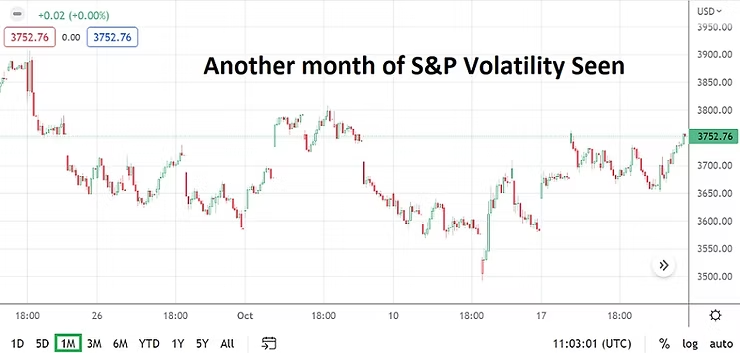
Past month of results from S&P 500

Global markets have faced perils before and will again in the future. Long term perspective is needed. The U.K, U.S and Brazil are all within intriguing political circumstance. The U.K is about to have its third Prime Minister after the ‘sacking’ of Liz Truss. The U.S is about to have a mid-term election and it appears the Republicans may seize control of the House of Representatives and Senate. Meanwhile in Brazil, the race for President appears to be getting closer and President Bolsonaro may actually pull off a photo finish against his challenger.

U.S indices have suddenly started to show brief moments of strong buying again. However many financial analysts remain skeptical. Fear of inflation, recession, quarterly earnings, debt and rumblings regarding stagnation are legitimate reasons for financial institutions to worry about this Halloween season. Jokes aside, the short term will likely remain rather challenging.

The U.S Federal Reserve has served as a solid place to show officials remain locked within their offices without a vision regarding the real world, but that is too easy to merely claim. Numbers need to be looked at and quantified to cast official blame on bad monetary policy. It does appear the Fed will raise interest rates again in November. Will they rest after this coming hike and actually wait for corporate evidence and economic data afterwards to help guide their decisions late in 2022 and early in 2023? We shall see.

The USD remains very strong and is hurting other economies as nations deal with the rising costs of food and energy, particularly when imports are involved. Things are not going to get tranquil in the short term, more hurdles need to be jumped. Remaining calm as an investor and trader is needed. Being reactionary will likely not lead to good results.

post11.1

The Yuan’s Slip is Showing and Troublesome

The Yuan’s Slip is Showing and Troublesome

Two and a half weeks from Xi Jinping’s expected and unprecedented 3rd term coronation as China’s president, the country is trying hard to tamp down any distractions in a year that has provided plenty of them: pandemic lockdowns; faltering economy; supply chain headaches; a reeling real estate bubble; you know the list.

We can now add plunging currency to the usual suspects, as China’s Yuan — also known as renminbi (literally translated as the peoples’ currency) or simply RMB — weakened a further 3.7% against the dollar in the past month, and over 11% so far this year. That’s trending for its worst annual performance against the Greenback since 1994, which is the year China unified its currency market in an effort to modernize it. Not great for a basket currency its promotors aspire to be the world’s finest.

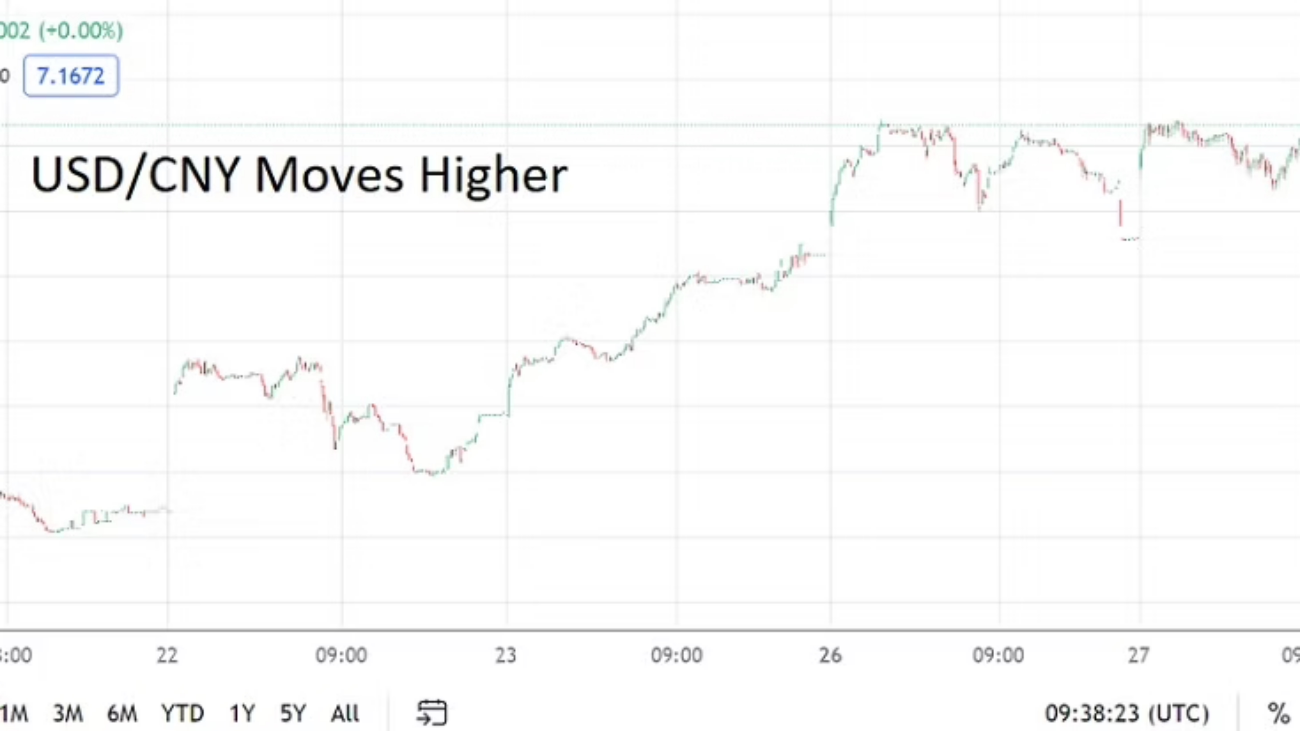
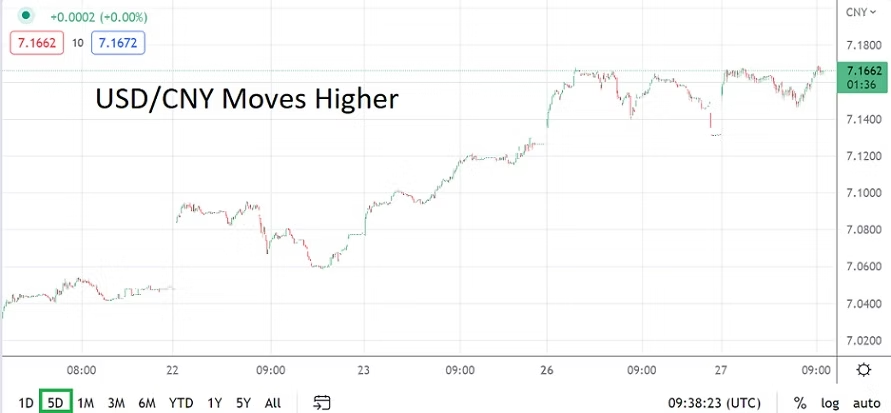
Monday’s mark of 7.1738 RMB to dollar is also its worst since 2008, back when global markets were collapsing. This is a psychologically meaningful level that all but guarantees aggressive pushback by the People’s Bank of China (PBOC). On Monday, the bank announced the imposition of a risk reserve requirement of 20% on currency forward sales by banks, starting on September 28.

China has adjusted the FX risk reserve ratio on occasion in recent years, starting in 2015, but stopped doing so in 2020. The goal is to deter short sellers betting on further depreciation, something government spokesmen have even come out and warned investors against in the past several weeks, including PBOC deputy governor Liu Guoqiang.

USD/CNY 5 Day Chart

It’s not the only move we’ll see. Other steps we can expect in the long term are delays in easing of monetary policy (a recent tool against recession); further cuts to foreign exchange reserve ratios; and pumping central bank bills into Hong Kong or elsewhere to stave off RMB liquidity. You can bet on a lot more firmer than usual midpoint fixings going forward as well.

Of course there’s not much they can do against the prime driver of the dollar’s recent surge: that would be the Federal Reserve, which has been aggressively raising rates to pump the brakes on inflation, resulting in part in bringing the trading strength of the dollar to a 20 year high, with all indications the policy will continue into next year. Other currencies, including the British pound and the South Korean won, have also struggled of late; the pound reaching a historic record low against the currency this week.

Look for more PBOC efforts to keep a lid on the problem, especially as the calendar draws nearer to the opening of the 20th Party Congress on October 16. While it has so far avoided more direct intervention, such moves are not off the table, should the slide persist or worsen significantly. Time will tell.