
Aristotle's Square of Opposition and Why Traders Still Walk Off Cliffs
Somewhere in a 9th century Carolingian monastery a logician diagrammed four sentences into a square to help him distinguish whether a statement was universally true, or only partially so. A thousand years later and that square can explain why a trader with a positive-expectancy strategy and a spotless backtest can still walk off a cliff. The tool is Aristotle’s Square of Opposition. The victim is anyone who has confused what happens on average across many trades with what happens to one trader using the same strategy over time.
The Square
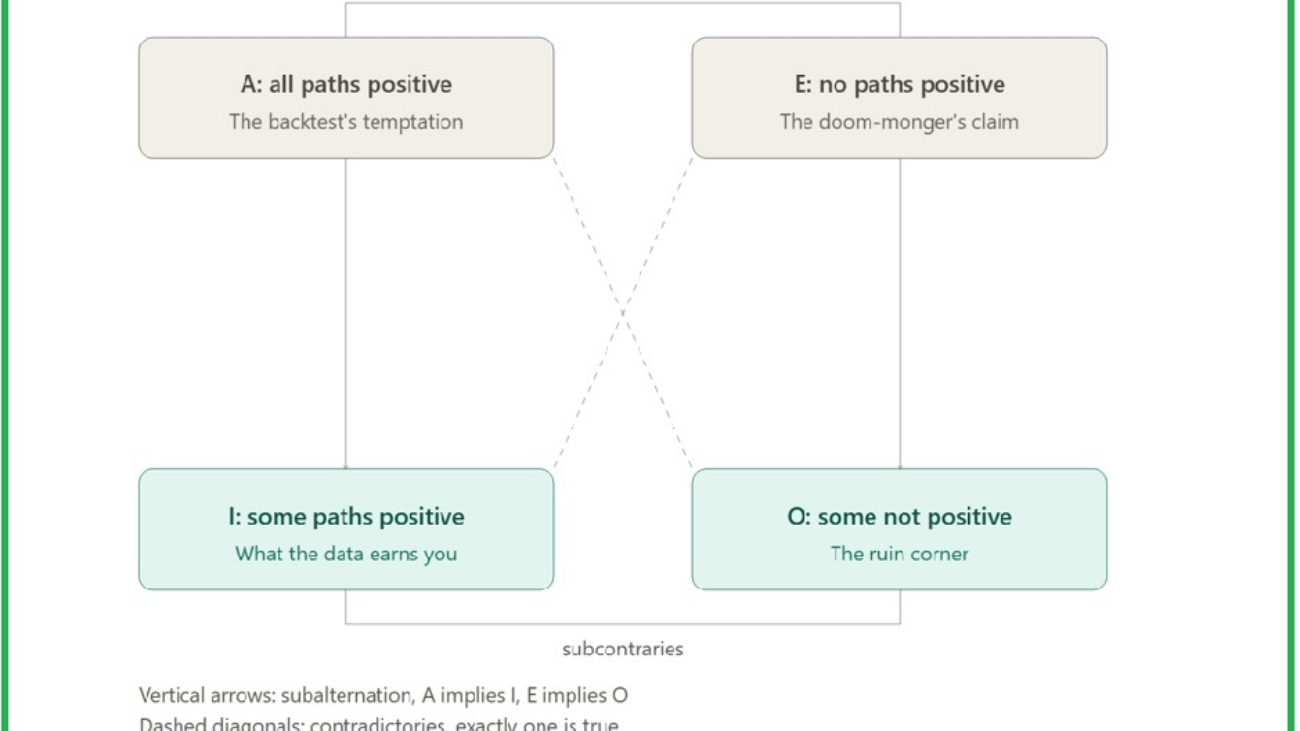
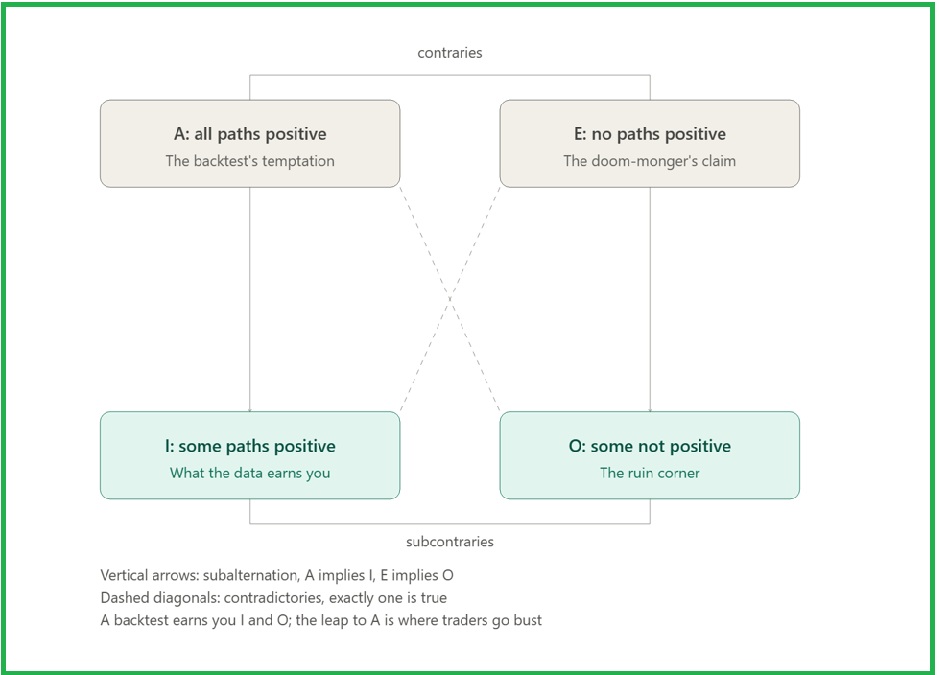
Aristotle’s Square of Opposition sorts any claim about “all,” “none,” “some,” and “some not” into four corners: A (universal affirmative — “all X are Y”), E (universal negative — “no X are Y”), I (particular affirmative — “some X are Y”), and O (particular negative — “some X are not Y”). The corners have relationships: A and E can’t both be true, but can both be false. I and O can’t both be false, but can both be true. And crucially, A and O are direct contradictories — exactly one of them holds. Medieval scholars used this to catch people smuggling a universal claim into an argument that had only earned them a particular one. It turns out finance does this constantly.
Why Some Traders Go Bust: What Medieval Logic Knew That Your Backtest Doesn’t
The Deception: Ensemble vs. Time
Imagine a bet: 50% chance of +50%, 50% chance of -40%. Average that across a thousand parallel traders taking the bet once, and the ensemble average is comfortably positive. Looks like a great trade. But average it across one trader taking that bet a thousand times in a row, and the time average growth rate is negative. Same bet, opposite verdict, because compounding is multiplicative, not additive. This is the ergodicity problem: the ensemble average and the time average only coincide if the process is ergodic, and most wealth processes — especially leveraged, compounding ones — are not.
Nassim Taleb gave us the gut feeling for this in Fooled by Randomness. As an Options trader he was intimately familiar with the notion of skewed distributions and how these can impact wealth in terminal ways. In FX (my world) the carry strategy buying high yielding currencies and selling them against low yielding currencies has an asymmetric payoff, similar to picking up pennies on the tracks in front of an oncoming train. The formal model of ergodicity as applied to economics was developed later by physicist Ole Peters in a great paper “The Ergodicity Problem in Economics”( 2019) building explicitly on the Kelly criterion. He demonstrates why time averages diverge from ensemble averages in multiplicative systems, and showed the divergence isn’t a glitch, it is structural.
Putting a Strategy on the Square
It is tempting when reviewing a backtest with a fat positive Sharpe ratio, to leap straight to A: “this strategy is profitable” — full stop, universal, works everywhere, always. Let’s gear it up. But probably the more honest claim your data has actually earned is closer to I: “some paths through this strategy are profitable” — a particular, not a universal. The Square’s discipline is to check category before you trust quantity. Before asking “how profitable?” ask “profitable for whom, under what — the ensemble of possible paths, or the one path you’ll actually live through?” A strategy can be I-true (some simulated paths win handsomely) while quietly also being O-true (some paths, including, possibly, yours; go to zero). I and O aren’t contradictions; they’re subcontraries, and they can both hold simultaneously. That’s precisely the shape of a fat-tailed strategy: mostly fine, occasionally ruinous.
Why Expectancy Lies by Omission
Expectancy (“average win × win rate minus average loss × loss rate”) isn’t itself a universal claim. The mistake comes when we quietly promote an ensemble average into one by letting an I-shaped number pretend to answer an A-shaped question. Positive expectancy tells you the average across scenarios is favourable; it says nothing about whether your single compounding sequence survives long enough to enjoy it. One of the questions that expectancy cannot answer, but survival requires us to ask, is the probability of ruin. Given position sizing and volatility, what fraction of paths hit zero before they hit target? Monte Carlo simulation offers one way to estimate this but it should be used with extreme caution. Feed a Monte Carlo engine the wrong return distribution such as thin tails in place of real world fat ones and it will confidently hand you a beautifully wrong answer. A mis-specified Monte Carlo is just a very fast way to fool yourself with more decimal places.
The Habit Worth Keeping
The practical takeaway isn’t a formula, it’s a reflex. Before trusting any metric — a Sharpe ratio, an expectancy figure, a backtested drawdown — ask the medieval logician’s question: is this claim universal, or is it merely particular? Most of what a backtest can honestly give you lives at I and O, not A. The traders who go bust aren’t usually wrong about the arithmetic. They’re wrong about the quantifier — mistaking “true for the ensemble” for “true for me, through time.” Aristotle can’t size your position for you. But he can stop you asking the wrong question about it.
The deeper point of the monastery image we opened with echoes a point Jeremy Naydler makes “In the Shadow of the Machine – a pre history of the computer”. The instruments we reason with don’t just extend the mind, they reshape it: what counts as thinkable changes with what’s sitting on the desk. The Square of Opposition is one of the earliest such instruments, a piece of technology built to discipline inference. The backtest, the Sharpe ratio, the Monte Carlo engine are its modern descendants — and like any tool, they don’t just answer questions, they quietly decide which questions get asked at all. The trader who never learns to ask “universal or particular?” isn’t missing a fact. He’s missing a habit of mind his tools may not have taught him to have. A framework is most powerful not when it gives us the wrong answer, but when it prevents us from noticing that we have asked the wrong question.