
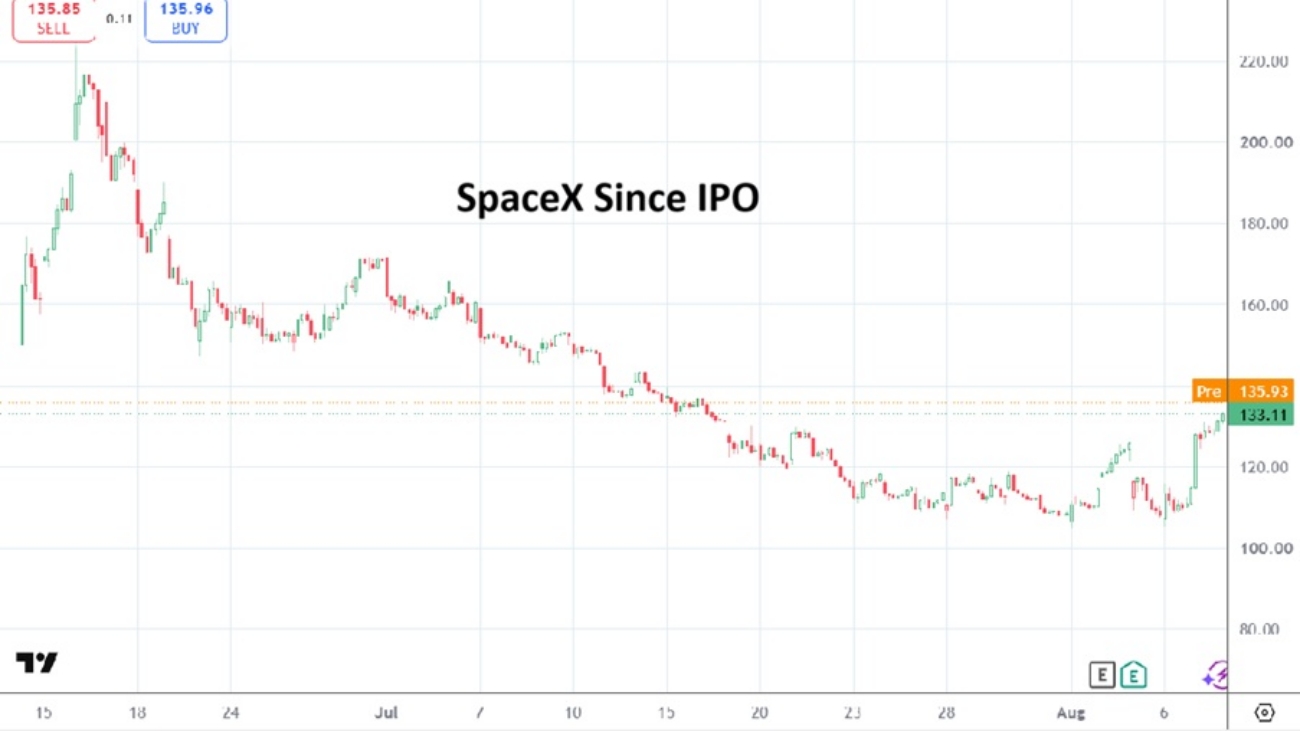
SpaceX 20260810

With SpaceX IPO, Elon Musk’s New Problem is the End of Easy Money

Private Companies Can Raise Capital at Negotiated Valuations, Public Companies Have to Raise Capital at Market Valuations

For years, Elon Musk benefited from something most corporate leaders can only dream of: easy access to practically unlimited private funding at hefty valuations determined by himself. All he had to do was build the proper narrative and convince a few large investors that his own valuation was the right one.

The SpaceX IPO fundamentally changed the process. It doesn’t mean Musk can no longer raise money. Surely, he can. But what changes is the ease, flexibility, and discretion with which he can do so.

When SpaceX was private, raising billions of dollars was relatively straightforward. Musk could approach a small group of investors, give a valuation, issue new shares, and obtain fresh capital without having to expose every detail of the transaction. He didn’t even have to convince all of them. If only a few believed his narrative, the company could raise money at an enormous valuation even while showing continuously negative operating cash flow.
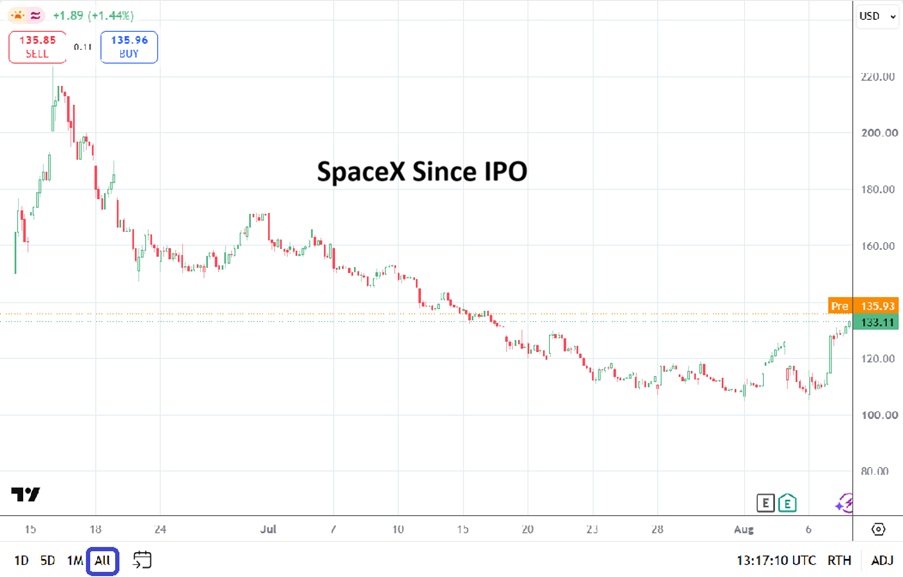
SpaceX (SPCX) Chart Since IPO as of 10 August 2026

That mechanism becomes much more difficult now that SPCX is publicly traded.

A public company has a market price every second of every trading day. Any new equity issuance is immediately visible. Investors know exactly how many shares are being created, at what price, and why the company needs the money. If the market suspects a company is raising capital because its existing operations cannot finance its ambitions, the stock can fall dramatically. And that creates a fundamental difference.

A private company can raise capital at a negotiated valuation. A public company has to raise capital at a market valuation.

The pressure on Musk is mounting. Every quarter he needs to deliver. Every quarter he needs to find a new narrative to prevent the stock price from collapsing.

Let’s imagine SpaceX needs $10 billion funding. When it was private, Musk could potentially raise the money from institutional investors at a valuation agreed upon with those investors. The transaction itself could even reinforce the perception that SpaceX is worth more.

As a public company, however, the calculation is completely different. If SpaceX is trading at a $1.5 trillion valuation and announces a $10 billion equity offering, investors immediately ask why the company needs the money, whether its cash flow is sufficient, and whether further dilution is coming. And if the stock falls 20% following the announcement, the company would have made its financing problem much worse than before.

This problem is particularly critical because SpaceX is a highly capital-intensive business. Its only profit comes from Starlink. But Starlink cannot finance all the other negative-cash-flow businesses by itself, mainly Starship launches and AI ambitions.

Starlink is the only cash-generating asset inside the group, and it cannot become the piggy bank for the entire group, including Tesla.

How can we forget that, earlier this year, SpaceX came to the rescue of Tesla by buying up all the unsold Cybertruck inventory, at hefty margins for Tesla, which then “beat expectations” thanks to the trick?

Would such a move be accepted by the market now that SpaceX is publicly traded?

When SpaceX was private, the boundaries between Musk’s various ventures were much less visible to the public markets. Capital could move through a relatively complicated ecosystem of private companies and investors.

Now that SPCX is public, the shareholders would question every move, knowing that they are not necessarily willing to see their company become a financing vehicle for every project associated with Elon Musk.

With the SpaceX IPO, Elon Musk played his last Ace card. Now he’s left with a handful of weak cards to try to win the game. He can still bluff that he’s got another Ace hidden in his sleeve, but it’s not clear the market will believe him this time.

Private markets gave Musk something extraordinarily valuable: financial flexibility. Public markets are now forcing him to operate without it.

But Elon Musk’s financing problems aren’t limited to the SpaceX IPO. Like any capital-intensive venture, he also has to contend with the Fed’s ill-considered policy of keeping interest rates high, supposedly to fight inflation that stems from supply shocks.

Because of the Fed, every additional percentage point of interest represents billions of dollars transferred from productive investment to debt servicing. Money that could finance AI chips, data centers, engineers, research laboratories, or new factories instead goes to creditors!

The Fed might believe it is fighting inflation, but it is in fact raising the cost of winning the AI race for companies like SpaceX. 

It’s surprising that Elon Musk isn’t openly denouncing the Fed’s absurdity of keeping interest rates high, when his own companies are among those suffering most from it.

SpaceX’s recent $25 billion bond offering is a perfect illustration. The company issued five tranches, including $3.5 billion of senior notes carrying a 6.65% coupon and maturing in 2056. If the Fed’s rate were closer to 2%, the company’s borrowing costs would be at least half their current level. This bond offering is costing SpaceX somewhere around $1.5 billion a year in interest expense, that could have been slashed by half had the Fed acted quickly in reducing interest rates.

And this is precisely where the Fed’s policy becomes relevant to Musk’s financing problem.

High interest rates make borrowing far more expensive for Musk. At the same time, restrictive monetary policy makes investors more demanding about equity valuations and makes long-duration growth stories more vulnerable to changes in discount rates. They also make car loans much more expensive for potential buyers, which significantly affects Tesla sales.

Musk therefore faces a particularly uncomfortable combination: Equity financing is more visible and potentially dilutive. Debt financing is expensive. Private financing is no longer available on the same scale.

The SpaceX IPO, on top of the Fed’s mistake of keeping interest rates high, is putting significant financial stress on the “richest man in the world” as he urgently needs to find new imaginative ways to fund his highly capital-intensive ventures.

And this is without even considering the probability of a 2008-like financial crash triggered by the bursting of the AI bubble. How would Elon Musk manage to sort himself out this time in case of such financial collapse?
Copy and paste the text from AMT that you want to share

Share:
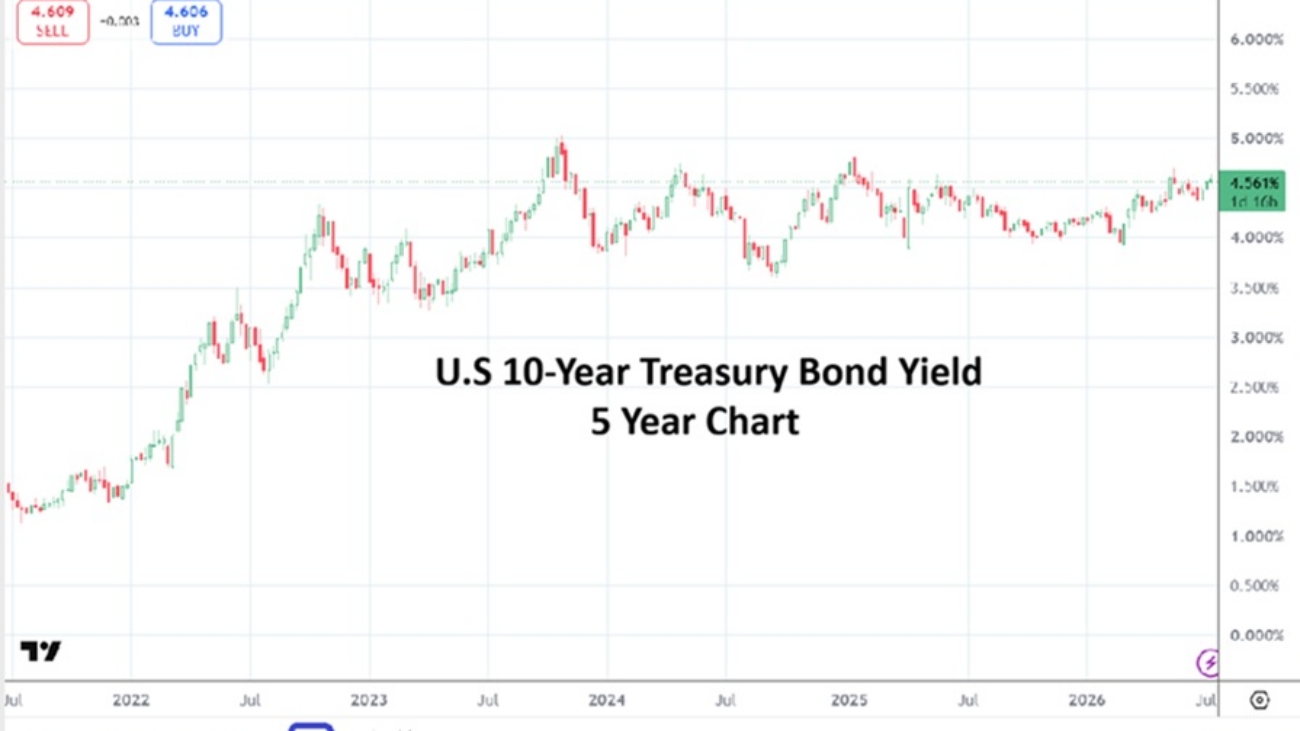
10Y US Treasury Yield 20260716

Why the U.S Fed Should Lower Interest Rates Closer to 2%

Fighting Inflation with Higher Interest Rates is Totally Counterproductive

For nearly a century, central banks have relied on one dominant prescription to fight inflation: raise interest rates. The theory is straightforward. Higher borrowing costs discourage spending and investment, reducing demand and eventually slowing price increases.

While this approach may have worked reasonably well in the past, today’s economy is fundamentally different. Applying the same monetary formula developed in the past century by Irving Fisher is obviously creating more problems than it solves. In many cases, raising interest rates has become a counterproductive way to fight inflation.

  • The first and most obvious consequence is the impact on government finances. As interest rates rise, the U.S. Treasury must refinance its enormous public debt at increasingly expensive rates. The result is an explosion in annual interest payments, which now exceed $1 trillion. Those payments are in fact a direct injection of additional liquidity into the economy while simultaneously widening the federal deficit.

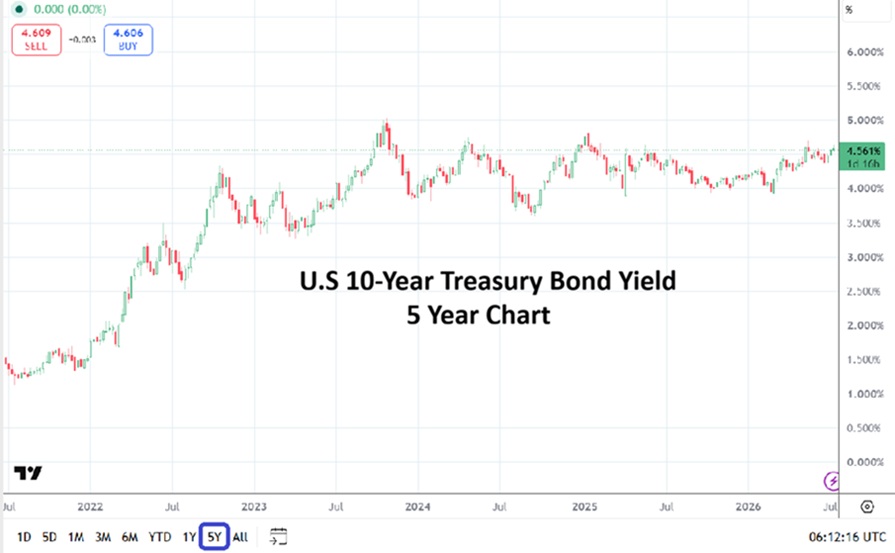
U.S 10-Y Treasury Yields Five Year Chart as of 16th of July 2026

Ironically, a policy designed to reduce inflation is contributing to larger government spending through higher debt-servicing costs. Instead of easing inflationary pressures, excessively high interest rates may actually reinforce them through this fiscal channel.

  • Consumers also bear a heavy burden. Modern households depend far more on credit than previous generations. Credit cards, auto loans, and consumer financing have become an integral part of everyday life. When the Federal Reserve raises interest rates, millions of Americans see the interest on their credit card balances climb to 20% or more.

Many families attribute their declining purchasing power entirely to inflation, when in reality a significant portion of the financial pressure comes from soaring interest payments.

  • Businesses suffer as well. Higher interest rates increase the cost of financing, while the same capital could be dedicated to investment, expansion, innovation, and research. Every additional dollar spent on interest is a dollar that cannot be invested in productive activity.

A recent example is SpaceX, which issued debt carrying a yield of approximately 6.65%. Given the company’s negative cash flow, investors naturally require a risk premium. However, if the Federal Reserve’s policy rate were closer to 2% rather than current levels, the company’s borrowing costs would be at least half their current level. The extra interest payments would instead be directed toward research, development, hiring, that would strengthen long-term economic growth.

In the current race for AI, that requires heavy investments, the Fed should lower the financing burden on U.S companies. Every additional percentage point of interest represents billions of dollars transferred from productive investment to debt servicing. Money that could finance AI chips, data centers, engineers, research laboratories or new factories instead goes to creditors.

The U.S cannot simultaneously declare China its principal strategic competitor while maintaining a monetary policy that systematically makes capital more expensive for American businesses than for their Chinese rivals, that benefit from much lower rates. The Fed may intend to fight inflation, but it is also making it more costly for American companies to invest in the industries that will determine economic leadership over the decade. The Fed may believe it is fighting inflation, but it is simultaneously increasing the cost of winning the AI race.

Perhaps the greatest weakness of relying on high interest rates is that much of today’s inflation originates from supply-side shocks that monetary policy simply cannot fix.

How does raising interest rates reduce the price of oil when energy prices are driven by geopolitical tensions such as the war with Iran?

How does raising interest rates lower egg prices when shortages stem from productivity issues in the poultry industry?

How does raising interest rates lower the prices of wheat, corn, or cocoa when inflation is due to droughts, floods, or other climate-related events?

How does it reduce insurance premiums that are rising because natural disasters have become more frequent and more costly?

In each of these cases, higher interest rates are totally inefficient to address the underlying cause of inflation. Instead, they merely increase financing costs across the economy while leaving supply constraints largely unchanged.

A more effective strategy would be to fight inflation where it actually originates. Governments possess fiscal tools that can be deployed with much greater precision than broad monetary tightening. Temporary subsidies, targeted tax relief, incentives for increased production, strategic investment in critical industries, and, in exceptional circumstances, carefully designed price controls can address specific inflationary pressures without unnecessarily slowing the entire economy.

For example, if geopolitical tensions cause oil prices to spike, temporarily subsidizing fuel or reducing fuel taxes is likely to be a far more direct and effective response than raising interest rates across the entire economy. Similarly, boosting domestic agricultural production is a better solution to food inflation than making mortgages, business loans, and credit cards more expensive.

The Fed should therefore focus on reducing the financing burden on both the federal government and the private sector. Maintaining interest rates closer to 2% would significantly lower debt-servicing costs, support productive investment, and allow fiscal authorities to intervene more effectively with targeted measures when inflation arises from specific sectors.

The doctrine of fighting inflation through higher interest rates was developed by Irving Fisher nearly a century ago, in an era with very different financial institutions, consumer behavior, and sources of inflation. Credit cards did not exist. Household debt was far lower. Global supply chains, geopolitical energy shocks, and climate-related disruptions were not defining features of inflation.

The modern economy requires modern solutions. Rather than relying almost exclusively on higher interest rates, policymakers should recognize that today’s inflation often demands targeted fiscal responses. Persisting with an outdated monetary framework risks imposing unnecessary costs on governments, businesses, and households while failing to address the real drivers of rising prices.

Supporters of high interest rates often argue that they are unavoidable whenever inflation rises. Yet international experience suggests otherwise.

Switzerland has repeatedly maintained policy interest rates close to 1%, or even below zero in previous years, despite being exposed to many of the same global shocks affecting other economies. Switzerland imports energy, is affected by fluctuations in oil prices, and faces the same geopolitical uncertainties. Yet the Swiss National Bank has generally preferred to tolerate modest inflation rather than impose unnecessarily high financing costs on households, businesses, and the government.

This illustrates an important principle: not every inflation shock requires an aggressive monetary response. When inflation is primarily imported through energy prices or supply-chain disruptions, forcing the entire economy to pay dramatically higher borrowing costs creates more economic damage than the inflation itself.

Copy and paste the text from AMT that you want to share