Western Leaders 20260814

Standing on the Precipice: Western Leaders Continue to Fiddle

Will The West Stay Awake and Become Alert?

Opinion: The following article is commentary and its views are solely those of the author. This article was first published the 14th of August via The Angry Demagogue.

In February 2022 the Russian member of the Axis invaded Ukraine. In October 2023, less than two years later, the Iranian proxy Hamas invaded Israel and their proxy Hezbollah joined the fight the next day. North Korea and China the other members of the axis did not, probably, coordinate either attack, but nor did they discourage it or help to end it. In the period of less than two years, the free countries of the world were given a wake-up call to what historians may end up writing was the start of a new world war.

Sweden and Finland were spooked enough to take a bold move and join NATO and the existing European members of NATO seem to realize that they need to start worrying about their own defense – at least against Russia, if not the rest of the Axis. In Ukraine, they put together a bold defense and created a drone force that is, if not winning, at least is not losing the war of attrition that the conflict has “settled” into. Ukraine may have convinced itself that it can win this war on the battlefield and Russia is counting on its Axis allies to help it overcome their own military incompetence. North Korean troops are dying in Ukraine and there are rumors that 50,000 more North Korean troops are on the way. Iran and China are supplying weapons. The Axis is not only keeping the war going for Russia, it is arguably, along with its nuclear weapons, a path to victory.

Standing on the Precipice: Western Leaders Continue to Fiddle

Europe and parts of the United States did not take the hint that in October 2023 that the Putin’s Russia is not the only country threatening their security. The Iranian piece of the Axis also aims to dismantle Western freedoms and religion via direct military threats, terrorism and unchecked immigration.

Has the Middle East changed after the Ukraine invasion and more specifically, October 7? Asking different people will get you different answers. For Israeli PM Netanyahu it has been a strategic victory for Israel as both Hezbollah and Hamas are on their heals and Iran’s nuclear and missile forces have been severely damaged. For Israel’s opposition, the last three years have brought no positive change for Israel in the Middle East since Hamas, Hezbollah and the Islamic Republic of Iran still exist.

For Iranian Islamists it has changed by showing that they can stand up to their own people and to the United States so that any attempt to topple them will end in failure. For the Islamic Republic, a non-total-defeat shows the world that they can continue their quest for regional and global control despite the hiccups caused by Israel and the United States. The same holds for Hamas and Hezbollah who believe that Israel has been isolated in the world and that the UN, the Hague and the EU – along with America’s DSA – will make being Jewish and Israeli so illegitimate that they will soon be able to chose their apartments in Tel Aviv and Jerusalem.

According to Erdogan’s Turkey, the Middle East is their playground as they have managed to maintain positive relations with both Hamas and the United States. They have troops in Qatar, a new alignment with Saudi Arabia and Pakistan and have so many forces in northern and sub-Saharan Africa that an expanded Ottoman Empire lies in the not too distant future. Greece will be overcome and where Iran failed to destroy Israel, they will succeed.

President Trump believes, or states, that the United States has scored a decisive victory over Iran, is bringing peace to Lebanon and Gaza via Israeli concessions and the disarmament of Hamas and Hezbollah and the future in the middle east goes through Washington. The President also states that the Abraham Accords will be expanded and that Israel, Turkey, Qatar, Saudi Arabia are all strong and reliable allies of the United States and that all these countries are moving towards a more peaceful and economically vibrant Middle East.

Back in the 1960’s and 1970’s when there were two regional Moslem states that were friendly to Israel, Turkey and Iran. During that cold war period, the only Gulf state that counted was Saudi Arabia. Syria and Egypt were Israel’s existential enemies and the Hashemites of Jordan were more concerned with survival than fighting (at least after 1967). Lebanon was a non-threat to Israel (as a matter of fact Israel supplied arms to the Shiite villagers in the south during the civil war of the late 1970’s at the request of the Shah of Iran).

Currently Iran is Israel’s main enemy, although Turkey is pushing to move ahead of them as the main existential threat to Israel. Israel faces a “Sunni Vise” that includes Turkey and Syria in the north and Egypt in the South. We can add to that Saudi Arabia and Pakistan although that alliance (which now includes Turkey) seems to be more a showpiece than a defense treaty. Or, in the words of Hussein Aboubakr Mansour, “In the Middle East, the vocabulary of collective defense is often detached from the activity of defending. The announcement is the whole of the content”.

Regarding the United States presence in the Middle East, only the details have changed. The Cold War is over but the U.S still has the challenge of controlling oil flow out of the region as its new main enemy, China, depends on it. As for the United States and Israel, that relationship has moved from dependent to almost partner on defense and technology but Israel is still the same steady, reliable, democratic presence it has been for the past few decades. The U.S is certainly closer to the other Gulf states, notably Qatar, but their money has simply replaced (or actually supplemented) Saudi money, although they are much more cynical and effective with it.

The Arab world has barely changed even though the UAE and others have jointed the Abaraham Accords and have a relatively strong relationship with Israel. However, the real issue in the middle east has never been Israel-Palestine but has been and still is the intra-Arab and intra-Moslem rivalry and mistrust. Even when ostensibly on the same side, like the Saudis and UAE are in Yemen, there are separate armies fighting and last month the Saudis bombed the UAE forces – even though both were fighting the Houthis.

Egypt and Turkey, the two largest Sunni states in the region by population and military force are at opposite ends of the Moslem Brotherhood fight. Egypt is more suspicious of Turkey’s support for the Brotherhood, arch enemies of the Al-Sisi government, than they are of Israel’s moves in Gaza. Syria too, while pretending to act as a unified country is at war with the Kurd citizens in the north, Druze in the south and Alawites in the northwest. Their inclusion of ISIS and al-Qaeda fighters in their army – even foreign fighters – means that even within the Sunni majority, there is distrust and fighting.

And Libya is a proxy war if there ever was one with Turkey, Egypt, Iran and Russia involved.

So where do we stand in Europe and the Middle East today?

On the one hand, everyone is correct – Israel is in a better spot strategically, yet has not finished the job. The United States has, with Israel, set back Iran’s plans for regional domination but that gain is one “agreement” away from being overturned. Turkey is extending its influence but does not have the wherewithal to create a new Ottoman Empire as not only Israel stands in the way but so too does Egypt and the rest of the Sunni-Arab world as they do not have fond memories of Ottoman control of Arab lands. The Arab countries, large and small, are fighting the same tribal wars they have fought for the past decades and even centuries. Israel has strong internal unity and morale while its leaders re-arrange their parliamentary chairs.

In Europe, Ukraine has stopped an army three times its size while Russia, against most predictions is able to absorb massive casualties and economic sanctions due to the help of its allies .

Before the invasions of Ukraine and Israel by members of the Axis in 2022 and 2023 the geopolitical situation consisted of four revisionist powers united only in their opposition to the international status quo and the free countries united in their wish to maintain the status quo and to concentrate on comfort to the neglect of all else -including freedom. The Western European powers had no real military power to speak of (with the possible exception of France) as even the UK’s glorious navy was reduced to the minimum number of ships necessary to still call it an ocean going Navy. Ukraine ignored Russian threats and Israel was convinced it could outsmart, deter and bribe its sworn enemies to give up all for a life of comfort.

In the United States, the military was organized as a Walmart or Target warehouse with “just in time inventory”, no long term armaments contracts and with nothing much done to create what won WWII and the Cold War – a strong economic and industrial base. Looking for cheap labor and products and piling debt upon debt, the America;s industrial and fiscal situations mirrored its military un-readiness into a game of catch up – which it is doing neither fiscally nor militarily. Although the current administration is pushing to increase its manufacturing might, the fact that the American shipbuilding industry is able to produce only 3 military ships a year means, one, two or three administrations won’t be enough to complete the task. It requires a seriousness of purpose lacking in a Democratic party fearful of the DSA and a Republican party not serious enough to create a national consensus that will require some sacrifice from citizens.

Although there is a lot of talk, the current leadership in all free countries are the same leaders that led us down this path where they are not ready to meet and defeat middling powers let alone powerful ones.

Just four years ago the late Henry Kissinger published a book called “Leadership” which focused on six leaders he thought were consequential to their countries and the world. You might disagree with his choice but one thing running through each of these leaders (Germany’s Adenauer, France’s de Gaulle, Sadat of Egypt, UK’s Thatcher, Singapore’s Lee Kuan Yew and Richard Nixon) is that they were patriots and they were willing to take risks to push their countries forward. We don’t seem to see Western leaders who are dedicated first and foremost to their country and its citizens and who recognize the ongoing (the never ending!) threat from tyrants.

Putin, Xi, Khamenei (or whomever is in charge) and Kim are tyrants who don’t need to concern themselves with their citizens and that is the one thing our uncreative and cowardly leaders do not seem to understand. The obsession of today’s western leaders with negotiations and deals and false human rights claims just feeds the tyrannical rule of its enemies and pushes their defeat further and further away. Eisenhauer famously refused to shake hands with the Nazi general who surrendered to him in spite of military custom because he realized that this was not a war of one country against another but a war by his country and their allies against evil.

This is not a call for war against all evil or perpetual conflict of power against power but rather a recognition that if one is not ready to face what tyrants want – your destruction – eventually they will defeat you. America was not prepared to fight WWII but it had an industrial and managerial base that could be transformed into a wartime asset no one has ever had. It also had the luxury of two oceans protecting their manufacturing plants from enemy attack. Finally, it had, admittedly only after Pearl Harbor, the understanding that the moral imperative was defeating the evil that was Nazism as well as Japanese militaristic barbarism and not in coming to some rapprochement with it.

The geopolitical situation has not changed even if there are small tactical advantages that one side has over the other in localized theatres. We are still in the same position where the Axis of revisionist states is using all its force and all the weaknesses of the western world to its advantage and a western world that is continuing to ignore that reality. The internal and external threats in free countries are now at crisis levels.

When it comes down to it, as much as we like to blame our leaders (and we certainly do), it is up to the citizens to demand and to choose brave, creative leaders who are not locked into what has brought us to the precipice of defeat. The leadership since the end of the Cold War has been lacking any sense of urgency no matter what happens. The disaster that was Afghanistan should have been a wake up call – instead it was ignored. The invasion of Ukraine should have put free countries on a war footing for the manufacture and supply of military hardware but instead of was treated as if no other wars would be fought until this one was over. October 7 and the subsequent fighting in Gaza, Lebanon, Yemen, Iran, Iraq, Syria, the entire Persian Gulf should have told the west that terrorism and the immigration of real and potential terrorists into its borders will destroy what it loves best.

So far, the Axis leaders have not waited for the west to wake up, re-arm, control its borders and stop shooting itself in the foot and there is no reason to think it will wait before its next adventure.

Disclaimer: the views expressed in this opinion article are solely those of the author, and not necessarily the opinions reflected by angrymetatraders.com or its associated parties.

Follow Ira Slomowitz via The Angry Demagogue on Substack https://iraslomowitz.substack.com/

Copy and paste the text from AMT that you want to share

Share:
post234

New Alternatives for Regional Alliances & Global Effects?

New Alternatives for Regional Alliances & Global Effects?

Opinion: The following article is commentary and its views are solely those of the author. This article was first published the 14th of March, 2025 via The Angry Demagogue.

There is so much going on that it really is difficult to keep up. Israel is at the center of many of the regional developments, as would be expected. But it is not just Israel as Israel, but Israel as an ally of the United States that is interesting. The Syria problem we have written about and it is still not clear what the Trump administration’s policy is there as they look skeptically but hopefully at Al-Julani’s Syria. In our opinion that decision will be made for them, since the chances that Al-Julani has changed his stripes to a Western democrat is small and even if we are wrong there – the armed Jihadist groups that he needs to control seem more interested in ridding Syria of ‘heretics’ than stabilizing the country.

Lebanon has changed enough for the United States and Israel to take chances. While it is too bad that Israel did not do more in ridding the country of Hezbollah, the fact that Syria is no longer part of the Shiite crescent means that they are isolated and not able to get funding and arms from Iran with the same ease. What is important about the current Lebanese government is that Hezbollah is not a part of it. That does not leave them powerless, but it allows the government to act more independently. The Lebanese Shiites, under Hezbollah and the less but still militant Amal, will have to rethink their loyalty to these two organizations. At the least, it should move Amal away from their stronger partner.

Iran now has no land route to Hezbollah and will have a harder time arming the Houthis, too. But it is in Iraq that they are facing problems which could cause as much damage to their projection of power as did the loss of Syria. Due to US pressure, Iraq has stopped buying Iranian electricity although they can still buy gas. It seems that the US is giving Iraq some time to find alternatives to Iranian gas and the Iraqi government is moving away from Iran on other issues too and are trying to get rid of Iran’s Shiite militias.

But the most interesting thing to happen is Israel’s attempt to strengthen America’s relationship with Azerbaijan, a country that Israel is in close contact with regarding Iran. Israel has always been rumored to plan to use Azeri air force bases in a possible attack on Iran. The Azeri official responsible for regional development was in Israel last month and is trying to bridge differences between Israel and Turkey. The Azeri’s next stop after Israel was to Turkey. Steve Witkoff is reported to have stopped in Baku after his visit to Moscow.

An Azeri company has also bought rights to Israel’s Tamar gas field. Israel currently gets oil from Azerbaijan via a pipeline that goes through Turkey so the energy relationship is strong and longstanding between Israel and Azerbaijan. It seems that Turkey’s relationship with Azerbaijan is more important to them than their animosity towards Israel – probably because the Azeris and Armenians are enemies. It seems that sometimes not only friendships have to be ranked but enemies, too.

Trump’s game with Ukraine is not necessarily to my taste but it could be that there is something much bigger going on here and that is connecting Israel, Russia, Central Asia and Turkey to a grand alliance with the United States. I don’t think that Trump will succeed in pulling Russia away from Iran and China and that Erdogan’s Turkey will not give up their dream of destroying Israel. But what if the Iranian regime falls after a combination of harsh sanctions, economic collapse and Israeli military attacks? What if Iran is pulled away from the alliance leaving Russia with just China? What if a Russian base in Syria is dependent upon their moving away from China?

Last year the Axis held a near continuous land bridge from the Pacific to the Mediterranean. China was moving into Russia’s “sphere of influence” in the “Stans” of Central Asia with their economic bear hugs. This was something that the Biden administration ignored, but could be a bigger headache for Putin than a well armed but non-NATO Ukraine with American businessmen instead of soldiers as a tripwire.

Are we giving too much credit to Trump and his foreign policy team and to Israel’s influence in the expanded region that reaches beyond Syria? Is there more going on than we know or less?

On October 7 and the days that followed, the Biden Administration was sure that Israel was in such a panic that it would agree to anything, and they could force the Obama Middle East of a hegemonic Iran and a Palestinian state down Israel’s throats – and overthrow Netanyahu as an extra. None of those things happened.

Only a fool would predict what will be in a year, but what we have discussed above is one scenario no one would have considered even six months ago. The post WWII world looked nothing like the world of 1937, and the post WWIII world (the one we wrote about a year ago and may or may not have happened!) will look nothing like September 2023 – no matter how hard the UN yells and screams.

Could Israel and Azerbaijan be the keys to a realigned world?

It is against my nature to be optimistic, especially since Israel is still not done with Gaza, the hostages are not yet home and the internal politics are reaching levels that border on a soft coup.

However, while we don’t know where the aces are, we know that the Obama-Biden jokers are no longer in the deck.

Disclaimer: the views expressed in this opinion article are solely those of the author, and not necessarily the opinions reflected by angrymetatraders.com or its associated parties.

You can follow Ira Slomowitz via The Angry Demagogue on Substack https://iraslomowitz.substack.com/ 
postN19

Broader Alliances: Sustaining Economic and Political Power

Broader Alliances: Sustaining Economic and Political Power

The following article is commentary and its views are solely those of the author.

If the United States decides to abandon its role as the premier global superpower and shall only be a Pacific and Atlantic power, withdrawing as defender of free seas, free trade and freedom in general, its democratic allies will have to start looking elsewhere for broader military alliances. This large group of nations would have to defend their interests against a revanchist China tied to Iran, Russia, North Korea and many of the Latin American countries – possibly including Brazil, and South Africa who have questionable politics and outlooks.

Eastern Mediterranean Alliance: A Strong Sea Power

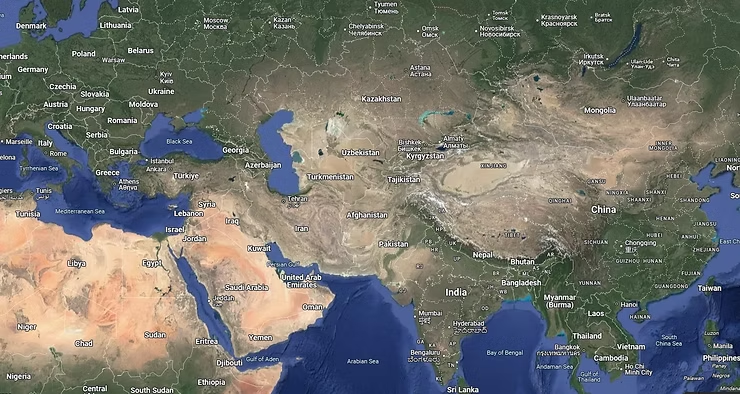
Here is a speculative, yet reasonable look at the future of the free world. Let’s start with the Eastern Mediterranean where the two major powers are Israel and Turkey. One cannot deny that both these countries outclass all others regarding military might in the region. Israel’s air force is second to none and its navy is becoming a strategic necessity as it needs to defend its natural gas fields miles offshore. It now has six submarines that are capable of projecting power anywhere in the Mediterranean and even into the Indian Ocean and Persian Gulf. Turkey is currently a NATO member, but it is not clear that this will outlast the first half of the 21st century.

There is currently an informal alliance among Israel, Greece and Cyprus (both NATO countries) via joint military exercises and intelligence sharing. The Israeli navy and air force train regularly with Greece and its special forces train in the Cyprian mountains with its army. It would be in all three countries interests to formalize a treaty – if not of mutual defense, at least of mutual aid during times of war. All three of these countries are democracies and all three have mutual economic interests.

A formalization of this alliance makes sense now and if there is a NATO collapse it turns into a necessity for Greece and Cyprus. Adding Egypt (although it would be the only non-democracy) to this group would only strengthen the alliance and keep Turkey at bay. A post-Erdogan Turkey that is comfortable with its Islamic character and its modern society could even join this grouping with Israel as a potential peacemaker between the historic Greek-Turkish rivalry.

This alliance without Turkey is a powerful force in the eastern Mediterranean, and this alliance with Turkey could neutralize a nuclear Iran. A Post-Hezbollah Lebanon which is in the interests of all of these alliance members (including Turkey and Egypt), could become a reality and another member.

A New Alignment: The United Border Nations

What about Eastern and Central Europe? Poland is rapidly becoming the major non-nuclear European military power. Within the next few years it will outshine Germany and the U.K and rival France. It is quite clear, nuclear weapons aside, Poland would probably defeat Russia in a number of weeks, if not days if a conflict were to ignite.

Whether the Russian-Ukrainian war ends in a Russian defeat or in some sort of face saving armistice, Russia will not lose its aggressive nature or nuclear capabilities and it will inevitably become aligned more closely with China and Iran because of its current political nature.

The important new alignment will be categorization of ‘countries bordering Russia’. A new alliance of Poland, Finland, Sweden, Norway and the Baltic states – Lithuania, Estonia and Latvia together would have the land, sea and air power necessary to deter and defeat, if necessary, any Russian imperialist expansion. Even with closer ties to China it would be difficult to imagine that, over the next 50 years, Russia would be a threat to this alliance. Adding Ukraine to this grouping would make a powerful force. Its joint population of over 100 million people, while not quite Russia’s 150 million – would be a formidable adversary, especially as the technological skills of these countries is first world and continuing to improve. Adding the other former Warsaw Pact countries like Czech, Slovakia, Romania, Moldova and Bulgaria can only increase its potency.

Unlike the Eastern Mediterranean alliance mentioned above, this would have to be based on a mutual defense treaty in order to properly deter any Russian-Chinese-Iranian attack. Linking up, informally with the ‘new’ Eastern Mediterranean Alliance would create a powerful grouping of free countries against any attempt by authoritarian adversaries. Adding an economic aspect to these border nations and an alliance with the Eastern Med group with free trade zones would create a strong challenge to any attempted Chinese hegemony.

Asian Border Nations Group: Potential Look Ahead at Potential

If we were to unite the Eastern Mediterranean and Border Alliances to an admittedly non-democratic Asian ‘stans nations, including Kazakhstan, Kyrgyzstan, Tajikistan, Turkmenistan and Uzbekistan with a joint population of around 80 million, we are beginning to see the creation of a multi-cultural alliance that extends from the Arctic Ocean through Central Europe, Northern Africa and into Asia.

The Crucial Partner in Order to Balance Power: India

Which leads us to the Indian Ocean; a dominant India can help control the sea lanes from the Persian Gulf to the Bay of Bengal and down to Australia. An Indian-Australian alliance, along with Israel would create a democratic economic and military force that would keep China and Iran from dominating the region. This would require an Indian navy that is not only large, but effective also because it would hold a main responsibility for patrolling the seas from the Persian Gulf up to Australia strongholds.

As India also reaches its potential as a global manufacturing giant, it will be a force to be reckoned with. Including into this potent mix of nations, is the possibility of adding authoritarian countries like Saudi Arabia and the other Gulf states; along with Thailand, Myanmar, Malaysia and Indonesia who have strong ‘western’ economic interests and would create a formidable bulwark against China’s imperialist Belt and Road project.

Without the need to project naval power worldwide the Unites States could use it massive naval, air and ground forces to take better control of the Pacific Ocean along with Japan, South Korea and Australia.

If we add countries like the Philippines and Vietnam, then China would be deterred from further aggression. The only other region that would fall under American responsibility would be the Atlantic Ocean – the shipping lanes to Europe, West Africa and the Mediterranean. Along with the UK and France there would be no challenger to the control of the Atlantic. This could also lead to a revival of the old Monroe Doctrine and maybe free South America from the destructive influences of Iran, China and Russia.

The Global Economy and Free Trade Zones with a Stable USD as Reserve Currency

What does all this mean for the global economy? The free world along with its less than free allies who fear China, Russia and Iran could still maintain a U.S dollar based world. Free trade zones amongst and between the various alliances along with a revival of manufacturing led by a technology revolution using AI, quantum computing, renewable energy and space exploration could lead to a global resurgence of free countries that could stop the authoritarian appetites of Russia, China and Iran in its tracks. This can only happen with a stable reserve currency the ‘West’ can rely upon which is the USD.

Potentially a U.S freed from being the sole defender of freedom in the world, would help get America’s fiscal house in order and allow it to focus on being a dominant economic power. Is there a future for the ‘free world’ without a United States that projects power globally? Currently, a U.S withdrawal from global military assertion would certainly cause the end of freedom (economic and political) in the world for many nations. However, with the new alliances described above and a fiscally responsible United States, freedom could yet make a comeback.

Disclaimer: the views expressed in this article are solely those of the author, and not necessarily the opinions reflected by angrymetatraders.com or its associated parties.