postN88

Iran, Oil and The Crumbling of a Criminal Dictatorial Wall

Iran, Oil and The Crumbling of a Criminal Dictatorial Wall

Step aside for a moment from the conspiracy theorists and let’s consider that the U.S did not take out Maduro of Venezuela in order to facilitate more supply of oil. Let’s consider the possibility that Maduro was removed because he did not facilitate free enterprise and ran a criminal enterprise that did not favor the U.S.
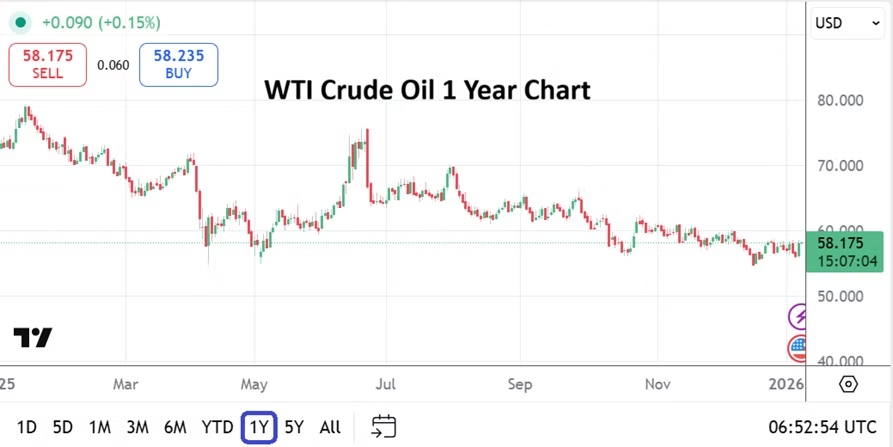
WTI Crude Oil One Year Chart as of 9th January 2026

Venezuela has the largest demonstrated oil reserves in the world, but the U.S has done rather well without it for years. The Trump administration’s move to take over Venezuela deters China and Russia’s influence in the Americas, while also putting another nail in the coffin of the Cuban regime. The word regime is used implicitly to point out that Venezuela, Russia, China and Cuba are all regimes of one sort via their one party ruling systems. Yes, you can argue the United State has returned to an imperialist philosophy, but that doesn’t mean it has dictatorial rule. Some will argue that point, I understand. But let’s step away from the complexity of political biases – including my own – and insights and discuss oil for a moment.

The takeover of the Venezuelan oil infrastructure, which has not happened in full yet via the U.S military action, does not mean U.S oil companies will make trillions of dollars from the adventure immediately. In fact a glut of oil is one of the potential consequences if Venezuela were to return to an open market system with its energy supply. Yes, the price of oil would in theory likely get cheaper. While it can be argued that this will help the U.S consumers, however many U.S producers of the shale oil industry would be put in a difficult spot. Producing oil from shale deposits requires hydraulic fracturing – known as fracking – and is an expensive endeavor. Cheaper oil from Venezuela in other words could put small and medium producers in the U.S out of business if supply becomes too ample

Now let’s turn our attention to Iran and the attempted revolution that is fomenting a reaction from the regime of that nation. Oil supply is certainly at stake for the world, but there is the overwhelmingly important possibility of allowing 90 million plus people to live in a system without repression. As of last night internet and telephone lines have been shuttered by the dictatorial government. There is a legitimate fear that many people protesting for their rights to be free now face the risk of violence and some have already begun to pay with their lives. Freedom is more important than oil for the people of Iran and Venezuela. It should also be pointed out that Venezuela and Iran are members of OPEC and this is likely not going to change.

The Trump administration is threatening military action against the Iranian rulers, but it is questionable how the regime of Iran could be overthrown by outside forces if there are not active combat boots the ground. While it may be possible to attempt a Venezuela like mission in Iran, that would be difficult at best considering the regime is already paranoid and on high alert. The civilians of Iran will have to do a lot of the work by themselves. Which means the populace of Iran will need to be able to organize and collectively topple a dictatorship, and this is unlikely to be done by handing out flowers. The regular army of Iran must disobey orders and the police must decide not to participate in violence against the protesters, allowing a seizure of power by the people.

At this juncture it remains difficult to say what will happen in Iran, except to say that there is likely going to be blood spilled. The Berlin Wall fell after decades of Cold War between the West and East. The wall of the Islamic Republic of Iran which was declared in the first week of April 1979 has nearly been running its dictatorship as long as the communists controlled Eastern Europe.

If and it is a big if, the Iranian people are able to topple the Islamic Republic of Iran it would be a game changer the world over. The complexity of the mafia style state that the current dictatorship has controlled not only in the Middle East, but throughout South America and elsewhere via influence with its proxies like Hezbollah is enormous. The dismantling of this network would take longer than the toppling of the Iranian regime. The world is unlikely to ever know in full detail the criminal activity of the current Iranian government and its proxies worldwide.

This is not about oil, it is about freedom. However, if the oil of Iran suddenly came under the control of a Western looking Iran that was unshackled, yes it would add to a vast amount of energy that the world already enjoys, but OPEC would find a way to manage the supply.

If Iran were to join the ranks of free nations and castoff its current leadership the world would benefit greatly. Only nations and proxies that gain from the exploitation of the Iranian dictatorship would worry. If the Iranian dictatorship falls there will not be paradise, but the event would be significant and transform the current state of global affairs.
Copy and paste the text from AMT that you want to share

postN75

U.S National Security, Part 3: Don’t Underemphasize Freedom

U.S National Security, Part 3: Don't Underemphasize Freedom

Opinion: The following article is commentary and its views are solely those of the author. This article was first published the 30th of December via The Angry Demagogue.


Conclusion

The post-Cold War world that the Strategy Paper tries to figure out is much more than the collapse of the Soviet Union and the rise of China. One of the main goals of the Trump administration is to turn the clock back on “globalization”, be it via tariffs, other economic ways or even, military means.

While the world is panicking over AI’s destruction of good white collar jobs, it has, paradoxically, created a world where the auto industry can’t find enough qualified mechanics at nice six figure salaries. Not even ten years ago the journalists were haranguing out of work blue collar workers with “go learn to code”, the beer guzzling crew can now tell the tearful journalists and Hollywood “writers” who can’t write better than AI to “go learn how to weld” (or at least handle a screwdriver). But the strategic issues we are facing go beyond manufacturing jobs.

The challenge to the United States and to other free countries is how to handle a new reality where massive debt threatens the diminution, if not the destruction, of the life style we have all come to take for granted and where revanchist regimes don’t quite understand that their power and “prestige” is a result of what has been built in those free countries they want to replace. China, like Russia, Iran, Turkey, Qatar and the non-state actors like Hamas, Hezbollah, the Moslem Brotherhood and others don’t quite understand that while they can use, and even sometimes improve on what freedom has provided them, they will stagnate once they attain their goal of defeating and destroying the free world.

As advanced as China becomes and even if it flies to the moon, overtakes the United States in AI and quantum computing and manages to make the United States into only the breadbasket of the world, they will stagnate as only free markets and free people can move the world to the next step. Growth can only be accomplished by free people. True enough, the economy often grows in ways that we don’t always like, the alternative is stagnation and a return to the pre-scientific age. For all the talk of “new man” and “progress” and everything else that the Soviet Union strived to create, they produced no medicines, no medical devices and no medical treatments.

Therefore, the defeat of the revanchist world and the preservation of freedom needs to be the paramount goal of American foreign policy. This does not mean the creation of democracies where none have ever existed and it does not mean sending troops in every time a political prisoner is arrested or even a plan to militarily defeat the CCP, but it does mean always supporting free countries against the unfree even when the United States is also “friends” with the unfree one.

This means that it will also give free countries leeway when their interests do not align perfectly with America’s (non-core) interests. America as sole protector of the free world has leverage that America as midwife to a set of regional alliances does not. This is a choice that America can make and a correct reading of the Strategy Paper tells us that the United States no longer wants to or can be the main power in every region in the world. This means that there needs to be a change in attitude in America so that it cannot force its will on its allies just because there is another contract to be had or another “cause” that has caught the eye of the country’s establishment.

Encouraging regional alliances of free countries such as the new Eastern-Med Alliance that has already been established between Greece, Cyprus and Israel is a prime example. In addition to the economic cooperation there has been joint defense training and there are agreements that will lead to a defense cooperation pact if not a NATO-like security treaty. Turkey is the common competitor, or enemy, of these three countries. Turkey claims certain Greek islands, occupies parts of Cyprus and has designs on Israel as it strives to be the Islamic “liberator” of Jerusalem. There are gas exploration agreements and cooperation and there would have been a pipeline to Europe if the Biden administration had not stopped it (while they approved the Russian-German pipeline).

Italy ought to be a natural member of the East-Med Alliance and maybe the dissolution of NATO will make them realize that they have more in common with Israel and Greece than they think they do. If Italy were to join then that would create a powerful naval and air deterrence of free countries against aggressors in the eastern Mediterranean. The addition of Malta, a small but strategically important country south of Sicily would provide naval bases that could control the sea lanes between north Africa and Europe helping to stem illegal migration and Turkish attempts to control those same lanes. Malta also brings with it a history of defeating Suleiman the Magnificent in a four month siege when the Ottomans tried to conquer this important island. As we stated before, the United States as a “midwife” to alliances cannot instruct countries on their own national interests. That means that allies of the United States will clash but America must always come down on the side of the free countries and not the revanchist power – in this case, Turkey.

There are of course other regional alliances that can come into being and a remake of the post-WWII world is in order. The end of the cold war created economic booms across the globe raising hundreds of millions of people out of poverty, but recent decades have seen an increase in terror and tyranny and that itself needs to be dealt with. If not by the United States alone then by the US along with the regional alliances that the Strategy Paper has highlighted and we have demarcated (partially) here. But concepts like “territorial integrity” (see Syria, Somalia and the rest of Africa) and “sovereignty” have lost their moral imperative as they are used as excuses by tyrants (and their enablers at the UN) to further their cruelty. One of the faults of the old “liberal international order” has been allowing tyrannies the same rights and respect as free countries. During the Cold War, when nuclear war loomed, this might have made sense but after the fall of the Soviet Union these “principles” have created more harm than good.

In the National Security Strategy of the administration, the words “free” and “freedom” appear twenty times, but never in the context of an alliance of free countries. While it speaks of freedom of religion and speech and free markets it never speaks of the need to put allies that are free ahead of friends that are not free. Allies are those countries that share values and will come to your aid because of that. Friends, in international affairs, are those that look to short-term gain and have no desire to further your values or interests. There is no reason that the United States, in its current fiscal condition needs to fight the fight of freedom around the world alone, but neither can it abandon that fight in the pursuit of short-term contracts or frivolous causes.

Disclaimer: the views expressed in this opinion article are solely those of the author, and not necessarily the opinions reflected by angrymetatraders.com or its associated parties.

You can follow Ira Slomowitz via The Angry Demagogue on Substack https://iraslomowitz.substack.com/ 

postN19

Preventing WWIII: Part 2 – Reviving Western Deterrence

Preventing WWIII: Part 2 - Reviving Western Deterrence

Opinion: The following article is commentary and its views are solely those of the author.

Aggressive Western Action Can over-extend China and Revive Needed Deterrence.

Some cliches are just correct, in spite of their being cliches – “if you want peace, prepare for war” is one. But really it should be “if you want to avoid war, deter war”.

Therefore, it is not clear to me why there is opposition by some in the Republican party to fighting Russian aggression in Ukraine. For some, I guess it is a knee jerk reaction against Biden administration policy while for others it seems to be a general loathing of American involvement in the world. 

Each is understandable on its own but does not take into effect the appeasement of Russia will have on Western deterrence around the world – including in the Western hemisphere and the Indo-Pacific. While most Americans understand that Russian control of Ukraine threatens the main Western European countries, the key to Russian imperialism really is in the south. Historically, Russia has always tried to find a warm water port to call its own. For nearly four centuries Czarist Russia fought Ottoman Turkey so that Russia could expand its territory southward and have a warm water presence in the Mediterranean. Currently, a Ukrainian presence in the Black Sea denies Russia even the opportunity to pressure modern Turkey to abide its wishes.

A Russian victory in Ukraine would mean dominance of the Black Sea by the Russian Navy and directly challenge Turkey to appease Russian power by giving them free passage through the Dardanelles to the Mediterranean. That in itself would not be worth much to the Russians without a port in the Mediterranean, which they currently have. That they have one goes back to the disastrous decision by the Obama administration to invite Russia back into the Mideast in order to take care of Syrian chemical weapons. This came, we all remember, when the Syrians laughed at Obama and crossed his “red line” about using chemical weapons against its own people. We might also remember when then Secretary of State John Kerry (the one who was never right on a single foreign policy issue ever) who, first demanded that Syria turn over all chemical weapons in a week, then reassured them that even if we attack it will be “unbelievably small”.

In 1973-4, Henry Kissinger brilliantly took advantage of the Israeli-Arab War’s outcome with Israel’s surrounding the Egyptian 3rd Army in the south and controlling the road to Damascus in the north, by brokering a cease fire on both fronts. This led directly to the expulsion of Russia/Soviet Union from the Middle East. While Russia continued friendly ties with the murderous Assad family – first Hafez and then his son, Bashar, they did not have a military, air or naval presence there. Due to this longstanding relationship with Assad’s Syria, Obama and Kerry thought it a brilliant idea to have them come in and do the dirty work that they didn’t want to do – prevent Assad from gassing his own people. 

As Russia came in and established air and sea bases in Syria and introduced the infamous Wagner group to carry out its brutal ground operations, Russia slowly started to strengthen its position in the region. While slyly allowing Israel to attack Iranian arms shipments meant for Hezbollah while pretending to be its ally, Russia formed a close  relationship with Iran. Wagner, which fought hand in hand with Hezbollah in order to prop up the Assad regime (and attack American forces fighting ISIS) is now rumored to be training Hezbollah in the use of Russian anti-aircraft systems. 

In addition, reports last week that an Iranian Ilyushin 76 cargo jet has now landed in one of the Russian air-bases they established after Obama’s kind invitation to return to the Mideast. This plane, filled with Iranian arms destined for Hezbollah has been unable to land in regular Syrian airports or bases because Israel continuously puts them out of service. Knowing that Israel would never attack a Russian base – this is a safe haven that Russia gladly supplies. 

When free countries unite in warfare there is usually one joint goal  – that they are all united to defend freedom – that is why they fight together.  While autocratic and totalitarian regimes fight together it is usually a combination of a negative goal – disturbing or destroying the current world or regional order – as well as the goal for each power in itself. Currently, the joint goal in the Mideast (of Russia, China, Iran and North Korea) is to hurt the main ally of the US in the region – Israel, in order to weaken and embarrass the US. For Iranians, they also want Israel destroyed. For Russia, they want Israel weakened so they can replace the US as the power broker in the Mideast. For China, it is to dismantle America’s control of the flow of oil and, eventually, the replacement of the USD in the global economy with the Yuan.

Ukraine is important in this calculus because, as we said above it gives Russia complete control of the Black Sea and will pressure Turkey – whose NATO membership is uses only to its own advantage – to break permanently with the West. While the Chinese theory is that the two fronts the US is supplying arms to, Ukraine and the Mideast, are tying it down and expending its resources it would otherwise use in the Pacific, in truth, an aggressive strategy on both fronts would be to over-extend Russian and Chinese resources in order to keep China from moving on Tiawan. A credible threat of destruction or even marginalization of the Axis allies in the Mideast – including (besides the soon to be gone Hamas) Hezbollah, Shiite-Iranian proxies in Iraq and Syria, as well as Iran itself combined with a major offensive in Ukraine will tie down Axis resources and possibly prevent a Chinese blockade or attack on Taiwan.   If its two main allies need full supply and full readiness to be able to respond to credible and massive attacks by Ukraine, Israel and the US, China itself might have to expend resources to prop up its own allies. 

Add to that a major show of naval force in the Indo-Pacific by Japan, India, Australia and South Korea combined with US forces will give China the choice of destroying their own wavering economy by attacking or blockading Taiwan or in maintaining peaceful Pacific trade routes while trying to prevent the collapse of its Axis allies. 

An immediate and radical change in policy can restore Western deterrence quickly.   Re-arming Ukraine and leaving Israel to do its job without pressure to stop in Gaza and to respond forcefully in Lebanon will send a strong message. Biden brought two carrier groups to the Mideast and told Hezbollah, “don’t”. But they did.  

In spite  of that  US Secretary of Defense Austin told Israel that its response to Hezbollah aggression in the north is “provoking” them.  

And the US hesitates even against Iranian proxies. Just now, the NY Times has reported that Biden-Blinken have turned down a Pentagon plan to be more aggressive in response to Iranian attacks against US forces in Syria and Iraq for fear of “provoking Iran” (this seems to tell us that the Austin complaint from Austin to Israel is really from Blinken).  

Iran never seems to fear provoking the US.   

Israel fooled itself by thinking Hamas was deterred by its destruction of an arms factory or two (as the US is doing now in Iraq/Syria) when proper deterrence would have meant them knowing we can and will go into Gaza and destroy their underground city as Israel is doing now. Instead, media fear mongers, backed by Israeli ex-Generals on the payroll of the US progressive left (via cushy think-thank jobs) combined with policy directives by successive governments have told us and Hamas time and time again that Israel cannot destroy Hamas as the cost is too high. I don’t want to speak too early, but that seems to have been as wrong as their assurance that Hamas is deterred since they want to drink white wine in the evening overlooking the Mediterranean while watching their children play innocent video games.

It is time to stop calling for cease fires and repeating UN hypocrisy and to start being aggressive and provocative in the defense of freedom. 

Disclaimer: the views expressed in this opinion article are solely those of the author, and not necessarily the opinions reflected by angrymetatraders.com or its associated parties.

You can follow Ira Slomowitz via The Angry Demagogue on Substack https://iraslomowitz.substack.com/